Available online: https://edupediapublications.org/journals/index.php/IJR/ P a g e | 1120
Data Reduction and Effective Bug Triage in
Software
V. SURESH KUMAR1 & MR. M. DHARANI KUMAR2
1M.TECH, DEPT. OF CSE P.V.K.K INSTITUTE OF TECHNOLOGY,
ANANTHAPURAMU, AFFILIATED TO JNTUA INDIA.
2ASSISTANT PROFESSOR, DEPT. OF CSE P.V.K.K INSTITUTE OF TECHNOLOGY,
ANANTHAPURAMU, AFFILIATED TO JNTUA INDIA.
ABSTRACT
Software companies spend over 45 percent of cost in dealing with software bugs. An inevitable
step of fixing bugs is bug triage, which aims to correctly assign a developer to a new bug. To
decrease the time cost in manual work, text classification techniques are applied to conduct
automatic bug triage. In this paper, we address the problem of data reduction for bug triage, i.e.,
how to reduce the scale and improve the quality of bug data. We combine instance selection with
feature selection to simultaneously reduce data scale on the bug dimension and the word
dimension. To determine the order of applying instance selection and feature selection, we
extract attributes from historical bug data sets and build a predictive model for a new bug data
set. We empirically investigate the performance of data reduction on totally 600,000 bug reports
of two large open source projects, namely Eclipse and Mozilla. The results show that our data
reduction can effectively reduce the data scale and improve the accuracy of bug triage. Our work
provides an approach to leveraging techniques on data processing to form reduced and
high-quality bug data in software development and maintenance.
Key words: - Bug Triage; Data Reduction; Bug Repositories; Prediction for Reduction Order;
Feature Selection; Instance Selection; Word Dimension; Bug Dimension.
1. INTRODUCTION
MINING software repositories is an
interdisciplinary domain, which aims to
employ data mining to deal with software
engineering quandaries. In modern software
development, software repositories are
immensely colossal-scale databases for
storing the output of software development,
e.g., source code, bugs, emails, and
designations. Traditional software analysis
is not thoroughly opportune for the sizable
Available online: https://edupediapublications.org/journals/index.php/IJR/ P a g e | 1121
software repositories. Data mining has
emerged as a promising denotes to handle
software data. By leveraging data mining
techniques, mining software repositories can
denude fascinating information in software
repositories and solve real-world software
quandaries. A bug repository (a typical
software repository, for storing details of
bugs), plays a paramount role in managing
software bugs. Software bugs are ineluctably
foreordained and fine-tuning bugs is
sumptuous in software development.
Software companies spend over 45 percent
of cost in fine-tuning bugs. Astronomically
immense software projects deploy bug
repositories (additionally called bug tracking
systems) to fortify information amassment
and to avail developers to handle bugs. In a
bug repository, a bug is maintained as a bug
report, which records the textual description
of reproducing the bug and updates
according to the status of bug fine-tuning. A
bug repository provides a data platform to
fortify many types of tasks on bugs, e.g.,
fault presage, bug localization and reopened
bug analysis. In this paper, bug reports in a
bug repository are called bug data.
2. RELEGATED WORK 2.1Existing System
A time-consuming step of handling software
bugs is bug triage, which aims to assign a
correct developer to fine-tune an incipient
bug. In traditional software development,
incipient bugs are manually triaged by an
expert developer, i.e., a human triage. Due
to the astronomically immense number of
daily bugs and the lack of expertise of all the
bugs, manual bug triage is sumptuous in
time cost and low in precision. In manual
bug triage in Eclipse, percent of bugs are
assigned by mistake while the time cost
between opening one bug and its first
triaging is 19.3 days on average. To evade
the extravagant cost of manual bug triage,
subsisting work has proposed an automatic
bug triage approach, which applies text
relegation techniques to prognosticate
developers for bug reports. In this approach,
a bug report is mapped to a document and a
cognate developer is mapped to the label of
the document. Then, bug triage is converted
into a quandary of text relegation and is
automatically solved with mature text
relegation techniques, e.g., Verdant Bayes.
Predicated on the results of text relegation, a
human triager assigns incipient bugs by
incorporating his/her expertise. To
Available online: https://edupediapublications.org/journals/index.php/IJR/ P a g e | 1122
techniques for bug triage, some further
techniques are investigated, e.g., a tossing
graph approach and a collaborative filtering
approach. However, sizably
voluminous-scale and low-quality bug data in bug
repositories block the techniques of
automatic bug triage. .Since software bug
data are a kind of free-form text data
(engendered by developers), it is
compulsory to engender well-processed bug
data to facilitate the application
In the subsisting system, we address the
quandary of data reduction for bug triage,
i.e., how to reduce the bug data to preserve
the labor cost of developers and amend the
quality to facilitate the process of bug triage.
Data reduction for bug triage aims to build a
minuscule-scale and high-quality set of bug
data by abstracting bug reports and words,
which are redundant or non-informative. In
our work, we amalgamate subsisting
techniques of instance cull and feature cull
to simultaneously reduce the bug dimension
and the word dimension. The reduced bug
data contain fewer bug reports and fewer
words than the pristine bug data and provide
homogeneous information over the pristine
bug data. We evaluate the reduced bug data
according to two criteria: the scale of a data
set and the precision of bug triage. To
eschew the partialness of a single algorithm,
we empirically examine the results of four
instance cull algorithms and four feature cull
algorithm.
2.2Proposed System
In the proposed system, a bug report is
mapped to a document and a cognate
developer is mapped to the label of the
document. Then, bug triage is converted into
a quandary of text relegation and is
automatically solved with mature text
relegation techniques, e.g., Ingenuous
Bayes. Predicated on the results of text
relegation, a human triager assigns incipient
bugs by incorporating his/her expertise. To
amend the precision of text relegation
techniques for bug triage, some further
techniques are investigated, e.g., a tossing
graph approach and a collaborative filtering
approach. However, astronomically
immense-scale and low-quality bug data in
bug repositories block the techniques of
automatic bug triage. Since software bug
data are a kind of free-form text data
(engendered by developers), it is
indispensable to engender well-processed
Available online: https://edupediapublications.org/journals/index.php/IJR/ P a g e | 1123
Since bug triage aims to presage the
developers who can fine-tune the bugs, we
follow the subsisting work to abstract
unfixed bug reports, e.g., the incipient bug
reports or will-not-fine-tune bug reports.
Thus, we only cull bug reports, which are
fine-tuned and duplicate (predicated on the
items status of bug reports). Moreover, in
bug repositories, several developers have
only fine-tuned very few bugs. Such
dormant developers may not provide ample
information for soothsaying correct
developers. In our work, we abstract the
developers, who have fine-tuned less than
10 bugs.
3. IMPLEMENTATION
3.1 Admin:
In this module, the Admin has to login by
using valid user name and password. After
admin login successful he can do some
operations such as add domain, add projects,
assign projects, view all bugs, list all
projects, list all assigned projects, list all
users, view searched history.
3.1.1Add domain:
In this module, the admin can add the
domain. If the admin want add the domain,
he will enter domain name and click on
submit button. The details will be stored in
the database.
3.1.2 Add projects:
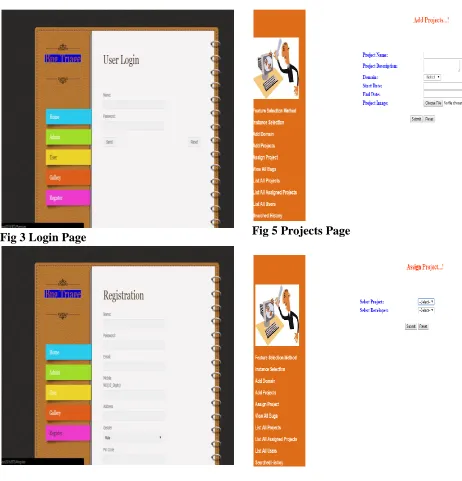
In this module, when the admin wants to add
projects, he clicks on add projects and enter
project name, project description, domain
name, start date, end date and project image
and click on submit button the details will be
stored in the data base.
3.1.3 Assign project:
In this module, when the admin wants to
assign projects, he clicks on assign projects
and select project and select developer and
click on submit button, then he enters the
developer name, project name, project
description, domain start time and end time
the corresponding details will be assigned
successfully.
3.2User
In this module, there are n numbers of users
are present. User should register before
doing some operations. After registration
successful he has to login by using
authorized user name and password. Login
successful he will do some operations like
view my details, view project assigned, view
send bug report, view all bugs, list search
other bugs, list my searched history. If user
Available online: https://edupediapublications.org/journals/index.php/IJR/ P a g e | 1124
will give response to the user with their tags
such as UID, developer name, project name,
project description, domain, start date, end
date, project image..
3.2.1Send bug reports:
In this module when user clicks on send bug
report button, he will select the project and
clicks on submit button, then he will enter
developer name, project name, project
description, domain, start date, end date,
select bug type, enter bug description and
click on assign button, the corresponding
details will be stored.
3.2.2 Feature selection method and
instance selection method and view bugs:
In this module when admin click on feature
selection method he will get different defect
bug type like UI defects, boundary related
defects, error handling defects, calculation
defects, control flow defect, interpreting
data defect, race condition defect and load
balancing defect on the basis of details as
follows bug ID, developer name, project
name, project description, domain, start
date, end date, bug type, bug description and
status. Click on solution provider select bug
ID and enter solution, click on submit button
and fix the bug.
4. EXPERIMENTAL RESULTS
Fig 1 Architecture Diagram
Available online: https://edupediapublications.org/journals/index.php/IJR/ P a g e | 1125 Fig 3 Login Page
Fig 4 Registration Page
Fig 5 Projects Page
Fig 6 Project Assign Page
5. CONCLUSION
Bug triage is a sumptuous step of software
maintenance in both labor cost and time
Available online: https://edupediapublications.org/journals/index.php/IJR/ P a g e | 1126
with instance cull to reduce the scale of bug
data sets as well as ameliorate the data
quality. To determine the order of applying
instance cull and feature cull for an incipient
bug data set, we extract attributes of each
bug data set and train a predictive model
predicated on historical data sets. We
empirically investigate the data reduction for
bug triage in bug repositories of two
immensely colossal open source projects,
namely Eclipse and Mozilla. Our work
provides an approach to leveraging
techniques on data processing to compose
reduced and high-quality bug data in
software development and maintenance. In
future work, we orchestrate on ameliorating
the results of data reduction in bug triage to
explore how to prepare a high quality bug
data set and tackle a domain-concrete
software task. For soothsaying reduction
orders, we orchestrate to pay efforts to
ascertain the potential relationship between
the attributes of bug data sets and the
reduction orders.
6. REFERENCE
[1] J. Anvik, L. Hiew, and G. C. Murphy,
“Who should fix this bug?” in Proc. 28th Int.
Conf. Softw. Eng., May 2006, pp. 361–370.
[2] S. Artzi, A. Kie_zun, J. Dolby, F. Tip, D.
Dig, A. Paradkar, and M. D. Ernst, “Finding
bugs in web applications using dynamic test
generation and explicit-state model
checking,” IEEE Softw., vol. 36, no. 4, pp.
474–494, Jul./Aug. 2010.
[3] J. Anvik and G. C. Murphy, “Reducing
the effort of bug report triage:
Recommenders for development-oriented
decisions,” ACM Trans. Soft. Eng.
Methodol., vol. 20, no. 3, article 10, Aug.
2011.
[4] C. C. Aggarwal and P. Zhao, “Towards graphical models for text processing,”
Knowl. Inform. Syst., vol. 36, no. 1, pp. 1–
21, 2013.
[5] Bugzilla, (2014). [Online]. Avaialble:
http://bugzilla.org/
[6] K. Balog, L. Azzopardi, and M. de Rijke,
“Formal models for expert finding in enterprise corpora,” in Proc. 29th Annu. Int.
ACM SIGIR Conf. Res. Develop. Inform.
Retrieval, Aug. 2006, pp. 43–50.
[7] P. S. Bishnu and V. Bhattacherjee,
“Software fault prediction using quad
tree-based k-means clustering algorithm,” IEEE
Trans. Knowl. Data Eng., vol. 24, no. 6, pp.
Available online: https://edupediapublications.org/journals/index.php/IJR/ P a g e | 1127
[8] H. Brighton and C. Mellish, “Advances
in instance selection for instance-based
learning algorithms,” Data Mining Knowl.
Discovery, vol. 6, no. 2, pp. 153–172, Apr.
2002.
[9] S. Breu, R. Premraj, J. Sillito, and T.
Zimmermann, “Information needs in bug
reports: Improving cooperation between
developers and users,” in Proc. ACM Conf.
Comput. Supported Cooperative Work, Feb.
2010, pp. 301–310.
[10] V. Bol_on-Canedo, N.
S_anchez-Maro~no, and A. Alonso-Betanzos, “A
review of feature selection methods on
synthetic data,” Knowl. Inform. Syst., vol.