Available online: http://internationaljournalofresearch.org/ P a g e | 481
A Copy Move Technique Using Block wise Detection for
an Image Forgery
Renu Thakur
1Varun Sanduja
21/M.tech student,Deptt of ECE , Er. 2/Assistant Professor,CGCTC, jhanjeri
Chandigarh Group of Colleges Technical Campus, Jhanjeri
1
email:[email protected]
2email:[email protected]
Abstract— Digital pictures are easy to alter
because of ease of access of prominent picture transforming further more altering programming. We Specifically concentrate on recognition of an unique sort of advanced fraud – the replica move attack in which a piece of the picture is replicated and stuck some place else in the picture with the purpose to cover a dominant picture characteristic. In this paper, we explore the issue of recognizing the replica move forgery and portray an efficient and solid identification approach.The system might effectively differentiate the fashioned piece actually when the duplicated zone is improved/modified to union it with the base and when the fashioned picture is spared in a lossy association, for example, joint photographic expert group (JPEG). Experimental results show the effectiveness of these techniques in our system.
Index Terms— copy move, image forgery,
Image processing, enhanced detection.
I.
INTRODUCTION
An image suggests reality of what has happened. By the by, seeing is no more accepting in light of the fact that, in today's
Available online: http://internationaljournalofresearch.org/ P a g e | 482
routines are grouped into two classes[3]. The main class is in view of advanced watermarking, which hides a watermark into the picture at the catching end and concentrates it at the verification end to look at whether the picture has been altered. Embeddings the watermark either at the season of catching the picture utilizing a uniquely prepared cam or later by an approved individual is the principle disadvantage of watermarking. Likewise, the consequent preparing of the first picture could debase the image visual quality. The second class of strategies is taking into account advanced marks[4]. Those techniques separate interesting highlights from the image as a mark at the picture catching end. At the confirmation end, the mark is recovered utilizing the same technique, and the legitimacy of the picture can be recognized through examination[2]. Advanced marks have comparable burdens to the watermarking class. Uninvolved picture confirmation, which is additionally called advanced picture crime scene investigation, is the method of validating computerized pictures without utilizing any extra data beside the photos..
Figure 1: An example of forgery image A: Original image. B: Forged image. C: Duplicated regions
A.Image Forgery:
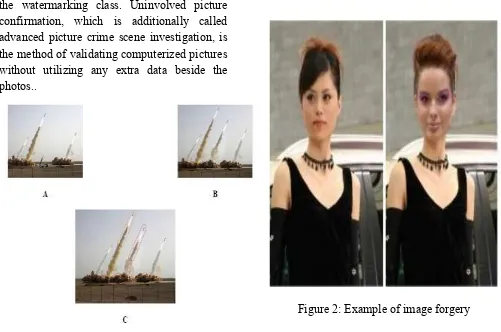
Digital images can be manipulated very effectively because of accessibility of number of pictures altering programming. By utilizing these product's it is conceivable to include or expel critical highlights from a images. Images can be controlled in such a path, to the point that the altering can't be distinguished just by imagining it[2]. Advanced images can be fashioned effectively with today's broadly accessible picture handling programming[7]. The term alter implies any post-preparing operations that perform on an image. In the previous many of the years, numerous picture alter recognition systems have been proposed. Illustration of picture fraud is indicated in Figure 2 where face of the young lady in left side has change with another face in right side.
Available online: http://internationaljournalofresearch.org/ P a g e | 483
Images, not at all like substance, address an effective and normal correspondence media for individuals, on account of their expeditiousness and easy way out to understand the photo content.Generally, there has been trust in the reliability of visual data, such that a photo imprinted in an every day paper is for the most part recognized as an issue of the truthfulness of the news[1][3]. With the quick spread of modest and simple to use devices that permit the acquirement of our visual data, for all intents and purposes everybody has today the probability of recording, securing, and giving a good deal of automated pictures. Meanwhile, the generous openness of picture modifying programming instruments makes enormously simple to alter the substance of the photos, or to make new ones, so that the probability of adjusting and copying visual substance is no more constrained to masters.
In the above figure the historical backdrop of a digital image can be spoken to as an issue of some steps, gathered into three main stages: securing, coding, and altering. Amid obtaining, the light originating from the genuine scene encircled by the advanced cam is concentrated by the lenses on the cam sensor (a CMOS or a CCD), where the digital picture sign is produced. Before arriving at the sensor, not with standing, the light is typically sifted by the Color Filter Array(CFA), a dainty film on the sensor that specifically allows a certain segment of beam to pass through it to the sensor. In practice, to every pixel, stand out specific primary shade (R,G,B) is assembled[8]. The sensor yield is progressively added to get all the three primary main shades for every and each pixel, through the supposed demosaicing procedure, to get the computerized shade picture[9]. The got signal experiences extra in-cam handling that can incorporate white adjusting, color preparing, picture honing, complexity improvement, and gamma amendment[3].
B. TWO TYPES OF APPROCHES: 1. Active approach.
2. Passive approach.
Figure 3: Active and passive approach
Active process uses digital watermark to examine the fake pictures as shown in Figure 3. Hiding information into the picture before using can be used to examine the history of that picture. Nevertheless, this technique also has limitation such as the user has to know how to embed the secret information onto the picture. This technique is inappropriate and difficult to inspect the picture.
To find a reaction to the past issues, the investigation gathering enlivened by blended media content security has proposed a couple of strategies that can be most importantly else described into dynamic and inert advances, as identifies with in Figure 4, where by "element" we suggest that for the evaluation of constancy, some information that has been figured at the source side Presentation the acquisition step, is ill-used, however with the interpretation "detached," an answer which tries to make an assessment simply having the propelled substance at exchange is to be plane.
C.Copy move forgery:
Available online: http://internationaljournalofresearch.org/ P a g e | 484
when the complete set of tools is used, a human expert can fuse the collective evidence and hopefully provide a decisive answer.
In a Copy-Move forgery, a small part of the image/picture is copied and then pasted into another part of the same picture.
This is mainly performed with the purpose to make an object “fade away” from the image by covering it with a segment copied from another part of the image.
Textured areas, such as grass, foliage, gravel, or fabric with irregular patterns, are ideal for this purpose because the copied areas will likely blend with the background and the human eye cannot easily discriminate any mistrustful artifacts[5][8]. Because the copied parts come from the same figure or picture, its noise component, color palette and most other important properties will be companionable with the rest of the image and thus will not be detectable using methods that look for incompatibilities in statistical measures in different parts of the image.
Figure 4 shows a Copy-Move falsification that is much harder to distinguish outwardly. This picture has been sent to the creators by an outsider/third person who did not unveil the nature of the fraud. We utilized this picture as a genuine test for assessing our location devices. A visual assessment of the picture did not uncover the vicinity of anything suspicious.
Fig 4: Copied_dog.
II.
ALGORITHUM USEDAvailable online: http://internationaljournalofresearch.org/ P a g e | 485
III.RESULTS
ANALYSIS:
1.Imported origional image in GUI
2. Import images for both tampered and
un-tampered. Convert picture to degraded palette.
Deteriorate picture into little Nxn pixel squares.
Order these blocks alphabetically by their pixel values.
Remove only those nearby blocks which have little absolute color variation.
Cluster these blocks into clusters by junction area among blocks.
Take out only those clusters which are larger than block size.
Remove only these clusters which have parallel cluster, by using some sort of similarity function ( Hausdorff distance between clusters).
Available online: http://internationaljournalofresearch.org/ P a g e | 486 3. Grayscale image of the tampered sample.
4. FFT of the tampered image. It also shows number of blocks.
4. Histogram of detected part:
Available online: http://internationaljournalofresearch.org/ P a g e | 487
6. GUI of forgery detection part:
7. Forgery part is shown if detected:
IV.CONCLUSION
In this paper, we have introduced a method to find out the forged part of an image using block-wise division of an image. These blocks are of 64 pixels each. These blocks have been gone through Fast Fourier Transform. we discover the matter of recognizing the copy move falsification and hard identification policy. Our work will be based on an
“Enhanced detection algorithm”. The system
might effectively discriminate the created part actually when the duplicated zone is customized to union it with the base and when the fashioned image is spared in a lossy organization, for example, JPEG(joint photographic expert group). The execution of the proposed strategy is showed on a few produced images. This research paper gives the better results when we compared our results with previous results.
REFRENCES
[1] Tehseen Shahid, Atif Bin Mansoor(Copy-Move Forgery Detection Algorithm for Digital Images and a New Accuracy Metric), International Journal of Recent Trends in Engineering, Vol 2, No. 2, November 2009.
[2] S.Devi Mahalakshmi, Dr. K. Vijayalakshmi,E. Agnes,(A Forensic Method for Detecting Image Forgery), 2013 IEEE International Conference on Emerging Trends in Computing, Communication and Nanotechnology (ICECCN 2013).
Available online: http://internationaljournalofresearch.org/ P a g e | 488
Singapore International Conference on
Communication Systems, 2008, pp. 362–366.
[4] Cheng Yan,(Research on Forensic Identification of Forged Images), 2013 International Conference on Mechatronic Sciences, Electric Engineering and Computer (MEC) Dec 20-22, 2013, Shenyang, China.
[5] Najah Muhammad, Muhammad Hussain, Ghulam Muhammad, and George
Bebis(COPY-MOVE FORGERY
DETECTION USING DYADIC WAVELET TRANSFORM), 2011 Eighth International Conference Computer Graphics, Imaging and Visualization.
[6] R.Caldelli, I.Amerini, L.Ballan, G.Serra and M.Barni, A.Costanzo,(ON THE EFFECTIVENESS OF LOCAL WARPING AGAINST SIFT-BASED COPY-MOVE DETECTION), Proceedings of the 5th International Symposium on Communications, Control and Signal Processing,ISCCSP 2012, Rome, Italy, 2-4 May 2012.
[7] Ashima Gupta, Nisheeth Saxena, S.K. Vasistha(Detecting Copy Move Forgery In Digital Images), Research and Applications (IJERA) ISSN: 2248-9622 www.ijera.com Vol. 3, Issue 2, March -April 2013, pp.094-097.
[8] Abhitha.E, V.J Arul Karthick(Forensic Technique for Detecting Tamper in Digital Image Compression), International Journal of Advanced
Research in Computer and Communication Engineering Vol. 2, Issue 3, March 2013.
[9] Jessica Fridrich, David Soukal, and Jan Lukáš,(Detection of Copy-Move Forgery in Digital Images).
[10] SALAM A.THAJEEL,GHAZALI SULONG,"A SURVEY OF COPY-MOVE
FORGERY DETECTION
TECHNIQUES",JOURNAL OF THEORETICAL AND APPLIED INFORMATION.
BIOGRAPHY
RENU THAKUR was born in Hamirpur
(Himachal Pradesh). She has done her B.Tech in Electronics and Communication Engineering from Shiva institute of engineering and technology,Bilaspur (H.P) and presently doing M.Tech from chandigarh group of colleges(cgc technical campus) jhanjeri mohali (Punjab). Her research interest area is Image Processing and Wireless Communication.