International Journal of Research (IJR) Vol-1, Issue-10 November 2014
ISSN 2348-6848
STUDY OF SPRING FRAMEWORK Rohan Khanna, Piyush, Puneet Bhalla
P a g e
|
419
STUDY OF SPRING FRAMEWORK
Rohan Khanna
1, Piyush
2, Puneet Bhalla
3Student , Computer Science Engineering, MDU University Delhi, India
Student , Computer Science Engineering, MDU University Gurgaon , Haryana , India
Student , Computer Science Engineering, MDU University Gurgaon , Haryana , India [email protected]
Abstract
In this paper, we are focusing on Spring, its
framework which is globally used for making
applications. The concepts behind the Spring has
created more than just the core framework, so this
paper also tells about the various characteristics and
features of Spring. The Spring framework can be
used with J2EE to develop applications. The model
on which (ie Spring MVC Model) it works is also
described. And the last section focuses on the
architectural benefits of Spring.
Keywords-
POJO, OSGi, Security, Batch, Web Flow,
Web Services, AspectJ, MVC
1.
INTRODUCTION
After its inauguration in 1997, Java quickly became the predominant platform for enterprise applications. An important reason for this success was the standardization of several common services for enterprise application as J2EE (Java 2 Enterprise Edition). This platform managed to get reckoning by several large companies such as BEA (to become part of Oracle), Oracle, IBM, Sun and SAP. Despite this success, many Java J2EE projects failed and the platform seemed highly complex, missing some vital features while other were not usable in practice.
In today’s world, with the introduction of information technology and communication media large number of companies use frameworks for making the development of their applications easier.
International Journal of Research (IJR) Vol-1, Issue-10 November 2014
ISSN 2348-6848
STUDY OF SPRING FRAMEWORK Rohan Khanna, Piyush, Puneet Bhalla
P a g e
|
420
2. Architecture
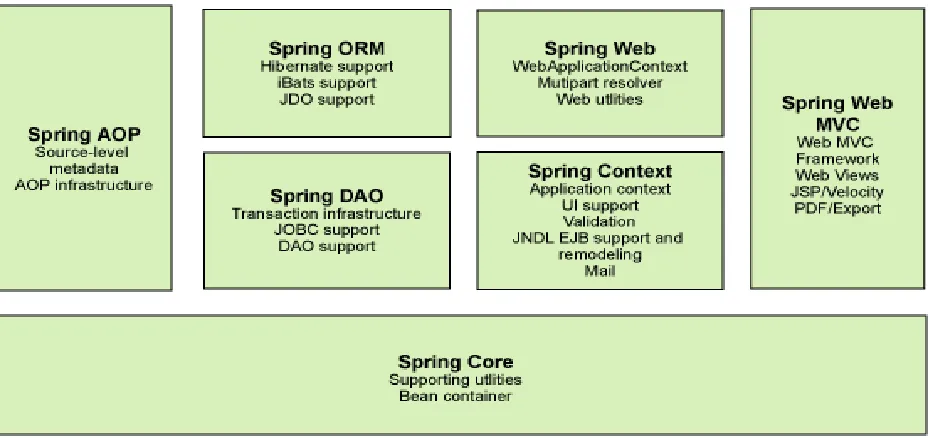
Fig. Spring’s Architecture
The architecture of the Spring Framework is designed to support Simple Objects. Sometimes in the Java world they are also called POJOs (Plain Old Java Objects). The basic characteristic of such an object is that it does not depend unnecessarily on any technology. Independence from technology is a well-known best practice in software development.
This has several benefits:
Investment in business code is retained even if a new technology is used:- So, if you decide to migrate the application to a new environment such as a new version of an Application Server or a lightweight alternative such as a Web Server, the business logic itself is not changed. The developer can focus on creating business value
instead of dealing with the technology:- This makes him/her more productive in terms of business value generated over time.
The objects can easily be tested in isolation:- Instead of using a production-like environment, all collaborating objects can be exchanged against a mock object. These provide a behavior similar to the production environment but are much simpler. This allows faster tests and simulation of exceptional situations otherwise hard to provide in a production-like environment. The main benefit is that errors can be tracked down to the single
object that was not mocked and is therefore the only possible source of the error.
Tests of single objects in isolation are not enough:- By using the Simple Object approach it is also possible to use a lightweight alternative environment to test a collaboration of several objects. So, instead of deploying the application to a server infrastructure, which is a time consuming task, such a test can be started from the developer’s Integrated Development Environment (IDE), which greatly speeds up development and enables easier debugging of the applications.
2.1 Features
Spring is a free, open source framework that offers a lot of functions to programmers. It was created by Rod Johnson and Juergen Hoeller. The most important features are the Inversion of Control, Aspect oriented programming and Spring MVC. Spring has its own MVC framework that can be used with other frameworks. The Aspect oriented programming, IoC and MVC are the important features.
International Journal of Research (IJR) Vol-1, Issue-10 November 2014
ISSN 2348-6848
STUDY OF SPRING FRAMEWORK Rohan Khanna, Piyush, Puneet Bhalla
P a g e
|
421
2.2 Spring’s Characteristics
Spring’s values can also be applied to other areas. For this reason the Spring Framework is now complemented by a set of technologies that solve other common problems in Enterprise Computing while sharing the same values of the Spring
Framework:
Spring Security (formerly Acegi Security) is the only
security solution that leverages the power of AOP. It allows
the implementation of a powerful, fine-grained security system without influencing the business logic. It is not limited
to role-based security but can also use Access Control Lists and can easily be extended to use other approaches. It
offers an integration of security technologies such as x.509 Certificates, JAAS, LDAP, CA Siteminder, HTTP Basic, HTTP Digest and can be adjusted to specific requirements, as needed.
Spring Dynamic Modules for the OSGi Platform: OSGi
allows the creation of services and dynamic updates of them. This means that parts of the application can be updated without restarting the whole application. However, the application has to deal with situations in which certain services are not available at runtime. The Spring Dynamic Modules framework simplifies the creation and discovery of services to become just a simple configuration. Also,
dynamic updates of such services are automatically dealt with.
Spring Integration: Enterprise Integration is becoming
more and more important for enterprise. A set of Patterns of Enterprise Integration has been established. Spring Integration provides a simple yet powerful programming model based on these patterns. It allows the implementation of routing, splitting and other message handling with a
minimum of coding. It can be connected to several different data sources and output channels like JMS or file
import/export.
Spring Batch: Batch applications remain mission critical
for many enterprises. Spring Batch is the first Open Source framework that supports batch processing applications. It addresses common challenges in this area like
retry, failure handling and efficient handling of batch updates to database.
Spring .NET is a port of the Spring Framework to the
Microsoft .NET platform. It offers features like Dependency
Injection, Aspect Oriented Programming and Enterprise Service Abstraction for a set of .NET APIs like ASP.NET,
ADO.NET and NHibernate.
Spring Web Flow allows developers to model user actions
as high-level modules called flows that are runable in any environment. The framework delivers improved productivity and testability while providing a strong solution to enforcing navigation rules and managing application state.
Spring Web Services focuses on creating
document-driven Web services. Spring Web Services aims to facilitate
contract-first SOAP service development. This is done without writing WSDL manually which is known to be a very
tedious task. Spring Web Services also allows for the creation of flexible web services using one of the many ways
to manipulate XML payloads.
AspectJ extends the AOP approach used by Spring to be
even more powerful. It allows more efficient
implementation of aspects and a bigger set of pointcuts, among others.
3. Spring mvc model
The Spring Framework provides its own MVC model. The major components of Spring MVC are as follows:
DispatcherServlet- It receives the request transferred to it by web.xml file.
Controller- It handles the request and is created by user. They are objects that can respond to the actions a user takes like form filling or clicking a link.
View- It can be thought of as a way of representing the output to the end users.
ModelAndView- Whenever a request come it‟s the job of ModelAndView to associate the view to the particular request. It is created by controller and when it executes it returns data and name of view.
ViewResolver- It tries to resolve the view based on output given by ModelAndView and select the output media.
HandlerMapping- Whenever DispatcherServlet receives incoming requests it associates the request to individual
International Journal of Research (IJR) Vol-1, Issue-10 November 2014
ISSN 2348-6848
STUDY OF SPRING FRAMEWORK Rohan Khanna, Piyush, Puneet Bhalla
P a g e
|
422
4. ARCHITECTURAL BENEFITS OF
SPRING
There are many architectural benefits of Spring framework. They can be described as follows: Spring Framework can be effectively used with
other frameworks such as struts, hibernate.
Spring provides easy access to database by using hibernate framework and avoiding the handling of error mechanism.
Applications developed using this framework depends on few APIs.
Due to its Inversion of Control feature the amount of time needed for testing the code is less.
Because Spring is a layered architecture users can select which of its components can be used.
The Spring Web MVC framework is robust, flexible and well designed for rapidly developing web applications.
CONCLUSION
Spring framework is a powerful framework for building enterprise wide java applications. It can also be easily integrated with some other frameworks such as struts and hibernate frameworks for developing efficient enterprise wide java applications thereby reducing the coupling and clear separation of layers so easy to understand. Due to the lightweight feature of Spring framework it is easy to use. It can easily work with a simple web server such as Tomcat that can also be used during integration of spring with other frameworks. Considering the current scenario wherein there is struts2 framework that can be used only for web tier; spring framework that provides all layers can be used effectively for all the three tiers to build an efficient enterprise application. The Spring framework can be easily integrated with any other ORM tool such as Hibernate with the help of XML mapping and also with iBATIS.
REFERENCES
[1] Chunsheng Zhao, Mai Jiang, Zhiyong He,” The Design of E-Commerce System Architecture Based on Struts2, Spring and Hibernate”, IEEE Transaction Paper Dated 2010.
[2] Jiya Jiang , Tong Liu , Yu Liu,”The Construction of E-Business Portal Based on Struts, Spring and Hibernate”, IEEE Transaction Paper Dated 2009. [3] Praveen Gupta, Prof. M.C. Govil,” Spring Web MVC Framework for rapid open source J2EE application development: a case study”, International Journal of Engineering Science and Technology, Vol. 2(6), 2010, 1684-1689
[4] Praveen Gupta, Prof. M.C. Govil,” MVC Design Pattern for the multi framework distributed applications using XML, spring and struts framework” , International Journal on Computer Science and Engineering, Vol. 02, No. 04, 2010, 1047-1051
[5] Rod Johnsonet,” Professional Java Development with the Spring Framework”, Publications John Wiley & Sons 2005
[6] Craig Walls with Ryan Breidenbach, ” Spring in Action” , Publications Manning 2008
International Journal of Research (IJR) Vol-1, Issue-10 November 2014
ISSN 2348-6848
STUDY OF SPRING FRAMEWORK Rohan Khanna, Piyush, Puneet Bhalla
P a g e
|
423
http://www.ibm.com/developerworks/web/library/wa -Spring1/
[8] Model-View-controller Accessed from: http://en.wikipedia.org/wiki/Model-view-controller
[9] Hao, Xiafei, Tang, Hongxi.
”Struts+Spring+Hibernate Integrated Framework and its Use in Log Accounting and analyzing System”, International Conference Dated 2010.
[10] Ke Ju, Jiang Bo,” Applying IoC and AOP to the Architecture of Reflective Middleware”, International Conference Dated 2007.
[11] “Research of Structure Integration based on Struts and Hibernate”, IEEE Conference 2010. [12] Erxiang Chen Personnel department “Research and Design on Library Management System Based on Struts and Hibernate Framework”, IEEE Conference 2009.
[13] Hui Li, Jingjun Zhang, Lei Wang,” The Research and Application of Web-Based System with Aspect-Oriented Features”, IEEE International Conference Dated 2010.
[14] Dipankar Majumdar, “Migration from Procedural Programming to Aspect Oriented Paradigm”, IEEE International Conference Dated 2009.
[15] Hui Li , GuiJun Xu , Mingji Zhou, Lingling Si, “Aspect-oriented Programming for MVC Framework” , IEEE Paper Dated 2010.
[16] Robert J. Walker, Elisa L.A. Baniassad and Gail C. Murphy, “An Initial Assessment of Aspect-oriented Programming”, ACM Paper Dated 2009. [17] Richard Millham, Evans Dogbe, ” Aspect-oriented security and exception handling within an object oriented system”, IEEE Paper Dated 2011.
[18] Hui Li, Mingji Zhou, GuiJun Xu, Lingling Si, “Aspect-oriented Programming for MVC Framework”, IEEE Transaction Paper Dated 2010. [19] Struts vs spring mvc accessed from: http://www.coderanch.com/t/456799/Spring/struts-Vs-spring-mvc
[20] Benefits of spring mvc over struts accessed from: http://orangeslate.com/2006/11/10/12-benefits-of-spring-mvc-over-struts/
[21] ShenJiang, YuHongzhi, HeXiangzhen, ” Modern Distance Education System Design Based on struts2”, International Conference on Advanced Computer Theory and Engineering, Dated 2010.
[22] J.Wojciechowski, B.Sakowicz, K.Dura, A. Napieralski, ” MVC Model, Struts Framework and
File upload Issues in Web Applications Based on J2EE Platform”, TCSET, Dated 2004.
[23] Nana Qi, Zhimin Yang,” Research of Struts2 Framework and Web Application Based on Ajax”, IEEE Transaction Paper Dated 2009.
[24] Yang guigui, Cheng gengguo, Bao kaomin, Wu li, ”Design and Realization of Equipment’s Archives Management System Based on Struts2 and Hibernate”, IEEE Transaction Paper Dated 2010. [25] KeYin, Kaifeng,”Application Research on a Persistent Technique Based on Hibernate”, IEEE Conference Dated 2009.
[26] Wu Peng,” Exploration of a Realization Pattern of System Based on Hibernate”, International Conference Dated 2010.
[27] PengWu, Kaifeng,” Application Research on a Persistent Technique Based on Hibernate”, IEEE Conference Dated 2010.
[28] Chuanlong Xia,” Efficient implement of ORM use in J2EE framework: Hibernate”, IEEE Conference Dated 2008.
[29] PengWu Computer Center Henan University Kaifeng, China,” Application Research on a Persistent Technique Based on Hibernate”, IEEE Conference Dared 2010.
[30] Piotr Ziemniak, Bartosz Sakowicz, Andrzej Napieralski, “Object Oriented Application Cooperation Methods with Relational Database (ORM) based on J2EE Technology”. .
[31] Marcin Śliwiński, Bartosz Sakowicz, Bartłomiej Świercz, Andrzej Napieralski, ”Implementation of a Web Hosting Service Based on J2EE Technology” TCSET Conference Paper Dated 2008.
[32] Spring - A Manager’s Overview
Prepared by: Eberhard Wolff, Principal Consultant, SpringSource Summer 2008
[33]
http://www.developersbook.com/images/spring_fram ework.gif