Simplified AODV with Urgent Data Indication
(sEAODVu): An Energy Efficient Routing
Protocol for Zigbee Network
Sohil A. Dabhi1, Manish K. Patel2
Assistant professor, Dept. of EC, Dharmsinh Desai University, Nadiad, Gujarat, India1
Assistant professor, Dept. of EC, Dharmsinh Desai University, Nadiad, Gujarat, India2
ABSTRACT: ZigBee is the emerging industrial standard for Ad-hoc wireless networks based on IEEE 802.15.4,
having characteristics such as low data rate, low price, and low power consumption. It is widely used in wireless sensor networks for remote monitoring, Home-appliance networks, and industrial automation. It supports tree and mesh routing. A major concern in wireless sensor networks (WSNs) is energy conservation, since battery-powered sensor nodes are expected to operate for a long time (for months or even years). AODV, an on-demand routing protocol is used for ZigBee mesh networks. The high number of control packets, makes AODV unsuitable for certain applications that requires energy efficient communications. A new routing strategy (sEAODV) is proposed here: combination of i) simplified AODV (sAODV): will try to reduce control overhead and hence energy consumption and ii) Energy Aware Mesh Routing (EAODV): to prevent early death of nodes having low energy (less than 10% of its initial energy level) will not forward RREQ messages hence, they will not be a part of communication. The algorithm performance is simulated using NS-2 simulator. Our proposed scheme shows overall performance improvement compared to original AODV in terms of Energy Consumption, Routing Overhead and Number of packet drops. At the end one idea is proposed to indicate emergency/urgent data (fire alarm or sensory data of a patient in ICU) by a flag bit, which forces even the low energy node to deliver the data to the destination node.
KEYWORDS: ZigBee, Energy Efficient, Simplified AODV, NS-2 simulator, Wireless Sensor Networks, Routing.
I.INTRODUCTION
The Ad-hoc On-demand Distance Vector (AODV) routing protocol provides a method of routing in mobile ad-hoc networks. Though AODV is simple in comparison to other MANET routing protocols, the specification still contains many sections prone to erroneous programming. AODVjr is a trimmed down AODV, which removes some elements of AODV. It is shown[2] that AODVjr has nearly the same performance as AODV.
AODVjr[2] is a Simplified Version of AODV. As AODV was designed to incorporate many features and designed to
maximize performance, so it is bit complex on the other hand AODVjr does not require:
1. RERR messages 2. Sequence numbers 3. Precursor lists 4. Gratuitous RREP 5. Hop count 6. Hello messages.
To perform route maintenance route lifetimes are only updated by the reception of packets and not the sending of packets. This requires the destination to occasionally send a packet to the source. If data traffic is unidirectional periodic messages (connect) are sent to maintain the route. If data communications are bidirectional, no additional overhead is needed. Using this end-to-end strategy, hello messages, RERR and precursor lists are not needed.
II.RELATED WORK
To decide on the optimal path in AODVjr-network, link quality is used instead of hop count. This is achieved by means of calculating the link cost C(l) and path cost C(P) in accordance with Eq. (1) and Eq. (2)[3], where p is the probability of successful packet delivery in link I.
( ) = 7, … (1)
( ) =∑ ( ) … (2)
But it is an energy-unaware algorithm which may cause a high energy consumption of nodes leading to the early death of the whole networks.
In order to solve this problem, Ref. [3] presented energy-aware routing.This paper proposes a multi-path energy balance routing algorithm E-AOMDVjr[3] to reduce energy consumption, improve network energy efficiency as well as avoid network segmentation and node death.When Energy Balance is used to selects a path to transmit data, the appropriate nodes with more energy will be selected for it.
Also EA-AODV[4]built optimal path dynamically according to the remaining energy of the node in order to decrease and balance network energy consumption.As the speed of energy consumption of each node is different, all the nodes are divided into three different energy levels which can react to the routing request according to their own energy level in the process of data transferring.
III.PROBLEMS
Case [A]
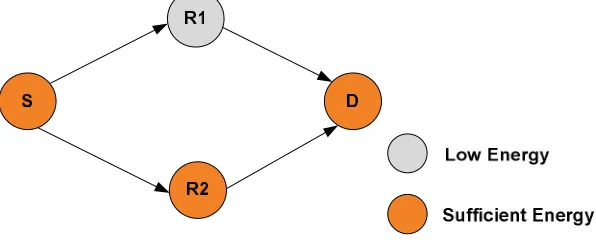
During the route discovery phase in AODV and AODVjr, a node must forward each RREQ packet received by it regardless of its remaining battery/energy level. This is a fatal waste of energy for nodes having lower energy level. As these nodes will going to die soon, just after they become a relay node in forwarding packets from sender to the destination as shown in Figure 1.
Figure 1: RREQ forwarded by R1 would become useless soon
1, it turns out to be the optimal route. The problem is: As the energy level of Node R1 is low, it drains all the energy very soon. And that results in a route failure and necessity of finding new route will arise. To solve the problem mentioned above, we propose an improved AODV algorithm which states that if a node is having low remaining energy(less than 10%) than it should not participate in forwarding in RREQ, hence it will not be a relay node for forwarding packet/s.
Case [B]
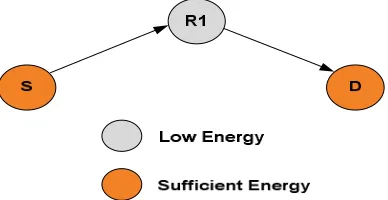
Node S starts route discovery to find the optimal route to Node D. There is only one path available: Pathl: S - R1 - D as shown in Figure 2.
Figure 2: Only one route is available via low energy node
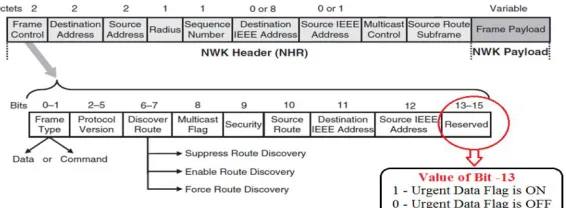
Node R1 with low energy(less than 10%) will not forward the RREQ and hence it will not deliver a packet to D. As a consequence, data cannot be sent from S to D. To avoid this problem in case of emergency or urgent data (fire alarm or sensory data of a patient in ICU)the sending node will use one flag bit in control frame of network layer. This bit location is shown in Figure 5.6. If the value of this bit is set to 1 then any node will try its best to send the data to the destination node in spite of having low energy level. But if this bit value is 0 then energy aware mechanism as mention above in Case [A] will be applied and the node will not be a relay node for forwarding packet/s.
IV.PROPOSED ALGORITHM
AODV has some drawbacks and some modifications are already proposed by different authors to improve the performance of the same. Further, we have seen AODVjr, which is actually simplified AODV, also performs almost similar to AODV[2]. Figure 3 shows the flow of proposed modifications. First of all Original AODV protocol is simplified in block(2). This modified code removes the following parameters from the original AODV. -Gratuitous RREP, Hello messages, and Precursor lists. To add the remedy for energy aware routing the protocol is further modified as shown in bock(3). Which makes the route finding procedure more efficient. As discussed in Case: [A], if a node is having low remaining energy(less than 10 %) participates in forwarding RREQ then it will die out soon. So nodes running on low energy are not allowed to forward RREQ. Which make them automatically inactive and we can prevent the death of those nodes in near future.
At the end in block(4) the idea is proposed to use a flag bit to indicate emergency/urgent data as a remedy discussed in Case: [B]. This bit can be used from one of the three reserved bits present in General Network Frame Format as shown in Figure 4. If urgent data/packet is being transmitted then this bit can be set to 1. Which indicates that the node will give maximum efforts to deliver the data in spite of having low energy. In short, the modification shown in block(3) will be deactivated. Whole process is explained with the help of flow chart in Figure 5.
Figure 4: Network Layer General Frame Format showing the reserved bits
Receive RREQ Source Node? Routing Table Entry? N Path Cost Lower Than The Entry? Update the Entry Y Destination Node? Route Reply Y
Remaining Energy Level ?
N Normal (>10%) Low (<=10%) Broadcast RREQ Y Discard RREQ N Y Create Entry N Emergency /
Urgent Data? N
Y
V.RESULT AND DISCUSSION
To compare the performance of original AODV with sEAODV, the NS-2 simulator was utilized. The basic AODV code was a version updated by Marina Mahesh. The Simplified AODV-sAODV code was developed for this testing and energy aware routing mechanism is also included, which forms the sEAODV version.
Various fields were used -
250 m x 250 m field with 25 nodes, 500 m x 500 m field with 50 nodes, 700 m x 700 m field with 75 nodes, 1000 m x 1000 m field with 100 nodes, 1250 m x 1250 m field with 150 nodes, 1500 m x 1500 m field with 200 nodes.
The nodes placed randomly within the simulation area. For each result, simulation is performed 50 times and the average is taken for the same. The data rate is 250 kbps, packet size is 50 bytes and simulation time is 200 sec.
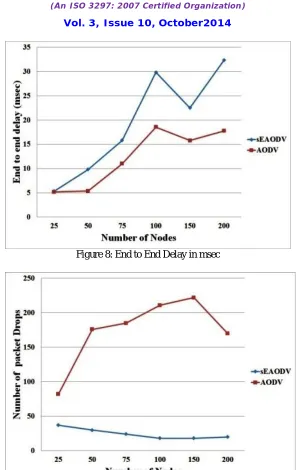
Results: Figure 6, 7, 8, 9.
Figure 6: Total Energy Consumption in Joule
Figure 8: End to End Delay in msec
Figure 9: Number of Packet Drops
The set of simulations compares AODV and sEAODV with varying number of nodes.The high routing overhead in AODV is due to the broadcast of hello messages by every node. Hello broadcast messages must be processed by each receiving node. Figure 6 shows the Energy consumption in Joule by entire network. sAODV outperforms AODV when the network size is large. Figure 9 shows the number of packet drops due to nodes with low remaining energy level acting as relay node for communication link and dies out early, which results in link failure and hence drop of packet. Along with increasing network size congestion will also increase.
VI.CONCLUSION
end to end delay. Which is increased by 58% compared to original AODV. At the end, one idea is proposed to deliver urgent packet/s even by the nodes which are dying (having low battery level). For this, one flag bit of control frame at network layer can be used.
Scope of Future Work
Application layer implementation of this urgent flag bit (present in Control Frame at Network Layer) and result analysis. Further the battery level of a node can be divided in more number of levels and accordingly multiple tasks can be assigned to the node based on current remaining battery level while processing RREQ.
REFERENCES
[1] Taehong Kim, Daeyoung Kim, Noseong Park, Seong-eunYoo, Toms Snchez Lpez, “Shortcut Tree Routing in ZigBee Networks”, IEEE, Information and Communications University, Electronics and Telecommunications Research Institute, 1-4244-0523-8/07/2007.
[2] Ian D. Chakeres, Luke Klein-Berndt, “AODVjr, AODV Simplified”, Mobile Computing and Communications Review, Volume6, Number3. [3] Jun Xiao and Xiaojun Liu, “The Research of E-AOMDVjr Routing Algorithm in ZigBee Network”, IEEE, Chinese Control and Decision
Conference, 978-1-4244-8738-7/11/26.00,pp. 2360-2365,2011.
[4] Yigong, P., Yingli,L., Hongcheng, L. & Jinshou, Y. ,“Method for saving energy in ZigBee network”, Wireless Communications, pp.24-26, September 2009.
[5] Antonio M. Ortiz, Fernando Royo, Teresa Olivares and Luis OrozcoBarbosa, “Intelligent Route Discovery for ZigBee Mesh Networks”, IEEE, 978-1-4577-0351-5/11/ 2011.
[6] V. RenuKachhoria, Renu Kachhoria, “An Implementation in AODV based on Active Route Timeout between sensor nodes in Wireless Sensor Networks”, International Journal on Computer Science and Engineering (IJCSE), Vol. 3 No. 3 Mar 2011.
[7] Maged Salah Eldin Solimana , SherineMohamed Abd El-kaderb, Hussein Sherif Eissac, Hoda Anis Baraka, “New Adaptive Routing Protocol for MANET”, Ubiquitous Computing and Communication Journal, Volume 2 Number 3.