ISSN 2286-4822
www.euacademic.org DRJI Value: 5.9 (B+)
Design and Application of Learning Obstacle to
Improve “Coverage” Skill for the Free Foot and Its
Impact on the Multi-worry with Beginner Players of
(110 m) Race
Dr. IMAD KADHIM YASSIR
College of Physical Education and Sport Sciences University of Thi-Qar Iraq
Dr. ADDUL ABBAS ABDULRAZAQ
College of Physical Education and Sport Sciences University of Thi-Qar Iraq
Dr. ADNAN ALWAN MAKTTOOF
University of Southern Technical Iraq
Abstract:
Learning aids have their own effect on improving difficult skills. In this paper, a learning obstacle was designed for running (100 m) obstacle race for beginners. Using this learning obstacle will develop one of the implied skills when passing the obstacle, which is the “coverage” skill for the free foot.
The psychological aspect is one of the causes behind any individual behavior in his/her group or society. The coverage skill has a big role in the technique followed to stretch the working muscles in a minimum time. The designed obstacle improves the flexibility of the free foot due to its movable parts that lessen fear and worry which themselves lead to falling. With the obstacles used now, if the player fails to pass and the foot touches the obstacle, all the obstacle will fail. This will embarrass the player and the activity.
The researchers have got good results in the tests conducted as the players obtained encouraging scores in their post-test.
Key words: learning obstacle, “coverage” skill, free foot, beginner players
1. Introduction:
The technological development all over the world does positively affect Athletics; this leads to objective learning processes in most of the athletic activities and to provide procedures that truly participate in real performance in which the player is enabled to use all positive force to resist negative forces and to move body parts within movement accordance in order to guarantee success.
The psychological aspect is a real indication for the individual’s behavior in the environment within the group to which the player belongs. It also has different aspect that reflect on motives and behaviors. It is an important for positive communication and ultimate correct work requirements. In most of theoretical research, experts emphasize the fact that the target of the learning process is to make scientific , logical changes in the learner’s performance; others see that there is a common mistake in the steps of the learning process , which is the testers’ misunderstanding of some of the performance aspects resulted from the psychological case like fear, worry and the like; reoccurrence of these mistakes can cause the player to lose the ability to learn skills.
the technical requirements of the learning aids, with less complication. It will increase the learners’ motives and lessen their fear and hesitation in the skill application.
This paper aims at:
1. Designing a learning obstacle for beginners to improve the coverage skill for the free foot and the technical steps at the moment of passing the obstacle in (110 m) race for men.
2. Applying some learning exercises for improving the coverage skill and the technical steps for passing the obstacle.
3. Indicating the differences in the multi-level worry for the learners in the research sample.
As for the problem of the paper , it is based on the researchers’ recognition through a thorough follow-up of the fact that there are a group of reasons behind beginners’ embarrassment when passing obstacles ; the case that delays the learning process. This activity of passing the obstacle is one of the difficult activities that need learning aids and time for precision. The obstacle’s weight if (10 kg); the obstacle’s fall due to the crashing force (3.5 – 4 kg) delays the learning process due to some psychological factors of fear and worry; as a result , the player falls and even injures. Therefore, researchers see that the poles must be flexible and not fixed in the learning exercises especially when learning the coverage skill. Dimensions must not change, but this flexibility will make the obstacle fall smoothly when crashed.
2. Procedures:
2.1. Experiment:
The choice of the sample can be done through different steps; some of these steps are compulsory to guarantee true representative sample of the society; this will enable researchers to generalize the results “the researcher must try to get samples that truly represent the original society” [2].
In this paper the society is the beginner players of (110 m) obstacles race; the sample is (20) beginners. The statistics used is K curve as indicated in table (1).
The sample is divided into two equal groups: the first were asked to follow the Coach’s exercises; the second were asked to follow the exercises applied on the designed obstacle for two months.
Table (1): Distribution values of the variables in table(1) refer to (Kolmogorov – Smirnov Test) [3]
2.2. Parts of the designed learning obstacle.
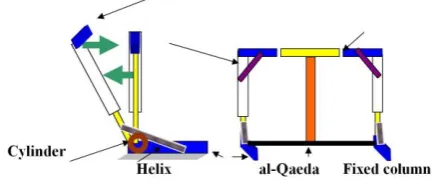
The movement of the mobile part of the foot free
Separation between the magistrates and the left right mover (1cm)
Figure (1) lateral movement during Figure (2) Front
Kolmogorov- Smirnov Test Maximum
Minim S.D
Mean Measure
Statistic
Variable
0.09 48
39 5.4 42. 2 Kg
Wight
0.12 175
150 5.81 168.1 Sm
Long
0.08 15
12 1.21 13.3
2.3. Performance of the designed learning obstacle: The upper wood piece can be divided into three equal parts, each is 40.6 cm (right, middle, left). The right and left parts are movable, but the middle is fixed with a pole to the ground but can move up to get the required height. The distance between the right and left parts and the middle part is 1 cm. This will be fixed on the two extremes of the obstacle on the movable key vertical on the base; the movement will be in accordance with the key movement forwards when force is to be put on the movable part. As for the middle area which is separated from the two sides (right and left), it will be fixed with a pole from the middle of the wood to the ground getting the required height for learning. This is shown in fig. 1 & 2.
Note: The new obstacle has been shown to a group of experts and they agreed on it.
2.4. Measuring the coverage skill and the technical stages for passing (110 m) obstacle:
The researchers measured the time for each stage in free foot coverage skill with 5 cameras fixed 25 m away; distance between each camera and another is 20 m. Then a computerized analysis was made as follows:
1. Converting the video tapes into computer files.
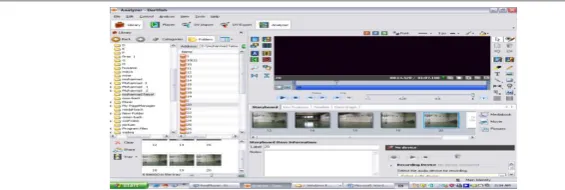
2. Cutting the movement by (VCD Cutter) program to find the variables. Data were saved.
Fig. 4 shows the interface of this program
2.5. Measurement Tool Used:
The researchers used the multi-worry measurement too designed by Mohammad Hassan Alawi, which includes 45 statements; each 15 statements are for a dimension. Validity was also measured by a group of experts and specialists in general psychology and physical psychology. They agreed in a percentage of 90 %. Reliability was measured through retest method after 2 weeks. The result in Pearson correlation value was 0.88.
2.6. Pre-Tests:
In order to know the time of the stages , the pretest were held on (21 / 2 / 2015) through video. Then measuring the multi-worry was conducted.
2.7. The Main Experiment:
A group of learning exercises was applied on the newly-designed obstacle. There were 16 learning units for 8 weeks, 2 units each week. As shown in the tab (2).
1. Preparatory part for 15 m.
2. The main part for 30 m. including : A. The learning activity for 5 m .
Table (2): Time divisions for the learning units and the Percentage Percentage% Total modules time Module minute time Module sections 30% 120 15 Section preparatory
General and special
exercises
60% 240
30 The main section
10% 50% 40 200 5 25 Educational part 1. educational 2. Applied 10% 40 5 Concluding part 100% 400 50 Total 2.8. Post-Tests:
On Tuesday 29 / 4 / 2015, at 4 P.M after the main experiment had finished post test were held.
2.9. Statistics:
The researchers used the Statistical Package (SPSS) version 19 to get the results.
3. Analysis & Discussion of the group 1 & 2 Results :
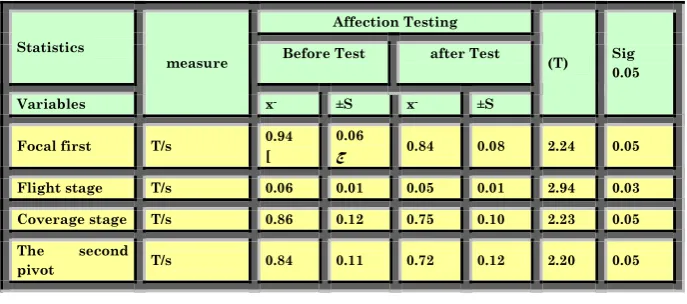
Table (3): Medium, Coefficient Relation and T degree for the Coverage Skill Time for the First Group
Sig 0.05 (T)
Affection Testing
measure
Statistics Before Test after Test
±S x- ±S x- Variables 0.05 2.24 0.08 0.84 0.06 ج 0.94 [ T/s Focal first 0.03 2.94 0.01 0.05 0.01 0.06 T/s Flight stage 0.05 2.23 0.10 0.75 0.12 0.86 T/s Coverage stage 0.05 2.20 0.12 0.72 0.11 0.84 T/s
The second
Table (4): Medium, Coefficient Relation and T degree for the Coverage Skill Time for the Second Group
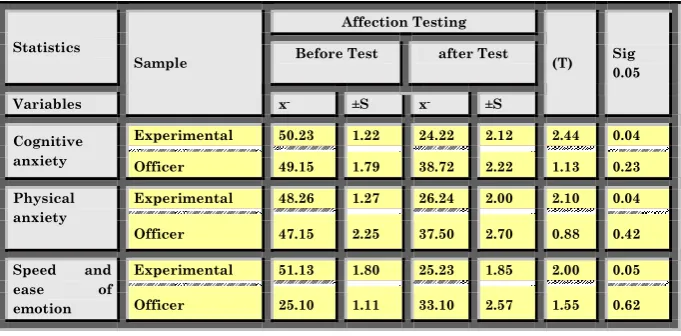
Table (5): Medium, Coefficient Relation and T degree for the muli-worry Dimensions for the Two Groups
The tables above show the progress in the two groups. A special progress was recognized in the second group. His means that there was a progress in the technique of the coverage skill which was a result to the fact the player removed the fear and worry.
Another reason for the second group progress was the level of neuro-muscular agreement which helped the players
Sig 0.05 (T)
Affection Testing
measure
Statistics Before Test after Test
±S x -±S x- Variables 0.02 2.63 0.17 0.70 0.14 0.91 T/s Focal first 0.03 2.37 0.01 0.03 0.22 0.05 T/s Flight stage 0.00 3.85 0.25 0.18 0.37 0.65 T/s Coverage stage 0.05 2.26 0.17 0.68 0.10 0.82 T/s
The second pivot Sig 0.05 (T) Affection Testing Sample
Statistics Before Test after Test
±S x- ±S x- Variables 0.04 2.44 2.12 24.22 1.22 50.23 Experimental Cognitive
anxiety Officer 49.15 1.79 38.72 2.22 1.13 0.23
0.04 2.10 2.00 26.24 1.27 48.26 Experimental Physical anxiety 0.42 0.88 2.70 37.50 2.25 47.15 Officer 0.05 2.00 1.85 25.23 1.80 51.13 Experimental
Speed and
ease of
perform correctly. The researchers also see that the learning of obstacle running needs organizing a special group of exercises in addition to a lrearning aid to develop performance. They also see that this race is different from the other races due to the short graduation distance which is 13.72 m in the beginning up to the first obstacle. The number of steps is different from a player to another according to the player’s height.
4. Conclusion:
The following conclusions can be stated:
1. Significant differences were discovered between the pre- and post-tests in the two groups in favor of the second group.
2. Significant differences can be seen in the free foot coverage skill and the technical steps followed in favor of the second group.
5. Recommendations:
1. This designed obstacle can be used because the experiment showed that it developed the coverage skill and the technical steps performance.
2. Applying the designed obstacle on more samples for more verification of the results.
3. Designing more means for leaning in order to improve other skills.
REFERENCES
[1]Abd al Rhman Mossa: Method Scientific Research, al kwet, 2006, p51.
[4]Schmidt, A Richard and Oraig A. Wrisberq. Motor Learning and per for mance, Second Edition. Human Kentics, 2000. [5]Singer, R: Motor Leaning and Human Performance an Application to Motor Skills and Movement Behaviors, Macmillan Publishing Co, Inc, 1985.
[6]Hay, Jamic G & Koh, Timothy J. Evaluating the Approach in The Horizontal Jumb. International Journal of sport Biomechanics, 1987, p15.