ISSN (Print) : 2320 – 3765 ISSN (Online): 2278 – 8875
I
nternational
J
ournal of
A
dvanced
R
esearch in
E
lectrical,
E
lectronics and
I
nstrumentation
E
ngineering
(A High Impact Factor, Monthly, Peer Reviewed Journal)
Website: www.ijareeie.com
Vol. 8, Issue 3, March 2019
Water Surface Cleaning Robot
R. Raghavi1, K . Varshini2, L. Kemba Devi3
Assistant Professor, Department of Electrical and Electronics Engineering, Kalasalingam Institute of Technology,
Krishnankoil, Tamilnadu, India1
UG Student, Department of Electrical and Electronics Engineering, Kalasalingam Institute of Technology,
Krishnankoil, Tamilnadu, India2
UG Student, Department of Electrical and Electronics Engineering, Kalasalingam Institute of Technology,
Krishnankoil, Tamilnadu, India3
ABSTRACT: Clean water is a basic need for all living beings. Without water survival in the Earth is not possible. Water covers about 70% of the Earth’s surface among that only 3% of that is pure water. Water gets polluted due to any reasons like industry waste, sewage waste, garbage waste. Hence it is important to maintain cleanliness and hygiene of water. We considered this water pollution as a serious issue and start to work on the project. We decided to incorporate technology to get the work done effectively and efficiently. Our project design is in such a way that it collects the waste which floats on water bodies. In present time almost all the people are familiar with robots. We are going to design a very interesting robot that is RF controlled Robot. It is important to monitor the pH of a water body. An alteration in normal pH in a water body can be an indication of increased pollution or other environmental factors. Hence the solubility and biological availability of the chemical constituents of water are determined by pH sensor.
KEYWORDS: Sewage, garbage, Remote Controlled Robot, Radio Frequency, potential hydrogen.
I. INTRODUCTION
Traditional method for collecting water surface floating waste are manual basis, by means of boat trash skimmer. The above methods are costly risky and large time consuming. To eliminate the drawbacks of the above mentioned methods the remote controlled water cleaning machine was designed which helps in cleaning the water surface efficiently and eco/friendly. The water waste cleaning Robot consists of RF transmitter and receiver DC motor battery pH sensor, bucket collector are attached to it for collecting the waste and monitoring the water. The authors of reference paper are Jacop Anderson, Erik Hall, Josephsan doval, Ryan N.Smith. The main objective of this paper is to develop a surface vehicle equipped with water quality monitoring sensors. The main drawback of this system is that it is very costly and manufacturing become complex.
In addition to that, it can only monitor the water quality .The above drawback can be rectified by our proposed system because it can not only monitor the water quality but also collect the garbge waste that floating on the water surface. The authors of our base paper are Zhai Yuji, Zhou Yu, Luo Huanxin, Liu Yunjia, Liu Liang from china used camera for monitoring the surface of the water bodies. But in our project we used pH sensor to monitor the water bodies. Because in our country the water bodies are mostly polluted by industrial liquid waste.
II. PROPOSED FRAME WORK
A. REMOTE CONTROL DESIGN
ISSN (Print) : 2320 – 3765 ISSN (Online): 2278 – 8875
I
nternational
J
ournal of
A
dvanced
R
esearch in
E
lectrical,
E
lectronics and
I
nstrumentation
E
ngineering
(A High Impact Factor, Monthly, Peer Reviewed Journal)
Website: www.ijareeie.com
Vol. 8, Issue 3, March 2019
This is a ASK hybrid transmitter and receiver operate at 433Mhz and has a crystal stabilised oscillator to maintain the accurate frequency control. This module is very efficient where long range RF communications is required. It does not send data using UART or microcontroller directly because lots of noise present at this frequency. It can be used with the help of encoder and decoder ICs which extract data from the noise.
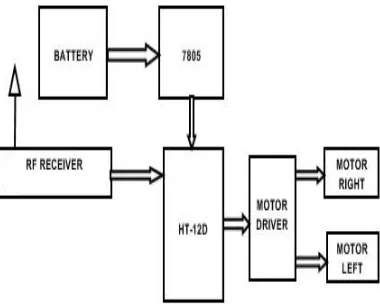
At the receiver end it consists of RF receiver to receive the signal or data. It consists of a decoder IC converts the received serial data into parallel data. The motor driver IC has two channels for two motors. According to the received data the robot will move by using the two motor. The motor used here are DC motor with gear box.
The RF modules are very small in dimension and have a wide operating voltage range 3 Volt to 12 Volt. The transmitter draws no power when transmitting logic zero while fully suppressing the carrier frequency thus consume significantly low power in battery operation. When logic one is sent carrier is fully on to about 4.5mA with 3 Volt power supply. The data is sent serially from the transmitter which is received by the tuned receiver.
Figure 1.1 Block diagram of RF transmitter
HT-12E is an encoder IC. The encoder can convert parallel data into the serial data and transmit it. HT-12D is a decoder IC which can convert the serial data again back to the parallel data.
ISSN (Print) : 2320 – 3765 ISSN (Online): 2278 – 8875
I
nternational
J
ournal of
A
dvanced
R
esearch in
E
lectrical,
E
lectronics and
I
nstrumentation
E
ngineering
(A High Impact Factor, Monthly, Peer Reviewed Journal)
Website: www.ijareeie.com
Vol. 8, Issue 3, March 2019
The above shown diagram is for the RF receiver circuit. Based on the signal received by the receiver , the motor will rotate and the robot will move.
Button Pressed at Transmitter Moving Direction of Robot
First(1) Left
Second(2) Right
First and Second(1&2) Forward
Third and Fourth(3&4) Backward
No Button pressed Stop
Table 1.3 Keypad number with robot motion.
When we press the first button robot start moving in left side and moving continues until the button is released. When we press the second button in the transmitter, it will moving in right side until the button is released. When we press first and second button at the same time, robot start moving in the forward direction until the push button is released. When we press third and fourth button at the same time the robot keep going in backward direction until the button is released.
B. COMPONENTS DESCRIPTION Battery source:
Lithium-ion batteries are common rechargeable batteries that are mainly used for portable electronics, with a high energy density, no memory effect. The 12V 7AH Lithium-ion battery features with built in battery production system that keeps the battery running at peak performance and protects the cells for thousands of cycles.
L293D Motor driver:
This is a motor drier IC which has two channels for driving two motors. It has two in built transistor Darlington pair for current amplification and has a separate power supply pin for giving external supply for motors. Two 9 volt batteries are used to power motor driver and remaining Rx circuit. And another 9 volt battery is used to power the transmitter.
DC Motor:
A 10RPM 12 volt DC motor with gearbox is used in our module. No-load current is 60mA(maximum) and load current is 300mA(maximum).This geared motors are widely used in robotics application. Nut and threads on shaft to easily connect . Internal threaded shafts for connecting it to the wheel.
Voltage Regulator :
7805 is a three terminal linear voltage regulator IC. A positive unregulated voltage is given at the input. Ground pin is common to both input and the output. The output regulated 5 Volt is taken at the pin of the IC.
C. pH MONITORING DESIGN
It is important to monitor the pH of a water body because it affects aquatic organisms. An alteration in normal pH in
a water body can be an indication of increased pollution. The PH value of the different water bodies at current situation are shown below
ISSN (Print) : 2320 – 3765 ISSN (Online): 2278 – 8875
I
nternational
J
ournal of
A
dvanced
R
esearch in
E
lectrical,
E
lectronics and
I
nstrumentation
E
ngineering
(A High Impact Factor, Monthly, Peer Reviewed Journal)
Website: www.ijareeie.com
Vol. 8, Issue 3, March 2019
WATER SOURCES Ph VALUE
Waters of volcanic exhalation >2
Mine Waters 3-4
Swamps 4-6
Ground Waters 5-7
Rivers 6.8-7.8
Fresh Lakes 7.3-9.2
Ocean 7.8-8.3
Table 1.4 Water sources and their pH values.
This tabulation is one among the evident for the pollution that has been exist in water bodies. The pH value of the fresh water should be equal to 7. The value goes above 7 are basic. The value goes below 7 are acidic. Now a days, due to the industrialization many of the industrial waste especially liquid waste without any recycling directly dumped into the rivers and lakes. Hence , it is important to monitor the pH value of all the fresh water resources . To ensure the safety of the fresh water and by using the pH monitoring system.
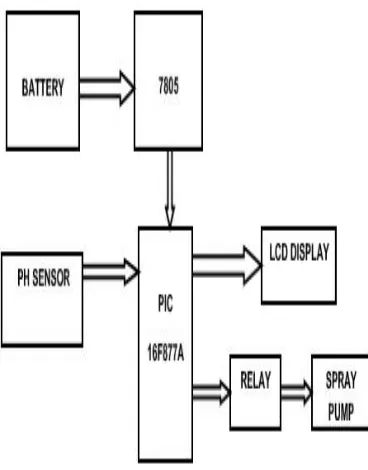
Figure 1.5 Block diagram of pH monitoring system
D. COMPONENETS DESCRIPTION pH sensor:
The most common method for measuring pH is to use an electrochemical pH sensor. Combination pH sensor are a type of electrochemical pH sensor that feature both a measuring electrode and a reference electrode the measuring electrode detects changes in the pH value while the reference provides a stable signal for comparison.
Micro controller:
ISSN (Print) : 2320 – 3765 ISSN (Online): 2278 – 8875
I
nternational
J
ournal of
A
dvanced
R
esearch in
E
lectrical,
E
lectronics and
I
nstrumentation
E
ngineering
(A High Impact Factor, Monthly, Peer Reviewed Journal)
Website: www.ijareeie.com
Vol. 8, Issue 3, March 2019
LCD:
The LCD module are very commonly used in most of the projects. The reason being its cheap price, availability and programmer friendly. 16*2 LCD is named so because , it has 16 columns and 2 rows.
SPRAY PUMP :
The spray displacement pump makes a fluid move by trapping a fixed amount and forcing that trapped volume into the discharge nozzle. The nozzle of the spray pump concentrates the liquid into steam by forcing it through a small hole. Spray pump also consists of one - way valve to keep air from flowing back into the pump and allows suction within the pump so that liquid can be pulled up.
E. BUCKET COLLECTOR DESIGN
The bucket collector is used to collect the waste that present in the surface of the water bodies. This method is most efficient in collecting the waste.
Electromagnetic relays are used in this system. This relay operates on the principle of electromagnetic attraction. It is a type of magnet switch which uses magnet for creating the magnetic field. The magnetic field then uses for opening and closing the switch and for performing the operation. A relay is an electromagnetic switch operated by relatively small electric current that can turn on or off a much large current. The heart of the relay is electromagnetic which is a coil of wire that becomes a temporary magnet when the electricity flows through it.
Figure 1.6 Block diagram of bucket collector.
Based on the above shown mechanism the bucket collector will collect the waste. The IR sensor is used to detect the object that present in the surface of the water bodies. The collected wastes are kept in a container.
Infrared motion sensors detect the motion in day time and night time reliably. The sensor does not require any
ISSN (Print) : 2320 – 3765 ISSN (Online): 2278 – 8875
I
nternational
J
ournal of
A
dvanced
R
esearch in
E
lectrical,
E
lectronics and
I
nstrumentation
E
ngineering
(A High Impact Factor, Monthly, Peer Reviewed Journal)
Website: www.ijareeie.com
Vol. 8, Issue 3, March 2019
III. WORKING PRINCIPLE
The machine consists of bucket collector coupled with motor, relay and IR sensor which are used for collecting the surface waste present in the water bodies. The collected waste is thrown on the container. The machine will run the water bodies with the help of the DC motor. The total electrical devices are controlled by RF transmitter and receiver which used to control the machine remotely.
IV. DESIGN ANALYSIS
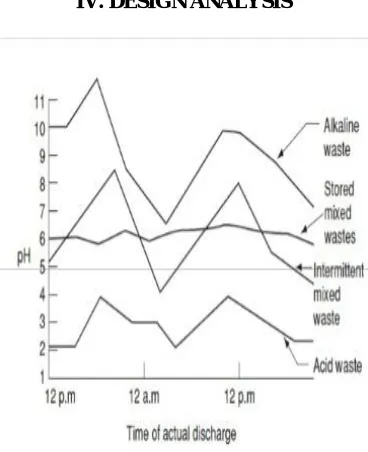
Figure 1.7 pH neutralization curve
Acid and alkaline waste may be produced and proper mixing of this waste at appropriate times can accomplish neutralization. Although, this requires the storage of waste to avoid slugs of acid or alkali. This waste can be stored in fluid form and sprayed by using the spray pump to achieve neutralization.
V. ADVANTAGES AND DISADVANTAGES
Advantages:
Initial and maintenance cost is low. This project is very useful for small as well as big lakes, rivers where garbage is present in large amount. Skill worker are not required to drive the system. Environment friendly system. Design of the system is made simple.
Limitations:
This machine is able to collect the waste which is only floating on water level.
VI. FUTURE SCOPE
ISSN (Print) : 2320 – 3765 ISSN (Online): 2278 – 8875
I
nternational
J
ournal of
A
dvanced
R
esearch in
E
lectrical,
E
lectronics and
I
nstrumentation
E
ngineering
(A High Impact Factor, Monthly, Peer Reviewed Journal)
Website: www.ijareeie.com
Vol. 8, Issue 3, March 2019
VII. CONCLUSIONS
This project “ WATER SURFACE CLEANING ROBOT “ has designed which is very much economical, easy to operate and helpful for water cleaning and it can be modified with more cleaning capacity and efficiency.
REFERENCES
[1]Prof. Kean V. Dhande, “Design and fabrication of river cleaning system”, “International Journal of Modern trends in Engineering and Research” Volume 4, Issue 2 [February-2017], ISSN (PRINT): 2393-8161.
[2]Prof. Ajay Dhumal, “study of river harvesting and trash cleaning machine” “International Journal of Innovation Research in Science and Engineering “, Volume 2, Issue 3[March-2016] ISSN:2454-9665.
[3]Prof. N.G.Jogi. “Efficient lake garbage collector by using pedal operated boat”, “International Journal of Modern trends in Engineering and Research”, Volume 02, Issue 04[April-2016] ISSN:2455-1457.
[4] B.D. Shiwalkar, “Design data for machine elements”,2013 Edition,Denett& Co.pp.203.
[5]S. K. Hajra Choudhury, A. K. Hajra Choudhury, NirjharRoy, “Manufacturing processes”, Volume –I, 14th Edition, Media Promoters and Publisher Pvt. Ltd, pp 373.
[6] Jianhua Wang, Wei Gu, Jianxin Zhu, Jubiao Zhang. “An Unmanned Surface Vehicle for Multi - Mission Applications”. Proc . 2009 International Conference on Electronic Computer Technology, 20-22 Feb, Shanghai, P.R. China, Page(S):358-361.
[7] Caccia, M., Bibuli M., Bono R., Bruzzone G. “Aluminum hull USV for coastal water and seafloor monitoring”. Proc. OCEANS 2009-EUROPE, 11-14 May, Bremen Germany, Page(s): 1-5.
[8] Manley, J. “Unmanned Surface Vehicles, 15 Years of Development”, Proc. Oceans 2008 MTS/IEEE Quebec Conference and Exhibition (Ocean ’08), Sept. 2008.
[9]Basant Rai, Pollution and Conservation of Ganga River in modern India, International Journal of Scientific and Research Publication Volume-3, April 2013,ISSN2250-3153,PP 1-4.
[10] Rajendra Patil, Rahul Itnare, Sagar Ahirrao, Amol Jadhav and Ajay Dhumal, Study of river harvesting and trash cleaning machine, International Journal of Innovation Research in Science and Engineering , Vol.No.2, March 2016, pp.422-431.
[11] Priyam Das, Kenneth R. Tamminga, The gangas and the GAP, An Assessment of effect to clean a sacred river, sustainability 2012, 1647-1668, pp. 1647-1668.