Product Development Cycle – Past to Present
S. RajaduraiP
1
P
, C. ParameshwariP
2
P
1
P
Head-R&D, Sharda Motors Industries Ltd, Mahindra City, New Chennai
P
2
P
Project Executive-R&D, Sharda Motors Industries Ltd, Mahindra City, New Chennai
Abstract
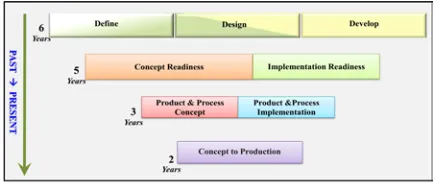
Cutting edge technological innovation and fast implementation are necessary for the commercial success of an industry. A systematic product development cycle is needed for implementing value management and lean manufacturing. Product development cycle from past to present focusing on developing a value targeted product in short time and low cost are clearly explained. An automobile exhaust system product development cycle from concept to production release is reduced from 6 years to about 18 – 24 months. A product development procedure with stages and gates is established. The Stage Gate system model divides the NPD into five discrete stages. The criteria to be fulfilled in each stage is clearly explained.
Keywords: Value management, Toyota Production System, Closing the Gap between innovation to industrial implementation, product development cycle,, stage gate process, project screening, Product specification process
1. Introduction
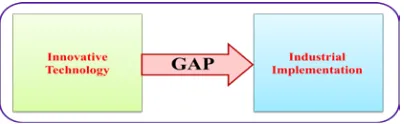
Technological innovation is one of the principal determinants of business success. Enterprises stand to reap greater benefits from innovation if they consider the full range of intellectual property issues in new product development. New product innovation and implementation is a very complexed area. Ideas and innovations should be coupled with research and development strategy, decision-making, management, production and marketing. It requires linking science and technology with commercials. The success of new products mostly depends on effective attainment of knowledge and using it as part of the product design process. There exists a gap between the innovative research and industrialization as shown in figure1.
Figure 1. Selection of Benchmarking Process
Although frugal engineering for value targeted product delivery is continuously growing in the globalized market [1,2] the gap between new technology development and time to market still exists. This gap can only be closed using a systematic product development plan dealing concept readiness and implementation readiness. Value management and lean manufacturing concepts are developed for automobile industry in the early twentieth century [3-5]. Toyota Production System (TPS) developed after the World War II focused on lean manufacturing eliminating waste resources, in manufacturing phases, investment tools, engineering tools and new product development time [6,7]. In 1980s, international motor vehicle program was created at MIT to learn Toyota’s techniques, and the research and learning of the fundamentals of lean manufacturing.
During the 1990s value stream mapping is developed as a part of lean manufacturing. Value stream mapping is a technique that estabilishes a common language to development process and products, a blue print for manufacturing. It helps the team to visualize the process, problem areas, and direction for focus. Gap existing between the innovative research and product implementation needs to be closed. A systematic product development plan can close the gap and bring a product in a short time.
2. Need for Product Development Plan
Figure 2.Product Development Plan
3. What is Product Development ?
A Product Development is widely recognized as a key to corporate prosperity. A new product development needs conceiving idea, screened for its technical, commercial and strategic fits, selected for marketing, developed to stand against the competition, tested for its durability and launched to the customer market.To create the new generation product, a design team goes through product development process steps again. Starting with a product idea, the team moves through several stages to generate all the details and documents needed to get the product built. A New Product Development (NPD) process goes through several stages as shown in Figure 3. The five step stage gate process explained in figure 3 clearly shows the steps involved in each stage and decision making. However, as this product has not been developed by the team before, new risks and uncertainties are introduced and often additional information is documented and shared with manufacturing.
Figure 3.Product Development Plan
Stage 1: Opportunity Assessment
In the first stage concept generation, oncept screening and economic analysis are sequentially carried out.
Concept Generation
A good concept is sometimes poorly implemented in subsequent development phases but a poor concept can rarely be manipulated to achieve commercial success.Concept generation typically consumes less than 5% budget and 15% of the development time. Because the concept generation activity is not costly, there is no excuse for lack of diligence and care in executing a sound concept generation method. The concept generation process steps are clarify the problem,external and internal searches, explore systematicallyandreflect on the results and the process. The detailed concept generation process
steps are shown in Figiure 4.
Figure 4.Concept Generation
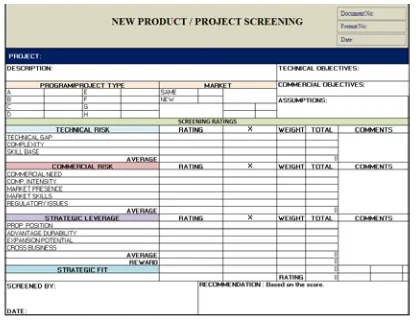
Project Screening
Figure 5.Project Screening Sheet
Economic Analysis
Economic analysis,asensitivity analysis to understand the project trade-offs and creating a net present value (NPV), is mandatory to start the project.The NPV financial model is created using development cost, testing cost, tooling investment, ramp-up cost, marketing cost, unit production cost and sales volume and lifetime warranty cost. Sensitivity analysis is also performed on internal and external influencing factors.
Stage-2: Specification and Planning
Product Specification is a detailed description of dimensions, materials, quantities, etc., of the work, together with directions to be followed. This document contains quantification of the customer needs describing the product or service does for the user.
Marketing Plan
Marketing plan provides direction for marketing activities. The marketing objectives should be based on understanding the strengths and weaknesses, and the business environment in which it operates. It should also be linked to the overall business strategy.
Packaging & Branding
Package is one of the greatest influences on a consumer's decision to try the product. The first and
most important step is in designing the package to establish the product requirements for the appropriate amounts in which the product is to be sold.A brand is
a
name, term, design, or symbol (or
combination) that identifies a business or
organization and its products.Branding is sometimes considered to be merely an advertising function.Stage-3: Product Design
Product design stage handles prototypedevelopment, quality assurance, quality control and enginerring change control. Prototypes are developed fordesign validation and design failure mode and effects analysis (DFMEA). Prototype is then perfected into the final product.
Stage-4: Trial Production
Analysis should be carried out on customer feedback, production cost and test marketing. Fixed cost, standard cost , direct cost , variable cost and labour cost are considered in the production cost analysis.
Stage-5: Full Production
The process sign-off shall be scheduled by the process sign-off team and agrees that all required supplier documentation has been reviewed and is acceptable. Production tooling is complete, finalized, on-site at the supplier's plant, has been setup and debugged, and the supplier readiness evaluation run is complete with the results documented and acceptable to the team. The production process is in place, preliminary performance has been determined, and the supplier is ready for the production demonstration run. This run is based upon a predetermined sample size and line speed. The production operators are trained and capable of running at the contracted peak and sustained line speed.The purpose of PSO is to demonstrate supplier process capability.
confused.Sales estimation is done both on Macro and Micro level.
Conclusion
Technological innovation and fast implementation of it is necessary for corporate success. Systematic product development cyclesarebeing evaluated from past to present to move towards value added product development in short time and low cost. A typical automobile exhaust system product development cycle from concept to start of production is reduced from 6 years to about 18 – 24 months. A product development procedure with stages and gates is established. The Stage Gate system model divides the NPD into five discrete stages. The criteria to be fulfilled in eachstage is clearly explained.Product development from past to present and its requirement to develop a value targeted product in short time and low cost is clearly explained.
Acknowledgement
The authors acknowledge Sharda Motor R&D.
References:
1. Dr. Rajadurai, S. and Parameshwari,C., “Benchmarking –The First Step for Frugal Engineering” IJISET Vol.1, issue 6 282-286 (2014).
2. 31Twww.lifehealthpro.com/.../frugal-innovation -
lessons-from-carlos -ghosn31T.
3. Womack, Dr. James; Foreward to “Becoming Lean”, edited byDr. Jeffrey Liker, Productivity Press Inc., USA(1997).
4. Womack, Dr. James; Lean Thinking; Simon & Schuster, USA (1996).
5. Womack, Dr. James; Learning to See : Value Strem Mapping to Create Value and Eliminate Muda; The Lean Enterprise Institute, USA(1999).
6. Liker, Dr. Jeffrey, “The Toyota Way, 14 Management Proniciples from the World’s Greatest Manufacturer,” McGraw Hill, USA (2004)
7. Ohno, Taiichi. 1988. Toyota production system: Beyond large-scale production. New York, NY: Productivity Press.
First Author:Dr.S.
Rajadurai, Ph.DDr. S. Rajadurai, born in Mylaudy, Kanyakumari District, Tamil Nadu, India, received his Ph.D. in Chemistry from
IIT Chennai in 1979. He has devoted nearly 35 years to scientific innovation, pioneering theory and application through the 20P
th
P
century, and expanding strides of advancement into the 21P
st
P
century. By authoring hundreds of published papers and reports and creating several patents, his research on solid oxide solutions, free radicals, catalyst structure sensitivity, and catalytic converter and exhaust system design has revolutionized the field of chemistry and automobile industry.
As a corporate executive in the United States and in India for over three decades, Dr. Rajadurai managed strategy on power train development and emission control for low, ultra low, super ultra low and partial zero-emission systems. From 1990-1996, he was the Director of Research at Cummins Engine Company. He was the Director of Advanced Development at Tenneco Automotive between 1996 and 2002 and subsequently Emission Strategist and Director of Emissions at ArvinMeritor until 2004. From 2004-2009, he was Vice-President of ACS Industries and since 2009 as Head of R&D Sharda Motor Industries Ltd.
Dr. Rajadurai has held leadership positions on the Board of Directors for the U.S. Fuel Cell Council, Manufacturers of Emission Control Association (MECA), Chairman of MECA Committee on Advanced Technologies and Alternate Fuels and Walker Exhaust India. He is an active participant in Clean and Green Earth Day demonstrations since 1997 and US Clean Diesel School Bus Summit (2003). He was a panelist of the Scientists and Technologists of Indian Origin, New Delhi 2004. He is a Fellow of the Society of Automotive Engineers. He was the UNESCO representative of India on low-cost analytical studies (1983-85). He is a Life Member of the North American Catalysis Society, North American Photo Chemical Society, Catalysis Society of India, Instrumental Society of India, Bangladesh Chemical Society and Indian Chemical Society.
Second Author: C. Parameshwari , B.Sc., MCA
Ms.C.Parameshwari, born in Chennai, Tamil Nadu, is working as a Porject Executive at Sharda Motors R&D since
2012. Parameshwari completed B.Sc. at SRM University in 2006 and MCA at Sathyabama University in 2010.She worked at Saint Globetain on Data Base Management System prior to joining Sharda Motor R&D.
She has specialized in SQL and .Net.
She is also working as a project executive for scheduling and managing R&D functional activities such as benchmarking, testing and advanced development. She has formed a team for continuous improvement on benchmarking and value analysis. She has published a paper on benchmarking, the first step for frugal engineering.