Scholarship@Western
Scholarship@Western
Electronic Thesis and Dissertation Repository
8-2-2016 12:00 AM
Defining and Predicting Dropout from Children’s Mental Health
Defining and Predicting Dropout from Children’s Mental Health
Services: A Novel Need-Based Definition Of Dropout
Services: A Novel Need-Based Definition Of Dropout
Kimberly Williams Dossett The University of Western Ontario
Supervisor Dr. Graham Reid
The University of Western Ontario Graduate Program in Psychology
A thesis submitted in partial fulfillment of the requirements for the degree in Master of Science © Kimberly Williams Dossett 2016
Follow this and additional works at: https://ir.lib.uwo.ca/etd
Part of the Clinical Psychology Commons
Recommended Citation Recommended Citation
Dossett, Kimberly Williams, "Defining and Predicting Dropout from Children’s Mental Health Services: A Novel Need-Based Definition Of Dropout" (2016). Electronic Thesis and Dissertation Repository. 3920. https://ir.lib.uwo.ca/etd/3920
This Dissertation/Thesis is brought to you for free and open access by Scholarship@Western. It has been accepted for inclusion in Electronic Thesis and Dissertation Repository by an authorized administrator of
i
Background: Dropout from children’s mental health services has negative impacts on children,
families and community mental health agencies. In order to reduce dropout, it is essential to correctly define individuals as treatment dropouts, and understand the predictors of dropout. Methods: Manuscript 1 describes the development of a novel need-based definition of dropout
and contrasts this definition to existing definitions of dropout in the literature. Manuscript 2 uses the need-based definition to examine predictors of dropout, and compares predictors of dropout using different definitions of dropout. Results: The need-based definition categorizes individuals differently from existing definitions of dropout. Caregiver needs are a consistent predictor of dropout across the need-based definition and existing definitions of dropout in the literature. Conclusions: The need-based definition is a valuable method for categorizing individuals as
dropouts or completers. It suggests families that can be targeted with engagement interventions to reduce dropout from children’s mental health services.
Key Words
ii
First and foremost, I am immensely grateful to my supervisor, Dr. Graham Reid. For recognizing my grit, pushing me to find new strength, and patiently supporting me in the moments I did not believe this was possible. I am a better student and a better scientist because of you.
This project could not have been possible without the use of data from the wonderful Frequent Flyers Predictors study. I thank each of you for your hard work that resulted in a trove of information for me to work from. I consider myself fortunate to have had access to this data, I hope I have done it justice.
I also extend a sincere thank you to both Dr. Richard Neufeld and Gésine Alders who provided me excellent consultation in planning and conducting my analyses.
It is hard to put into words how much the support of my family has meant to me throughout this process. Mom, for inspiring my persistence and for always being willing to talk about it one more time. Dad, for reminding me that even superheroes are human. Thank you both for being the people I strive to be. Amanda, for always seeing the best in me and caring for me unconditionally, no matter how much distance there is between us. Greg, for sharing this little city with me and being a safe haven whenever I need to feel grounded, you always help me remember what is truly important.
iii
iv
Abstract... i
Acknowledgements... ii
Table of Contents... iv
List of Tables ... ix
List of Figures...xi
List of Appendices... xii
List of Abbreviations ... xiii
Chapter 1 General Introduction ... 1
1.1 Overview of Thesis ... 2
1.2 The Problem of Dropout ... 2
1.3 Enhancing Treatment Engagement ... 4
1.4 Dropout and Children’s Mental Health Services ... 5
1.5 Theoretical Models of Service Use and Dropout ... 7
1.5.1 The Socio-Behavioural Model... 7
1.5.2 Network-Episode Model ... 8
1.5.3 Gateway Providers Model ... 9
1.5.4 Barriers to Treatment Model ... 10
1.6 Choosing the Appropriate Model... 11
1.7 Definitions of Dropout ... 12
v
1.10 Summary ... 17
1.11 References ... 19
Chapter 2 Defining Dropout from Children’s Mental Health Services: A Novel Need-Based Definition of Dropout ... 26
2.1 Dropout from Children’s Mental Health Services ... 27
2.2 Methodological Issues in the Dropout Literature ... 28
2.2.1 Inconsistencies in Definitions of Dropout ... 28
2.2.2 Modelling Dropout Based on Number of Sessions ... 31
2.2.3 Early and Late Dropout ... 34
2.3 A Need-Based Definition of Dropout ... 35
2.4 Objectives ... 36
2.5 Methods... 37
2.5.1 Principal Study ... 37
2.5.2 The Current Study ... 40
2.5.3 Data Analyses ... 50
2.5.4 Preliminary Analyses ... 51
2.6 Results ... 60
2.6.1 Sample Characteristics ... 60
vi
2.7 Discussion ... 75
2.7.1 The Need-Based Definition ... 75
2.7.2 Advantages of a Need-Based Definition ... 77
2.7.3 No Definitions of Dropout ... 78
2.7.4 All Definitions of Dropout ... 80
2.7.5 Some Definitions of Dropout ... 81
2.7.6 Limitations ... 82
2.7.7 Implications ... 84
2.7.8 Future Directions ... 85
2.8 References ... 87
Chapter 3 Predicting Dropout from Children’s Mental Health Services: Using a Need-Based Definition of Dropout ... 101
3.1 The Problem of Dropout ... 102
3.2 Inconsistencies in Definitions of Dropout ... 103
3.3 The Socio-Behavioural Model ... 105
3.4 Factors Predicting Dropout by Definition... 106
3.5 Need-Based Definition of Dropout ... 109
3.6 Importance of Comparing Predictors by Definition ... 110
vii
3.9 Methods... 112
3.9.1 Principal Study ... 112
3.9.2 The Current Study ... 116
3.9.3 Operational Definitions of Dropout ... 123
3.9.4 Analyses... 126
3.10 Results ... 128
3.10.1 Sample Characteristics ... 128
3.10.2 Operational Definitions of Dropout ... 130
3.10.3 Agreement Between Definitions ... 134
3.10.4 Predictors of Dropout by Definition ... 138
3.10.5 Comparing Predictors by Definitions ... 140
3.11 Discussion ... 141
3.11.1 Dropout Prevalence Rates by Definition ... 141
3.11.2 Service Use Comparisons Across Definitions ... 145
3.11.3 Advantages of a Need-Based Definition ... 147
3.11.4 Predictors of Dropout ... 148
3.11.5 Implications ... 153
3.11.6 Limitations ... 154
viii
Chapter 4 General Discussion ... 169
4.1 Discussion Overview ... 170
4.2 Need-Based Definition of Dropout ... 170
4.3 Predictors of Dropout ... 175
4.4 Theoretical Considerations ... 176
4.5 Limitations ... 178
4.6 Implications... 180
4.7 Future Directions ... 181
4.8 Conclusion ... 182
ix
Table 2.1: Summary of patterns of service use across five children’s mental
health agencies. ... 38 Table 2.2: Low need - Number of sessions by discharge CAFAS outcome. ... 55 Table 2.3: High need - Marital status by number of sessions by discharge
CAFAS outcome. ... 58 Table 2.4: Summary of Sample Demographics. ... 60 Table 2.5: Description and prevalence of dropout according to each operational
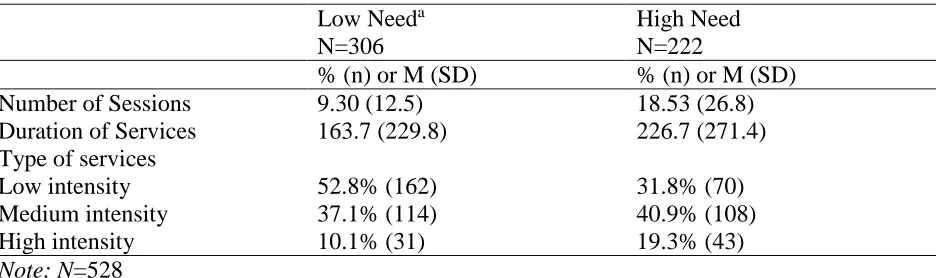
definition of dropout ... 61 Table 2.6: Service use by need groups... 63 Table 2.7: Comparison of sample characteristics around chosen cut-offs for the
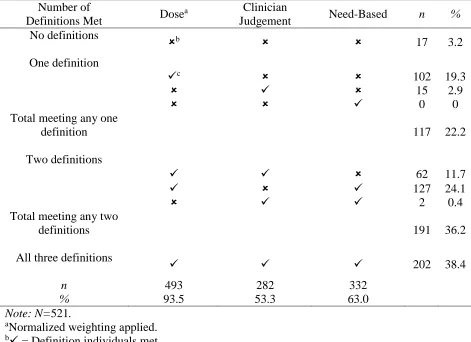
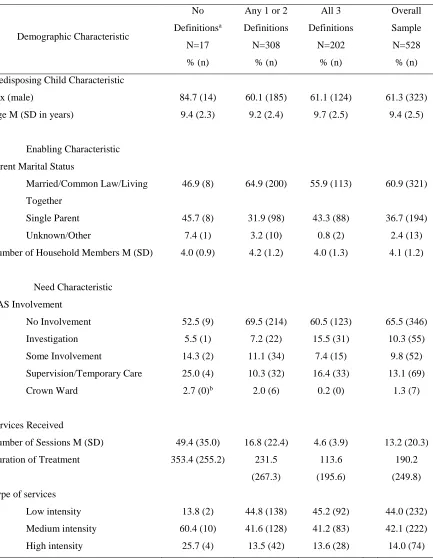
need-based definition. ... 64 Table 2.8: Overlap of definitions of dropout. ... 66 Table 2.9: Comparison of sample characteristics meeting various overlaps of
definitions. ... 67 Table 2.10: Discriminant Function Analysis Structure Matrices. ... 70 Table 2.11: Positive and Negative Predictive Value Classification of Definition
Overlap Groups. ... 73 Table 3.1: Robust predictors across both designs and dropout definitions... 106 Table 3.2: Summary of patterns of service use across five children’s mental
health agencies. ... 111 Table 3.3: Description and prevalence of dropout according to each operational
x
Table 3.5: Comparisons of sample characteristics – Completers and dropouts by
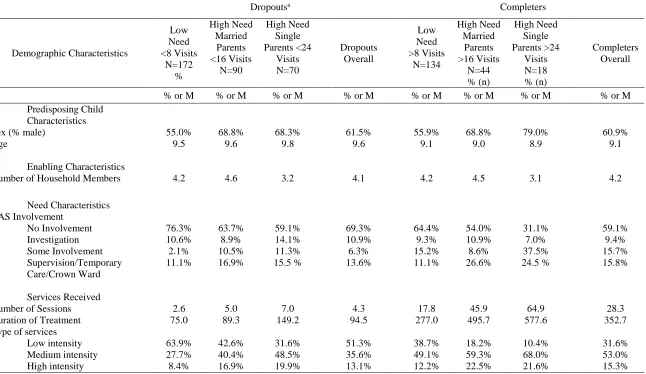
each definition ... 128 Table 3.6: Overlap of definitions of dropout. ... 129 Table 3.7: Categorization agreement by each pair of definitions. ... 132 Table 3.8: Demographic characteristics of groups sorted similarly or differently
xi
Figure 2.1: Good enough level model... 34
Figure 2.2: Flow diagram of chart review data collection. ... 40
Figure 2.3: Calendar time transformed to analysis time scale. ... 44
Figure 2.4: Low need receiver operating curve. ... 54
Figure 2.5: Service intensity by overlap of definitions of dropout. ... 68
Figure 2.6: CANS average dimension scores by definition group. ... 70
Figure 2.7: Structure Matrix. ... 71
Figure 2.8: Functions at group centroids. ... 72
Figure 3.1: Flow diagram of chart review data collection. ... 114
Figure 3.2: Calendar time transformed to analysis time scale.. ... 118
xii
Appendix A: Mental health session intensity groupings. ... 183
Appendix B: Categorizing overall service use intensity for nature of sessions. ... 184
Appendix C: Child and adolescent needs and strengths items by dimension. ... 189
Appendix D: Normalized weighting adjustment. ... 190
Appendix E: Differences in distributions of patterns of service use across agencies. ... 192
Appendix F: Unweighted vs. weighted sample demographic characteristics ... 193
Appendix G: Comparison of scoring methods for the CANS. ... 195
Appendix H: Receiver operating curve for high need. ... 199
Appendix I: Comparison of distribution of need definition completers and dropouts with and without a CAFAS. ... 200
Appendix J: Coreelations between CANS dimensions and BCFPI scales. ... 203
Appendix K: Parameters of each logistic regression model by definition... 204
xiii
AIC BCFPI BCQ
Akike Information Criterion
Brief Child and Family Phone Interview Burden of Care Questionnaire
BIC Bayesian Information Criterion
CAFAS Child and Adolescent Functional Assessment Scale CAMHS Children and Adolescent Mental Health Services CANS Child and Adolescent Needs and Strengths CAS Child Assessment Scale
CAS Children’s Aid Services CBCL Child Behavior Checklist
CMHC Children’s Mental Health Centre EBT Evidence Based Treatment
EoC Episode of Care
GEL Good Enough Level
ICC Intraclass Correlation Co-efficient NEM
PCAS
Network Episode Model Parent Child Assessment Scale RCT Randomized Controlled Trial ROC Receiver Operating Curve
TRF Teacher Report Form
Chapter 1
1.1 Overview of Thesis
This thesis developed an improved definition of dropout for children’s mental health services, and compared this novel method of classifying individuals to existing definitions of dropout. Predictors of dropout are compared between the novel and existing definitions in the literature. Findings can guide specific interventions designed to improve service retention and engagement by helping to identify and target risk factors associated with families that dropout (McKay & Bannon, 2004).
This thesis followed the integrated article format outlined by the School of Graduate and Postdoctoral Studies at Western University. There are four chapters. Chapter 1 is a general introduction. Chapters 2 and 3 are stand-alone manuscripts focusing on dropout from children’s mental health services using data from a previously conducted study on children’s patterns of mental health service use (Reid et al., 2010). Chapter 2 describes the development of a novel need-based definition of dropout and contrasts this definition to existing definitions of dropout in the literature. Chapter 3 uses the need-based definition to examine predictors of dropout, and compares predictors of dropout using different definitions of dropout. Chapter 4 is a general discussion integrating the findings from the two manuscripts.
1.2 The Problem of Dropout
Dropout from children’s mental health treatment has long been a concern for clinicians
dropping out (Lai, Pang, Wong, Lum, & Lo, 1998; Luk et al., 2001). These estimates suggest that many ostensibly “treated” individuals in need of mental health services receive less than an adequate dose of care (Gonzalez, Weersing, Warnick, Scahill, & Woolston, 2011). Compared to children who complete treatment, those who drop out are more likely to experience persistence of symptoms, engage in delinquent activities, abuse substances, dropout of school and be unemployed (de Haan, Boon, de Jong, Hoeve, & Vermeiren, 2013).
For community mental health agencies, dropout results in the inefficient and ineffective use of limited services. Dropout poses a financial burden in terms of higher staffing costs, creates unnecessarily long waiting lists, negatively influences the community perception of the agency, and limits the number of people an agency can serve (Klein, Stone, Hicks, & Pritchard, 2003; Tantam & Klerman, 1979). Dropout also creates additional costs in the future, as individuals who leave with unresolved symptoms are more likely to return to care repeatedly (Kazdin, 1990). In order to minimize or prevent the negative consequences of treatment dropout, it is important to understand its predictors and determinants. Predictors are considered to be any variables associated with dropout, whereas determinants are the actual processes that lead to dropout. The prevention of dropout should result in more beneficial and cost effective treatment (de Haan et al., 2013).
The majority of research on dropout has focused on adult populations. Unfortunately, despite a sizeable adult dropout literature and a growing number of studies focused specifically on dropout from children’s mental health services, little progress has been made in understanding
practical and psychological barriers to treatment participation (Walitzer, Dermen, & Connors, 1999). Some work on enhancing treatment engagement has also been conducted with children.
1.3 Enhancing Treatment Engagement
Engagement is often defined as initial attendance to treatment and then retention over time. Some definitions of engagement also involve emotional investment beyond simple participation (Staudt, 2007; Yatchmenoff, 2005). Nonetheless, engagement is primarily measured by attendance. Attendance can be objectively measured, and participation in treatment is a necessary prerequisite for attitudinal or emotional investment in treatment. Engaging families in child mental health treatment remains challenging despite continuing advances in evidence-based treatment approaches and intervention efforts focused on retaining families in treatment (Gopalan et al., 2010).
A recent review of randomized-controlled trials testing methods to improve family engagement and retention in child mental health programs indicated brief interventions could improve engagement in the early sessions. These brief interventions often included providers explicitly addressing families’ practical (e.g. schedules, transportation) and psychological (e.g. family members’ resistance, beliefs about the treatment process) barriers as they entered
treatment. Examples of these brief engagement interventions include; direct approaches to service engagement (e.g., appointment reminders, brief engagement interviews prior to treatment) or interventions where engagement was addressed indirectly (e.g., changes to the way in which families are invited to engage in intervention – group versus individual family treatment) (Ingoldsby, 2011).
effective treatment programs, in general, successful engagement methods were (a) individualized and addressed families’ particular needs, concerns, and barriers; (b) intensive, addressing engagement at multiple time-points, with multiple family members, and in multiple ways as families progressed in treatment; (c) developed from a strong theoretical framework, and (d) integrated seamlessly into the underlying treatment or prevention program structure (Ingoldsby, 2011).
To accomplish this, the interventions often integrated motivational interviewing, family systems approaches, and enhanced family stress and coping support strategies at multiple points throughout treatment (Ingoldsby, 2011). Given the need for additional resources and the associated costs, it is likely not feasible to offer these ongoing, intensive, and personalized engagement interventions universally. This makes it important to better understand and identify which families are most in need of such interventions. Targeting and tailoring of programs to those children and families most at risk for dropout can lead to greater engagement and participation and improve the public health benefit of these programs (Ingoldsby, 2011).
In order to target programs most effectively, clear and consistent profiles of families likely to dropout from children’s mental health services are required. This thesis facilitated this
goal through the development of an improved definition dropout with the aim of identifying children/families most at risk. Treatment engagement programs could then target these individuals/families. Ideally, programs could also be tailored to influence predictors of dropout amenable to change through intervention.
1.4 Dropout and Children’s Mental Health Services
Hoff, 2001). Furthermore, studies on engagement and reducing dropout from children’s mental health services remains scarce. Identification of predictors of dropout specific to children is an important prerequisite to such interventions. Studies specific to children’s dropout from mental health services are important as children’s access to, and use of services, are distinctly different from that of adults. Unlike adults, children do not seek or use services on their own. Instead, children tend to access services through the influence of their parents, teachers, juvenile justice authorities, and other adults (Stiffman, Pescosolido, & Cabassa, 2004); it is usually parents and caregivers who facilitate continued use. This makes studies of dropout from children’s mental health unique, and particularly complex, as one must consider characteristics of the parent/caregiver, child, service provider and agency, as well as the combinations of these characteristics (Sirles, 1990).
Several studies have examined dropout specifically in child and adolescent outpatient settings (e.g., Armbruster & Fallon, 1994; Armbruster & Kazdin, 1994; Evenson et al., 1988; Gould, Shaffer, & Kaplan, 1985; Kazdin & Mazurick, 1994; McKay et al., 1996; Miller, Southam-Gerow, & Allin, 2008); no single variable appears to be sufficient to predict dropout from treatment. Many variables have been related to dropout, including; socioeconomic disadvantage, minority group status, single-parent household, the severity of the child’s symptoms, the internalizing vs. externalizing nature of the child’s disorder, parental stress, caregiver’s mental status, caregiver’s perception of treatment, perceived barriers to treatment,
Researchers have suggested a number of features of the dropout predictor research that may contribute to this including a lack of theoretical basis underlying many studies of dropout from children’s mental health, and the inconsistency of operational definitions of dropout used across
studies. Relevant theoretical models related to dropout will be discussed, followed by a review of issues related to the definition of dropout.
1.5 Theoretical Models of Service Use and Dropout
A number of models relevant to dropout are discussed.
1.5.1 The Socio-Behavioural Model
The Socio-Behavioural model (Aday & Andersen, 1974) is a classic health service model. It allows for a broad conceptualization of dropout from children’s mental health services as resulting from both the presence of pre-treatment factors, as well as some barriers that arise early in the service seeking process. Originally developed to understand adult health service use in the United States, this model posited three influences on service use: 1) need factors refer to a client’s illness severity and can be measured through clinical status or subjective perceptions of one’s own mental health (e.g., child diagnosis); 2) predisposing factors exist prior to illness
onset and describe the propensity of individuals to use services (e.g., age, sex); 3) enabling (or inhibiting) factors are situational variables that describe one’s means to use services and can act
use, this model may also be applicable to predictors of adherence to or dropout from treatment (Wang, 2007).
1.5.2 Network-Episode Model
The socio-behavioral model has been adapted for use specifically with mental health care, and for children in the mental health sector by incorporating features of the family. These adapted models share common features of Andersen’s Socio-Behavioural Model. One example, is the Network-Episode Model (NEM) (Costello, Pescosolido, Angold, & Burns, 1998; Pescosolido, Gardner, & Lubell, 1998) which emphasizes social networks and social action along with individual action in understanding the help-seeking process. The model suggests that pathways to mental health services are not fully explained by characteristics of the individual. Rather, the NEM focuses on the importance of outside social influence on when, how and if individuals receive care (Pescosolido et al., 1998). This social influence can operate as a part of the individual making an active choice to seek treatment, or caregivers, family members or others community members (e.g., police) may make the decision for the individual (Pescosolido et al., 1998).
1.5.3 Gateway Providers Model
The Gateway Providers Model builds off the Network-Episode Model by incorporating decision theory (Slavic & Fischhaff, 1977) to clarify how service use can be understood as a series of rationally-based decisions (Stiffman et al., 2004). The Gateway Providers model draws insights from the NEM to understand which individual, treatment and social factors need to be explicitly considered in treatment decisions, whereas decision theory describes the process that begins with these factors and ends in the selection of a particular service (Stiffman et al., 2004).
The Gateway Providers Model focuses on three central influences that affect the treatment children receive. First, it incorporates the NEM concept of the key role of an outside individual, often not in the mental health system (e.g., parent, teacher), who initiates or directs the trajectory of service use (Stiffman et al., 2004). This person is referred to as the gateway provider. Second, it recognizes from Decision theory that the quality of advice, suggestions, assistance and referrals coming from the gateway providers are dependent on the information the gateway provider has and their understanding of the child’s needs (Stiffman et al., 2004).
Superior information and understanding on the part of the gateway provider can improve the quality of care offered to clients. Third, gateway providers’ attitudes, perspectives and support
can facilitate or hinder the implementation of new approaches in treatment systems (Stiffman et al., 2004).
1.5.4 Barriers to Treatment Model
Most studies focus on child or family and parent factors that are present prior to treatment and cannot be changed during treatment. For example, child sex, family socioeconomic status, and parental marital status. Some researchers (e.g., Kazdin, Holland, & Crowley, 1997; Nock & Ferriter, 2005) suggest the focus should shift to the processes and mechanisms underlying dropout, and factors that can be changed throughout treatment (e.g., treatment demands, the perceived relevance of the treatment and therapist relationship factors).
1.6 Choosing the Appropriate Model
There are a number of different models which have been developed for and applied to dropout from adult and children’s health services. The theoretical model chosen depends on the purpose of the study. Some models aid in overall predictive conceptualizations of factors contributing to dropout, whereas others focus on tangible explanatory mechanisms of dropout. For the purposes of the current studies, we are more concerned with the prediction of dropout, and are not aiming to propose specific mechanisms of dropout.
There are benefits to studying the underlying mechanisms of dropout (e.g., suggests clear foci for intervention). When using a process model, some variables are present at intake; however, majority of variables only appear as barriers throughout the course of treatment. Unfortunately, it is difficult to assess barriers at every session in routine community care to make use of these process models. This limits the usefulness of the resulting predictor data for applications to engagement interventions. For this reason, the Socio-Behavioural model, which is parsimonious and focused on variables already available to community agencies at intake, is used in this thesis. Predictors of dropout can be used to target engagement interventions (Ingoldsby, 2011) to families upon initial intake in services. That is, if we can identify individuals at intake who are most likely to dropout, only these individuals would need to receive pretreatment interventions designed to decrease dropout.
health agencies and available at the initial appointment to aid in prediction of later dropout. Thus, the Socio-Behavioural model will be used throughout this thesis to understanding factors contributing to dropout.
1.7 Definitions of Dropout
The varied findings in studies seeking to characterize dropouts may be explained in part by their methodological differences (Armbruster & Kazdin, 1994). Importantly, these differences include variations in the operational definition of dropout used across studies. Dropout has been defined in primarily two different ways. First, dropout has been defined as ceasing treatment before a set number of sessions, or a specified “dose” of treatment is completed (Johnson,
Mellor, & Brann, 2008). Second, dropout has also been defined as termination of treatment against clinician judgment (Wierzbicki & Pekarik, 1993). A recent study examining differences in classification and predictors across definitions of dropout highlights issues related to defining dropout.
appointment definition; having low caregiver-reported youth functioning predicted dropout by the clinician judgement definition; and living with a non-biological family, routine intakes (as compared to urgent intakes), and longer wait times predicted dropout by the dose definition.
The underlying assumption in research in this area is that there are important differences between clients who drop out and those who complete treatment. Ideally, if a definition is appropriately categorizing individuals as homogenous groups of dropouts or completers, distinct and replicable differences will be found between these two groups. The difficulty in finding consistent estimates of dropout prevalence or replicable differences between dropouts and completers suggests current definitions of dropout are categorizing individuals inconsistently and possibly incorrectly (Pekarik, 1985).
1.8 Issues with Current Definitions of Dropout
The dose definition of dropout, - ceasing treatment before a specified amount of treatment is completed (Johnson et al., 2008) - is typically used in randomized controlled trials (RCTs). This definition provides a useful objective standard for defining dropout. However, this definition may be inappropriate for use in community mental health agencies, where evidence based treatments (EBTs) are not consistently offered, clients display a heterogeneous mix of diagnoses and often have comorbid issues which may require longer or more complex treatments (Schoenwald & Hoagwood, 2001).
The “clinician judgement” definition of dropout - termination of treatment against
differing assumptions about treatment goals and expectations (Garfield, 1994). Clinicians may seek to have clinically significant change while families may instead aim for partial reduction in problem severity such that the child’s problems can be managed successfully at home without further treatment.
Both the dose and clinician judgment definitions of dropout rely, to some degree, on the amount of time (typically reflected in the number of sessions rather than duration of time) an individual has been in treatment to determine if an individual is considered to have dropped out. However, treatment duration may not be directly related to dropout (Pekarik, 1985). Inappropriate termination can occur at any time, including the late stages of treatment, or appropriate termination of treatment may occur after a few sessions. For example, some patients, although terminating treatment earlier than a set number of sessions, can still be considered appropriate terminators, if sufficient improvement in their mental health was achieved in a shorter than planned duration. Therefore, not all “premature” terminators may represent dropout. Grouping individuals based on a specific number of sessions attended would obscure differences between dropouts and completers who might require differing amounts of treatment. There are also likely fundamentally different reasons for individuals dropping out after a single session in comparison to dropping out after a year of treatment. For these reasons, categorizing treatment participants by a dose or clinical judgment definition may result in a dropout group comprised of a mixture of dropouts and appropriate terminations (Johnson et al., 2008). This signifies that definitions should take more than treatment duration into account when categorizing individuals based on dropout status.
Incorporating “need” into a definition of dropout may resolve some of the above issues
problem as well as the family and caregiver context of that problem (further discussed in subsection 1.9). Need is also related to the differences between clinician and client perspectives on treatment outcomes and dropout. Clinicians may seek to have clinically significant change, while families may instead aim for an outcome that is good enough for them to manage at home. What constitutes good enough may depend both on the severity of the child’s problem at intake as well as the family’s coping ability. By failing to take an individual’s need for treatment into
account, both a dose and clinician judgment definition may create heterogeneous groups of dropouts.
1.9 Development of a Need-Based Definition of Dropout
The underlying assumption in dropout research is that there are important differences between clients who drop out and those who complete treatment. Ideally, if a definition is accurately categorizing individuals as homogenous groups of dropouts or completers, distinct and replicable differences will be found between those classified in each group. Unfortunately, existing definitions of dropout do not appear to adequately categorize dropouts and completers as homogenous groups. Neither a dose nor clinician judgment definition of dropout takes the nature and severity of the client’s problem, as well as the family and caregiver context of that problem into account. There is significant evidence that problem severity impacts continued service use.
Given the clear impact of the nature and severity of the child’s problem, as well as the family and caregiver context of that problem - hereafter referred to as need - on both service use and dropout from services noted above, we propose that an improved definition of dropout should recognize need. This novel needs-based definition recognizes that children differ in their need for treatment at intake and that this should influence the point at which a child might be categorized as having dropped out or completed treatment.
1.10 Summary
In this thesis, two studies were conducted. Both are based on secondary analyses of data from a previous study (Reid et al., 2010). The first of the two studies outlines the development and initial use of a novel need-based definition of dropout from children mental health services. A need-based definition suggests the optimal number of sessions required for treatment completion should vary based on a client’s level of need at intake. Dropout would then be defined as receiving significantly lower than the optimal number of sessions. The two-step process for developing a need-based definition of dropout is presented; (a) defining problem severity at intake and (b) determining number of treatment sessions required based on need. In this first study this definition is compared to other commonly used definitions of dropout, dose and clinician judgement. The results of this study suggest how various definitions categorize the same individuals, where definitions overlap and what characteristics distinguish those who meet multiple definitions of dropout from those who meet no definitions of dropout.
1.11 References
Aday, L. a, & Andersen, R. (1974). A framework for the study of access to medical care. Health Services Research, 9, 208–220.
Armbruster, P., & Kazdin, A. (1994). Attrition in child therapy. In Advances in clinical child psychology (pp. 81–108).
Cobham, V. E., Dadds, M. R., & Spence, S. H. (1998). The role of parental anxiety in the treatment of childhood anxiety. Journal of Consulting and Clinical Psychology, 66(6), 893– 905. http://doi.org/10.1037/0022-006X.66.6.893
Costello, E., Pescosolido, B., Angold, A., & Burns, B. (1998). A family network based model of access to child mental health services. Research in Community and Mental Health, 9, 165– 190.
de Haan, A. M., Boon, A. E., de Jong, J. T., Hoeve, M., & Vermeiren, R. M. (2013). A meta-analytic review on treatment dropout in child and adolescent outpatient mental health care. Clinical Psychology Review, 33(5), 698–711. http://doi.org/10.1016/j.cpr.2013.04.005
Dierker, L., Nargiso, J., Wiseman, R., & Hoff, D. (2001). Factors predicting attrition within a community initiated system of care. Journal of Child and Family Studies, 10(3), 367–383. http://doi.org/10.1023/A:1012581027044
Dumas, J., & Wahler, R. (1983). Predictors of treatment outcome in parent training: Mother insularity and socioeconomic disadvantage. Behavioral Assessment. Behavioral Assessment, 5(4), 301–313.
Garfield, S. (1994). Research on client variables in psychotherapy. In Handbook of psychotherapy and behavior change (pp. 190–228).
Gonzalez, A., Weersing, V. R., Warnick, E. M., Scahill, L. D., & Woolston, J. L. (2011).
Predictors of treatment attrition among an outpatient clinic sample of youths with clinically significant anxiety. Administration and Policy in Mental Health and Mental Health Services Research, 38, 356–367. http://doi.org/10.1007/s10488-010-0323-y
Gopalan, G., Goldstein, L., Klingenstein, K., Sicher, C., Blake, C., & Mckay, M. (2010). Engaging Families into Child Mental Health Treatment : Updates and Special
Considerations. Journal Canadian Academy of Child and Adolescent Psychiatry, 19(3), 182–196.
Haaga, D. A. F. (2000). Introduction to the special section on stepped care models in psychotherapy. Journal of Consulting and Clinical Psychology, 68(4), 547–548. http://doi.org/10.1037//0022-006X.68.4.547
Hansen, N. B., & Lambert, M. J. (2003). An evaluation of the dose-response relationship in naturalistic treatment settings using survival analysis. Mental Health Services Research, 5(1), 1–12. http://doi.org/10.1023/A:1021751307358
Ingoldsby, E. M. (2011). Review of Interventions to Improve Family Engagement and Retention in Parent and Child Mental Health Programs. October, 19(5), 629–645.
http://doi.org/10.1007/s10826-009-9350-2.Review
Johnson, E., Mellor, D., & Brann, P. (2008). Differences in dropout between diagnoses in child and adolescent mental health services. Clinical Child Psychology and Psychiatry, 13, 515– 530. http://doi.org/10.1177/1359104508096767
antisocial behavior. Journal of Child Psychology and Psychiatry and Allied Disciplines, 31(3), 415–425. http://doi.org/10.1111/j.1469-7610.1990.tb01578.x
Kazdin, A., Holland, L., & Crowley, M. (1997). Family Experience of Barriers to Treatment and Premature Termination From Child Therapy. Journal of Consulting and Clinical
Psychology, 65(3), 453–463.
Kazdin, A., Holland, L., Crowley, M., & Breton, S. (1997). Barriers to Treatment Participation Scale: evaluation and validation in the context of child outpatient treatment. Journal of Child Psychology and Psychiatry, and Allied Disciplines, 38(8), 1051–1062.
http://doi.org/10.1111/j.1469-7610.1997.tb01621.x
Kazdin, A., Mazurick, J., & Bass, D. (1993). Risk for attrition in treatment of antisocial children and familie. Journal of Clinical Child Psychology, 22, 2–16.
Kazdin, A., Mazurick, J., & Siegel, T. (1994). Treatment Among Children Woth Externalizing Disorders Who Terminatie Prematurely Versus Thos Who Complete.Pdf. J Am Acad Child Adolesc Psychiatry, 33(4), 549–557.
Kazdin, A., & Wassell, G. (2000). Predictors of barriers to treatment and therapeutic change in outpatient therapy for antisocial children and their families. Mental Health Services Research, 2(1), 27–40. http://doi.org/10.1023/A:1010191807861
Klein, E., Stone, W., Hicks, M., & Pritchard, I. (2003). Understanding Dropouts. Journal of Mental Health Counseling, 25(2), 89–100.
Kopta, S., Howard, K., Lowry, J., & Beutler, L. (1994). Patterns of Symptomatic Recovery in Psychotherapy. Journal of Consulting and Clinical Psychology, 1009–1016.
Epidemiology, 33, 45–48. http://doi.org/10.1007/s001270050021
Luk, E. S. L., Staiger, P. K., Mathai, J., Wong, L., Birleson, P., & Adler, R. (2001). Children with persistent conduct problems who dropout of treatment. European Child and Adolescent Psychiatry, 10, 28–36. http://doi.org/10.1007/s007870170044
MacKian, S., Bedri, N., & Lovel, H. (2004). Up the garden path and over the edge: Where might health-seeking behaviour take us? Health Policy and Planning, 19(3), 137–146.
McKay, M. M., & Bannon, W. M. (2004). Engaging families in child mental health services. Child and Adolescent Psychiatric Clinics of North America, 13, 905–921.
http://doi.org/10.1016/j.chc.2004.04.001
Nock, M. K., & Ferriter, C. (2005). Parent management of attendance and adherence in child and adolescent therapy: A conceptual and empirical review. Clinical Child and Family
Psychology Review, 8(2), 149–166. http://doi.org/10.1007/s10567-005-4753-0
Owens, P. L., Hoagwood, K., Horwitz, S. M., Leaf, P. J., Poduska, J. M., Kellam, S. G., & Ialongo, N. S. (2002). Barriers to Children’s Mental Health Services. J Am Acad Child Adolesc Psychiatry, 41(6), 731–738.
Pekarik, G. (1985). The effects of employing different termination classification criteria in dropout research. Psychotherapy: Theory, Research, Practice, Training, 22(I), 86–91. http://doi.org/10.1037/h0088531
Pelkonen, M., Marttunen, M., Laippala, P., & Lönnqvist, J. (2000). Factors associated with early dropout from adolescent psychiatric outpatient treatment. Journal of the American Academy of Child and Adolescent Psychiatry, 39(3), 329–336.
http://doi.org/10.1097/00004583-200003000-00015
services: Stories of choice, coercion and “muddling through” from “first-timers.” Social
Science and Medicine, 46(2), 275–286. http://doi.org/10.1016/S0277-9536(97)00160-3
Reid, G., Stewart, S., Barwick, M., Carter, J., Evans, B., Leschied, A., … Zaric, G. (2010).
Predicting and understanding patterns of service utilization within children’s mental health
agencies.
Rogers, C. (1951). Client-centered therapy. Boston: Houghton Mifflin. Boston: Houghton Mifflin.
Ruma, P. R., Burke, R. V., & Thompson, R. W. (1996). Group parent training: Is it effective for children of all ages? Behavior Therapy, 27(2), 159–169. http://doi.org/10.1016/S0005-7894(96)80012-8
Saxe, L., Cross, T., & Silverman, N. (1988). Children’s mental health: The gap between what we
know and what we do. American Psychologist, 43(10), 800.
Sayal, K. (2004). The role of parental burden in child mental health service use: longitudinal study. Journal of the American Academy of Child and Adolescent Psychiatry, 43(11), 1328– 1333. http://doi.org/10.1097/01.chi.0000138353.83357.fa
Schoenwald, S. K., & Hoagwood, K. (2001). Effectiveness, transportability, and dissemination of interventions: what matters when? Psychiatric Services (Washington, D.C.), 52(9), 1190– 1197. http://doi.org/10.1176/appi.ps.52.9.1190
Shmueli, G. (2010). To Explain or to Predict? Statistical Science, 25(3), 289–310. http://doi.org/10.1214/10-STS330
Sirles, E. a. (1990). Dropout from intake, diagnostics, and treatment. Community Mental Health Journal, 26(4), 345–360. http://doi.org/10.1007/BF00752725
Staudt, M. (2007). Treatment engagement with caregivers of at-risk children: Gaps in research and conceptualization. Journal of Child and Family Studies, 16(2), 183–196.
http://doi.org/10.1007/s10826-006-9077-2
Stiffman, A. R., Pescosolido, B., & Cabassa, L. J. (2004). Building a model to understand youth service access: The gateway provider model. Mental Health Services Research, 6(4), 189– 198. http://doi.org/10.1023/B:MHSR.0000044745.09952.33
Tantam, D., & Klerman, G. (1979). Patient transfer from one clinician to another and dropping-out of dropping-out-patient treatment. Social Psychiatry, 14(3), 107–113.
http://doi.org/10.1007/BF00582175
Todd, D. M., Deane, F. P., & Bragdon, R. a. (2003). Client and therapist reasons for termination: A conceptualization and preliminary validation. Journal of Clinical Psychology, 59(1), 133–147. http://doi.org/10.1002/jclp.10123
Walitzer, K., Dermen, K., & Connors, G. (1999). Strategies for preparing clients for treatment: A review. Behavior Modification, 23(1), 129–151. http://doi.org/10.1177/0145445599231006 Wang, J. (2007). Mental health treatment dropout and its correlates in a general population
sample. Medical Care, 45(3), 224–229. http://doi.org/10.1097/01.mlr.0000244506.86885.a5 Warnick, E. M., Gonzalez, A., Robin Weersing, V., Scahill, L., & Woolston, J. (2012). Defining
dropout from youth psychotherapy: How definitions shape the prevalence and predictors of attrition. Child and Adolescent Mental Health, 17(2), 76–85. http://doi.org/10.1111/j.1475-3588.2011.00606.x
Wierzbicki, M., & Pekarik, G. (1993). A meta-analysis of psychotherapy dropout. Professional Psychology: Research and Practice, 24(2), 190–195.
Chapter 2
Defining Dropout from Children’s Mental Health Services:
2.1 Dropout from Children’s Mental Health Services
2.2 Methodological Issues in the Dropout Literature
2.2.1 Inconsistencies in Definitions of Dropout
Researchers have theorized that the discrepancies in predictors of dropout may occur because no single factor is a necessary or sufficient condition for dropout, but rather certain factors in the context of other factors can altogether lead to dropout (Warnick et al., 2012). This is likely contributing to the inconsistencies found. However, there is evidence that a second issue is also playing a role. As suggested by Warnick and colleagues (2012), observed predictors of dropout vary with the definition of dropout used in the study (Armbruster & Fallon, 1994; Issakidis & Andrews, 2004; Kazdin, Holland, & Crowley, 1997; Wierzbicki & Pekarik, 1993). Dropout has been defined in two different ways in the literature: number of sessions attended and clinician judgment.
First, studies have defined dropout using number of sessions attended as the criterion - children attending less than the specified number of sessions are categorized as dropouts. This can be thought of as a “dose” definition, and is often used in efficacy studies and in the context
oriented towards effectiveness or efficacy. In effectiveness studies, the criteria for defining dropout is generally a simple number of sessions, whereas in efficacy studies it is usually thought of as a percentage of the expected protocol. There is considerable variability across studies using these two different approaches of defining dropout in terms of number or percentage of sessions attended. For example, effectiveness studies have categorized dropout as attending only the first appointment (McCabe, 2002; Miller et al., 2008), fewer than four sessions (Friars & Mellor, 2007) or fewer than 21 sessions (Baruch, Fearon, & Varouva, 2009; Baruch, Gerber, & Fearon, 1998). The dose definition of dropout has been categorized in efficacy studies as attending less than 50% of the intended sessions (Peters, Calam, & Harrington, 2005), less than 80% (Lock, Couturier, Bryson, & Agras, 2006) or less than 100% of the intended sessions (Prinz & Miller, 1994). Though dose definitions provides a useful objective standard for defining dropout, this approach to defining dropout is likely inappropriate for use in community mental health agencies, where EBTs are not consistently offered, clients display a heterogeneous mix of diagnoses and often have comorbid problems which may lengthen the number of treatment sessions (Schoenwald & Hoagwood, 2001).
Second, dropout has been defined using the clinician’s judgment of the appropriateness
treatment (Kazdin, Holland, & Crowley, 1997), treatment does not continue after the evaluation/assessment phase, or the key problems have not been “worked through” and need for
care is still evident to the clinician (Pelkonen, Marttunen, Laippala, & Lönnqvist, 2000). On the other hand, treatment can be considered complete when problems have been resolved, the treatment regime, as determined by the clinician, is completed, and/or both the therapist and family agree about termination (Kazdin, Holland, & Crowley, 1997; Pekarik, 1985). Though a clinician judgment definition of dropout has face validity - the concept of dropout means that treatment is terminated prematurely (Johnson et al., 2008) - clinicians may use different criteria for judging the appropriateness of termination (Wierzbicki & Pekarik, 1993). Some clinicians may base their judgement on specific symptom improvement, while other clinicians may look for changes in overall functioning. As well, clinicians and clients may have differing assumptions about treatment goals and expectations (Garfield, 1994). For example, the client may end treatment because “enough” relief has been obtained, even if the criteria for “clinical improvement” or recovery have not been met (Hynan, 1990; McKenna & Todd, 1997; Todd,
Deane, & Bragdon, 2003). A clinician may view this as dropout, if s/he believes that clients should achieve symptom resolution prior to ending treatment.
sufficient improvement in their mental health was achieved in a shorter than planned duration. For these reasons, categorizing treatment participants by a dose or clinical judgment definition, which relies primarily on number of sessions attended, may result in a dropout group comprised of a mixture of dropouts and appropriate terminations. Grouping individuals this way would make it difficult to find consistent estimates of dropout prevalence or replicable differences between dropouts and completers (Johnson et al., 2008).
In order to understand the ways in which differences in operational definitions of dropout can impact prevalence rates of dropout, Warnick and colleagues (2012), conducted a study comparing three different definitions used on the same group of individuals; 1098 families receiving services for children aged 5 through 18 at an urban outpatient mental health clinic in the United States. Rates of dropout varied substantially depending on how dropout was defined. Three different definitions of dropout were examined: dose, clinician judgment and a definition related to the child missing their final scheduled appointment. Overall, 39% of youth were considered treatment dropouts according to all three definitions, while 96% of the sample was coded as dropping out by at least one definition. Clinician judgment and the “missed last appointment” definition resulted in similar rates of dropout (63.1% and 56.6% respectively); the
dose definition resulted in a higher dropout rate (88.1%). The missed last appointment definition is considered to be an overly conservative view of dropout and is not commonly used in the dropout literature (Wierzbicki & Pekarik, 1993).
2.2.2 Modelling Dropout Based on Number of Sessions
of this, data from children and youth seen in Child and Adolescent Mental Health Services (CAMHS) agencies from across Ontario (Barwick & Vlad, 2015) suggests that majority of clients for whom the Child and Adolescent Functioning Scale (CAFAS) was completed are vastly improved prior to leaving services according to this objective measure. Data from this 10-year retrospective report on children aged 6-17 attending service providers across Ontario, suggests that 75% of children show absolute improvement in functioning (Barwick & Vlad, 2015). There are limitations to these data however. The CAFAS “baseline” is administered after approximately three months of services; thus, children receiving less than about three months of service would not have been included in the analysis. Nonetheless, it objectively implies a sizeable portion of clients should be considered completing sufficient amounts of treatment to achieve clinical improvement. This goes against the notion, suggested by dropout percentages as high as 88%, that only a very small proportion of clients are benefitting sufficiently from treatment. Thus, such high dropout rates are difficult to rectify without accepting that the focus purely on the number of sessions attended to determine if dropout has occurred is insufficient. It is likely that the number of sessions needed to achieve meaningful improvement varies depending on the nature and severity of the child’s presenting problem and/or contextual factors
which may impact treatment success (e.g., parental educational attainment, single vs. two-parent families).
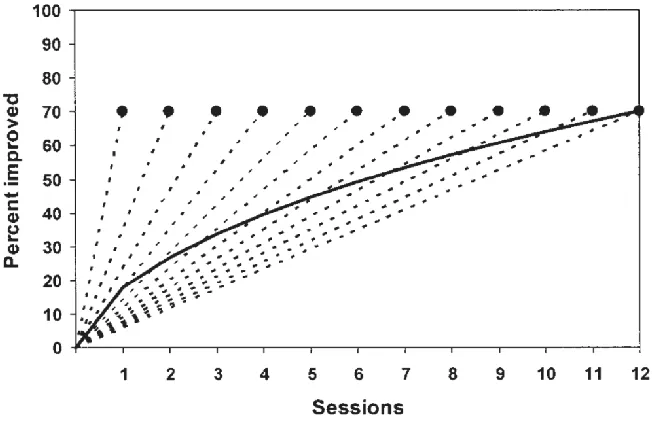
derive less benefit than the sessions prior. More recently, an alternative a good enough level (GEL) model has been suggested (see Figure 2.1; Barkham et al., 1996, 2006). Initially, Barkham and colleagues (2006) observed that session-by session plots of improvement for up to 16 sessions tended to look more or less linear; this finding was in contrast to previous findings. They also noted that in most of these dose-effect studies clients had varying lengths of treatment. Thus, different aggregations of clients were represented at each successive point, which might explain the finding of a negatively accelerating curve. Barkham and colleagues suggest that problems might be assumed to improve at a steady (i.e., linear) rate across sessions until it reaches a GEL; at this point, therapy is discontinued. The rate of improvement might vary depending on the characteristics of the problem (e.g., acute distress vs. personality issues), characteristics of the client (e.g., personal resources, external stressors), or characteristics of the treatment (e.g., limitation to a greater or lesser number of sessions), and as a consequence, different problems would take different numbers of sessions to reach their GEL. Thus, the authors suggest that although the response of specific symptoms may be linear, “averaging across multiple clients or multiple problems would yield a negatively accelerated curve, as clients with more quickly responding problems dropped out of treatment” (Barkham et al., 1996).
Figure 2.1. Good Enough Level Model. From Barkham et al., 2006, “The endpoints of the dotted lines represent the assumed constant percentage (70%) of clients meeting improvement criteria for groups who attended 1 to 12 sessions. The dotted lines represent interpolated percentages at intermediate points. The solid line represents the percentage of clients remaining in therapy at each session who met the criteria, calculated as the average of the interpolated percentages for clients remaining in treatment at each session.”
2.2.3 Early and Late Dropout
Characteristics of individuals who terminate treatment may vary as a function of the time point at which they terminate. Referring to all such individuals as dropouts may mask reliable differences and impede understanding of what is needed at different time points in treatment to engage and retain children and their families (Kazdin & Mazurick, 1994). Although, one study which compared early and late dropouts (used median spilt; early dropout: 5 sessions or less, late dropout: 6 sessions or more) found no differences between the two groups (Garcia & Weisz, 2002). The seminal study (Kazdin & Mazurick, 1994), and numerous works extending on this idea (Gonzalez, Weersing, Warnick, Scahill, & Woolston, 2011; Pelkonen et al., 2000; Sirles, 1990) have confirmed that in a variety of samples, subgroups of dropouts (based on time of dropout; early or late) can be identified and that different factors relate to their risk for dropping out. This study and others found that certain predictors became significant when looking at subsamples of early and late dropout, that were not significant when combining all individuals using a pure clinician judgement definition (Gonzalez et al., 2011).
However, Kazdin and Mazurick (1994), confirm that studies that combine all individuals can still likely identify some reliable differences even when subgroups are ignored. The suggestion from this body of work was that, the issue in the dropout literature may not specifically be delineating subsamples. Rather, developing a conceptual scheme and more finely grained understanding and analysis of the heterogeneity of individuals who drop out and the salient influences on the dropout process, at the points they are most likely to assume significance.
2.3 A Need-Based Definition of Dropout
Neither a dose nor clinician judgment definition of dropout takes the nature of the client’s
community based individual psychotherapy, researchers have compared the differential response rates of symptom types to therapy doses and results showed that different symptoms (e.g., acute vs. chronic) improved at different rates, requiring a different number of sessions to reach a 50% response rate (Kopta, Howard, Lowry, & Beutler, 1994). Thus, different clinical syndromes may require different types of treatment at varying doses, depending on the severity and persistence of symptoms (Hansen & Lambert, 2003). Furthermore, a positive association has been found between higher levels of need (i.e., child symptom severity) and greater children’s mental health
service use in community-based samples (Farmer, Stangl, Burns, & Costello, 1999; Sayal, 2004). However, individuals with higher levels of need also tend to be more likely to dropout from mental health treatment (Kazdin et al., 1994); it should be noted that Kazdin’s review did not consider the issue of variation in need for treatment with respect to the definition of dropout.
Given the issues noted above, we propose that a definition of dropout must recognize the individual differences in problem presentation and context – hereafter referred to as need for treatment. A need-based definition suggests the optimal number of sessions required should vary based on a client’s symptom severity at intake as well as the family and caregiver context of that
problem. The optimal number of sessions would be determined to be the average number of sessions received by individuals with a similar level of need at intake, and positive outcomes following completion of treatment. Dropout would then be defined as receiving significantly lower than the optimal number of sessions.
2.4 Objectives
Objective 1: Determine the prevalence rates of dropout according to three definitions: (a) dose, (b) clinical judgment and (c) level of need.
Objective 2: Compare the characteristics of children and their families, and the treatment received who meet one or more definitions of dropout. Characteristics of children and their families includes: child age, child sex, child problem severity, child risk behaviors, child functioning/impairment, parental marital status, number of household members, involvement with CAS, caregiver needs and strengths, care intensity and organization. Treatment received includes: number of sessions, duration of treatment and intensity of services received.
2.5 Methods
Secondary data analyses were conducted using data from a larger study on patterns of service use across Ontario children’s mental health agencies (Reid et al., 2010). The methodology and key findings from the principal study will be described first, followed by methods for the current analyses.
2.5.1 Principal Study
Administrative data were obtained from five children’s mental health agencies that: (a)
(i.e. the Brief Child and Family Phone Interview and the Child and Adolescent Functional Assessment Scale) were also obtained.
Patterns of Service Use. Multi-level latent class cluster analysis (Vermunt & Magidson,
2002) of children’s visit data was performed. Five distinct patterns of service use were identified and labeled as: Minimal (53% of children), Brief-Episodic (8%), Acute (20%), Intensive (13%), Intensive-Episodic (6%). Children’s service use within each cluster was described in terms of number visits and duration of involvement within specific episodes of care (EoC; see Table 2.1). A minimum of three visits marks the beginning of an EoC, and a free period of 180 days without a visit signifies the end of an EoC (Reid et al., 2015).
Table 2.1.
Summary of patterns of service use across five children’s mental health agencies
Pattern N % of all
clients Two or more episodes Duration involvement (years) Mean visits (over 4 years)
Minimal 2997 53% 2% 0.4 3
Brief-Episodic 447 8% 71% 3.5 29
Acute 1131 20% 4% 0.8 16
Intensive 730 13% 27% 1.8 33
Intensive-Episodic 327 6% 46% 3.3 87
Note: N= 5632 (Table from Reid et al., 2010)
Chart Reviews. Chart reviews were conducted for a stratified [age (5 to 9; 10 to 13), and
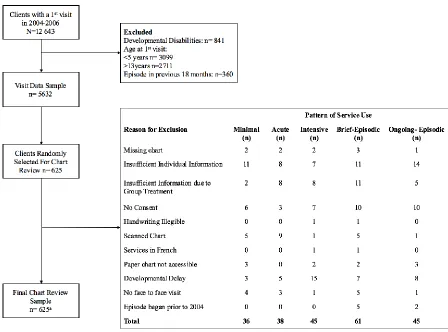
demographic information was recorded and the level of functioning was coded using the Child and Adolescent Needs and Strengths (CANS) scale (Lyons, 1999) at the start and end of each EoC. Treatment disposition at the end of each episode of care was also coded. If a chart was unable to be reviewed, (e.g., the chart could not be located, or it contained insufficient individual data to complete a Child and Adolescent Needs and Strengths (CANS; Lyons, Rawal, Yeh, Leon, & Tracy, 2002) rating) another chart from the same pattern of service use was chosen for review. Figure 2.2 presents a flow diagram for the chart review data collection.
At minimum, chart reviews were completed at intake (i.e., first face-to-face visit during the study period) and where appropriate, at the end of each episode of care (EoC). Chart review ratings were made using all the information available within a specified number of sessions or number of months (see below). Chart reviews were completed at the start and end of each episode of care. When making ratings about caregivers, ideally, the caregiver(s) with whom the child is currently living were rated. If the child is not with long-term caregivers (e.g., foster care, residential treatment centre), then ratings focused on the caregiver to whom the child would be returned. If it was a long term placement, then the current caregiver was rated.
correlation coefficient (ICC) with measures of absolute agreement (Shrout & Fleiss, 1979): ICC (2,4)=0.84. Percent agreement on non-CANS items in the chart review was 95.6% and overall percent exact agreement was 92.1%.
Figure 2.2. Flow diagram of the chart review data collection.
Note: No consent = individual consent for participation was not required for the study as a whole; however, if some clients had explicit, documented refusal to allow chart reviews for any reason (e.g., accreditation). In these cases, chart reviews were not conducted.
aExcluded charts were resampled.
2.5.2 The Current Study
Sample
Children were aged 5-13 years (mean age= 9.4, SD=2.5) at intake; 62.2% were male. At intake, the majority of children (60.9%) had parents who were married, common law or living together, on average, each family had a total of 4.1 household members, and the majority of children had no involvement with CAS at intake (64.2%).
Measures/Variables
Only measures and variables utilized in the current study are presented.
Predictor Variables
Demographics
Demographic variables collected included: age, sex, primary caregiver marital status (i.e., single parent, married, common-law, other, unknown), total number of household members and involvement with child welfare – the Children’s Aid Society (CAS). CAS involvement was coded as: (a) no involvement, (b) investigation only (i.e., family has been investigated for reports of child abuse or neglect though no further services were provided), (b) some involvement (i.e., services were provided to a family who voluntarily participates, children remain in the home) (c) temporary care (i.e., children were placed in short-term foster or group homes), supervision (i.e., services are mandated for the family, children remain in the home ), Crown Ward (i.e., child is placed under the protection of a legal guardian and is a legal responsibility of the government).
Variables used to compute outcome variables
Two variables were used to compute various definitions of dropout (see 2.6.2 Operational Definitions of Dropout, below).
Visit data were abstracted such that only face-to-face visits were included. For the purposes of this study, a “treatment” session was defined to include all forms of contact with the
agency as each may improve patient’s outcomes, whether the purpose of the contact is to treat the presenting problem in the individual or it is a service delivered as part of the agencies care for the entire child/family. This includes visits coded (Ministry of Children and Youth Services, 2010) by the primary study as an “Outpatient Visit” (i.e., drop-in resources, brief therapy, evidence-based interventions, family, group or individual counselling, or other targeted interventions), “Emergency Response” (i.e., crisis intervention or counselling, mobile crisis services, trauma crisis stabilization), “Residential Service” (i.e., hospital-based inpatient services), “Intensive Service” (i.e., foster care or wraparound services), “Day Treatment” (i.e., special education, counselling, parent training, vocational training, skill building, recreational therapy - usually lasting at least four hours a day), “Assessment” (i.e., diagnosis, intake or specialized assessments), “Respite Service” (i.e., both in and out of home services providing temporary support and relief to families and caregivers of children with mental health problems) and “Service Coordination” (i.e., case management, case conferencing and multi-professional
team meetings).
To facilitate description of the nature of services received, each session was categorized as either low, medium, or high intensity. Appendix A provides a detailed description of various combinations of types of services that were used to categorize children into either low, medium, or high intensity of service use. Generally, services that restricted the child’s daily functioning
by services that remove the child from the home for a significant period of time, such as residential care (Farmer et al., 1999; Hodges, Doucette-Gates, & Kim, 2000). All other services were categorized as medium intensity.
It was possible for children to have a mix of service intensity types. Thus, the percentage of low, medium or high intensity sessions was computed based on the total number of sessions. The intensity category with the highest percentage of sessions was used to determine overall service use intensity (see Appendix B). If a child had equal percentages of more than one intensity, then the highest intensity was used to determine overall service use intensity.
Disposition at Discharge
Disposition at the time of the client’s last visit, at the end of an EoC (or end of
involvement if the child did not have sufficient visits in the correct time frame for an EoC) was coded using all available information in the patient’s file. Disposition at discharge was coded as “Family dropped out” if the family did not attend the scheduled appointment and then did not
return telephone calls to rebook. In some cases, a telephone contact did occur at some point after a missed appointment and the parent may have stated a reason for dropping out (e.g., that he/she felt services were no longer needed) which was also coded. Other coding options included: “Family moved”, “Refused treatment”, “Treatment received and refused additional treatment”, “Completed treatment” (i.e., child/family completed treatment as mutually agreed upon with service provider, usually stated in discharge report), “Referred elsewhere for treatment”, or “Treatment ongoing” (i.e., additional visits after four-year study period).