A Cellular Network Architecture with Polynomial
Weight Functions
Fayaz Khan &Puneti Manoj Kumar
1M-Tech, Dept. of ECE, bomma institute of technology and sciences,Khammam, Telangana.
2Associate Professor,Dept. of ECE, bomma institute of technology and sciences,Khammam,
Telangana. Abstract
Copies of cell nonlinear systems on the computerized reconfigurable system are eminent for a powerful calculation of
massive information, surpassing the
precision and flexibility of complete-hand crafts. In this dedication, [1] a automatic usage with polynomial coupling weight
capacities is proposed abruptly,
constructing up novel fields of use, e.G., inside the restorative flag getting ready and inside the association of fractional differential situations. We showcase an engineering that is geared up for getting ready widespread scale systems with a high stage of parallelism, actualized on quality in
magnificence subject-programmable
entryway clusters.
Key words: - polynomial, building up
novel, advanced utilization, weight
capacities, cellular prepare.
1. INTRODUCTION
Since their presentation in 1988, the phone nonlinear structures (CNN's) have turned out
to be reasonable for the image managing, restorative flag making ready, robotic control, and association of midway differential conditions (PDEs), amongst others. Simple and blended flag usage of the CNN all inclusive gadget provide the superb computational execution of heaps of dealing with units on a solitary chip. In any case, the exactness of easy usage is usually now not ok for numerically present day packages. [2] Besides, the outline of these software precise incorporated circuits (ASICs) is with the aid of and huge settled and parameters like gadget size or information accuracy can't be balanced. Therefore, the copying of CNN's on reconfigurable advanced gadgets,
particularly on field-programmable
entryway clusters (FPGAs), ends up it seems
that beautiful for prototyping and
various certainly spurred packages and specifically to resolve PDEs. In, a
full-custom mixed-signal chip with a
polynomial-kind CNN (PTCNN) has been proposed for the programs in EEG flag preparing. This is regarded as the main feasible utilization of a PTCNN up till now. In this dedication, we exhibit a headway of the as of late familiar NERO design with the TITUS engineering for the advanced imitating of PTCNNs with a subjective
polynomial request. 2.RELEGATED
WORK
2.1Existing System
Since their presentation in 1988, the phone nonlinear networks (CNN's) have become out to be suitable for the image managing, medicinal flag getting ready, robotic manage, and arrangement of incomplete differential conditions (PDEs), amongst others. [4] Simple and mixed flag usage of the CNN all-inclusive machine supplies the great computational execution of lots of preparing devices on a solitary chip.
2.2Proposed System
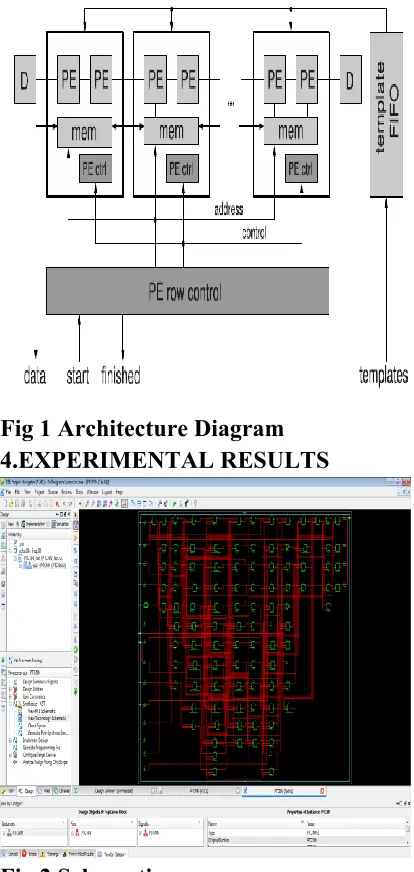
An immediate mapping of the cell set up shape to the automated device is doable and proficient but firmly constrained by the aid of the on-hand belongings. [5] Thus, we deliberate the NERO engineering by means
of mapping big scale structures to medium-or little scale processmedium-or clusters, yet conserving the community couplings of the CNN worldview and prescribing the range and period of interconnections between the PEs.
3.IMPLEMENTATION 3.1CNN architecture:
As a result of their variety and series of plans, it's far tough to give a correct definition for a CNN processor. From a building perspective, CNN processors are a path of action of a constrained, settled wide variety, settled region, settled topology, secretly interconnected, diverse statistics, single-yield, nonlinear dealing with devices. [6] The nonlinear getting equipped gadgets are often counseled as neurons or cells. Experimentally, every phone can be proven as a dissipative, nonlinear dynamical gadget in which information is encoded via its primary state, wellsprings of records and components used to describe its direct. Elements are normally ceaseless, as-as a result of Continuous-Time CNN (CT-CNN) processors, but may be discrete, as attributable to Discrete-Time CNN (DT-CNN) processors.
A CNN is a popular recreation plan for coping with segments (PEs) (cells) which are coupled to its buddies in flat and corner to a corner route. [7] In a boring 1-community each telephone is ultimately coupled to 8 friends and to itself (moreover known as three × 3 neighborhood). In a
PTCNN, the couplings among the
neighboring cells are addressed with the aid of polynomial weight limits. Since a fashionable version has now not yet been defined, we just propose feedback and feedforward terms of polynomial demand P
∈ N which activates a cell kingdom
portrayed by means of the differential condition.
3.3CNN Controllers
RoVEn makes it plausible to reenact various instructions of the controller and their
communications. Controllers study
information from sensors and observe upon the actuators such that the robot makes a particular pass. [8] Collaborating controllers can read and hold in contact with excellent registers that reenact the registers frequently gave by using PC device. We have carried out a few wonderful training controller. Underneath we portray them quick. Interface This magnificence of controller offers an interface among gadgets and registers
(which may be perused and changed by using distinctive controllers). For every class of machine, RoVEn suggests statistics portraying parts reasonable for affiliation with registers.
Fig 1 Architecture Diagram 4.EXPERIMENTAL RESULTS
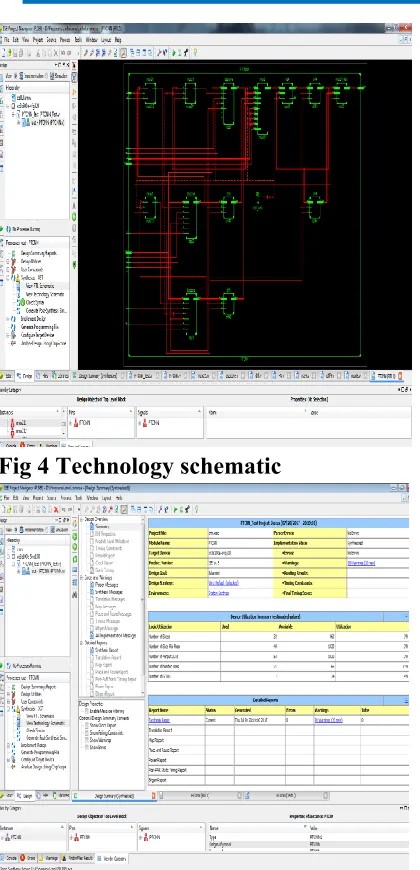
Fig 4 Technology schematic
Fig 5 Design summery
Fig 6Simulation 5.CONCLUSION
really proficient assurance of difficulty specific formats.
6.REFERENCE
[1] L. O. Chua and L. Yang, “Cellular neural networks:Theory,” IEEE Trans. Circuits Syst., vol. 35, no. 10, pp.1257–1272, Oct. 1988.
2] L. Nicolosi, F. Abt, A. Blug, A. Heider, R. Tetzlaff, andH. Höfler, “A novel spatter detection algorithm based ontypical cellular neural network operations for laser
beamwelding processes,” Meas. Sci.
Technol., vol. 23, no. 1, p.015401, 2012. [3] F. Gollas, C. Niederhöfer, and R. Tetzlaff, “Toward anautonomous platform for spatio-temporal EEG-signalanalysis based on cellular nonlinear networks,” Int. J. CircuitTheory Appl., vol. 36, nos. 5–6, pp. 623–639, Sep. 2008.
[4] P. Arena, L. Fortuna, M. Frasca, and L. Patané, “A CNNbasedchip for robot locomotion control,” IEEE Trans.Circuits Syst. I, Reg. Papers, vol. 52, no. 9, pp. 1862–1871,Sep. 2005.
[5] T. Roska, L. O. Chua, D. Wolf, T.
Kozek, R. Tetzlaff,and F. Puffer,
“Simulating nonlinear waves and
partialdifferential equations via CNN. I. Basic techniques,” IEEETrans. Circuits
Syst.I, Fundam. Theory Appl., vol. 42, no.10, pp. 807–815, Oct. 1995.
[6] F. Puffer, R. Tetzlaff, and D. Wolf, “Modeling nonlinearsystems with cellular neural networks,” in Proc. IEEE Int.Conf. Acoust., Speech, Signal Process.(ICASSP), vol. 6.May 1996, pp. 3513–3516.
[7] T. Roska and L. O. Chua, “The CNN universal machine:An analogic array computer,” IEEE Trans. Circuits Syst. II,Analog Digit. Signal Process., vol. 40, no. 3, pp. 163–173,Mar. 1993.
[8] A. Rodriguez-Vazquez et al., “ACE16k: The thirdgeneration of mixed-signal SIMD-CNN ACE chips towardVSoCs,” IEEE Trans. Circuits Syst. I, Reg. Papers, vol. 51,no. 5, pp. 851–863, May 2004.
[9] J. J. Martínez, J. Garrigós, J. Toledo, and
J. M.Ferrández, “An efficient and
expandable hardwareimplementation of
multilayer cellular neural
networks,”Neurocomputing, vol. 114, pp. 54–62, Aug. 2013.
[10] J. Müller, J. Müller, and R. Tetzlaff, “NEROvideo: Ageneral-purpose CNN-UM video processing system,” J.Real-Time Image Process., pp. 1–12, Sep. 2014.
FAYAZ KHAN.Pursuing m.tech in
“BOMMA INSTITUTE OF
TECHNOLOGY AND SCIENCES” in the branch of “DIGITAL ELECTRONICS AND COMMUNICATION SYSTEMS (DECS)” and got 64.7% in my first year of M.TECH and completed B.TECH in the year of 2014
in “KHAMMAM INSTITUTE OF
TECHNOLOGY AND SCIENCES” in the
branch of “ELECTRONICS AND
COMMUNICATION ENGINEERING
(ECE)” and got 71.6% in my B.TECH.
PUNETI MANOJ KUMAR (P.MANOJ
KUMAR)Associate Professor in Bomma
Institute Of Technology AndSciences
Completed B.Techin”sreekavitha