Direct Application of Excitation Matrix as Sparse Transform
for Analysis of Wide Angle EM Scattering Problems
by Compressive Sensing
Xinyuan Cao1, Mingsheng Chen1, *, Meng Kong1, Liang Zhang1, Xianliang Wu2, Xiangxiang Liu1, Liangliang Cheng1, Qi Qi1, 2, and Bingbing Chen1
Abstract—When compressive sensing (CS) was employed to solve electromagnetic scattering problems over wide incident angles, the selection of sparse transform strongly affects the efficiency of the
CS algorithm. Different sparse transforms will require different numbers of measurement. Thus,
constructing a highly efficient sparse transform is the most important work for the CS-based electromagnetic scattering computing. Based on the linear relation between current and excitation vectors over wide incident angles, we adopt the excitation matrix as sparse transform directly to obtain a suitable sparse representation of the induced currents. The feasibility and basic principle of the algorithm are elaborated in detail, and the performance of the proposed sparse transform is validated in numerical results.
1. INTRODUCTION
In the field of computational electromagnetics (CEM), fast calculation of wide angle electromagnetic (EM) scattering problems is always a difficult task. Classic numerical methods, such as method of moments (MoM) [1], finite element method (FEM) [2], and finite difference time domain (FDTD) [3], have to repeat computation as incident angle changes, which result in low efficiencies.
As one of the most used methods in CEM, MoM is widely applied to different types of EM scattering problems. Many fast algorithms based on traditional MoM, such as fast multipole method (FMM) [4], multi-level fast multipole algorithm (MLFMA) [5], and adaptive integral method (AIM) [6], have been developed gradually. However, when these algorithms were used to solve EM problems over wide incident angles, they still cannot avoid the problem of repeated calculations.
Compressive sensing (CS) [7] originates from the field of digital signals, and it is an attractive signal processing technology with the most advantage of low sampling rate which breaks the limit of Nyquist theorem. In its solving framework, the structure of sparse transform is an important link which directly determines the times of measurements and even the whole calculation efficiency.
Introducing CS into traditional MoM has developed a quick solution for wide angle EM scattering problems [8]. In this algorithm, the selection of sparse transform is also a key link that greatly affects the computation times of MoM and the total speed of the solution. In previous research, we used to take excitation vectors over wide angles as prior knowledge to construct a kind of sparse transform which presented a good performance by decomposing the expression of excitation layer upon layer [9]. However, this treatment of the prior knowledge seems still not so direct and excellent. Whether the property of the apriority of excitation can be exploited entirely becomes a meaningful work.
In this paper, an audacious attempt has been studied, in which a new sparse representation of induced currents is constructed directly by the excitation vectors. Numerical analysis of differently
Received 28 November 2016, Accepted 21 January 2017, Scheduled 27 January 2017
* Corresponding author: Mingsheng Chen ([email protected]).
1 School of Electronics and Information Engineering, Hefei Normal University, Hefei, Anhui, China. 2 School of Electronics and
shaped objects has shown that the total number of measurements required with this new type of ready-made excitation matrix can be reduced obviously compared to traditional transforms.
2. FORMULATIONS AND EQUATIONS
2.1. CS Frame
The basic formulas of CS is reviewed as follows:
(i) Apply measurement matrix (denoted as Φ) to measure original signals (denoted as X):
ΦX=s (1)
thus, a low-dimensional projection ofX can be obtained.
(ii) Construct a sparse transform ofX and substitute it into Eq. (1):
ΦΨA=s (2)
in which Ψrepresents the sparse transform and AtheK-sparse projection ofX. (iii) Solve Eq. (2) as an optimization problem by recovery algorithms:
ˆ
A= minAL s.t. (ΦΨ)A=s (3)
(iv) The original signal can be approximated as ˆ
X=Ψ ˆA (4)
2.2. Application of CS into MoM
The fast solution for wide angle EM scattering problems by introducing CS into MoM is designed as follows:
Step 1. CalculateM times of linear summations of excitation vectors overndiscrete angles (denote the results asV1CS,VCS2 , . . . ,VCSM):
VCSi =αi1Vθ1 +αi2Vθ2 +. . .+αinVθn (i= 1,2, . . . , M) (5) thusM measurements of excitation vectors are obtained.
Step 2. Calculate theM current vectors corresponding toVCS1 ,VCS2 , . . . ,VMCS by traditional MoM (denote the results as ICS1 ,ICS2 , . . . ,ICSM). According to the invariance of the impedance matrix with incident angles,M measurements of unknown current vectors overnwide angles are actually obtained:
ICSi =αi1Iθ1 +αi2Iθ2 +. . .+αinIθn (i= 1,2, . . . , M) (6)
Step 3. With the utilization of the sparse transform (denoted by Ψ) and recovery algorithms, sparse projections of [ Iθ1 Iθ2 . . . Iθn ]T in the transform domain can be solved by CS frame and denote the results as a matrix form (denoted by A), unknown currents can be approximated byˆ
ˆI=Ψ ˆA (7)
The solution reduces computation times of MoM from n to M (M n), thus realizing fast
calculation of wide angle electromagnetic scattering problems. Obviously, in this algorithm, the value ofM is the most important key which is determined by the construction of sparse transform to a great extent.
2.3. Sparse Transform Composed by Excitation Matrix
The basic equation of MoM can be written as
ZN×NIN×1 =VN×1 (8)
in whichZrepresents the impedance matrix,Ithe unknown current vector, andVthe excitation vector. While solving wide angle EM scattering problems, Eq. (8) can be rewritten as
in which θ1, θ2, . . . , θn represent discrete wide incident angles. Transpose Eq. (9), we can get
[ I1 I2 . . . IN ]·ZT = [ V1 V2 . . . VN ] (10)
in which Ii, Vi (i = 1,2, . . . , N) respectively represent currents and excitations on every element of the scatterer over wide angles. Thereby, solving wide angle EM scattering problems is just calculating [ I1 I2 . . . IN ] which can be expressed in the form of
[ I1 I2 . . . IN ] = [ V1 V2 . . . VN ]·
ZT−1 (11)
It means that each Ii can be decomposed into a linear combination of V1,V2, . . . ,VN:
Ii =βi1V1+βi2V2+. . .+βiNVN (i= 1,2, . . . , N) (12)
Moreover, as V1, V2, . . ., VN represent values of excitation on each different element of the
scatterer over wide angles, those column vectors on adjacent elements necessarily possess similarities. So multiple columns in [ V1 V2 . . . VN ] will appear linear correlations, in other words, the excitation
matrix [ V1 V2 . . . VN ] must be a low-rank matrix, and with further refinement of subdivision of
scatterers, this low-rank characteristic will become more and more obvious. This implies that the linear combination in Eq. (12) can be transformed to some form of sparse representation as
Ii = [ V1 V2 . . . VN ]·Ki (i= 1,2, . . . , N) (13)
in which Ki is not a column of (ZT)−1 but a sparse vector. So we come to an interesting conclusion that the excitation matrix is a ready-made sparse transform of unknown [ I1 I2 . . . IN ]. By using
this conclusion, we can solve all larger values in Ki (i= 1,2, . . . , N) by recovery algorithms:
ˆ
K1 Kˆ2 . . . KˆN
= min[ K1 K2 . . . KN ]L
s.t. (ΦM×n·[ V1 V2 . . . VN ])·[ K1 K2 . . . KN ] =ΦM×n·[ I1 I2 . . . IN ]
(14)
in which ΦM×n represents the measurement matrix and M n(nis the number of incident angles). ΦM×n·[ I1 I2 . . . IN ] is just the transpose of ICSi in Eq. (6) calculated by MoM, so ultimately,
unknown currents can be approximated by ˆ
I1 ˆI2 . . . ˆIN
= [ V1 V2 . . . VN ]·
ˆ
K1 Kˆ2 . . . KˆN
(15)
3. NUMERICAL RESULTS
In order to verify the availability and efficiency of the excitation matrix as a sparse transform, take three groups of numerical experiments based on EFIE, MFIE and CFIE, respectively, and set electromagnetic parameters as: the frequency of incident waves f = 3×10⁹Hz, permittivity = 1/(4π×9×109) F/m, permeabilityμ= 4π×10−7H/m, and the waves are located inyozplane andE-polarized inxdirection. The range of the wide angle is set as [0◦, 360◦] (assume that the direction parallel to y+ axes is defined as 0◦ and discretize the wide angle to 1◦, 2◦, . . ., 360◦). Choose Gauss random matrix and orthogonal matching pursuit (OMP) [10] as the measurement matrix and the recovery algorithm. The operation environment of programs is Mathworks Matlab7.0, Pentium(R) Dual-Core CPU at 2.10 GHz and an internal memory with capacity of 2 GB.
3.1. Basic Object
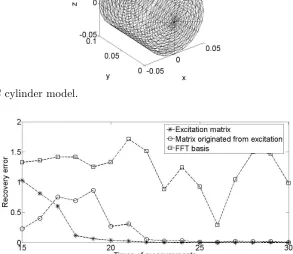
Select a horizontal perfect electronic conductor (PEC) cylinder whose radius of the bottom surface is 0.05 m and the height 0.1 m as an example, as shown in Figure 1. Take EFIE as the basic integral equation.
The CS-based solution is applied to calculate induced currents over wide incident angles, and the ready-made excitation matrix, the matrix originated from excitation vectors [9] and FFT basis are selected as the sparse transform, respectively. As shown in Figure 2, the relations between recovery errors and the number of measurements for the three different sparse transforms are compared.
Figure 1. The PEC cylinder model.
Figure 2. Comparison of recovery errors changing with times of measurements for the cylinder.
Figure 3. Comparison on calculation results of currents of the cylinder as the incident angle is equal to 245◦.
is reduced to 0.0094; experiments show that for FFT basis, to achieve an error of this magnitude, the times of measurements need to be at least 52.), the performance of the excitation matrix itself is better (While the number of measurements equals 22, and the error achieves 0.0081. Compared with the matrix originated from excitation vectors, its recovery results are more stable.).
To verify the accuracy of calculation results, take 22 times of measurements for example, the recovery values of the CS solution with excitation matrix as the sparse transform, and the calculation results of traditional MoM are compared. Figure 3 shows the results of induced currents under a random incident angle (take 245◦ for example).
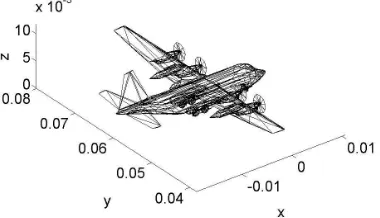
Figure 4. The plane model.
3.2. Complex Object
Calculate a plane model whose shape and size are shown in Figure 4 based on MFIE for example. As the CS-based solution is applied to calculate induced currents under incident angles at 1◦, 2◦,
. . ., 360◦ with excitation matrix itself, the matrix originated from excitation vectors [9] and FFT basis as sparse transforms respectively, the relations between recovery errors and the number of measurements for the mentioned three kinds of sparse transforms are also described in Figure 5.
From Figure 5, we can see that the superiority of excitation matrix itself is even more significant for the calculation example of plane model (The recovery error is reduced to 0.0013 while the number of measurements only reaches 12; for the matrix originated from excitation vectors, to achieve errors of this magnitude, the number should be increased to about 31; for FFT basis, this number has to be
Figure 5. Comparison of recovery errors changing with times of measurements for the plane model.
increased further more.).
In Figure 6, for a given RWG basis, the induced currents obtained by CS-based solution with excitation matrix as the sparse transform is compared with the results of traditional MoM. The given RWG is chosen as the 505th one with its center at (−0.0041002, 0.057735, 0.00051275).
3.3. Multi-Object
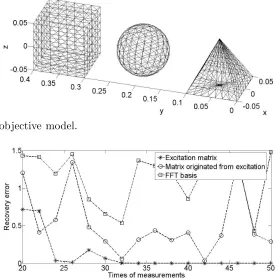
Compute a multi-objective model consisting of a sphere with the radius of 0.05 m, a cube with the edge-length of 0.1 m and a rectangular pyramid with the size of 0.1 m∗0.1 m∗0.1 m based on CFIE, as shown in Figure 7.
The computational performances of the excitation matrix, the matrix originated from excitation vectors [9] and FFT basis, are compared and shown in Figure 8.
Figure 7. The multi-objective model.
Figure 8. Comparison of recovery errors changing with times of measurements for the multi-objective model.
(a) (b)
From Figure 8, we can see that the effect of the excitation matrix is significantly better than that of the other two sparse transforms (As the number of measurements reaches 32, the recovery error is close to zero; experiments reveal that to realize accurate recovery, the matrix originated from excitation vectors needs at least 70 times of measurements, and for FFT basis, this number has to be further increased to about 100.). As shown in Figure 9, when the number of measurements is chosen as 32, the RCS results of CS based solution is computed and compared with that of traditional MoM (take the
E-plane bistatic RCS with the incident angles of 44◦, 213◦, 337◦ for instance).
From Figure 9, one can see that the results of RCS obtained by the CS-based solution with excitation matrix as sparse transform are accurate.
4. CONCLUSION
A sparse transform is proposed for the CS based EM scattering analysis over wide incident angles. The excitation matrix is directly applied to construct a new sparse transform. Numerical results show that the performance of the proposed sparse transform is excellent and better than the FFT transform and other sparse transforms that we proposed before.
ACKNOWLEDGMENT
This work was supported by the National Natural Science Foundation of China (51477039), Anhui Provincial Natural Science Foundation of China (1408085QF104), the Key Project of Provincial Natural Science Research of University of Anhui Province of China (KJ2014A206, KJ2014A199, KJ2015A260).
REFERENCES
1. Yu, J. J. and X. Q. Sheng, “Scattering from 3-D targets in the subsurface using MOM,” Journal of Electronics and Information Technology, Vol. 28, No. 5, 950–954, 2006.
2. Giuseppe, S. P.,Finite Elements for Wave Electromagnetics Methods and Techniques, IEEE Press, New Jersey, 1994.
3. Ge, D. B. and Y. B. Yan,Finite-difference Time-domain Method for Electromagnetic Waves, Xidian University Press, Xi’an, 2011.
4. Yoshida, K., N. Nishimura, et al., “Application of new fast multipole boundary integral equation method to crack problems in 3D,” Engineering Analysis with Boundary Elements, Vol. 25, No. 3, 239–247, 2001.
5. Song, J. M., C. C. Lu, and W. C. Chew, “Multilevel fast multipole algorithm for electromagnetic scattering by large complex objects,” IEEE Transactions on Antennas and Propagation, Vol. 45, No. 10, 1488–1493, 1997.
6. Ewe, W. B., L. W. Li, et al., “AIM analysis of scattering and radiation by arbitrary surface-wire configurations,”IEEE Transactions on Antennas and Propagation, Vol. 55, No. 1, 162–166, 2007. 7. Donoho, D. L., “Compressed sensing,”IEEE Transactions on Information Theory, Vol. 52, No. 4,
1289–1306, 2006.
8. Chen, M. S., F. L. Liu, H. M. Du, and X. L. Wu, “Compressive sensing for fast analysis of wide-angle monostatic scattering problems,”IEEE Antennas and Wireless Propagation Letters, Vol. 10, No. 3, 1243–1246, 2011.
9. Cao, X. Y., M. S. Chen, M. Kong, L. Zhang, and X. L. Wu, “Method of moments based on prior knowledge for solving wide angle EM scattering problems,”Chinese Physics Letters, Vol. 31, No. 11, 118401, 2014.