Impact of Intervention Program on Functional Skills of Children
with Autism: Its Influence on the Social Adjustment of their fathers
and mothers
Sanatombi Chingangbam & Dr. Venkat Lakshmi, H. *Ph.D. Research Scholar, ** Associate Professor and Research Guide
Department of Human Development and Research Centre Smt. V.H.D. Central Institute of Home Science (Autonomous)
Seshadri Road, Bangalore
Email: *[email protected], ** [email protected] Abstract
Autistic children need assistance from their parents in performing their day to day activities. Parents have multiple roles, demands and duties to be discharged in the family, community and society as well. In addition, they have very little time for themselves and for the other members of family and friends due to the increased amount of caregiving time that their child with autism requires, which in turn affects their social adjustment.
Hence, the purpose of this study was to assess the impact of intervention program on functional skills for parents of children with autism on their social adjustment. The sample consisted of 190 parents of children with autism between 5 to 10 years of age. The pre-test and post-test method was used with an intervention program. The data was collected by the investigator using a self -structured rating scale from the parents of children with autism attending special schools in Bangalore City. The pre-test data showed that mothers of children with autism reported significantly low level of social adjustment and fathers had an average level of social adjustment. An intervention program was conducted by the investigator as a part of the study. The t-test was computed to compare the mean scores of Pre and Post-tests. The results of post-test data showed that there was not much of statistical difference in the social adjustment of fathers of children with autism. However, there was a highly significant improvement in the social adjustment of the mothers of children on the autism spectrum. The study highlighted that when parents are introduced to the techniques of teaching functional skills to their autistic children it will help their child develop identity; and which in turn reflects on the social adjustment of the parents.
Keywords
Autism, Children with Autism, Functional Skills, Social Adjustment, Intervention Program
1. Introduction
parents. According to Collins (2008) [8], functional skills are defined as ―skills that are used every day, in different situations at home, school and community. It includes domestic or self-care skills, functional academics skills, vocational skills, social skills and community living skills. Parent as a primary caregiver plays an important role in dealing with the issues related to the functional skills of their children. They have multiple roles, demands and duties to be discharged in the family, community and society as well. In addition, they have little or no time for themselves and for the other members of family and friends. This could be due to the increased amount of caregiving time that their child with autism requires, which in turn affects their social adjustment. Social adjustment can be defined as “the manner in which an individual fulfils his/her roles in social relationships and the individual's well-being within these relationships” [9]. Meeting the high care demands of their autistic children needs extra time, effort and patience. This often causes psychological distress, depression, anxiety and other mental or physical health issues among their parents [10-13].
2. Methodology
Objective: The objective of this study was to assess the impact of intervention program of functional skills of children with autism on the social adjustment of the fathers and mothers.
2.1. Sample: The sample comprised of one-hundred and thirty four mothers and fifty-six fathers with a total sample of one-hundred and ninety parents of children who were diagnosed with autism between 5 to 10 years of age were identified for the study. Special schools catering to the educational needs of the children with Autism in Bangalore city was considered for identifying the sample.
2.2. Tool used:
1. A five point Likert type rating scale was developed by the investigator to assess the social adjustment of the parents of children with autism before and after the intervention program. The response options given to the respondents were “Never”, “Rarely”, “Sometimes”, “Often” and “Always”. It contained 14 items, of which 8 items were positive and the remaining 6 items were negative. Positive items were given a score of 1, 2, 3, 4, 5 and negative items were reverse scored.
2.3. Method:
Experimental design with pre- test, post-test method with an intervention program was used.
2.4. Pre-test:
Permission and consent was sought from principal of various special schools requesting them to encourage the parents to participate in the study. Those schools which granted permission was finalised for the study. Further a rapport was established with parents of autistic children and they were informed about the objective of the study. Parents were told that the information procured from them will be kept confidential and used only for the research purpose. A self-developed checklist on functional skills of children with autism and a social adjustment scale of their parents were administered to assess the impact of intervention program on functional skills of children with autism and its influence on the social adjustment of their parents. The pre-test data collection was followed by the intervention program for the parents of experimental group.
2.5. Intervention Program:
The objective of the intervention program was to train the parents on how to teach functional skills to their children with autism. Also to help the parents understand the need and importance of functional skills, in order to make their autistic child to become independent in
performing their day to day activities. The intervention program was conducted for a period of 16 weeks for the duration of 3 hours per session. Following topics was covered during the intervention program:
a) Understanding children with autism; its characteristics, and causes, prevalence.
b) Understanding functional skills, “why it is important for a child with autism?” and “how it affects their parent‟s adjustment?”
c) Tips of teaching functional skills to children with autism. Functional skills includes:
Domestic or Self- Care skills such as brushing, toileting, bathing, dressing, eating, wash hands and night routine
Functional academic skills such as to identify and read alphabets, number concept from a book, magazine or a paper, identify colours, recognize shapes, time concept, money concept, identify body parts and to identify the days, months and date from the calendar.
bags, diya decoration and candle making etc.
Social skills such as learning to make eye contact, telling name, making friends, emotions, behaviours, helping others, greeting or praising others and apologising to others.
Community living skills such as following instructions, using public transportation, following rules in school, to know the role of community workers, to identify and recognise public places (post office, medical store, school, hospital, etc.).
The investigator employed various teaching techniques and strategies such as power point presentations, flash cards, video clips, lectures, posters, models, group discussions, role play, hands on experience, etc. to explain the above mentioned topics to the participants.
2.6. Post-test:
After the completion of the intervention program, post-test data was recollected from the experimental group using the tools that was used at the time of pre-test. This was done to check the improvement in the functional skills of children with autism and in their parents‟ social adjustment.
The data collected was scored, analysed and tabulated using „t‟ test and correlation analysis. The findings of the study are discussed below:
3. Result and Discussion
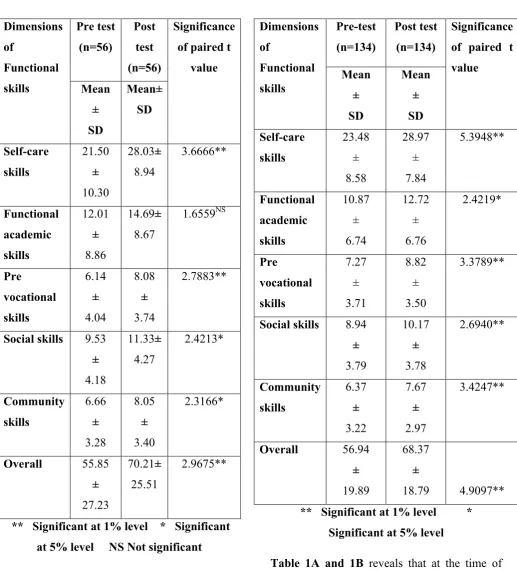
Table 1A: Comparison of mean scores of Pre and Post tests for Functional Skills of Children with Autism with regard to the Fathers Dimensions of Functional skills Pre test (n=56) Post test (n=56) Significance of paired t
value Mean ± SD Mean± SD Self-care skills 21.50 ± 10.30 28.03± 8.94 3.6666** Functional academic skills 12.01 ± 8.86 14.69± 8.67 1.6559NS Pre vocational skills 6.14 ± 4.04 8.08 ± 3.74 2.7883**
Social skills 9.53
± 4.18 11.33± 4.27 2.4213* Community skills 6.66 ± 3.28 8.05 ± 3.40 2.3166*
Overall 55.85
±
27.23
70.21±
25.51
2.9675**
** Significant at 1% level * Significant at 5% level NS Not significant
Table 1B: Comparison of mean scores of Pre and Post tests for Functional Skills of Children with Autism with regard to the Mothers Dimensions of Functional skills Pre-test (n=134) Post test (n=134) Significance of paired t value Mean ± SD Mean ± SD Self-care skills 23.48 ± 8.58 28.97 ± 7.84 5.3948** Functional academic skills 10.87 ± 6.74 12.72 ± 6.76 2.4219* Pre vocational skills 7.27 ± 3.71 8.82 ± 3.50 3.3789**
Social skills 8.94
± 3.79 10.17 ± 3.78 2.6940** Community skills 6.37 ± 3.22 7.67 ± 2.97 3.4247**
Overall 56.94
±
19.89
68.37
±
18.79 4.9097**
** Significant at 1% level * Significant at 5% level
autism based on their fathers and mothers responses had lower scores in all the dimensions. Studies have shown that children with autism have poor daily living skills [14]. Daily living skills include personal hygiene and grooming, eating, and getting around the community [15, 16]. Studies have reported that children with autism experienced difficulty in their development of self-help skills which are critical for maintaining physical health and well-being and form the foundation for other essential skills [17]. A highly significant difference between pre and post tests for all the dimensions of functional skills of their children with autism was observed. There was an improvement in the functional skills of their children after the influence of intervention program. The „t‟ test value divulges that mothers have shown interest in understanding the meaning of teaching functional skills to their autistic children in order to help their child perform the day to day tasks with little or no support. While, fathers are making a sustain effort in supporting their autistic child to be independent in performing their day to day routine.
Table- 2A: Comparison of mean scores of Pre and Post tests for Social Adjustment of Fathers
Dimension s of Social
Pre test (n=56)
Post test
Significan ce of
Adjustmen t-
(n=56) paired t value Mean
± SD
Mean ± SD Related to
public life
18.08 ± 2.61
18.57 ± 2.54
0.9836NS
Related to support system
11.82 ± 2.36
12.64 ± 2.36
1.8925NS
Related to family and relatives
15.28 ± 2.63
15.69 ± 2.16
0.9584NS
Overall 75.10
± 10.60
78.12 ± 10.27
1.5936NS
** Significant at 1% level * Significant at 5% level NS Not significant
marital and family relations [20- 22]. On the whole; fathers had an average mean score of 75.10 at the time of pre-test. But after the influence of the intervention program, they did not improve much in their social adjustment. Nevertheless, there was a notable improvement between pre and post tests for social adjustment of the fathers of children with autism, with an overall mean score of 78.12.
Table 2B implies that at the time of pre-test, mothers of children with autism were in their average in their scores on all the dimensions of social adjustment. According to Hoefman et al. (2014) [23], most of the mothers of children with autism expressed that they felt unhappy when the relatives or guest visited their house because they did not have much time to spend with them due to their autistic child‟s high care demands.
Table-2B: Comparison of mean scores of Pre and Post tests for Social Adjustment of Mothers
Dimensions of Social Adjustment -
Pre-test (n=134
)
Post - test (n=134
)
Significanc e of paired
t value
Mean± SD
Mean± SD Related to
public life
13.79±
2.81
14.43±
2.81 2.0483*
Related to support system
10.38±
2.01
11.32 ±
2.01 4.3743**
Related to family and relatives
13.52±
2.75
13.67±
2.54 0.4845 NS
Overall 61.70±
10.31
65.19±
10.58 3.0896**
** Significant at 1% level * Significant at 5% level NS Not significant
tests for social adjustment of their mothers at 1% level.
Relationship between functional skills of children with autism and social adjustment of the parents has a tremendous influence on one‟s life style and the analysis has shown in table 3A and table 3B.
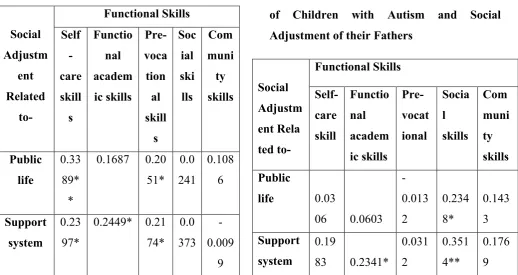
Table 3A and 3B reveals the correlation coefficient between functional skills of children with autism and social adjustment of their mothers and fathers. There is a positive correlation between the level of self-care skills of autistic children with their mothers‟ and father‟ social adjustment in all the dimensions.
Table-3A: Relation between Functional Skills of Children with Autism and Social Adjustment of their Mothers
Social Adjustm ent Related to- Functional Skills Self -care skill s Functio nal academ ic skills Pre- voca tion al skill s Soc ial ski lls Com muni ty skills Public life 0.33 89* *
0.1687 0.20 51* 0.0 241 0.108 6 Support system 0.23 97*
0.2449* 0.21 74* 0.0 373 - 0.009 9 Family & Relative s 0.24 55*
0.1917* 0.16 48
0.0 734
0.096 1
** Significant at 1% level * Significant at 5% level
It means that when the child is able to perform their daily living activities such as brushing, toileting, bathing, dressing etc. with minimal support then their mother‟s and father‟s social adjustment will also be increased. When children with autism improve in daily living skills, their parent‟s well-being has also been improved [26]. Increases in daily living skills leads to better outcomes for children with autism [27] as well as lower parenting stress [28, 29].
Table-3B: Relation between Functional Skills of Children with Autism and Social Adjustment of their Fathers
Social Adjustm ent Rela ted to- Functional Skills Self-care skill Functio nal academ ic skills Pre-vocat ional Socia l skills Com muni ty skills Public
life 0.03
06 0.0603 - 0.013 2 0.234 8* 0.143 3 Support system 0.19
83 0.2341*
Family & Relative s
0.10
58 0.0761
0.105 3
0.149 2
0.293 2*
* * Significant at 1% level * Significant at 5% level
A positive relation between the levels of social skills of autistic children with both the parents‟ social adjustment in all the dimensions was observed. Parents reported that sometimes they felt hesitant to go out for social gathering due to their child‟s inappropriate problem behaviours that they may be exhibited in the public places. Parents of children with autism also experienced higher stress levels while adjusting with behavioural problems [30-33]. Negative correlation was observed with aspect of support system of the mothers and community skills of their children which indicates that there is need to sensitize the public about autism, so that a better support can be extended when required. Likewise negative correlation was also observed with aspect of public life of the fathers and pre vocational skills of autistic children, which could be attributed to the fact that acceptance of the family with autism plays a pivotal role in encouraging the child/children to hone the pre vocational skills.
4. Conclusion
It can be concluded that there is a need for intervention program in order to educate or
train the parents about the importance of functional skills and techniques for teaching functional skills to their children with autism. When parents are given the intervention program it will aim to increase their knowledge on caregiving skills and self-efficacy. It will also provide them an insight to read and learn more about the disorder in order to simplify the teaching –learning process, which can result in better social adjustment of the parents. Further the use of visuals like charts, books, models, puppets, drawings, hands on experience and through story telling the functional skills can be taught in a very effective manner.
5. References
[1] Aleem, M.A. (2015, April 1). World Autism Day 2nd April 2015 Theme: Employment: The Autism Advantage. Message
posted to
http://drmaaleem.blogspot.in/2015/04/world-Autism-day-2nd-april-2015theme.html
[2] Elsabbagh, M., Divan, G., Koh, Y.J., Kim, Y.S., Kauchali, S., Marcín, C., Montiel-Nava, C., Patel, V., Paula, C.S., Wang, C., Yasamy, M.T., &Fombonne, E. (2012).Global prevalence of Autism and other pervasive developmental disorders. Autism Research, 5(3), 160–179. doi: 10.1002/aur.239.
of Mental Disorders. Washington, DC: British Library Cataloguing in Publication Data.
[4] Ministry of Health and Welfare (MOHW) & Korea Institute for Health and Social Affairs (KIHASA) (2011). 2011 National survey on persons with disabilities (Report No. 2011-82). Seoul: Korea Institute for Health and Social Affairs.
[5] Hendricks, D. R., & Wehman, P. (2009). Transition from school to adulthood for youth with autism spectrum disorders: Review and recommendations. Focus on Autism and Other Developmental Disabilities, 24(2), 77-88.
[6] Sigafoos, J., O‟Reilly, M., Cannella, H., Edrisinha, C., de la Cruz, B., Upadhyaya, M., ... & Young, D. (2007). Evaluation of a video prompting and fading procedure for teaching dish washing skills to adults with developmental disabilities. Journal of Behavioral Education, 16(2), 93-109.
[7] Teaching Students with Autism: A Resource Guide for Schools. (2003). British Columbia, Canadian Cataloguing in Publication Data
[8] Collins, J. (2008, March 16). What Are Functional Skills And Why Does My Child With A Disability Need Them? Message posted to http://ezinearticles.com/?What-
AreFunctional-Skills-And-Why-Does-My- Child-With-A-Disability-NeedThem?&id=1049755
[9] Lazarus, R. S. & Folkman, S. (1984). Stress, appraisal, and coping.New York
[10] Bromley, J., Hare, D. J., Davison, K., & Emerson, E. (2004). Mothers supporting children with autistic spectrum disorders: Social support, mental health status and satisfaction with services. Autism, 8(4), 409-423.
[11] Hamlyn-Wright, S., Draghi-Lorenz, R., & Ellis, J. (2007). Locus of control fails to mediate between stress and anxiety and depression in parents of children with a developmental disorder. Autism, 11(6), 489-501.
[12] Khanna, R., Madhavan, S. S., Smith, M. J., Patrick, J. H., Tworek, C., & Becker-Cottrill, B. (2011). Assessment of health-related quality of life among primary caregivers of children with autism spectrum disorders. Journal of autism and developmental disorders, 41(9), 1214-1227.
[13] Kuhlthau, K., Kahn, R., Hill, K. S., Gnanasekaran, S., & Ettner, S. L. (2010). The well-being of parental caregivers of children with activity limitations. Maternal and child health journal,14(2), 155-163.
Children with Autism Spectrum Disorders. Journal of Autism and Developmental Disorders, 39(2), 231-241.
[15] De Wolfe, J. (2014). Parents of children with autism: An ethnography. Springer.
[16] Stabel, A. (2013). Daily Living Skills. Encyclopedia of Autism Spectrum Disorders, 839-840
[17] Lucker, K. D. (2009). A Review of Self-Help Skills for People with Autism: A Systematic Teaching Approach by Stephen R. Anderson, Amy L. Jablonski, Marcus L. Thomeer, and Vicki Madaus Knapp. Behavior analysis in practice, 2(1), 65-67.
[18] Altiere, M. J., & von Kluge, S. (2009). Family functioning and coping behaviors in parents of children with autism. Journal of child and Family Studies, 18(1), 83.
[19] Autism Society. (2011). Retrieved from http://www.autism-society.org
[20] Baxter, C., Cummins, R., & Yiolitis, L. (2000). Parental stress attributed to family members with and without disability: A longitudinal study. Journal of Intellectual and Developmental Disability, 25, 105- 118. doi:10.1080/13269780050033526
[21] Benson, B. A., & Gross, A. M. (1989). The effect of a congenitally handicapped child upon the marital dyad: A review of the
literature. Clinical Psychology Review, 9, 747-758. doi:10.1016/0272-7358(89)90021-4
[22] Margalit, M., & Heiman, T. (1986). Family climate and anxiety of families with learning disabled boys. Journal of the American Academy of Child Psychiatry, 25, 841-856. doi:10.1016/S0002-7138(09)60204-1
[23] Hoefman, R., Payakachat, N., van Exel, J., Kuhlthau, K., Kovacs, E., Pyne, J., & Tilford, J. M. (2014). Caring for a child with autism spectrum disorder and parents‟ quality of life: application of the CarerQol. Journal of autism and developmental disorders, 44(8), 1933-1945.
[24] Farrugia, D. (2009). Exploring stigma: medical knowledge and the stigmatisation of parents of children diagnosed with autism spectrum disorder. Sociology of Health & Illness, 31, 7, 1011–1027
[25] Doron, H., & Sharabany, A. (2013). Marital patterns among parents to autistic children. Psychology, 4(04), 445.
[26] Green, S. A., & Carter, A. S. (2014). Predictors and course of daily living skills development in toddlers with autism spectrum disorders. Journal of autism and developmental disorders, 44(2), 256-263.
outcome in toddlers diagnosed with autism spectrum disorders. Journal of autism and developmental disorders, 37(1), 98-107.
[28] Hauser-Cram, P., Warfield, M. E., Shonkoff, J. P., Krauss, M. W., Sayer, A., Upshur, C. C., & Hodapp, R. M. (2001). Children with disabilities: A longitudinal study of child development and parent well-being. Monographs of the Society for Research in Child Development, i-126.
[29] Tomanik, S., Harris, G. E., & Hawkins, J. (2004). The relationship between behaviours exhibited by children with autism and maternal stress. Journal of Intellectual and Developmental Disability, 29(1), 16-26.
[30] Bluth, K., Roberson, P. N., Billen, R. M., & Sams, J. M. (2013). A stress model for couples parenting children with autism spectrum disorders and the introduction of a mindfulness intervention. Journal of family theory & review, 5(3), 194-213.
[31] De Bellis, M. D., Spratt, E. G., & Hooper, S. R. (2011). Neurodevelopmental biology associated with childhood sexual abuse. Journal of child sexual abuse, 20(5), 548-587.
[32] Estes, A., Munson, J., Dawson, G., Koehler, E., Zhou, X. H., & Abbott, R. (2009). Parenting stress and psychological functioning among mothers of preschool children with
autism and developmental delay. Autism, 13(4), 375-387