Available online: https://edupediapublications.org/journals/index.php/IJR/ P a g e | 3518
Suggestive Node Tracking
Enterprising
Reception
Network Using
Stream Influence Maximization
S.V.N.Vamsidhar & M.Sravan Kumar Babu
1M.Tech, Assistant Professor, 2 Assistant Professor,
1E-Mail.: [email protected] , 2E-Mail.Id:[email protected]
N.V.R College Of Engineering And Technology, Tenali
ABSTRACT: Greedy algorithm is used for mining top-K
influential nodes. It has two components dividing the mobile social network into several communities by taking into account information diffusion and selecting communities to find influential nodes by a dynamic programming. Location Based community Greedy algorithm is used to find the influence node based on location and consider the influence propagation within particular area. Influence Maximization (IM), which selects a set of k users to maximize the influence spread over a social network is a fundamental problem in a wide range of applications such as viral marketing and network monitoring. We define a novel IM query named Stream Influence Maximization (SIM) on social streams. Technically SIM adopts the sliding window model and maintains a set of k seeds with the largest influence value over the most recent social actions. We propose the Influential Checkpoints (IC) framework to facilitate continuous SIM query processing. We propose a model of dynamic rumor influence reduction with user expertise (DRIMUX).Our goal is to cut back the influence of the rumor by block an exact set of nodes. A dynamic propagation model considering every the worldwide quality and individual attraction of the rumor is given supported realistic state of affairs. To boot altogether completely different from existing problems with influence reduction, Our goal is to cut back the influence of the rumor block an exact set of nodes The prior works have shown that the rumor blocking problem is approximated within a factor of (1 − 1/e) by a classic greedy algorithm
combined with Monte Carlo simulation. Unfortunately, the Monte Carlo simulation based methods are time consuming and the existing algorithms either trade performance guarantees for practical efficiency. We present a randomized approximation algorithm which is provably superior to the state-of-the art methods with respect to running time.
Index Terms: Rumor Influence, Social Network, Mobile social network, Influence maximization, community greedy algorithm, Social networks, rumor blocking, approximation algorithm.
INTRODUCTION
Available online: https://edupediapublications.org/journals/index.php/IJR/ P a g e | 3519 additionally planned to influence maximization drawback.
Problem has gained a lot of less attention still there are consistent efforts on planning effective ways for obstruction malicious rumors and minimizing the negative influence [6]. The new algorithm is known as location based community greedy algorithm to find most influential node. The people in same area are more influence as compare to the people in different area or state [7]. Persons in same area always have more contact than persons in different area. Communication Time between persons & location of person these two parameters are considered in Location Based Community Greedy algorithm. Location Based community greedy algorithm have higher accuracy and efficiency than existing community based Greedy algorithm [8]. It turns out that the greedy algorithm with Monte Carlo simulation has the Ω(k · m · n · poly(δ −1 )) time complexity to achieve a (1 − 1/e − δ) approximation ratio, and it takes several hours even on very small networks. With the recently analysis of influence diffusion [9], [10], the difficulty in solving such problems has shifted from the nodes selection strategy to the calculation of the objective function.
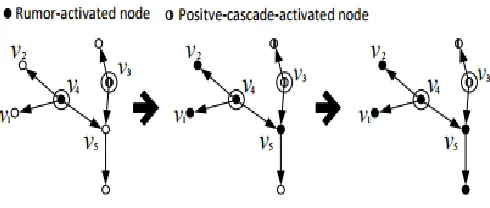
Fig. 1: An illustrative example
1. RELATED WORK
IM aims to extract a given number of users that maximize the influence spread over a network we summarize them separately IM in Static Networks. There has been a vast
amount of literature on influence maximization (IM) in static networks over the last [11].The state-of-the-art static IM method on the classic influence models and linear threshold (LT)) is IMM [12]. It runs in nearly linear time wrt. the graph size with a (1 − 1/e − ε) approximation guarantee. Nevertheless, static IM methods including IMM cannot efficiently support highly evolving networks since a complete rerun is required for every update on influence graphs [13]. We address the smallest amount price Rumor block (LCRB) drawback wherever rumors originate from a community m within the network and a notion of protectors square measure wont to limit the dangerous influence of rumors the matter is summarized as distinguishing a minimal set of people as initial protectors to reduce the amount of individuals infected in neighbor communities of m at the top of each diffusion processes observant the community structure property [14]. We have a tendency to listen to a sort of vertex set, referred to as bridge finish set, within which every node has a minimum of one direct in-neighbor in m and is approachable from rumors [15]. Rumor detection aims to distinguish rumor from genuine news. Framework for tracking the spread of misinformation and observe a set of persistent temporal patterns in the news cycle [16]. Build a machine learning framework to detect the early stages of viral spreading of political misinformation. In [18], the rumor detection problem by exploring the effectiveness of three categories of features: content-based, network-based, and micro blog specific memes. Takahashi study the characteristics of rumor and design a system to detect rumor on Twitter [17].
2. SYSTEM MODEL
Available online: https://edupediapublications.org/journals/index.php/IJR/ P a g e | 3520 dynamics of the rumor to a possible spreader the
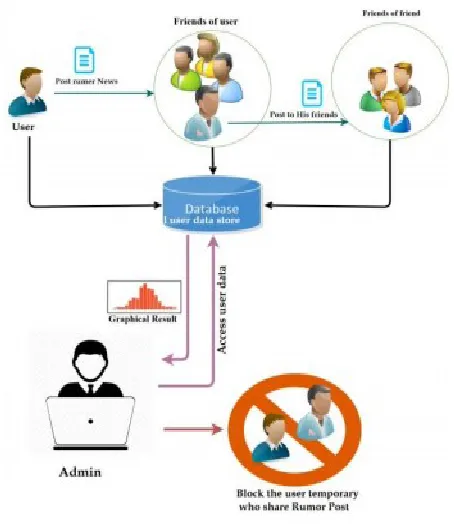
individual tendency to forward the rumor to its neighbors. Third acceptance chance of the rumor recipients [18]. In our model galvanized by the Ising model in our rumor interference ways we have a tendency to think about the influence of interference time to user expertise in universe social networks. We have a tendency to propose interference time constraint into the standard rumor influence diminution objective perform. Our technique optimizes the rumor interference strategy while not sacrificing the web user expertise [19].
Fig No 2. System Model
3. METHODOLOGY
Our community greedy algorithm uses community detection algorithm to fine community. Community detection algorithm consists of partition and combination. We extend the algorithm with the information influence mechanism based on Independent Cascade model. The algorithm, a nearly linear algorithm for community
detection, is designed for undirected [20]. It is not directly applicable we develop a method to combine communities such that the difference between influence degree of a node in its community and its influence degree in the whole network is restricted.
A. LOCATION BASED COMMUNITY
GREEDY ALGORITHM
Given a mobile social network G = (V, E, W), we aim to mine a set of top-K Influential nodes I on the network such that R is maximized using the Independent Cascade information diffusion model. It has been proved that the optimization problem is NP- hard. However, the community s greedy algorithm is used in whole network for solving the influence maximization problem on a large-scale network. We propose Location Based community greedy algorithm [21].
Fig 3: Location Based community Greedy Algorithm
Algorithm LCGA
1. Network G = (V, E, W), size of result k, influence speed, size of result, Location_Id
Available online: https://edupediapublications.org/journals/index.php/IJR/ P a g e | 3521 3. Calculate maximal increase of influence degree with
regard to community.
4. Sort according to location degree.
5. Choose community that which yields the largest increase of influence degree among all communities. 6. Select community from first m communities to mine influential node
B. ALGORITHM 2: DYNAMIC BLOCKING ALOGORITHM
Different from the greedy blocking algorithm, which is a type of static blocking algorithm, we propose a dynamic rumor blocking algorithm aiming to incrementally block the selected nodes instead of blocking them at once [22]. The blocking strategy is split into several rounds and each round can be regarded as a greedy algorithm chooses the number of rounds is also very important for the algorithm. We will elaborate on the algorithm design and how we choose the specific parameters [23].
Algorithm 2 Dynamic Blocking Algorithm
Input: Initial Edge matrix A0
Initialization: VB(t) = 0.
for j = 1 to n do
for i = 1 to kj do
Δf = f (tj |s (tj-1); Ai-1) – f (tj |s (tj-1);
Ai-1\ʋ), u = arg max {Δf}, Ai: = Ai-1\u,
VB(tj) = VB(tj) U {u}.
end for
end for
Output: VB(t).
C. INFLUENTIAL CHECKPOINTS
FRAMEWORK
The high level idea of the IC framework is to avoid handling the expiry of old actions when the window shifts. Towards this goal, the framework maintains a partial result incrementally for each window shift the sliding window model is transformed to a simpler append-only model for each checkpoint, where many existing approaches [4, 19] can provide theoretically bounded approximate solutions.
Technically let an influential checkpoint Λt[i] (1 ≤ i ≤ N) denote a checkpoint oracle5 which provides an ε-approximate solution for SIM over contiguous actions {Wt[i], . . . , Wt[N]}. By maintaining N checkpoints (i.e., Λt[1], . . . , Λt[N]), a simple procedure to handle a window shift from Wt−1 to Wt is presented in Algorithm . Whenever a new action at arrives the oldest checkpoint in Wt−1 (i.e., Λt−1[1]) expires and a new checkpoint Λt[N] is added to Wt (Line 2) [24]. After adding the remaining checkpoints in Wt−1 to Wt (Lines 3-4), each checkpoint in Wt processes at as an appending action to update its partial solution (Lines 5-6). To answer the SIM query for Wt, we simply return the solution of Λt [1].
Algorithm IC Maintenance
Require: IC:{Λt−1[1], . . . , Λt−1[N]}
1: — on receiving action at —
2: Delete Λt−1[1], create Λt[N];
3: for all Λt−1[i] do
4: Λt[i − 1] ← Λt−1[i];
Available online: https://edupediapublications.org/journals/index.php/IJR/ P a g e | 3522 6: Λt[i].process(at);
7: — on query —
8: return the solution of Λt[1];
It is not hard to see that once each checkpoint oracle maintains an ε-approximate solution for its append-only action stream, IC always returns the solution with the same approximation ratio [25].
4. EXPERIMENTAL RESULTS
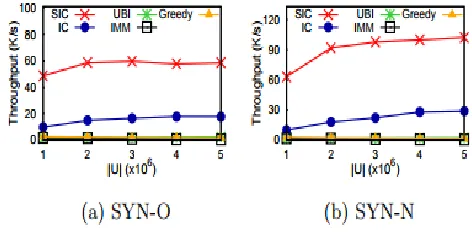
In this section, we evaluate the efficiency and effectiveness of our proposed frameworks on several real-world and synthetic datasets. First, we compare IC and SIC for influence values and processing efficiency. Influence Value: The influence values of IC and SIC with varying β are presented in Figure 5a–5d. The influence values of IC are slightly better than SIC in most experiments. This is because SIC trades quality for efficiency by maintaining fewer checkpoints. In spite of that, SIC is able to obtain competitive values with at most 5% off from IC. In addition we can see that both SIC and IC achieve better influence values for a smaller β and the influence values of SIC degrade faster than IC for a larger β due to the deletion of checkpoints. We note that in the SYN-N dataset, the influence values of SIC degrade more severely than other datasets for a larger β. This is because the average replies distance is very short, which leads to the frequent changes of the influential users.
The results have verified the effectiveness of SIM as the seeds for SIM queries achieve nearly equivalent influence spreads as the seeds retrieved by IMM under the WC model. Moreover SIC shows competitive qualities though it maintains fewer checkpoints than IC. In contrast, the qualities of UBI are close to IMM when k is small (i.e., k ≤ 25). But its qualities degrade dramatically when k increases. This is because UBI relies on interchanging users to maintain the influential users against the updates of the influence graph
Figure : Throughputs with varying
5. CONCLUSION AND FUTURE SCOPE
Available online: https://edupediapublications.org/journals/index.php/IJR/ P a g e | 3523 Location Factor. we tend to introduce the thought of user
expertise utility and propose a changed version of utility perform to live the connection between the utility and obstruction time. Another direction of future work as mentioned is to study the parameter setting of the RBR algorithm. Finally exact algorithm designed based on Triple sampling method is possibly obtainable for special graph structures like trees and regular graphs.
7. REFERENCES
[1] W. Chen, Y. Wang, and S. Yang, ―Efficient influence maximization in social network,‖ in KDD, 2009, pp. 199– 208.
[2] C. C. Aggarwal, S. Lin, and P. S. Yu. On influential node discovery in dynamic social networks. In SDM, pages 636–647, 2012.
[3] G. Ausiello, N. Boria, A. Giannakos, G. Lucarelli, and V. T. Paschos. Online maximum k-coverage. Discrete Applied Mathematics, 160(13–14):1901–1913, 2012.
[4] A. Badanidiyuru, B. Mirzasoleiman, A. Karbasi, and A. Krause. Streaming submodular maximization: Massive data summarization on the fly. In KDD, pages 671–680, 2014.
[5] C. Budak, D. Agrawal, and A. E. Abbadi, ―Limiting the spread of misinformation in social networks,‖ in Proc. 20th Int. Conf. World Wide Web, 2011, pp. 665–674.
[6] M. Kimura, K. Saito, and H. Motoda, ―Blocking links to minimize contamination spread in a social network,‖ ACM Trans. Knowl.Discov. Data, vol. 3, no. 2, pp. 9:1– 9:23, Apr. 2009.
[7] W.Yu, G.Cong, G.Song, and K.Xie, ―Community-based greedy algo- rithm for mining top-k influential
nodes in mobile social networks,‖ in KDD, 2010, pp. 1039–1048
[8] F.Bass, ―A new product growth model for consumer durables,‖ Manage- ment Science, vol. 15, pp. 215–227, 1969.
[9] E. Morozov, ―Swine flu: Twitters power to misinform,‖ Foreign policy, 2009.
[10] D. Kempe, J. Kleinberg, and E. Tardos, ―Maximizing the spread of ´ influence through a social network,‖ in Proc. of the 9th SIGKDD. ACM, 2003, pp. 137–146.
[11] N. Barbieri, F. Bonchi, and G. Manco. Topic-aware social influence propagation models. In ICDM, pages 81– 90, 2012.
[12] S. Bharathi, D. Kempe, and M. Salek. Competitive influence maximization in social networks. In WINE, pages 306–311, 2007.
[13] C. Borgs, M. Brautbar, J. Chayes, and B. Lucier. Maximizing social influence in nearly optimal time. In SODA, pages 946–957, 2014.
[14] L. Fan, Z. Lu, W. Wu, B. Thuraisingham, H. Ma, and Y. Bi, ―Least cost rumor blocking in social networks,‖ in Proc. IEEE ICDCS’13,Philadelphia, PA, Jul. 2013, pp. 540–549.
[15] J. Yang and J. Leskovec, ―Patterns of temporal variation in online media.
[16] L. Fan, Z. Lu, W. Wu, B. Thuraisingham, H. Ma, and Y. Bi, ―Least cost rumor blocking in social networks,‖ in Proc. of the 33rd ICDCS. IEEE, 2013, pp. 540–549.
Available online: https://edupediapublications.org/journals/index.php/IJR/ P a g e | 3524 large-scale social networks,‖ in Proc. of the 16th
SIGKDD. ACM, 2010, pp. 1029–1038.
[18] D. Chelkak and S. Smirnov, ―Universality in the 2d ising model and conformal invariance of fermionic observables,‖ Inventiones Mathmaticae, vol. 189, pp. 515– 580, Sep. 2012.
[19] W. Chen, C.Wang, and Y.Wang, ―Scalable influence maximization for prevalent viral marketing in largescale social networks,‖ in Proc. 16th ACM SIGKDD Int. Conf. Knowl. Discovery Data Mining, 2010, pp. 1029–1038.
[20] D.Kempe, J.Kleinberg, and E.Tardos, ―Influential nodes in a diffusion model for social networks,‖ In ternational colloquium on automata, languages and programming, no. 32, pp. 112–1138, 2005
[21] J.Goldenberg, B.Libai, and E.Muller, ―Talk of the network: A complex systems look at the underlying process of word-of-mouth,‖ Marketing Letters, vol. 12, no. 3, pp. 211–223, 2001
[22] W. Chen, C.Wang, and Y.Wang, ―Scalable influence maximization for prevalent viral marketing in large-scale social networks,‖ in Proc. 16th ACM SIGKDD Int. Conf. Knowl. Discovery Data Mining, 2010, pp. 1029–1038.
[23] S. Shirazipourazad, B. Bogard, H. Vachhani, and A. Sen, ―Influence propagation in adversarial setting: How to defeat competition with least amount of investment,‖ in Proc. 21st ACM Int. Conf. Inf. Knowl. Manag., 2012, pp. 585–594
[24] H. Li, S. S. Bhowmick, A. Sun, and J. Cui. Conformity-aware influence maximization in online social networks. The VLDB Journal,
24(1):117–141, 2015. [25] Y. Li, J. Fan, D. Zhang, and K.-L. Tan. Discovering your selling points: Personalized