© 2015, IJCSMC All Rights Reserved
360
Available Online at www.ijcsmc.comInternational Journal of Computer Science and Mobile Computing
A Monthly Journal of Computer Science and Information Technology
ISSN 2320–088X
IJCSMC, Vol. 4, Issue. 1, January 2015, pg.360 – 366
RESEARCH ARTICLE
Document Image Binarization Using Image
Segmentation Algorithm in Parallel Environment
Prakash N Ekhande
1, Sharad A Rumane
2, Mayur A Ahire
31, 2, 3
B.E Computer, Department of Computer Engineering, GES’s R.H.Sapat College of Engineering, Nashik-422005, Maharashtra, India
1 [email protected], 2 [email protected], 3 [email protected]
Abstract: -
The Segmentation of text from poorly degraded document images is a very hard due to the high intravariation between the document background and the foreground text of different document images. The algorithms used for Image processing take more time for execution on a single core processor. Graphics Processing Unit (GPU) is becoming most popular due to their speed, programmability, less price and more integral execution cores in it .The main goal of this research work is to make binarization faster for recognition of a large number of degraded document images on GPU as well as on single core processor. In this system we provide new image segmentation algorithm that each pixel in the image has its own threshold proposed. We are doing parallel work on a window of m*n size and extract object pixel of text stroke of that window. The document text is further segmented by a local threshold that is estimated based on the intensities of detected text stroke edge pixels within a local window.Keyword:
Segmentation, Pixel classification, GPU, Parallelization, binarization.I. Introduction:
© 2015, IJCSMC All Rights Reserved
361
Document Image Binarization is performed in the preprocessing stage for document analysis and it aims to segment the foreground text from the background of document image. A quick and proper document image binarization technique is important for the ensuring document image processing tasks such as Document Image Binarization Using Image Segmentation Though document image Binarization has been studied for many years, the thresholding of degraded document images is still an unsolved problem due to the high inter/intravariation between the text stroke and the document background across different document images [6][7]. The handwritten text within the degraded documents often shows various types of problems in terms of the stroke brightness, stroke connection, stroke width, and document background. In addition, old documents are often degraded by the hemorrhage through where the ink of the other side seeps from end to end [7]. In addition, old documents are often degraded by different types of imaging artifacts. These different types of Document degradations are likely to induce the document thresholding error and make degraded document image binarization a big challenge to most state of the art techniques [7].
In classical threshold image segmentation an image is usually segmented and simply sorted to object and background by setting a threshold [2]. If there are two peaks in the histogram of an image, it is easy to get good result by threshold segmentation. But if there is complex formation in the image, the threshold algorithm is not suitable definitely [3] [11]. There have been several upgraded algorithms based on threshold segmentation which give the optimum threshold. It has a limitation that it gives only one threshold, which is difficult to extract all the useful information in the image. A new segmentation algorithm is proposed that each pixel in the image has its own threshold by calculating the statistical information of the gray scale values of its neighborhood pixels.
II. Methods:
2.1
Gray Scale Conversion: -
The Main aim of the system is to have a clear binarized document image. For that we are going to first convert the image into the gray scale using serial and parallel approach. We are using the two approaches for calculating the time required for processing of the document image. We can simply calculate which approach required more time for getting the results.Gray scale Algorithm
:I) Serial Approach
Algorithm:-Grayscale transformation in a CPU.
Input: I image vector Output: GI grayscale image
1. for i = 0 to (width(I) × height(I)) do
2. GI[i] = (I[i×3] + I[i×3+1] + I[i×3+2] ) /3
3. End for
II) Parallel Approach Algorithm:-
Grayscale transformation using CUDA in a
GPU.
Input: I image vector
Output: GSC grayscale image
1. For each GPU task i = blockIdx.x × (blockDim.x×blockDim.y) + blockDim.x × threadIdx.y + threadIdx.x;
2. GSC[i] = (I[i×3] + I[i×3+1] + I [i×3+2] ) /3
3. End for
After the conversion is done into the gray scale of the document image the next step will be the intensity calculation of the gray scale document image [1] [2].
2.2
Intensity Calculation: -
For intensity calculation we will consider a window of the image and the sum will be calculated for the window pixel and the average value will be calculated of the window. After calculating the average value of the window the value will future consider for image segmentation calculation [9] [11].© 2015, IJCSMC All Rights Reserved
362
Image Segmentation Algorithm:-Input:
i.
‘G’ is Gray Scale image vector.ii.
Set threshold value ‘th’.iii.
Set window size ‘Ws’Output: - „BZ’ for binarized image vector.
1. for each row 1 to height –Ws
2. for each column 1 to width –Ws
3. Curr_Pixel=G [row, column];
4. If (Curr_Pixel < avg – th)
5. Label BZ [row, column]=0;
6. Else
7. Label BZ [row, column]=1;
8. End;
9. End;
10. Return binarized image BZ;
III. System:
3.1 Existing system: -
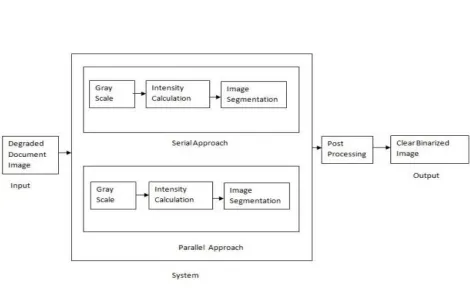
Many thresholding techniques have been reported for document image binarization. As many degraded documents do not have a clear bimodal pattern, global thresholding is usually not a suitable approach for the degraded document binarization. Adaptive thresholding, which estimates a local threshold for each document image pixel, is often a better approach to deal with different variations within degraded document images [8]. The local image contrast and the local image gradient are very useful features for segmenting the text from the background document image because the document text usually has certain image difference to the adjacent background document image. They are very efficient and being used in many document image binarization techniques. The Old system mainly uses serial approach for processing images. Due to this the processing time of image is high means to generate the output it takes more time. [3] The existing system is as shown below:© 2015, IJCSMC All Rights Reserved
363
3.2 The System: -
Most of the work in image processing area is done serially. Means the approach used for clearing the image is serial approach due to that time required for getting clear image is much more. We proposed a system which uses a parallel approach in image processing area we will provide a degraded document image, which will then detect the text stroke edges through the combination of the Gray Scale Image and then we will calculate the intensity of window for each image and then applying New Image Segmentation algorithm which will generate Clear Binarized Image. But here is not the final output of the system after segmentation Is done we will apply post processing algorithm to detect stroke edges of the letters by post processing the stroke edges will be automatically detected if the letters are not properly written. The system is shown below.© 2015, IJCSMC All Rights Reserved
364
IV. System Result:
The proposed system uses various algorithms. The degraded document image will pass as the input to the system the image will be converted to gray scale first by using gray scale algorithm. Then the gray scale document image will be pass to calculate the intensity of the image then the image segmentation algorithm will be apply on the document image. The document image will be divided into various segments for generating output. Lastly the post processing algorithm will be apply to detect the stoke edges of the words automatically and the clear binarized document image will be generated.
4.1 Input to the System: -
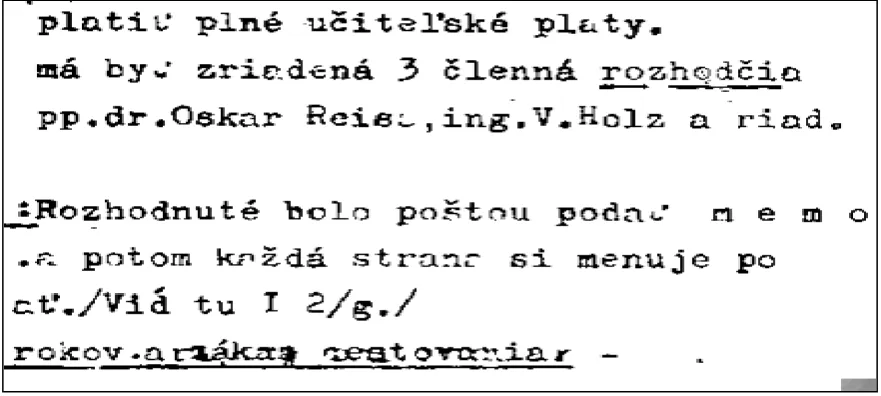
The input to the system will be the degraded document image. We can also provide the input to the system by passing various degraded images. For the input to the system we are using the data set provided by the DIBCO (2009) and DIBCO (2011). The DIBCO provides various data sets we are using the data sets as input to the system [4][5]. The example is shown below.Fig 4.1 Example input to system as degraded document image.
4.2
Gray Scale Image: -
Passing the degraded image to the for getting clear binarized image we will first convert the image into the gray scale form by using serial and parallel approach.Fig 4.2 Example of Gray Scale Image
© 2015, IJCSMC All Rights Reserved
365
image. After that we will apply the image segmentation algorithm for generating clear binarized image. The processing will be done in two approaches serial and parallel and the calculation will be done.
Fig 4.3 Clear Binarized Document image as output
V. Conclusion:
This paper presents a document image Binarization technique that is tolerant to different types of document degradation. The proposed technique is simple and robust, only few parameters are involved. We have presented an approach for document image processing using parallel computing using C# .Net And CUDA for running in a GPU. However, from the results we can conclude that CUDA obtained better results in most cases than OpenCV. We have Integrated CUDA in C# .net using Manage CUDA due to that we get simple platform to develop and easier to implement the system.
Thus we propose Parallel Approach for Document Image Binarization Using Image Segmentation Algorithm for generating clear document image from giving degraded document image.
Acknowledgement:
The satisfaction that accompanies the successful completion of any task would be incomplete without
mentioning the people who made it possible. We are grateful to a number of individuals whose professional
guidance along with encouragement have made it very pleasant endeavor to undertake this project. We have a great
pleasure in presenting the project
“Document Image Binarization Using Image Segmentation Algorithm in
© 2015, IJCSMC All Rights Reserved