A-LEACH Algorithm to Maximize the Life
Span of Wireless Sensor Network
Shibdas Bhattacharya1, Subhajit Mukherjee2, Dipra Mitra3, Prasun Kumar Mitra4
Lecturer, Department of Computer Science and Technology, Technique Polytechnic Institute, Hooghly, W.B, India1
Lecturer, Department of Electronics and Telecommunication, Technique Polytechnic Institute, Hooghly, W.B, India2
Lecturer, Department of Computer Science and Technology, Technique Polytechnic Institute, Hooghly, W.B, India3
Lecturer, Department of Computer Science and Technology, Technique Polytechnic Institute, Hooghly, W.B, India4
ABSTRACT: Wireless Sensor Network assists in maintaining regular surveillance over various kinds of ambient
conditions like temperature,humidity etc and then by transmitting them into electric signal. As wireless nodes are run by battery primary objectives lies on increasing the network lifetime so that the battery need not to be replenished soon. Clustering sensor nodes is an effective technique for achieving this goal.In this work,we propose an energy efficient clustering algorithm for sensor networks based on the LEACH protocol . LEACH (Low Energy Adaptive Clustering Hierarchy) is one of popular cluster-based routing protocol, which has been widely used in wireless sensor networks. The proposed protocol A-LEACH-(Advanced LEACH algorithm) have an additionalconstrainti.e distance from the base station while selecting the cluster head in the set up phase. This consideration reduces the consumption of the network resource as compare to LEACH algorithm in each round in simulated environment. The work is based on maximizing network lifespan that is defined as the number of alive nodes that lie within the transmission range of a given node is more as compare to LEACH algorithm.
KEYWORDS: LEACH; A-LEACH; alive nodes; network lifespan
I. INTRODUCTION
Wireless sensor is a network of tiny, low power and low cost sensor nodes which are equipped with radio transceiver, a micro controller, and a battery. A wireless sensor poses of hundreds or thousands these tiny nodes which can either communicate with the base station or with themselves shown in the figure 1.As these nodes are battery driven and its not feasible to replenish battery of sensor each time thus designing energy efficient routing protocol entertains highest priority. Usually sensors are scattered in the area of sensing and they route the collected data either directly to the base station or to themselves depending upon the routing algorithm.The base station receives data and process them to make decisions like finding shortest path.
Based on the network structure routing protocols for WSN can be categorized into flat and hierarchical and location based[1]. In flat routing all the nodes have same functionality The Sensor Protocols for Information via Negotiation (SPIN) [2] and Directed Diffusion [3] fall into this category.Hierarchical routing protocols divides the network into clusters to make the system more energy efficient.Such a very popular algorithm is LEACH[1]. In location based protocol location of the nodes are used to compute the routing path..Example of such kind of routing algorithm is Geographic Adaptive Routing[1].
Clustered network is an efficient way to organize WSNs.A cluster head is responsible for transmitting information after gathering and aggregating data before sending to the sink.LEACH is one of the most popular clustering protocols used in WSNs.LEACH selects cluster head of the cluster in a probabilistic manner in each round of transmission.In this text LEACH protocol has been modified with additional constraints I.e accounting distance along preserving the basic features of the LEACH.
II. RELATED WORK
Clustering is the method by which sensor nodes in a network organize themselves into hierarchical structures. By doing this, sensor nodes can use the scarce network resources such as radio resource, battery power more efficiently. Within a particular cluster, data aggregation and fusion are performed at cluster- head to reduce the amount of data transmitting to the base station. Cluster formation is usually based on remaining energy of sensor nodes and sensor’s proximity to cluster-head [1]. Non cluster-head nodes choose their clusterhead right after deployment and transmit data to the clusterhead. The role of cluster-head is to forward these data and itsown data to the base station after performing data aggregation and fusion. LEACH is one of the first hierarchical routing protocols for WSNs. The idea proposed in LEACH has inspired many other hierarchical routing protocols [9, 10]
.
A. LEACH:
In LEACH protocol selection of cluster head is done in two phases.
1.Setup Phase
During the setup phase each node generates a random number between 0 and 1. If the random number is smaller than the threshold value then that node becomes CH. The threshold value is calculated based on the following equation [1] that is given below:-
Here p is the desired percentage of cluster heads and r is the current round, G is the group of nodes that has not been the CHs in the last rounds. The sensor node that is selected as a CH in previous round is not selected in the next rounds until all other nodes in the network becomes cluster heads. Nodes that are cluster heads in round r shall not be selected in the next 1/p rounds. The node whose number is bigger than the threshold will select itself as the cluster-head. Then the CH will broadcast an advertisement message to inform their neighborhood that it is the new cluster-head. The non-cluster nodes send the message containing their IDs by using CSMA (carrier sensing multiple access) to join a non-cluster with strongest signal strength. After that, each CH knows its own member nodes information including the numbers and IDs. Based on the message, the CH creates TDMA schedule table and broadcasts it to the cluster members. So all the member-nodes know their idle slots, and then the steady-state phase start.
2. Steady Phase
data from the nodes of its cluster and then it send the aggregated data to the base station. The nodes in the cluster do not directly communicate with the base station [1].
Advantagesof LEACH Protocol
One of the advantages of LEACH is that it is completely distributed and does not require global knowledge of network. LEACH achieves over seven times more reduction in energy dissipation compared to direct communication and four to eight times as compared to the minimum transmission energy routing protocol. Leach employs dynamic clustering which increases lifetime of the system .
Disadvantagesof LEACH Protocol
In LEACH, the cluster heads are randomly selected using a random number and not on the basis of residual energy which is the biggest disadvantage of LEACH. The set up phase does not guarantee that the nodes are evenly distributed among the cluster heads. LEACH protocol may lead to unbalanced energy distribution due to random selection of cluster head. LEACH assumes that all sensor nodes have sufficient power to reach the base station as in LEACH algorithm, in the given formula there is no energy factor included, this would restrict the nodes having energy constraint.
B. I-LEACH:
I-LEACH proposes a routing algorithm based on LEACH algorithm to balance the energy utilization of sensor nodes in order to maximizes the lifetime of the network and reduce the energy consumption .I-LEACH based on the round concept of LEACH. In routing protocols, the number of cluster head nodes is the main factor that affects the performance of the protocol. If the number of cluster head nodes is less then each cluster head will have to cover larger area, which will create problem that energy consumption will increase and reduces the lifetime of network Therefore, it is necessary to choose sufficient number of cluster heads to reduce energy consumption .In the I-LEACH , we use the technique that will choose the cluster head which has largest residual energy as the root node.
C. Mod-LEACH:
This work is based on LEACH protocol that can be extended to SEP and DEEC. Basically, we introduce two techniques to raise network life time and throughput. To understand our proposed scheme, we have to understand mechanism given by LEACH. This protocol changes the cluster head at every round and once a cluster head is formed, it will not get another chance for next 1/p rounds. For every round, cluster heads are replaced and whole cluster formation process is undertaken. We, in this work, modify LEACH by introducing “efficient cluster head replacement scheme”. It is a threshold in cluster
head formation for very next round. If existing cluster has not spent much energy during its tenure and has more energy than required threshold, it will remain cluster head for the next round as well. This is how, energy wasted in routing packets for new cluster head and cluster formation can be saved. If
cluster head has less energy than required threshold, it will be replaced according to LEACH algorithm.
three modes of transmission in a cluster based network. 1) Intra Cluster Transmission
2) Inter Cluster Transmission
3) Cluster Head To Base Station Transmission
III. PROPOSED ALGORITHM
A. Design Considerations: No. Of nodes 200.
All nodes are randomly distributed into sensor area.
All nodes are immobile and able to reach base station
There exists only one sink and it is at (100,75)
Electric Energy(Elec) is 70nJoul
Transmit Amplifier energy(Eamp) is 120p Joul.
No of rounds is 2000.
Node distribution random
Data Aggregation energy ,EDA is 5nJoul.
Initial battery energy E0 50Joul.
B. Description of the Proposed Algorithm:
Aim of the proposed algorithm is to maximize the network life by only considering those nodes as cluster Head whose distance from the base station is lesser than the average distance of from the sink.The changes from basic LEACH to this modified A-LEACH is in selecting the cluster nodes in setup phase.
IV. PSEUDO CODE
Step-1: Create Sensor Network Model by assigning positions to all the nodes and base station. Step-2: Assign initial energy to sensor nodes.
Step-3: Calculate the distance of each node. To calculate node-distance from Base-Station the given formula is used:-
node_distance (i) = √ ((S(i).xd-(sink.x))^2+(S(i).yd-(sink.y))^2)
Step-4: Assign weight to all the nodes.Let it be negative of its distance and calculate the mean of the distance. Step-5: if ( temp_rand <= ( p/ ( 1 - p * mod(r,round(1/p)) ))
if(S(i).weight>(-mean)) S(i).type='C'
Decrease the energy of the nodes chosen as cluster head by the formula as mentioned below by checking the conditions:
if (node_distance (i)>do) Eq1; else
Eq2; Step-6: For the next round r =1:1: rmax If (S(i).E >=Eavg)
then i = nominee_clusterhead //nominated for cluster-head selection If (node_degree>=avg_degree)
If the neighbourhood of the nominee cluster head is not a cluster head then i=cluster head //cluster-head selected
Step-7: Dead node: if (S(i).E = 0) then Dead=i //ith node dies n=n-dead //n: decrease no of alive nodes Step-8: Goto step-6
Step-9: End
________________________________________
Eq1:S(i).E=S(i).E-((ETX+EDA)*(4000)Emp*4000*(node_distance(i)*node_distance(i)*node_distance(i)*node_distance(i) ));
V. EQ2:S(I).E=S(I).E- ( (ETX+EDA)*(4000) + EFS*4000*( NODE_DISTANCE (I)* NODE_DISTANCE(I) ));
VI. SIMULATION RESULTS
The simulation done using MATLAB where we consider 200 nodes are randomly distributed in a 200m x200m area where base station is situated at (100,75) probability for being a cluster head is 0.1 and initially energy given to each node is 0.5 J.The desired parameters are given in a table below:
Table:1
Parameters Values
No. of nodes 200
Sink(base station) 100,75
Electric energy (Eelec ) 70nJoul
Transmit amplifier energy (Eamp) 120pJoul
Node Distribution Random
Data Aggregation Energy, EDA 5nJoul
Initial Energy, E0 0.5
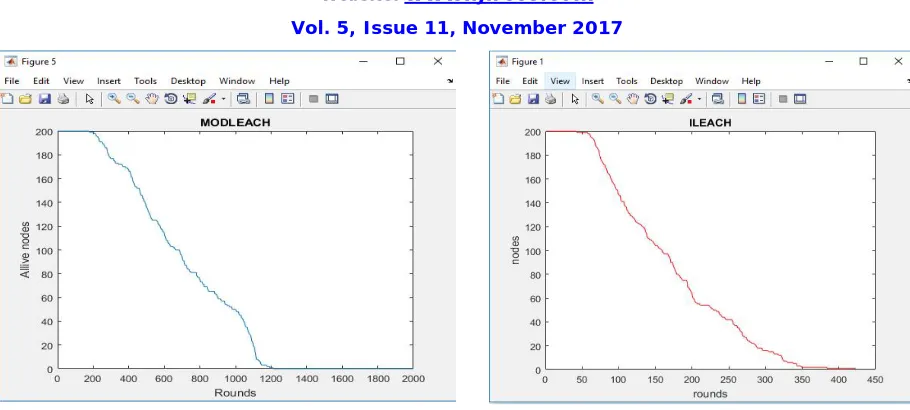
Fig.2. No of nodes alive vs rounds in Mod-LEACH Fig. 3. No of nodes alive vs rounds in ILEACH
Fig. 4.No of nodes alive vs rounds in A-LEACH Fig. 5. No of nodes alive vs rounds in LEACH
VII. OBSERVATIONS
No. Of Rounds(2000)
No of nodes(200) A LEACH LEACH I-LEACH Mod-LEACH
1st node died 800 143 300 220
Half node died 1200 706 610 643
All nodes died Some nodes (100 a pprox) alive after 2000 rounds
VIII. CONCLUSION AND FUTURE WORK
This paper presents a comparison between LEACH its variants and A-LEACH (Advanced Algorithm).Where we have added new constraint while choosing the CHs where distance comes into account.In this text by means of network life time we suggests the number of alive nodes after a certain number of nodes alive.Where we can see from 200 nodes 1st node for LEACH died at round 143 where as 1st node for A-LEACH died in 800th round. Simulation also shows half of the total nodes for LEACH are dead after 706 rounds where as for A- LEACH half of the nodes are dead after 1200 rounds which far much later than the 900th round when all the nodes in I-LEACH are dead and almost in the same round when all the nodes in Mod-LEACH are dead too.We can also see from the simulation that some of the nodes are even alive after 2000 rounds.This algorithm is doing good in simulated environment but it is yet to implement in the real time environment which will give better conception regarding the efficiency of the algorithm.
REFERENCES
1. Lu, W. Heinzelman, A. Chandrakasan and H. Balakrishnan, ”Energyefficientcommunication protocols for wireless microsensornetworks”
Proceedings of the Hawaii International Conferenceon Systems Sciences, Jan. 2000.
2. C.Intanagonwiwat, R.Govindan, D.Estrin, “Directed diffusion: ascalable and robust communication paradigm for sensornetworks”
Proceedings of ACM MobiCom’00, Boston, MA,U.S.A., Aug 2000.
3. DilipKumar S. M. and Vijaya Kumar B. P. ,’Energy-Aware Multicast Routing in MANETs: A Genetic Algorithm Approach’, International Journal ofComputer Science and Information Security (IJCSIS), Vol. 2,2009.
4. AlGabri Malek, Chunlin LI, Z. Yang, Naji Hasan.A.H and X.Zhang ,’ Improved the Energy of Ad hoc On- Demand Distance Vector
Routing Protocol’, International Conference on Future Computer Supported Education, Published by Elsevier, IERI, pp. 355-361, 2012.
5. D.Shama and A.kush,’GPS Enabled E Energy Efficient Routing for Manet’, International Journal of Computer Networks (IJCN), Vol.3,
Issue 3, pp. 159-166, 2011.
6. Shilpa jain and Sourabh jain ,’Energy Efficient Maximum Lifetime Ad-Hoc Routing (EEMLAR)’, international Journal of Computer
Networks and Wireless Communications, Vol.2, Issue 4, pp. 450-455, 2012.
7. T. C. Hou, T. J.Tsai, “An access-based clustering protocol formultihop wireless ad hoc networks ”IEEE Journal on SelectedAreas in
Communications, July 2001
8. Nobuo Ezaki, Marius Bulacu Lambert , Schomaker , “Text Detection from Natural Scene Images: Towards a System for Visually Impaired
Persons” , Proc. of 17th Int. Conf. on Pattern Recognition (ICPR), IEEE Computer Society, pp. 683-686, vol. II, 2004
9. A. Manjeshwar, D.P. Agrawal, TEEN,”A protocol for enhancedefficiency in wireless sensor networks” Proceedings of the 1stInternational
Workshop on Parallel and Distributed ComputingIssues in Wireless Networks and Mobile Computing, SanFrancisco, CA, April 2001.
10. A. Manjeshwar, D.P. Agrawal, APTEEN, “A hybrid protocol for efficient routing and comprehensive information retrieval in wireless sensor