Scholarship at UWindsor
Scholarship at UWindsor
Electronic Theses and Dissertations Theses, Dissertations, and Major Papers
2009
An assessment of the intersection between love and violence: Do
An assessment of the intersection between love and violence: Do
romance narratives support the development, continuation and
romance narratives support the development, continuation and
attitudinal tolerance of intimate partner violence?
attitudinal tolerance of intimate partner violence?
Surbhi Bhanot
University of Windsor
Follow this and additional works at: https://scholar.uwindsor.ca/etd
Recommended Citation Recommended Citation
Bhanot, Surbhi, "An assessment of the intersection between love and violence: Do romance narratives support the development, continuation and attitudinal tolerance of intimate partner violence?" (2009). Electronic Theses and Dissertations. 8124.
https://scholar.uwindsor.ca/etd/8124
This online database contains the full-text of PhD dissertations and Masters’ theses of University of Windsor students from 1954 forward. These documents are made available for personal study and research purposes only, in accordance with the Canadian Copyright Act and the Creative Commons license—CC BY-NC-ND (Attribution, Non-Commercial, No Derivative Works). Under this license, works must always be attributed to the copyright holder (original author), cannot be used for any commercial purposes, and may not be altered. Any other use would require the permission of the copyright holder. Students may inquire about withdrawing their dissertation and/or thesis from this database. For additional inquiries, please contact the repository administrator via email
support the development, continuation and attitudinal tolerance of intimate
partner violence?
by Surbhi Bhanot
A Dissertation
Submitted to the Faculty of Graduate Studies through Psychology
in Partial Fulfillment of the Requirements for the Degree of Doctor of Philosophy at the
University of Windsor
Windsor, Ontario, Canada 2009
1*1
Published Heritage Branch
395 Wellington Street OttawaONK1A0N4 Canada
Direction du
Patrimoine de I'edition
395, rue Wellington OttawaONK1A0N4 Canada
Your Tile Votre r6f6rence ISBN: 978-0-494-57654-0 Our file Notre reference ISBN: 978-0-494-57654-0
NOTICE: AVIS:
The author has granted a
non-exclusive license allowing Library and Archives Canada to reproduce, publish, archive, preserve, conserve, communicate to the public by
telecommunication or on the Internet, loan, distribute and sell theses
worldwide, for commercial or non-commercial purposes, in microform, paper, electronic and/or any other formats.
L'auteur a accorde une licence non exclusive permettant a la Bibliotheque et Archives Canada de reproduire, publier, archiver, sauvegarder, conserver, transmettre au public par telecommunication ou par I'lnternet, prefer, distribuer et vendre des theses partout dans le monde, a des fins commerciales ou autres, sur support microforme, papier, electronique et/ou autres formats.
The author retains copyright ownership and moral rights in this thesis. Neither the thesis nor substantial extracts from it may be printed or otherwise reproduced without the author's permission.
L'auteur conserve la propriete du droit d'auteur et des droits moraux qui protege cette these. Ni la these ni des extraits substantiels de celle-ci ne doivent etre imprimes ou autrement
reproduits sans son autorisation.
In compliance with the Canadian Privacy Act some supporting forms may have been removed from this thesis.
Conformement a la loi canadienne sur la protection de la vie privee, quelques
formulaires secondaires ont ete enleves de cette these.
While these forms may be included in the document page count, their removal does not represent any loss of content from the thesis.
Bien que ces formulaires aient inclus dans la pagination, il n'y aura aucun contenu manquant.
Author's Declaration of Originality
I hereby certify that I am the sole author of this thesis and that no part of this thesis has been published or submitted for publication.
I certify that, to the best of my knowledge, my thesis does not infringe upon anyone's copyright nor violate any proprietary rights and that any ideas, techniques, quotations, or any other material from the work of other people included in my thesis, published or otherwise, are fully acknowledged in accordance with the standard referencing practices. Furthermore, to the extent that I have included copyrighted material that surpasses the bounds of fair dealing within the meaning of the Canada Copyright Act, I certify that I have obtained a written permission from the copyright owner(s) to include such material(s) in my thesis and have included copies of such copyright clearances to my appendix.
Abstract
This study tested whether two specific romance narratives, the Dark Romance and Prince
Charming narratives, support the development, continuation, and attitudinal tolerance of
intimate partner violence. Moreover, the study explored the mechanisms underlying this
relationship. Four hundred and one participants completed an online survey comprised of
the Love Stories Scale (Sternberg, 1998), the Conflict In Adolescent Dating
Relationships Inventory (Wolfe et al., 2001), the Ambivalent Sexism Inventory (Glick &
Fiske, 1996), the Inventory of Beliefs about Wife Beating (Saunders et al, 1987), the
Acceptance of Sexualized Aggression subscale (Stevens, DiLalla, & Che, 1994) and the
Attitudes Towards Male Psychological Dating Violence scale (Price & Byers, 1999). The
results partly supported the hypotheses. Men's endorsement of the Dark Romance
narrative was associated with increased levels of abusiveness and people's (i.e.,
survivors, perpetrators, and those without an abuse history) endorsement of this narrative
was associated with attitudes more tolerant of physical, sexual, and psychological abuse.
Additionally, women's endorsement of the Prince Charming narrative was associated
with increased attitudinal tolerance for sexualized aggression via the mediating effect of
benevolent traditional gender role beliefs. However, contrary to what was expected, there
was no significant relation between the Dark Romance and Prince Charming narratives
and the continuation of intimate partner violence. Survivors who had a higher level of
endorsement of these narratives were not bound to their abusive relationships for longer
periods of time than survivors who had lower levels of endorsement of these narratives.
These results imply that people's internalization of popular romance narratives can have a
Acknowledgements
First and foremost, I would like to thank God for giving me the strength and
capacity to complete this dissertation. Without your grace, this dissertation would never
have been possible. I am eternally grateful to you Babaji and I promise to use my skills to
serve as well as better humanity. I would also like to thank my family. My parents have
made tremendous sacrifices in order to provide a better future for their children in
Canada. My father Jagdish is an intelligent, kind, and generous man who has toiled for
endless hours at work in order to ensure that his family has the best of everything and that
I did not have to worry about my tuition. My strong and wise mother Shruti has been the
consummate nurturer - always willing to do whatever she can to make her children's
lives a little easier. Both of them have always put the happiness of others before their
own -1 am very blessed to have both of them in my life and they are my true role models.
I hope to continue to make them proud in the future. My younger siblings, Amit and
Sumedha, have also been a great source of support. I have learned a great deal from them
despite being older and their comic relief was much appreciated on my cranky days! My
partner in life, Rohin, is one of my greatest inspirations. His intellect, perseverance, and
dedication to excellence has motivated me to be as well as do better. I look forward to
continuing our 'happily ever after' - kids, dog and all! I feel very privileged to have
these people in my life. My family is my backbone and my biggest cheerleaders -1
would have never made it this far without their unconditional love and support.
I would also like to thank and acknowledge my friend and 'soul sister' Ritu
Kaushal. I am deeply indebted to her for all of her help. She provided me with shelter
when I didn't have any, took care of me when I was sick, and encouraged me to push
word friend, it is Ritu. I have been lucky enough to have her in my life for the last twenty
years and I'm sure that there are many more to come.
Last but certainly not least, I would like to thank my advisor Dr. Charlene Senn.
She has been an advisor par excellence. I don't think that it is possible to be a better
teacher than Charlene. She challenges you, inspires you, and forces you to think in ways
that you did not think were possible. I have never met anyone with more passion and
dedication to their craft. I am grateful for all of her guidance and help. I hope that I can
TABLE OF CONTENTS
AUTHOR'S DECLARATION OF ORIGINALITY iii
ABSTRACT iv
ACKNOWLEDGEMENTS v
LIST OF TABLES ix
LIST OF APPENDICES xi
I. INTRODUCTION 1
Definitions and Theories of Intimate Partner Violence 4
Personality-based Theories 5 Family Violence Theory 7 Intergenerational Transmission Theory 8
Feminist Theories 10 The Use of Narratives 12 Dark Romance Narrative 15 Prince Charming Narrative 22 Limitations of the Research to Date 28
Sternberg's Theory of Love as a Story 30 Love Stories versus Romance Narratives 31
Assumptions 34 The Gendered Nature of Sternberg's (1998) Love Stories 35
Rationale for the Current Study 38
II. METHOD 45 Participants 45 Measures 46 Procedure 50
III. RESULTS 54 Normative Data and Internal Reliability 54
Exploring Potential Group Differences 54
Abuse History 59 Preliminary Analyses for Multiple Regression 62
Dark Romance Related Hypotheses 74 The Mediating Role of Gender Role Beliefs 80
IV. DISCUSSION 90 Romance Narratives and the Development and Attitudinal Tolerance of
Intimate Partner Violence 91 Romance Narratives and the Continuation of Intimate Partner
Prince Charming Narrative and the Development of Intimate Partner
Violence 101 Theoretical Contributions 102
Methodological Contributions 110
Study Limitations 114 Implications for Prevention and Intervention Efforts 119
Directions for Future Research 124
Conclusion 126
REFERENCES 127
List of Tables
Table Page
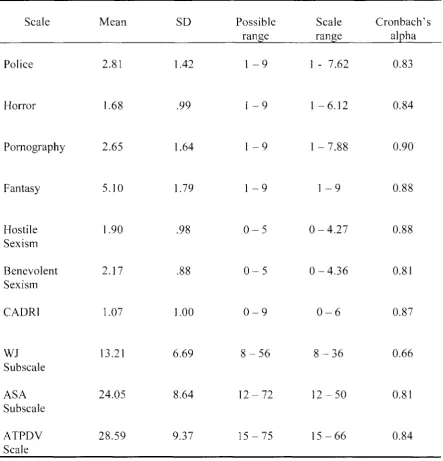
1 Descriptive Statistics for all Scales 55
2 Overview of Women's Victimization History Based on Results
ofCADRI 61
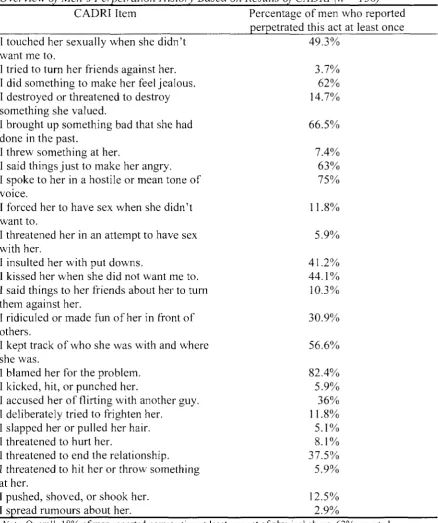
3 Overview of Men's Perpetration History Based on Results of
CADRI 63
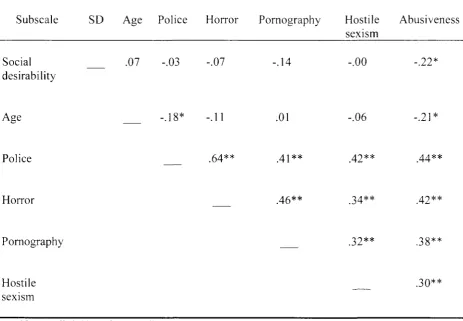
4 Intercorrelations between Predictors and Criterion Variables for
Development-Related Dark Romance Narrative Analyses 65
5 Intercorrelations between Predictors and Criterion Variables for
Development-Related Prince Charming Narrative Analyses 66
6 Intercorrelations between Predictors and Criterion Variables for
Continuation-Related Dark Romance Narrative Analyses 67
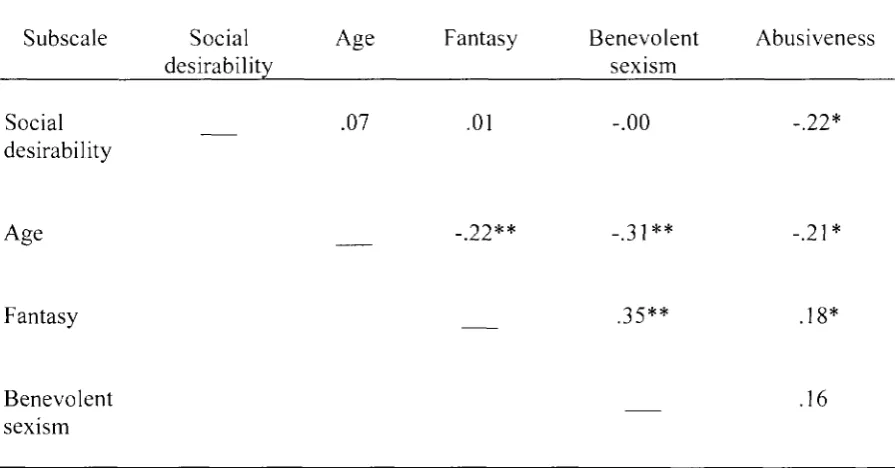
7 Intercorrelations between Predictors and Criterion Variables for
Continuation-Related Prince Charming Narrative Analyses 68
8 Intercorrelations between Predictors and Criterion Variables for
Tolerance-Related Dark Romance Narrative Analyses 69
9 Intercorrelations between Predictors and Criterion Variables for
Tolerance-Related Prince Charming Narrative Analyses 70
10 Varimax Rotation of Two Factor Solution for Love Stories Subscales... 73
11 Hierarchical Regression Analysis Examining the Relation Between
the Dark Romance Narrative and the Development of Intimate Partner
Table Page
12 Hierarchical Regression Analysis Examining the Relation Between
the Dark Romance Narrative and the Attitudinal Tolerance of Physical
Intimate Partner Violence 78
13 Hierarchical Regression Analysis Examining the Relation Between
the Dark Romance Narrative and the Attitudinal Tolerance of Sexual
Intimate Partner Violence 79
14 Hierarchical Regression Analysis Examining the Relation Between
the Dark Romance Narrative and the Attitudinal Tolerance of
Psychological Intimate Partner Violence 81
List of Appendices
Appendix Page
A Screening Questions 150
B Love Stories Scale (Sternberg, 1998) 151
C Ambivalent Sexism Inventory (Glicke & Fiske, 1996) 158
D Conflict in Adolescent Relationships Inventory
(Wolfe etal., 2001) 160
E Inventory of Beliefs About Wife Beating - Short Form (Saunders,
Lynch, Grayson, & Linz, 1987) 163
F Acceptance of Sexualized Aggression Subscale (Stevens, 1996) 165
G Attitudes towards Male Psychological Dating Violence (Price &
Byers, 1999) 167
H Marlowe-Crowne Social Desirability Scale - Short Version
(Reynolds, 1982) 169
I Background Information Sheet 170
J Consent Form - University Participants 174
K Information Sheet 177
L Community Resources Sheet - Students 178
M Study Invitation 179
N Consent Form - Community Participants 180
O Internet Safety Instructions 183
P Intimate Partner Violence Resources - Women 187
List of Appendices (ctd.)
Appendix Page
R Correlations for Dark Romance Development-Related Analyses... 189
S Correlations for Dark Romance Continuation-Related Analyses... 190
T Correlations for Dark Romance Tolerance-Related Analyses 191
U Correlations for Prince Charming Tolerance-Related Analyses.... 192
V Correlations Between Additional Love Stories and Criterions 193
Introduction
Intimate partner violence is an epidemic. Early estimates suggest that intimate
partner violence occurs in 1 out of 6 couples (Straus & Gelles, 1990; Straus, Gelles, &
Steinmetz, 1980), while a national survey found that approximately 1.3 million women
are physically assaulted by their male partners annually in the United States (Tjaden &
Thoennes, 2000). In the Canadian context, recent estimates by Statistics Canada (1999)
suggest that 8 percent of Canadian women have been physically, sexually, or
psychologically abused by a partner within the past 5 years. Based on recent census data,
this equates to over one million women experiencing intimate partner violence every five
years (Statistics Canada, 2006). Furthermore, much violence goes unreported; thus, these
numbers likely reflect conservative estimates. Even going by these moderate estimates,
intimate partner violence is a grave societal problem that needs to be addressed.
Critics have argued that the rates of intimate partner violence are at epidemic
proportions because facets of culture support such violence (Dobash & Dobash, 1979;
Wood, 2001b). Feminist researchers in particular posit that the cultural ideology of male
dominance or patriarchy contributes to intimate partner violence (Dobash & Dobash,
1979; Yllo & Bograd, 1988; Yodanis, 2004). The historical structure of male domination
within society leads women to occupy a subordinate position in this social structure. In
this context, intimate partner violence is conceptualized as a means to maintain male
power over women (Bograd, 1988). Cross-cultural research supports the relation between
male dominance and violence, suggesting that less family violence occurs in more
egalitarian societies (Jewkes, 2002; Levinson, 1989; Yodanis, 2004), while other research
has found that intimate partner violence is a consequence of women's inequality in
Overall, these findings point to patriarchy as the underlying cause of intimate partner
violence.
According to theorists, one of the means by which patriarchy is maintained in
North American society is through the construction of romantic love (Comer, 1974;
Firestone, 1972; Greer, 1970). This has led researchers to examine how popular ideas
about romantic love may contribute to intimate partner violence—particularly how
romance narratives may construct ideas about love that support the development and
continuation of intimate partner violence. Romance narratives can be broadly defined as
the stories about romantic love which exist in society. Although there are many different
types of romance narratives (Sternberg, 1998), the Dark Romance and Prince Charming
narratives have come to the forefront of this school of thought. Such narratives suggest
that men's abusive behaviors are loving or passionate and that ideal heterosexual
relationships occur between powerful males and powerless females (Jackson, 2001;
Wood, 2001b), thereby seeming to support the development of intimate partner violence.
In addition, exploratory qualitative studies conducted with survivors have demonstrated
that these narratives support the continuation of intimate partner violence because women
are led to believe that violence is a normal and routine part of'loving' relationships
(Wood, 2001b) and that female deference in relationships is natural or normal (Fraser,
2003; Jackson, 2001).
Despite previous research findings suggesting that romance narratives construct
ideas about love that support the development and continuation of intimate partner
violence, this assertion has not been tested. Consequently, one of the goals of this study
was to test whether two specific romance narratives which contain patriarchal
development and continuation of intimate partner violence in the current North American
context. Furthermore, although researchers have examined how the Dark Romance and
Prince Charming narratives may contribute to the development and continuation of
intimate partner violence, they have not addressed how these narratives may support the
attitudinal tolerance of intimate partner violence. Therefore, a second goal of this study
was to determine whether these narratives also support the attitudinal tolerance of
intimate partner violence. The final goal of this study relates to gender role beliefs.
Researchers have previously suggested that the Dark Romance and Prince Charming
narratives support intimate partner violence because of their underlying gender narrative
(Jackson, 2001; Wood, 2001b)—specifically, that they reinforce a traditional gender role
ideology, which renders men powerful and women powerless in romantic relationships.
This suggests that gender role beliefs mediate the relation between the Dark Romance
and Prince Charming narratives and intimate partner violence. Consequently, the final
goal of this study was to assess whether a) the relation between the Prince Charming
narrative and the development, continuation, and attitudinal tolerance of intimate partner
violence is mediated by benevolence-based gender role beliefs and b) whether the
relation between the Dark Romance narrative and the development, continuation and
attitudinal tolerance of intimate partner violence is mediated by hostility-based gender
role beliefs.
Prior to delving into a more detailed discussion of the goals of this study, I will
first provide the reader with a definition of intimate partner violence as well as review the
various theories that have been used to explain this violence. I will then elaborate on the
narrative-based feminist poststructuralist view of intimate partner violence and discuss
the development, continuation, and attitudinal tolerance of abuse. Finally, 1 will identify
the gaps in this existing literature and provide a rationale for the current study.
Definitions and Theories of Intimate Partner Violence
What exactly do theorists mean by the term intimate partner violence! One
popular definition defines intimate partner violence as actual or threatened physical,
sexual, or psychological abuse directed toward a spouse, ex-spouse, or current or former
dating partner (Saltzman, Fanslow, McMahon, & Shelley, 1999). Intimate partner
violence was initially conceptualized as a single overarching phenomenon; however,
debates over the extent to which women are perpetrators of interpersonal violence led
researchers to later differentiate between types of intimate partner violence. For example,
Johnson (1995, 2001) developed a typology in which he identified four distinct types of
intimate partner violence based on the context in which they occur: 1) situational couple
violence—violence not connected to a general pattern of control; 2) violent resistance—
violence used as a form of self-defense; 3) mutual violent control—both partners
engaging in violent and controlling behaviors; and 4) intimate terrorism—violence rooted
in an attempt to exert general control over the relationship. Johnson suggests that what
most people categorize as "domestic violence" or "wife beating" is more appropriately
referred to as "intimate terrorism" since this type of violence is the product of a desire to
control. He further suggests that men are more likely to perpetrate acts of intimate
terrorism than women. While recognizing that many different types of intimate partner
violence exist, this study focused on male-perpetrated intimate terrorism against females
since research suggests that this type of violence accounts for 90 to 95 percent of intimate
partner violence cases (Kurz, 1997) and (almost) all intimate femicides (Hotton, 2001;
Personality-based Theories
Explaining intimate partner violence has been the subject of various theories.
Early personality-based explanations associated intimate partner violence with
personality disorders in female survivors (Snell, Rosenwald, & Robey, 1964). Proponents
of such controversial theories suggested that the survivors had psychological
characteristics that actually provoked their partners to act violently toward them. These
early theories were subsequently strongly refuted by research indicating that survivors
'personality problems' are a consequence rather than a cause of abuse (Coker et al., 2002;
Humphreys & Thiara, 2003; Mechanic, Weaver, & Resick, 2008) and that survivors
recover from their mental health concerns once they leave their abusive relationships
(Campbell, Sullivan, & Davidson, 1995; Surtees, 1995).
More recent personality-based theories of intimate partner violence focus on the
personality characteristics of the perpetrators. Personality characteristics associated with
a propensity for intimate partner violence include low self-esteem (Murphy, Meyer, &
O'Leary, 1994; Murphy, Stosny, & Morrel, 2005; Russell, Lipov, Phillips, & White,
1989), antisocial personality disorders (Beasley & Stoltenberg, 1992; Danielson, Moffitt,
Caspi, & Silva, 1998; Edwards, Scott, Yarvis, Paizis, & Pannizzon, 2003), and hostility
(Maiuro, Cahn, Vitaliano, Wagner, & Zegree, 1988; Leonard & Senchak, 1993). Murphy,
Stosny, and Morrel (2005) examined the association between self-esteem and intimate
partner violence in abusive men and found that a lower level of self-esteem was
associated with increased physical aggression against a partner. Additionally, in their
study examining the relation between personality disorders and spousal violence,
Edwards et al. (2003) found that perpetrators scores on the antisocial personality disorder
more general psychological characteristics associated with a propensity for men to
behave abusively toward their female partners include anger (Dutton, 1995; Beasley &
Stoltenberg, 1992), depression (Hamberger & Hastings, 1991; Julian & McHenry, 1993),
and jealousy (Dutton, van Ginkel, & Landolt, 1996; Holtzworth-Munroe, Stuart, &
Hutchinson, 1997).
However, personality-based explanations for intimate partner violence have been
criticized for a number of reasons. For example, empirical findings suggest that a
substantial proportion of perpetrators do not have personality disorders or mental illness.
Less that half of the male perpetrators in Gondolf s (1999) study had MCMI-III scores
suggesting a personality disorder. A second criticism relates to the samples used in the
studies that found a relation between personality variables and intimate partner violence.
Many of these studies used small samples of perpetrators from psychiatric or prison
populations; thus, the results may not hold true for the general population.
Personality-based explanations of intimate partner violence have also been criticized on the grounds
that they do not take into consideration contextual and/or societal factors that can
contribute to their abusive behaviour (Dobash & Dobash, 1979).
Finally—and most significantly—these theories blame victims while reducing the
accountability of the perpetrators. Theories that suggest intimate partner violence is a
consequence of survivors' personality characteristics directly blame victims for the
violence that they experience, yet such theories are grossly inaccurate since a substantial
amount of research suggests that the personality of survivors of abuse may actually be the
very product of the victimization (Coker et al., 2002; Humphreys & Thiara, 2003;
Mechanic, Weaver, & Resick, 2008). In addition, personality-based explanations of
abusive behavior; if such violence is perceived to be the product of a personality
problem/disorder, people may make the erroneous assumption that the violent behavior is
beyond the control of the perpetrator. Overall, little support exists today for the
contention that personality disorders cause intimate partner violence.
Family Violence Theory
The family violence perspective provides a more general framework of intimate
partner violence that focuses on spouse abuse or family violence in a gender neutral way
rather than intimate terrorism. The primary assumptions underlying this approach are that
spouse abuse is a consequence of the nature and structure of the family unit and that
violence affects all family relationships equally (i.e., all family members perpetrate and
are victims of violence) (Straus, 1973). Straus (1990c) highlights a number of
characteristics unique to the family that make it prone to violence. For example, he
argues that families legitimize violence by using corporal punishment and accepting
violence as one solution to conflict. In addition, he suggests that families provide basic
training in the use of violence through physical punishment, thereby creating a link
between love and abuse (e.g., children may believe that their parents physically punish
them because of their love and concern for them).
One of the most divisive issues in the family violence approach is the notion of
violence by women. Proponents of this approach argue that women are as violent, or
more violent, than men in intimate relationships (Straus, 2008). Much of this research
was conducted using the Conflict Tactics Scales (Straus, 1979, 1990a, 1990b), a research
instrument criticized for its simplicity and lack of context (Dobash & Dobash, 1979;
Kurz, 1997). Kurz and others have argued that such research findings contradict data
arrests, which indicate that women are the victims of male-perpetrated violence in the
vast majority of reported family violence cases. Researchers have also found that assaults
perpetrated by men are more severe and degrading than those perpetrated by women
(Felson & Cares, 2005; West & Rose, 2000).
Intergenerational Transmission Theory
The intergenerational transmission theory of intimate partner violence is based on
the premise that intimate partner violence is a learned behaviour (Caroll, 1977; Kalmuss,
1984; Herzberger, 1983). According to this framework, men are violent towards their
intimate partners as adults because they are modelling violent behaviours that they were
exposed to in their families as children. Men may model the violent behaviour of their
family members for two reasons. First, they may learn that violent behaviour is
acceptable as a consequence of their own childhood abuse. When children are physically
beaten by their parent, they have direct exposure to aggression (Kalmuss, 1984). Through
this experience, they may learn that the use of aggression is an effective means of coping
with frustration and conflict (O'Leary, 1988). Second, men may learn to become violent
if they witness violent interactions between their parents. By repeatedly witnessing
intimate partner violence as children, men may learn that violence is normal and
acceptable in intimate relationships and that certain behaviours need to be physically
punished regardless of who commits them (Herzberger, 1983). Based on the preceding,
men who are exposed to violence in their family or origin may be more likely to
perpetrate intimate partner violence themselves.
There is some empirical support for the intergenerational transmission theory of
intimate partner violence. In one of the earliest studies conducted in this area, Carroll
were more likely to perpetrate intimate partner violence as adults than men who
experienced lower levels of physical punishment. This view is supported by subsequent
research which suggests that men who perpetrate intimate partner violence have a high
incidence of witnessing or experiencing violence as children (Bernard & Bernard, 1983;
Laghinrichsen-Rohling, Neidig, & Thorn, 1995; Rosenbaum & O'Leary, 1981; Sonkin,
Martin, & Walker, 1985).
While the intergenerational theory of intimate partner violence has its merits, it
also suffers from limitations. One such limitation is that the theory has limited
explanatory power. Many individuals who experience abuse in their family of origin do
not go on to become perpetrators whereas many individuals who are not exposed to
violence in their families during their childhood go on to become perpetrators (Widom,
1989). Theorists have suggested that this discrepancy may be a result of other mediating
factors which may also contribute to intimate partner violence. For example, Dutton
(1998) posits that although children may learn to be violent based on their exposure to
violent behaviour in their families, this violence may not be manifested unless the
violence serves some function for them as adults. Another criticism of this theory is that
it takes a very limited view of men's abusive behaviour. For example, intervention
programs which adopt a social learning approach focus primarily on anger control while
ignoring other equally abusive and controlling behaviours (Gondolf & Russell, 1986).
Finally, the intergenerational transmission view of intimate partner violence is limited
because it does not account for the social context in which this violence occurs. In
particular, it does not address how intimate partner violence supports the subordination of
women except for cases in which it is directly rewarding (Gondolf, 1985; Pence &
Feminist Theories
The feminist understanding of intimate partner violence emphasizes the role of
patriarchy and oppression. Feminists seek to understand why men as a class engage in
violence against women and what functions such violence serves in a particular cultural
and historical context (Dobash & Dobash, 1979; Martin, 1976; Pagelow, 1984;
Schechter, 1982; Walker, 1984). Proponents of this approach believe that intimate partner
violence becomes understandable only through the examination of a social context that is
largely based on multiple forms of oppression (e.g., sexism, racism, classism, and
heterosexism) (West, 2004). For example, men perpetrate intimate partner violence
because they are the dominant class and have differential access to material and symbolic
resources. Conversely, women of colour are particularly vulnerable to abusive
relationship experiences because of their marginalized status in society. Feminist
theorists contend that all men can potentially use violence to subordinate women; in
addition, even if individual men refrain from intimate partner violence, as a class they
benefit from women's fear of such violence.
The feminist approach also differs from other approaches because it validates
women's experiences. Bograd (1988) argues that "when men's lives, values, and attitudes
are taken as the norm, the experiences of women are often defined as inferior, distorted,
or are rendered invisible" (p. 15). Consequently, feminists believe that a basic step
toward understanding intimate partner violence is illuminating women's experiences
from their own frames of reference. Feminists are particularly concerned with the ways in
which women are blamed for or implicated in intimate partner violence.
The feminist perspective has received substantial empirical support. Existing
patriarchal social structures and higher rates of violence against women (Yllo, 1983; Yllo
& Straus, 1984)—a relation that has been supported cross-culturally as well. These
findings suggest that intimate partner violence is more common in communities where
cultural values dictate male dominance in gendered relationships and emphasize
traditional roles for women and men (Dasgupta, 2000; Morash, Bui, Zhang, & Holtfreter,
2007; Morash, Bui, & Santiago, 2000; West, Kantor, & Jasinski, 1998). Furthermore,
researchers have demonstrated a relation between patriarchal beliefs and intimate partner
violence (Dobash & Dobash, 1979; Smith, 1990). Smith (1990) found that husbands who
endorsed patriarchal beliefs were more likely to beat their wives than husbands who
endorsed relatively egalitarian beliefs.
In my view, the feminist explanation of violence against women is the best
framework for understanding intimate partner violence because this violence relates to
power. The power that a man gains by engaging in abusive behavior extends beyond
personal gains and reflects the more general power structure of societies at large. Women
have an inferior status in most societies and are subjected to violence on numerous levels,
whereas men are socialized to maintain their dominant positions in this patriarchal system
(Dobash & Dobash, 1979; Yllo & Bograd, 1988). Therefore, researchers cannot gain a
full understanding of intimate partner violence without examining the intersection
between gender and the power that supports this violence.
Many feminist frameworks exist for studying intimate partner violence; however,
this study adopted an understanding of intimate partner violence that drew upon certain
elements of feminist poststructuralist theory, which differs from other feminist theories in
that it rejects 'totalizing discourses' and 'meta-narratives' of women's experiences.
across historical contexts, classes, cultures, and other forms of difference (Weedon,
1997). Language is considered to be a central component of this approach. All experience
is conceptualized as having no inherent meaning; rather, this meaning is given to
experience via language in the form of discourse (Weedon, 1997). Proponents of this
theory are particularly interested in examining how popular discourses shape and alter
people's social identities over time and how these discourses are used to subjugate
women (Weedon, 1997). In the context of intimate partner violence, they are interested in
examining how popular discourses may contribute to the development, continuation, and
attitudinal tolerance of intimate partner violence.
The Use of Narratives
Although feminist poststructuralists study various types of discourse, the research
examining intimate partner violence has largely centered on narratives. The term
narrative generally refers to a story-like explanation of events typified by plots,
characters, and sequencing (Kellas & Manusov, 2003). Narratives are believed to perform
multiple functions in cultures, including making sense of individuals' lives (Fisher, 1987;
Gergen, 1997). According to Wood (2001b), "when we place ourselves within some
narratives (and not others) we confer structure, sequence, and coherence on experiences
that would otherwise be fragmentary and inchoate" (p. 241). Furthermore, narratives are
socially constructed (Berger, 1996). Societies construct, sustain, and reproduce
narratives; those narratives reproduced most frequently have the most power and
endurance (Gergen, 1997). Finally, poststructuralists reject the idea that narratives have
one purpose, meaning, or singular existence; rather, they are conceptualized as being
multi-faceted. The meanings of a narrative shift in relation to certain variables—usually
Recent narrative-based feminist poststructuralist investigations of intimate partner
violence have focused on the intersection of romantic love and intimate partner violence,
particularly on how romance narratives contribute to intimate partner violence. Romance
narratives can be broadly defined as stories about romantic love that exist within a
society. From a social constructivist perspective of romantic love, these narratives serve
to construct people's ideas about romantic love and relationships (Beall & Sternberg,
1995; Sternberg, 1998); thereby playing an important role in people's understandings of
romantic love. In addition, they also serve as examples of social constructions themselves
and are influenced by the norms of dominant groups in societies. For example, many
romance narratives in North America reflect a masculine western heterosexual view of
love despite being criticized for such a reflection (Ebert, 1988; Wood, 2001b). Given this
understanding of romance narratives, they can be used as a means of understanding how
dominant groups shape mainstream understandings of romantic love.
Many romance narratives exist in North American society (Sternberg, 1998), as
does a wide variation among these narratives (Rose, 1988). Prominent examples of these
narratives can be found in fairytales, movies, and romance novels (Jackson, 2001;
Radway, 1991). A significant body of literature (e.g., cultural anthropology, Jungian
psychology) suggests that these narratives represent cultural themes or archetypes (Jones,
2003; Short, 1997; von Franz, 1978, 1996). Anecdotal evidence further alludes to the
influence of these narratives because, although the stories are told primarily to children,
many adult women view the perfect love as being a 'fairytale' in which they meet their
'Prince Charming' and live 'happily ever after.'
Given the pervasive influence of romance narratives, particularly on women,
Early feminist scholars condemned these narratives for supporting patriarchy. Greer
(1971) argued that romance narratives were "dope for dupes"—a means of brainwashing
women into subservience. Her comments were based on earlier more general criticisms
of romantic love suggesting that love was bait for the marriage trap—that it served to
justify women's subordinate status to men (Comer, 1974; Firestone, 1972). In making her
case for the feminist revolution, Firestone (1972) further identified love as the pivot of
women's oppression. According to Firestone "men were thinking, writing, and creating,
because women were pouring their energy into those men; women are not creating
culture because they are preoccupied with love" (p. 113). This view is shared by
prominent African-American feminist Ti-Grace Atkinson (1969), who also condemned
love as the psychological pivot of women's persecution. More recent critiques of
romance narratives have drawn similar conclusions. Jackson (2001) argued that the texts
of meaning in these narratives "conform to a social order of male dominance and female
submission" (p. 307). Heroes are depicted as "masterful, dominating, privileged, [and]
wealthy and are usually in a position of authority with economic control over the
heroine" (Ebert, 1988, p. 41). Given these patriarchal underpinnings, Rose (1988)
questioned whether the romance genre itself is dysfunctional for women.
The notion that romance narratives support patriarchy is particularly problematic
given what research has shown about the relation between intimate partner violence and
patriarchy. As mentioned previously, much research has demonstrated that intimate
partner violence is a consequence of patriarchy (Bograd, 1990; Dobash & Dobash, 1979;
Smith, 1990; Yllo, 1983; Yllo & Bograd, 1988; Yodams, 2004). Rates of intimate partner
violence are higher in patriarchal societies in which cultural values dictate male
patriarchal beliefs are more likely to perpetrate intimate partner violence than men who
hold egalitarian beliefs (Smith, 1990). Finally, a patriarchal social structure is associated
with increased attitudinal tolerance for intimate partner violence (Haj-Yahia, 2003,
2005). These findings suggest that, by supporting patriarchal practices, romance
narratives may create ideas about romantic love that support intimate partner violence—a
line of thinking that has led researchers to examine the relation between romance
narratives and intimate partner violence critically.
Dark Romance narrative. Romance narratives may support intimate partner
violence in a number of different ways. Some narratives may directly contribute to the
development of intimate partner violence by suggesting that men's abusive behaviors are
'loving.' Termed 'Dark Romance' narratives, these narratives—which are
well-established in western culture—cast men as controlling and violent in relationships
(Wood, 2001b). According to Rose (1988), the basic plot of the Dark Romance centers
on a hero who engages in cruel and ambivalent behavior toward the female protagonist.
This behavior serves to confuse her: Does the hero truly love her? Is he really her prince?
The female protagonist's uncertainty about the hero's unpredictable behavior creates
erotic mystery, engaging her because the hero's violent and controlling behaviors are
portrayed as being a manifestation of his love for her. As a result, the construction of love
is "violent, rather than gentle: heroines 'tremble' under the seductive power of heroes"
(Jackson, 2001, p. 307). The Dark Romance narrative is evident in many romance novels
and vampire stories. A perusal of the titles of bestselling romance novels, such as
Bishop's (1990) Beloved Savage, Day's (1994)// Gentle Taming, and Rogers' (2001)
Sweet Savage Love as well as the classic Wuthering Heights (Bronte, 1964) illustrates this
misogynistic rapper Eminem's song Kim. In this song, he narrates his relationship with
his then wife Kim. Chillingly some of the lyrics read: "Don't you get it bitch, no one can
hear you? Now shut the fuck up and get what's coming to you. You were supposed to
love me. (Kim choking) Now bleed! Bitch bleed!" (Katz, 2006, p. 160).
Theorists have argued that the construction of romantic love in such Dark
Romance narratives is problematic because male brutality is presented as an expression
of love (Modelski, 1980). The violent, controlling, and degrading behaviors of Heathcliff
toward Catherine in Wuthering Heights are presented as a sign of his intense love for her
rather than abusive acts. Similarly, the violent attacks of vampires in stories such as
Dracula have passionate and erotic undertones. These violent undertones are problematic
given that narrative theory suggests that people draw upon these narratives to gain their
understanding of romantic love and relationships (Wood, 2001b). If men are led to
believe that abusive behaviors are 'loving' or 'sexy' based on such narratives, they may
be more prone to believe that their masculine identity relies on the ability to exhibit their
love in these ways—suggesting that Dark Romance narratives may directly support the
development of intimate partner violence.
Since Dark Romance narratives suggest that violent, controlling, and sexually
debasing behaviors are 'loving', these narratives may also support the continuation of
intimate partner violence. Survivors who are led to believe that these abusive behaviors
are an indication of love may be bound to their abusive relationships for longer periods
of time. Fraser (2005) explored this idea in her analysis of the factors that lead women to
remain with abusive lovers. Basing this analysis on 83 narrative feminist interviews
1 In this text, the term bound is used in discussing women's victimization experiences because it
conducted with women in Australia and Canada as well as her experience as a social
worker, she concluded that popular narratives send mixed messages about heterosexual
love that lead women to misinterpret abusive behaviors as a form of love. She further
suggested that this misinterpretation is problematic because it not only binds women to
their abusive relationships but also does so for longer periods of time since it takes
women time to figure out that abusive behaviors are not passionate, but harmful.
Wood (2001b) also investigated how the Dark Romance narrative supports the
continuation of intimate partner violence. In her study, she examined how survivors of
abuse constructed the meaning of the violence perpetrated against them. Through
minimally structured interviews with 20 American women (12 Caucasian, 5 Black, 1
Native American, and 2 mixed ethnicity), she examined how survivors of abuse described
themselves and their partner's violence through narratives. Wood based her study on
narrative theory, which suggests that a) people use narratives to impose coherence on
their life and b) people are particularly likely to draw upon narratives when they are in
situations that do not make sense (e.g., an abusive relationship). She expected survivors
of abuse to use romance narratives to make sense of their abusive relationships in one of
three ways: 1) interpreting their relationship so that it was consistent with the Prince
Charming narrative; 2) giving up the Prince Charming narrative and using a Dark
Romance narrative; or 3) inventing a new narrative that defined violence as unacceptable
in romantic relationships.
Wood's (2001b) findings supported her assertions; the current discussion will
focus on findings related to the Dark Romance narrative, which are more relevant to the
current study. The participants drew upon both the Prince Charming and the Dark
Dark Romance narrative when they could not sustain belief in the Prince Charming
narrative. Participants who adhered to this Dark Romance narrative reported that they
were bound to their abusive relationships because they believed that violence was a
'normal' and routine part of loving relationships—which, according to the previous
discussion, the Dark Romance narrative promotes. Thus, Wood's (2001b) findings
support the assertion that the Dark Romance narrative supports the continuation of
intimate partner violence by constructing ideas about love that normalize violent
behaviour as 'loving.'
The Dark Romance narrative may further construct ideas about love that
encourage the attitudinal tolerance of intimate partner violence. People who gain their
understanding of love through this narrative are led to believe that abusive behaviors are
a 'normal' and 'loving' part of romantic relationships, as Wood's (2001b) findings
suggest. Thus, one would expect that people who adhere to this narrative hold attitudes
that are more tolerant of intimate partner violence. Existing research suggests that the
attitudinal tolerance of intimate partner violence relates to many aspects of abuse; for
example, researchers have found that the tolerance of intimate partner violence supports
the perpetration of such abuse. In a study conducted with 94 batterers, Meyer (2000)
concluded that men's sexual aggression related significantly to attitudes supporting
violence against women. Hanson, Cadsky, Hanis and Lalonde (1997) also found that
abusive men reported attitudes more tolerant of spousal assault relative to non-abusive
men. Other studies suggest that this attitudinal tolerance is associated with less
sympathetic attitudes toward battered women and less support for the contention that
society (e.g., governmental agencies) should help survivors of intimate partner violence
investigated the relation between the Dark Romance narrative and the tolerance of
intimate partner violence, clearly these results point to the need to do so.
Although the construction of love in the Dark Romance narrative appears
to support the development, continuation, and attitudinal tolerance of intimate partner
violence directly, this narrative as well as other romance narratives may influence
intimate partner violence more indirectly, such as through their emphasis on traditional
gender roles. Myers and Spencer (2006) define gender roles as "a set of behaviour
expectations (norms) for males or females" (p. 554). Traditionally, the masculine gender
role is associated with such characteristics as behaving in a physically and emotionally
tough manner, having a high status position in society (e.g., through wealth and
occupational success), and avoiding any activity (e.g., jobs, hobbies, interests) considered
stereotypically feminine (Thompson & Pleck, 1986). In contrast, the feminine gender role
is associated with being loyal, compassionate, and sympathetic to the needs of others
(Auster & Ohm, 2000).
However, many theorists argue that such a distinction between the gender roles is
problematic as it supports the oppression of women (Dobash & Dobash, 1979; Smith,
1990; Yllo & Bograd, 1988). For example, researchers have found that men's
endorsement of traditional gender roles results in more date rape supportive attitudes and
self-reported perpetration of sexually coercive behaviour towards women (Truman,
Tokar, & Fischer, 1996). Promoting traditional gender roles also appears to adversely
affect women's academic achievement. Females raised in traditional households (i.e.,
households in which parents adhere to traditional gender roles) experience declines in
their academic achievement after reaching adolescence (Updegraff, McHale, & Crouter,
career-related ambitions; women's support of traditional gender role beliefs equates to lower
educational and professional aspirations and the tendency to attribute less importance to
their careers (Eccles, 1987; Phillips & Imhoff, 1997). Collectively, these findings indicate
that traditional gender roles are one means of maintaining women's subordinate status in
society.
Researchers initially studied gender roles by directly examining people's
personality characteristics and their views about the rights, roles, and abilities of both
men and women. However, recent changes in gender roles and the resulting shift in
contemporary attitudes towards women have led researchers to re-evaluate as well as
expand their conceptualization of gender roles and gender role ideology. For example,
Eastwick et al. (2006) and McHugh and Frieze (1997) suggest that it may be possible to
gain a more nuanced understanding of people's gender role ideology by examining their
levels of ambivalent sexism. Ambivalent sexism is a conceptualization of sexism that
assumes that "sexism is not only hostile, but fundamentally ambivalent, because some
'traditional' beliefs are associated with subjectively positive feelings and stereotypes
about women" (McHugh & Frieze, 1997, p. 10). Researchers have generally used this
framework to distinguish between hostile sexism—a type of sexism predicated upon
hostility towards women—and benevolent sexism—a type of sexism based upon
relatively positive feelings and stereotypes about women (Glicke & Fiske, 1996).
Eastwick et al. (2006) suggest that ambivalent sexism can also be used as a measure of
traditional gender role ideology. The hostile sexism component of ambivalent sexism
measures sexist antipathy towards women (e.g., the idea that feminists want to have more
power than men) while reflecting negative attitudes towards non-traditional women
women (e.g., the idea that good women should be set on a pedestal by men) while
reflecting positive attitudes towards traditional women. Based on this understanding, a
higher level of endorsement of either hostile or benevolent sexism is indicative of more
traditional gender role ideology.
Such a conceptualization of traditional gender role ideology is advantageous to
previous conceptualizations for two reasons. First, since ambivalent sexism is a relatively
covert measure of gender role ideology, it is possible to avoid the ceiling effects that can
occur with more overt measures of gender role ideology, as evidenced by the Attitudes
towards Women Scale (Beere, 1990; Larsen & Long, 1988). Second, this
conceptualization of gender role ideology accounts for different rationales or reasoning
that may underlie an individual's gender role beliefs. In particular, it is possible to
differentiate between traditional gender role ideology rooted in a negative affect or
hostility towards women and traditional gender role ideology rooted in a relatively
positive (but still oppressive) affect towards women.
Beyond examining the different rationales that may serve as the grounds for
traditional gender role ideology, researchers have also examined the various ways in
which individuals may be socialized into gender roles as well as how they may form their
gender role beliefs. The research to date suggests that gender role socialization can occur
through the modelling of parental behaviours and beliefs (McHale, Crouter, & Tucker,
1999), through interactions with peers (Witt, 2000), and through exposure to popular
media such as television, books, and video games (Dill & Thill, 2007; Glascock, 2001;
Signorielli, 1989). Of most relevance to the current study is researchers' assertion that
individuals can form their gender role beliefs based on romance narratives (Kramer &
to be "dominating and to regard women as inferior" while women learn to be
"accommodating and to seek and please men" (p. 242). The idea that individuals form
their gender role ideology from romance narratives makes sense considering the general
assumptions underlying the narrative framework. Narrative theory assumes that people
draw upon narratives to understand themselves and make sense of their lives (Fisher,
1987; Gergen, 1997). As such, people would likely draw upon romance narratives to gain
an understanding of gender since these narratives are one of the dominant gender-related
scripts found within North American society. Thus, it is important to examine what
romance narratives suggest about the roles of both women and men.
Prince Charming narrative. A popular romance narrative that reinforces
traditional gender roles is what will herein be referred to as the Prince Charming
narrative. The Prince Charming narrative—which includes Rapunzel and Cinderella—
centers on the relationship between a virtuous young female protagonist and a courageous
hero, encouraging what Eastwick et al. (2006) referred to as benevolent sexism (i.e.,
traditional gender role ideology based in sexist positivity towards women). The narrative
generally begins with the female protagonist—who conforms to the traditional feminine
ideal and is depicted as passive, accommodating, and subordinate (Wood, 2001b)—being
held captive by some evil force (Rose, 1988). Her passivity prohibits her from freeing
herself from the bad situation. Eventually, a handsome young prince arrives to help her;
unlike the passive and obedient female protagonist, the prince is depicted as strong,
courageous, and capable so that he is able to 'protect' and 'save' her. As the narrative
unfolds, the couple collectively encounters a plethora of obstacles to their love, although
the narrative ultimately ends with the couple surmounting these obstacles and living
Dark Romance narrative. The Dark Romance narrative similarly encourages
traditional gender roles; however, in this case, the narrative encourages hostile sexism
(i.e., traditional gender role ideology based on hostility and sexist antipathy). As
previously mentioned, the basic plot of the Dark Romance narrative centres on the
tumultuous relationship between an unpredictable and abusive hero and a passive and
empathetic 'heroine'. The male hero in this narrative is explicitly dominant; his
stereotypically masculine behaviours stem from his 'raw sexuality' and 'rugged
masculinity' rather than his 'chivalrous' desire to protect the female protagonist. The
narrative further suggests that men assert and maintain their masculinity by engaging in
hostile and abusive behaviours towards women.
For example, Rogerson's brutal beatings of Caitlin in the popular teen romance
novel Dreamland (Dessen, 2000) serves to remind Caitlin that he is 'the man'. Similarly,
Edward Cullen, the vampire hero of the popular romance series Twilight, affirms his
masculinity through his hostility towards the female protagonist Bella, as evident in
Edward's description of his relationship with her as that of a predator and his prey. Bella
is described as a "stupid lamb" who has fallen in love with a "sick masochistic lion"
(Meyer, 2005, p. 310). Edward's explicitly dominating, controlling, and threatening
behaviours towards Bella during the course of the story serve to enhance rather than
detract from his dark masculinity and allure.
In contrast, the Dark Romance narrative prescribes passive femininity for women.
The female protagonists found in this type of narrative do not challenge the hostile and
abusive behaviours of the hero; rather, as women, their role is to understand, empathize
with, and support the hero—in other words, unconditionally 'stand by their man'. In the
immediate negative recourse. For example, in Twilight, when Bella goes against
Edward's wishes and decides that she does not want to return home, Edward ensures
Bella's 'safety' by physically dragging her to her car (Meyer, 2005).
The depiction of ideal heterosexual relationships found in both the Prince
Charming and Dark Romance narratives may have consequences for the development of
intimate partner violence. By suggesting that in ideal heterosexual relationships
stereotypically masculine men fall in love with stereotypically feminine women, these
narratives encourage romantic relationships in which men have relatively more power
than women (Jackson, 2001). As described earlier, much research has shown that
intimate partner violence is a consequence of patriarchy (Dobash & Dobash, 1979;
Walker, 1984; Yllo, 1993). Rates of intimate partner violence are generally lower in
relatively egalitarian societies (e.g., Canada) compared to more patriarchal societies (e.g.,
India) (Watts & Zimmerman, 2002) and rates of marital violence are higher in
male-dominant couples relative to egalitarian couples in North America (Coleman & Straus,
1986). Given the preceding, both the Prince Charming and Dark Romance narratives may
be inadvertently supporting the development of intimate partner violence by constructing
ideas about love that favor patriarchal romantic relationships. The Prince Charming
narrative may be supporting the development of intimate partner violence by encouraging
male-dominant relationships which are based in benevolent sexism whereas the Dark
Romance narrative may be encouraging the development of intimate partner violence by
encouraging patriarchal relationships which are entrenched in hostile sexism.
Fraser (2003) examined this assertion as part of a broad discourse analysis in
which she examined how people narrate love and abuse in intimate relationships. She
have negative implications for intimate partner violence. One example is the polarity
between 'real men' and 'weaklings;' according to this polarity, 'real men' are able to
succeed at romantic relationships whereas 'weaklings' are not. Romance narratives also
include polarities about women, such as the polarity between 'good women', who are
stereotypically feminine (i.e., passive and weak) but are able to "bring out the best in
their men", and 'bad women', who are neither and cannot [bring out the best]. Fraser
implies that the interplay between these two gender-related polarities encourages the
development of intimate partner violence by making male dominance 'natural' and
female deference 'normal' in romantic relationships. Thus, although Fraser did not
distinguish between traditional gender role ideology rooted in benevolence or hostility
towards women, her work does suggest that traditional gender roles may support the
development of intimate partner violence.
In addition, the traditional gender roles found in the Prince Charming and Dark
Romance narratives may also support the continuation of intimate partner violence.
Survivors who adhere to these narratives may believe that women who love their partners
should adopt a passive 'heroine'-like role in their romantic relationships—a role
researchers suggest may increase vulnerability in abusive relationship experiences (Levy,
1991; Mercer, 1988; Towns & Adams, 2000). In particular, Jackson (2001) suggests that
this emphasis on traditional femininity may hinder women's attempts to extricate
themselves from abusive relationships—a view supported by findings that women's
adherence to the traditionally feminine gender role impedes their resistance in abusive
relationships (Frisch & MacKenzie, 1991). Given these findings, survivors who adhere to
the 'heroine' role may face difficulty in leaving their abusive relationships.
contributed to the continuation of intimate partner violence. In her qualitative study, she
explored how survivors used the Prince Charming narrative to make sense of abuse that
they had experienced in their relationships. She conducted open-ended interviews with 23
New Zealander high school students and asked them: a) how they began their
relationships, b) how they negotiated the abuse in their relationships, and c) how they
resolved these relationships. Jackson's findings suggest that women adopted the
traditionally feminine role of the female protagonist when they were being victimized in
their relationship. When asked to discuss this initial phase of their abusive relationship,
some participants described themselves in stereotypically feminine terms (needy,
dependent, etc.). Women abandoned this feminine 'heroine' role when they began to
resist their perpetrator's abuse; at this point they began to take on the stereotypically
masculine role of the hero in their relationship (i.e., the women were strong and
assertive), whereas their abusers appeared to take on the stereotypically feminine role of
the 'heroine' (i.e., the men were emotional and needy).
Jackson's (2001) findings suggest two outcomes. First, people who are in abusive
relationships can sometimes adopt the traditional gender roles of Prince Charming
narratives in their own relationships. Second, the traditional gender roles in Prince
Charming narratives may contribute to the continuation of intimate partner violence. In
Jackson's study, survivors adhered to the stereotypically feminine 'heroine' role when
they were experiencing the abuse, but subsequently abandoned this role when they
resisted the abuse. Although obviously many other factors contribute to the continuation
of intimate partner violence, this finding suggests that the female protagonist's role in
Prince Charming narratives could be one of these factors—at least in impeding women's
escape.
The traditional gender role ideology characteristic of the Prince Charming and
Dark Romance narratives may also support the attitudinal tolerance of intimate partner
violence. Since the female and male protagonists in these narratives conform to
traditional gender roles, and people draw upon romance narratives to form their gender
role beliefs, people who adhere to these narratives may be more likely to hold traditional
gender role beliefs. Specifically, individuals who have higher levels of endorsement of
the Prince Charming narrative may hold traditional gender role beliefs which are rooted
in benevolence whereas individuals who have higher levels of endorsement of the Dark
Romance narrative may hold traditional gender role beliefs which are rooted in hostility
towards women. Researchers examining gender role beliefs more generally have found a
significant association between traditional gender role beliefs and the attitudinal tolerance
of intimate partner violence. For example, in her study of 360 American college students,
Berkel (2000) found that individuals with traditional gender role beliefs indicated more
support for domestic violence than those with egalitarian beliefs. Similarly, Finn (1986)
examined the relation between gender role beliefs and attitudes toward marital violence
in a college sample consisting of Caucasian and African-American men from the United
States and found that individuals who held traditional gender role beliefs were more
likely to hold attitudes that endorsed the legitimacy of men using physical force in
marriage. Finally, researchers examining dating violence have found that traditional
gender role beliefs predict a greater degree of tolerance toward the use of violence in
dating relationships relative to more liberal attitudes (Bhanot & Senn, 2007;
Muehlenhard, Friedman, & Thomas, 1985; Proite, Dannells, & Benton, 1993). Studies
have shown similar results. For example, in a study examining the views of Turkish
students, Sakalh-Ugurlu, Sila-Yalcin and Glick (2007) found that a higher level of
benevolent and hostile sexism predicted less positive attitudes towards rape victims.
Additionally, researchers have found that individuals with a higher level of benevolent
sexism attribute more blame to victims of acquaintance rape (Abrams, Viki, Masser, &
Bohner, 2003) and attribute less blame and recommend shorter sentences for perpetrators
of acquantaince rape (Viki, Abrams, & Masser, 2004). Overall, these findings suggest
that, by encouraging benevolent and hostile traditional gender role beliefs, the Prince
Charming and Dark Romance narratives may also be encouraging the attitudinal
tolerance of intimate partner violence.
Limitations of the Research to Date
Thus far, this review has outlined the different ways that romance narratives may
support intimate partner violence. In particular, the review has examined research
suggesting that the Dark Romance and Prince Charming narratives may construct ideas
about romantic love that support the development and continuation of intimate partner
violence. In addition, the discussion has provided rationales for why these narratives may
also contribute to the attitudinal tolerance of intimate partner violence. Although the
studies reviewed provide useful information about the relation between the Dark
Romance and Prince Charming narratives and intimate partner violence, these studies
also face certain limitations. First, the research to date has focused almost exclusively on
how the Dark Romance and Prince Charming narratives may bind women to their
abusive relationships (Jackson, 2001; Wood, 2001b), thereby supporting the continuation
of intimate partner violence. In order to gain a better understanding of the relation