Secure Data Deduplication with Auditability
in Cloud
Kruthika, Annie Sujith
PG Scholar, Department of CSE, T-John Institute of Technology, Bangalore, India
Assistant Professor, Department of CSE, T-John Institute of Technology, Bangalore, India
ABSTRACT: Cloud computing has turned into an essential perspective in today's innovation and storage in cloud computing frames a critical part as the need of virtual space to store our vast information has become over these years. In any case, the speed of uploading and downloading limits the processing time and there is a need to comprehend this issue of substantial information taking care of or huge information handling. The second issue is secure deduplication. The fast appropriation of cloud administrations is joined by expanding volumes of information put away at remote cloud servers. Among these remote put away documents, the greater parts of them are copied: by late overview by EMC, 75% of late digital information is duplicated copies. To defeat these two issues in this paper we are proposed powerful deduplication process with the nearness of secure inspector. From the server side for the secure storage
KEYWORDS: Cloud Computing, Big data processing, Data Deduplication, SP theory of intelligence.
I. INTRODUCTION
Cloud storage is a modeled situation of organization storage programs where date is saved in virtualized segmented pools of storage which are usually maintained through nameless third party administration providers. There are various benefits which cloud can furnish buyers with ranging from scalability of the services, cost availability, comfort and so on. Cloud computing is a brand new and very nearly specific concept of computing process, by which computer resources are shared dynamically by means of the web for this reason with the aid of attractive considerable and brilliant attention and curiosity from both institutions and enterprise. Examining these technologies briefly would emphasize or help us to analyze our proposed approach in a radical state of affairs and as a result would provide a basement for the advance of new algorithms which is relatively what the science wishes. One in all these ways is identity headquartered encryption which was once first introduced with the aid of Shamir in 1985.In the IBE, the sender of a message can characterize a personality such that lone a recipient with precisely indistinguishable personality can decode it. This is absolutely a sound variety from Public-key Encryption, in which the encryption does not have to issue additional key to unscrambling for every cipher-text. In the IBE, the secret key or private key produced, which contains the data about the personality data of a holder, is disseminated to each client just once when he joins the system. Nonetheless this strategy gives great flexibility however compromises if the innovation advancement is known. To moderate this IBE – Fuzzy Identity-Based Encryption which is additionally synonymously known as Attribute-Based Encryption (ABE) is presented. In their work, a identity is seen as a creation of engaging attributes. Unique in relation to the IBE, where the decryption could unscramble the message just if his own data is simply identical as what indicated by the encryption, fuzzy IBE secures the unscrambling situation if there is 'identity overlap' crossing a pre-defined threshold between the one determined by encryption and the other one compares to decryption. In any case, this sort of attested plan was restricted for giving more broad system in light of the fact that the pre-defined threshold based algorithm can't fulfill a general condition.
most normally to an incremental style. The SP framework is intended to acclimatize new data to a steadily developing assemblage of generally compressed old data.
Large scale information sets present numerous information administration challenges [2]. Notwithstanding minimizing computation time, legitimate information representations can likewise decrease the measure of required storage (which interprets into diminished correspondence if the information are transmitted over a system)
One barricade to utilizing cloud administrations for enormous information examination is the issue of exchanging the vast information sets. Keeping up a high-limit and wide scale correspondences system is extremely costly and just marginally profitable. To control costs, creators of the registering framework need to make sense of how to minimize the measure of vitality utilized for processing information. The SP framework may advance the productive transmission of information by making it smaller.
II. LITERATURESURVEY
Robert Escriva et.al [12] this paper presents HyperDex, a novel dispersed key-value store that gives a one of a kind hunt primitive that empowers queries on secondary attributes. The key knowledge behind HyperDex is the idea of hyperspace hashing in which objects with different qualities are mapped into a multidimensional hyperspace. This mapping prompts effective usage for recovery by essential key, as well as for mostly determined secondary attribute searches and range queries.
J Gerard Wol et.al [5] provides confirmation to quite a bit of arterial intelligence, human discernment and perception, standard processing, and arithmetic, might be comprehended as pressure of data by means of the coordinating and unication of examples. J Gerard Wolff et.al [3] This article is an outline of the SP hypothesis of insight, which intends to rearrange and incorporate ideas crosswise over artificial intelligence, standard figuring and human recognition and cognizance, with data compression as a unifying theme. It is thought about as a mind like framework that gets "New" data and stores a few or every bit of it in compacted structure as "Old" data; and it is acknowledged as a computer model, a first form of the SP machine. The coordinating and unification of examples and the idea of numerous arrangements are focal thoughts.
III. PROPOSED SYSTEM
a. Proof of ownership
Going for considering auditable and de-duplicated capacity, we propose the SecCloud framework. In the SecCloud framework, we have three entities:
Cloud Clients have information documents to be stored and depend on the cloud for information maintenance and computation. They can be either singular purchasers or business associations;
Cloud Servers virtualizes the assets as per the necessities of customers and uncover them as storage pools. Normally, the cloud customers may purchase or rent storage limit from cloud servers, and store their individual information in these purchased or leased spaces for future use;
Reviewer which helps customers upload and review their outsourced information maintains a MapReduce cloud and acts like an authentication power. This suspicion presumes that the evaluator is connected with a couple of public and private keys. Its public key is made accessible to alternate substances in the framework.
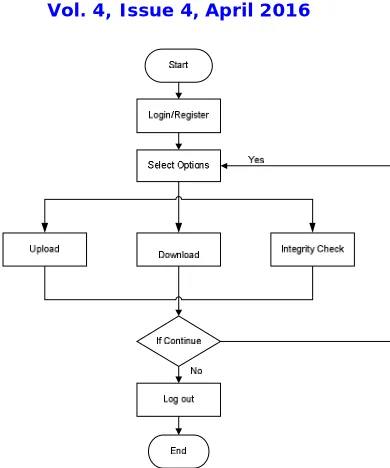
Figure 1: Flowchart for User process
File Uploading Protocol: This convention goes for permitting customers to upload records by means of the examiner. In particular, the record uploading convention incorporates three phases:
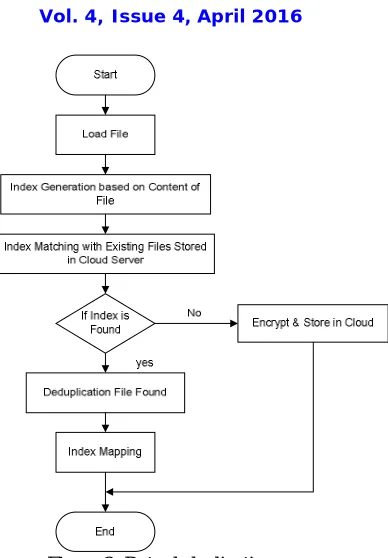
Phase 1 (cloud customer → cloud server): customer performs the copy check with the cloud server to affirm if such a record is stored in distributed storage or not before uploading a document. In the event that there is a copy, another convention called Proof of Ownership will be keep running between the customer and the distributed storage server. Something else, the accompanying conventions (counting stage 2 and stage 3) are keep on running between these two entities.
Phase 2 (cloud customer → examiner): customer uploads records to the auditor, and gets a receipt from auditor. •
Phase 3 (reviewer → cloud server): auditors produce an arrangement of labels for the uploading record, and send them
alongside this document to cloud server. b. Integrity Auditing Protocol:
It is an intelligent protocol for trustworthiness confirmation and permitted to be instated by any substance with the exception of the cloud server. In this protocol, the cloud server assumes the part of prover, while the examiner or customer fills in as the verifier. This protocol incorporates two phases:
Phase 1 (cloud client/auditor → cloud server): verifier (i.e., customer or evaluator) creates an arrangement of difficulties and sends them to the prover (i.e., cloud server).
Figure 2: Data deduplication process
It is an intelligent protocol introduced at the cloud server for confirming that the customer precisely possesses an asserted record. This protocol is normally activated alongside record uploading protocol to keep the spillage of side channel data. On the contrast to integrity auditing protocol, in PoW the cloud server functions as verifier, while the customer assumes the part of prover. This protocol additionally incorporates two Phases
Phase 1 (cloud server → client): cloud server creates an arrangement of difficulties and sends them to the customer Phase 2 (client → cloud server): the customer reacts with the verification for document ownership, and cloud server at long last confirms the legitimacy of confirmation.
Our principle goals are outlined as follows. c. Integrity Auditing.
The main configuration objective of this work is to give the ability of confirming accuracy of the remotely stored information. The Integrity confirmation further requires two features: 1) public verification, which permits anybody, not only the customers initially, stored the record, to perform verification;
2) Stateless confirmation, which can remove the requirement for state data support at the verifier side between the activities of inspecting and information storage.
Secure De-duplication. The second outline objective of this work is secure de-duplication. At the end of the day, it requires that the cloud server can diminish the storage room by keeping only one copy of the same document. Notice that, with respect to secure de-duplication, our goal is recognized from past work [3] in that we propose a technique for permitting both de-duplications over documents and labels.
IV. RESULTS
Proposed sp theory of secured system was tested for its big data handling and deduplication efficiency. Here we tested deduplication efficiency on various types of files.
Deduplication Efficiency (Irrespective of File Type)
Security Achieved
Dropbox 82% 88%
Amazon 87% 93%
Proposed 89% 95%
Table 1: Result Analysis
V.CONCLUSION
Cloud computing has transformed into an imperative perspective in today's. Cloud computing has conveyed with it a couple of challenges like security, stockpiling, booking etc. Capacity in Cloud preparing outlines a crucial part as the need of virtual space to store our expansive data has ended up over these years. Regardless, the pace of exchanging and downloading limits the get ready time and there is a need to settle this issue of broad data dealing with. Proposed approach proficiently stores the information utilizing vigorous indexing framework.
VI. ACKNOWLEDGMENT
The authors are very grateful to Mrutyunjaya S. Hiremath, CTO, eMath Technology, India for interesting discussions regarding this work.
REFERENCES
[1] Wolff, James Gerard. "Big data and the SP theory of intelligence." Access, IEEE 2 (2014): 301-315.
[2] Albus, James S. "Outline for a theory of intelligence." Systems, Man and Cybernetics, IEEE Transactions on 21.3 (1991): 473-509.
[3] Wolff, J. Gerard. "Information compression by multiple alignment, unification and search as a unifying principle in computing and cognition." Artificial Intelligence Review 19.3 (2003): 193-230
[4] S. Watanabe, editor. “Frontiers of Pattern Recognition. Academic Press,NewYork”, 1972.
[5] K. Pearson. The Grammar of Science. Walter Scott, London, 1892 Republished by Dover Publications, 2004, ISBN 0-486-49581-7.
[6] H. B. Barlow.” Sensory mechanisms, the reduction of redundancy, and intelligence”. In HMSO, editor, The Mechanisation of Thought Processes, pages 535{559. Her Majesty's Stationery Oce, London, 1959.
[7] .”National Research Council, Frontiers in Massive Data Analysis, National Academies Press”, 2013). [8] Robert Escriva.” HyperDex: A Distributed, Searchable Key-Value Store for Cloud Computing”. [9] J Gerard Wolff .” The SP Theory of Intelligence: Benefits and Applications”. Information 2014.
[10] Erik Kruus, Cristian Ungureanu, Cezary Dubnicki. Bimodal ContentDefined Chunking for Backup Streams. In Proceedings of of 8th [11] USENIX Conference on File and Storage Technologies. Feb. 2010.