ABSTRACT
BOYLAN, ROBERT VINCENT. Decision Criteria for Selection of Psychometric Assessment Instruments Used in Employee Selection and Development Applications: A Delphi Study. (Under the direction of Dr. James Bartlett.)
There was a two-fold purpose for this study. The main purpose of this study was to determine decision criteria HRD professionals should consider when selecting instruments for employee selection and development by engaging a panel of experts knowledgeable in psychological tests used for employment and development decisions in a Delphi study. Secondly, the study compared the experts’ opinions on decision criteria for choosing instruments used in employee selection and development.
The first research question considered the decision criteria that should be considered when selecting assessment instruments for employee selection as identified by a panel of experts in psychometric instrument use. Similarly, the second research question considered the same for employee development. The third research question investigated the level of importance of decision criteria that should be considered when selecting instruments for employee selection among an assembled panel of experts in psychometric instrument use, and to what extent is there reliable consensus on these criteria. The fourth research question considered the same for employee development. The fifth research question examined differences of opinion among an assembled panel of experts on decision criteria that should be considered when selecting assessment instruments for employee selection and
development.
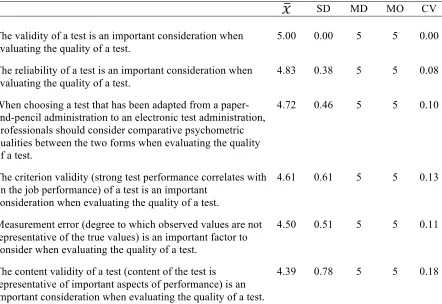
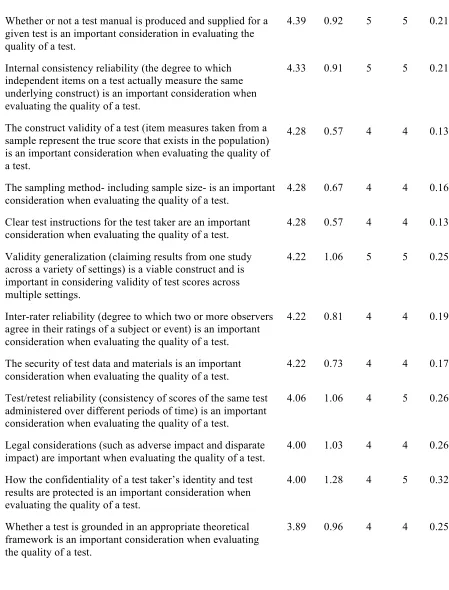
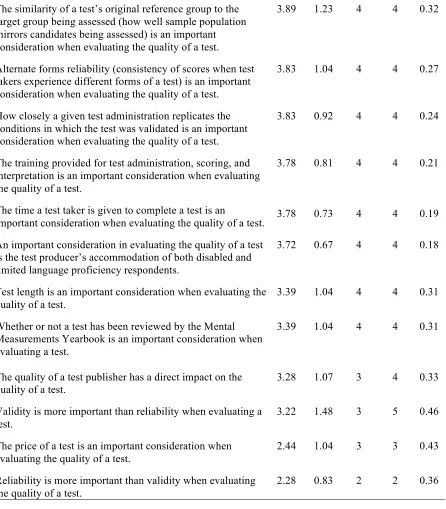
importance of thirty criteria identified in the literature as potentially relevant to choosing instruments for employee selection and development. Expert panelists also offered
qualitative comments on each of the criteria under consideration, as well as additional criteria that were evaluated in later rounds of the Delphi.
Data analysis from an exhaustive review of literature, and subsequently two rounds of a Delphi survey instrument included mean, standard deviation, median, mode, and coefficient of variation. A paired-samples t test was used to answer research question number five.
Decision criteria for selection and development were considered separately across two rounds of the Delphi, with item importance measured by an analysis of means, and consensus measured by the coefficient of variation. Findings indicated strong study stability and unanimous consensus on the degree to which expert panelists agree on the importance of decision criteria used in choosing instruments for employee selection and development. Finally, expert panelists concluded that there was no significant difference in decision criteria that should be considered for employee selection compared to employee development.
Recommendations from this study include conducting research on decision criteria practitioners use to choose instruments for selection and development, development of relevant theoretical frameworks to support research activities, an increase in research focused on instrument use in employee development applications, and the development of high impact learning events that utilize research to inform practice.
Decision Criteria for Selection of Psychometric Assessment Instruments Used in Employee Selection and Development Applications: A Delphi Study
by
Robert Vincent Boylan
A dissertation submitted to the Graduate Faculty of North Carolina State University
in partial fulfillment of the requirements for the degree of
Doctor of Education
Adult and Community College Education
Raleigh, North Carolina 2014
APPROVED BY:
_______________________________ ______________________________
James Bartlett Kevin Brady
Committee Chair
BIOGRAPHY
Bo Boylan resides in Charlotte, NC with his wife, Mary, and son, Tanner. He shares his undergraduate alma mater, Virginia Tech, with his wife, and attended Wake Forest University where he earned his Master of Business Administration degree in 1997.
After a fifteen-year career in the construction products industry, he launched Ravenwood Consulting Group, a consultancy focused on organizational strategy and sales effectiveness in 2003. He also co-founded Innofen, LLC, an innovate producer of value added fabrication components for the North American window and door industry. Along the way he joined the faculties of the American Management Association, the University of North Carolina at Charlotte, and Central Piedmont Community College where he authored numerous professional development seminars and served as a facilitator.
ACKNOWLEDGMENTS
To Dr. James Barlett, I am indebted to you for helping me navigate this onerous doctoral process. You have a very keen sense of your students’ interests, their capabilities, their motivation, and their commitment to crafting a meaningful dissertation. It is difficult to imagine completing this process without your steady guidance and wisdom. Thank you.
To Dr. Kevin Brady, Dr. Brad Mehlenbacher, and Dr. Michelle Barlett, I am thankful you volunteered your time and very useful insights to my dissertation process as committee members. You helped me focus and refine my message as I neared the end of the process, and I benefitted greatly from your involvement. Thank you.
To the Charlotte Executive EdD 2009 cohort, you significantly enriched my doctoral experience, just as I had hoped. I made a purposeful decision to enroll in a cohort format for my doctoral studies, expecting to experience the fellowship, camaraderie, and support I wanted- and needed- to be more successful than if I had made this journey alone. You certainly did not disappoint. Thank you.
To my seatmate and colleague Dr. Jim Hale, you set such a strong example of the right way to approach this process that I found, at times, almost impossible to live up to. You pushed me to achieve more than I though I ever could on my own. Thank you.
To my son Tanner, an outstanding student in his own right. You inspired me to work harder and expect more out of my efforts through your commitment and diligence in your own academic pursuits. I love you.
TABLE OF CONTENTS
LIST OF TABLES vii
LIST OF FIGURES ix
CHAPTER ONE: INTRODUCTION 1
Statement of Problem 10
Purpose Statement 11
Theoretical Framework 12
Normative Decision Models 13
Prescriptive Decision Models 17
Descriptive Decision Models 17
Conceptual Framework 18
Research Questions 19
Significance of Study 20
Limitations 21
Delimitations 22
Definition of Terms 22
Summary 34
CHAPTER TWO: REVIEW OF LITERATURE 35
History of Instrument Development and Use 36
Instrument Development 44
Instrument Definitions and Uses 44
Instrument Development Models 46
Investigation of the Gable and Wolf Model 51
Alternative Selection and Development Tools 60
Uses of Instruments in Employee Selection and Development 63
Key Characteristics Tests Intend to Measure 68
Legal Considerations 73
Decision Criteria for Choosing Instruments for Selection and Development 80
Summary 88
CHAPTER 3: METHOD 90
History and Purpose 90
Characteristics of the Delphi 91
Critiques and Benefits of the Delphi 93
Construction of a Panel of Experts 94
The Delphi Process 95
Study Approach to Delphi 100
Summary 102
CHAPTER 4: FINDINGS 103
Research Questions 103
Review of Data Collection, Study Stability, and Consensus 104
Demographics 112
Research Question 3 118
Research Question 4 137
Research Question 5 158
Summary 174
CHAPTER 5: SUMMARY, CONCLUSIONS, AND RECOMMENDATIONS 176
Research Questions 176
Chapter Summaries 176
Conclusions and Discussion 178
Implications for Future Research 188
Recommendations for Research 189
Implications for Practice 191
Limitations 194
REFERENCES 196
APPENDICES 227
Appendix A: Round One Participant Comments 228
Appendix B: Round Two Participant Comments 238
Appendix C: IRB Approval 244
Appendix D: IRB Consent Form 245
Appendix E: Round One Delphi Survey 247
LIST OF TABLES
Table 1 Validities of Various Employee Selection and Development Tools 7 Table 2 Instrument Development Model Comparisons of Benson & Clark, Gable &
Wolf, and Churchill 47
Table 3 Guidelines for Identifying Significant Factor Loadings Based on Sample Size 50 Table 4 Response Formats for Rating Agreement, Frequency, Importance, Quality,
and Likelihood 56
Table 5 Uses of Instruments in Employee Selection 64
Table 6 Uses of Instruments in Employee Development 66
Table 7 Key Characteristics Tests Intend to Measure 68
Table 8 Legal Cases Influencing Use of Instruments in Employee Development and
Selection 78
Table 9 Decision Criteria Practitioners Should Consider When Choosing Instruments 81 Table 10 Coefficient of Variation Decision Protocol for Delphi Consensus 100 Table 11 Instrument Stability Measures of Mean, Median, and Mode Between Rounds
105
Table 12 Summary Demographics Data for Expert Panelists 112
Table 13 Decision Criteria for Choosing Instruments for Employee Selection and
Development 114
Table 14 Frequency Distribution: Decision Criteria for Choosing Instruments for
Employee Selection Round One 119
Table 15 Summary Descriptive Statistics of Mean, Standard Deviation, Mode, Median, and Coefficient of Variation for Choosing Instruments for Employee Selection
Table 16 Frequency Distribution: Decision Criteria for Choosing Instruments for
Employee Selection Round Two 128
Table 17 Summary Descriptive Statistics of Mean, Standard Deviation, Mode, Median, and Coefficient of Variation for Decision Criteria for Choosing Instruments
for Employee Selection Round Two 135
Table 18 Frequency Distribution: Decision Criteria for Choosing Instruments for
Employee Development Round One 138
Table 19 Summary Descriptive Statistics of Mean, Standard Deviation, Mode, Median, and Coefficient of Variation for Decision Criteria for Choosing Instruments
for Employee Development, Round One 144
Table 20 Frequency Distribution: Decision Criteria for Choosing Instruments for
Employee Development, Round Two 147
Table 21 Summary Descriptive Statistics of Mean, Standard Deviation, Mode, Median, and Coefficient of Variation for Decision Criteria for Choosing Instruments
for Employee Development Round Two 153
Table 22 Adjusted Paired-Samples t Test for Decision Criteria Used in Choosing Instruments for Employee Selection and Development, Round One Round
One 159
Table 23 Adjusted Paired-Samples t Test for Decision Criteria Used in Choosing
LIST OF FIGURES
Figure 1 Characterization of Three Theoretical Perspectives of Decision Theory 13
Figure 2 Conceptual Framework 19
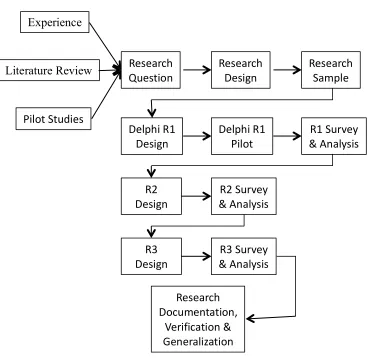
Figure 3 Flow Chart of a Typical Delphi Process 96
CHAPTER 1: INTRODUCTION
“Our people are our greatest asset” (Choppin, 1996, p. 8) is a common colloquialism emanating from corporate boardrooms to shop floors, from owner’s suites to fields of play, from administrative buildings in academia to the classroom. No organization is immune from the stark reality that having the right personnel in the right roles at the right time is a major determinant of future success (Barrick, Mount, & Judge, 2001; Lohman, 2004). In fact, many organizations consider recruiting, selecting, training, and developing personnel their most important competitive advantage (Salgado, Viswesvaran, & Ones, 2001). In a study 481 human resource professionals, Fallaw, Kantrowitz, & Dawson (2012) determined that identifying, selecting and developing a qualified workforce prevails as the lead concern of executives across a variety of organizational settings. Employing a competent workforce was clearly on the mind of respondents of Price Waterhouse Coopers’ (2013) annual survey of chief executive officers, with more than half of the 167 participants citing accessibility to quality workers as the single greatest obstacle to profitable growth. Smart (2012) states, “the single most important driver of organizational performance and individual managerial
success is human capital or talent” (p. 1).
of focus and resources as investment in buildings, land, systems infrastructure, and inventory (Baptiste, 2001).
Perhaps coincidentally, scholars in the late 1950’s and early 1960’s used HCT to explain enhancements to productivity increases that could not be explained by examining investments in financial capital, labor, land, and management alone (Gould, 2005). HCT suggests that an investment in an organizational learning asset, the worker, should be
considered with equal voracity to investments made in more traditional organizational assets (Nafukho, Hairston & Brooks, 2004). Investment in human capital goes beyond benefiting organizations alone to providing benefits to the broader society at large. Scholars have for decades documented the lasting effects of securing and developing human capital
(Sweetland, 1996; Rominger & Sandoval, 1998). Swanson & Holton (2009) go further to suggest that investment in traditional economic organizational assets without commensurate investment in human capital will fall short of achieving maximization of revenue and profit targets.
In the realm of employee selection and development, the monetary stakes of securing the right talent are high (Schmidt & Hunter, 1999). Valero Energy, a global energy company with over $75 billion in revenue, estimates costs associated with individual recruitment and selection at $12,000 (Harris, Craig, & Light, 2011). Costs associated with replacing
to perform at prescribed levels of proficiency related to knowledge, skills, attitudes, and abilities (Schmidt & Hunter, 1998; Lamoureux, 2011). Under Berkley’s guidance, a person collecting a $100,000 salary would cost $150,000 to replace. Generally the Berkley
calculation includes costs associated with recruiting and preliminary onboarding activities. Mornell (1998) sets the multiplier at two and a half times annual salary. Barada (2004) reports costs associated with a bad hire to be three times annual earnings. In his seminal book Topgrading, author Dr. Bradford D. Smart presents a far more daunting view. Offering a comprehensive synthesis of total costs incurred in the hiring process that includes recruitment expenses, assessments, travel related expenses, compensation, mistakes, opportunity costs, training, and severance resulting from separation, Smart surmises cost associated with bad hires approach a factor four times base salary for a supervisory level employee and a factor of fifteen times base salary for vice president level employees. Again assuming $100,000 salary, costs associated with a bad hire can exceed $1,500,000 (Smart, 2012).
standard deviation from a mean measure, which has been found to be at least 40%. Consider the following example:
The 40% figure is a lower bound value; actual values are typically considerably higher. Thus, if the average salary for a job is $40,000, then SDyis at least $16,000.
If performance has a normal distribution, then workers at the 84th percentile produce $16,000 more per year than average workers (i.e. those at the 50th percentile). And the difference between workers at the 16th percentile (“below average workers”) is twice that: $32,000 per year. Such differences are large enough to be important to the economic health of an organization. (Schmidt & Hunter, 1998, p. 263)
While considering the cost of a bad hire in the context of a multiple of salary provides a useful insight into the magnitude of the problem it does not tell the whole story. Relevant qualitative factors with ramifications resulting from bad hires and productivity losses include overall enterprise morale, disillusionment from internal and external customers,
organizational apathy, and lack of creativity (Wolf & Jenkins, 2002; Schneider, 1987). Costs associated with bad hires are but one area of significant concern for human resource development (HRD) professionals tasked with leading organizational selection and employee development initiatives. HRD professionals must also contend with legal
area reviewed is the four-fifths rule. “Under this rule, the selection ratios (number
selected/number eligible) of a protected group and the majority group are compared. When the comparison of the two selection ratios is less than four fifths, or 80%, that result is taken as evidence of adverse impact” (Clardy, 2003, pp. 134-134). For example, a selection process for a hypothetical job category at Sample Company, Inc. evaluates twenty Caucasian candidates for a position, extending offers to fifteen. Conversely, ten African American candidates were evaluated, with five offers extended. The African America job acceptance rate of 50% (five of ten offered a position) is less than four fifths of the corresponding rates for Caucasians of 75% (fifteen of twenty offered a position). Clardy (2003) goes on to review validation of training practices, test construction and validation, negligence in HRD, and the implications of legal schema for both HRD practitioners and scholars, counseling all that “…it is clear that the HRD function must be attentive to the legal requirements affecting training and development activities within the organization” (p. 150).
Ford Motor Company is all too familiar with the financial penalties arising from discriminatory testing procedures. EEOC v. Ford Motor Company and the United
female and Hispanic employees allegedly denied access to upward mobility and professional development programs; Target Stores paid $2 million to a group of prospective employees for asking inappropriate questions on a pre-employment test; State Farm Insurance paid $157 million to a class of prospective employees declaring sex discrimination in selection policies and procedures (EEOC, 2013). The EEOC v. Ford Motor Company and the United
Autoworkers case also calls attention to the fact that active and past employees are seven times more likely to bring suit against their organizations than those being considered for future employment (Sharf & Jones, 2000).
The ability of organizations to reliably predict future performance of job applicants, as well as facilitate learning growth and performance management of existing human resources is an essential component of organizational success (Crook, A. E., Beier, M. E., Cox, C. B., Kell, H. J., Rittmayer, A. & Motowidlo, S. J., 2011). At stake, minimally, are employee productivity, threatening financial and safety errors, and excessive employee turnover and absenteeism (Fiala, 2000). HRD professionals have a cadre of tools at their disposal to enhance their ability to secure the right personnel for vacant positions and to engage personnel in professional development initiatives including personal interviews, reference checks, resumes, bio data, assessment centers, employment tests, and psychometric assessment instruments (Society for Industrial and Organizational Psychology [SIOP], 2003). Of all of the tools available to practitioners, psychometric assessment instruments have
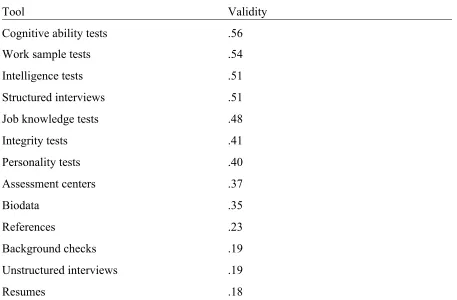
by using valid tests during the selection, promotion, and development process. Table 1 provides a review of the comparative validities of various employee selection and development tools.
Table 1
Validities of Various Employee Selection and Development Tools
Tool Validity
Cognitive ability tests .56
Work sample tests .54
Intelligence tests .51
Structured interviews .51
Job knowledge tests .48
Integrity tests .41
Personality tests .40
Assessment centers .37
Biodata .35
References .23
Background checks .19
Unstructured interviews .19
Resumes .18
Note. Adapted from “Personnel Selection,” by I. T. Robertson and M. Smith, 2001, Journal of Occupational and Organizational Psychology, 74, p. 443. Copyright 2001 by The British Psychological Society.
1991; Murphy, 1989; Murphy & Bartram, 2002; Ones, Viswesvaran, & Schmidt, 1993; Outtz, 2002; Rothstein & Goffin, 2006; Schmidt & Hunter, 1998). Both the American
Educational Research Association [AERA] (1999) and SIOP (2013) recognize the synonymic relationship between the terms test, assessment, profile, and instrument. For the purposes of this study, these four terms are used interchangeably and characterized by the following definition: “an evaluation device or procedure in which a sample of an examinee’s behavior in a specified domain is obtained and subsequently evaluated and scored using a standardized process” (AERA, 1999, p. 2). The scholarly foundation for the use of assessment
instruments parallels support at the practitioner level with studies suggesting the
pervasiveness of use in organizations approaching 75% (Giumetti & Sinar, 2012; Fallaw, Kantrowitz, & Dawson, 2012; Schmidt & Hunter, 1998; Houran & Lange, 2006; Furnham & Jackson, 2011; Lamoureux, 2011; Lombardi, 2013).
governmental advocacy agency responsible for investigating and remedying claims of testing discrimination, admonishes HRD professionals to wade cautiously into employment testing:
Employers should ensure that tests and selection procedures are not adopted casually by managers who know little about these processes. A test or selection procedure can be an effective management tool, but no test or selection procedure should be
implemented without an understanding of its effectiveness and limitations for the organization, its appropriateness for a specific job, and whether it can be
appropriately administered and scored. (p. 6)
Misapplying an instrument dilutes the efficacy of the information it produces, potentially leading HRD professionals to act on misguided information (Ellingson, Sackett, & Connelly, 2007; Guion, 2011). Advancing the purpose of their organizational guidelines on test use, the International Test Commission [ITC] (2000) states:
A competent test user will use tests appropriately, professionally, and in an ethical manner, paying due respect to the needs and rights of those involved in the testing process, the reasons for testing, and the broader context in which testing takes place. This outcome will be achieved by ensuring that the test user has the necessary
competencies to carry out the testing process, and the knowledge and understanding of tests and test use that inform and underpin this process. (p. 6)
Statement of Problem
Evers et al. (2011) sounded an alarm amongst both researchers and practitioners, reporting that incorrect test use was the highest ranked concern of over 12,000 psychologists participating in an expansive study conducted by the European Federation of Psychologists’ Associations. Test use in selection and development can aptly be characterized as a
discipline where research has followed practice, and sadly, the gap separating the two has grown significantly over the years (Anderson, 2005; Klehe, 2004; Robertson & Smith, 2001). In their study of 255 human resource practitioners, Furnham & Jackson (2011) arrived at the following conclusion: “…it is very difficult for untrained people to differentiate between good and bad psychometric tests” (p. 553). Scholars agree that organizations are
increasingly choosing selection and development tools of poor psychometric value and unnecessary exposure to litigation (Klehe, 2004; Pulakos, 2005). Risavy & Hausdorf (2011) concur, stating, “organizational members in charge of selection procedures may not
If HRD practitioners do not understand and utilize proper decision criteria for
choosing and administering assessment instruments for employee selection and development, they face potentially devastating consequences for their organizations. First, they expose their organizations to meaningful costs associated with turnover and replacement of bad hires (Smart, 2012). Second, worker productivity losses tied to underperforming employees may negatively impact efficiency and drive up costs of operations (Schmidt & Hunter, 1998). Third, litigation resulting from successful employee claims of adverse impact may result in significant financial penalties (Kohl, 1983).
While the use of instruments in employee selection and development is well documented, no guiding decision criteria exist to aid HRD professionals, both in selection and development, in mitigating the substantive risks associated with instrument selection and use. If HRD professionals are expected to choose, administer, and interpret instruments for employee selection and development, then a reliable, valid set of decision criteria for proper instrument selection is needed. “The proper use of tests can result in wiser decisions about individuals and programs that would be the case without their use.” (AERA, 1999, p. 1).
Purpose Statement
Theoretical Framework
Prescriptive decision theory will be used as the study’s theoretical framework. Following Swanson’s (2001) three legged stool metaphor for the theoretical foundations of HRD, decision theory is claimed by the disciplines of psychology and economics. Other disciplines laying claim to decision theory include sociology, management, and philosophy (Einhorn & Hogarth, 1988). From a psychological perspective, Einhorn & Hogarth (1988) suggest “psychologists can best contribute to decision research by elucidating the basic psychological processes underlying judgment and choice” (p. 140). Fishburn (1991) defines decision theory in the following manner:
“Decision theory includes theories of preference, utility and value, subjective probability and ambiguity, decision under risk or uncertainty, Bayesian decision analysis,
probabilistic choice, social choice, and elections” (p. 27).
Scholars tend to contemplate decision theory from three conceptual perspectives: normative decision theory, prescriptive decision theory, and descriptive or behavioral decision theory (Becker & McClintock, 1967; Bell, Raiffa, & Tversky, 1988; Baron, 1996; Brown, 1989; Fishburn, 1991; Freeling, 1984; Holton & Naquin, 2005; Luce, 1992; Machina, 1982; Weber, 1987). Freeling (1984) surmises an efficient characterization of the three theoretical
perspectives: “A descriptive theory describes how a person acts, a normative theory describes how a perfectly rational, super being would act, and a prescriptive theory prescribes how a person should act” (p. 189). Figure 1 depicts an illustration of Freeling’s (1984)
Figure 1. Characterization of three theoretical perspectives of decision theory. Adapted from “A Philosophical Basis for Decision Making,” by A. Freeling, 1984, Theory and Decision, 16(2), 176-206. Copyright 1984 by Springer.
Normative
Normative decision models were conceived to arm decision makers (DM) with ammunition to make the best possible decision in a given situation, informed by specific guidance for what the DM should consider, and ultimately how they should make their decision. Normative theory attempts to designate optimal decision processes, and how a person should make a decision with guidance from these processes (Ellsberg, 1961; Becker
Decision Theory Norma0ve
Prescrip0ve Behavioral/
Descrip0ve
How a person should act. How a person acts.
How a perfectly rational,
& McClintock, 1967). The theory was founded on the premise that a rational person will optimize, or maximize their utility while simultaneously mitigating risks based on certain mathematically computational probabilities of achieving maximized utility. Normative theories acquaint DM’s with transcendent decision frameworks that will result in infallible results (Luce, 1992; Siegel, 1957; Pitz & Sachs, 1984). Holton & Naquin (2005) and Simon (1955) explain several assumptions underlying normative models:
• Decision making in undertaken in a logical, sequential fashion including problem definition, identification of alternatives, weighing of alternatives, selection of optimal decision, and evaluation of decision
• Objective is to maximize benefit and mitigate down side
• DM is a rational human being capable of consuming, processing, and acting on large volumes of information in complex situations
• DM has complete access to all information necessary to make a decision • Complete rationality is feasible
• DM has the capacity to calculate payoff probabilities by alternative • Irrational decision making is the failure of human cognition
• DM has clearly defined preferences
Coupled with these underlying assumptions are several axioms of normative models. The first, transitivity, deals with ordering of preferences based on expected utility.
somewhere between choice p and p’ there exists choice r, then r is preferred over p’ (Luce 1982; Tversky & Kahneman, 1988). Finally, the independence axiom states that “if I prefer p to p’, I’ll also prefer the possibility of p to the possibility of p’, given that the other
possibility in both cases is some p”. In particular, the axiom says that if I’m comparing ap + (1 – a)p” to ap” + (1 – a) p’, I should focus on the distinction between p and p’ and hold the same preference independently of both a and p” (Levin, 2006, p. 6).
Two seminal normative decision theories are expected utility (EU) theory and subjective expected utility (SEU) theory. Daniel Bernoulli is credited with the first
While they are still very much anchored in decision making for both theoretical and practical purposes, normative models have their critics (Ellsberg, 1961). Studies document violations of transitivity and independence axioms, as well as many of the underlying assumptions of normative theory mentioned previously. Simon (1955) for example,
famously coined the terms “satisfice” (p. 104) and “bounded rationality” (p. 113) to describe this phenomenon. Relieving his economic bent with a more psychological perspective, he endeavored “to replace the global rationality of economic man with a kind of rational behavior that is compatible with the access to information and the computational capacities that are actually possessed by organisms, including man, in the kinds of environments in which such organisms exist” (p. 99). Satisficing, then, became a new standard for optimal decision-making given the constraints of information access and limitations of the human mind to function in a completely rational manner. In subsequent work, Simon (1957) laid the groundwork for decades of scholarly work challenging perfect rationality, advising all to consider “the capacity of the human mind for formulating and solving complex problems is very small compared with the size of the problems whose solution is required for objectively rational behavior in the real world- or even for a reasonable approximation to such objective rationality” (p. 198).
Prescriptive
“Normative models are evaluated by their theoretical adequacy, that is, the degree to which they provide acceptable idealization or rational choice. Prescriptive models are evaluated by their pragmatic value, that is, their ability to help people make better decisions” (p. 18). Baron (1996) echoes this practicality stating “normative theory is an idealized abstraction, an analytic framework that we impose on disorderly flow of existence for the sake of defining a standard…..Rules that are better than others according to the standard are called prescriptive” (p. 7). Prescriptive models substitute the concept of the fully rational DM with the fully real DM. While prescriptive models ease what some pundits see as the harsh, unrealistic
constraints of normative models, critics still question prescriptive models to function properly in a world with limited and imperfect information (Weber, 1987). Fama (1970) cautioned against belying rationality based solely on evidence of violations of normative axioms and assumptions.
Descriptive
Where normative models determine how a DM should make a decision, descriptive (also known as behavioral) models evaluate how people actually behave (Becker &
McClintock, 1967; Brown, 1989; Einhorn & Hogarth, 1988; Fishburn, 1991; Freeling, 1984; Pitz & Sachs, 1984). Descriptive models have gained popularity both for their response to observed limitations of rational decision models as well as directed scholarly inquiry whose sole purpose is to describe how people actually make decisions. And enhancements to technology have opened previously inaccessible windows of insights into brain function- and its requisite impact on decision-making. Electroencephalography (EEG),
Resonance Imaging, and Functional Magnetic Resonance Spectroscopy are but a few examples of specific technologies allowing researchers to map brain function to structured stimuli. Many researchers, for example, have challenged the notion of a rational, orderly decision making processes in favor of a more instinctual conceptualizations based on new understanding of brain activity in what is termed the reptilian brain (Sousa, 2006). There is little doubt about the positive impact of a greater understanding of how the brain actually engages decision making to drive enhancements to descriptive decision models. Others see just as much promise of enhancements to both normative and prescriptive models based on the same findings (Sylwester, 2005).
Conceptual Framework
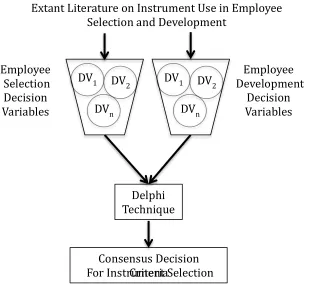
The conceptual framework models the research path, beginning with a comprehensive review of extant literature on the topic of instrument use in employee selection and
Figure 2. Conceptual framework
Research questions
1. What are the decision criteria that should be considered when selecting assessment instruments for employee selection applications as identified by a panel of experts in psychometric instrument use?
2. What are the decision criteria that should be considered when selecting assessment instruments for employee development applications?
Employee Selection
Decision Variables
Employee Development
Decision Variables
DV1 DV 2
DVn
Delphi Technique
Consensus Decision Criteria
For Instrument Selection
Extant Literature on Instrument Use in Employee
Selection and Development
DV1 DV 2
3. What is the level of importance of decision criteria that should be considered when selecting instruments for employee selection among an assembled panel of experts in psychometric instrument use and to what extent is there reliable consensus?
4. What is the level of importance of decision criteria that should be considered when selecting instruments for employee development among an assembled panel of experts in psychometric instrument use and to what extent is there reliable consensus?
5. Are there differences in the opinion among an assembled panel of experts on decision criteria that should be considered when selecting assessment instruments for employee selection and development applications?
Significance of Study
This study has the potential to add significant value to both practitioners and scholars in the field of HRD engaged in utilizing assessment instruments for selection and
development of employees. First, the study addresses a meaningful gap in extant literature on the subject, and as such, contributes new knowledge to the HRD field. This new
interest in ensuring their instruments are administered correctly and that the information provided does in fact inform good hiring and development decisions. Finally, business development professionals charged with merchandising and selling instruments to organizations can position their product and service offerings more effectively by better understanding decision criteria used by their prospects and customers.
Limitations
This study has several limitations. First, the Delphi method by its nature is a limited, purposeful sample, eliminating the possibility of collecting a true random sample.
Second, the overwhelming majority of participants came from academia, so caution should be used on how broadly findings can be generalized beyond this population. And while the number of participants (18 for round one and 15 for round two) certainly fell within accepted standards of sample size for a Delphi study, caution should also be used around generalizing findings for this reason as well.
Third, the study participants were principally based in the United States. To the extent that regional geographic differences exist in the context of the study’s research questions, these differences were not explored or otherwise accounted for.
Delimitations
The study only queried experts who have reviewed instruments presented in the Mental Measurements Yearbook. Second, the study will limit its focus to tests, assessments, and instruments used in employee selection and development applications. Instruments used in psychological testing beyond this scope will not be considered.
Definition of Terms
Ability testing is “the use of standardized tests to evaluate the current performance of a person in some defined domain of cognitive, psychomotor, or physical functioning”
(Riverside Publishing, 2013, p. 1).
Accommodation is “the general term for any action taken in response to a determination that an individual’s disability requires a departure from established testing protocol.”
(AERA, 1999, p. 101)
Achievement test is “a test designed to measure the extent to which a person has acquired certain knowledge and/or skills that have been taught in school or as a part of some other planned instruction or training” (Riverside Publishing, 2013, p. 1).
Adaptive test is “a computer-administered test in which the next item or set of items selected to be administered depends on the correctness of the test taker’s responses to the most recent items administered” (National Council on Measurement in Education [NCME], 2013, p. 1).
Assessment “commonly refers to a process that integrates test information with information from other sources” (AERA, 1999, p. 2).
Aptitude test is “a test designed to measure the ability of a person to develop skill or acquire knowledge. Any test used to assess a person´s "readiness" to learn or potential for future success in a particular area if the appropriate education or training is provided (e.g., musical aptitude test). An IQ test is a well-known example of an aptitude test for measuring general academic ability” (Riverside Publishing, 2013, p. 1).
Assessment is “a tool or method of obtaining information from tests or other sources about the achievement or abilities of individuals. Often used interchangeably with test” (NCME, 2013, p. 1)
Bias is “construct irrelevant components that result in systematically lower or higher scores for identifiable groups of examinees.” (AERA, 1999, p. 76)
Central tendency is “a term that refers to the center or middle of a score distribution, typically represented by some type of average. The mean and median are measures of central tendency (Riverside Publishing, 2013, p. 1).
Classical test theory is “a theory of testing based on the idea that a person’s observed or obtained score on a test is the sum of a true score (error-free score) and an error score” (NCME, 2013, p. 1)
Cognitive assessment is “the process of systematically gathering test scores and related data in order to make judgments about an individual's ability to perform various mental activities involved in the processing, acquisition, retention, conceptualization, and
organization of sensory, perceptual, verbal, spatial, and psychomotor information” (Riverside Publishing, 2013, p. 1).
Confidence interval is “an interval between two values on a score scale within which, with specified probability, a score or parameter of interest lies. An individual's test score provides a good point estimate of the respondent’s ability in a specific area. However, this estimate, as in any measurement process, contains some degree of error (either for or against the student's favor). A confidence interval provides a range of values around the estimate to indicate how accurate or precise the estimate is likely to be” (Riverside Publishing, 2013, p. 1).
Computer-based testing is “a test administered on a computer rather than with paper and pencil: items are displayed on a screen and the test taker responds using a keyboard, mouse, or similar device” (NCME, 2013, p. 1).
Construct is “the psychological trait or characteristic that an assessment tool has been designed to measure. Examples include achievement, cognitive ability, and interests” (NCME, 2013, p. 1).
Content validity is the “assessment of the degree of correspondence between the items selected to constitute a summated scale and its conceptual definition” (Hair et al., 2006, p. 102).
Correlation is “the degree of relationship (or strength of association) between two sets of scores based on the same set of individuals. Correlation simply refers to the strength of the relationship existing between two sets of values and does not necessarily imply that one influenced the other or caused the other to happen. The most commonly used statistic for measuring correlation is Pearson's product moment r (Pearson's correlation coefficient)” (Riverside Publishing, 2013, p. 1).
Correlation coefficient is “a statistic used to show how the scores from one measure relate to scores on a second measure for the same group of individuals. A high value
(approaching +1.00) is a strong direct relationship, a low negative value (approaching -1.00) is a strong inverse relationship, and values near 0.00 indicate little, if any, relationship” (NCME, 2013, p. 1).
Criterion is the performance or result considered important: “…a dependent variable, the variable to be predicted” (Guion, R. M., 2011, p. 85).
Criterion score is “a score used in obtaining criterion-related validity evidence— concurrent evidence or predictive evidence —for a set of scores” (NCME, 2013, p. 1).
Cut score is a “specified point on a distribution of scores above which candidates pass, or are accepted, and below which they fail, or are rejected” (Cascio, Outtz, Zedeck, & Goldstein, 1991, p. 234).
Delphi Study is “a survey method of research which aims to structure group opinion and discussion” (Goodman, 1987, p. 729).
Diagnostic test is “an intensive, in-depth evaluation process with a relatively detailed and narrow coverage of a specific area, generally prompted by a perceived problem and administered in order to determine a student's current level of functioning” (Riverside Publishing, 2013, p. 1).
Differential item functioning is “said to exist when examinees of equal ability differ on average, according to their group memberships, in their responses to a particular item.” (AERA, 1999, p. 77)
Difficulty is “a property of a test item, usually represented by the proportion of a group that correctly answers the item, obtained from a specific group on a single occasion” (NCME, 2013, p. 1)
Distribution is “the tabulation of scores (ordered either in ascending or descending value) showing the number of individuals in a group obtaining each score or contained within a specified fixed range of scores (score interval). Also commonly referred to as a Frequency Distribution” (Riverside Publishing, 2013, p. 1).
Employment Test is a “…systematic procedure for examining candidates and drawing methodical inferences, based on objective criteria, about their sustainability for employment” (Douglas, Feld, & Asquith, 1989, p. 3).
Error of measurement is “inaccuracies in measuring the true variable values due to the fallibility of the measurement instrument, data entry errors, or respondent errors” (Hair et al., 2006, p. 101).
Error score is, “in classical test theory, the score that represents the random error portion of a test taker’s obtained or observed score. The other portion is the true score” (NCME, 2013, p. 1).
Face validity is “the extent to which items on a test appear to be meaningful and relevant” (Kaplan & Saccuzzo, 2009, p. 618).
Fairness is exists when “no bias exists if the regression equations relating the test and the criterion are indistinguishable for the groups in question.” (AERA, 1999, p. 79)
Instrument means “a device used to measure the concept of interest in a research project” (Brokopp & Hastings-Tolsma, 2003, p. 207).
Intelligence test is “a psychological or educational test designed to measure an individual's level of cognitive functioning (verbal reasoning, abstract reasoning, memory, etc.), in accord with some recognized theory of intelligence” (Riverside Publishing, 2013, p. 1).
Intercorrelations is “a matrix of correlation coefficients, calculated between two or more sets of scores for the same set of individuals” (Riverside Publishing, 2013, p. 1).
Internal consistency is the “degree of consistency among responses to items” (Brokopp & Hastings-Tolsma, 2003, p. 218).
Inventory is “an assessment tool, usually in the form of a self-report questionnaire or checklist, that is used to obtain information about a person’s attitudes, interests, preferences, or some other personality trait” (NCME, 2013, p. 1).
IQ Test is “an intelligence test administered to measure an individual's IQ (Intelligence Quotient). IQ scores were originally expressed as the ratio of an examinee's mental age to his/her chronological age, although over the years that formula has been replaced with the concept of the deviation IQ (e.g., a standard score with a mean of 100 and a standard deviation of 16)” (Riverside Publishing, 2013, p. 1).
Item is “a specific stimulus to which a person responds to overtly; this response can be scored or evaluated” (Kaplan & Saccuzzo, 2009, p. 6).
Interquartile range is “a computed value indicating the distance between the lower quartile and upper quartile” (Riverside Publishing, 2013, p. 1).
Mean is “the average score obtained by some identified group. All scores are added and the sum is divided by the number of scores” (NCME, 2013, p.1).
Measurement is “consists of rules for assigning numbers to objects in such a way as to represent quantities of attributes” (Nunnally, 1978, p. 3).
Measurement Error is “the hypothetical difference between an examinee’s observed score on any particular measurement and the examinee’s true score or universe score for the procedure.” (AERA, 1999, p. 25)
Median is “the score above which and below which exactly half of the scores in a certain group are located when the scores are placed in order from high to low. It also is known as the middle score or 50th percentile” (NCME, 2013, p. 1).
Mode is “the score(s) obtained by the largest number of individuals in a group. It is the most-frequently-occurring score(s) within a given set of scores” (NCME, 2013, p. 1).
Normal distribution is “a graphic display of scores for a large group that has the shape of a bell: many persons have scores in the middle and a much smaller number have very high or very low scores. Many physical and psychological characteristics demonstrate a normal, or bell-shaped, distribution when shown graphically” (NCME, 2013, p. 1).
O*NET is “a system of occupational description information designed to provide data about jobs in the workplace of today and into the future” (Jeanneret & Strong, 2003, p. 466).
Parallel forms is “two or more forms of a test that have been demonstrated (statistically) to measure the same ability, with the same degree of accuracy. They yield scores for an individual that are interchangeable in meaning. Also known as alternate forms, equivalent forms, or comparable forms” (NCME, 2013, p. 1).
Pearson's correlation coefficient is “a measure of correlation when both variables are measured on interval scales or ratio scales”(Stuart-Hamilton, 2007, p. 197).
Performance is “…something that people actually do and can be observed. By
definition, it includes only those actions or behaviors that are relevant to the organization’s goals and that can be scaled (measured) in terms of each person’s proficiency. Performance is what an organization hires one to do, and to do well. Performance is not the consequence or result of action, it is the action itself” (Campbell, McCloy, Oppler, & Sager, 1993, pp. 40-41).
Performance assessment is “product and behavior based measurements based on settings designed to emulate real-life contexts or conditions which specific knowledge or skills are actually applied. In the strictest sense, performance assessments involve some motor or manual response on the part of the examinee and tend to minimize the role of language” (Riverside Publishing, 2013, p. 1).
Pilot test is “a test administration that occurs during the development process to check on the quality and appropriateness of test items, administration procedures, scoring, and/or reporting. Sometimes the purpose is to check on the impact of optional ways of
administering, scoring, or reporting” (NCME, 2013, p. 1).
Predictive evidence is “information gathered in the process of validation to show that scores from one test are related to criterion scores collected at some later point in time. Correlation coefficients often are used as a form of such evidence” (NCME, 2013p. 1).
Psychological Test is “any test used to quantify a person’s mental abilities, aptitude, intelligence, or personality (Furnham & Jackson, 2011, p. 549).
Psychometrics “concerns the measurement of individual differences in applied settings- in schools, the military, industry, government, and other institutions” (Nunnally, 1975, p. 8).
Random error is “an unsystematic measurement error. A quantity (often observed indirectly) that appears to have no relationship to any other variable or is due to random causes” (Riverside Publishing, 2013, p. 1).
Range is “the range of a distribution of scores is defined as the difference between the two extremes (maximum score minus minimum score), and is a rough indication of the spread or variability of the scores” (Riverside Publishing, 2013, p. 1).
Response format is a term used to describe the composition, configuration, and
arrangement of an examinee’s answer to a given item such as short answer, multiple choice, or constructed response. (AERA, 1999)
Sample is “the subset of the population on which the study collects data”. (Agresti & Finlay, 2009, p. 4)
Scales are “tools that related raw scores on test items to some defined theoretical or empirical distribution” (Kaplan & Saccuzzo, 2009, p. 620).
Scaling is “the process of creating a scale or a scale score” (Riverside Publishing, 2013, p. 1).
Stability is “the consistency of responses between successive rounds of a study” (Dajani, Sincoff & Talley, 1979, p. 84).
Standard deviation is “a statistic that describes how much the scores in a particular group vary; it is a measure of variability. Conceptually, the number indicates the average amount by which the scores in a group differ from their mean score” (NCME, 2013, p. 1).
Standard error of measurement is, “in classical test theory, a statistic computed for a set of scores using the standard deviation of those scores and a reliability coefficient. It is used in score interpretation to show the amount of error that likely would be associated with a
particular obtained score” (NCME, 2013, p. 1).
interpreted through comparisons to a specific reference group (norm group) who were administered the test under the same conditions” (Riverside Publishing, 2013, p. 1).
Systematic error is “a consistent score component or measurement error that is not related to the test performance. Also known as a bias” (Riverside Publishing, 2013, p. 1).
Test is “an evaluative device or procedure in which a sample of an examinee’s behavior in a specified domain is obtained and subsequently evaluated and scored using a standardized process” (AERA, 1999, p. 2).
Test retest reliability is “a reliability coefficient obtained by administering the same test a second time to the same group of examinees after a short time interval and correlating the two sets of scores” (Riverside Publishing, 2013).
True score is “the score a test taker would receive if there were no influences of random error in the testing process. In classical test theory, the hypothetical score a person would receive if the same test could be given many times and the scores were averaged across those occasions (NCME, 2013, p. 1).
Validity is “the degree to which the evidence obtained through validation supports the score interpretations and uses to be made of the scores from a certain test administered to a certain person or group on a specific occasion. Sometimes the evidence shows why
competing interpretations or uses are inappropriate, or less appropriate, than the proposed ones” (NCME, 2013, p. 1).
Chapter Summary
CHAPTER TWO: REVIEW OF THE LITERATURE Introduction
The review of literature includes seven sections with each section presenting foundational content that undergirds understanding of decision criteria used for choosing assessment instruments for employee selection and development. Section one considers the historical context of instrument use in selection and development. Historical context is important because it provides awareness of factors that have influenced and shaped present day instrument use. Section two provides an overview of instrument development, outlining how instruments are conceptualized and subsequently constructed, providing an
understanding of the process by which instruments are validated, constructed for reliability, and ultimately used by practitioners. Included in this section is a presentation of Gable & Wolf’s (1993) influential 15-step instrument development model.
Section three briefly examines tools other than assessment instruments practitioners utilize to inform employee selection and development decisions, including interviews,
Section six reviews the legal considerations of using instruments for selection and development. Consideration of legal issues facing practitioners is meritorious due to the significant individual and organizational risks associated with poor management of this important construct. Finally, section seven lays out selection criteria practitioners should consider when choosing an instrument for employee selection and development. This section is the most important part of the review of literature in that the factors discussed will
ultimately be used to populate the questionnaire for the Delphi study, which is outlined in detail in Chapter Three.
History of Instrument Development and Use
This section provides historical context of instrument development and use. Examination of history is important because it illuminates important people, events, and conditions that have shaped present day construction and administration of instruments for employee selection and development. The history of instrument development and use
1985; Kaplan & Saccuzzo, 2009; Berger & Ghei, 1995). Scholars generally agree on the fact that this early development and use of instruments strongly influenced adoption of testing in the United States. A landmark decision was made by the United States government in 1883 to charter the American Civil Services Commission, whose purpose was to author and administer tests for government jobs (Kaplan & Saccuzzo, 2009).
Concurrently, Alfred Binet’s pioneering work on intelligence testing established a profound mark on what would become present day psychological testing: “…a history of mental testing is in large part a history of Alfred Binet’s scale and its descendants”
(Cronbach, 1990, p. 227). At their core, psychological tests are about discriminating between individual differences, and Binet’s work focused on what he termed normal and sub normal intelligence (Kaplan & Saccuzzo, 2009; Rominger & Sandoval, 1998; Zemke, 1983). Work by Thorndike, Spearman, Galton, Munsterberg, Cattell, and Thurstone were also early contributors to instrument use in employee selection and development (Kaplan & Saccuzzo, 2009; Ree, Earles, & Treachout 1994; Cronbach, 1990; Campbell, 1990).
both military and industrial applications. Apparent success in military applications created an appetite for use in industrial settings through the early 1960’s (McDaniel, Morgeson, Finnegan, Campion, & Braveman, 2001; Menjoge, 2003; Rominger & Sandoval, 1998). Of particular note in this era is the emergence of personality as a construct to measure and predict employee performance (Barrick & Mount, 1991; McDougall, 1932; Cattell, 1943; McDaniel et al., 2001; Cronbach, 1990; Menjoge, 2003).
Two additional events of significance in the early to mid 1900’s are the introduction of statistical analysis, specifically factor analysis, to instrument development and use, and the publication of the first Mental Measurement Yearbook (MMY). Charles Spearman is
credited with the development of factor analysis, a statistical tool used to simplify a
multitude of variables into a smaller number of factors (Kaplan & Saccuzzo, 2009). “Factor analysis is a procedure that attempts to reduce the complexity of a multi-variable data set so it becomes easier for people to use the data in applied settings or in the
Without doubt the most significant event in the mid-1900’s was the launch of the Civil Rights Act of 1964. The Act set forth terms and conditions for eliminating
discrimination in workplace hiring and employee development. Included in the Act were guidelines on the development and administration of psychological tests in employee selection and development applications (EEOC, 2013; Aguinis & Smith, 2007; Camara & Mernda, 2000; Fiala, 2000; Guion, 2011; Hunter & Schmidt, 1982; Menjoge, 2003). The effects of the Civil Rights Act of 1964, and accordingly the subject of adverse impact, are discussed in greater detail in section six of the literature review. In terms of scholarly contributions to employee selection and development in the 1960’s, Guion & Gottier’s (1965) influential article on the merits of personality deserves special recognition (Murphy & Dzieweczynski, 2005; Tett, Jackson, & Rothstein, 1991). Prior to their article, personality as a predictive measure of future performance had gained acceptance among scholars and practitioners. Guion & Gottier (1965) literally changed the course of discussion on personality, citing poor validity evidence: “it is difficult, in the face of this summary to advocate, with a clear conscience, the use of personality measures in most situations as a basis for making employment decisions about people” (p. 160). This perspective persisted through the next twenty-five years.
2003; Rominger & Sandoval, 1998). Fearing possible litigation from improper test use, in particular tests of intelligence and cognition, organizational support of the use of tests cooled significantly for a period of twenty years (Zemke, 1983; Murphy & Dzieweczynski, 2005; Rominger & Sandoval, 1998; Clardy, 2003). While interest in intelligence tests waned, the use of personality as a predictive measure of future success experienced a renaissance (Ones, Dilcheert, Viswesvaran, & Judge, 2007; Outtz, 2002; Anderson, 2012; Borman, Hanson, & Hedge, 1997; Robertson & Smith, 2001). Kanfer, Ackerman, Murtha, & Goff (1995) challenged Guion & Gottier’s (1965) decades long belief that personality was not a viable predictor of future performance, citing increases in validity and reliability, and from their perspective, fundamental success declared by practitioners: “from a practical standpoint, recent findings suggest that the controversy over whether personality tests can be useful for prediction of employee performance is no longer pertinent” (p. 597).
generalizability across multiple job categories (Barrick & Mount, 1991; Oh & Berry, 2009; Tett, Jackson, & Rothstein, 1991). Validity Generalization (VG) is “the working hypothesis that a selection rule found valid in one setting will be valid in the next” (Cronbach, 1990, p.434). Schmidt & Hunter (1998) rejuvenated VG in predicting job performance,
challenging the notion that certain characteristics, such as intelligence, or cognition, were job specific. Researchers were admonished to consider the fact that individual study variation was actually caused by “study artifacts” (Guion, 2011, p. 258) such as measurement error, sampling error, and range restriction, and that results of meta-analysis were generalizable across jobs categories for certain variables like cognition and personality (Mendoza & Mumford, 1987; Murphy & Shiarella, 1997; Murphy, 2003; Schmidt, 2012).
The period 1970-2000 also saw two additional occurrences of historical note: computer assisted testing (CAT) and the development of the Occupational Information Network (O*NET). CAT shows up in the literature in the late 1970’s and early 1980’s (Barak & English, 2002; British Psychological Society [BPS], 2005). CAT “may be considered to include any psychological assessment that involves the use of digital
regard to remote test takers, and concerns by some that computer tests are not equivalent to paper-and-pencil instruments (Barak & English, 2002; Meade, Michels, & Lautenschlager, 2007; Naglieri, et.al., 2004; Preckel & Thiemann, 2003; Weigold, Weigold, & Russell, 2013; US Department of Labor, 2006; Buchanan, 2002).
Concerns over test equivalency between paper-and-pencil and computer administered tests have largely been laid to rest, with a multitude of studies proving comparable validities between the two mediums (Weigold, Weigold, & Russell, 2013; Smith & Leigh, 1997; Buchanan & Smith, 1999; Pasveer & Ellard, 1998; Pettit, 1999; Rothstein & Goffin, 2006). Bartram & Brown (2004), for example, compared results of paper-and-pencil and computer assisted administrations of the Occupational Personality Questionnaire (OPQ) to over 1,100 respondents. No significant differences in validity and reliability were observed. The advent of the computer also enabled the development and introduction of adaptive testing to
psychological assessment (Barak & English, 2002). Adaptive testing protocols “actively monitor the test-taker’s responses to each item then selectively administer subsequent items that are most likely to provide responses that are maximally informative in terms of
pinpointing the test-taker’s level on the respective…trait” (Rothstein & Goffin, 2006, p. 173). Finally, the creation of O*NET consolidated job analysis information into a single database, allowing users a single point of access to important criterion to be used to model desirable traits in job candidates in terms of predicting future success (Jeanneret & Strong, 2003; Guion, 2011; Murphy & Dzieweczynski, 2005).
and awareness of adverse impact and its effects on instrument selection and use. Further, the decade also saw increasing calls for the establishment of universal standards and guidelines for test use. Three prominent themes emerged related to computer based testing: expanded use of adaptive testing (Houran & Lange, 2006), administration of testing on remote users (Beaty et al., 2011), and the popularity of user preferences for test taking on mobile devices (Fallow, Krantrowitz, & Dawson, 2012). Of particular interest were studies evaluating the efficacy of unproctored remote testing and growing calls for certification of test
administrators (Lombardi, 2013; Naglieri et al., 2004; Evers et al., 2011; Bartram, 2011). Beaty et al. (2011), for example, conducted meta-analysis on over 100 studies evaluating comparative validities of proctored and unproctored tests, with no significant differences reported.
Personality as a predicative measure of performance continued to gain in popularity during this time period (Risavy & Hausdorf, 2011; Anderson, 2012; Hough & Oswald, 2005). Scholars lend partial credit to the growth in popularity of personality measures to the fact that, unlike tests of cognition, personality tests do not create user and test-taker
Instrument Development
This section investigates the instrument development process using a framework developed by Gable & Wolf (1993). First, definitions of instruments and measurement are offered, as well as examples of instrument use in a variety of applications. Second, the Gable & Wolf (1993) framework is considered in a general sense relative to a four part generic development model, as well as models by Benson & Clark (1982) model, and Churchill (1979). Models were chosen for their pervasive mention in the literature, and for their cross disciplinary representation of marketing, occupational theory, and education. The section continues with an investigation of the 15 stages of the Gable & Wolf model.
Instrument Definition and Uses
The ambition of research is to discover conclusive answers to questions of meaningful consequence. Informed by appropriate theoretical frameworks and careful review of the literature, researchers formulate research questions, specify variables of interest, select specific statistical methods, collect and analyze data, interpret data, draw conclusions, and finally, make recommendations for future research and cite implications for practice (Creswell, 2009). Data collection occurs through a variety of methods, most
“consists of rules for assigning numbers to objects in such a way as to represent quantities of attributes” (Nunnally, 1978, p. 3).
Instruments are used broadly in corporate (in particular marketing), medical, psychological, educational, scientific, military, and social settings. Their use attempts to provide objectivity, quantification, communication, and ultimately, scientific generalization (Nunnally, 1978). Berk (1979) for example constructed a rating instrument for faculty evaluation in a university setting. Other examples of educational use include tools designed to assess graduate student attitudes towards quantitative research methodologies, a scale measuring quality of life among staff and students in a college setting, and an instrument designed to measure the self efficacy of high school football coaches (Chang, 1996; Cummins, Mccabe, Romero & Gullone, 1994; Feltz, Chase, Moritz & Sullivan, 1999). Assessments have been used to identify listening style preferences of sales people (Bodie & Worthington, 2010; Castleberry, Ridnour & Shepard, 2011; Drollinger, Comer, &
Worthington, 2006). In attempting to better understand psychosocial needs of United States Air Force (USAF) personnel, Chang, Frost & Ree (2010) developed an instrument to
measure needs of USAF assets stationed overseas.
Leong & Tan, 2006). The psychological community is a prolific producer and consumer of instruments designed to assess conditions associated with maladaptive behavior and a popular assortment of personality style assessments such at the Myers Briggs Type Indicator (Dennis & Vander Wal, 2010; Myers, McCaulley, Quenck & Hammer, 2009).
Instrument Development Models
This section provides a comparison of prominent instrument development models advanced by Benson & Clark (1982), Gable & Wolf (1993), and Churchill (1979). Table 2 displays characteristics of all three models bound by the general classification of planning, construction, evaluation, and validation offered by Benson & Clark (1982).
Planning begins with some conceptual basis for an instrument. All three models follow Guttman’s (1958) directive to “conceptualize- in substantive terms- what is being studied before one proceeds to design tests, gather data, and go through elaborate statistical analysis” (p.498). Researchers should thoughtfully consider purpose, persons included and ultimately affected by conclusions drawn from analysis, and the disposition of results and insights gleaned from the process (Berk, 1979). Benson & Clark’s (1982) model originates with a statement of purpose subsequently informed by careful review of extant literature on the topic of study. A bank of preliminary questions are then formulated and delivered to a specified group of content experts. Feedback from content experts’ give researchers early evidence of the relevance and accuracy of the proposed content, thus developing a