ABSTRACT
BOYCE, ACEY KREISLER. Deep Gamification: Combining Game-based and Play-based Methods. (Under the direction of Dr. Tiffany Barnes.)
Deep Gamification: Combining Game-based and Play-based Methods
by Acey K. Boyce
A dissertation submitted to the Graduate Faculty of North Carolina State University
in partial fulfillment of the requirements for the degree of
Doctor of Philosophy
Computer Science
Raleigh, North Carolina 2014
APPROVED BY:
_______________________________ ______________________________ Tiffany Barnes, Ph.D. Michael Young, Ph.D.
Committee Chair
________________________________ ________________________________
DEDICATION
BIOGRAPHY
Acey Boyce will graduate from North Carolina State University in August 2014 with his PhD in Computer Science focused on the incremental development and refinement of BeadLoom Game into a deeply-gamified educational system for teaching Cartesian
coordinates, graphing, iteration, layering, and optimization to middle school children. Boyce led a team of 4 students from 2008-2012 to design, prototype, test, and develop the
BeadLoom Game for deployment in middle school camps, schools, and after school
ACKNOWLEDGEMENTS
First I want to thank my advisor Dr. Tiffany Barnes. Without her I would have never gone for my PhD and never had any of the exciting adventures that have happened as a result. Although I introduced her to Dominion so I guess we are even.
I also would like to thank my mom for putting up with my long academic career and supporting me all the while. I doubt she expected me to spend 10 years in college learning about video games. You are the best.
TABLE OF CONTENTS
LIST OF TABLES ... vii
LIST OF FIGURES ... viii
Introduction ...1
Early Educational Games – Edutainment ...1
Serious Games ...3
Gamification ...5
Classifying Serious Games and Gamified Systems ...19
Problems with Traditional Gamification ...24
Constructionist Learning Environments ...27
Research Questions ...29
Virtual Bead Loom ...35
Virtual Bead Loom Design ...36
BeadLoom Game Prototype ...40
Initial Trial ...43
BeadLoom Game 1.0 ...45
Study One: BLG ...48
Methods...49
Results ...51
Study Two: BLG Vs VBL ...53
Methods...53
Results – Middle School Camp...55
Results – High School Camp ...58
Discussion ...61
BeadLoom Game 2.0 ...63
Study Three: Custom Puzzles ...68
Results – Tests ...72
Results – Game Metrics ...75
Results – Surveys ...78
Discussion ...83
Study Four: Showcase...85
Methods...86
Results ...89
Discussion ...90
BeadLoom Game 3.0 ...91
Effective Strategies for Guiding User Behavior in User-Generated Content Creation Environments ...92
Study Five: Point Limits ...98
Prototype Methods ...99
Prototype Results ...101
Prototype Discussion ...103
BeadLoom Game 3.0 Study Method ...104
BeadLoom Game 3.0 Study Results ...105
Discussion ...106
Deep Gamification ...108
Overall Results ...117
Application ...123
Limitations and Future Research ...124
Conclusion ...126
REFERENCES ...128
APPENDICIES ...137
Appendix A: Pretest for BeadLoom Game Studies ...138
LIST OF TABLES
Table 1.Research Overview ...35
Table 2.Average percentage test score changes between middle school groups ...58
Table 3. Number of students who chose each activity by day ...58
Table 4.Average percentage test score changes between middle school groups ...61
Table 5.Study three session schedule ...72
Table 6.Percent of groups that prefer BeadLoom Game ...81
Table 7.Favorite BeadLoom Game 2.0 feature ...82
Table 8.Least favorite BeadLoom Game 2.0 feature ...83
LIST OF FIGURES
Figure 1. The gamification loop ...6
Figure 2. The educational serious game CopyMe ...11
Figure 3. The educational serious game Wu’s Castle ...13
Figure 4. Gamification example from Target cash register ...18
Figure 5. The G/P/S model of game classification ...23
Figure 6. Screenshot of the Virtual Bead Loom with a student-created pattern ...38
Figure 7. Linear and Triangle Iteration in the Virtual Bead Loom ...39
Figure 8. Example prototype puzzle with no gridlines...45
Figure 9. BeadLoom Game 1.0 screenshot ...46
Figure 10. Example iteration question ...51
Figure 11. Study one pre to posttest scores for all participants, sorted by posttest score ...52
Figure 12. Average test scores (%) of middle school camp Game and Tool groups ..57
Figure 13. Average test scores (%) of high school camp Game and Tool groups ...60
Figure 14. Easy (left) and hard (right) BeadLoom Game puzzles ...65
Figure 15. Average A-day group test scores out of twelve ...73
Figure 16. Average B-day group test scores out of twelve ...74
Figure 17. A-day group play time in hours ...76
Figure 18. B-day group play time in hours...77
Figure 19. Top rated custom puzzles ...78
Figure 20. Two 25-point custom puzzle designs ...97
Introduction
The purpose of this research is the improvement of educational video games through a novel process we call “deep gamification.” Deep gamification seeks to create gamified educational systems that produce higher learning gains and are preferred by more users when compared to traditional educational software and traditional gamified systems. This approach combines the two types of games in order to appeal to a wider range of users and guide user interaction towards desired behavior and learning outcomes.
Early Educational Games - Edutainment
Games have been shown to have inherent motivational properties that allow them to be used for improving educational applications (Garris, Ahlers, & Driskell, 2002; Gee, 2003; Barnes, et al., 2008). The use of games for education is not a new area of research. The term “Edutainment” was coined in the early 1990s and was adopted by academia and industry for games targeted to children. The purpose of edutainment was “to attract and hold the attention of the learners by engaging their emotions through a computer monitor full of vividly
● Little intrinsic motivation
● No integrated learning experience ● Drill-and-practice learning principles ● Simple gameplay
● Small budgets ● No teacher presence
● Distributed and marketed differently than commercial games
A major problem with this early approach to educational games was that the learning elements were often completely separate from the game elements resulting in a lack of an integrated learning experience (Egenfeldt-Nielson, 2005). Game elements can be defined as “a set of building blocks or features shared by games” (Deterding, et al., 2011a). The game elements of edutainment games were often limited to colorful graphics used to lure in a player and did not tie into, or augment, the experience (Egenfeldt-Nielson, 2005). In the worst cases these edutainment games would have the player play a traditional game then engage with traditional learning content before being allowed to continue the game. For example, a user may engage in a traditional match-three puzzle game, but might be forced to answer math questions between moves or game rounds. Answering the math question, and thus learning, is completely separate from the game. This can result in “learners [who] will not be motivated to learn but just to play with the computer” (Okan, 2003). The learning component becomes an obstacle to be done as quickly as possible or even skipped
of behavior in his survey of edutainment software and studies including “skipping text about the pyramids [the learning objective of the game] and going straight for the mini-games located in the game universe” (2005).
Serious Games
As the popularity of edutainment games declined a new term and design philosophy emerged called serious games. Serious games are “games that do not have entertainment, enjoyment, or fun as their primary purpose” (Chen & Michael, 2005). As this definition suggests, there are a wide variety of different types of serious games including (Chen & Michael, 2005):
● Military Games - Goal is to train soldiers in safe game environment ● Educational Games - Goal is to teach a skill or knowledge
● Corporate Games - Goal is to incentivize or evaluate work performance ● Healthcare Games - Goal is to encourage exercise and other healthy habits ● Games with a Message - Goal is to make the player think about topics such as
politics, religion or art
While it is good to know that games can be used for such a wide variety of purposes, using use one term for them all is problematic. For example, game elements and design principles that are effective for learning may not be effective for making a game with a message about child labor. This makes it very difficult to discuss things like design
reason that this research focuses only on the Educational Game category (Chen & Michael, 2005) of serious games.
It is also a challenge to create serious games. People may have a message, skill, or
learning objective they want to express through a game but not have the game design skills or tools to create it (Djaouti, Alvarez, & Jessel, 2010). The inverse, having knowledge of game design and the tools to make games but not having an expert knowledge of a field, is also often true. In other words serious games require a partnership between experts in the field of the game’s purpose and game designers, or game designers with knowledge of both areas.
A problem with both edutainment and serious games approaches is that they define an end product. The reason why this is problematic is that the end product is a game, a term that is itself very loosely defined. One definition of game is “a form of play with goals and structure” (Maroney, 2001) or put formulaically Game = Play + Goals + Structure (Nicholson, 2012b). An important distinction for educational games is the distinction
between an educational game and an educational tool. Nicholson defines an educational tool as software with the goal of teaching with structure or formulaically Tools = Goals +
Although the primary use of the app is to collect coupons and reviews, users can also compete to become the “mayor” of specific locations by having the most check ins over the last 60 days. Is Foursquare a game or simply a “gamified” system? What complicates this question is that the answer may depend on the user and how the user interacts with the system (Deterding, et al., 2011a). Many users enjoy “playing” Foursquare and attempting to become the mayor of their favorite hangouts while others use it only for reviews and deals. In a similar way, the line between educational tool and game is very difficult to define. In order to avoid this “is the system a game” debate we do not claim to be creating a serious
educational game. Instead we will focus on the addition of game elements to existing tools.
Gamification
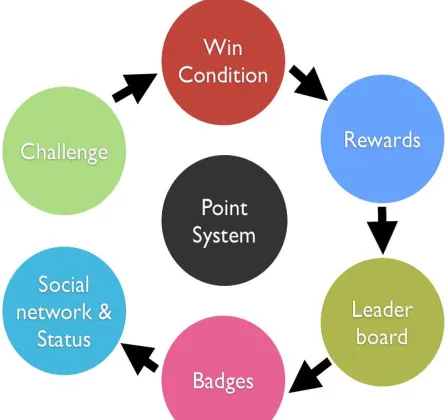
Although the definition of gamification suggests all game elements could be used, gamification tends to focus on the elements of points, badges, and leaderboards (Bogost, 2011; Nicholson, 2012b, Iosup & Epema, 2014). The system awards points for completing certain tasks and presents badges based on the number of points achieved. These scores are recorded on a leaderboard so that users can compare their performance to their peers. The theory behind this type of gamification is that if users have their scores beaten they are challenged to overcome the new best scores and are thus incentivized to replay the game. Liu et al. refer to this as the “gamification loop” as outlined in Figure 1 (2011).
The cornerstone of this approach is the point system. The simple addition of points can sharply increase user performance in a system or task. Mekler et al. investigated the impact of points and providing a meaningful frame on performance and motivation in an image annotation system (2013). They conducted their experiment with 172 participants (26 male, 123 female, 3 not specified; mean age 32.95 years, range 15-74) using a 2x2 between-subjects experimental design. Their independent variables were points (points vs. no points) and meaningful framing (framing vs. no framing). Participants were assigned randomly to one of the four pairings then asked to annotate one image without points and without a meaningful frame. The fourteen additional images were then annotated with the additional features of their group. Meaningful frame was established by telling the participants that their tags would help improve computerized image categorization. Points were awarded at 100 points per annotation. After finishing the image annotation activity, participants filled out the Intrinsic Motivation Inventory (IMI) to measure their motivation (Merker et al., 2013).
Merker et al. found that the single game element of points resulted in higher quantity of image annotations and in higher intrinsic motivation (Merker et al., 2013). They
sensible or nonsensical and using the Linguistic Inquiry and Word Count (LIWC) Analysis and with both measures the combination of points and meaningful frame resulted in
significantly higher quality compared to other groups. Goh and Lee also gamified an image annotation system using both cooperative and competitive point systems and found the point based approaches to be especially motivating for users “with a high need for achievement” based on participant feedback (2011).
manipulate it so it takes up the smallest volume possible and creates multiple good bonds. Players are given points based on how well their folding meets these criteria and they are ranked against the other players’ scores. Foldit was used to help decipher the structure of the Mason-Pfizer monkey virus, a problem which had been unsolved by scientists for 15 years (Khatib et al., 2011).
What distinguishes gamification from serious games? Gamification focuses on the process and elements used to create the gamified system rather than trying to define the end product. Although this process still leverages the motivational properties of games it does not concern itself with whether the final product is or is not a game. Examples of this distinction can be seen by examining various gamified systems for physical health. Some of these are referred to as “exergames” (Braumer er al., 2013) which are a type of serious game
(Bergeron, 2006).
A very common approach to creating an exergame is to have an exercise task and assign points to the player for performing this task. This task can be anything from collecting apples (Brauner, 2013; Nickel et al., 2014), dodging asteroids (Nickel et al., 2012; Nickel et al., 2014), to standing instead of sitting while riding on crowded Japanese public
Pal uses calories as points and additional game elements like leaderboards and achievements to help users achieve their fitness and weight loss goals. As with Foursquare, it is possible for some to engage with My Fitness Pal as if it was a game but it is not clear if it can be called a game. What is clear is that My Fitness Pal has enhanced the task of tracking nutrition and exercise with game elements, and thus has had some degree of gamification. Whether systems like these which have been enhanced with gamification are “games” or “gamified systems” is left to other research. Our research focuses on the impact of gamification on users.
Like exergames, many educational serious games are actually gamified systems. Many serious games are designed from scratch rather than beginning with an existing educational tool and adding game elements to them. However, many can be thought of as an educational tutor with some additional game elements. For example CopyMe is an
Figure 2. The educational serious game CopyMe (Harrold et al., 2014)
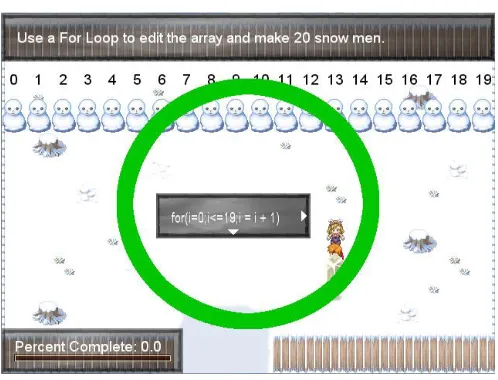
The Code of Everand and CopyMe are designed for audiences of teens and younger but serious educational games can also be used to teach college level material. Wu’s Castle is a serious educational game designed to teach loops and arrays in college level introductory computer science courses (Eagle & Barnes, 2009). In it players visually walk through loops and nested loops by navigating corridors. Players also learn to use arrays by placing
snowman heads on snowman bodies; each snowman body or full snowman represents the data that is held in a particular array position as shown in Figure 3. Wu’s Castle was found to be more effective at teaching the concepts of arrays and nested loops than a traditional programming homework assignment (Eagle & Barnes, 2009). While this system does not have a traditional point system it does include a progress bar which acts as a reward as the player advances.
Another highly researched game-based system is the reading tutor iSTART. iSTART (Interactive Strategy Training for Active Reading and Thinking) is a reading tutor developed by Danielle McNamara which was converted to the game-based tutor iSTART-ME in 2009 (Jackson et al., 2009). The gamified version of the system featured points, levels, purchasable rewards, mini-games, and customizable avatars (Jackson et al., 2009). The evolution of this system is an excellent example of typical long-term educational game research. Early work with the game was primarily focused on explaining the system (Jackson et al., 2009). This was followed by studies showing that the game-based system was rated as more fun than the non-game version (Jackson, et al. 2011) and that the game-based system was more
motivational than the non-game version (Jackson & McNamara, 2011).
Work on iSTART-ME culminated in comparative studies comparing the learning gains of the game-based to the non-game based system. In both studies they found that the game-based system did generate significant learning gains but not ones that were
This concurrent research to our own illustrates the potential of gamification and the importance of long term gamification research, but does not investigate the traditional gamification method. Instead it looks at the impact of an expanded form of gamification that includes avatars, points as currency, and mini-games. Their iSTARS-ME gamified system does generate more enjoyment than the original iSTART system and provides learning gains equivalent to those in the original system, but does not improve upon them. This calls into question about the effectiveness of purely traditional gamification approaches to achieve improved enjoyment and learning. The iSTART research demonstrates that a successful educational system can be gamified without reaching the full potential of gamification – to achieve both fun and improved learning gains. Their results failed to show that their gamified system could outperform their original non-gamified system in the area of learning gains. Our deep gamification approach seeks to improve both the enjoyment of the system and the learning gains from using the system compared to a non-gamified system.
not evaluate individual game elements separately or independently. This means it is difficult to attribute improvements in the system to particular features, mini-games, or design choices. Studies like this show a game can work but does not answer which game elements contribute to that success. Without understanding the impact individual game elements have on learning and player preference it is impossible to identify what game elements should or should not be used in gamification to maximize learning gains or player preference.
Gamified systems can be designed from the ground up with both domain experts and experts in game design working together. Similar results could theoretically be obtained by starting with an existing educational system designed to teach the topic and adding game elements to it. In fact the research presented in this dissertation began as serious games research. It was later that we realized that in creating an educational game by adding game elements to an existing educational tool that we had engaged in gamification. This allowed us to focus on the game elements and their impact rather than on the educational content of the system.
This ability to add on to an existing system represents one of the major strengths of gamification. In addition to not worrying about whether the final system is a game or not, gamification does not suffer from the two-domain experts problem. Gamification only requires an expert in game design and does not require an expert in the domain of the
this means two experts are still technically required, there are already thousands of tools and systems that can be enhanced through gamification. All that is needed are people with the skills needed to implement game elements and a deeper understanding of the impact of those elements.
One of the fastest growing areas for gamification is in industry. There seem to be two subcategories in this growing trend. The first are companies designed to assist other
companies in gamifying their traditional services (Hamari, 2014). These include Badgeville (Badgeville, 2014), NextBee (NextBee, 2014) and GameEffective (GameEffective, 2014). These companies gamify existing systems and companies with only an understanding of game design thus illustrating gamification’s ability to circumvent the two experts problem. Like most gamification implementations the most well-known game elements these
companies use are leaderboards, badges, and points (Bogost, 2011; GameEffective, 2014; Badgeville, 2014). These companies provide solutions that award points to customers and employees based on performing certain desirable tasks.
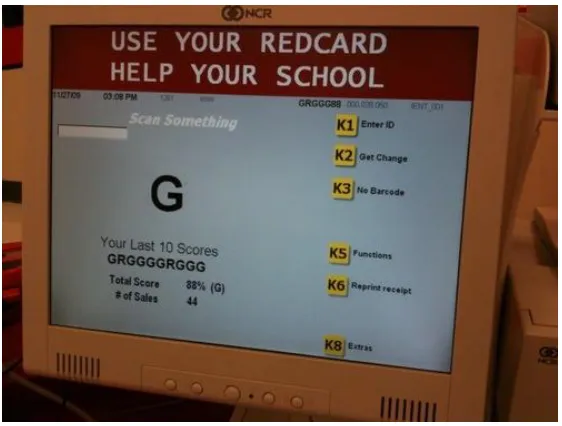
superstore Target (Crowley, 2009). Figure 4 shows the screen of a Target cash register after finishing a transaction. Each transaction is scored either a G or green for good or an R or red for needs improvement. Target cashiers are also presented with their last ten scores and an overall percentage of greens. These scores are based on the total transaction time relative to the number of items purchased. It is designed to encourage faster more efficient transactions. Employees have their own personal leaderboard and these scores impact things like raises, promotions, and who remains an employee (Crowley, 2009). This is clearly an example of gamification used more for the improving user engagement over user experience. By 2015 Gartner estimates that over 50% of all organizations managing innovation processes will gamify some aspects of their business (2011).
Similar to the gamification of the work environments many teachers and professors have begun to gamify their classrooms. One popular method is the restructuring of
homework and tests into quests and grades into experience points like in traditional role playing games (Gillispie & Lawson, 2010). This approach lends itself extremely well to studying or working with medieval or fantasy environments although that is not required. In their report on the gamification of their technical university courses, Iosup and Epema identify seven core tools for successful gamification of the classroom (2014). There are the core game mechanics of point systems, levels, and leaderboards and the core dynamics of badges, onboarding, social engagement, and unlocking content (Iosup & Epema, 2014). Although this approach involves a few additional elements, classroom gamification, like most other gamified systems, is focused on the game elements of points, leaderboards, and badges.
rewards the goal of the gamified system remains, as the definition states, “to improve user experience and user engagement” (Deterding, et al., 2011c).
Gamification boils down to encouraging users to perform a task, and making the task itself more enjoyable through the use of game elements. The target task can range from solving problems, to learning material, to exercising, to doing your job. It is possible that game elements and gamification strategies that are effective for one task may be effective for another; however that is research left for future work. In this research we focus our objective on maximizing the effectiveness of gamification for a single educational software system.
Classifying Serious Games and Gamified Systems
Serious games and gamified systems come in variety of different forms. To make cataloging, searching for, and understanding these systems easier, work has been done on developing classification systems. One approach is “market-based” classifications which aim to classify the systems based on the market that uses the system (Djaouti et al., 2011). The serious game classifications listed earlier represent one such market-based system (Chen & Michael, 2005) although others exist (Zyda, 2005; Alvarez & Michaud, 2008). However, new markets are constantly being explored and discovered and market-based classification focuses on the use of the game rather than its content (Djaouti et al., 2011).
of this would be Bergeron’s seven purpose categories: Activism games, Advergames, Business Games, Exergames, Health and Medicine Games, News Games, and Political Games (2006). Although these classifications are similar to market-based approaches they have the important advantage of focusing on a game’s content rather than the intended use. Focusing on the uses requires making assumptions about the intent of the creators while focusing on the content does not. However, neither of these classification approaches considers the game elements or structures of the system.
Sawyer and Smith combined these two approaches to create a multiple criteria classification system called the “Serious Game Taxonomy” (2008). It categorized serious games by both market (Government and NGO, Defense, Healthcare, Marketing and Communication, Education, Corporate, or Industry) and purpose (Games for Health, Advergames, Games for training, Games for education, Games for science and research, Production, or Games as Work). This system had overlaps between the market categories and purpose categories and also lacked some key purposes such as games with a message.
Although there are multiple criteria in this system, it still did not incorporate the game elements of the system.
In their work in developing an improved classification system Djaouti et al. wanted to combine previous classification systems with the concepts of game elements and mechanics (2011). They first looked at game classification used by traditional games in the
mechanics were too subjective. The categories also had too much overlap and were in a constant state of flux as genres and mechanics were created and evolved (Djaouti et al., 2011). Their goal was to create a classification system that would be less affected by the evolution of games and work in the context of changes in game mechanics and principles.
Djaouti et al. believed “gameplay” would be a good way to classify the game elements and mechanics of these serious games and gamified systems. First they looked towards Portugal’s definition of “gameplay” as the combination of rules, input methods, space-related setup, time-related setup, and drama-related setup (2006). They chose to focus on the rules because rules lend themselves to formal and objective deconstruction.
Game-based and play-based classification can define the type of gameplay for entertainment games, serious games, and game-like systems. For example SimCity can be defined as play-based and Pac-Man as game-based (Djaouti, 2011). Note that this
classification is based only on what the system presents you. The user is free to set their own goals in play-based systems. Even if a user decides to create a city with a million people in SimCity, this is a self-defined goal, so SimCity remains play-based.
We shall be using the terms game-based (featuring system defined objectives) and play-based (featuring user-defined objectives) systems and elements throughout this paper. Education research would refer to game-based systems as more guided learning and play-based systems as more open-ended learning or sandbox environments. Investigating the results of combining these elements is a primary area of investigation in this research.
Figure 5. The G/P/S model of game classification (Djaouti, 2011)
Problems with Traditional Gamification
The most typical approach to gamification is the addition of points, leaderboards, and badges ((Bogost, 2011; Nicholson, 2012b, Iosup & Epema, 2014). Nicholson calls this approach “BLAP gamification” (Nicholson, 2012b). BLAP stands for Badges, Levels and Leaderboards, Achievements, and Points. This approach falls perfectly in line with many research and industry implementations including Liu et al.’s previously discussed
gamification loop (2011) and nearly every example covered in the overview of current gamification trends.
Many have questioned this focus on points and leaderboards. To illustrate this point some have suggested renaming gamification to “BLAP gamification” (Nicholson, 2012b), “pointsification” (Robertson, 2010), “Ludification” (Bouca, 2012), or even
“exploitationware” (Bogost, 2011). The central argument for all of these name suggestions is that, since games are more than just game-based points and leaderboards, gamification should also be more than just adding points and leaderboards to systems. We will refer to the BLAP form of gamification as “traditional gamification.”
non-gamified system to the non-gamified system. For example in Goh and Lee’s work comparing gamified image annotation systems they found that some participants who used the non-gamified annotation system reported liking that system because “they did not need to challenge anybody” (2011). While traditional gamification and its focus on points and leaderboards is very appealing to players “with a high need for achievement” (Goh & Lee, 2011) not all players prefer game-based systems. Traditional gamification fails to draw users who may prefer play-based systems that do not focus on system-defined challenges.
In their literature review of gamification, Hamari et al. collected 24 empirical studies by the research community each analyzing whether gamification works (2014). They looked at what game elements were used in the gamification of several systems. Story/Theme was the only non-game-based element featured in these studies and it was only used in six of the studies (Hamari, 2014). Points, leaderboards, badges, or achievements were present in 18 of the studies (Hamari, 2014). This gravitation towards only a small subset of game elements may be because of how easy it is to add points, leaderboards, and achievements to existing systems (Nicholson, 2012b). The spectrum of game elements are not being fully explored in a majority of gamification research (Nicholson, 2012a; Nicholson 2012b; Hamari, 2014)
intended for required use in a classroom environment. This is a difficult challenge but one that is important to address because play can encourage learning (Hirsh, 2008). Meaningful options that can lead to play should be incorporated into the gamification of educational software to maximize appeal while also improving learning gains (Nicholson 2012a; Nicholson 2012b). Traditionally-gamified systems lack these meaningful options and only present one (game-based) way to engage with the system. There are no other options for those students who do not want to engage with a competitive game-based system. Therefore, people not interested in game-based systems are unlikely to identify using that system as play. We believe play-based game elements can be used to provide meaningful options for students who do not see game-based elements as play.
Constructionist Learning Environments
The first example of a more “play-based” constructionist learning environment software was the LOGO programing language (LOGO Foundation, 2011) where users control a triangular turtle’s movement on the screen with programing commands. Other successful examples of (play-based or open-ended) constructionist learning environments linked to computational thinking include Scratch (Resnick, et al., 2009), Alice (Cooper et al, 2000), and Culturally Situated Design Tools (Eglash, et al., 2006). Ito refers to such systems as the “construction genre” of educational software (2009). Students are free to play and explore in these play-based environments and learning occurs organically. There are no objectives or rules. Although these systems are not games, if they were categorized using the continuum between game-based systems defined by rules and objectives, or a play-based system with only potential user-set goals we are using here, they would certainly be play-based systems and not game-play-based. It should be noted that this is not a rigid classification. For example many teachers when using Alice or Scratch will develop objectives for the class to perform and a way to evaluate those objectives. In doing so they have added “system” defined rules and objectives. This transforms the play-based environment with its user-defined goals into a more game-based environment with system-user-defined rules and goals.
discovery environments are less effective for some learners than guided discovery
environments (Mayer, 2004) citing multiple studies comparing pure discovery and guided discovery environments (Kittel, 1957; Gagne & Browne, 1961; Shulman and Keisler, 1966) including a study using the LOGO environment (Fay & Mayer, 1994). In all of these studies a constructionist learning environment was compared against itself with the experimental variable being guided discovery versus pure discovery. In the pure discovery groups
participants only engaged with the constructionist learning environment without any outside influence from teachers or experimenters. In the guided discovery groups participants were given feedback and help from teachers or experimenters when they made mistakes in the constructionist learning environment. In all studies the pure discovery approach was found to be less effective at improving learning gains compared to the guided discovery. Pure
discovery lacked the guidance and feedback some students needed in order to succeed.
We found an additional problem in our work with the constructionist learning environment of Culturally Situated Design Tools (csdt.rpi.edu) (CSDTs). In all of the CSDTs, there are two ways, one simple and one complex, to create the same artifact. For example, in Graffiti Grapher students can create virtual graffiti using either Cartesian coordinates or the more advanced polar coordinate system. In after-school outreach
programs, we observed that students would almost always default to the simplest behavior in creating their artifacts and would not use the more complex systems without outside
complex learning objectives can occur in other constructionist learning environments such as using suboptimal coding practices in Scratch or Alice. The desire to encourage full
exploration of existing learning environments and systems was one of the initial motivating factors of this research.
Gamification may be the solution to these shortcomings. Gamification provides strong encouragement to perform certain tasks and creates well-structured problems with immediate feedback, which constructionist learning environments lack. Constructionist learning environments’ open-ended play-based structure may provide the free play that traditional gamification approaches lack. The separation between traditional gamification methods and constructionist learning environments is similar to the divide seen between game-based and play-based games. By combining game-based elements, elements that define rigid system based rules and outcomes, and play-based game elements, elements that do not impose system defined rules and encourage free play, it may be possible to achieve a system with the benefits of both gamified systems and constructionist learning environments.
Research Questions
Traditional gamification has shown great success in improving a variety of tasks and systems including educational software. Traditional gamification’s focus on rules and points results in purely game-based systems which lack options that encourage play. These are major shortcomings of traditional gamification which must be addressed in order to
new approaches to gamification through the incremental gamification of an existing educational system. These approaches will combine the success of traditional game-based approaches while giving players new play-based options. We refer to this new approach to gamification and the design methodology associated with it as “deep gamification.”
The success of our new approach will be measured by its ability to improve an educational tool in the areas of learning gains and user preference compared to the original system and a traditionally gamified version of the system. In order to make these
measurements we will incrementally gamify an existing educational tool known as the Virtual Bead Loom (VBL). In doing so we will create a gamified system called BeadLoom Game (BLG). Both of these systems will be fully elaborated upon in their respective chapters. Each study we will refine our gamification methodology and further enhance the software and run comparative studies using previous versions for comparison. We believe that the deep gamification techniques developed in this research may suggest ways that designers can create gamified educational systems that outperform traditional educational software and traditional gamified systems. This will be evaluated by the gamified BeadLoom Game’s ability to outperform the non-gamified Virtual Bead Loom and previous incarnations of BeadLoom Game.
This research seeks to address the following research questions:
Since we will be incrementally gamifying the Virtual Bead Loom software it is important that the baseline involving the traditional gamification techniques is successful in generating learning gains. Similar questions looking at the effectiveness of serious games have been conducted (Eagle & Barnes, 2009; Jackson et al., 2012; Jackson & McNamara, 2013; Dunwell et al., 2014; Harrold et al., 2014), however none of these implemented the pure traditional or BLAP gamification approach of points, leaderboards, and
achievements/badges without additional features. A rigorous evaluation of the learning outcomes from traditional gamification is a required first step in improving gamification. This question will be addressed in study one with the hypothesis of the gamified system BLG will generate learning gains in the areas of iteration and layering.
R2: Can the use of a traditionally gamified system outperform a non-gamified educational tool in the areas of learning gains and user preference?
As discussed in the literature review there is a lack of studies formally comparing serious games to non-game counterparts in areas other than user preference. It is important to ensure that traditional gamification results in systems that are both more popular and
addressed in study two with the hypothesis of the gamified system BLG will outperform the non-gamified system VBL in the areas of iteration, layering, and user preference.
R3: Does a gamified system featuring both game-based and play-based game elements outperform a traditionally gamified system in the area of user preference?
Studies one and two evaluate and help inform design principles for the game-based elements associated with traditional gamification: points and achievements. This question addresses the binary nature of the Gameplay/Purpose/Scope (Djaouti, 2011) and seeks to understand what happens when you combine both game-based and play-based elements into a single gamified system. Does integrating both types of game elements into a single system improve user preference? This question is addressed in study three and although learning gains are also evaluated the primary hypothesis is the gamified system BLG 2.0 (featuring both game-based and play-based features) will outperform the traditionally gamified BLG 1.0 and non-gamified VBL in the area of user preference.
R4: Can play-based game elements be added to a traditionally gamified system to guide user behavior?
nature. An evaluation of our initial play-based elements and the associated design principles is conducted in study four. It features two hypotheses. The first is that content made in BLG 2.0 will be more creative and complex than content made in VBL due to BLG’s peer driven content rating system. The second hypothesis is that content made in BLG 2.0 will be made with more iterations than content made in VBL due to BLG’s peer driven content rating system. This research question will be further addressed in study five with the hypothesis of content made in BLG 3.0 will be made with more iterations than content made in VBL or BLG 2.0.
R5: Can engaging only with the play-based elements of a gamified system produce learning gains?
Although the goal of deep gamification is the creation of educational gamified systems that combine both game-based and play-based elements it is possible for some students to choose to only engage with one type of element. In other words some students may use only the game-based features and others may use only the play-based features. Studies one and two evaluate the learning gains of the game-based elements alone but it is equally important evaluate the learning gains of only the play-based elements. Study five addresses this question with the hypothesis the play-based mode of BLG 3.0 alone will generate learning gains in the areas of Cartesian coordinates, iteration, and layering.
There is not one particular study dedicated to addressing this particular question. Instead this question represents the culmination of the knowledge we shall gain from
conducting studies one through five. With each study we will gain a deeper understanding of the impact of individual game elements which we incrementally add to the gamified system BeadLoom Game. In the end we will have a deeper understanding of the effect of select game-based and play-based game elements on learning and preference as well as design principles to help maximize these effects. What we learn from these studies will combine to form our deep gamification design methodology which we will present as our solution to this question.
Table 1.ResearchOverview
Media Educational Tools &
Educational Video Games Methodology &
Theoretical Framework
Gamification Ludology
Application Educational game design
Goals Improve learning gains
Higher user preference Future Directions Application of new design
methodology to existing gamified and non-gamified systems
Virtual Bead Loom
The Virtual Bead Loom (csdt.rpi.edu/na/loom/bl/beadloom.html) is the educational tool used as a baseline for this research. It is one of many Culturally Situated Design Tools used in middle school outreach by the STARS Alliance. Culturally Situated Design Tools are a suite of educational constructionist learning environments designed to teach math and computer science through the creation of cultural artifacts. These tools have been shown to be effective at teaching basic mathematical principles and were designed to be more appealing than traditional assignments especially for minorities that are traditionally
found to be very effective at motivating students regardless of cultural background (Eglash, et al., 2006).
The Virtual Bead Loom is one of the most popular Culturally Situated Design Tools (Bert, et al., 2009). The Virtual Bead Loom is designed to teach Cartesian coordinates, geometry, and the basic computer science concept of iteration. Users use six different graphing functions to place virtual beads on a grid to create Native American bead art. The Virtual Bead Loom has shown positive results in teaching basic mathematical principles and users reported preferring to use the tool compared to a more traditional assignment (Eglash, et al., 2006).
In our STARS Alliance outreach sessions with the Virtual Bead Loom we observed similar results to those reported by Eglash et al. However we also observed that a majority of users did not use the more complex and challenging graphing functions available in the Virtual Bead Loom (Boyce, et al. 2009). This meant that the users were avoiding the game mechanic designed to teach the learning objective of iteration. The Virtual Bead Loom needed a way to guide user behavior and encourage users to explore and learn from all the functions available. This made the Virtual Bead Loom a perfect candidate for gamification.
Virtual Bead Loom Design
Before discussing the gamification of the Virtual Bead Loom it is important to
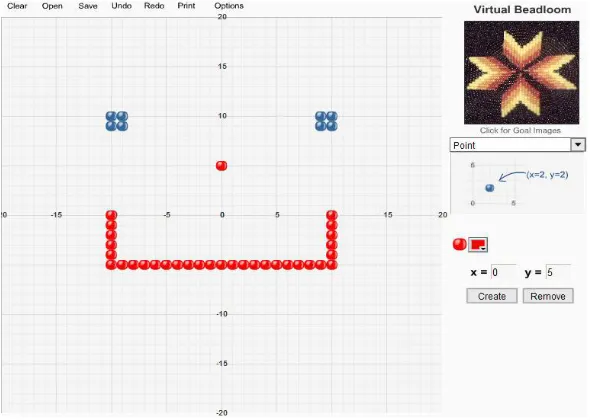
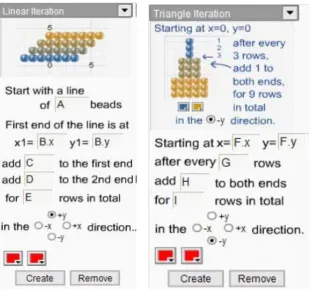
own Native American bead art by placing colored dots (beads) onto a 41 by 41 (-20 to 20 along the x and y axis) Cartesian coordinate grid. This is done through the use of six different graphing functions: point, line, rectangle, triangle, linear iteration, and triangle iteration.
For each function the user must input values for variables, select a color, and then click the create button to plot beads onto the grid based on their input. The point function takes numbers for x and y and a color as inputs, and places a bead of the chosen color at the given Cartesian coordinate point. All possible designs can be created by using this function exclusively; however doing so would require one point function call for each of the 1681 cells of the grid. Students can speed up this process with the other functions that can place multiple beads per function call.
The Virtual Bead Loom line and rectangle functions each take two Cartesian coordinate points (4 variables) and create a line or rectangle of beads of the given color between those points. Similarly, the triangle function creates a triangle of beads from three points (6 variables). These functions are more complex than the point function, but students tend to quickly learn how they work and use them in conjunction with the point function to make their own art. Ideally, the students would transition from these basic geometric functions into using the more advanced iterative functions.
Figure 7. Linear and triangle iteration in the Virtual Bead Loom
designs helps introduce users to the concepts of efficiency and optimization that are corner stones of Computer Science.
BeadLoom Game Prototype
The Virtual BeadLoom was gamified into BeadLoom Game with the goal of creating a system that was fun and encouraged students to explore all of the system’s learning
objectives. The first step was to analyze what the Virtual Bead Loom did well. The Virtual Bead Loom was very effective at teaching the basic concept of the Cartesian coordinate system (Eglash, et al., 2006). This was possibly because the very act of creating the designs with the functions required understanding and mastering the Cartesian coordinate system. Students practiced this learning objective at every step of the creation process; thus learning was tied to, and not separate from, creation.
We wanted to integrate this successful element into the gamified version by ensuring there was no separation between the learning element and the game element. This solves the problem many edutainment titles suffered from by preventing the learning from being an obstacle to play. We wanted learning to occur from playing the game and not as a
the Virtual Bead Loom. Skills from one system would be directly transferable from one to the other.
Where the Virtual Bead Loom had problems was getting the students to use all six functions. The system did not provide any reason to use the more complex strategies like iteration, optimization, or layering. Thus students could engage in the less desirable activity of only using the point and line functions or the desirable activity of using all the functions to create their designs in an optimal fashion. We hypothesized that points and achievements could be used to encourage full exploration of the system. However awarding points and achievements for superfluous activities would not guide user behavior. Therefore we needed to integrate the points and achievements with learning objectives and desired behavior. BeadLoom Game needed to reward players for engaging in desirable behavior and mastering the learning objectives.
The point system we designed had players recreating a given goal image in the fewest function calls or “moves” possible. Their score was how many moves it took them to solve a given goal image or “puzzle” with a lower score being better. Although every puzzle can be solved with the less desirable behavior or only using the point and line functions, the only way to get a better score is to engage in the desired behavior and master the learning objectives that are associated with that behavior.
thus it would lose its effectiveness as a tool for improving learning. Points could not just be randomly given out and needed to guide player behavior ensuring the only way to improve in game performance is through learning the material and performing the desired behavior.
An alternative design we could have used was to not allow users to use the simple functions and only allow users to use the iterative functions. In other words we could have prohibited the less desirable behavior and only allowed the desirable behavior. This was not ideal because less desirable behavior is still desirable behavior and thus should not be prohibited. In BeadLoom Game using the point and line functions is helping the students learn Cartesian coordinates which is one of the learning objectives. Additionally starting with the complex iterative functions would create a steep learning curve that would drive away many students. Understanding the Cartesian coordinate system is an important first step to using the iterative functions. We wanted players to start with the less desirable behavior. Once they are ready they can choose to transition to the more desirable behavior with the point system encouraging them to make that transition. This also increases the chances that the students will be able to identify the BeadLoom Game activity as play because choice and freedom are key elements to play (Brown, 2009; Caillois 2005). Therefore we felt it was important to not prohibit less desirable behavior and instead let the point system simply discourage it.
user-behavior. To accomplish this, a mixed-fidelity prototype combining the Virtual Bead Loom with paper and pencil worksheets was created. By integrating the pencil and paper version with the functioning custom puzzle mode the system could avoid the traditional problems with pure paper prototypes like abstractness and response lag (Lim et al., 2006). The worksheets had a goal image or “puzzle” created using the Virtual Bead Loom. Users were asked to recreate the image using the Virtual Bead Loom and record the functions used on their worksheets. This design has many drawbacks. Users have to manually log every move they make including the values for all variables. In addition, the user must determine when the puzzle is finished. We hypothesized that, if users still enjoy playing BeadLoom Game even with these shortcomings it would indicate that this game objective is effective and a full software version should be developed.
Initial Trial
We ran a simple trial to get player feedback on this prototype version of BeadLoom Game in a weekly after school apprenticeship program called Citizen Schools that lasted ten weeks. We worked with a group of eight middle school students who had voluntarily
BeadLoom Game 1.0
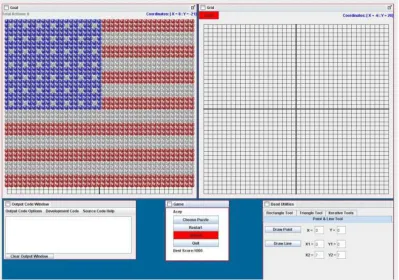
BeadLoom Game 1.0 was developed by adding additional features to an existing Java implementation of the Virtual Bead Loom. The user is presented with the same 41 x 41 grid on which to plot virtual beads of various colors using the same six functions as in the Virtual Bead Loom: point, line, rectangle, triangle, linear iteration, and triangle iteration. A second grid was added with a completed design on it that acts as the goal image from the prototype. On both grids the user can hover over a point to see the Cartesian coordinates of that point. This prevents the problem we had in the prototype of not being able to see the grid lines and having to count individual beads to get the Cartesian coordinates. We also added a menu where users can change puzzle, restart the current puzzle, submit their solution for scoring, and a counter that tracks how many moves have been used so far. Figure 9shows a
Figure 9. BeadLoom Game 1.0 screenshot
Like the prototype, the core game mechanic of BeadLoom Game 1.0 is the recreation of the given goal image or “puzzle” using the six available functions. Using any of the functions counts as a “move” and the goal is to solve each puzzle in the fewest moves possible. Every puzzle has an “ideal solution”: the lowest number of moves needed to
To encourage finding the ideal solution, when the player matches the goal image exactly they are awarded a medal based on their performance. If the player finds an ideal solution they receive a platinum medal. A gold medal is awarded for solving it in up to two times the ideal solution, silver is awarded for up to three times the ideal solution and for just completing it they receive a bronze medal. For example, if a puzzle can be finished in 10 moves, a gold medal means the player finished in 20 or less moves, a silver medal means finishing in 30 or less moves, and a platinum medal means finishing in 10 or less moves. Or less is used for platinum because an algorithm for solving these puzzles was not developed. The best solution our developers and designers found is used as the ideal. If a student does find a solution better than the current best solution then the ideal solution is updated
accordingly. This acts as a form of tiered achievements. The goal of this tiered structure was to help prevent discouraging the player by lowering the learning curve. If there was only one correct solution and the player could not find it they may become discouraged and not try again. The tiers allow them to explore less ideal solutions while showing them that more optimal solutions exist. This provides incentive to replay completed puzzles to get a better score and by extension of the integrated learning objectives better learn the material.
defined. The goal was not gamification but the conversion of the tool into a game. It was not until later that it was realized that this process had essentially been gamification. Using the Gameplay/Purpose/Scope model (Djaouti, 2011) this version of BeadLoom Game would be classified as a game-based system.
Study One: BLG (Boyce & Barnes, 2010)
R1: Can a traditionally gamified educational system produce learning gains?
The goal of the first study was to determine if a traditionally gamified system could generate learning gains - an important starting point. Prior to this study there had been a lack of rigorous research on educational games and gamified systems that utilized pre and posttest analysis of learning objectives. Much educational games related research has focused on user preference. While user preference is an important measure, the ability to generate learning gains is extremely important for educational software. Previous work also did not focus on a minimal gamification approach of adding only points and achievements. It was also
important to determine if the game elements and design decisions made for BeadLoom Game were effective before moving forward to deeper research questions. If there was a
fundamental flaw in the system it was important to identify it early. We hypothesized that the traditionally gamified system BeadLoom Game will generate learning gains in the areas
Study One: BLG - Methods
For this study data was collected during a high school summer camp held at UNC Charlotte in 2009 with 18 students: 16 male and 2 female. This summer camp was a five-day video game and computer forensics camp where half the day was devoted to learning
computer forensics and the other half to learning how to develop video games using the Game Maker software. BeadLoom Game was integrated into the video game portion of the camp as an example of an educational video game.
At the beginning of the week before engaging with BeadLoom Game the students were given a short pretest (Appendix A) to gauge their understanding of Cartesian
coordinates, iteration, and layering/optimization. The pretest consisted of 12 questions with 4 questions devoted to Cartesian coordinates, 4 questions devoted to iteration, and 4 questions devoted to layering and optimization. The Cartesian coordinates questions asked the students to draw given points on a graph with one point in each of the four quadrants. Two iterative questions asked the user to fill in the blank to create a given iterative pattern (Figure 10) and two asked the students how many beads would be present after iteratively adding beads for a certain number of steps. For the fill in the blank questions with multiple parts, partial credit was given for each correct part. The layering and optimization questions asked how many shapes it takes to recreate a given image. At the end of the five-day summer camp students were given an isomorphic posttest.
We were forced to remove the questions regarding Cartesian coordinates from the analysis in this study. As mentioned this study was conducted at a summer camp dedicated to learning how to create video games using the Game Maker software. Game Maker uses a different coordinate system than the traditional Cartesian system with the point (0, 0) being the top left of the grid instead of the middle. As a result some of the students believed they were supposed to use the Game Maker coordinate system to answer the Cartesian coordinate questions. No elements of Game Maker we utilized during the camp pertained to iteration or layering so the changes from pretest to posttest for these questions were the result of playing BeadLoom Game.
Study One: BLG - Results
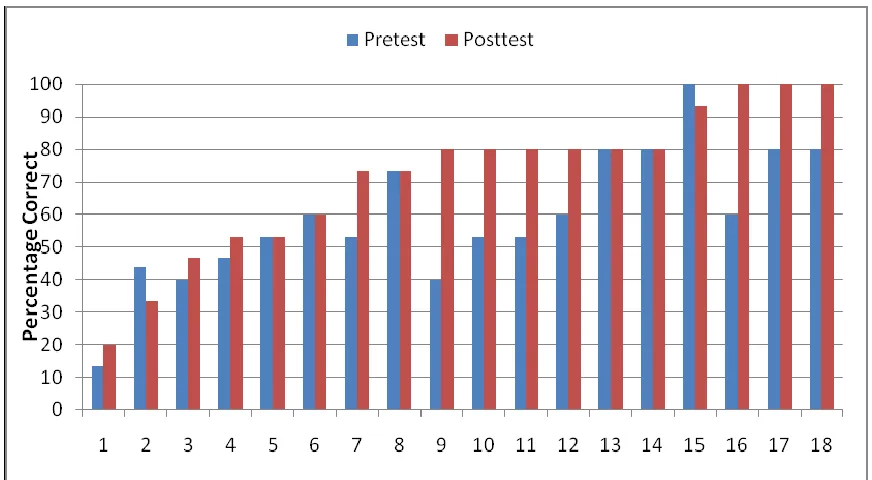
Figure 11. Study one pre to posttest scores for all participants, sorted by posttest score
In addition to the quantitative pre and posttest analysis we collected a few qualitative measures. On the posttest students were asked to rate the fun of BeadLoom Game on a scale from one to five with five being the most fun and one being the least fun. The students gave BeadLoom Game an average of 4.28 out of five. Additionally two of the participants
requested a copy of the game on a CD to take home to play. They were committed to getting a platinum medal on all the puzzles in the game. This suggests that in addition to being educational this version of BeadLoom Game was fun for at least a majority of the students and extremely fun for at least two.
gamified system BLG can generate learning gains. Additionally our subjective measures
suggest that BLG can achieve these learning gains in a way that is fun for a majority of participants. BeadLoom Game was a successful piece of educational software but further evaluation was necessary to compare it to its predecessor the Virtual Bead Loom.
Study Two: BLG Vs VBL (Boyce et al., 2011a)
R2: Can the use of a traditionally gamified system outperform a non-gamified educational tool in the areas of learning gains and user preference?
The goal of the second study was to compare the learning gains from the traditional educational software Virtual Bead Loom and the gamified educational software BeadLoom Game. This study was also designed to determine if the students preferred to use the Virtual Bead Loom or the gamified BeadLoom Game. The goal was to see if the use of a
traditionally gamified system can outperform a non-gamified educational tool in the areas of learning gains and user preference. We hypothesized that the gamified system BeadLoom Game will outperform the non-gamified system the Virtual Bead Loom in the areas of iteration, layering, and user preference. We needed to compare learning gains from both systems to test this hypothesis.
Study Two: BLG Vs VBL - Methods
on the use of Culturally Situated Design Tools and had 21 middle school students with six females. The second camp was the 2010 version of the high school camp we used in study one which focused on computer forensics and game design. That year it had 20 students with seven females.
We used a “switching replications” study design as used by Eagle and Barnes (2009). This design involves dividing the participants into two groups: control and experimental. After exposing the groups to their condition participants are evaluated and then the groups are switched exposing the control group to the experimental condition and vice versa. This allows all participants to experience both conditions allowing them to provide feedback on things like preference comparing the two conditions.
At the start of both camps we gave the students a pretest to gauge their knowledge of Cartesian coordinates, iteration, and layering. We utilized the same test format as in study one with the exception of making it clear that the coordinates questions were not using the Game Maker coordinate system for those students in the high school summer camp.
After using the Game or the Tool respectively, each group used the other software for 90 minutes. Following this activity, the middle school camp was introduced to other
Culturally Situated Design Tools, while the high school camp learned how to use Game Maker. Since none of the activities with Culturally Situated Design Tools or Game Maker used iteration or layering, BeadLoom Game would be the only source of learning in these areas. A clear distinction between Cartesian coordinates and the coordinate system used in Game Maker was also made with the high school camp.
Each day after the first day began with a 30-minute BeadLoom Game contest like the ones held in study one with students competing to find the best solution for a given puzzle. Additionally the middle school group was given 30 to 60 minutes at the end of the day where they could choose from a selection of activities including BeadLoom Game, the Virtual Bead Loom, and the other Culturally Situated Design Tools introduced thus far in the camp. Each day one to two additional Culturally Situated Design Tools would be introduced except for the first day where only BeadLoom Game and the Virtual Bead Loom were used. Their selections during this time were recorded. At the end of each camp the students took a second isomorphic posttest (post2) to evaluate overall learning gains, and a short survey to determine which system they preferred to use.
Study Two: BLG Vs VBL - Results - Middle School Camp
BeadLoom Game and the Virtual Bead Loom use the same basic functionality to plot Cartesian coordinates. The success of the Virtual Bead Loom at teaching Cartesian coordinates is one of its strongest features and is one of the reasons it was selected for gamification.
Figure 12 shows the middle school students’ pre, post, and post2 test scores on the eight remaining questions on iteration and layering. The Game group showed increases in knowledge during the first session with their system and continued to improve through the remainder of the summer camp. The Tool group showed no learning in their first session with their system but after being exposed to BeadLoom Game showed significant learning gains.
0 10 20 30 40 50 60
Pre Post Post2
Table 2 compares the changes in test scores for each group for the iteration and layering questions for the middle school camp. There was a statistically significant difference in the test scores changes from pre to post between the Game and Tool groups. This indicates that the Game group learned more from using the gamified system for 90 minutes than the Tool group did from the non-gamified system in the same amount of time. There was not a statistically significant difference in change between the two groups by the end of the camp indicating that the Tool group was able to reach the same level of learning gains as the Game group through exposure to BeadLoom Game.
Table 2.Average percentage test score changes between middle school groups
N Post-Pre Post2-Post
Post2-Pre
Game 11 12.12 8.33 20.45
Tool 10 -1.67 18.75 17.08
Difference p value .019 0.27 0.70
t-stat 2.57 -1.12 0.38
Thursday to allow for preparation time for the Friday presentation. Each day BeadLoom Game was the most popular choice.
Table 3. Number of students who chose each activity by day
Monday Tuesday Wednesday
BeadLoom Game 16 19 13
The Virtual Bead Loom 5 0 0
Other - 2 8
When asked which system they preferred between BeadLoom Game and the Virtual Bead Loom 16 selected BeadLoom Game and 5 selected the Virtual Bead Loom. There was also an area for the students to explain their preference. One student responded that he liked BeadLoom Game best “because we have to solve (puzzles) using our brains.” Over the course of the five-day summer camp the 21 middle school students earned a total of 183 Platinum medals.
Study Two: BLG Vs VBL - Results - High School Camp
subject and had little change from pre to post and on to post2. These students already had a strong understanding of the Cartesian coordinate system.
Figure 13 shows the high school students’ pre, post, and post2 test scores on the iteration and layering questions. Similar to the middle school group, the Game group saw improvements from pre to post and continued to improve into the post2 while the Tool group saw no improvement from pre to post. It was not until after these students were exposed to BeadLoom Game that their scores improved.
Figure 13. Average test scores (%) of high school camp Game and Tool groups
0 10 20 30 40 50 60 70
Pre Post Post2
Table 4 compares the changes in test scores for each group for the iteration and layering questions for the high school camp. As with the middle school camp there was a statistically significant difference in the test scores changes from pre to post between the Game and Tool groups. Once again the Game group had a significantly larger change in test score resulting from the 90-minute session with the gamified system compared to the group that used the non-gamified system. After exposure to BeadLoom Game there was no
statistically significant difference between the groups.
Table 4.Average percentage test score changes between middle school groups
N Post-Pre Post2-Post
Post2-Pre
Game 10 27.50 8.33 35.83
Tool 10 .083 30.42 31.25
Difference p value .0012 0.27 0.63
t-stat 2.57 -1.12 0.49
When asked which they preferred, 13 of the high school students chose the gamified BeadLoom Game and 7 chose the non-gamified Virtual Bead Loom. In the free response section one student wrote “the game forces me to use more complicated iterations to improve my score which makes it a fun activity and a good learning tool.” During the five-day camp the high school students earned 215 Platinum medals.
Study Two: BLG Vs VBL - Discussion
Prior to this research there was a lack of rigorous research comparing learning gains in educational software and a traditionally gamified version of that software. Using a
switching replications experimental design this study was able to evaluate the learning gains resulting from playing both the original Virtual Bead Loom and the traditionally gamified BeadLoom Game while also allowing the students to select which system they preferred. In both the middle school and the high school groups the gamified BeadLoom Game generated higher learning gains from 90 minutes of play. Once the students that began with the Virtual Bead Loom had used BeadLoom Game they showed similar learning gains. In addition in both age groups a majority of students reported preferring BeadLoom Game. This verifies the hypothesis and shows that the gamified system BLG outperforms the non-gamified
system VBL in the areas of iteration, layering, and user preference.