Optimization of Quality of Service in Optical
Burst Switching using FTM
Aishwarya Jagtap, Komal Shitole, Akshata Somkuwar, Chinmay Sutar
B.E Students, Department of Computer Engineering, AISSMS COE, Pune, India.
ABSTRACT: Optical Circuit Switching (OCS), Optical Packet Switching (OPS) and Optical Burst Switching (OBS) are existing switching techniques available for digital traffic. Flow Transfer Mode (FTM) is introduced combining advantages of existing switching technique and integrates them into single switching technique. To optimize Quality of Service this paper provides analysis and comparison between various scheduling algorithms. The result shows noticeable improvement in burst loss ratio, bandwidth utilization and throughput when FTM is used for the resolution of the traffic.
KEYWORDS: Energy Switching Techniques, OBS, OPS, OCS, FTM, Quality of Service, Scheduling algorithms, Burst Loss, Bandwidth utilization, throughput
I. INTRODUCTION
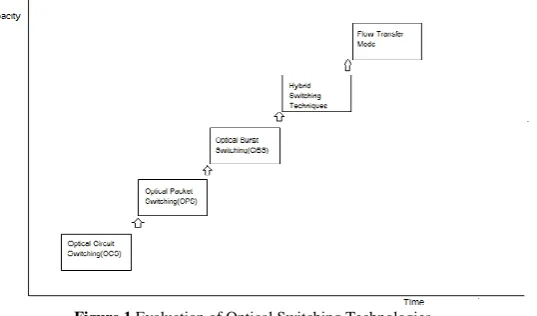
The rapid growth of Internet traffic requires high transmission rates beyond a conventional electronic router’s capability. Huge bandwidth demands the use of optical fibres and thus increase the fibre cost but the necessity of harnessing the bandwidth is need of future generation. Fig. 1 represents one view of how optical switching technologies may evolve to play an increasingly important role in future WDM optical network [1].
Figure 1.Evaluation of Optical Switching Technologies
Figure 2.Optical Circuit Switching Technique
An OPS is the simplest and most natural extension of packet switching over optics. There is no requirement to establish connection initially, the channel is available to use by many users. The information is padded with header which contains address of source and destination.
Figure 3.Optical Packet Switching Technique
The biggest challenge that packets face in an optical switch is the lack of large buffers for times of contention less number of techniques available to solve the contention. In addition, packets no longer follow the same path, and so they may arrive out of order at destination [1].
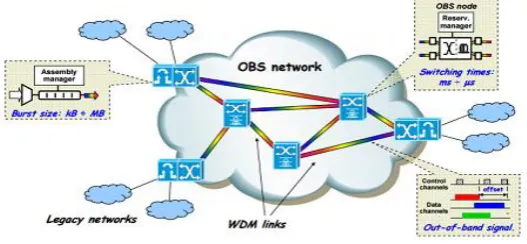
Figure 4.Optical Burst Switching Technique
Instead of considering single packet or bursts for transfer of data a universal switching technique known as the Flow Transfer Mode (FTM) is introduced which forwards the data by considering flows. The technique works on nanotechnology which contains the most recent advances in photonic crystal technology [4].
Figure 5.Different Switching Techniques
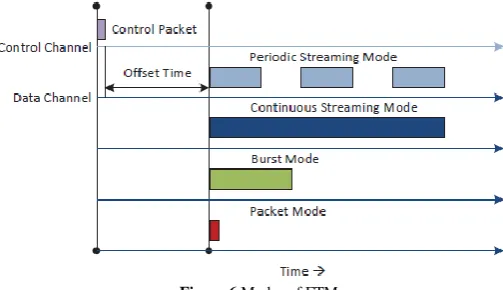
The OBS does not divide the incoming traffic into data flow known as modes. The FTM divides the data into four different modes namely packet mode, burst mode, continuous streaming mode and lastly Periodic steaming mode. The data flow contains a packet control that is sent in advance. The packet mode of data flow in traffic is not considered here as it generates additional overheads. In this paper a comparative analysis study of FTM with OBS is done. This paper compares the results of FTM with QoS when applied to void filling algorithms particularly Latest Available Unused Channel First-Void Filling (LAUC-VF) and segmented Best Fit Void Filling (BFVF).
The remaining of the article is organized as follows: In the Section II we discuss the work related to the FTM, its provisioning along with QoS as mentioned in [3]. In Section III we analyse in detail the proposed system in [3], describing each of its blocks. In Section IV the comparison and alteration of the system with different algorithms is mentioned. The paper ends with the conclusions and the future work lines in Section V.
II. FLOW TRANSFER MODE
The author [4] defines FTM as “a universal switching method with a layer-1 switching technology, and layer-2 or layer-3 control for scheduling continuous or periodic data flows as well as short flows consisting of a single packet or a burst of aggregated packets”. As stated earlier the FTM divides the incoming traffic into different modes. The different modes are shown the figure 6.
The description of each node is stated below:
A) Packet mode:
In this mode the number of data units and the control packets is the same hence this mode does not allow the processing overhead. However the advantage of this mode is that it can help in the improvement of network performance. The data can be scheduled with the node and rearrangement can be done until the data arrives.
B) Burst mode:
The burst mode is similar to the OBS; the data is aggregated in the form of bursts which processes the overheads. If the traffic monitoring information is available then the burst size can be estimated for advance transmission of control packet before the burst assembly completion.
C) Periodic streaming mode:
The request is made by a single control packet for all the corresponding nodes between the sender and the receiver. The wavelength allocation request for all the future bursts having fixed time gap is done by the single control packet. When certain amount of data is generated that this type of mode is used eg.Voice calls, VoIP.
D) Continuous streaming mode:
Large amount of data needs to be transfer from one end to the other. When large volumes of data are used this mode is helpful. The real-time applications or backup services use can use this type of mode where the connection is setup dynamically or through network management.
The control of end -end delays in the network is the main advantage of FTM. The FTM permits the delays that are independent of the mode. As per the requirements the delays can be made constant.FTM used at end-end forwarding increases the performance. Burst switching especially streaming has the biggest advantage of FTM.
III.ANALYSIS OF PROPOSED SYSTEM
The author has proposed the implementation of QoS along with the FTM. The QoS technique is thus divided for two parts: QoS at edge nodes and QoS at core nodes.
A. QoS at Edge nodes:
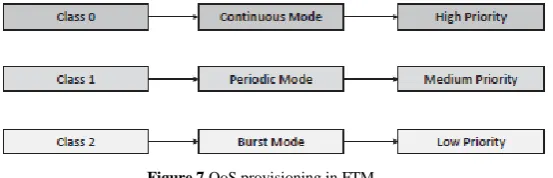
The incoming traffic is divided into three modes of FTM. The use of classifier is made at the edge node in order to classify the bursts. The burst is further classified into different classes and the classes are given certain priority. The following figure shows the classification of the burst. Continuous streaming mode is given high priority (HP) followed by periodic streaming mode with medium priority (MP) and the burst mode with low priority (LP). In nutshell 3 different classes are assigned with 3 different priorities that have 3 different modes. HP requires assigning extra offset time as compared to that of the MP and LP classes to increase the scheduling chances. The extra offset is four times of the offset of LP and MP to give optimal performance [10]. The MP and LP classes do not require the extra offset time.
Figure 7.QoS provisioning in FTM
B. QoS at core nodes:
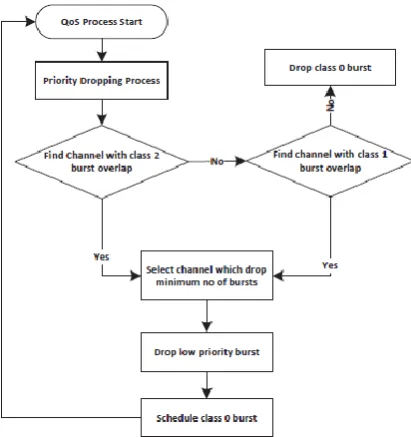
core node about the dropping of the bursts. Consider a situation where a stream of HP needs to wavelength to be allocated and there is no channel available then the scheduler searches for LP burst and tries to drop it. If LP burst is not available then it tries searching for the MP burst and drops the MP burst and schedules the HP. Finally if LP and MP bursts cannot be found by the scheduler then it drops the incoming HP class stream. Since we are using QoS the upcoming burst is not dropped. The algorithm is designed to find the overlapping bursts of LP class. If the overlapping is possible the least number of bursts are dropped and the scheduler schedules the HP stream. If the LP class burst is not available then it follows the same procedure done with LP for MP class burst. When both the cases fail the result is that HP stream is overlapped in all the channels and finally the HP stream is dropped. The same technique is applied to the periodic stream class.
Figure 8. Implementation of FTM with QoS
IV.PSEUDO CODE
Just Enough Time (JET) is used for signal processing of burst. In JET the output wavelength is reserved for a burst before arrival of first bit of burst. The throughput performance of JET is high [12]. The LAUC-VF algorithm [13] is used for the reservation of wavelength. The FTM is employed using the QoS provisioning. The continuous streaming mode requires extra offset time as stated earlier. The stream is first scheduled with LAUC-VF algorithm; in case the stream scheduling is unsuccessful then the pre-emptive scheduling is used where the priority buses are dropped for high priority scheduling. The concept of pre-emptive dropping is discussed in [11] for network communication. The BFVF algorithm using segmentation is a algorithm which provides maximum channel utilization and reduces the burst loss efficiently. Hence the comparison is done between the LAUC-VF and Best Fit Void Fill (BFVF) algorithm [14] and simulation results are done on the simulators where the programming is done in C++. The BFVF algorithm used here is such that:
Step 1: Calculate the void utilization factor.
Step 2: The void having maximum utilization is selected.
Step 3: If the void utilization factor is greater than 100% then consider channel having utilization factor close to 100%.
Step 4: If all the burst is not scheduled then use the pre-emptive scheduling algorithm for scheduling the remaining Burst.
V. RESULTS AND DISCUSSION
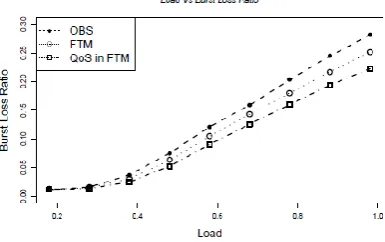
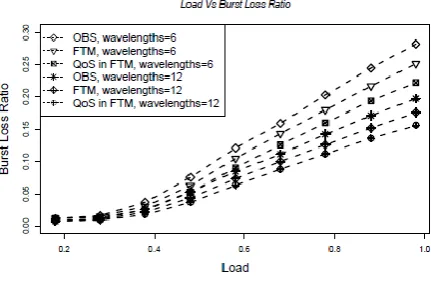
The three curves of the plot represent burst loss ratios of OBS, FTM and QoS in FTM. It can be noticed that there is no significant advantage of FTM as compared to OBS at lower load because at lower load majority of the bursts are successfully scheduled in both OBS and FTM but as the load increases, the difference in burst loss performance becomes more noticeable. FTM has higher bandwidth utilization and normalized throughput as compared to OBS and it is further improved by employing QoS in the FTM. The bandwidth is efficiently utilized if more bursts are scheduled [3].
Figure 8. Load vs Burst Loss Ratio
Figure 8. Load vs Bandwidth Utilization
Figure 8. Load vs Burst Loss Ratio
VI.CONCLUSION AND FUTURE WORK
We surveyed about hybrid optical switching technique i.e. FTM. FTM is similar to optical burst switching but it classifies traffic into different modes. We considered burst losses as the main parameter for QoS metrics. The investigation about delay can be the future work. The implementation of algorithm is ongoing work.
REFERENCES
1. Hardeep singh, Dinesh Arora, Pardeep Kumar, “Analysis of Switching Techniques in optical networks” IRACST- International Journal of Computer Science
and Information Technology, Vol. I, No. 2, December 2011
2. M. Fiorani, M. Casoni, and S. Aleksic, “Hybrid optical switching for an energy-efficient internet core,” IEEE Internet Computing, vol. 17,no. 1,
pp. 14–22, 2013.
3. Muhammad Imran, Khurram Aziz. "Performance Evaluation of Hybrid Optical Switching with Quality of Service". In proceedings of IEEE,
2015.
4. R. van As Harmen, “Flow transfer mode (FTM) as universal switching method in electronic and photonic networks,” Elektrotechnik und
Informationstechnik, vol. 126, no. 7-8, pp. 280–287, 2009.
5. H. R. van As, “Time for a change in electronic and photonic switching,” in Transparent Optical Networks, 2008. ICTON 2008. 10th
Anniversary International Conference on, vol. 1, 2008, pp. 140–143.
6. L. Peng, C.-H. Youn, W. Tang, and C. Qiao, “A novel approach to optical switching for intradatacenter networking,” Journal of Lightwave Technology, vol. 30, no. 2, pp. 252–266, 2012.
7. M. Imran, M. Collier, P. Landais, and K. Katrinis, “HOSA: hybrid optical switch architecture for data center networks,” in Proceedings of the
12th ACM International Conference on Computing Frontiers. ACM, 2015, p. 27.
8. G. Weichenberg, V. Chan, and M. Mdard, “Design and analysis of optical flow-switched networks,” Optical Communications and
Networking,IEEE/OSA Journal of, vol. 1, no. 3, pp. B81–B97, 2009.
9. Z. Rosberg, J. Li, F. Li, and M. Zukerman, “Flow scheduling in optical flow switched (OFS) networks under transient conditions,” Journal of
Lightwave Technology, vol. 29, no. 21, pp. 3250–3264, 2011.
10. N. Akar, E. Karasan, K. G. Vlachos, E. A. Varvarigos, D. Careglio,M. Klinkowski, and J. Sol-Pareta, “A survey of quality of service
differentiation mechanisms for optical burst switching networks,” Optical Switching and Networking, vol. 7, no. 1, p. 111, 2010.
11. J. A. Zubairi and N. A. Al-Bahbooh, “Novel schemes for traffic engineering in access domains,” International Journal of Network
Management, vol. 17, no. 1, pp. 69–83, 2007.
12. M. Yoo and C. Qiao, “Just-enough-time (JET): a high speed protocol for bursty traffic in optical networks,” in Vertical-Cavity Lasers, Technologies for a Global Information Infrastructure, WDM Components Technology, Advanced Semiconductor Lasers and Applications, GalliumNitride Materials, Processing, and Devi, 1997, p. 2627.
13. Yijun Xiong, Member, IEEE, Marc Vandenhoute, Member, IEEE, and Hakki C. Cankaya,”Control Architecture in Optical Burst Switched
WDM Networks”, IEEE JOURNAL ON SELECTED AREAS IN COMMUNICATIONS, VOL. 18, NO. 10, OCTOBER 2000.
14. A.K Rauniyar, A.S Mandloi , “Best Fit Void Filling Segmentation Based Algorithm In Optical Burst Switching Networks”, Journal of
BIOGRAPHY
Aishwarya Jagtap is a student at the All India Shri Shivaji Memorial Society’s, College of Engineering, Pune. She is
pursuing the Bachelors degree for Engineering (B.E Comp) in Pune, India under Savitribai Phule Pune University.
Komal Shitole is a student at the All India Shri Shivaji Memorial Society’s, College of Engineering,Pune. She is
pursuing the Bachelors degree for Engineering (B.E Comp) in Pune, India under Savitribai Phule Pune University.
Akshata Somkuwar is a student at the All India Shri Shivaji Memorial Society’s, College of Engineering, Pune. She is
pursuing the Bachelors degree for Engineering (B.E Comp) in Pune, India under Savitribai Phule Pune University.
Chinmay Sutar is a student at the All India Shri Shivaji Memorial Society’s, College of Engineering, Pune. He is