2D-3D Enhanced Image Conversion Using
NLS Method
Rohit Singla, Ms. Nandini, Deepak Dixit, Hemant Sharma
M. Tech Student, Dept. of Computer Science& Engineering, Shri Ram College of Engineering and Management, Palwal, affiliated to M.D.U Rohtak (Haryana), India.
Asst. Professor, Dept. of Computer Science& Engineering, Shri Ram College of Engineering and Management, Palwal, affiliated to M.D.U Rohtak (Haryana), India.
M. Tech Student, Dept. of Computer Science& Engineering, Shri Ram College of Engineering and Management, Palwal, affiliated to M.D.U Rohtak (Haryana), India.
M. Tech Student, Dept. of Computer Science& Engineering, Shri Ram College of Engineering and Management, Palwal, affiliated to M.D.U Rohtak (Haryana), India.
ABSTRACT: Image processing has completely different forms to perform the popularity, identification and enhancement of pictures. One in all the such associated growing field is that the transformation of the image from one kind to different. This transformation will be done from one image format to different or one structural facet to different. one in all such transformation sort is to generate the 3D image by mistreatment the series of 2nd pictures. As we know, in world objects are obtainable in 3D kind. If the objects area unit conferred in same approach in pictures, the recognition or the identification rate are high. however just in case of existing dataset available in 2D kind, there's the necessity of some machine-controlled system, which will get the 3D image from 2D image set. This image set is that the real time set of pictures that covers the various structural views of 2D face. The bestowed thesis work is on the brink of supported identical conception. The work is about to use the prevailing 2D real time image dataset and kind a 3D image from it. The presented work is targeted on facial dataset wherever a series of 2nd pictures in hand. The work relies on the structural analysis of the prevailing image and to derive the structural feature like depth of those feature points. To perform the facial feature analysis, the improved least sq. methodology is employed during this work. supported this analysis, the structural information is collected and also the correlation analysis is performed on these feature points to obtain the article similarities and also the feature analysis. Finally, the similar and distinctive options area unit separated and determine the meaningful options mistreatment that the face reconstruction is performed. The work is enforced in mat-lab atmosphere. The results obtained from the system shows the effective generation of 3D facial image from 2D image set.
KEYWORDS: 2D-3D Image Conversion, Image Processing, Non Linear Least Square Method, .Matlab.
I. INTRODUCTION
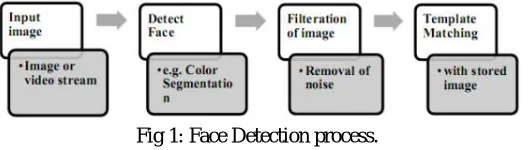
Face detection: Face detection is outlined as straightforward technique of extracting the faces from the image i.e. when we input the image to face detection method it straightforward detects the faces gift on the image. The face detection method are often divided into 3 classes that's face detection, face location and face chase. These stages square measure thought of after we solely specialize in the face detection method [20].
the system it's within the variety of image of the video. that the image we get as input is of high resolution, which can increase the quality of the detection process. therefore we tend to down sample the image at low resolution so the quality reduces. Now we do the detection of the faces from the image [20].
Fig 1: Face Detection process.
For this we even have take into account the instance of color segmentation that is explicit as follows, in this mainly 2 techniques area unit being employed that's color segmentation (using RGB, HIS, YCbCr) to detect the coloring and to induce binary image, second morphological technique (filtering erosion filter, dilation filter, gap filter closing filter etc.) to get rid of noise from the segmented image. currently the guide matching is completed over the obtained image with the average image. Then the face recognition method will be applied used any technique. It may be victimization computing, neural network or the other per your convenience.
Feature Extraction:
f
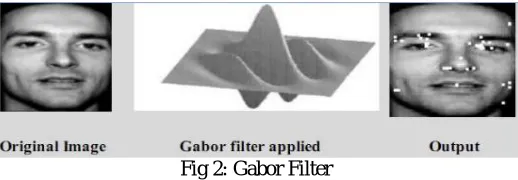
eature extraction is that the next step to the feature detection. Feature extraction suggests that extracting options from the image. it's the core sub method of the face recognition method. It helps in extracting relevant info from the image, which can facilitate us. in face recognition. In alternative words we will say that, options that area unit chosen play a really necessary role, so as to style the great and economical face recognition system [30]. Well, we've to perform depth estimation, therefore some special options area unit to be extracted from the input image. These special options will be chin, nose, lips, eyes and form of the face. There area unit several feature extraction ways distinct Fourier Transformation, distinct circular function Transformation, Eigenvectors-PCA, distinct moving ridge Transformation, Gabor filter and lots of more [30] currently let’s have a short discussion regarding the feature extraction method. This process helps us. to extract all sets of the options forming the actual patterns, which can help us. in face recognition. Patterns area unit the points within the multi dimensional area figure below depicts the same.surface gradient, or surface slant. The depth price is thought-about either because the relative distance from the camera to the surface points, or the relative surface height higher than the x-y plane. Many algorithms for 3D reconstruction are developed up to now, like shape-from-shading (SFS), the 3D morph-able model, structure from motion etc.
Fig 2: Gabor Filter
Shape from Shading: F Shape recovery is a classic problem in computer vision. The goal is to derive a 3D scene description from one or more 2D images. The recovered shape can be expressed in several ways: depth Z(x, y), surface normal ( nx,ny ,nz), surface gradient (p, q), and surface slant, and tilt . The depth can be considered either as the relative
distance from camera to surface points, or the relative surface height above the x-y plane. The surface normal is the orientation of a vector perpendicular to the tangent plane on the object surface.
The surface gradient (p, q)
= (
dz/dy)
* (dz,dx) is the rate of change of depth in the x and y directions, shading, stereo, motion, texture, etc. Shape from-shading (SFS) deals with the recovery of shape from a gradual variation of shading in the image [16] [1]. To solve the SFS problem, it is important to study how the images are formed. A simple model of image formation is the Lambertian model, in which the gray level at a pixel in the image depends on the light source direction and the surface normal. In SFS, given a gray level image, the aim is to recover the light source and the surface shape at each pixel in the image. However, real images do not always follow the Lambertian model [1].Fig.3: Face structure estimation process (a) Feature points on generic face model (b) morphed face model (c) certain pose (d) image and features (e) distance map (f) 2D features (g) lookup tables.
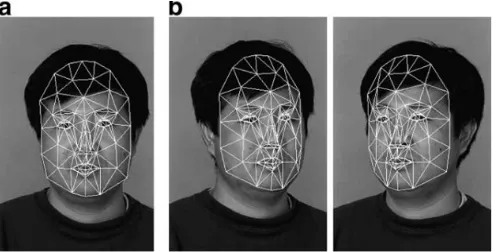
Structure From Motion: It is a popular approach to recover the 3D shape of an object when multiple frames of an image sequence are available. Given a set of observations of 2D feature points, SFM can estimate the 3D structure of the feature points. For example, this technique can be applied to video recordings of a talking person. The CANDIDE model is used for initialization only in iterative process because the 3D face structure is unknown in the first iteration. The definitions of the three axes are shown in Fig 1.5 [18] [19].
Fig 4: The CANDIDE model in frontal and profile view
Based on the position of the important feature points, the CANDIDE model is first adapted to the frontal-view face image as shown in Fig.5
Fig 4.: (a) Face images with an adapted face model, and (b) face images under different poses adapted by the rotated face mode
very helpful for real-time applications. However, when they are applied to face recognition, SFS and the 3D morph-able model generally have a better recognition performance than SFM because the information about more feature points is utilized. Recently, some hybrid algorithms have been proposed to alleviate the drawbacks of any one algorithm. Among various SFM methods, the partial transformation approach is one important branch. Specifically, in [18] a similarity-transform based method is proposed to derive the 3D structure of a human face from a group of face images under different poses. The proposed algorithm does not require any prior knowledge of camera calibration, and has no limitation on the possible poses or the scale of the face images. In addition, the method in [18] has been verified that it can be extended to face recognition to alleviate the effect of pose variations. Unfortunately, the genetic algorithm (GA) used to estimate the depth usually encounters a heavy computational burden. Moreover, how to design a reasonable chromosome, how to make a feasible gene operation scheme, and how to adjust the parameters remain difficult problems. To reduce the computation of the method in [1], the nonlinear least-squares (NLS) model-based methods are proposed to estimate the depth values of facial feature points, i.e., a sparse 3D face representation. In the NLS model, not only the pose parameters, but also the depth values of the facial feature points, are considered as the variables to be optimized. In addition, the symmetry information of face is utilized further in the proposed methods in order to alleviate the sensitivity to the training samples used. Note that one frontal view face image and one non-frontal-view face image are sufficient to reconstruct a 3D face model using our proposed algorithms. And for cases when multiple non-frontal-view face images are available, a model-integration approach is proposed to improve the depth estimation accuracy [1].
II. LITERATURE REVIEW
Literature review includes various new approaches as under:
In [2], Prasanna S R et al. presented a new face-recognition algorithm by combining Gabor features within the scope of diffusion-distance calculation. This strategy starts from the Gabor filtering that consists of three scales and six orientations. It is followed by the calculation of diffusion distance based on a Bayesian model. This proposed algorithm has been compared against several state-of-the-art techniques. The experimental results show that the proposed face-recognition scheme has the best performance in accuracy. In this paper, Gabor features are generated to represent the local characteristics. These features are driven by the nature of human perception, being of a good capability to differentiate the face images used. To enhance the performance of face recognition, a Bayesian model was used to determine the similarity degree between two histograms. The rationale of using this Bayesian decision model is to ensure the maximization of likely estimation across different histograms.
The available experimental results have justified the successful usage of the Gabor features and the Bayesian model.
In [3], Tudor BARBU proposed a novel supervised facial recognition system in this paper. The main contribution of this article is the proposed 2D Gabor filter-based feature extraction that produces robust three-dimensional face feature vectors. Another contribution of this paper is the supervised classifier used for facial feature vector classification. It uses minimum average distances and the squared Euclidean metric. The proposed threshold based verification technique, containing an automatic threshold detection procedure, represents an important novelty element of this paper, too. A high recognition rate has been achieved by this technique, as it results from the performed experiments. The obtained results prove the effectiveness of this method. This technique provides a higher recognition rate than many other facial recognition approaches.
In [5], Subhashini Ramalingam et al. proposed a novel approach having the following is different face gestures like Surprise, Smile, Sad, Disgust, Angry and Fear. Use of Gabor filters with the proposed way of getting feature extraction using energy, mean and standard deviation, uses less computation power with a pretty decent result compare to the complex way of using mathematical approaches. This system can be enhanced by using proper face model inclusion in the system. In short, this system used the Gabor filter for feature extraction. In this the different face expressions are being extracted and recognized.
In [7], Marc ESCHER et al. defined a face model i.e used which is modified to fit to the real face. Primarily two aspects are considered: (1) modeling involving the construction of a 30 texture mapped face model fitting to the real face: (2) the animation of the new constructed face. Automatic texture fitting is employed to produce the virtual face with texture mapping from the real face image.
III. RESERACHANDELABORATION
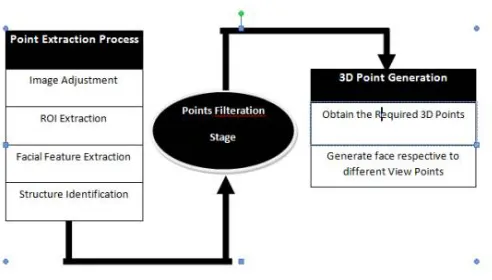
In this scheme, we propose algorithmic approach is Formulation Of NLS Model using sparse matrix, however he presented work is about the construction of the 3D face image by using a series of 2D face images and by performing the structural analysis over it. To perform this construction we need a set of 2D images with different poses. The presented work is divided in two stages.
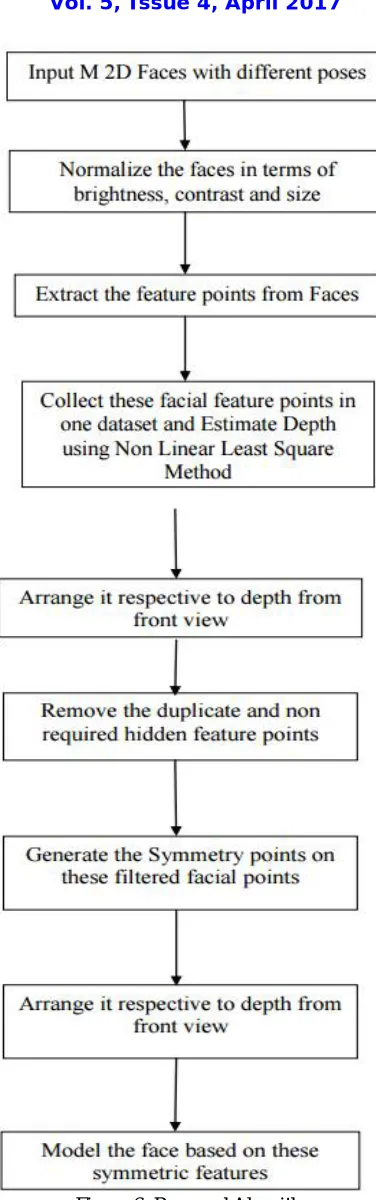
In first stage, the structural information will be extracted from the face image. These structural points are called the facial feature points and the second level, the depth estimation of these feature points will be done. To estimate the depth of feature points a non linear least square method will be adapted in this approach. The depth estimation includes the arranging the feature points according to obtained depth points as well as to eliminate the hidden points and to generate the structural boundaries over these points. Once the effective depth estimation will be performed, the structural symmetry will be points over these points and the model integration will be done. The work also includes the estimation of the accuracy over these points under the depth estimation as well as to generate the facial symmetry over these generated facial points. The work also includes the estimation of these points under the frontal view of the face and to obtain the structural boundaries respectively. The actual methodology steps that will be adapted in this presented work are defined in the form of process flow shown in figure 6 as underline proposed model.
In this present work, the 3D face reconstruction approach is presented using a set of 2D images. The presented work is a hybrid model in which the Least Square Analysis approach is used along with Structural Point Generation and lamination approach to perform the 3D Structural Point Reconstruction. The presented systems itself have a number of properties along with standard architecture. The architecture includes the basic three
components called Input Image Set, Structural Point Extraction, Generation of 3D Points. When the input image or the dataset images are collected or extracted they can be slightly different respective of defined properties. In such case before implementing the 3D Face Arrange it respective to depth from front view Remove the duplicate and non required hidden feature points Generate the Symmetry points on these filtered facial points Arrange it respective to depth from front view Model the face based on these symmetric features Generation after some preprocessing operations are performed to improve these Properties so that better extraction of facial features will be done. The Accuracy of the system is based on this pre-processing stage.
Figure 7 : Model of proposed work
The view sphere is separated into several small segments. On each segment, a face detector is constructed. In this work we have used a classification approach to categorize the input image in the form of relational images. We have maintained all the co related images as a single class. Once the dataset is maintained the network is to perform the matching process. Formulation depiction for feature extraction is below:
1) Start searching from bottom left to detect the right corner end point. 2) Start searching from bottom right to detect the left corner end point. 3) Start searching from top left to detect the right corner end point
4) Start searching from top right to detect the left corner end point. After detecting the corner end point of each Object, Euclidean distance of each end point is measured and stored in a data base and corner end point is marked by a middle symbol.After finding the gray level co-occurrence matrices of each Object the following equation can be used to get a texture feature of Objects:-
1) Input Image
I(x,y)=front view image
2) Detect face region by applying viola-Jones algorithm
Face_Img = viola_jones(I)
3) Convert face region into Gray scale Gray_face=Grayscale(Face_Img )
4) Crop different Object from gray scale image Left_eye_face =crop(Gray_face)
Right_eye_face=crop(Gray_face) Nose_face = crop(Gray_face) Mouth_face =crop(Gray_face)
PMouth_PEP=PEP(Mouth_face)
6) By using the Gray level co-occurrence matrix (PEP) of each Object, equation from 3-10 is evaluated for calculating the different texture parameter.
7) Store each texture parameter in a database
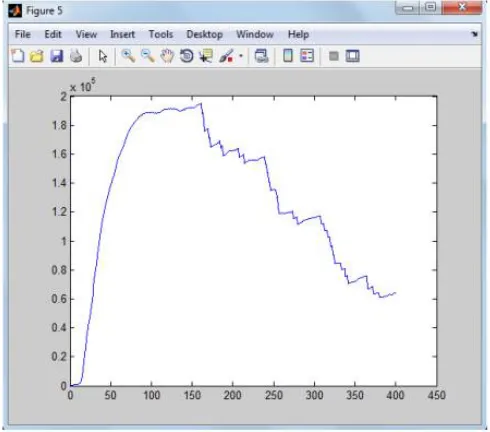
Figure 8 : Result : pixel vs frequency graph for figure 4.
IV. CONCLUSION
The presented work is about to generation of the 3D face image from a series of 2D facial images. In this present work, an improved Least square method is presented to generate the 3D facial image by using the 2D real time image set. The presented work is based on the structural feature extraction and the analysis. At the earlier stage, the least square method is used to identify the facial features. After the extraction of features, the correlation analysis and the feature point analysis is performed to identify the effective facial features, feature similarity and the distinctive features. Based on this analysis, the effective feature selection is performed and the organization of these features results the construction of 3D face image. The work is tested on real time dataset and the obtained results shows the effective generation of 3D face from 2D face images.
REFERENCES
1. Zhan-Li Sun, “Depth Estimation of Face Images Using the Nonlinear Least-Squares Model”, IEEE transactions on image processing, vol. 22, no. 1, january 2013.
2. Prasanna SR, Prof. Karpagam, “Recognizing face using Gabor Filter with Perceptual Features”, in the proceedings of Journal of computer applications, 2012.
3. Turdor Barbu, “Gabor filter- based Face Recognition Technique”, in the proceeding of the roman academy series A, 2010 .
4. Faten Bellakhdhar, Kais Loukil, Mohamed ABID “Face recognition approach using Gabor Wavelets, PCA and SVM”,in the proceeding of international journal of computer science issues, 2013.
5. Subhashini Ramalingam, Dr llango Paramasivam, Mangayakarasi Ramiah, “Recognition of facial gestures using Gabor filter”, in the proceedings of international journal of computer application, 2011.
6. Martin D. Levine , Yingfeng (Chris) Yu “State-of-the-art of 3D facial reconstruction methods for face recognition based on a single 2D training image per person” Pattern recognition letters 30,2009
7. Marc ESCHER, “Automatic 3D Cloning and Real-Time Animation of a Human Face”, IEEE, pp 58-66, 1997 8. A.Z. Kauzani, “Synthesising A Front Pose Face Image”, IEEE, pp 93-96, 2004
9. S. Hassan Amin, “Analysis of 3D Face Reconstruction”, 14th International conference on Image Analysis and Processing, IEEE, pp 1-5 2007 10. Pedro Jim´ enez, “Face Pose Estimation and Tracking Using Automatic 3D Model Construction”, IEEE, pp 1-5, 2008
11. Sung Won Park, “3D Face Reconstruction from a Single 2D Face Image”, IEEE, pp 1-6, 2008
12. M. Shahriar Hossain, “Inexpensive Construction of a 3D Face Model from Stereo Images”, IEEE, pp 1-6, 2007
13. Pascal Paysan, “A 3D Face Model for Pose and Illumination Invariant Face Recognition”, Advanced Video and Signal Based Surveillance, pp 296-301, 2009 72
14. Narendra M Patel, “3D Model Reconstruction and Animation from Single View Face Image”, ICALIP, pp 674-682, 2012
15. Narendra Patel, “3D Facial Model Construction and Expressions Synthesis From a Single Frontal Face Image”, International Conference of Computer and Communication Technology, pp 652-657, 2010
16. Ruo Zhang, Ping-Sing Tsai, James Edwin Cryer, and Mubarak Shah, “shape from shading - a survey” IEEE transactions on pattern analysis and machine intelligence, vol. 21, no. 8, august 1999.
17. Chongzhen Zhang and Fernand S. Cohen, Senior Member, IEEE “3-D Face Structure Extraction and Recognition From Images Using 3-D Morphing and Distance Mapping” IEEE transactions on image processing, vol. 11, no. 11, november 2002.
18. Hei-Sheung Koo, Kin-Man Lam “Recovering the 3D shape and poses of face images based on the similarity transform” Pattern recognition letters ,2008.
19. Christoph Bregler, Aaron Hertzmann, Henning Biermann “Recovering Non-Rigid 3DShape from Image Streams” IEEE 2000.
20. Sonal Mahajan, Sukhbir Singh “A Expression Invariant Approach to Perform Face Recognition” International Journal of Advanced Research in Computer Science and Software Engineering Volume 3, Issue 9, September 2013.
21. Digital image enhancement tutorials CYH/Image Enhancement
22. Digital image processing for image enhancement and information extraction tutorials. 23. Amit K. Roy-Chowdhury and Rama Chellappa, Fellow, IEEE “Statistical Bias in 3-D
24. Reconstruction From a Monocular Video” IEEE transactions on image processing, vol. 14, no. 8, August 2005.
25. Jose Gonzalez-Mora, Fernando De la Torre, Rajesh Murthi, Nicolas Guil, Emilio L. Zapata,” Bilinear Active Appearance Models” IEEE 2007. 26. Jose Gonzalez-Mora, Nicolas Guil, Emilio L. Zapata, Fernando de la Torre” Efficient image alignment using linear appearance models” IEEE
2009.
27. Andrea Thelen, Susanne Frey, Sven Hirsch, and Peter Hering ” Improvements in ShapeFrom-Focus for Holographic Reconstructions With Regard to Focus Operators, Neighborhood-Size, and Height Value Interpolation” IEEE transactions on image processing, vol. 18, no. 1, January 2009.