ISSN(Online): 2320-9801
ISSN (Print): 2320-9798
International Journal of Innovative Research in Computer
and Communication Engineering
(An ISO 3297: 2007 Certified Organization)
Vol. 4, Issue 9, September 2016
Implementing the Cloud and Internet of Thing
concepts in Robots
J Thasleen Fathima1, C Kamaraj 2
, P Saravanakumar3
Assistant Professor/Research Scholar, Dept. of I.T., H.K.R.H College, Uthamapalayam, Tamilnadu, India 1
Assistant Professor, School of Information Technology, SRM University, Sikkim, India 2
Assistant Professor/ Research Scholar, School of Information Technology, SRM University, Sikkim, India 3
ABSTRACT: Using Cloud technology we can able to retrievedata anywhere. By connecting everything to internet
gave more accessibility of data from one type system to another type of system. Implementation of these concepts in Robotics led us efficient production process, better understanding of problem solving skills to robots and efficient
system design .The Internet of Things (IoT) is a system of interrelated computing devices, mechanical and digital
machines, objects, animals or people that are provided with unique identifiers and the ability to transfer data over a network without requiring human-to-human or human-to-computer interaction.
This paper describes about a new methodology to create robots with the integration of Cloud and Internet of Things (IoT). This method is applicable for almost all type robots. But it works efficiently in the system design where large number of function implemented in robots. It has the aim to solve the problem which arises when
we develop the robotic systems.
.
KEYWORDS: Cloud Computing; Internet of Things (IoT); Robots; High functional Robots; Industrial Robots;
Artificial Intelligence (AI)
I. INTRODUCTION
Robotics is one of now fast growing field. Using robots we can reduce the work flow process and also the efficient of manufacturing process could be increase. Artificial intelligence enables us to make robots to act smart for any given situation. The programming of artificial intelligence is too difficult. Also the robot needs to analyse and store more data in the learning process. So, the memory capacity of robot should be greater than any other programming system (because of implementing learning function).
The Internet of things and Cloud are two comparative challenging technologies are been merged together to change not only current and future of the Internet working services. As Internet of Things has limited capabilities of processing power and storage also consequential issues such as performance, security, reliability, privacy, integration of Internet of Things with Cloud is more beneficial for undergoing unlimited capabilities like Storage, and Processing power. Cloud can even benefit from the Internet of things that it can extend its limits with real world things in more dynamic and distributed manner, and deliver massive number of services in real time.[1] Cloud application has realized the business process of industry application, which can be used as a part of the cloud platform, and can also integrate third-party industry applications, such as traffic logistics, health monitoring and agriculture monitoring.[2]
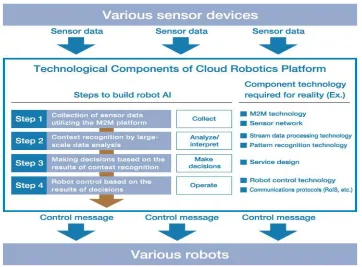
Fig. 1 refers to connecting robotic system into Internet we can access that robotic system anywhere (i.e. we can
gave command to the robot anywhere). The development of mobile robots was driven by the desire to automate
ISSN(Online): 2320-9801
ISSN (Print): 2320-9798
International Journal of Innovative Research in Computer
and Communication Engineering
(An ISO 3297: 2007 Certified Organization)
Vol. 4, Issue 9, September 2016
Fig. 1. Components of Cloud Robotics Platform
II. RELATED WORK
In [2] authors used Machines as intelligent as humans should be able to do most of the things humans can do. Flexible automation schemes and systems are quickly gaining acceptance and are being increasingly applied in industry. Now a day, they are use robots for manufacturing process. Applications of Artificial Intelligence to medicine have been increasing in recent years. Artificial Intelligence employed in the medical field mainly to perform a rational analysis of the data available from clinical examination (such as Computerized Tomography, Nuclear Magnetic Resonance(NMR), Digital Angiography, etc.) in order to get a reliable diagnosis of the patient’s disease and a suitable decision support. Also lot of robots invented to work in home. Robots also invented to play chess, soccer etc. Robots can think well when we implement artificial intelligent concept to it.
ISSN(Online): 2320-9801
ISSN (Print): 2320-9798
International Journal of Innovative Research in Computer
and Communication Engineering
(An ISO 3297: 2007 Certified Organization)
Vol. 4, Issue 9, September 2016
III.PROPOSED SYSTEM
A. ARTIFICIAL INTELLIGENCE:
The field of artificial intelligence, attempts to understand intelligent entities. Thus, one reason to study it is to learn more about ourselves. But unlike philosophy and psychology, which also concerned with intelligence, artificial intelligence strives to build intelligent entities as well as understand them. Another reason to study artificial intelligence is that these constructed intelligent entities are somewhat interesting and useful in their own right. Artificial intelligence has produced many significant and impressive products even at its early stage in its development. [5] .The first work of AI was done by Warren McCulloch and Walter Pitts (1943)
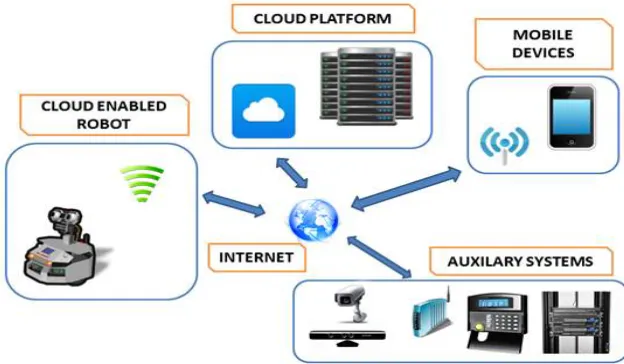
Fig. 2. Cloud Enabled Robot using IoT
B. ROBOTS:
Robotics is concerned with the study of those machines that can replace human beings in the execution of a task, as regards both physical activity and decision making[7]. Robots can be defined as programmed machines or computers that can able to do some (physical) work. Robots have become incorporated into human life over the last half century: what was once only science fiction has now become a reality.[8] Also there is some biblical passage (Luke 19:37- 40 and Matthew 3:9)[9] that said like non-living thing can speak and Almighty God can make stones to human like thing[10].
C. CLOUD COMPUTING:
ISSN(Online): 2320-9801
ISSN (Print): 2320-9798
International Journal of Innovative Research in Computer
and Communication Engineering
(An ISO 3297: 2007 Certified Organization)
Vol. 4, Issue 9, September 2016
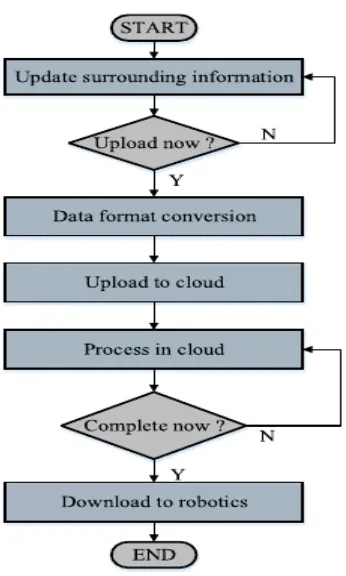
Fig. 3. Step by Step Implementation of Robotics in Cloud
D. INTERNET OF THINGS (IOT):
Connecting almost all type of things (like car, home appliances, watch etc.) into Internet known as Internet of things. The Internet of Things refers to uniquely identifiable objects (things) and their virtual representations in an Internet-like structure. Fig .2. Refers to everyday objects, that are readable, recognizable, locatable, addressable, and/or controllable via the Internet using either RFID, wireless LAN, wide-area network, or other means.[13]
IV.PROPOSEDMETHODSANDIMPLEMENTATION
STEP 1: ANALYSING TASKS
First of all the tasks which need to implement to our robot or a robotic system is pointed out. It may be listed separately.
STEP 2: CONCEPT TO MAKE ROBOT
Listing the general concepts to make the robot according to the tasks listed in previous step is the next process in this method. It means when we make a robot to take a ball is one of the task of the robot, the dimension of the ball and the corresponding sensor requirement are assumed as a general concept. Also in non-humanoid robots like in car industries two robots are fit the two sides of the door and then another robot screwed it. Here that robots hand like machine, Screwdriver, screws etc are considered in this process. If we implement some sensors programming the sensors and other parts (like microprocessor, some chip sets etc.) are also considered in this process.
STEP 3: CONCEPT-ARTIFICIAL INTELLIGENCE
ISSN(Online): 2320-9801
ISSN (Print): 2320-9798
International Journal of Innovative Research in Computer
and Communication Engineering
(An ISO 3297: 2007 Certified Organization)
Vol. 4, Issue 9, September 2016
be transparent), the robot must think that box need to open and took the ball. This is known as artificial intelligent thinking. Likely in non-humanoid robots as in previous example (to make door of a car), When other side of the door cannot be in the place(i.e. not taken by the robot), the other robot also just screwed the one side without knowing it. Here if the two robots have or haven't the door side must be known by the other robot by using any appropriate sensors. And also learning from day to day from its environments is necessary to work efficiently.
STEP 4: RECHECKING THE CONCEPTS
Rechecking whether the concept doesn't violate another concept ( i.e. one task doesn't violate another task) In practical we could be able to find some contradiction. These things need to correct in this step.
STEP 5: IMPLEMENTING CLOUD
Uploading the software to a cloud server and checking the programs and check whether it will work correctly considered in this process. In other words, it will connect to a cloud. Because of this the size of the robotic system also reduced. So, learning by the robot and transferring one system to other is easy. Consider a robot 'A' learn from a person 'X'. When the person 'X' need to go other place (like foreign country). Person 'X' has no need to take a robot from his/her own place to another place. 'X' can use the other similar type robot by using the password or access key using the data stored in the cloud server. So it is another advantage when we implement programs to the cloud.
Also Cloud computing technology combines parallel computing, distributed computing and grid computing. The developing of the Internet of things depends upon high efficient storage and computing power, which is the advantage of cloud computing technology. So it is the basic of the internet of things.[14]
STEP 6: MAKE A ROBOT
Assemble all the hardware parts and install all the programs to make a robot.
STEP 7: MAKE IT TO CONNECT WITH OTHER SYSTEMS OR ROBOTS
Connection between two systems can be made wired or wireless. For wired we can use Metallic cables, Optical Fiber cables etc. For short distance accessing we can use Zig-bee , Wi-Fi, UWB, blue-tooth, the extension of broadband network and some integrated communication module, etc. But in the case of long distance we can use internet or Optical fibre cable to access the robotic system.
STEP 8: SECURITY CHECK
We need to check the security of the system in order to prevent malfunctioning and attacks. Because when we connect robot to a internet probably the risk of data threatening is increase. So may be some another person can change the configuration or gave command to our robotic system. So high en security is needed before we using the robotic system.
ISSN(Online): 2320-9801
ISSN (Print): 2320-9798
International Journal of Innovative Research in Computer
and Communication Engineering
(An ISO 3297: 2007 Certified Organization)
Vol. 4, Issue 9, September 2016
Robots and automation systems are no longer limited by onboard resources in computation, memory, or software.
Fig.4. Cloud Robotics and Automation
Fig.4. refers "Cloud Robotics and Automation" is a new paradigm where robots and automation systems share data and code and perform computation via networks building on emerging research in cloud computing. Consider Google's autonomous car. It uses the network to index maps, images, and data on prior driving trajectories, weather, and traffic to determine spatial localization and make decisions. Data from each car is shared via the network for statistical optimization and machine learning performed by grid computing in the Cloud. Cloud Robot and Automation systems can be broadly defined as any robot or automation system that relies on data or code from a network to support its operation, i.e., where not all sensing, computation, and memory is integrated into a single standalone system. Cloud computing has virtually unlimited capabilities in terms of storage and processing power, is a much more mature technology, and has most of the IoT issues at least partially solved. Thus, a novel IT paradigm in which Cloud and IoT are two complementary technologies merged together is expected to disrupt both current and future Internet.
ISSN(Online): 2320-9801
ISSN (Print): 2320-9798
International Journal of Innovative Research in Computer
and Communication Engineering
(An ISO 3297: 2007 Certified Organization)
Vol. 4, Issue 9, September 2016
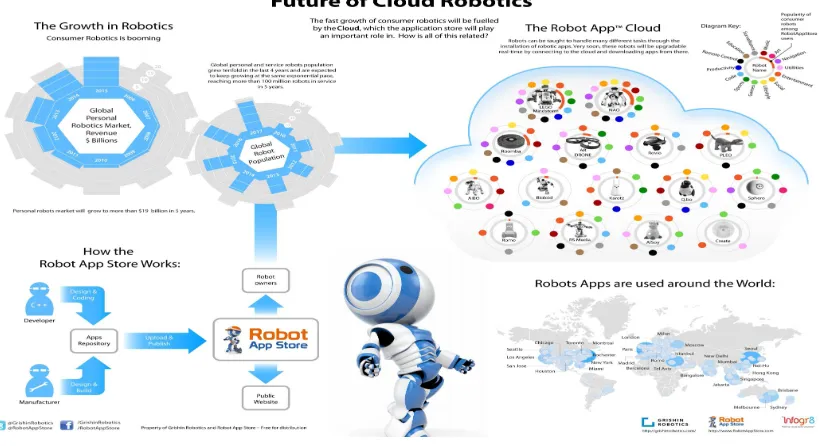
Fig.5. Future of Cloud Robotics
Fig. 5 refers at least four potential advantages to using the Cloud: 1) Big Data: access to updated libraries of images, maps, and object/product data, 2) Cloud Computing: access to parallel grid computing on demand for statistical analysis, learning, and motion planning, 3) Collective Learning: robots and systems sharing trajectories, control policies, and outcomes, and 4) Human Computation: use of crowd sourcing to tap human skills for analysing images and video, classification, learning, and error recovery. The Cloud can also provide access to a) datasets, publications, models, benchmarks, and simulation tools, b) open competitions for designs and systems, and c) open-source software. It is important to recognize that Cloud Robotics and Automation raises critical new questions related to network latency, quality of service, privacy, and security.
V. CONCLUSIONANDFUTUREWORK
By using Cloud and Internet of Things we can make a robot capable of learning and doing work efficiently. In
implementing these concepts and commercialization security plays a vital role. Researches going on to gave better security over cloud and internet of thing to implement it. Also using these concepts Surgery robots can be made with higher productivity [15]. M2M [Machine to Machine] communication can be possible in this method (by using cloud)[16].Industry, medical,army,research etc. need robots to perform jobs quickly and efficiently. These methods simplify the process of thinking and making the robot.
REFERENCES
1. Shaik Masthan Babu et al., “A Study on Cloud based Internet of Things: Cloud IoT”, Proceedings of 2015 Global Conference on Communication Technologies(GCCT 2015).
2. Jiang Rui, Sun Danpeng, “Architecture Design of the Internet of Things based on Cloud Computing” 2015 Seventh International Conference on Measuring Technology and Mechatronics Automation.
3. Aadhityan A. “ A Novel Method for Developing Robotics via Artificial Intelligence and Internet of Things”IJCA Proceedings on National Conference on Future Computing 2014 NCFC 2014(1):1-4, January 2014.
4. Aadhityan A, "A novel method for implementing Artificial Intelligence, Cloud and Internet of Things in Robots," Innovations in Information, Embedded and Communication Systems (ICIIECS), 2015 International Conference on, Coimbatore, 2015, pp. 1-4.
5. Stuart J. Russell and Peter Norvig. “Artificial Intelligence-A Modern Approach”. Prentice-Hall, Inc., 1995.
6. Cornelius T. Leondes, “Intelligent Systems: Technology and Applications, Six Volume Set Volume 1 of Intelligent Systems: Technology and Applications”, CRC Press, 2002.
7. Bruno Siciliano et al., “Robotics - Modelling, Planning and Control”, Springer-Verlag London Limited, 2009.
ISSN(Online): 2320-9801
ISSN (Print): 2320-9798
International Journal of Innovative Research in Computer
and Communication Engineering
(An ISO 3297: 2007 Certified Organization)
Vol. 4, Issue 9, September 2016
9. The Holy Bible, King James Version.
10. Ronald C Arkin, “Behavior based robotics”,MIT Press, 1998.
11. Peter Mell, Timothy Grance, “The NIST Definition of Cloud Computing”, NIST Special Publication 800-145.
12. Ping Zhou et al., “Quality Model of Cloud Service”2015 IEEE 17th International Conference on High Performance Computing and Communications (HPCC), 2015 IEEE 7th International Symposium on Cyberspace Safety and Security (CSS), and 2015 IEEE 12th International Conf on Embedded Software and Systems (ICESS).
13. Prahlada Rao B. B et al., “Cloud Computing for Internet of Things & Sensing Based Applications” 2012 Sixth International Conference on Sensing Technology (ICST).
14. Marozzo F, Talia D,Trunfio P. P2P-MapReduce: Parallel data processing in dynamic Cloud environments. Journal of Computer and System Sciences, 2012,78(5): 1382-1402.
15. liu J et al. , “Neuromaster: A robot system for neurosurgery” Proceedings - IEEE International Conference on Robotics and Automation Volume 2004, Issue 1, 2004, Pages 824-828.
16. Guoqiang Hu et al. , “Cloud Robotics: Architecture, Challenges and Applications”, IEEE Network, May/June 2012.
BIOGRAPHY
Thasleen Fathima J is an Assistant Professor @ Head / Research Scholar in the Information
Technology Department, H.K.R.H. College, Uthamapalayam, India. She received Master of Computer Applications (MCA) in 2002 from University of Madras, Chennai, India, She received Master of Philosophy in Computer Science (M.Phil) degree in 2011 from Madurai Kamaraj University, Madurai, India,. Her research interests are Digital Water Marking, Artificial Intelligence and Cloud Computing etc.
Kamaraj.C is an Assistant Professor / NCC Coordinator in the School of Information Technology
Department, SRM University, Sikkim, India. He received Master of Computer Applications (MCA) in 2014 from Madurai Kamaraj University, Madurai, India, He received Master of Business Administration (MBA-HR) in 2015 from Manonmaniam Sundaranar University, Thirulaveli, India. His research interests are Data Mining, Web Mining, Cloud Computing and Big Data Analytics etc.
Saravanakumar.P is an Assistant Professor / Research Scholar / Placement Coordinator in the School