ISSN(Online): 2320-9801
ISSN (Print): 2320-9798
I
nternational
J
ournal of
I
nnovative
R
esearch in
C
omputer
and
C
ommunication
E
ngineering
(An ISO 3297: 2007 Certified Organization)
Vol. 4, Issue 8, August 2016
QoS Evaluation Methods for the Selection of
Best Web Services
Khozema Ali Shabbar, Dr Tarun Shrimali, Dr Mohemmed Sha
Research Scholar, School of Engineering & Technology, Career Point University, Kota, Rajasthan, India
Principal, Faculty of Engineering, Sunrise Group of Institutions, Udaipur, Rajasthan, India
Asst. Professor, Dept. of Computer Science, College of Arts & Sciences, Prince Sattam bin Abdulaziz University, KSA
ABSTRACT: Web services have emerged as the major tool to provide the information sought by the users. Web services have established some sort of Standards enabling Integration of systems lying in distributed environments. With the help of a set of open interoperability standards, interaction among computers is allowed irrespective of the programming languages & operating systems being used by them. With the speedy growth and availability of web services over the Internet possessing similar functionalities, discovery/ selection of an appropriate, relevant & best suited service has emerged as a great challenge. Quality of Service (QoS) appeared to be an important tool for discovering web service that best suits to the requirements of the users. QoS is a measure for how well a service serves a user and is a set of non-functional attributes that are measured by one or more QoS metrics.
In this paper, we are having a thorough review study over different methodologies, techniques and parameters applied by different authors in their efforts to evaluate QoS of web services. While some of the authors considered both functional & non-functional attributes and others restricted themselves to non-functional attributes only in their efforts to evaluate QoS of web services.
KEYWORDS: Web Services, Quality of Service (QoS), functional &non-functional attributes, WsRF, UDDI; I. INTRODUCTION
Web services are considered to be those self-defined software utilities which can be disseminated, found and accessed over the Internet with the help of some of the standards like SOAP, WSDL and UDDI. With the advancement of both theory and technology of web services, the clients/users are expecting more specific and informative services than to those generally made available by a single/ lone web service. The solution lies in the Composition of two or more web services but the big question is the selection of web services which could better suit to the composite schema. If most of the web services retrieved are found to be identical functionally then which one among them is to be selected solely depends on the evaluation of the Quality of web services (QoS). To measure, evaluate & determine QoS of Web Services, Researchers/authors have applied different methodologies based on different parameters.
Here in this paper, we are reviewing the various approaches employed to evaluate/measure QoS, their complexity, efficiency and finally, the outcomes. The paper is composed of different sections – Section II is devoted to Related-Work. Section III discusses an analysis/ comparison of different Methodologies employed for the evaluation of QoS. Section IV showcases results & discussions. And finally, the paper is winded up in section V with Conclusion & the Future Work
.
II. RELATED WORK
ISSN(Online): 2320-9801
ISSN (Print): 2320-9798
I
nternational
J
ournal of
I
nnovative
R
esearch in
C
omputer
and
C
ommunication
E
ngineering
(An ISO 3297: 2007 Certified Organization)
Vol. 4, Issue 8, August 2016
Web services into existing Web Services Repository Builder (WSRB) architecture. They used different Web service
attributes altogether as constraints and found its effectiveness while performing search requests for relevant Web services. Also, for a specific web service, to measure the relevancy ranking which is based on QoS metrics and client’s preferences, they have used Web Service Relevancy Function (WsRF). Yutu Liu et al. [3] presented an extendible-QoS-model incorporating Preference-based service ranking and Free and Fair QoS computation. They have computed web service’s dynamic QoS values using users’ feedback and actively performing monitoring. Also, they proposed a mechanism for service providers. Service providers can perform query about registry’s computed QoS and can later update their advertised services in order to be more upgraded and up-to-date. Ziqiang Xu et al [4] proposed an extended version of the existing traditional Web service model. Traditional model is composed of a UDDI, a service consumer and a service provider. The proposed extended version consisting of an augmented UDDI facilitates accommodating a discovery agent, a reputation management system and information related to QoS. The role of discovery agent is to act as a middleman between a reputation manager, a UDDI registry and a service consumer and helps find out Web services that better suit to consumer’s over all requirements including – QoS, functional and reputation. The reputation management system performs tasks related to collecting and processing consumers’ service ratings, storing reputation scores in a Database and providing the scores to discovery agent whenever requested. Also, they developed an algorithm for service matching, ranking and selection. It first searches a number of services matching consumer’s requirements, then ranks these searched services considering their reputation scores and QoS information, and finally selects services in the service discovery request (considering consumer’s preferences). Rutao Yang et al [5] introduced a QoS evaluation, a service request model in particular to specify requirements for personalized service requests. Thereafter, they are evaluating candidate services’ quality based on collaborative filtered historical execution information. Emra Askaroglu et al. [6] presented a mechanism to calculate automatically the QoS values of web services. QoS value is computed by keeping track of the values for various parameters (like Price, Availability, Response Time, Throughput and Reliability) of services over a certain interval of time. As the values are measured and stored regularly, the QoS values can automatically be calculated without obtaining rating value from the users. Additionally, a significant feature included for the calculation of QoS is that newer values receive more weightage over the old ones in calculating overall QoS value. Computed QoS value thus provides information for doing comparison among web services and helping selecting the appropriate one. You Ma et al. [7] presented two new approaches to solve the two core problems of Web service recommendation. As a solution to the first problem, i.e., the prediction of unknown QoS property values, they proposed a tensor-based QoS prediction method (TBQP), which considers all QoS dimensions integrally and uniformly, allowing us to predict multi-dimensional QoS accurately and easily. To address the other problem, i.e., the evaluation of the overall QoS of Web services, they proposed an overall QoS prediction method based on user preference learning (OQPUP), which allows us to obtain user preferences accurately and easily, thereby enabling us to accurately evaluate the overall QoS. Zibin Zheng et al. [8] conducted user-dependent QoS computations of real-time Web services from different places. To measure the performance of QoS-driven web services, Service users invoked a fairly good number of real-time Web services from diversified locations. Xia Wang et al. [9] described a QoS model, value attributes, specific quality metrics, and their respective measurements using Web Service Modeling Ontology (WSMO) model and its features. In addition, in order to provide a fair and dynamic evaluation of web services, they have introduced an algorithm which normalizes different quality attributes. For that, they are taking into consideration both the quality requirements of the users and the quality values published by the service provider. They are performing normalization to evaluate those metrics which are close in quality attributes. For final evaluation, they have used a weight matrix. Netra Patil et al [10] proposed a model that facilitates web service usage monitoring, evaluation of Quality of Service (QoS) of web service depending on the feedback from the consumers. Then qualified web services are ranked accordingly and published this quantized ranking in UDDI registries. Later on, this ranking will play vital role in selecting the best-fit web service based on consumer’s requirements.
III.QOSEVALUATION METHODOLOGIES -AN ANALYSIS A. Approach I. Non - Functional based Service Selection
ISSN(Online): 2320-9801
ISSN (Print): 2320-9798
I
nternational
J
ournal of
I
nnovative
R
esearch in
C
omputer
and
C
ommunication
E
ngineering
(An ISO 3297: 2007 Certified Organization)
Vol. 4, Issue 8, August 2016
level of the Web service. Here, authors have done a good job. Instead of blindly following QoS values provided by the providers, they measured actual QoS values which gives more accurate/ reliable result.
In [4] authors are proposing an extended version of the traditional Web service model. The existing traditional model is composed of a service consumer, a service provider and a UDDI. They have included a reputation manger, a discovery agent and an augmented UDDI which contains QoS information allowing service discovery based on QoS. The discovery agent helps discovering Web services (satisfying consumers’ QoS, functional and reputation needs) by playing the role of a middleman between a reputation manager, a UDDI registry and a service consumer. The reputation management system performs the job of collecting & processing of consumers’ service ratings, storing reputation scores of the service in a Database and finally providing the scores to the discovery agent when requested. Also, they have developed an algorithm that retrieves a number of services matching the requirements of the Consumers. These retrieved services are ranked based on their QoS information and reputation scores, and at the end, (taking into account consumer’s preferences) a set of services are retrieved in the service discovery request.
The common thing between [1] & [4] is that both are not blindly following QoS values provided by service providers rather they are considering feedback provided by the users and then measuring QoS values on their own. But, the proposed model [4] is better & more elaborate than [1] as augmented UDDI is being used containing QoS information
which allows QoS-based service discovery.
In [7] too, authors are dependent on user’s feedback and evaluating QoS based on the user’s ratings history. In their approach, they are first performing the prediction of unknown QoS property values and then performing evaluation of the overall QoS of Web services. To perform the evaluation of the overall QoS of Web services, they are proposing an overall QoS prediction method based on user preference learning (OQPUP), that facilitates to find user preferences accurately and easily which in turn leads to accurately evaluate the overall QoS.
In this approach, authors are considering only two values – Response Time & Throughput which are not enough to ensure the reliability of the outcome leading to inaccurate evaluation of QoS values. Also, another drawback here is that authors are not discussing anything about functional parameters (attributes), they are focusing on non-functional attributes.
In [2] too, authors are not dependent on provider’s QoS values rather they devised their own mechanism called Web Service Relevancy Function (WsRF). It is used to measure the relevancy ranking of an individual Web service using QoS metrics and client’s preferences. Attributes such as Availability, Accessibility; Throughput, Response Time, Interoperability Analysis & Cost of Service were used as Quality attributes. An algorithm (QoS-based computational algorithm) finds the relevant web service based on QoS requirements provided by the client. The greatest value of calculated WsRF indicates the most relevant and desirable web service to a client (as per preferences).
In [6] authors are presenting a method which calculates automatically QoS values for web services keeping track of the web service Parameters (Price, Availability, Response Time, Throughput and Reliability) over a certain interval of time. As the values are measured and stored regularly, the QoS values can automatically be calculated without obtaining rating values from the users. Additional significant feature included for the calculation of QoS is that newer values are given more weightage than the old ones while calculating the overall QoS value.
Here authors have an innovative idea of automatic calculating QoS. Rather depending on the User rating/ feedback (as sometimes Users may be biased which leads to incorrect QoS evaluation), they are automatically calculating Qos keeping track of the parameters.
ISSN(Online): 2320-9801
ISSN (Print): 2320-9798
I
nternational
J
ournal of
I
nnovative
R
esearch in
C
omputer
and
C
ommunication
E
ngineering
(An ISO 3297: 2007 Certified Organization)
Vol. 4, Issue 8, August 2016
field. The shortcoming of the approach is that they are confining themselves taking into consideration only three non-functional QoS (user-dependent) parameters – Failure probability, Response Time & Throughput.
B. Approach II. Functional as well as non - Functional based Service Selection
In [3] authors are presenting an extensible QoS model considering both - functional and non-functional attributes i.e. both the generic and domain specific criteria to evaluate the QoS. The constraint or disadvantage of this approach is that authors are restricting themselves to a limited number of attributes. They are using only three attributes as generic criteria - execution price, execution duration & reputation and three attributes as domain specific criteria - Transaction,
Compensation rate & Penalty rate. Vital non-functional criteria such as- reliability, availability, accessibility etc. must be included to achieve more reliable results.
In [9] authors are introducing a QoS selection model, where they are performing filtration on web services at two levels. First, they are matching User’s requirement profile with the advertised attributes based on Non-Functional &
Functional features of the web services. Then, in the second filtration, they are employing all quality features and assigning quality metrics to select the best one among the services selected in the first filtration. Here they are considering - reliability, accuracy, cost, reputation, Execution Time, response Time, Exception Handling and security as necessary quality attributes. That means Non Functional attributes as well as other attributes like Cost & reputation of the services are also taken into consideration.
In [10] authors are depending on consumer feedback. They are proposing a model for the discovery of web service which is based on Quality of Service (QoS) where Web Service Broker is in key role by computing/assigning the Ranks to the web services based on QoS & Rating requirements. They are using both functional & non-functional constraints ((availability, reliability, performance & cost)) in order to retrieve the best suit web service. Also, they have come up with an algorithm which is first filtering/retrieving a set of services based on functional attributes, QoS values and rating requirements. Finally, it is retrieving the best suited web service based on highest computed rank. The short coming of the approach lies in the trustworthiness of the ratings as consumers may be biased sometime.
In [5] too, instead of relying on Providers, authors are rating services based on historical QoS execution information. Here service request includes both Functionality attributes & QoS Constraints. QoS constraints include - availability,
response time, price, reputation and failure probability. For QoS evaluation, authors are employing Collaborative approach where the QoS of a service is predicted from the behavior of other like-minded service invoking means historical records of service invoking already available in the service registry. Also, they have come up with an optimization method for efficient QoS evaluation based on user clustering which includes K-means algorithm and the above mentioned approach.
IV.RESULTS AND DISCUSSIONS
ISSN(Online): 2320-9801
ISSN (Print): 2320-9798
I
nternational
J
ournal of
I
nnovative
R
esearch in
C
omputer
and
C
ommunication
E
ngineering
(An ISO 3297: 2007 Certified Organization)
Vol. 4, Issue 8, August 2016
TABLE 1
CATEGORIZATION OF METHODOLOGIES
S. No. Paper/ Methodology Category
1 Zang et al. [1] Non-Fn attributes
2 Eyhab Al-Masri et al [2]
Non-Fn attributes
3 Yutu Liu et al. [3] Fn & Non-Fn attributes
4 Ziqiang Xu et al [4] Non-Fn attributes
5 Rutao Yang et al [5] Fn & Non-Fn attributes
6 Emra Askaroglu et al. [6]
Non-Fn attributes
7 You Ma et al. [7] Non-Fn attributes
8 Zibin Zheng et al. [8] Non-Fn attributes
9 Xia Wang et al. [9] Fn & Non-Fn attributes
10 Netra Patil et al [10] Fn & Non-Fn attributes
Having a look of Table 1, we find that majority of the authors are focusing on non-functional parameters in their approach to measure the Quality of Service (QoS). Though their approaches are different like some are relying on Provider’s QoS values while others are on users’ feedback and some are relying on both and making comparison between them but the ultimate goal is to find the best QoS value in order to select the most desirable & relevant web service which better suits to users’ requirements.
TABLE 2
EVALUATION OF QOS BASED ON NON-FUNCTIONAL ATTRIBUTES.
Authors/ Papers Methodology/ Algorithms Parameters
Zang et al. [1]
Web service reputation evaluation framework (WS-QoS measurement
tool)
Response Time, Availability, Accessibility
Eyhab Al-Masri et al [2]
Web Services Repository Builder (WSRB) Architecture
(Web Service Relevancy Function (WSRF))
Availability, Accessibility, Response Time, Throughput, Interoperability Analysis, Cost of Service
Ziqiang Xu et al [4]
Web services discovery model with an augmented UDDI (Service Matching, Ranking and Selection Algorithm)
Price, Availability, Response Time, and Throughput
Emra Askaroglu et al.
[6] QoS Calculation Algorithm
Response Time, Availability, Reliability, Throughput and Price
You Ma et al. [7] Overall QoS Prediction method based on User Preference learning (OQPUP)
Latency, Throughput Reliability, Response Time, Success Ability and Availability
Zibin Zheng et al. [8] Crawling Web Service Information
ISSN(Online): 2320-9801
ISSN (Print): 2320-9798
I
nternational
J
ournal of
I
nnovative
R
esearch in
C
omputer
and
C
ommunication
E
ngineering
(An ISO 3297: 2007 Certified Organization)
Vol. 4, Issue 8, August 2016
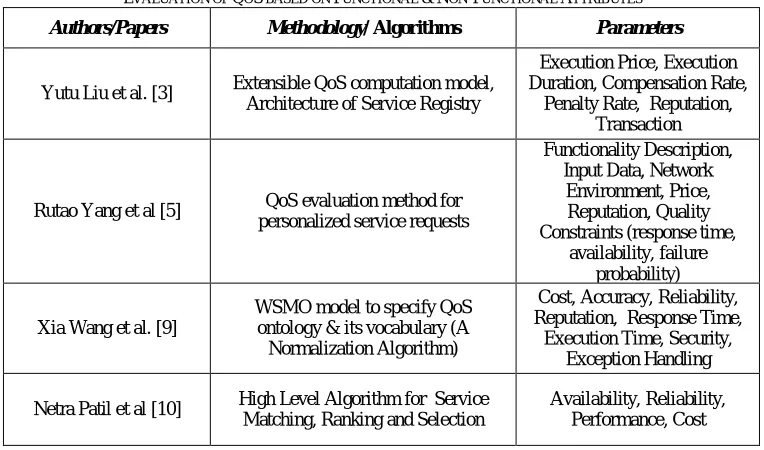
Table 2 exclusively showcases different methodologies/ algorithms employing non-functional attributes only. Here number of attributes taken into consideration are different and solely depend upon the type of methodology & algorithm being used. Below table 3 is showcasing methodologies/ algorithms employing both non-functional as well as functional
attributes. That means in the below mentioned methodology/ algorithm, both generic dimensions like Price, Execution Duration, Availability, Reliability as well as domain specific criteria are taken into consideration.
TABLE 3
EVALUATION OF QOS BASED ON FUNCTIONAL &NON-FUNCTIONAL ATTRIBUTES
Authors/Papers Methodology/ Algorithms Parameters
Yutu Liu et al. [3] Extensible QoS computation model, Architecture of Service Registry
Execution Price, Execution Duration, Compensation Rate,
Penalty Rate, Reputation, Transaction
Rutao Yang et al [5] QoS evaluation method for personalized service requests
Functionality Description, Input Data, Network
Environment, Price, Reputation, Quality Constraints (response time,
availability, failure probability)
Xia Wang et al. [9]
WSMO model to specify QoS ontology & its vocabulary (A Normalization Algorithm)
Cost, Accuracy, Reliability, Reputation, Response Time,
Execution Time, Security, Exception Handling
Netra Patil et al [10] High Level Algorithm for Service Matching, Ranking and Selection
Availability, Reliability, Performance, Cost
Approaches adopted by the authors [4] [6] & [9] are found to be more relevant as they all are taking into consideration a good number of non-functional attributes to measure the QoS. Besides that, they are proposing innovative & unique approaches to calculate QoS of web services. Authors [6] came up with an innovative idea of calculating QoS values automatically for web services keeping track of the Parameters. Authors [4] are adding up an additional feature of an augmented UDDI in the existing web service model which contains QoS information that allows QoS-based service discovery. Similarly, authors [9] are using web services Modeling Ontology (WSMO). Innovative idea proposed by authors [6] seems to be more effective as it doesn’t rely on user evaluation for calculating QoS. Another important aspect of the approach lies in giving more weightage to the newer ones over the old attribute values.
V. CONCLUSION AND FUTURE WORK
Selection of the best web service is still a great challenge. Quality of Service (QoS) appeared to play a vital role in resolving this issue. Researchers have done a great job in this regard & have come up with different techniques to calculate more accurate value of QoS in order to retrieve the most relevant & desirable web service from users’ point of view. But still, they are more or less depending on either Providers published information or users provided feedback. As discussed earlier, Providers published information may not always be true, credible & up-to-date. Similarly users provided feedback may also be biased sometimes. Hence we reach to the conclusion that an independent & consistent QoS evaluation system is still needed to measure more accurate value of QoS. Researchers have to focus their research on developing such a novel system which can work independently taking into consideration more number of non-functional attributes.
REFERENCES
1. Haiteng Zhang, Zhiqing Shao, Hong Zheng, and Jie Zhai, “Web Service Reputation Evaluation Based on QoS Measurement”, The Scientific
World Journal, Volume 2014, pp1-7, 2014
2. Eyhab Al-Masri, Qusay H. Mahmoud, “QoS-based Discovery and Ranking of Web Services”, IEEE, 2007
ISSN(Online): 2320-9801
ISSN (Print): 2320-9798
I
nternational
J
ournal of
I
nnovative
R
esearch in
C
omputer
and
C
ommunication
E
ngineering
(An ISO 3297: 2007 Certified Organization)
Vol. 4, Issue 8, August 2016
4. Ziqiang Xu, Patrick Martin, Wendy Powley and Farhana Zulkernine, “Reputation-Enhanced QoS-based Web Services Discovery”, IEEE
International Conference on Web Services (ICWS 2007), 2007
5. Rutao Yang, Qi Chen1, Lianyong Qi and Wanchun Dou, “A QoS Evaluation Method for Personalized Service Requests”, International
Conference, WISM, pp 393-402, 2011
6. Emra Askaroglu, Pinar Senkul, “Automatic QoS Evaluation Method forWeb Services”, IEEE, pp 000367 – 000369, 2012
7. You Ma, Shangguang Wang, Qibo Sun, “QoS evaluation for web service recommendation”, IEEE, 2015
8. Zibin Zheng, Yilei Zhang, and Michael R. Lyu. “Distributed QoS Evaluation for Real-World Web Services”, 2010 IEEE International
Conference on Web Services, pp 83-90, 2010
9. Xia Wang, Tomas Vitvar, Mick Kerrigan and Ioan Toma, “A QoS-aware Selection Model for Semantic Web Services”, 4th International
Conference, Chicago, IL, USA, pp 390-401, 2006