A Review on Energy Efficient Resource
Allocation in Uplink SC-FDMA System for
Improving QoS
Pallavi A. Chanekar, Prof. Rutuja A. Deshmukh, Dr. Neelam D. Deshmukh
M.E. Dept. of E&TC, D. Y. Patil College of Engineering, Akurdi, Pune, India.
Assistant Professor, Dept. of E&TC, D. Y. Patil College of Engineering, Akurdi, Pune, India.
H.O.D. Dept. of E&TC, Vice Principal, Priyadarshani Polytechnic College, Nagpur, India.
ABSTRACT: Long Term Evolution (LTE) is the popular technology so far for 4G mobile communication networks. The main goal of LTE is to provide high data rate, low latency and high mobility supporting flexible bandwidth deployments. LTE uses Single carrier frequency division multiple access (SC-FDMA) as transmission technique for the uplink traffic in the network. In this paper, we present comparative study of various resource allocation algorithms to enhance the Quality of Service (QoS) provision and energy efficiency of uplink LTE. We also propose the advantages and disadvantages of these algorithms to find out which one focuses on QoS improvement in real-time applications and energy efficiency.
KEYWORDS: Long term evolution (LTE), uplink, quality of service (QoS),Energy efficiency, resource allocation.
I. INTRODUCTION
Resource Allocation (RA) in single carrier frequency division multiple access (SC-FDMA) system is practically challenging due to specific power and quality of service constraints. Today’s wireless communication systems are facing the challenge of major demand for increased capacity, resource utilization efficiency, QoS provision, and optimal energy efficiency. Also energy efficiency has become an important issue in RA particularly where there is drastic growth of high end devices, such as smartphones. At the same time QoS provisioning in RA is also an important issue that needs to be considered for various types of delay sensitive services. The problem of energy efficient RA in SC-FDMA uplink for improving QoS is the main focus of this paper. Here resource allocation is performed taking into consideration the estimated packet delays in the uplink direction, the average delay and data rate of allocation in past, uplink power per resource block.
This paper is organized as follows: section II focuses on previous work related to resource allocation in LTE system, section IIIsystem model and overview of LTE subframe structure, section IV focuses briefly on various resource allocation algorithms for LTE uplink system and describes the suboptimal uplink resource allocation algorithm [7] in detail. Finally, section V provides conclusions.
II. RELATED WORK
literature do not focus on QoS improvement because of the imperfect knowledge of user’s buffer status and exact packet delay in uplink direction [2]-[4].
Joint user pairing and resource allocation in the uplink SCFDMA system is studied. An optimal algorithm based on branch and bound search is proposed and to minimize complexity the original problem is reduced into subproblems of user pairing [2]-[3]. The authors in [4] formalize a general SCFDMA resource allocation problem to determine the subchannel and power allocation to maximize the total user-weighted system capacity. In order to perform joint power and sub-channel allocation and adaptive modulation a canonical duality theory is used [5].
In [6] the authors had performed the resource allocation in time and frequency domains considering energy efficiency as a prime factor. The authors in [7] proposed an uplink resource allocation algorithm based on optimal cake cutting problem for LTE system, which focuses on QoS provision in real-time applications at the same time enhancing energy efficiency factor. Here the authors have also focused on addressing the delay sensitivity of real-time application for improving overall throughput of the system. In [8] a three stage uplink QoS-constraint resource allocation scheme is introduced where firstly, the time domain scheduler prioritizes UE according to their need for QoS. Then frequency domain scheduler prioritizes based on user’s channel quality and finally to enhance system throughput the modulation of the allocated resource blocks is determined. The authors in [9] have employ energy efficient resource allocation for uplink SCFDMA using canonical duality theory to enhance the energy efficiency simultaneously fulfilling QoS requirements. However, the effect of varying traffic demand on the resource allocation performance is not evaluated especially in case of real-time application.
III.SYSTEM MODEL
In uplink LTE system model, a single LTE macro cell and number of User Equipment (UE) devices are randomly installed in macro cell are. Each user in UE is having an active real-time video connection on uplink. The eNodeB is prime entity of LTE system which is mainly responsible for allocating available resources to each user in fair and energy efficient manner to satisfy QoS requirements of each user. The eNodeB works as base station to users present in LTE macro cell.
In LTE uplink resources are allocated to users in terms of uplink scheduling grants. Whenever any UE demands for uplink resources to transfer its pending data, it sends a Scheduling request (SR) to the uplink scheduler by raising a simple flag which is transmitted on the Physical Uplink Control Channel (PUCCH). At this time it is necessary for uplink scheduler to determine the required amount of resources to be granted to each user. For this, information about the available data for transmission in the uplink UE buffers is also required. This is done using Buffer Status Report (BSR) which provides information on UE buffer to the eNodeB. A BSR consist of a buffer size field which provides information about awaiting data to be transmitted across all logical channels [8].
In time domain, uplink LTE frame structure is composed of radio frames, each frame consist of two half-frames. These half-frames consist of five equally sized subframes of length T each. Each of this sub-frame consists of two equally sized slot which are further divided into N SC-FDMA symbol. Here the smallest resource in LTE is resource element which is composed of one subcarrier during one SCFDMA symbol. These resource elements are grouped into resource block which consist of N consecutive subcarrier in frequency domain and one slot N in time domain [8].
IV.DIFFERENT RESOURCE ALLOCATION ALGORITHM
A. OPTIMAL RESOURCE ALLOCATION AND GREEDY SUBOPTIMAL ALGORITHM
involves reformulating the problem as a pure binary-integer program as set partitioning problem in [4] which has following form:
max . . =
∈{0, 1}∀ (1)
where A :constraint matrix of zeros and ones, : a reward weight vector,
: c-length vector of optimization variables each of which can take value 0 or 1. Here the constraint matrix Ais used to show adjacency and exclusivity constraints.
Although the optimal solution is desirable, there is computational complexity solving set partitioning problem. Hence, a greedy suboptimal heuristic algorithm is developed [4] which is much less complex but at same time perform very significantly. This algorithm is based on a “steepest ascent” in objective function. It can be explain as: In each iteration, exactly one subchannel is assigned to one user, where the assignment is determined as the feasible assignment that maximizes the increase in the objective.
The author in [4] had shown that out of these two algorithms optimal algorithm outperforms the greedy suboptimal and previously proposed round robin algorithm. Also there is 50% improvement in the user spectral efficiency using greedy algorithm and 100% improvement in the user spectral efficiency when optimal algorithm is used when compared to round robin algorithm.
B. JOINT OPTIMAL ALGORITHM
To find the optimal solution of binary-integer programming (BIP) problem of resource allocation for LTE the exhaustive search is a straight forward and basic method. But this method is very complex and not practical. For this there are some effective algorithms proposed in [2] to reduce its complexity. Branch and bound search (BBS) is one of themwhich mainly include two parts: branching and bounding. First part is branching which divides the feasible region of resource allocation problem into multiple sub-regions and formulates the corresponding subproblems with these subregions. In later part bounding is used to find the upper and lower bounds for these subproblems with these subregions. Further branching is recursively repeated at each subregion such that a tree structure is formed. In this BBS-based algorithm, some branches of tree can be removed to reduce the complexity. Thus by usingthis algorithm, an easy optimal solution can be found for joint user pairing and resource allocation problem. The authors in [3] have proposed several suboptimal algorithms to further reduce the complexity.
C. OPTIMALUPLINK RESOURCE ALLOCATION USING CAKE CUTTING
The method of allocating a contiguous collection of scheduling block in a subfame to each user in a fair manner is termed as cake cutting. The problem of allocating a contiguous collection of scheduling block in a sub-frame to each user is related to the traditional fair division problem where cake is represented as the [0,1] interval [9]-[10]. The cake must be divided among the agents to optimize fairness criterion. In this paper discrete connected cake-cutting version is taken into consideration.Here the cake is a sequence of indivisible items which is non-overlapping (x, y) intervals whose union equals [0,1] and agents must be allocated a consecutive subsequence of these items. The users in the LTE system are mapped to agent in the cake-cutting setting while the uplink scheduling block of a subframe are mapped to the sequence of individual items that form the cake and the user metric functions are mapped to the agent utility function. The main objective of the cake cutting algorithm is to identify the optimal allocation of sets of contiguous scheduling block to the different users in a manner that maximizes the total utility of the system. This total utility is given by
∗= arg max { ( )} (2)
1. SUBOPTIMAL ALGORITHM FOR RESOURCE ALLOCATION
1) Firstly, the set of active users UE is sorted in descending order of metric function ( ) where
, ( ) = ( )
,
( ) ( )
, ( )
,. , which aims to provide higher resource allocation priority to users
with increased waiting time respect to delay threshold, high average delay and low average data rate of their allocation in the past. At the same time it also checks low uplink power requirement for transmission and high expected data rate per scheduling block.
2) In next the step, the algorithm identify the user’s need for an uplink transmission grant. This is decided based on whether SR is received by the user, i.e. ( ) = 1 or the value of the latest BSR verifies that the user buffer has uplink data waiting to be transmitted, i.e. ( ) > 0.If there is no need to allocate resources in this subframe, then the user is removed from UE.
3) If either ( ) = 1 or ( ) > 0 , then the algorithm determines set which consists of available scheduling block for which the user maximizes the value of ( ), i.e.
= ∈ : arg max ∈ ( )
4) If set is nonempty, the another scheduling block ∗ is determine, i.e. ∗= arg max∈ ( , ) which is having highest SNR value and if its BER is lower than the threshold then this will be the first scheduling block in set which is set of all scheduling blocks allocated to user iin this subframe.
5) The set and the number of maximum of contiguous scheduling blocks neighbouring ∗ that can be allocated to user iis calculated. Here a scheduling block is included in set , if
a) It is not already allocatedto another user. b) It maximizes the value of ( ).
c) It is neighbour to another scheduling block that is already included in so that there is no violation of contiguity constraint of scheduling block.
d) Its BER is lower than the threshold .
e) Number of scheduling block already included in is not enough accommodate all the traffic in the use’s buffer.
6) When the resource allocation is for user ifinalized, the user is removed from UE and all its scheduling block are removed from set of available scheduling blocks.
7) Finally, if Φ≠0, UE≠∅, then algorithm proceeds to the next step, otherwise resource allocation for this
subframe is complete and algorithm stops.
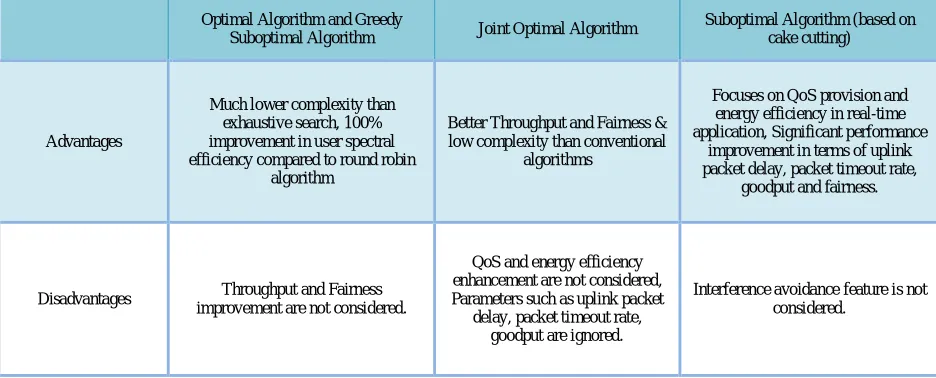
Optimal Algorithm and Greedy
Suboptimal Algorithm Joint Optimal Algorithm
Suboptimal Algorithm (based on cake cutting)
Advantages
Much lower complexity than exhaustive search, 100% improvement in user spectral efficiency compared to round robin
algorithm
Better Throughput and Fairness & low complexity than conventional
algorithms
Focuses on QoS provision and energy efficiency in real-time application, Significant performance
improvement in terms of uplink packet delay, packet timeout rate,
goodput and fairness.
Disadvantages Throughput and Fairness
improvement are not considered.
QoS and energy efficiency enhancement are not considered, Parameters such as uplink packet
delay, packet timeout rate, goodput are ignored.
Interference avoidance feature is not considered.
V. CONCLUSION
In this paper we have presented a comparative study of uplink resource allocation algorithm for SC-FDMA LTE uplinksystem. The main focus of this paper is on QoS improvement by efficiently utilizing available radio resources in resource allocation problem. The discrete cake cutting problem is beneficial for systems with infinitely backlogged traffic. The main advantage of suboptimal algorithm studied in this paper is addressing the delay sensitivity of real-time application improving energy efficiency.
REFERENCES
1. H. G. Myung, J. Lim, D. J. Goodman, “Single carrier FDMA for uplink wireless transmission”, IEEE Vehicular Technology Mag., vol. 1, no. 3, pp. 30-38, 2006.
2. J. Fan, Q. Yin, G. Y. Li, B. Peng and X. Zhu, “Joint user pairing and resource allocation for uplink SC-FDMA systems”, in Proc. 2011 GlOBECOM, Houston, TX, USA, 2011, pp. 1-5.
3. J. Fan, G. Y. Li, Q. Yin, B. Peng, and X. Zhu, “Joint user pairing and resource allocation for uplink LTE uplink transmission,” IEEE Trans. Wireless Communication , vol. 11, no. 8, pp. 2838-2847, Aug.2012.
4. I. C. Wong, O. Oteriand W. McCoy, “Optimal resource allocation uplink SCFDMA system”, IEEE Transaction Wireless Communication, vol. 8, no.5, pp. 2161-2165, 2009.
5. A. Ahmad, “Resource allocation and adaptive modulation in uplink SCFDMA system”, Wireless Pres. Communication, vol. 75, no. 4, pp. 2217-2242, 2014.
6. D. J. Dechene and A. Shami, “Energy-aware resource allocation strategies for LTE uplink with synchronous HARQ constraints”, IEEE Transaction Mobile Computing vol. 13, no. 2, pp. 422-433, 2014.
7. D. Triantafyllopoulou, K. Kollias and K. Moessner, “QoS and Energy Efficient Resource Allocation in Uplink SC-FDMA Systems”, IEEE Transaction Wireless Communication, Vol. 14, no. 6, 2015.
8. H.-C. Jang and Y.-J. Lee, “QoS-constrained resource allocation scheduling for LTE network”, in Proc. ISWPC, Taipei, Taiwan, 2013, pp. 1-6.
9. A, Aijaz, X. Chu and A. H. Aghvami, “Energy efficient design of SCFDMA based uplink under QoS constraints”, IEEE Wireless Commmunication Lett., vol. 3, no. 2, pp.149-152, Apr. 2014.
10. 3rd Generation Partnership Project; Technical Specification Group Radio Access Network; Evolved Universal Terrestrial Radio Access (E-UTRA) TS 36.213, V12.4.0, Jan. 2015.
11. J. M. Robertson and W. A. Webb, Cake-Cutting Algorithms−Be Fair if You Can. Natick, MA, USA: A K Peters, 1998. 12. J. B. Barbanel, The Geometry of Efficiency Fair Division. Cambridge, U. K.: Cambridge Univ. Press, 2004.
BIOGRAPHY
Pallavi A. Chanekarreceived her B.E. degree in the year 2013 from Jawaharlal Darda Institute of Engineering& Technology, Yavatmal at Sant Gadgebaba Amravati University, in Electronics & Telecommunication. Currently she is pursuing her M.E. in Communication Networks from D. Y. Patil College of Engineering, Akurdi at Savitribai Phule Pune University. Her research interest includes Long Term Evolution.
Mrs. Rutuja A. Deshmukha Research Assistant in Electronics and Telecommunication Department, D. Y.Patil College of Engineering, Akurdi at SavitribaiPhule Pune University. She received her B.E. degree from Raisoni Engineering College in Electronics & Telecommunication and Master’s degree from Priydarshani Engineering College at Nagpur University in VLSI. Her research interest is Signal Processing, VLSI.