Data Digitization using Multi-Model Biometric
Identity Platform
(Data Analysis and Security using Biometric)
B Sankara Babu
Professor, Dept. of Computer Science & Engineering Gokaraju Rangaraju Institute of Engineering & Technology
JNTUH, Hyderabad, India
ABSTRACT: According to UN (United Nations), about 25,000 people die every day of hunger or hunger related
causes. This is the one person for every three and half a seconds. Unfortunately it is the children who die most often. This is in spite of plenty of food in the world for everyone. The Targeted Public Distribution System (TPDS) in India is intended to provide food grains &essential commodities at subsidized prices to the poor. The presence of a large number of bogus and duplicate ration cards is resulting in this food subsidy scheme not reaching millions of poor eligible families. In addition, a huge number of ration cards have been issued to non-poor ineligible families. The Targeted Public Distribution System (TPDS) in India is a mechanism for ensuring access and availability of food grains and other essential commodities at subsidized prices to the households. Under the TPDS, commodities like Rice, Wheat, Sugar, Kerosene etc. are distributed to citizens on a monthly basis through a network of Fair Price Shops (FPS) also known as Ration Shops. TPDS is the most far reaching in terms of coverage as well as public expenditure on subsidy. With a network of about 480,000 Fair Price Shops (FPS) across the country, TPDS is perhaps the largest distribution network of its type in the world. In this paper, we highlight how this has been solved by using Biometrics. This has ensured that the duplicate/bogus / ineligible cards are weeded out resulting in “One Family – One Card”.
KEYWORDS: TPDS; UNWFP; Ration Card; Multi-Modal Biometrics; Unique ID;
I. INTRODUCTION
The first of its kind, the project incorporated the cutting edge biometric technologies and best management processes to ensure that distribution of ration cards to citizens is done cost effectively and efficiently. The project includes capturing of beneficiaries biographic and multi biometric (face, finger and iris) data, creating a unique database by eliminating duplicate entries using biometrics algorithms, printing and distributing the ration cards to the citizens.
The following steps give the interface over view of the topic.
Step 1: The old ration card registers were digitized and mapped to the database of BPL survey done in 1997 along with
the household survey data of 2002. The consolidated list of target beneficiaries was prepared.
Step 2: The Gram Panchayat wise target beneficiary database was transferred to the enrolment stations located in the
Designated Photography Locations (DPL) before commencement of the enrollment process. Wide publicity using posters, tom-tom and public announcement systems was given in the villages requesting them to visit the DPL’s for the enrollment.
Step 3: Family wise enrollment of the target beneficiaries was undertaken by capturing the biographic and biometric
data (4-4-2 slap fingerprints, 2- Iris and Facial Photograph). Since the DPL’s are located in remote areas with no internet connectivity, enrollment was done in a decentralized manner using standalone systems.
Step 4: Periodical backups were taken from the DPL enrolment stations and sent to data center for data aggregation.
Step 5: The aggregated data from the DPL’s was de-duplicated using multi modal biometric engine to check for
fraudulent enrolments. The identified duplicates were verified in the field to weed out duplicate beneficiaries.
Step 6: The final database of unique card holders was generated and stored in a centralized citizen database
Step 7: The households in the rural areas will be given laminated ration cards along with bar coded coupons by
presented by the cardholder to the FPS for verification and the coupons are surrendered for taking delivery of entitled commodities. The FPS dealer will surrender the coupons to the civil supplies department where they are scanned and destroyed. The data from the scanning device will be transmitted to the centralized server using internet connectivity.
Step 8: The households in the urban areas will be given smart cards containing details of the card holder and household
members, their biometric templates and their entitlements. The smart card is swiped in the Point of Sale (PoS) device and the transaction is authenticated by the biometric of the cardholder. The transaction data containing the card ID, quantities delivered to the card holder, time etc will be transmitted from the PoS device to the centralized server using GPRS connectivity.
Step 9: The data in the centralized server will enable the civil supplies department to get reports on the quantities of
commodities delivered to the ration card holders and arrive at the closing balance of commodities at the FPS. The closing balance will enable the civil supplies department to derive at the allotment for the succeeding months. The data in central server can also be given access to public and other government departments with a view to enhance transparency and accountability.
Fig.1. Work flow of Targeted Public Distribution System
II. LITERATURESURVEY
A. IRIS FEATURE EXTRACTION USING 2D PHASE CONGRUENCY
This says that Iris feature extraction is the crucial stage of the whole iris recognition process for personal identification. A brief survey is made firstly in this paper on the methods that feasibly implemented in iris feature extraction. Because the iris capture devices in use are mostly exposed to the natural scene, so the natural illumination or other variant conditions sometimes can greatly influence the iris images captured and further impact the recognition result. Out of this consideration, we made some experimental try to extract the iris feature using the 2D phase congruency, which invariant to changes in intensity or contrast, to try to avoid those problems. Nowadays, people put more and more attention on the security problem, and human identification which based on biometrics has become a hot topic in recent years. Among various biometrics, such as fingerprint, facial features, voice, signature etc, iris recognition has attracted more and more attention.
Iris is defined as the annular region between the sclera and the pupil of the human eye. In this region, there exists an extraordinary texture including many prominent features, on which the recognition is mainly relied. Iris has many advantages, such as stability, uniqueness and noninvasiveness etc, so it‟s desirable to choose iris pattern to realize the human identification. The whole iris identification process up-to-date is basically divided into four steps: 1) Iris localization; 2) iris normalization; 3) iris feature extraction; and 4) matching. Various algorithms for iris feature
1. Data Digitization
2
Integrated Citizen Database
3
Biometric and Biographic enrolment
4, 5
Data aggregation and De-duplication
6
Unique family/citizen ID database
7
Smart Ration Card
8
Issue of commodities at FPS( fair price shops)
9
extraction have been proposed by many researchers since 1990s. Doug man first proposed to extract the iris features with complex valued 2D Gabor wavelet in his work [1].And quantized local phase angles yield the final iris representation. His method is based on the property of the Gabor filters of offering the best simultaneous localization of spatial and frequency information. And a desirable recognition results are achieved using his method. In the view of the Wilds et al., Doug man‟s system yields a remarkably parsimonious representation of the iris via the Gabor filters. Wilds chose to make use of an isotropic band pass decomposition derived from application of Lap Lucian of Gaussian filters to the iris image.
This method retains more of the available iris information [2]. In the image processing techniques, zero-crossings can also correspond to significant features. So Bole and Boas hash [3] chose to extract and represent the features of the iris pattern by the zerocrossings of 1D wavelet transform of the concentric circles on the iris. Lim et al. [4] consider both the Gabor and Hare function as the mother wavelet to process the iris image. And the comparison of them shows that the recognition based on Hare wavelet is slightly better than Gabor wavelet. Log-Gabor also can be used in iris feature extraction [5]. Log-Gabor function is proposed by Field in 1987 [6], and he suggests that log Gabor functions should be able to represent natural images more efficiently than ordinary Gabor functions, which would over-represent the low frequency components and underrepresent the high frequency components. And moreover Log-Gabor has no DC component. Also some researchers propose to use wavelet packet on iris pattern [7]. The wavelet packets method permits to process the whole iris image at each level of resolution, and this is done recursively by partitioning the image in both low and high frequencies instead of only the low frequencies as the classic wavelet do. When the initial iris image is blurred and the iris texture is poor, the wavelet packets can be more robust than classic wavelet for its detail. Based on the Gabor filters and the characteristics of the iris pattern, Li Ma et al.[8] defined new spatial filters to extract iris features, which are Gaussians modulated by circularly symmetric sinusoidal function. Experiments show that they are suitable to iris feature extraction.
In [9], an algorithm was proposed to produce skeletons of the iris texture with unique paths among end-points using morphological operator, such as threshold, area opening and closing etc. This method requires low computational complexity (processing time) and low storage, but it is sensitive to the change of illumination and gray level distribution. There are also some other methods that can achieve good results of iris feature extraction, such as algorithm based on Key local variation [9] and on Local orientation description [8], ICA (Independent component analysis) [7] and fractal [9]etc. But many of the iris identification systems require a strict image quality control, such as illumination or position. If these requirements cannot be fulfilled wholly, the feature extraction and matching may be greatly influenced. So a method invariant to those external conditions is needed. Our experiments focus on the identification problem, that is, the match is in a one-tomany pattern. In order to test the proposed method, SJTU-IDB (Iris Data Base of Shanghai Jiao Tong University) is used. The SJTU-IDB contains 400 grayscale eye images collected from 100 persons. The age of the person ranges from 22 to 70, and of both male and female. The eye images in this database were all set to 372 245, and of 256 grayscales. Because the iris capture devices in use are mostly exposed to the natural scene, so the natural illumination or other variant conditions sometimes can greatly influence the iris images captured and further impact the recognition result. Out of this consideration, an iris feature extraction method based on 2D phase congruency is proposed in this paper and experiments are made to test its performance. The recognition results following this method are encouraging, and more work should be done to optimize this method. This work is supported by the National Natural Science Foundation of China under Grant No.60427002.
Person authentication technique using human IRIS recognition
Compared to fingerprint, iris is protected from the external environment behind the cornea and the eyelid, no subject to deleterious effects of aging, the small-scale radial features of the iris remain are stable and fixed throughout life [5]. In encryption of databases was used encryption techniques studied at the college graduation license theme and at the graduation of master thesis. Steps for achieving the objective:
a) Choosing an experimental iris image database provided by an institute. b) Studying the existing documentation in the field.
c) Identifying the characteristic features of reading and processing iris images. d) Development of software for processing and implementing iris recognition. e) Studying the possibility of storing encrypted iris database [6].
f) Encrypt the database.
g) Implementing multimodal software (password + iris identification).
h) Using iris reading at Computer Startup and at Windows Logon (mixed use "password + iris"). i) Using iris reading for opening folders, files, applications.
III. MULTIMODELBIOMETRICIDENTITYPLATFORM
A. MULTI-MODEL IDENTITY
This provides the end-to-end technology solution for completing all activities envisaged in the project. Key to the successful implementation of the project is the deployment of Multi-Modal Biometric Identity Platform (Figure 2.1). Identity Platform is a robust, scalable, interoperable identification engine that interfaces and manages multi-biometric and biographic search technologies. The platform provides an XML based interface to the custom-built application for identification and/or verification of a person’s identity. The platform supports key features like Interoperability, Scalability, Extensibility, Flexibility and adherence to open standards.
Interoperability: Identity Platform is capable of integrating not only multiple biometric devices but also search engine algorithms for iris, finger, face and biographic data.
Scalability: Identity Platform can easily scale up as the size of the deployment increases in terms of the number of people enrolled. The web server architecture can seamlessly integrate with additional servers and can be configured to suit licensing policies from various biometric vendors.
Extensible: Identity Platform is extensible as it has been developed using a modular software design approach. Modules can be added in a plug-and-play manner and can be integrated to suit customer requirements. Components can be configured for centralized or de-centralized deployments.
Iris reader
Camera
Finger Print Smart card
Fig.2.1. Multi-Modal Biometric Identity Platform
The above figure 2.1 shows how the system works for generating cards and how multi-modal biometric platform of works. By using the biometric devices which are shown in the fig.2.1, we identify the person identification. Totally it gives solution as “Many applications-One ID Management Solution”.
IV. DESIGNANDIMPLEMENTATION
TPDS is operated under the joint responsibility of the Central and the State Governments. The procurement of food grains is mainly done by the Central Government which are then stored in the Food Corporation of India (FCI) Godowns from where it is disbursed to the States & Union Territories. FCI issues food grains to the states based on allocations made by the Central Government. The State Governments undertake the operational responsibilities of identification of families below poverty line, issue of ration cards, allocation within the State, and distribution of commodities through the network of Ration Shops or Fair Price Shops. (FPS). The supply chain showing the movement of food grains from the farmers to the end consumers is shown in Figure 3.1.
Many applications – One ID Management Solution
Application Layer
Ration card management system
Social security pensions
Health Insurance
Housing schemes
MIS Portal
National Rural Employment Guarantee Scheme (NREGS)
Farmers insurance
Welfare scholarships
Welfare schemes
Others
Identity Platform Client
insurance Core Identity Engine
Iden tity DB
Department Specific DB
Iris
matching Fingerprint matching Facial matching
Figure. 3. 1. Supply chain showing the movement of food grains from the farmers to the end consumers.
The State Governments undertake the responsibility to identify the eligible households/ beneficiaries and issue a ration card also known as household supply card which enables them to avail the prescribed quantity of food grains and/or other commodities. Households are categorized into two main categories - Below Poverty Line (BPL) and Above Poverty Line (APL). Defining BPL & APL families is based on the criteria like annual income, land holding, type of dwelling etc., which are decided by the Government from time to time. Out of the BPL families, the poorest of the poor to the extent of the target are selected for Antyodaya Anna Yojana (AAY) Scheme and Annapoorna scheme. For each of these categories, the states issue rations cards of different colors to the beneficiaries to easily differentiate between them.
A. IMPLEMENTATION
Iris and Fingerprint Devices
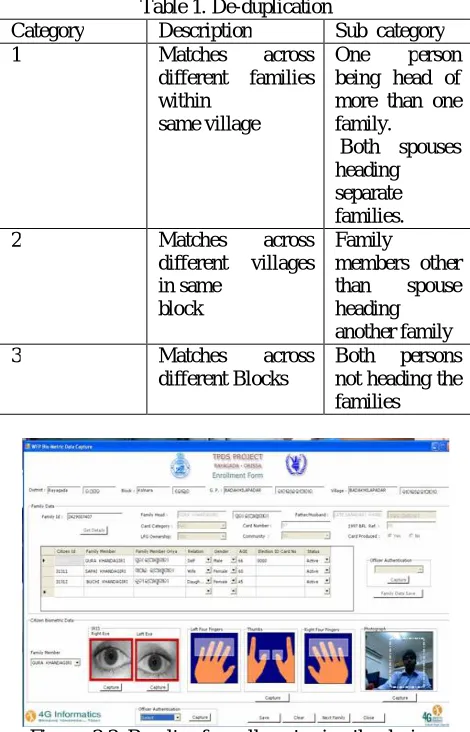
Iris images were captured using the PIER-T™ device from L-1 Identity Solutions. TPE-4100 fingerprint scanner from L-1 Identity Solutions was used to capture (4-4-2) four fingers on the right hand at one time followed by all four fingers on the left hand, followed by the two thumbs at the same time. The device had inbuilt real time feedback on the quality of the fingerprints being captured. The touch print photo capture digital system was used to capture the face of the citizen. The system also included the Identix Facet Face-Finding and Image Quality Assessment software reduces the potential for manual errors, so the operator no longer need to worry whether the image is centered, cropped or if the lighting is set properly. The photo capture component completely conformed to NIST best practices for high quality photo capture. Figure 4 shows photographs of the enrollment process using these devices.
Algorithms
Daugman 07 (D07) Iris algorithm and SIRIS matching platform from L1 Identity solutions Inc, USA can be used for Iris enrolment & matching. The new L1 Daugman 07 (D07) algorithms utilize cutting edge image processing techniques such as active contours and off-axis gaze correction which vastly improves both Failure to Enroll (FTE) and False Rejection Rates (FRR).SIRIS and the new Daugman 07 (D07) algorithm introduce enhancements over the previous generation matching algorithms by utilizing advancements in computer technology such as 64 bit processor architecture and multi-core CPU technology. These improvements have brought about significant increases in speed and throughput capability. The efficient data storing and matching design allows commercial off-the-shelf hardware to produce matching speeds exceeding 1,000,000,000 comparisons per second. For the fingerprints, the ABIS matching platform from L1 Identity solutions Inc. that incorporates the latest generation of Bio Engine fingerprint technology has been used. This system incorporates new and more accurate high-speed filters for fingerprint identification in increasingly large populations. ABIS System help to ensure that poor and unusable images are not admitted to the search database thus protecting optimum biometric performance.
De-Duplication
Figure. 3.2. Photographs of enrollment using the devices
Table 1. De-duplication
Category Description Sub category 1 Matches across
different families within
same village
One person being head of more than one family.
Both spouses heading separate families. 2 Matches across
different villages in same
block
Family
members other than spouse heading another family 3 Matches across
different Blocks
Both persons not heading the families
Figure. 3.4. Matches across different families within same village
Figure. 3 .5: Matches across different villages in same block
Figure. 3. 6: Matches across different Blocks
B. ISSUES IN THE FINGERPRINT DE-DUPLICATION PROCESS
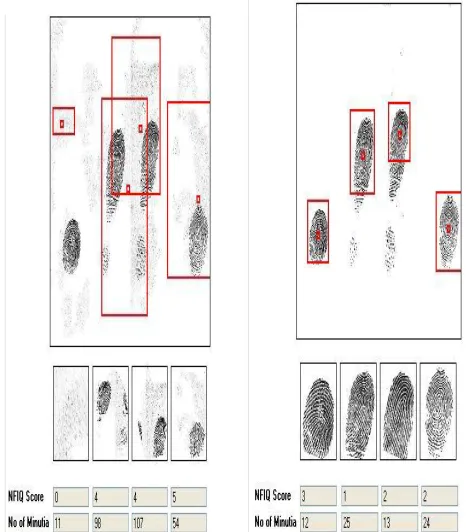
The fingerprints of citizens are captured during the enrolment process using the 4-4-2 slap method. Some of the issues that crop up during the fingerprinting enrolment and pre-process for the de-duplication are given below.
segmentation process which precedes de-duplication. To overcome this problem, 4G Identity Solutions’, a software Biometric company has developed a “noise” removal solution using advanced image processing filters and techniques. Figure 3.7.shows the segmented finger print images before and after elimination of “noise”.
Figure. 3.7. Segmentation before noise removal & Segmentation after noise removal
Other errors that could happen during the enrolment are cropped fingers, missing fingers, compressed fingers and overlapping fingers. This requires manual intervention in the system to assign the “right finger” to the “right place”. Figure 3.8 shows the case of cropped fingers in the case of thumbs.
C. IMPLEMENTATION CHALLENGES
Successful enrolment is the key to the success of any biometric project.
Multi-modal biometrics is preferred mode over a single biometric as each of them has their own advantages during enrollment, de-duplication, identification & verification. Moreover, enrolment of citizens is a major component of the total project cost and it is prudent to capture multi-modal biometrics of a citizen at one go instead of making them repeatedly visit the enrollment centers as and when a new biometric has to be captured.
Support & involvement of key stakeholders is essential for successful implementation of the project. End user acceptance and training is critical to the successful deployment of projects of this size and nature. Logistics in rural and tribal areas with inadequate infrastructure and transportation facilities pose the greatest challenge. This would be a common phenomenon in most parts of the country where villages do not have proper access especially during the rainy season. Lack of electricity also poses a great challenge and generators need to be carried. The integrated beneficiary database developed as a result of this process can be used to deliver other benefits to citizens.
D. “ONE CITIZEN – ONE ID – MANY PROGRAMS”
Governments today are implementing several welfare schemes such as PDS, Pension Schemes, National Rural Employment Guarantee Scheme (NREGS), Housing Welfare Scheme, Health Insurance scheme etc. for the most vulnerable and disadvantaged sections of society, with the objective of bringing about a qualitative change in their lives. These multiple initiatives are spread across several departments with each of them often duplicating the efforts of the others. It is essential that the Governments bring this plethora of welfare schemes onto a common platform. The ration card / household card information would be vital as this dataset is supposed to cover the entire population of the state. After de-duplication of the ration card data, a “Unique ID” for every citizen can be created that can be ported onto a “Central Identity Server”. An Enterprise Architecture Framework adhering to the national e-Governance Standards has to be designed to integrate various departments to the Central Identity Server to authenticate the beneficiaries as and when required as part of disbursement of welfare benefits. By uniquely identifying a citizen, the Government will be able to target the right people with the right benefit, thus eliminating most of the maladies in the current welfare delivery system.
E. EXPERIMENTAL RESULTS
Fig.3.10. Images using biometric devices
Fig.4.3. People having food grains using Ration Cards
V. CONCLUSIONANDFUTURESCOPE
A ration card in the Indian context has linkages to several schemes and Identity documents. A ration card is not only the basis for identifying beneficiaries under all the central and state government welfare schemes but is also a proof document for other citizen services like passport, Electoral Photo Identification Card (EPIC), driving licenses, land records, LPG connections, etc. If Governments do not establish a unique identity for a citizen through ration card or other means of identification, there will be far reaching financial, social and security implications.
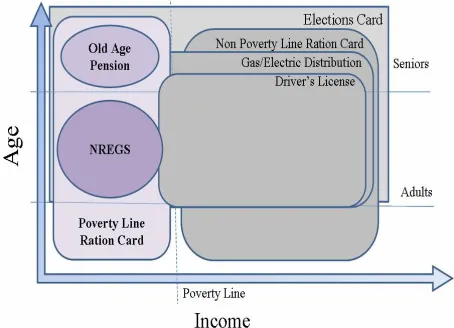
As shown in Figure 4.1, a citizen maybe eligible for various identity cards / benefits based on the Income and Age criteria. Based on the “Unique ID” database, Governments can issue a single card to a citizen and make him/ her eligible for different purposes be it driving licenses, voter ID or for benefits like pension, housing, essential commodities etc. This multipurpose citizen ID card can also be designated as a “National ID” card which will be unique across the entire country.
REFERENCES
[1] S. Sanderson, J. Erbetta, “Authentication for secure environments Based on iris scanning technology”, IEE Colloquium on Visual Biometrics, 2000.
[2] W. Boles, B. Boas hash, “ A human identification technique using Images of the iris and wavelet transform”, IEEE Transactions on Signal Processing, Vol. 46, No. 4, 1998.
[3] “A system for automated iris recognition,” in Proc. IEEE Workshop on Applications of Computer Vision, Sarasota, FL,1994, pp. 121–128. [4] “Special issue on Biometrics”, Proceedings of the IEEE, vo1.85, no.9, Sept. 1997.
[5] John Daugman, "How Iris Recognition Works", IEEE Transactions on Circuits and Systems for Video Technology, Vol. 14, No. 1, January 2004.
[6] R. Welds, “Iris Recognition: An Emerging Biometric Technology”, Proc. of the IEEE, vol.85, 1997.
[7] J. Daugman, “How Iris Recognition Works”, Proceedings of 2002 International Conference on Image Processing, Vol.2002.
[8]C. Boyce et al., “Multispectral iris analysis: a preliminary study” in IEEE Conference on Computer Vision and Pattern Recognition 2006, pp.51– 51.
[9]R. Donida Labati and F. Scotti, “Noisy iris segmentation with boundary regularization and reflections removal.” Image and Vision Computing, vol. 28, pp. 270-277, Feb. 2010.
[10] Daugman, J., Dowing, C. "Epigenetic randomness, complexity, and singularity of human iris patterns. In: Preceding soft the Royal Society, B, 268, Biological Sciences, pp.1737–1740(2001).
[11] Daugman, J." Statistical richness of visual phase information: update on recognizing Persons by iris patterns. Int. J. Comput.Vis.45 (1), 25– 38(2001).
[12] 6th International Symposium Electronics in Marine, ELMAR-2004, 16-18 June 2004, Zadar, Croatia 185.
[13] S. Prabhakar, S. Pankanti, A. K. Jain, "Biometric Recognition: Security and Privacy Concerns", IEEE Security & Privacy, March/April 2003, pp. 33-42.