DEVELOPMENT OF MICROBIAL FUEL CELL USING
CELLULOSE-DEGRADING BACTERIA
Aslizah, M. A., Adibah, Y. and Zaharah, I.
Biology Department, Faculty of Science, Universiti Teknologi Malaysia 81310 Skudai, Johor
Malaysia [email protected]
ABSTRACT
A Microbial Fuel Cell (MFC) comprising of cellulose degrader was developed in order to study their potential to produce electrical energy. In this paper, we constructed Microbial Fuel Cells using two selected strains of cellulose-degrading bacteria, methylene blue as mediator and various types of cellulose and nitrogen compounds as nutrient. The bacteria were previously isolated from palm oil sludge (strain Bb) and Palm Oil Mill Effluent (strain P9). The biological factors were optimized to elucidate the performance of MFC in relation to the effects on incubation temperature, initial pH, type of carbon and nitrogen sources. Results indicated that microbial growth cellulase production and electricity generation were directly related. At optimum conditions, both strains Bb and P9 showed two-fold increased in electricity generation compared to that under pre-optimized condition. The maximum electricity produced by these isolates under their optimum conditions were 0.46 V (0.31 mA) for strain Bb and 0.29 V (0.20 mA) for strain P9. The measurement of current output found that the Coulombic yields were altered by cellulase activities. The highest Coulombic yield achieved was 47.5 C (strain Bb) and 25.9 C (strain P9). The optimum power output recorded for strain Bb and P9 was 142.6 µW and 58.0 µW, respectively. In conclusion, the overall performance of MFC was enhanced up to 3 or 4 times by both strains when cellulase activities were maximum at the optimum conditions. Fermentation product such as solvent was believed to play important role for electron transfer in the set up. The low current output was directly attributed to the higher internal resistance of the set up. Long term operation showed a significant potential of the MFC.
Keywords: Microbial Fuel Cell, Cellulose-degrading bacteria, Electrochemically Active Microbes,
INTRODUCTION
The microbial fuel cell is a device that converts biochemical energy into electrical energy with the aid of the catalytic reaction of microorganisms [1]. A Microbial Fuel Cell consists of anode and cathode compartments separated by cation specific membrane. Microbes in the anode compartment oxidize fuel (electron donor) generating electrons and proton [2]. Electrons are transferred to the cathode compartment through the circuit and the proton through the membrane. Electrons and protons are consumed in the cathode compartment, reducing oxygen to water [3, 4]. Since most bacterial cells are electrochemically inactive, electron transfer from microbial cells to the electrode is facilitated by the help of mediator such as thionine, methylene blue, humic acid and so on [5]. Electrons are captured by the oxidized mediator and transferred to the anode. At the anode, the mediator is reoxidized by delivering electrons and ready to take electrons from microorganisms. In combination with suitable cathode, electrical energy is produced.
microorganisms. The ideal mediator has the following properties: i) It should display reversible redox reaction to function as an electron shuttle; ii) It should have appreciable solubility in an aqueous solution and stability; iii) It should freely penetrate the cell membrane to capture electrons; and iv) It should have low formal potential. The lower the formal potential, the larger the cell voltage since it is the difference between the cathode and anode potentials [6]. The MFC that utilize mediator as electron shuttle is called mediator-MFC. However, there are MFCs which mediator is excluded, known as mediatorless-mediator-MFC. In the mediatorless-MFC, an electrochemically active-bacteria is used to ensure high rates of fuel oxidation and electron transfer for the production of electrical energy. Up to now, most study has been focused on the generation of electricity by Fe (III)-reducing bacteria [1,7], glucose and starch fermentating bacteria [8], Sulphate-reducing bacteria [9] and others such as Escherichia coli, Enterobacter aerogens and so on [5].
The potential of cellulose-degrading bacteria to produce electrical energy has not been previously reported. In this work, we developed microbial fuel cells using two strains of cellulose-degrading bacteria as the microorganisms, methylene blue as mediator and various types of cellulosic compounds as the substrate. The electrochemical activity in MFC was optimized as the biological factors include temperature, pH, carbon sources and nitrogen sources. Formation of value added product was also investigated. Long term operation of the setup was carried out prior to study the potential of developed MFC in long run duration.
MATERIALS AND METHODS
Microorganisms
Locally isolated bacteria strains, Bb and P9 used in this study were capable of degrading cellulose. They were grown under facultatively anaerobic condition at 30ºC-37ºC. Growth and cellulose degradation study were carried out in Modified R2A liquid medium contains the following (g/L): Casamino acids (0.5), Yeast Extract (0.5), MgSO4.7H2O (0.05),
K2HPO4 (0.3), KH2PO4 (0.09) and carboxymethylcellulose (5.0) as substrate.
Microbial Fuel Cell (MFC) System
The anode and cathode compartments (working volume of 75 ml each) were separated by cation-exchange membrane (Nafion ®, Dupont Co., USA). Carbon electrodes (40 mm2) were used with copper wire connecting them through resistance and a multimeter. The cathode compartment contained a solution of 0.1 M Potassium ferricyanate in phosphate buffer (pH 7) as the electrolyte and the anode compartment contained 10 % (v/v) fresh bacterial inoculum in liquid medium. Methylene blue (0.18 % v/v) was added into the compartment as mediator. The MFC was placed in a temperature controlled chamber. Optimization was made varying these standard conditions.
Instrumentation and Analysis
Analytical Procedures
Cell-free supernatant of samples taken at regular intervals were used for the analysis of cellulases activity. Endoglucanase or CMCase activity was determined by measuring reducing sugar produce from 2 % (w/v) CMC while FPase activity was determined by estimating the reducing sugar liberated from Whatman filter paper [10]. Both reactions were performed in 0.05 M sodium acetate buffer at pH 5 and incubated at 50 ºC for 30 min for CMCase and 1 hour for FPase. The reducing sugar content was detected by using the 3, 5-dinitrosalicylic acid method (DNS) with glucose a standard. One unit of CMCase and FPase was defined as 1 µmol reducing sugar released/ml enzyme/min. β-glucosidase was determined by measuring the release of ρ-nitrophenol from ρ-nitrophenyl-β-D-glucoside [10]. One unit of β-glucosidase activity was determined as 1 µmol of ρ-nitrophenol liberated/ml of enzyme/min.
Cellulose concentration was determined by two steps including by treated the samples with SDS (20 %) to remove the bacterial cell discarded the supernatant to remove soluble sugars before reducing sugar in cellulose was then quantified by using the phenol-sulphuric acid method with glucose as a standard. Equivalent anhydroglucose was used for calculation [11].
RESULTS AND DISCUSSIONS
Effect of Initial Temperature and pH
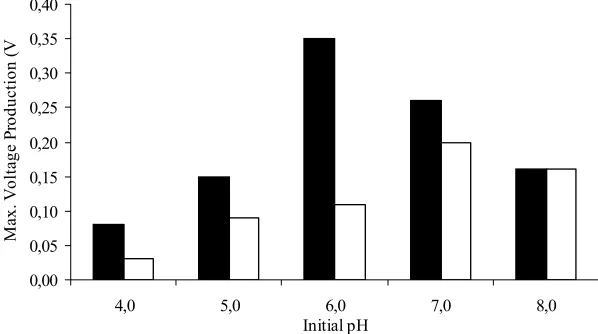
The temperature is a major environmental factor that affecting physiological activity of most prokaryotes. At optimum temperature, microbes perform biological activities at the maximum rate such as growth and metabolism. Strain Bb and P9 was able to show good performance on electricity generation at temperature ranging from 30 ºC to 45 ºC. The highest yield was obtained at 37 ºC for both strains. However, they were distinguished by a different optimum pH (Bb = pH 6.0 and P9 = pH7.0). The enzymes secreted by different strains have ionic group on their active sites and these ionic groups must be in a suitable form to be function. Therefore, variation in the pH of the medium results in changes in the ionic form of the active site. This will further changed the activity of the enzymes activity and hence the reaction rate. Maximum cellulases activity (CMCase, FPase and β-glucosidase) obtained were Bb = 1.7, 1.4 and 2.3 U/µl and P9 = 1.5, 1.4 and 1.8 U/µl. This was followed with enhanced maximum electricity generation observed in Strain Bb (0.35 V/ 0.13 mA) and P9 (0.20 V/ 0.12 mA) and generating power of 46.0 µW (Strain Bb) and 24.0 µW (strain P9).
The amount of electron was calculated as described by ---?. A total of 8.18 x 10¹⁹
0,00 0,05 0,10 0,15 0,20 0,25 0,30 0,35 0,40
4,0 5,0 6,0 7,0 8,0
Initial pH
M
ax
. V
ol
ta
ge
P
ro
duc
ti
on (
V
Figure 1: Effect of initial pH on voltage production by Bb ( ) and P9 ( ) grown at 37 ºC.
Effect of Carbon Sources
Two types of cellulose with different degree of crystallinity were used i.e. substituted soluble cellulose (CMC) and microcrystalline cellulose (ethyl cellulose, native cellulose and empty fruit bunch). The electrochemical activity on different types of cellulose used was summarized in Table 1. Electricity production was almost two times higher in native cellulose (Strain Bb) and empty fruit bunch (Strain P9) compared to that on CMC. It also showed an increased of cellulase activities i.e. 1.7, 3.3 and 4.8 U/µl (Strain Bb) and 1.9, 3.9 and 5.8 U/µl (Strain P9) for CMCase, FPase and β-glucosidase, respectively when grown in the medium supplemented with their optimum temperature, pH and carbon source.
Results represented that, cellulase and electrochemical activities were strongly depended on the type of substrate supplemented in the medium. It was demonstrated that the high crystallinity of cellulose (native cellulose and EFB) would actively induced cellulase activities. The stoichiometry of cellulose is commonly described by the following net reaction: [-C6H11O6-]n + a H2O → b CH3COOH + CH3CH2OH + d CO2 + H2 + (e-)n [11].
Therefore cellulose metabolism and cellulase activities were accompanied in order to increase electrochemical activity as an electrons donor by both strains. At this stage, it was clearly showed that power generation was almost 3 times higher (Strain Bb = 132.0 µW and Strain P9 = 58.8 µW) compared to when CMC was supplied as carbon source. A total electron transferred by Strain Bb and P9 were 2.43 x 10²⁰ and 1.70 x 10²⁰ electron, respectively. These suggested that carbon source played a very crucial role in cellulases and electricity production by both of strains.
Table 1: Kinetic of cellulases production and electrochemical activity by both strains at various carbon sources supplied with optimized pH and incubated at 37 ºC.
Strain Bb
Cellulases (U/µl) Type of
Carbon Sources
V max (V)
I max (mA)
Mol Electron Produced
Power (µW)
CMC
ase FPase Glu Β
-Cellulose degraded
(%)
CMC 0.32 0.23 2.40 x 10⁻⁴ 73.6 1.7 1.4 3.0 33.93
Eth Cel 0.26 0.20 1.79 x 10⁻⁴ 52.0 1.5 1.9 3.3 31.25
Nat Cel 0.44 0.30 4.03 x 10⁻⁴ 132.0 1.7 3.3 4.8 43.62
EFB 0.26 0.21 2.51 x 10⁻⁴ 54.6 1.7 3.3 5.0 34.44
Strain P9
CMC 0.21 0.15 1.57 x 10⁻⁴ 31.5 1.4 1.4 2.8 25.94
Eth Cel 0.21 0.17 1.52 x 10⁻⁴ 35.7 1.2 2.2 4.0 24.63
Nat Cel 0.28 0.20 1.79 x 10⁻⁴ 56.0 1.7 3.9 4.5 35.17
EFB 0.28 0.21 2.82 x 10⁻⁴ 58.8 1.9 3.9 5.8 46.25
Code: CMC: Carboxymethyl cellulose; Eth Cel: Ethyl Cellulose; Nat Cel: Native Cellulose and EFB: Empty Fruit Bunch.
In addition, a bioenergetical product of fermentation such as reduced products (ethanol) was also produced, which synthesis did not require ATP via the intermediates of central metabolic pathway. Furthermore, ATP demands for cellulases synthesis and transport are relatively small (≤ 17 %). Therefore, additional ATP remain from cellulose metabolism would resulted in an increased of electricity generation.
Effect of Nitrogen Sources
Two types of nitrogen sources were investigated i.e. casamino acids, peptone and yeast extract (represents organic nitrogen sources) and NH4Cl and (NH4)2SO4 (represents
inorganic nitrogen sources). In addition, combinations of organic nitrogen sources (casamino acids plus peptone, yeast extract plus peptone and yeast extract plus casamino acids) were also studied. Based on the results obtained, combinations of casamino acids and peptone (Strain Bb = 0.46 V/0.31 mA) and yeast extract and peptone (Strain P9 = 0.29 V/ 0.20 mA) enhanced the maximum electricity generation by the bacteria. The used of combinations of nitrogen sources were also described in literature for enhanced growth and metabolism of microorganisms [14].
Under these conditions, Strain Bb and P9 sustained a 1.95 x 10²⁰ and 1.44 x 10²⁰ electron through the circuit. This was followed by the increased in cellulase activities (CMCase, FPase and β-glucosidase) i.e. Strain Bb (1.7, 3.3 and 6.0 U/µl) and Strain P9 (2.0, 3.9 and 5.8 U/µl). A combination of two types of organic nitrogen increased electrochemical activity of the bacteria by approximately two fold compared to those supplemented with single organic nitrogen. A single nitrogen sources especially inorganic nitrogen sources were found halted the cellulase and electrochemical activities by both strains.
sources provided an extra carbon source, vitamins and mineral required by the bacteria for growth and cellulose metabolism. In addition, combination of casamino acid plus peptone that preferred by strain Bb provided high content of nitrogen, vitamins, free amino acids, carbon and minerals that were important for protein formation by the bacteria. On the other hand, mixture of yeast extract and peptone will provide the bacteria with high vitamin B and trace elements that important as growth factor. These growth factors also believed to
stimulate of synthesis of some other metabolites.
At the concentration of cellulose employed (0.5 %), neither strains degraded all the substrate. Though strain P9 degraded more cellulose (52.62 %) compared to strain Bb (48.96 %), strain Bb exhibited a significantly higher value of power generation (132.0 µW)
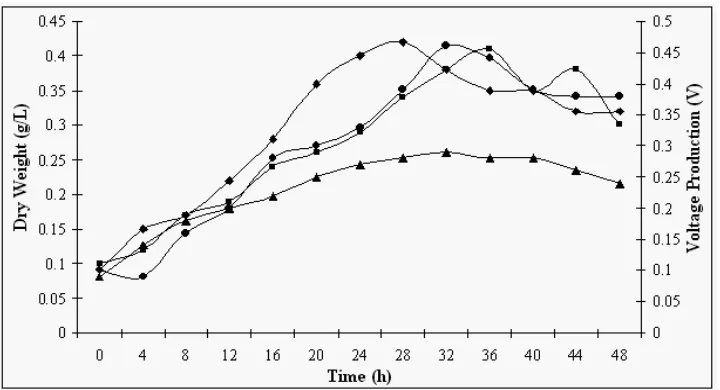
compared to strain P9 (58.8 µW). This may be due to the secretion of greater amount of cellulose by strain P9 during metabolism. Figure 2 illustrated the growth characteristics of both strains under optimized conditions. It was apparent that growth on crystalline cellulose (Native Cellulose and Empty Fruit Bunch) was slower than that in CMC (i.e. X max reached
after 28 h and 36 h for strains Bb and P9, respectively). The cells grew as rapidly on soluble cellulose with doubling time for strains Bb and P9 were 1.26 and 3.30 h, respectively., whereas growth was almost twofold slower on crystalline cellulose with doubling time of 3.15 h (strain Bb) and 4.33 h (strain P9). These were resulted from the bioavailability of the substrate to microbial degradation.
Therefore it was appeared that the actual solubilization process, involving disruption of the crystalline structure of cellulose and not hydrolysis of the glucan strands of amorphous cellulose and limits cell growth on the crystalline cellulose. It was also proposed that
CMCase action which catalyzed the breakdown of amorphous cellulose was not a growth-limiting factor. As the fermentation became more vigorous, the cellulose was gradually solubilized and the overlying liquid became turbid due to cell growth. Cessation of growth and fermentation usually occurred within 3 days of its inception. When a CMC-grown cell was used as the inoculums, no distinct lag in initiation of growth was observed and hydrolysis of cellulose followed immediately. These observations suggested that cells constitutively synthesized the enzyme necessary for digestion of crystalline cellulose.
Figure 2: The growth characteristics and voltage production of Strain Bb and P9 grown under optimized conditions. ( ): Cell Dry Weight of Strain Bb; ( ): Cell Dry
Formation of fermentation products
It is important to screen a wide variety of their metabolic pathway because differences in microbial metabolism could be attributed partly to genetic differences and/ or their
adaptation to changes in their environment. Different organisms contained different combinations of pathway when grown under different nutritional and environmental
conditions. The primary feature of this study was facultatively anaerobic metabolism which produced energy in the absence of oxygen. The cell must able to balance its generation and consumption of reducing power. During the fermentation, energy was generated without involving the electron transport chain. Since no electron transport is used, the organic
substrate must undergo a balanced series of oxidative and reductive reactions such as acetone and buthanol. The end products of cellulose degradation produced a simpler molecule of glucose. This unit of glucose was further metabolized and produced pyruvate via the glycolysis. The glycolysis process yields 2 mol ATP per mole of glucose which potentially been extractable by mediator compounds and later transferred into external electron
acceptors.
Strain Bb produced a significant amount of acetone (2.19 g/L) followed by the increment in pH of the medium (final pH 6.82).The pH of medium for strain Bb was found increased proportionally with solvent production. In contrast, Strain P9 produced maximum acetone (2.35 g/L) followed by ethanol (0.53 g/L) and buthanol (0.10 g/L) with pH medium was found dropped stepwise (to pH 6.88) before it was rising back gradually after 16 hours of incubation. It was suggested that some other acids compound production (i.e. butyric acids) or excess production of proton ion (H+) during cellulose degradation produced by strain P9. It was found that solvent production by both strains increased towards the end of
fermentation. This might be an indication to accumulation of by-product and main reason of alkaline condition occured during the final stage of fermentation. This was supported by high β-glucosidase produced compared to CMCase and FPase. The effect of nitrogen sources during cellulose metabolism had produced more glucose subunit which later converted to other product through glycolysis.
Long term Operation of MFC
Generally, to be practical in giving power output over long periods of time, MFCs will have to be converted to continuous flow and employed cathodic half-cells that can negate the need for replenishment. The latter can be achieved by exploiting oxygen from free air instead of ferricyanide that requires periodic replenishment. In such systems, substrate and other nutrients will be continuously supplied to the bacteria and furthermore, there will be no waste product accumulation as 80 % of previous medium will be constantly driven out of the system before the new replenishment.
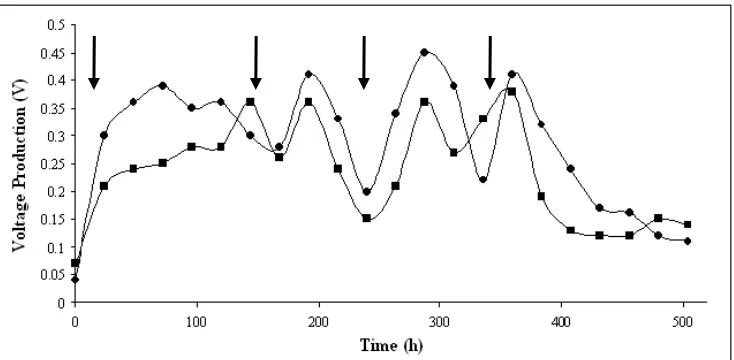
Figure 3: Charging and discharging curves for long-term operation of set up by Strains Bb ( ) and Strain P9 ( ). Arrows indicated for the replenishment of growth
media and mediator.
During second and third replenishment, it was observed that a longer steady current production interval (38 h to 48 h) before it decreases to about half of the maximum voltage. This exchange of medium with immediate resumption in current production was repeated three times with similar electrochemical generation trends. It was proposed that the anode chamber washing and substrate replacement procedures removed some amount of cells and soluble mediator though cells in the form of biofilm was retained on the electrode. This suggested that microbial cells attached to the electrode surface were primarily responsible for the current production [7]. However, performance was gradually declined under repeated operation. For longer operation of the cell, a new bacterial suspension may have to be injected.
The electricity generation became diminished over period operation may be due to the presence of thick biofilm on the anode was significantly decreased the electron flows. The biofilm and microbial clumps that clogged the anode surface could resulted in the loss of electron transfer ability. This situation can be defined as ohmic overvoltage that limited overall performance. This can be further determined by internal resistance during operation. It clearly showed that, internal resistance calculated were substantially higher (approximately twofold) compared to that initial value over the long (5 days) operation period. The changes with time prevent the use of the polarization curve method to compare power outputs across a range of resistors, a method, which requires steady-state conditions. The changes over time probably reflect a combination of mediator degradation, microbial exhaustion and acid waste build-up or substrate depletion [15].
After certain duration, the replenishment was stopped in order to determine the minimum electricity generation and to limit further growth of cells. It was observed that the decrease in electrochemical activity from maximum levels to baseline typically spans
approximately over 72 hours due to substrate exhaustion. These phenomena were greatly showed that without addition of new substrate, electrochemical activity was still observed. This suggested that the set up used in this study is potentially suitable for reasonably period of time though the major problem is to fix the internal resistance effect.
CONCLUSIONS
Bb and P9 showed enhanced (~ 77% and 71%, respectively) potential to generate electrical energy in comparison to those before optimization was conducted. Microbial metabolism could be directly related to electricity generation. When microbes metabolized their preferred substrate, large harvest of electrons and protons were stored as reduced
intermediates. Electrons and protons were transferred to the cathode compartment and in the presence of oxygen, water was produced. This was observed by the increased in the volume of catholyte. The characteristics of both isolates whose preferred organic substances as their carbon and energy sources proposed that both were heterotrophs.
Part of these nutrients is used for energy production and part for biosynthesis and product formation. Bearing in mind that the microorganisms itself needs some of the substrate for its own biomass production. Approximately 80 % of electron yield is
potentially to be harvested through the external circuit. The various current generation was due to several factors that influenced by the internal resistance. Though, results obtained indicated a good reason how these parameters affected the electron transfer. Further study need to be carried out to improve fuel cell design and to reduce the internal resistance of conductor in the set up. However, electricity generation in this set up was stable and can be repeated successfully and indicated that the electrochemical activities could be accepted. The ability to consistently produce power from cellulosic wastes in long-term and stable manner with cellulose degraders suggested that an efficient conversion of cellulosic wastes materials and biomass to sustain electricity is feasible.
ACKNOWLEDGEMENT
The author wish to thank Dr. Adibah Yahya and Assoc. Prof. Dr. Zaharah Ibrahim for their strong support, useful comment and critically reading of the manuscript.
REFERENCES
[1] Kim, H. J., Park, H. S., Hyun M. S., Chang, I. S., Kim, M. and Kim, B. H. (2002). A Mediatorless-Microbial Fuel Cell using a Metal-reducing Bacterium, Shewanella putrefaciens. Enzyme and Microbial Technology, 30, 145-152.
[2] Bond, D. R. and Lovley, D. R. (2003). Electricity Production by Geobacter sulfurreducens
Attached to Electrodes. Applied and Environmental Microbiology, 69 (3), 1548-1555.
[3] Madden, D. and Schollar, J. (2001). The Microbial Fuel Cell. Bioscience Explained, 1 (1),
1-4.
[4] Benetto, H. P. (1990). Electricity Generation by Microorganisms. Biotechnology Education, 1 (4), 163-168.
[5] Katz, E., Shipway, A. N. and Willner, I. (2003). Handbook of Fuel Cells-Fundamentals, Technology and Applications. John Wiley and Sons, Ltd, 1, 1-27.
[6] Kim, N., Choi, Y., Jung, S. and Kim, S. (2000). Development of Microbial Fuel Cells using Proteus vulgaris. Bull. Korean Chem. Soc, 21 (1), 44-48.
[7] Chaudhuri, S. K. and Lovley, D. R. (2003). Electricity Generation by Direct Oxidation of Glucose in Mediatorless-Microbial Fuel Cells. Nature Biotechnology, 21(10), 1229-1232.
[8] Park, H. S., Kim, B. H., Kim, H. S., Kim, H. J., Kim, G. T., Kim, M., Chang, I. S., Park, Y. K. and Chang, H. I. (2001). A Novel Electrochemically Active and Fe (III)-reducing Bacterium Phylogenetically Related to Clostridium butyricum, Isolated from a Microbial
Fuel Cell. Anaerobe, 7, 297-306.
[9] Cooney, M. J., Roschi, E., Marison, I. W., Comninellis, Ch. and Urs von Stockar. (1996). Physiologic Studies with the Sulphate-reducing Bacterium Desulfovibrio desulfuricans:
[10]Umikalsom, M. S., Ariff, A. B., Zulkifli, H. S., Tong, C. C., Hassan, M. A. and Karim, M. I. A. (1997). TheTreatment of Oil Palm Empty Fruit Bunch Fibre for Subsequent Use as Substrate for Cellulase Production by Chaetomium globosum Kunze. Bioresource Technology, 62, 1-9.
[11]Desvaux, M., Guedon, E. and Petitdemange, H. (2000). Cellulose Catabolism by
Clostridium cellulolyticum Growing in Batch Culture on Defined Medium. Applied and Environmental Microbiology, 66 (6), 2461-2470.
[12]Hu, Z. H., Yu, H. Q. and Zhu, R. F. (2005). Influence of Particle Size and pH on Anaerobic Degradation of cellulose by ruminal microbes. International Biodeteriotion and Biodegradation, 55, 233-238.
[13]Rampersad, K., Goldstone, L. A. and Tivchev, G. N. (1998). Study of Methods for the Cultivation of Anaerobic Cellulose-degrading Bacteria. Water SA. 24 (4): 343-345.
[14] Lynd, L. R., Weimer, P. J., Willem H. Van Zyl and Pretorius, I. S. (2002). Microbial Cellulose Utilization: Fundamentals and Biotechnology. Microbiology and Molecular Biology Reviews, 66 (3), 506-577.