Development Of IEEE802.15.4 Based Wireless
Sensor Network Platform for Image Transmission
Abdul Hadi Fikri Bin Abdul Hamid, Rozeha A. Rashid, Norsheila Fisal, S. K. S. Yusof, S. H. S. Ariffin Liza Latiff
Department of Telematics and Optics, Faculty of Electrical EngineeringUniversiti Teknologi Malaysia, 81310 Skudai, Johor, MALAYSIA [email protected], rozeha|sheila|kamilah|[email protected]
Abstract-- Conventional Wireless S ensor Network (WS N) mainly deals with scalar data such as temperature, humidity, pressure and light which are very suitable for low rate and low power IEEE 802.15.4 based networking technology. The commercial off-the-shelf (COTS ) CMOS camera has fostered researchers to push WS N a step further. The unique properties of multimedia data delivery pose novel challenges for resource-constrained sensor network. Transmitting raw data is very costly while limited processing power prevents sophisticated multimedia processing. This paper presents th e development of a low cost, low power WS N hardware platform named TelG embedded with an operating system called WiseOS, system software, and also a simple best effort JPEG images transmission over the network. The experimental results from the testbed illustrate that the performance of our designed WS N platform are comparable to the existing ones in the market in terms of packet reception rate (PRR) and received signal strength intensity (RS S I) with respect to the distance. It also shows that the end-to-end delay increases proportionally with the number of hops. At an average data rate of 48.38Kbps, we conclude that our platform not only can support real-time multimedia data delivery but also a low voice coding standard such as G.729a (8kbps).
Index Term-- Wireless sensor network, IEEE802.15.2, JPEG, CMOS , Multimedia.
1. INTRODUCTION
Large-scale networks of sensors with wireless communication capability have drawn the attention of researchers for the last few years. Most of the applications are centered towards harvesting information from the physical environment, performing a simple processing on the extracted data and transmitting it to remote locations [1]. In general, most of the applications require a small bandwidth demand and usually transmission delay is not a major concern [2]. These devices normally are equipped with multi-hop capabilities, self-healing, automatic-management and self configuration. These attributes make WSNs suitable for a wide range of application ranging from home-automation, surveillance to industrial process control [3]. The idea of including image processing capability into the sensor mote not only will enhance the existing application s but also will enable new ones.
Wireless Multimedia Sensor Network (WMSN) is defined as a network of wireless embedded devices that allow retrieving video and audio streams, still images and scalar sensor data from the physical environment which can be
understood as a convergence between the concept of WSN and distributed smart cameras [4]. Literature survey in [1][2][4] addressed various issues regarding the challenges faced by research community in realizing WMSN. Even with the availability of CMOS camera which is low cost, low power and small form factor, current WSN constraints still prohibit the implementation of effective and efficient multimedia data into it. A new paradigm is needed in order to realize WMSN in the aspect of hardware design, algorithms, protocols and techniques to deliver multimedia content over a large-scale network given the nature of the wireless sensor network which has a very tight resource constraint.
Most of the platform developed for WSNs utilized an 8-bit microcontroller as its central processing unit (CPU), two AA batteries as its power unit and IEEE802.15.4 compliant radio module. It is argued in [5] that for multimedia data processing, a 32-bit microprocessor will consume less power than an 8-bit microprocessor. In [6], the authors proposed a mote with 32-bit microprocessor together with Field Programmable Gate Array (FPGA) as its image processing unit. One unique properties of image sensor mote is that, each sensor has a different interface. In practical, a mote must be designed to provide a single type of interface only. This means that the type of the image sensors that can be used is limited to the sensors that use the same interface as the mote. Generally, the proposed platform for WMSNs concentrate on either providing enough processing power and memory on the mote itself like [5] and [6] or designing a separate image sensor daughter-board like Cyclops [7] and CMUcam3 [8] to be interfaced with any motes.
(PC) OS (Windows, Linux, Mac) is that embedded OS shares the same memory space with the user program while PC OS does not. Since ROM and RAM of embedded systems are very tight, a careful consideration should be made in designing the OS. The advantage of using co -routine OS is the single stack memory for every tasks ’ feature. This technique requires a small amount of RAM for operation and the implementation is simpler compared to preemptive OS which requires a huge RAM space and sophisticated programming technique for inter-tasks communication.
To make vision-enabled applications a reality using WSN platform, a combination of in-node and distributed processing are needed. Based on the constraints posed by WSN as the guideline, we describe in Sec II the development of our own platform, named TelG, which is equipped with an adequate in-node processing capability and low power devices to enhance the node lifetime. The design and implementation of our own OS called WiseOS, is given in Sec III. It is an event-driven OS based on TinyOS architecture, written in C language and featuring small foot print. Sec IV explains the experimental testbed while the results and analysis are presented in Sec V. The conclusion follows in Sec VI.
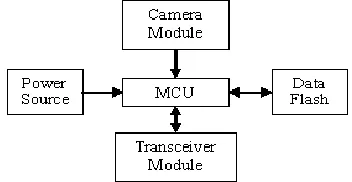
2. HARDWARE DEVELOPM ENT (TelG mote) In this section we discuss the design and implementation of our own sensor mote, named TelG, and the criteria for the hardware selection. Four main components of a sensor mote are the processing unit, wireless transceiver, sensors and power unit. The analysis of these components is presented by comparing it to the commercially available WSN platforms. Fig. 1 shows the basic block diagram of a sensor mote.
Fig. 1. Block diagram of the sensor mote
2.1 Microcontroller
We choose our microcontroller unit (MCU) based on several requirements such as low power consumption, rich on-chip peripherals, RAM and ROM with decent size. For TelG, ATmega644P/V is chosen after evaluating existing products from Atmel, Texas instruments and Microchip. Table I shows the comparison of the MCUs.
TABLE I
Microcontroller comparison
Table I illustrates that Atmega644P/V has the lowest current consumption for both active and sleep modes. The operating voltage is down to 1.8V. Low operating voltage is required for power source utilization. An AA battery cut-off voltage is measured at 0.9V. The cut-off voltage for two AA batteries in series would be 1.8V which is exactly the same minimum voltage required by the MCU to operate. Atmega128 operating voltage is at 2.7V leaving most of the batteries unused. Atmega644P/V uses an advanced RISC architecture where most of the 131 instructions only require one clock cycle to be executed and up to 20 Million Instructions Per Second (MIPS) at 20MHz. It also provides all the basic peripherals for microcontroller with additional USART port, Timer and PWM modes. Atmel microcontroller need s almost no additional circuit to get it running except for the power supply. 4kB RAM is smaller compared to 10kB RAM (MSP430F16x), but we consider power consumption as key criteria in choosing Atmega644PV as our MCU. Although flash sizes are useful for large application programs , they are not the limiting factor in developing WSN applications [9].
2.2 Radio Module
TABLE II
IEEE802.15.4 compliant radio comparison
For TelG mote, we select XBEE module from MaxStream despite its high power profile. One of the most alluring features of XBEE is its ease-of-use, it only needs two pins (RX/TX) from the host to communicate with each other. The module also provides a complete solution including the antenna where the rest of the radio chip requires a careful design of an external antenna. The USART device interface is very easy to config. and XBEE has two modes of operation which are transparent and API mode. The transparent modes replace the XBEE as a wire on the USART host while the API mode can be set to strictly follow IEEE802.15.4 packet based communication. Other downside of XBEE is the USART interface which limits the data rate up to 115.2kbps.
2.3 Visual Sensor
To avoid designing a daughter board for the sensor and also the need of processing power from the MCU to perform multimedia data processing, C328R camera from CoMedia is chosen. This CMOS camera is integrated with lens, JPEG compression engine, flash memory, and EEPROM program in a single module. The camera has a small form factor measuring 20x28mm in dimension with VGA resolution that can be down sample to QVGA or CIF operating at 3.3V with 60mA power consumption. The EEPROM contain s a serial type program memory to provide easy, user friendly commands to control the module by the external host. JPEG codec, built in the OV528 compression engine chip , is capable of performing down sampling, clamping and windowing functions with desired resolution as well as color conversion depending on the user request through the serial bus host command.
3. SYSTEM SOFTWARE DEVELOPM ENT (Operating System)
An operating system, named WiseOS, is designed and implemented based on TinyOS architecture. It is a non-preemptive event-driven OS with several goals in mind. The OS must support multitasking capability which is crucial for the programmer to develop the application in a linear manner. The common paradigm for multitasking must be retain ed in such a way that application developers only need to concentrate on the application logic rather than the low level system issues such as accessing I/O, scheduling and networking. It is desirable for the OS to handle networking such as multi-hop support, routing and a simple user-level
networking abstraction. Considering image data is voluminous and the time needed by the OS to service such task may be longer, it must allow the user to manually time-slice their functions to avoid a slow system response. Although preemptive OS can handle this kind of problem by assigning different priorities to each task, low-end microcontroller has a small RAM spaces which make it unattractive. Small footprint is crucial to any OS design for embedded processors.
Most of the low-end microcontrollers have a large Flash but a small RAM, hence, WiseOS is designed to cope with this trend by optimizing RAM usage as a higher priority. This memory constraint leads to the decision of using static library instead of a dynamic one since randomly allocating free memory in a small RAM system might cause the whole system to breakdown unpredictably. A simple abstraction for the user to access the sensors for reading and actuating will greatly improve the end-user application developing time. The device driver must be handled by the OS that can return real-world unit such as image data and ADC values. Fig. 2 depicts the architecture of WiseOS.
Fig. 2. WiseOS architecture
3.1 Task management and scheduling
Each task in WiseOS is populated during the initialization and system image creation. In small RAM low-end microprocessors, this feature is desirable. Task in WiseOS is scheduled to run until completion and only hardware interrupt can preempt a task. One linked list is used to maintain the task queue. This linked list is processed at the main loop to ensure that the task will be executed each time the processor is free. A task may schedule itself or another task to provide a virtual infinite loop of process.
3.2 Timing
WiseOS provide two types of timing operations, one-shot and periodic. Timing interrupt is used to update the global TOD (time of day) periodically. A timer event may preempt a task since it is a hardware interrupt and it may schedule a task. The TOD is incremented periodically and overflows will not occur in foreseeable intervals of time.
3.3 Network stack protocol
the node will trigger an interrupt to handle it. In WiseOS, buffers are allocated statically and managed by the OS. Upon successful reception of packets, OS will place the data into the buffer and pass the buffer handler to the application. The OS will not touch the data until the application releases the buffer handler. This way, the application can manipulate the data in the buffer directly without the need to copy the data. This feature is important for conserving the memory and CPU cycles. Each packet received will be placed in a single buffer where the applications need to listen to it. If multiple applications exist, every application must listen to the buffer.
Routing protocols can be very challenging in the sensor networks environment. WiseOS provides a basic functionality for the developers to implement their own protocols. WiseOS only provides a one-hop transmission packet on behalf of the application. Packet received by node will contain a specific data structure as shown in fig. 3.
Fig. 3. Received packet format
4. IM AGE TRANSM ISSION
In this section we implement an image transmission (JPEG) mechanism using the platform that we have developed. JPEG compression is simpler than JPEG-2000 which has a higher source coding complexity but provides a better resolution and quality scalable bit-stream [16]. C328R camera provides JPEG compression which is suitable for WSN applications because of its simplicity in which every node is expected to capture shots and send images to a sink node.
In our experimental testbed, only the source and destination (sink) node need to encode and decode the images while the intermediate nodes are only for relaying the images. IEEE802.15.4 does not support packet fragmentation. However, C328R camera already fragmentize the data into a selectable packet size. We choose the data to be fragmented into 64Bytes per packet to fit into the IEEE802.15.4 MTU and operate in non-beacon mode. The sink node is connected to a PC via RS-232 connection and acts as a gateway to allow the collection of the data from the network. A simple application that runs on the PC is developed using JAVA programming language. The application will assemble the fragmented images, store the images into the hard drive and display it on the screen. Each image received will be time stamped. The source node is programmed to capture and
transfer the images at the maximum data rate possible continuously. We vary the resolution of the images captured by the camera to determine the delay of the transmission. The source node is set up to relay the data to one intermediate node placed in between the source node and the sink node.
5. RESULT S AND ANALYSIS
5.1 TelG mote platform
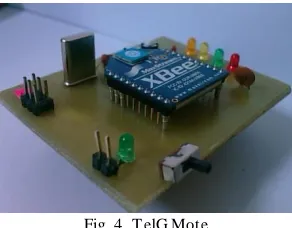
The printed circuit board (PCB) of the sensor node is designed through several times of improvement and troubleshooting. Certain cautions are taken such as avoiding excessive use of soldering paste and long contact between soldering iron and the surface-mount ATmega644PV chip during soldering. This is to ensure that the process would not damage the MCU and other components. The sensor node size is miniaturized by using small components such as surface mount resistor and LEDs . Fig. 4 shows the PCB based TelG mote.
Fig. 4. T elG Mote
Table 3 shows the measured current consumption of TelG mote in different states.
TABLE III
Measured T elG Mote Current Consumption
voltage is 1.8V, due the auxiliary components such as the radio module and crystal oscillator, the actual cutoff voltage for TelG mote is 2.7V. This value can be reduced further by using low-power crystal oscillator and radio module. This power profile indicates that for image processing, even for a simple JPEG compression, the power consumption is over two magnitudes higher than communication activities. As opposed to the classical sensor network which process es scalar data where communication consumes highest power, multimedia sensor network consumes much more processing power during the image processing activity.
A simple experiment is conducted to measure the effective distance based on received signal strength (RSSI), packet rate ratio (PRR) and end to end delay. The experiment was conducted indoor where a certain degree of interference is expected and the transmission power is set at 0dBm. PRR value can be calculated based on equation (1).
m
j SNR
j j
e
j
PRR
16 20 1 12
16
1
16
1
15
8
1
(1)Where SNR = signal to noise ratio m = Frame length in bit
To calculate end to end delay, each transmitted packet will be stamped by a TOD. When the packet completes its round trip, the difference between current TOD and the initial TOD will give the round trip delay for the actual end to end delay calculation based on equation (2)
hops
of
Number
time
trip
Round
delay
end
to
End
(2)
Fig. 5-9 show the results of the experiment as well as comparison between TelG mote and the existing platform.
Fig. 5. End to End delay
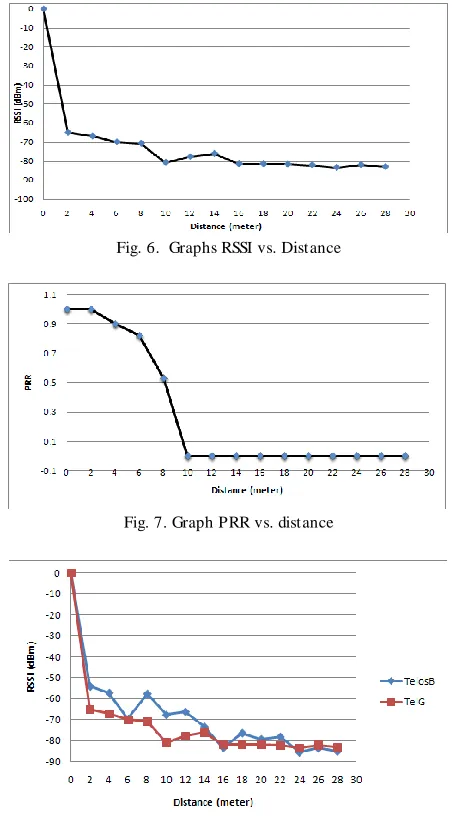
Fig. 6. Graphs RSSI vs. Distance
Fig. 7. Graph PRR vs. distance
Fig. 8. RSSI vs. Distance graph comparison between T elG and T elosB
Fig. 9. PRR vs. Distance graph comparison between T elG and T elosB
From Fig. 5, it can be observed that end-to-end delay for packets increases proportionally to the number of hops. It is expected that if the number of hops is greater than 10, the end-to-end delay will exceed 150ms which can no longer be considered real-time. Fig. 6 and 7 illustrate a distance of approximately 8 meters for an effective communication if the Quality of Service (QoS) is defined by RSSI threshold above -70 dBm and PRR greater than 50%.
Fig. 9 depicts that the PRR for TelG mote drops to 0 at a distance of 10 meter while TelosB is at 14m. This is due to the antenna used by both platforms. TelG uses chip antenna as opposed to TelosB which uses micro-strip antenna. Antenna transmit gain has a direct impact on the PRR value. Equation (3) shows that power received at antenna is directly proportional to the antenna transmit gain.
2
4
R
G
G
P
P
r t t r
(3)Pt = Transmit power in dBm
Pr = Receive power in dBm
Gr = Receive antenna gain in dBi
Gt = Transmit antenna gain in dBi R = Distance between antennas in dBi λ = Wavelength in meters
Micro-strip antenna has a higher transmit gain compared to chip antenna and hence the shorter distance achieved by TelG mote compared to TelosB in terms of PRR.
5.2 Simple image transfer
Using the experimental setup explained previously, we calculate the frame rate for a single image to be captured, segmented, transferred, received, assembled and displayed for 4 different image resolutions as shown in Table IV.
TABLE IV
Frame rate for different image resolutions
Fig. 10 shows the image being displayed using a JAVA program.
Fig. 10. GUI for displaying the image
At the lowest resolution, we let the camera capture and transmit images continuously without the sleep mechanism. 105 JPEG frames were received (averaged 14.50Kbps). This low data rate is largely contributed by the delay required for
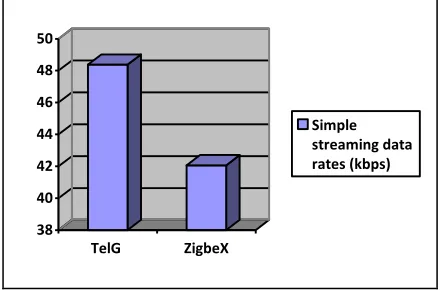
the camera to capture the images and inter-packet delay during transmission. The images captured by the camera is first compressed and fragmented then stored into the camera Flash. The host has to issue a command to fetch the fragmented packets before it can be transmitted. The whole mechanism increases the delay for the images to be transmitted. Power consumption recorded is about 110mA. Although IEEE802.15.4 allows for two mode of operation (beacon and non-beacon), we conduct the experiment using non-beacon mode to achieve the highest data rate possible. In [17], the experiment is conducted in both modes using Zigbee network protocol and an enhanced version of IEEE802.15.4 protocol is also presented. From the experiment, non-beacon mode can achieve data rates at 10 times higher compared to beacon mode but consumes 5 times more power. However, the data rates achieved using our TelG platform are significantly higher in non-beacon mode as shown by the comparison in Fig. 11.
38 40 42 44 46 48 50
TelG ZigbeX
Simple streaming data rates (kbps)
Fig. 11. Comparison between ZigbeX and T elG mote on simple streaming data rates in non-beacon mode
The difference in data rates lies on several factors such as the radio module itself, the environment (presence of interference) and also the operating system performance.
To investigate the highest data rate attainable by our sensor node, we conduct another experiment using dummy packets with the maximum size allowed by the standard. We continuously transmit the packets for 100 seconds and the data rate achieved is 48.38Kbps and the power consumption is 60mA. It is understood that when a sleep mechanism is implemented, the power consumption can be greatly reduced to prolong network lifetime. With low data traffic applications, the non-beacon mode can be used together with sleep mechanism to further decrease power consumption. Since C328R camera can only capture meaningful images during daytime only, the camera can be put into sleep and the sensor node can be used to transmit scalar data only. At an average data rate of 48.38Kbps, we conclude that our platform not only can support multimedia data but also a low voice coding standard such as G.729a (8kbps).
6. CONCLUSION
sensor network imposes new challenges where high data throughput is desirable without severely compromising energy efficiency. In this project, we develop a new platform based on the existing WSN platform as our guideline and choose low power and an easy to interface devices to provide a multimedia platform together with an embedded operating system. A simple image transfer experiment is conducted to investigate the suitability of multimedia data using our platform. From the experimental results, we show that with the right combination of hardware processing power and efficient operating system, it is highly possible to carry out multimedia delivery over WSN.
An efficient, energy aware routing protocols can be implemented for future work to enhance the image transfer protocol as well as using lower power consumed devices to prolong network lifetime.
REFERENCES
[1] Stanislava Soro, Wendi Heinzelman, “ A Survey of Visual Sensor Network”, Hindawi Publishing Corporation, Advances
in Multim edia, vol. 2009, id. 640386, May 2009
[2] Ian F. Akyildiz, T ommaso Melodia, Kaushik R.Chowdhury, “A Survey on wireless multimedia sensor networks” Com puter Networks (Elsevier), vol.51, no. 4, pp. 921-960, Mar. 2007. [3] Anthony Rowe, Dhiraj Goel, Raj Rajkumar, “ FireFly Mosaic:
A Vision-Enabled Wireless Sensor Networking System”
Carnegie Mellon University, U.S.A., 2007
[4] Ian F. Akyildiz, T ommaso Melodia, Kaushik R. Chowdh ury, “Wireless Multimedia Sensor Networks: Applications and T estbeds”, Proc. of the IEEE, vol. 96, No. 10, October 2008. [5] Ian Downes, Leili Baghaeii rad and Hamid Aghajan,
“Development of a Mote for Wireless Image Sensor Networks”, In proc. of cognitive system s and interactive sensors (COGIS), Paris, March 2006.
[6] Zhi-Yan Cao, Zheng-Zhou Ji and Ming-Zeng Hu, “ An Image Sensor Node for Wireless Sensor Networks”, Proc. of the International Conference on ITCC, 2005
[7] M. Rahimi, R. Baer, O. Iroezi, J. Garcia, J. Warrior, D. Estrin, M. Srivastava, “Cyclops: In-situ image sensing and interpretation in wireless sensor network”, Proc. of the ACM conf. on Em bedded Networked Sensor System (SenSys), San Diego, CA, November 2005.
[8] Anthony Rowe, Adam Goode, Dhiraj Goel, Illah Nourbakhsh, “CMUcam3: An open programmable Embedded vision Sensor”, Robotics institute, Carnegie Mellon University, May 2007.
[9] Joseph Polastre, Robert Szewczyk, and David Culler, “ T elos: Enabling Ultra-Low power Wireless Research”, In Proc. IEEE/ACM Inform ation Processing in Sensor Networks (IPSN), pp. 364-369, April 2005.
[10] J.Hill, R.Szewczyk, A.Woo, A.Hollar, D. Culler, K.Pister, “System Architecture Directions for Networked Sensors”, Proc. of Ninth international Conference on Architectural Support for Program m ing Languages and Operating System (ASPLOS), November 2000.
[11] Rich Goyete, “An analysis and description of the inner working of the freeRT OS kernel”, Carleton University, April 2007. [12] Adam Dunkels, Bjorn Gronvall, T hiemo Voigt, “ Contiki – A
lightweight and flexible operating system for tiny networked sensors” Swedish institute of com puter science, 2004.
[13] Chih-Chieh Han, Ram Kumar, Roy Shea, Eddie Kohler and Mani Srivastava, “A Dynamic Operating System for sensor Nodes”, University of California, Los Angeles.
[14] Khawar M.Zuberi, Padmanabhan Pillai and Kang G.Shin, “EMERALDS: a small-memory real-time microkernel”,
University of Michigan, 1999.
[15] Anand Eswaran, Anthony Rowe and Raj Rajkumar, “Nano -RK: an Energy-aware resource-centric RT OS for Sensor Networks”
in proc. of the 26th IEEE International Real-Tim e System symposium (RTSS’05), 2005.
[16] Georgiy Pekhteryev, Zafer Sahinoglu, Philip Orlik and Ghulam Bhatti, “Image T ransmission over IEEE802.15.4 and Zigbee Networks”, in Proc. International conference on Autonomic
and Autonom ous System (ICAS), May 2005.
[17] Changsu, Zeeshan Hameed Mir and Young-Bae Ko, “ Design and implementation of enhanced IEEE 802.15.4 for supporting multimedia services in Wireless Sensor Network” in Elsevier Com puter network 52, 2008.
Author Biographies
Abdul Hadi Fikri Abdul Hamid is a fellow Mast er student at Universiti T eknologi Malaysia. He received B.Eng. degree in Electric-Electronic Engineering from the Universiti T eknologi Malaysia, Johor Bharu, Johor, Malaysia in 2007.
Roz e ha A.Rashid received her B.Sc. in Electrical Engineering from the University of Michigan, Ann Arbor,
USA and her MEE in
T elecommunication from Universiti T eknologi Malaysia in 1989 and 1993, respectively. She is currently pursuing her PhD in the field of Cognitive Radio.