ISSN(Online): 2320-9801 ISSN (Print): 2320-9798
I
nternational
J
ournal of
I
nnovative
R
esearch in
C
omputer
and
C
ommunication
E
ngineering
(A High Impact Factor, Monthly, Peer Reviewed Journal) Website: www.ijircce.com
Vol. 7, Issue 7, July 2019
An Example of the Assessment of Human
Laterality Using Virtual Reality
Beata Sokołowska
1, Ewa Sokołowska
2Bioinformatics Laboratory, Mossakowski Medical Research Centre Polish Academy of Sciences, Warsaw, Poland1 Department of Clinical Psychology, Faculty of Social Sciences, John Paul II Catholic University of Lublin,
Lublin, Poland2
ABSTRACT: Laterality is an intensively studied phenomenon that is still not fully understood and explained. An essential aspect of these researches is the methods of functional evaluation of laterality in both physiology and pathophysiology in humans. Hands are an important and specialized organ, and their functionality plays a significant role not only in daily activities, but also in social relations. The paper presents a new approach to the assessment of lateralization hands in healthy adults using Virtual Reality (VR) technology. VR is an innovative, interactive and attractive method with a significant emotional impact (among VR exercises were particularly liked and preferred by the subjects). The proposed test tasks in Virtual Training allow the effective and quantitative functional assessment the hand(s), both dominant and non-dominant. In the future, the implementation of virtual personal training/ e-rehabilitation (for example, in the patient's home conditions and under internet/ remote medical supervision), apart from the classical rehabilitation of dysfunctional hands in specialized medical centers, gives the possibility of additional personalized training and emotional patients involvement (the home rehabilitation) to achieve the best effects of improving the hand function, especially in order to restore the functionality of the dominant hand.
KEYWORDS: Laterality, handedness, dominant and non-dominant hand, virtual reality.
I. INTRODUCTION
ISSN(Online): 2320-9801 ISSN (Print): 2320-9798
I
nternational
J
ournal of
I
nnovative
R
esearch in
C
omputer
and
C
ommunication
E
ngineering
(A High Impact Factor, Monthly, Peer Reviewed Journal) Website: www.ijircce.com
Vol. 7, Issue 7, July 2019
brain asymmetry show that the dominant hemisphere of the brain is the left hemisphere in the right-handed persons, and the right hemisphere in the left-handed ones [4-6]. Different laterality models have been defined. The basic, considered as a norm, are two unilateral models: (a) right-sided laterality model (prevailing in the human population) and (b) left-sided one. Homogeneous right-sided laterality means the domination of the right hand, right leg and right eye. And left-sided laterality presents functional ascendancy of these organs on the left body side, respectively. In addition, other laterality models have been defined, that are less advantageous/ favorable than one-sided domination, such as: (c) a crossed model (means the domination of the hand, leg and eye on different body sides) and (d) an unsteady/ undefined model (in general the dominance cannot be determined for hand, leg or eye). In 1971 Carolus Oldfield [7] presented a proposal evaluation and analysis of handedness, and basis on this algorithm the manual hand assessment is available on-line the website http://zhanglab.wikidot.com/handedness [8]. Nowadays, there are many different techniques, methods and algorithms to assess not only the upper limbs but also the lower limbs, or the coordination of the hand/ leg with the eye/ ear, which may be used in both health and diseases [9-11]. Particularly, very interesting and promising is new modern Virtual Reality (VR) technology creates interactive, multimodal sensory stimuli that offer unique advantages to (neuro)science research and applications, such as for example combine VR with brain imaging methods, as well as development in VR systems for animal model study [12-14]. Moreover, practicing (bio)scientists, (neuro)psychologists or therapists/ rehabilitants, too, stand to gain from progress in VR environments, which provides a high degree of control over the clinical experience [15-18]. VR has the potential to solve many problems that are common to real – world exposure therapy and has generally produced favorable results. VR treatment has been applied to a range of disorders, including fear conditioning, anxiety disorders and brain damages. For example, one of the most widely explored applications of VR to psychiatric rehabilitation is in the area phobia, or to neurological treatment is to aid analgesia. The important medical approach is also VR neurorehabilitation, which have been focused on two areas: balance disorders and recovery of function after stroke (for example VR system: http://www.neuroforma.en).
The paper presents the results of study on the assessment and comparison of the dominant and non-dominant hands in healthy adult right-handed volunteers, using virtual reality environments, for virtual training/ exercises with a choice of body side (right, left or both) and difficulty level of tests (easy, medium or difficult).
II. SUBJECTS AND METHOLOGY
A. Subjects
In the study were involved twenty adult healthy volunteers, ten women and ten men, aged 18-43 (Table 1). The dominance of hands was determined in each person by the interview and the test questionnaire [11], and also simple physical trials. The subjects were right – handed, and physically and professionally active. They performed sessions of exercises and tasks in a computer virtual reality platform. The subjects practiced at least twice the selected/ defined virtual training session for right, left and both hands. Written informed consents were obtained from all participants.
Parameters Subjects (n=20) Women (n=10) Men (n=10)
Age (years) 31±8 (18-43) 31±9 (18-43) 31±7 (23-43)
Weight (kg) 67±13 (52-87) 60±10 (52-81) 74±14 (60-87)
High (m) 1.71±0.08 (1.56-1.84) 1.66±0.06 (1.56-1.74) 1.77±0.06 (1.70-1.84)
BMI (kg/m2) 22.9±3.0 (18.0-29.0) 22.0±3.2 (18.0-29.0) 21.0±2.6 (19.9-26.3)
Table 1. Characteristics of the studied group (average values with standard deviation and interval for minimum and maximum values in brackets are given).
B. Virtual Reality Sessions
ISSN(Online): 2320-9801 ISSN (Print): 2320-9798
I
nternational
J
ournal of
I
nnovative
R
esearch in
C
omputer
and
C
ommunication
E
ngineering
(A High Impact Factor, Monthly, Peer Reviewed Journal) Website: www.ijircce.com
Vol. 7, Issue 7, July 2019
how many elements of the task remained until the end of each 1-minute round. This information was displayed as a movable vertical "beam" on right and left side of the screen. In addition, summary results were displayed on the screen after the exercise/ task programs. The virtual programs included two-round training sessions consisting of two blocks: (a) movement exercises as BOX, BUTTERFLY, and (b) cognitive-movement tasks as BALLS, ARITHMETIC OPERATIONS [19].
Figure 1. The example of choosing hands and the level of difficulty for cognition BALLS exercises in NEUROFORMA’s Virtual System [19].
The exercise of BOX required opposing "punching" with white markers ("sights") that appeared on the "training bags" on right or left side of the screen (right hand - left bag and left hand - right bag). An additional requirement was to avoid emerging black markers. The time of displaying the white sights decreased with increasing the difficulty level, and then it was necessary to hit faster. In addition, black markers appeared directly under the white ones, so hand was quickly withdrawn. The practitioner received the point for each hit white sight, and lost the point for hitting the black sight. This exercise was easy to perform both the dominant and the non-dominant hand, and was willingly chosen by the practitioners.The next BUTTERFLY exercise was following a trajectory of a butterfly, but the butterfly moved in a chaotic, unpredictable way. There were also various distractors, i.e. distracting elements, they moved similar as the butterfly. The speed and trajectory of the butterfly were determined by the selected level of difficulty. The practitioner received points for every second in which he managed to keep his hand on the butterfly.
Figure 2.The illustration of performance of the Virtual Session in Bioinformatics Laboratory MMRC PAS, for BOX and BUTTERFLY exercises (from our database library) [20].
ISSN(Online): 2320-9801 ISSN (Print): 2320-9798
I
nternational
J
ournal of
I
nnovative
R
esearch in
C
omputer
and
C
ommunication
E
ngineering
(A High Impact Factor, Monthly, Peer Reviewed Journal) Website: www.ijircce.com
Vol. 7, Issue 7, July 2019
difficulty, the time was shorter for completing this task and the number of balls increased. The practitioner received points for each correctly thrown ball.The last ARTHMETIC OPERATIONS exercise required estimating - according to the command displayed on the screen - the largest or the smallest result of basic arithmetic operations. With the increase in the level of difficulty, the choice of answers increased, the response time was reduced, and the spread between individual displayed results decreased. The practitioner received a point for every correct result indicated by the hand. The calculations were most often too slow. For shorter times, the dominant hand allowed to keep up and indicate the result faster than the non-dominant.
C. Statistical Analysis
The data was analysed using the STATISTICA 9.0 PL statistical package software. Whitney-Mann and Wilcoxon tests were applied to assess differences of scores in the sessions. The χ2 test was used to estimate scoring distributions. The results are expressed as mean with standard deviation (SD). A p value <0.05 was considered statistically significant.
III. RESULTS AND DISCUSSION
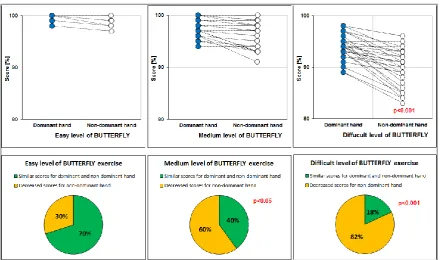
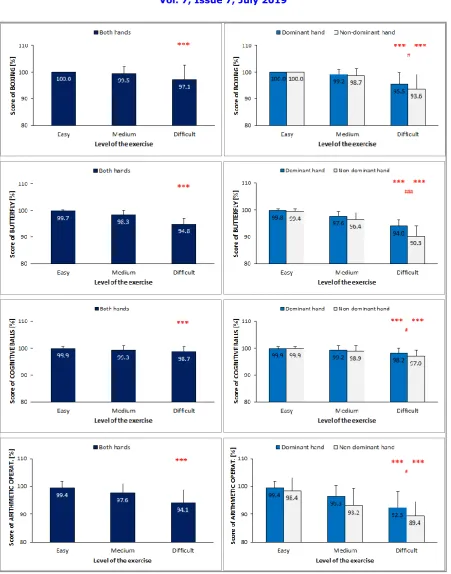
In the study group, no statistically significant differences in the level of virtual exercise performance were observed due to gender and age of the subjects. Figures 3 and 4 illustrate the results obtained. Figure 3 presents a comparison of the average scores obtained in the study group for the exercises of both hands (panel on the left), and exercises for the dominant and non-dominant hands (panel on the right). Figure 3 shows the individual results for each of the exercisers for the BUTTERFLY exercise, which was the most sensitive and the best indicated the functional lateralization of the hands.
ISSN(Online): 2320-9801 ISSN (Print): 2320-9798
I
nternational
J
ournal of
I
nnovative
R
esearch in
C
omputer
and
C
ommunication
E
ngineering
(A High Impact Factor, Monthly, Peer Reviewed Journal) Website: www.ijircce.com
Vol. 7, Issue 7, July 2019
Figure 3. The example results of subjects for following the BUTTERFLY on easy, medium and difficult level of exercise for the dominant and the non-dominant hand (top panel: value p for comparison between right and left hands; down panel: p for comparison with the easy
ISSN(Online): 2320-9801 ISSN (Print): 2320-9798
I
nternational
J
ournal of
I
nnovative
R
esearch in
C
omputer
and
C
ommunication
E
ngineering
(A High Impact Factor, Monthly, Peer Reviewed Journal) Website: www.ijircce.com
Vol. 7, Issue 7, July 2019
Figure 4. Results of both, dominant and non-dominant hands in all virtual exercises for easy, medium and difficult levels. Values are presented as mean ± SD. ***P<0.001 for comparison of easy versus the difficult levels; #p<0.05, ###p<0.001 for comparison of dominant
ISSN(Online): 2320-9801 ISSN (Print): 2320-9798
I
nternational
J
ournal of
I
nnovative
R
esearch in
C
omputer
and
C
ommunication
E
ngineering
(A High Impact Factor, Monthly, Peer Reviewed Journal) Website: www.ijircce.com
Vol. 7, Issue 7, July 2019
All participants signaled greater fatigue of the non-dominant hand at the highest levels of exercises. In addition, in the exercises with cognitive elements, the dominant instead of the non-dominant hand was used more often, especially when the time to complete the task decreased. As already indicated, the BUTTERFLY exercise required following of the hand after it, and as a result caused fatigue symptoms of the exerciser's hand, and when it was a non-dominant hand, it did not follow the butterfly's trajectory. Finally, lower results were observed compared to the easy levels, and in particular, significant smaller scores for the non-dominant hand.
IV. CONCLUSION AND FUTURE WORK
The research on functional efficiency of a dominant and non-dominant hand using virtual reality methods (created for example by the NEUROFORMA platform, in an interactive form and with a decision algorithm analyzing results and correctness of the task), indicate not only the usefulness, but also the sensitivity of these methods in the study and evaluation (quantitative / comparative) of handedness.
The research shows that in virtual reality:
• functional laterality of the hands is revealed, the quantitative evaluation of which is the result of the virtual test, • the level of performing the virtual task with both hands is similar / similar to the results obtained with the dominant hand, and the trend of more frequent use of the dominant hand was observed (this was particularly evident in the case of difficult exercises),
• when the task / test is associated with a certain physical effort, fatigue is felt earlier and more clearly in the hands of the non-dominant,
• tasks with cognitive elements are more eagerly performed and motivated (emotionally engaging practitioners despite, for example, signs of fatigue) to achieve better results and advance to a higher levels.
Technologies using virtual reality (VR) are universal systems that can be generally used to assess the efficiency / effectiveness of the human systems in health and disease conditions [13]. The VR system can adapt to the capabilities and / or limitations of the practitioner on an ongoing basis [15]. VR environments allow researches to manipulate multimodal stimulus inputs, so the user’s sensorimotor illusions of being “present” in the represented environment is maximized by an open display such as a computer monitor. Including exercises with interesting cognitive elements additionally engages emotionally and motivates to continue the undertaken tasks. The presented virtual measurement/ training is an example of an innovative, non-invasive, method of assessing the musculoskeletal system, with a potentially wide spectrum of applications, both in the conditions of physiology and pathophysiology, in the clinic. For example, in rheumatoid arthritis (RA), in which 90% of patients have a bilateral hand occupation, in therapy and rehabilitation, hand exercises are a very important element of their improvement [21-23]. The presented Virtual Reality can be a real, non-invasive/ "friendly"/ personalized support in the prevention and/ or monitoring of the rehabilitation and progression of hand deformities, especially for improving and maintaining their proper function, including maintaining the dominant hand function.
V. ACKNOWLEDGEMENTS
Authors wish to acknowledge researches and students who participated in this project, in particular to Professor Bogdan Lesyng and to Angelika Błażejewska from University of Warsaw. The study was a scientific own project "Research of the movement system using the augmented and virtual reality". This research was carried out using the computational infrastructure of the Biocentrum-Ochota project (POIG.02.03.00-00-0030/09) and applying NEUROFORMA’s virtual software of Titanis’ technologies.
Each author's contribution was equal.
REFERENCES
1. G Forrester,WD Hopkins,K Hudry,A Lindell (eds.), Cerebral Lateralization and Cognition: Evolutionary and Developmental Investigations of Behavioral Biases. Progress in Brain Research 2018; vol. 238.
2. LJ Rogers, G Vallortigara (eds.), Lateralized Brain Functions: Methods in Human and Non-Human Species, Neuromethods 2017, vol. 122. Springer Science+Business Media LLC 2017.
3. G. Young, Causality and Development: Neo-Eriksonian Perspectives. Springer Nature Switzerland AG 2019.
4. M Gut, A Urbaniak, L Forsberg, M Binder, Rymarczyk, B Sobiecka, J Kozub, A Grabowska, Brain correlates of right-handedness.
ISSN(Online): 2320-9801 ISSN (Print): 2320-9798
I
nternational
J
ournal of
I
nnovative
R
esearch in
C
omputer
and
C
ommunication
E
ngineering
(A High Impact Factor, Monthly, Peer Reviewed Journal) Website: www.ijircce.com
Vol. 7, Issue 7, July 2019
5. MC Corballis, IS Häberling, The Many Sides of Hemispheric Asymmetry: A Selective Review and Outlook. Journal of the International Neuropsychological Society 2017; 23: 710–718.
6. C McManus, Half a century of handedness research: Myths, truths; fictions, facts; backwards, but mostly forwards. Brain and Neuroscience Advances 2018; 3: 1–10.
7. RC Oldfield, The assessment and analysis of handedness: the Edinburgh inventory. Neuropsychologia1971; 9(1): 97-113. 8. Y Zhang,2014, Online tool for handedness assessment. See: http://zhanglab.wikidot.com/handedness.
9. J Prieur, S Barbu, C Blois-Heulin, 2017, Assessment and analysis of human laterality for manipulation and communication using the Rennes Laterality Questionnaire. R. Soc. open sci. 4: 170035. http://dx.doi.org/10.1098/rsos.170035.
10. EL Nelson, SL Gonzalez, JM El-Asmar, MF Ziade, RS Abu-Rustum, The home handedness questionnaire: pilot data from preschoolers.Laterality: Asymmetries of Body, Brain and Cognition 2018; 24(4): 482-503.
11. V Forkiewicz, My profile of domination - the illustrated test to investigation of lateralization at children and adult. Harmonia 2016 (in Polish).
12. WR Sharman, WR Craig, Understanding Virtual Reality. Interface, Application, and Design. Elsevier Science 2003 (USA). 13. R Riener, M Harders, Virtual Reality in Medicine. Springer-Verlag London 2012.
14. S Kulkarni, N Takawale, Comparative Study of Augmented Reality and Virtual Reality. International Journal of Innovative Research in Computer and Communication Engineering 2016; 4(11): 20034-20039.
15. CJ Bohil, B Alicea, FA Biocca, Virtual reality in neuroscience research and therapy. Nature Reviews | Neuroscience 2011; 12: 753-762. 16. NE Mahrer, JI Gold, The Use of Virtual Reality for Pain Control: A Review. Current Pain and Headache Reports 2009; 13:100–109. 17. B Sokolowska, B Lesyng, Brain asymmetry in health and neurological disorders, including selected aspects based on VR solutions. Folia
Neuropathologica 2018; 56(3): 270-271.
18. JSutherland, JBA Sheikh, L Chepelev, W Althobaity, BJW Chow, D Mitsouras, A Christensen, FJ Rybicki, DJ La Russa, Applying Modern Virtual and Augmented Reality Technologies to Medical Images and Models. Journal of Digital Imaging 2019; 32: 38–53. 19. NEUROFORMA: The instruction and the description of practices.
20. AM Błażejewska, Testing and assessment of lateralization of the motor system using the computer system Neuroforma with elements of virtual reality.University of Warsaw 2017. (Master Thesis).
21. K Księżopolska-Orłowska, T Sadura-Sieklucka, K Kasprzak, E Gaszewska, A Rodkiewicz-Bogusławska, B Sokołowska, The beneficial effects of rehabilitation on hand function in patients with rheumatoid arthritis. Reumatologia 2016; 54(6): 285–290.
22. B Sokołowska, T Sadura-Sieklucka, A Błażejewska, K Księżopolska-Orłowska K, Inflammatoryautoimmunedisorders and lateralization in humans. Folia Neuropathologica 2017; 55(3): 276.
![Figure 1. The example of choosing hands and the level of difficulty for cognition BALLS exercises in NEUROFORMA’s Virtual System [19]](https://thumb-us.123doks.com/thumbv2/123dok_us/1372308.1169957/3.595.88.507.566.720/figure-example-choosing-difficulty-cognition-exercises-neuroforma-virtual.webp)