Moving Vehicle Detection and Counting
Rahul Badekar1, Jaya Dewan2
P.G. Student, Department of Information Technology, Pimpri Chinchwad College of Engineering, Maharashtra, India1
Professor, Department of Information Technology, Pimpri Chinchwad College of Engineering, Maharashtra, India2
ABSTRACT: Surviellance system plays a significant role to track object whereas video surveillance can be used to track moving vehicle, it is a way to keep a track, monitor traffic which can effect the monitoring of vehicles to avoid conflicts, traffic scenario and also can be used to take effective measures to prevent long traffic. This paper describe to detect an moving vehicle from an input sequence of video, various research work is done in this still it has a way for improvements. Whereas to do precise detection and counting it is implemented to develop a unique method using Gaussian mixture model and blob detection methods. Firstly an input video is taken as input and and it is divided into a small frames , we differentiate foreground from background in frames by learning the background substraction. Further detection of moving objects and a binary computation is done to define rectangular regions around every moving vehicle detected. After that morphological operations are applied to get accurate moving vehicle detected object and to remove unwanted disturbances .Lastly final counting of vehicle is done to get the final results which give’s improved result with accuracy more than 91% using Gaussian mixture model and Blob detection methods.
KEYWORDS: Frames, Foreground image, Rectangular regions Boundary, Count.
I.INTRODUCTION
On roads as the number of vehicles are increasing there is a major concern of road safety. Accidents on road validating the inefficiency of the current surveillance systems. It’s been a place for life threatening consequences where improper speed of vehicles, rash driving and the one who don’t follow the lanes and the one who violates the norms of traffic rules are being followed. As per the data analysis of death rate in road accidents has increased at higher rate every year. Now there is a need for updation current surveillance system and here comes the idea of Intelligent transport system. Surviellance using radars and magnetic sensors have the problem of hardware complexity this is overcome by computer vision where it simply needs a video footage from the surveillance camera to do the same work which cost less as compared to other high prices of hardware. Traffic video surveillance can be broadly classified into three sections detection of vehicle, tracking of vehicle and counting the number of moving vehicles. Automatic recognition of vehicle data has been widely used in the vehicle information system and intelligent traffic system. It has acquired more attention of researchers from the last decade with the advancement of digital imaging technology and computational capacity. Automatic vehicle detection systems are keys to road traffic control nowadays; some applications of these systems are traffic response system, traffic signal controller, lane departure warning system, automatic vehicle accident detection and automatic traffic density estimation.
An Automatic vehicle counting system makes use of video data acquired from stationary traffic cameras, performing causal mathematical operations over a set of frames obtained from the video to estimate the number of vehicles present in a scene. It is just the ability of automatically extract and recognize the traffic data e.g. total number of vehicles. Counting vehicles gives us the information needed to obtain a basic understanding over the flow of traffic in any region under surveillance. So, the first data we have tried to gather is counting of vehicles from available traffic videos from various libraries. In each video frame, Gaussian mixture model differentiates objects in motion from the background by tracking detected objects inside a specific region of the frame, and then counting is carried out.
II. RELATED WORK
In the recent years of researches, various approaches have been applied in this particular area of detecting vehicle data but still the gap is there as it needs improvement in detection and tracking for accurate prediction. Few researcher applied the technique of virtual line based detector which mainly uses multiple time-spatial images (TSIs), each one obtained from a multiple virtual detector (MVDL) line on the frames of a vehicle video. MVDL-based method may be highly effective in intelligent transportation system but accuracy may or may not be satisfactory in complex traffic situations. Lin et al applied the technique of detecting possible vehicles in the specified blind-spot area by integrating the appearance-based features and edge-based features but the results are slightly unsatisfactory due to the complex background. Feed-forward neural network has been used to identify the vehicles by P. Rajesh for solving problems such as classification, clustering, and function approximation but it needs clear video input to stop mis-detection of vehicles.
Huang et al presented a feature-based method of vehicle analysis and counting for bi -directional roads in a real-time traffic surveillance system but it is not clear that how much it is perfect in the scenarios of increased traffic volume. Hashmi et al proposed a different approach based on statistical parameters to determine the traffic situation at heavily crowded junctions in urban areas and this method need optimization in parameters i.e. color, shape, size and classification of vehicles. Nandyall and Patil used automatic vehicle detection and classification based on pair wise geometrical histogram and edge features to represent the model of vehicle type. Then these features are trained with neural network which works fine but counting of vehicles is dependent on threshold value and may not be accurate in heavy traffic. Kota and Rao proposed the frame difference method to detect the moving regions with different time instances to classify and count the vehicles. However, the performance of this system is significantly affected by the selected thresholds. A vision based detection and attribute-based search of vehicles in dense traffic monitoring has been presented by Feris.
Using multiple detectors and can be extended to large scale adaptation. Huang and Ma proposed moving object detection algorithm from video for localization of vehicle by differentiating current image and background image and applying connectivity and relabeling technique to count vehicles. Although the approach has filtered background noise from video using opening operation, still it has some noise clustering which cannot be filtered easily.
Zhao and Wang have proposed a new approach to count vehicles in complex traffic scenarios by utilizing the information from semantic regions and counting vehicles on each path separately. The approach has some limitations as a semantic region could be detected if pedestrians frequently walk through a zebra crossing causing difficulty on trajectory clustering. Bouvie et al presented an alternative using particle motion information but interrupted traffic flow and occlusion may downgrade the results. Very small vehicles can be missed, since the number of particles may be insufficient to generate a cluster. Soo Siang Teoh and Thomas Bräunl proposed a mechanism for vehicle tracking and controlling in consecutive video frames based on Kalman filter and a reliability point system. The most probable location of a detected vehicle in the subsequent video frame is predicted by Kalman filter and this data is used by the tracking function to narrow down the search area for re-detecting a vehicle. It also helps to smooth out the irregularities due to the measurement error. To monitor the quality of tracking for the vehicles in the tracking list, this system uses reliability points. Each vehicle is assigned with a reliability point, which can be increased or decreased at every tracking cycle depending on how consistent the vehicle is being re-detected.
III.PROPOSEDMETHOD
It can be explained like the following steps:
Search through each pixel in the array:
Check if the pixel is a blob color, label it '1' otherwise label it 0 Go and search the next pixel
If it is also a blob color And if it is adjacent to blob 1 label it '1'
else label it '2' (or more)
repeat the loop until all pixels are done.
Step 4 :After that frame is capture and foreground image which refers to one of the video frames and foreground mask computed by the detector respectively. Filtering the foreground image to remove the disturbances of noise
Step 5 : BlobAnalysis method is used to for Bounding box output area and further rectangular boxes to highlight the detected moving vehicles.
Step 6 : Finally Vehicle tracking and counting It can be explained as below :
If frame end is greater than frame end-1 then do this
Count end is greater than count end-1 then carcount=carcount+1 Count end is less than or equal to then carcount=carcount. Else carcount=carcount.
Step 7: End
IV. SIMULATIONRESULTS
The simulation studies involve the few video sets of data to improve the accuracy of detection and counting. The proposed method is implemented with MATLAB. We transmitted a video data set which with further processing of methods detects and counts the number of moving vehicles.. Our results shows better results than compared to existing system
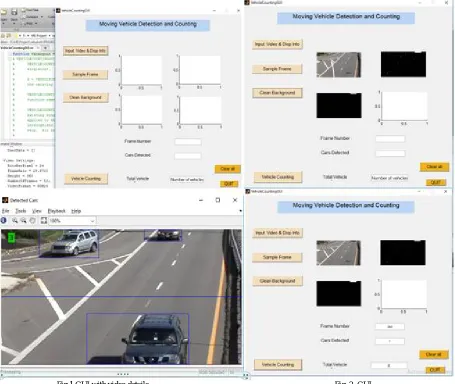
The Fig. 1 shows the video input data the width, height , number of frames etc data while an input of vide is given . Fig. 2 shows the futher capturing of segmented frames and detecting the foreground from background substraction followed by removal of unwanted disturbances as noise to get a clean foreground image. Fig. 3 shows the vehicle detection and tracking with a rectangular box to count to extract it as a moving vehicle and fig 4 shows the graphical user interface of system which include the total number of vehicles counted in the video data sets.
Fig.1.GUI with video details Fig. 2. GUI
V. CONCLUSION
Manual detection and counting of vehicle is a time-consuming process and subject to manual variations and errors.
We present a system called vehicle detection and tracking which is useful for tracking and counting of vehicles without more human interventions.
Vehicle counting will help students to gain experience and to develop more improved precise system in the Intelligent transport field and overcome the learning curve issue.
The aim of this project was to design and develop a system where students and other researchers could both benefit.
This improved system having better results and more precise.
Implemented an Detection and counting system with static code analysis
Accuracy: Existing – 87% Our System – 93% .
REFERENCES
[1] El-Keyi, A.; ElBatt, T.; Fan Bai; Saraydar, C., "MIMO VANETs: Research challenges and opportunities," Computing, Networking and
Communications (ICNC), 2012 International Conference on, vol., no., pp.670, 676, Jan. 30 2012-Feb. 2 2012.
[2] Hashmi, M.F.; , A.G., "Analysis and monitoring of a high density traffic flow at T-intersection using statistical computer vision based approach," Intelligent Systems Design andApplications (ISDA), 2012 12th International Conference on ,vol., no., pp.52,57, 27-29 Nov. 2012.
[3] Bin-Feng Lin; Yi-Ming Chan; Li-Chen Fu; Pei-Yung Hsiao; Li-An Chuang; Shin-Shinh Huang; Min-Fang Lo; "Integrating Appearance and
Edge Features for Sedan Vehicle Detection in the Blind-Spot Area," Intelligent Transportation Systems, IEEETransactions on , vol.13, no.2, pp.737,747, June 2012.
[4] Feris, R.S.; Siddiquie, B.; Petterson, J.; Yun Zhai; Datta, A.; Brown, L.M.; Pankanti, S., "Large-Scale Vehicle Detection,
Indexing, and Search in Urban Surveillance Videos," Multimedia, IEEE Transactions on , vol.14, no.1, pp.28,42, Feb. 2012.
[5] Soo Teoh and Thomas Bräunl, "A reliability point and Kalman filter-based vehicle tracking technique", Proceedings of the International Conference on Intelligent Systems (ICIS'2012), Penang, Malaysia, pp. 134-138, May 2012.
[6] D. Djamaluddin, T. Indrabulan, Andani, Indrabayu, and S. W. Sidehabi, “The simulation of vehicle counting system for traffic surveillance using Viola Jones method.” Makassar Int. Conf. Electr. Eng. Inform. MICEEI, pp. 130 – 135, 2014
[7] R. Y. Bakti, Indrabayu, and I. S. Areni, Cascade Classification for Car Detection”. SNATIKA, 2015. [Indonesian]
[8] Juan Zhicai,Wu Jianping, and McDonald Mike, “Socio-economic impact assessment of intelligent transport systems,” Tsinghua Science and
Technology, v 11, n 3, p 339-350, June 2006.
[9] Lai Lo Benny Ping, Sun Jie, and Velastin Sergio A., “Fusing visual and audio information in a distributed Intelligent surveillance system for
public transport systems,” Zidonghua Xuebao/Acta Automatica Sinica, v 29, n 3, p 393-407, May 2003.
[10] Mr. .Jyothi kiran ,K.S. Roy,” A Video Surveillance System for Speed Detection in Vehicles” International Journal of engineering Trends and Technology (IJETT) - Volume4Issue5- May 2013.
[11] Gholam ali rezai rad , Javad mohamadi” Vehicle Speed Estimation Based On The Image” 4 International Conference: Sciences of Electronic,