Energy Efficient Multipath Routing Protocol
based on Particle Swarm Optimization for
WSN
Roshni Jha1, Dr.Shivnath Ghosh2
M.Tech Scholar, Department of Computer Science and Engineering, MPCT, Gwalior, India1
Associate Professor, Department of Computer Science and Engineering, MPCT, Gwalior, India2
ABSTRACT: The energy constraint sensor nodes operate on limited batteries, so the energy consumption is a key
design criterion for the routing protocols in wireless sensor networks. Comparing with single path routing algorithm,
multi-path routing algorithm can balance the network energy distribution and extend the network lifetime better.In this
paper an energy efficient multipath routing protocol is proposed. The proposed algorithm is based on selection of energy efficient paths from multiple shortest distance path from source to destination. For selection particle swarm optimization algorithm is applied. The PSO algorithm selects energy efficient route among different shortest paths. The k-shortest route is selected on the basis of bandwidth and distance. The performance of the proposed algorithm is compared with multipath AODV routing protocol and concluded that PSO optimized energy efficient path is more efficient with respect to remaining energy of the network. The result is analyzed with variable number of packets send.
KEYWORDS: Wireless Sensor Network, Multipath Routing, Particle Swarm Optimization, Energy Efficiency.
I. INTRODUCTION
A significant challenging concern on designing system structures of ad hoc network applications is to design and develop an efficient routing protocol. When comes to wireless sensor networks (WSNs), special design requirements emerge due to themselves’ characteristic of large-scale and limited computational capabilities, power supply, and communication bandwidth[1].
Most of routing protocols stated above found a single path to transmit data. They aim at selecting an optimal path that bases on the metrics, such as the gradient information, the hops to the sink node, the nodes residual energy on the path, or the energy cost of the path. But in the applications of WSNs, using single path has some problems of reliability.
In recent years, multipath routing strategies have been suggested to improve the WSNs performance of fault tolerance, robustness, security, end-to-end delay and energy balancing. In these approaches, multiple paths can transmit the data in turn to keep the energy balance of the whole network. Multiple copies of the data can also be sent along different paths, allowing for resilience even if failure of a certain number of paths.
consume large sum of energy and every node needs to use excessive memories to keep the partial topology of the network. Furthermore, many paths discovered are actually meaningless due to their long delay and large cost [7,8]. In this paper, we propose an energy-efficient particle swarm optimal multipath routing protocol based on bandwidth requirement for wireless sensor networks.
II. PROPOSED METHODOLOGY
The proposed algorithm is focused for determining optimized route in multipath routing protocols. For this approach the proposed algorithm contributes to define multiple routes between a destination nodes and the source node by selecting a subset of all existing routes [9-11]. The route selection is dependent on node density and remaining energy of each nodes.
This section discusses about the working of proposed energy efficient bandwidth aware shortest path routing protocol for multipath routing in wireless sensor network. The proposed algorithm is based for choosing energy efficient shortest path. In routing algorithm, route that have shortest path among multipaths selected by particle swarm optimization algorithm.
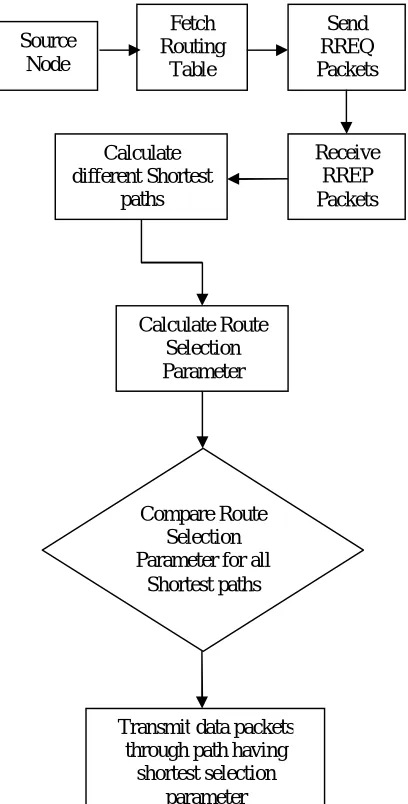
Among these shortest paths, that path is selected which require minimum route selection parameter.The flow chart of proposed algorithm is discussed below:
Steps of Proposed Algorithm
Step 1: Send RREQ from source node
Step 2: Receive route reply from neighbor nodes
Step 3: Establish different paths from source to destination
Step 4: Calculate shortest path based on distance and remaining energy of the nodes in the path using particle swarm optimization
Step 5: Select multiple shortest path from network
Step 6: Calculate route selection parameter of each node in the selected shortest path
Step7: Select one among different shortest paths whose selection parameter value is minimum.
Step 8: Forward Data packets
Figure 1: Proposed Algorithm Flow Chart
Particle swarm optimization based shortest path selection
Algorithm:
For every particle or jobs
Initialize jobs
end
Source Node
Fetch Routing
Table
Send RREQ Packets
Calculate Route Selection Parameter
Transmit data packets through path having
shortest selection parameter Compare Route
Selection Parameter for all
Shortest paths
Receive RREP Packets Calculate
Calculate fitness value
If the fitness value is greater than the best fitness value (pBest) in history
Then set current fitness value as the new pBest
End
Choose the job with the best fitness value of all the particles as the gBest
For each job
Calculate particle velocity
Update job position in queue
End
While maximum iterations or minimum error criteria is not attained.
In this proposed algorithm the best path is chosen according to fitness value which is according to the minimum distance to be travelled by a data up to base node as well as energy of the node.
Fitness Function
To find optimize path using PSO, need to find the fitness value of each path.
= ( , ) + ( )
+ ( )
(i)
This fitness value will be used to select the local best and global best for PSO. The path having minimum fitness value will be the best optimal solution.
Calculation of route selection parameter
For calculating the selection parameter Source Node, Destination Node Transmission Range and power loss acts as an input. The route selection parameter is estimated as below in equation:
= ( ) ( , )
∑ ( ) ( , )+
(ii)
Where, P(tx) = Transmission Power
d-α (i,j) = Distance between node i and j
σ = Power level of noise α = Path loss components
Depending on the distance between transmitter and receiver, multiple fade and free space channel patterns are used.
The free space model (loss of power d2) is mainly used for communication, while the power loss model d4 is used for
communication between clusters. The threshold distance is greater than or equal to d0. The radio energy consumed by
the transmitter to transmit a 1bit message at a distance d is:
The radio energy consumed by the transmitter to transmit a 1bit message at a distance d is:
( , ) = ( ) + ( , )
= + ,
And energy consumed by the receiver is:
( ) = ( ) = (iv)
Where,
Eelec = Per bit energy consumed to execute transmitter and receiver
Efs= amplifier energies for free space
Eamp = amplifier energies for multipath models
The Advantages of Proposed Approach are End to End Delay is less, Energy consumption is reduced due to fact that the routes that are discovered are very less. The algorithm takes route selection parameter based on power requirement and bandwidth requirement of the route to pick the forwarding nodes or forwarding link hence the throughput is high because the route chosen is bandwidth aware.
III. SIMULATION AND RESULT ANALYSIS
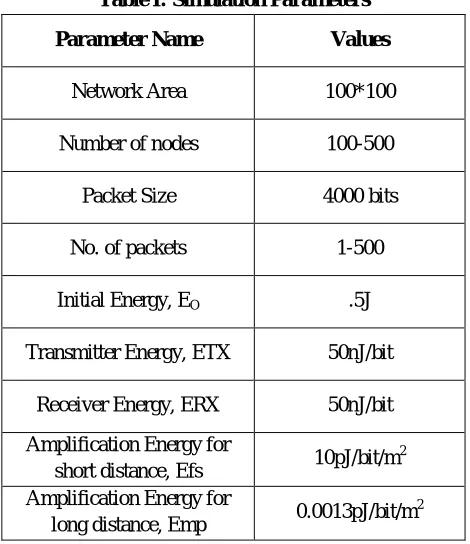
In this research work the MATLAB tool is used to simulate and verify the validity of PSO optimized multipath routing protocol. For simulation environment we have assumed WSN consisted of 100 sensor nodes and nodes are randomly distributed in the 100*100m area. The simulation parameters are given below in table I.
Table I: Simulation Parameters
Parameter Name Values
Network Area 100*100
Number of nodes 100-500
Packet Size 4000 bits
No. of packets 1-500
Initial Energy, EO .5J
Transmitter Energy, ETX 50nJ/bit
Receiver Energy, ERX 50nJ/bit
Amplification Energy for
short distance, Efs 10pJ/bit/m
2
Amplification Energy for
long distance, Emp 0.0013pJ/bit/m
2
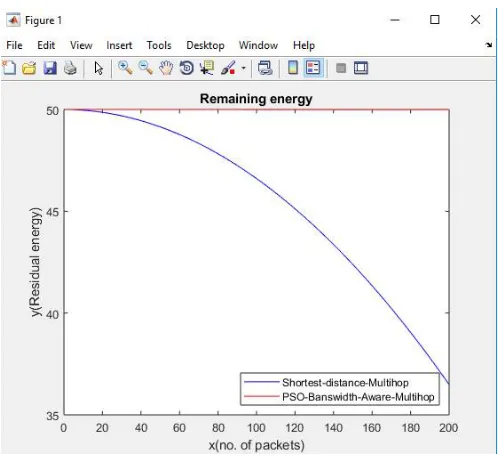
Figure 2: Residual Energy Analysis with 100 Packets
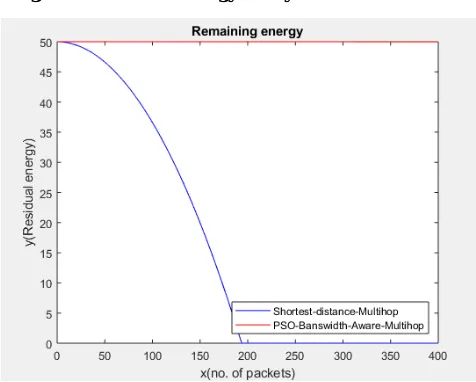
Figure 3: Residual Energy Analysis with 200 Packets
In figure 3, the result analysis is performed for 200 packets and it is concluded that PSO optimized multipath routing protocol outperforms better with respect to shortest multipath routing protocol.
Figure 4: Residual Energy Analysis with 300 Packets
Figure 5: Residual Energy Analysis with 400 Packets
Figure 6: Residual Energy Analysis with 500 Packets
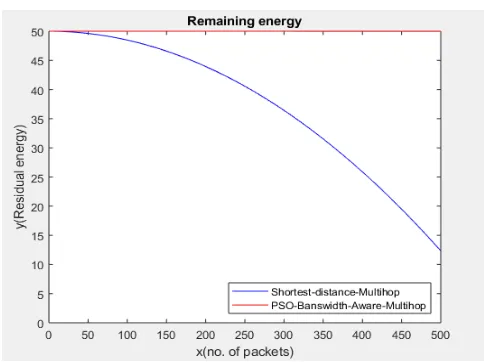
In figure 6, the result analysis is performed for 500 packets and it is concluded that PSO optimized multipath routing protocol outperforms better with respect to shortest multipath routing protocol.
IV. CONCLUSION
In this paper an energy efficient multipath routing algorithm is proposed. This algorithm is used to find optimum path among all shortest path discovered which utilizes the minimum energy of nodes and thus wireless network remains for long time span. The proposed algorithm uses distance as well as energy of nodes as a parameter to find optimum paths using particle swarm optimization. Among these selected paths, only one optimum path is selected which reduces the energy requirement of the network. The PSO algorithm selects energy efficient route among different shortest paths. The k-shortest route is selected on the basis of bandwidth and distance. The performance of the proposed algorithm is compared with multipath AODV routing protocol and concluded that PSO optimized energy efficient path is more efficient with respect to remaining energy of the network. In future work this concept would be implemented to find bandwidth aware multipath routing protocol.
REFERENCES
[1] Sung-Min Jung, Young-Ju Han, and Tai-Myoung Chung,“Theconcentric clustering scheme for efficient energyconsumption in thePEGASIS,” The 9th International Conference on AdvancedCommunication Technology, vol. 1, pp. 260-265, February 2007.
[2] M. D. Kwong, S. Cherkaoui, R. Lefebvre, “Multipledescription andmulti-path routing for robust voicetransmission over ad hoc networks,”IEEE International Conference on Wireless and Mobile Computing,June 2006, pp.262–267.
[3] G. Venkat Raju, T. B. Reddy, C. Siva Ram Murthy and T. BheemarjunaReddy, “On supporting real-time speech over ad hoc wireless networks,”14th IEEE International Conference on Networks, vol. 2, Sept. 2006, pp.1–6.
[4] Y. Charfi, N. Wakamiya, M. Murata, “Network-adaptiveimage andvideo transmission in camera-based wireless sensor networks,” FirstACM/IEEE International Conferenceon Distributed Smart Cameras,Sept. 2007, pp.336-343.
[5] D. Ganesan, R. Govindan, S. Shenker and D. Estrin, “Highly-resilient, energy-efficient multipath routing in wireless sensor networks,” Mobile Computing and Communications Review(MC2R), 2002.
[6] Wenjing Lou, Younggoo Kwon, “H-SPREAD: a hybrid multipath scheme for secure and reliable data collection in wireless sesnsor networks,” IEEE Transactions on Vehicular Technology, vol. 55, pp. 1320–1330, July 2006.
[7] Nisheeth Khanna and K Krishna NAik,” An Energy Efficient Path Routing Protocol Based on AODV Routing protocol for Mobile Ad hoc Network,” IJERT, Vol.4, Issue12, Dec-2015.
[8] Annapurna P Patil, B Varsha Chandan, S Aparna, R Greeshma, H P Akshatha, “An improved energy efficient AODV routing protocol for WSNs”, IEEE, 2014. [9] Mohammed Aashkaar, Purushottam Sharma, “Enhanced energy efficient AODV routing protocol for WSN”, IEEE, 2015.
[10] Abdelkader Laouida, AbdelnasserDahmani, AhcèneBounceur, Reinhardt Euler, Farid Lalem, Abdelkamel Tari, “A distributed multi-path routing algorithm to balance energy consumption in wireless sensor networks”, Elsevier, 2017.