- - )
Understanding the solution-diffusion mechanism in gas separation
membrane for engineering students
Ahmad
Fauzi
lsmailr'2
, Tutuk
Djoko
Kusworol
l, Azeman
Mustafal
2 and Hasrinah
Hasbullahr2
rMeInbrane Resedch Unit, Facultv ofChemical and Natural Resources Ergineer'ng' Universiri Teknologi Malavsia, 81310 UTMI Skudai, JohorBahru' Malavsia'
E-maili afauzi@uim mv
'Deoanmem ofGas [ngineering. Faculrv ofChemical and \arural Resources tngineering' L n i v e n i r i T e k n ; l o g i M a l a v s i a 8 l l l 0 ( T M S k u d a r ' J o h o r B a h r u M a l a v s i a
rPermanent Addressr Departmenr ofChenical Engineering, Diponegoto Universitv Semarang' tndonesia
An onpoins strusele for manv leclurcn is to motivate their students to leam and understand whal they leen il;;-;il ff U" po.ti"uturty unmotivated to learn mat€rials that alp€ar uninter€sling to then o' ""."i"i"d . trlei. own tite expelences
a career goals. Howder' €iucational
-dev-elopments are an ; ^ " " ' t " * " . " " * r " . * " " " d e n t s t o a d a p t t o t h e n e w a n d i n t e r e s r i n g p h e n o m e ' o n ' S o t h a t , t h € y c a n f u l l y ".i_",","ir,"1."r,"r""i r."akhroueh in ienain field thar leads to rhe commercial;zatior
ofcertain research "lia""o. U..tt-" technologv is one of the sucoessful
products or proc€sses that has been [...1ir^Ji.'
"* 'ixLure
separation Thrs process emplo]5 !he esrablished solurion-diftusinr mndel ; ; ; ; ; ; ; ; ; i ; t " " ; . ' ; a n s p o n ' o r $ s e s i n iorvmeric m e m b r a n e t n r h i s p a p e r ' - w e . d e n v e s i m p r e "i"""..""r.ei'""r
.q*,l"ns forrranspon ofgxes rn membrane based on the soludon-drffit\ion model Keyvota: Gds seParctiok, Sofutjon4if6io4 nodeL patvnet nebDtuhe
production fron air, hydrogen separatron 'n annonia plants and refineries, removal of carbon dioxide from natural gas. The separation of oxvgen from environrn€ntal air is one of the most another application of membrane technolosy [4]
Gas separaiion membranes are often packaged in hollow-fiber modules Houow fibe. meftb.me consists offibers instaued as abundle
'n a slainless st€el iube. Th€ shell side hollow fiber modul€ is shown in Figure I Two tvpes ofhollow fiber modules are used for gas separation applicarions. Shell-side feed moduies are generallv usld for high-pressure applications up io l'000 Dsis. Bore side feed modules are generallv used for medium-pressure feed streams uP to t50 psig, for which sood flow c-ontrol to minimize fouling ahd concentration polarizaiion on the feed side of the n€mbrane is desired I5l. Tte inside dd outside dian€rers of each fiber are 150 and 100 microneters, respectively [4-5] Tvpicallv' the
1. lntroduction
Gas separalion wilh polymer membmnc' is rapidly becoming a mainstream separa on technolo$ for indusrrial gas separarion [l'2l lr is one of thi mosl recenr advanced technologres and recognized as a viable and econom;cal unn oDeration. offering lower overall costs ol gas n6e$ins a5 compared ro rhe convenlional l e p a m r i o n r e c t n i q u e
fiber wall is approximately 75 microrneters thick with a very thin, dense separation membraDe layer of 500 io 1000 A (0.05 to 0.1 miorometers) thick, on th. outside ofthe fiber. Ideally, this thin layer provid€s all of ihe mass tmnsfer fesistance and separaiion ability of the hollow fiber' Th€ remairing 74.9 to 74.95 micrometers of the fiber wall are comprised of a porous polymer layer that provides mechanical support to the thin membmne, but otrers little or no mass transfer resistance (To put fiber dimensions in perspective, the diameter of a rypical human hair is about 100 micrometeN). Ga! (air in thh €xample) flows under pressure into the module, where it is disaibuted .o the bores of the fiberc. Th€ air gases permeaie through the wall of the fib€rs inio the shell of the hollow-fiber module, which is essentially maintained ar atmospheric pressure. Th€ gas permeating through the fibem and into the shell is collecied and leaves the module as the pe.meate stream Hollow fiber perm€alors have apProxinately three times as much afea per uDit volune as the spiral wound units [5]. Tav€ira e1 al (200t) r€porred that hollow fiber mEmbrane could pack larger quantities of membrane area into smau volumes. Hollow fiber nembranes have five major advantages over flat sheet membranes: (1) hollow fib€ts have a much larser ratio ofmembrane area to un;t volume (ratio as h:sh as 10,000 lrl'In'3) and hence highe. prcductiviiy per unit volume of m€mbrane module, (2) they are self-supporting with ease of nanufacrure and replacement, (3) they have good flexibility in operatio!, (4) hollow fiber modules do not requir€ cosrly membrane supports and (5) they are more danage resistant than other types modules t7l.
Figure l: Schematic diagram ofhollow fiber module used for air seParation
Th€ principle characteristic of m€nbranes that ls sliU useful in separaiion applications is the ability r o c o n n o l t h e p e r m e a r i o r o l d i l f e r e n t s p e c i e ' . I h i paper presents a brief baokground on the
lundamenral ol gas transpo( in polyme membranes. Later, we will discuss the models of mass transfer in gas separation nodules. The solution-ditrusion model rs used ro dercribe rhi.
2. Bsckground
Th€ solution-diffusion model is the nost sidely used rmnspon model for permealron ir pol),mer membrane. The model allows the membrane separation process of dialysis, reverse osmosis, gas separation and p€rvaporalion. The fundamental mechanism of gas tresport across a pol],rner membrane had be€n propos€d by Sir Thomas Graha$ more than a oentury ago [8"9]. Ihis mechanism model is known as the solurion-diffusion model in which perrnedts dissolve in the memhane materia' and then dilluse through ihe membrane down a concentration gradilnt. ^ separation is aohieved between difierent permeaots hecause of diffsences in the mount of mat€rial that dissolves in the membrane and the rate at whioh ihe mat€rial diftuses through ihe membrane. Therefore, the solution-diffusion nodel has postulat€d a tbree-step prooess for gas traLnsport lhrough a polym€r l) dissolution ofthe gas into the high-pressure (or high ohemical por€ndal) upstream face of the polymer, 2) diffusion of the gas rhrough the polymer, and 3) desorption liom the low-pressure (i.e., low chemical potential) downstream face ofthe polyn€r. Steps I and 3 ee very fast relative to step 2, so diffusion through the polymer is the raielimiting step iD nass transpori
3. Concentratron and pressure gradients in membranes
The perineability coefficient fof a particular component can therefore be described as the product of th€ solubility and diftusion co€fficienr. The basic concepi of a membrane separarion process is schemslically depicied il Figure 2. For a binary or multicomponenl gd mixture, th€ sepa$tion oan be achieved using a pollmer;c n€nbrane which exhibits different resisrance to the transport of various molecules. The ratio of permeability of the more permeable component to that of the less permeable through the membrane is knos,n as the seleciivity of the
)
'-,/ )
membrane. The resistance to molecular flo across a membrane is a func,ion of chemical and phlsical properties of the peneirant noleoul€s such a,s polariry, chemical afiinity with the membrune, mol€cular size and shape ofpenetrant
Figlre 2 The balic concepl of membrsne
The stariing Point for the mathEmatical description of permeation in all membranes h the proposition, solidly based in thermod)'namics that the driving forces of pressure, temperature' concentration and eiectromotive force are intenelated and the overall driving force producing movenent of a permeant is the gradient in its chemioal potential. The difusion is the prooess bv which a small molecule (organic liquids, vapours, eases. etc.) is transferred in the svstem due to imdom molecular motions.It is a kinetic r€rm thar reflects the p€netrani mobility in the pol)tner phase Consider a polymer membrane of thickness 1, of surface ,4 s bjected to a fluid and O is the total amount of pen€trant lhat has passed through this m e m b t u e a r L i m e r ' T h e d i m r s i v e fl u x o f a p€netrant mdlecule (4 is the quantity of penetrant crosses the polymer membrane during one unit of lime and area of penetrant molecule (r, is given by'
J = o/At (1)
T h e F i c k s f i r s r la w e s l a b l i s h e s a l i n e a r r e l a r i o n between ihe flux of sobstance diffusing through a membrane and the concentration gradient between both sides oflhe membrane:
J -D \dc /Ax) ( 2 )
where D h the diffusion coeffic;ent (crn'ls). This first law is applicable in the steadv state when the concentration does not vary with time and the fl x
is constant. On the other hand, Fick's second la* d$crib€s the nonsteady state for transpori process, which is given by the rare o' chanse of the
Denetnnt concenfranon \oc t (tx) at a ptane within lhe membrane, i.e.
te)="feLl
\ d l l \ d , ' )Thh is an ideal case in which the membrane is isonop;c and Lhe diffusion coePilcienr i' independent of distance, tine and cono€ntraiion. Dependins on the boundary conditions, many solutions are available from Eq. r1). Strong polymef penetrant intemction occuN w;th many organic p€netrant molecules. H€nce D is depending on conceniration. Therefore, Eq. (3) becomes,
AD@)(ac
/ ax)
(4)
( L \ = o
\ a t )
AnallticaUy, ihis cannot be solv€d easily and heoce anofter form ofEq. (4) is commonly used as in Eq (5),
/ dc ) ^. dc' dD1cl(dc\' .
l = l - r ( c ) ^ ; -
- : l - l ( 5 r
\ o t ) o x o c \ o x l c€nerally exper;ments are conducted ovel a relativ€ly sinall interval of c and the term (aD(cyac) is negligible oompared to rfc). Then we get a .nean or integral diftusion ooeffici€nt , ovff a ooncentration range c/ to cr, as given byD : I D(c)ddt.rc) ( 6 ) where c1 and c, is are the concent ations of penetrant at the low and high concentmtion fbces ofthe membrane, respectively. In the steady state condition, diffusion flo\t is constant and the diffrrsion coefiicient is independent of oo'cen-tration.ln this case Equation (2) may be inregrated to give
n t . -. \
J = " \ ' t - ) ) l l l
I
c = K C ( 8 )
where c is ihe sorbed concentration, C is the ambienr penermnr concennarion in coniacr wilh the pollmer surfdce and K depends on temDerature and c. In lhe cale of transport of gas€s dd vapours, pressLre p is used rnsread of surface concenrralon. According to Henry's law,
A similar expression oar be writte. for component B a t
P .
J , = 3 - l l l - x , ) p , - l t - y , ) p , l ( j 6 r
I '
4. Ana$1ical model
Th€ mole fiaction of gas ,4 on the permeak or downstrean side of (he memDrane t given by rhe flux of component ,{ through rhe membrane divides by the total gas flux the
( 1 7 )
|a^t, - nn,t
(rs)
lL',t, r^c;.|W-"^)p,-o
p,l
Equation 18 can be reorganized as follows pemit a direct calculation of permeate purity:in-"
wher€ S is the solubility coefficient. The combination of Eqs (6) and (8) g;v€s the well known p€|meation equation,
D S ( o , - o . \
J = - 0 0 )
I
where pr and p, ale the ambient pressures on two sides of a menbrane of thickness /. The product DS is called the pemeability coeftcientP, so that
P = D * S
( r r )
The diffusion coefici€nt D and solubility coefficient s are then oaloulated as
(r2)
0 3 )
where dis thetime las (seo) and / is the membrane thickness (cm). ln terms of permeability, the flux Eq. (10) can be written as
, P(p,- p,)
I
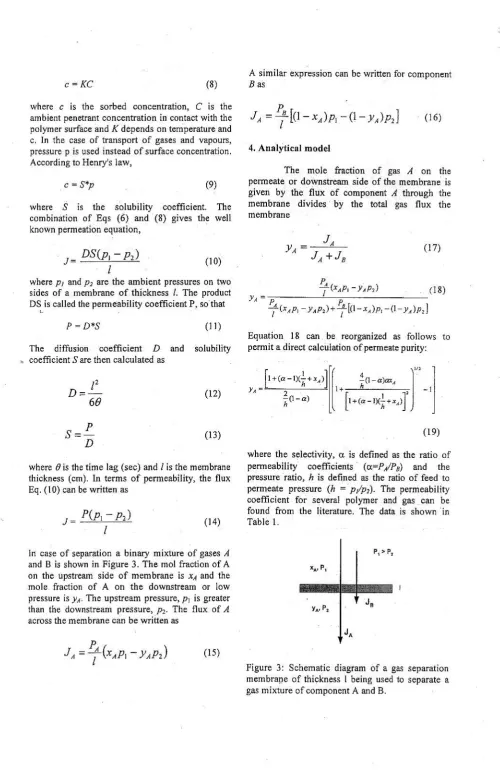
In case of separation a binary mixture of gases ,4 and B is shown in F'gure 3. The mol fraction ofA on the upsfi€am side of membrane is .r, and the mole liacdon of A on the downstream or low pressure is.i,,- The upstream pressure, pr is g.eater than the downstream pressur€, p,. The flux ofl across themembrane can be writt€n as
(e)
l
60
( 1 4 )
( r e )
whe.e the sel€ctivity, o is defined as th€ ratio of pemeability coeffici€nts (s=PrlPr) and the pr€ssure ratio, I' is defined as the ratio of feed to permeate pr€ssure (h = prh,).'the perrr.eabitiry coefficient for several polymer and gas can be found fion Lhe lirerarure. The dau is showr in Table 1
Figure 3: Schematic diagram of a ga! s€paration membrape of thickness I being used io s€parate a gas mixiure ofcomponent A and B.
-
P , ,
Polymer a o,r\l
Poly( 1 +rimethylsilYl- 1 . 6 Poly(dimethyl siloxane) 2 Polv(4-methvl-l Dentene)
Polvrrhenvlene oxid€)
Ethyl cellulose 3 . 4
6FDA-durene 3 . 8 4 5 . 8 6 . 8
5. f,ffect of pressure ratio, feed composition and membrrne selectivi8 on predicted peneate
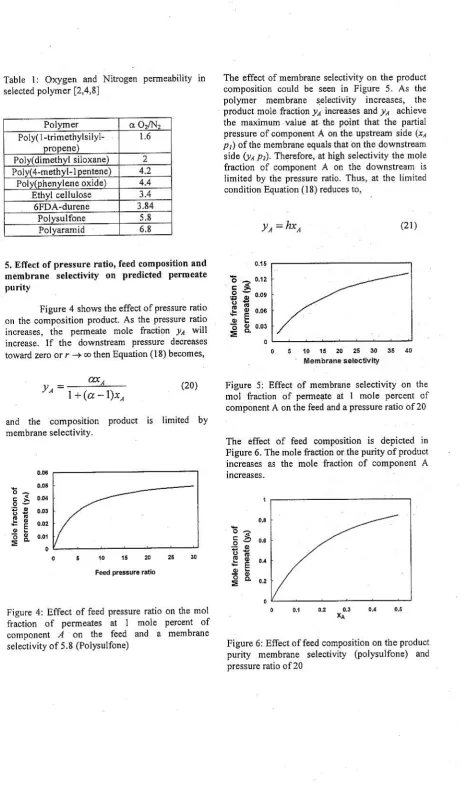
Figure 4 shows the effect of pressure ratid on the oomposition p.oduct. As the pt€ss$e ratio increases, the permeate mole fraction Jr, will increase. If the downstream pressure decreases toward zero or," -+ co then Equation (18) becones,
Table l: Oxygen and Nitrogen selecied polymer I2,4,81
oJ/
Y^=
t +(d -t)x,
and the composition Product membrane selectivity.
The effect ofnembrane selectivity on the product composition could be seen in Figure 5. As the polymer membrane sslectivity increases, the pmduct mole fraction y,{ increas€s and y, achieve lbe mdinum value ar the point that the parrial pressure ofoomponent A on the upstream side (r/ p') of the membrane equah that on the downstream
side (l/ pr. Ther€fore, at high selectivity the mole {racuon of componenr A on Ihe downslream is limiaed by th€ prcssure ratio. Thus, at lhe limited condition Equation (18) redlces .o,
penneability in
,, - 1"- (21)
Z -
t 1 r
.9 tr o.os
3 e ,*
6 I 0.03 E *
E e o r 8 { u
* E
= * r , (20)
is limited by
lvlenbrane 5.16ctlv19
Figu.e 5i Eff€ct of membrare selectivity on the mol fraction of permeate at I mole percent ol componentA on lhe feed and apressure ratio of20
The etrect of feed composirion is depifled in Iigure 6. The mole ftaction or the purity of producl i.creas€s as the mole fraction of component A
E g o . d '! P cu 5 _
l-igure 4: EtrecI of feed pressure rario on rhe m^1 naction of permealeq al I mole percenl of componenr I on lhe feed and a menbrane
selectivity of 5.8 (Poiysulfone) Figure 6: Effect offeed composition on the produci
6. Conclusion
Tbis paper has discussed on the apprication of polymer membnnes as separation agents. The 8as irdspon phenomenon can be described by solution-dilirsion model. The model can be assist student to understand th€ performance ofgas separation menbrare better.
Ill saufi, s.M and rsmail, A.F, ..Fabrication of carbon membranes for gas separation-a review," C ar ba n, 42, 2004, 241-259.
[2] Lin,w-H, Vora,R.H and chuns, T-S, "Gas transpori propenies of 6FDA-Durene/,."-phenylenediamine (pPDA) copolyimeds", Jaunal of polynet Science:partB: Polyuer physics 3,2000, 2703-27t3.
[3] Baker, R.w., "Membrane Technolosy and Applications", Mc Graw-Hill Book Co., New York, 2000
[4] Koros, w.J and Fleming, G.K., "Membran€ based sas separation", Journal of Menbnne Science 83,1993,1-80.
[5] Ho, w.s.w., and Sirkar, K.K., "Membrane Handbook. New York Chapma:n and Hall, 1992. [6] Taveira, P., Cruz, P., Mendes,A., Costa, C., md Magalhaes, F., "Consideration on the performance o i h o l l o u f i b e r m o d u l e w i t h g l a s s y p o l y m e r i c membftnes," Jounal of Menbrune Science, 188, 200), 263-277 .
[7] Stern, S.A. "Polymer for sas separations: the next decade" Jounal of Menbrune Science,94, 1 9 9 4 , 1 - 6 5 .
I8l wijmans, J.c., and Baker, R.w., "The solution-diffusion model:a te\iew" Jounal of Menbrune Scierce, 107, 1995, t-21.
[9] Pandey, P and chauhan R.S., "Mernbrare for gas separaiion", Progrcss Polyher Science, 26. 2 0 0 1 , 8 5 3 - 8 9 3 .
[]01 Moaddeb, M., and w.J. Koros. "Gas TransDon Properties of Thin Pollmeric Menbranes in the Pr€sence of Silicnn Dioxide Pafticles." Joumal of Memblane Science, 125