Detecting Capability Leaks in Android-based Smartphones
Michael Grace, Yajin Zhou, Zhi Wang, Xuxian Jiang
North Carolina State University
890 Oval Drive, Raleigh, NC 27695
{mcgrace, yajin_zhou, zhi_wang, xuxian_jiang}@ncsu.edu
ABSTRACT
Recent years have witnessed increased popularity and adoption of smartphones partially due to the functionalities and convenience of-fered to their users (e.g., the ability to run third-party applications). To manage the amount of access given to smartphone applications, Android provides a permission-based security model, which requires each application to explicitly request permissions before it can be in-stalled to run. In this paper, we systematically analyze eight flagship Android smartphones from leading manufacturers, including HTC, Motorola, and Samsung and found out that the stock phone images do not properly enforce the permission model. Several privileged permissions that protect the access to sensitive user data and danger-ous features on the phones are unsafely exposed to other applications which do not need to request them for the actual use, a security vi-olation termedcapability leakin this paper. To facilitate identifying these capability leaks, we take a static analysis approach and have accordingly developed a system called Woodpecker. Our results with eight phone images show that among13privileged permissions ex-amined so far, 11were leaked, with individual phones leaking up to eight permissions. By exploiting these leaked capabilities, an un-trusted application can manage to wipe out the user data, send out SMS messages (e.g., to premium numbers), record user conversation, or obtain user geo-locations on the affected phones – allwithoutthe need of asking for any permission.
1.
INTRODUCTION
Recent years have witnessed increased popularity and adoption of smartphones. According to data from IDC [22], smartphone manu-facturers shipped 100.9 million units in the fourth quarter of 2010, compared to 92.1 million units of PCs shipped worldwide. This is the first time in history that smartphones are outselling personal com-puters. The popularity is partially attributed to the incredible func-tionalities and convenience smartphones offered to end users. In fact, existing mobile phones are not simply devices for making phone calls and receiving SMS messages, but powerful communication and enter-tainment platforms for web surfing, social networking, location navi-gating, and online banking etc.
The smartphone popularity and adoption is also spurred by the pro-liferation of feature-rich devices as well as compelling mobile appli-cations (or simply apps). In particular, these mobile apps can be
read-Permission to make digital or hard copies of all or part of this work for personal or classroom use is granted without fee provided that copies are not made or distributed for profit or commercial advantage and that copies bear this notice and the full citation on the first page. To copy otherwise, to republish, to post on servers or to redistribute to lists, requires prior specific permission and/or a fee.
Copyright 20XX ACM X-XXXXX-XX-X/XX/XX ...$10.00.
ily accessed and downloaded to run on smartphones from variousapp stores[5]. For example, it has been reported [21] that Google’s An-droid Market already hosts 150,000 apps as of February, 2011 and the number of available apps has tripled in less than 9 months. More-over, not only official smartphone platform vendors such as Apple and Google are providing respective app stores to host hundreds of thousands of apps, but also third-party vendors including Amazon are competing in this market by providing separate channels for mobile users to browse and install apps.
Not surprisingly, mobile users are increasingly relying on smart-phones to store and handle personal data. Inside the phone, we can find current (or past) geo-location information about the user [7], phone call logs of placed and received calls, an address book with var-ious contact information, as well as cached emails and photos taken with the built-in camera. The type and the volume of information kept in the phone naturally lead to various concerns [16, 15, 25, 37] about the safety of this private information, including the way it is managed and accessed.
To mediate access to various personal information and manage cer-tain advanced phone functions, smartphone platform vendors have explored a number of approaches. For example, Apple uses a vet-ting process through which each third-party app must be scrutinized before it will be made available in the app store. Google defines a permission-based security model in its Android platform, which re-quires that any app, before installation, must explicitly request per-missions to access certain information and features. In other words, the requested permissions essentially define the capability the user may grant to an Android-based mobile app. By showing the re-quested permissions to the user before the app can be installed, this permission-based security model allows a user to gauge the app’s ca-pability and determine whether or not to install the app in the first place. Due to the central role of the permission-based security model in the Android design, it is critical that the security model is properly enforced in existing Android-based smartphones.
In this paper, we systematically study eight popular Android-based smartphones from leading manufacturers, including HTC, Motorola, and Samsung and are surprised to find out that these stock phone im-ages do not properly enforce the permission-based security model. Specifically, several privileged (or dangerous) permissions that pro-tect access to sensitive user data or features on the phones are unsafely exposed to other applications which do not need to request these per-missions for the actual use. For simplicity, we use the termcapability leakin this paper to represent the situation where an app can gain access to a permission without actually requesting it. Each such situ-ation essentially leads to a violsitu-ation of the permission-based security model in Android.
danger-ous permission from a public, unguarded interface. To better examine possible capability leaks, our system distinguishes two different cat-egories.Explicit capability leaksallow an app to successfully access certain permissions by exploiting some publicly-accessible interfaces or services without actually requesting these permissions by itself.
Implicit capability leakssimilarly allow an app to obtain unautho-rized permissions without requesting them. However, instead of ex-ploiting some public interfaces or services, such an app can acquire or “inherit” permissions from another app with the same signing key (presumably by the same author). Consequently, explicit leaks repre-sent serious security errors as they subvert the permission-based se-curity model Android uses to control access to dangerous features or sensitive data while implicit leaks could misrepresent the capabilities available to an app.
We have implemented a Woodpecker prototype to uncover both types of capability leaks in Android-based smartphones.1 Our
cur-rent prototype focuses on 13representative privileged permissions that protect sensitive user data (e.g., geo-location) or phone features (e.g., sensors like the camera or microphone, or the ability to send SMS messages). We have used our prototype to examine eight pop-ular Android phones: HTC Legend/EVO 4G/Wildfire S, Motorola Droid/Droid X, Samsung Epic 4G, and Google Nexus One/Nexus S. Our results show that among these13privileged permissions,11were explicitly leaked, with individual phones leaking up to eight permis-sions.2 In particular, by exploiting these leaked capabilities, an un-trusted app on these affected phones can manage to wipe out the user data on the phones, send out SMS messages (e.g., to premium numbers), record user conversation, or obtain user geo-locations – all
withoutasking for any permission.
The rest of this paper is organized as follows: Section 2 describes background information on the Android platform. Section 3 describes our system design for capability leak detection in Android phone im-ages. Section 4 presents its detailed prototype. Section 5 contains the evaluation results from our study of eight Android-based smart-phones from leading manufacturers. Section 6 discusses the limita-tions of our approach and suggests avenues for future improvement. Finally, Section 7 describes related work, and Section 8 summarizes our conclusions.
2.
BACKGROUND
In this section, we briefly review key concepts and background about Android, which are essential to our system but may be unfa-miliar to some readers. Readers with sufficient background can safely skip this section.
Android [1] is an open source mobile phone platform developed by Google. It is based on Linux but contains its own runtime. Associated with the runtime, Android provides an application framework that contains a wide variety of application programming interfaces (APIs) to facilitate the software development. The framework and third-party apps are mainly written in an Android-specific dialect of Java while some performance-critical parts could be in C.
Each Android app is running inside a Dalvik [6] virtual machine (VM), which is instantiated as a user-level process in Linux. Different apps are running in different Dalvik VMs, isolated from each other.
1
The reason why we chose to implement Woodpecker in Android is due to its open-source nature and wide adoption. However, the same need for possible capability leak detection exists and similar design principles are applicable for other smartphones (e.g., from Apple).
2Since last month (April, 2011), we have been in the process of
re-porting the discovered capability leaks to the corresponding vendors. So far, Motorola and Google have confirmed all discovered vulner-abilities related to their phones. Meanwhile, we experienced some difficulties with HTC and Samsung. Our experience is similar to others [8], echoing “the seven deadly sins of security vulnerability reporting.”[30]
Protection level Description
normal Low-risk permissions granted to any
package requesting them
dangerous Higher-risk permissions that require user
confirmation to grant
signature Only packages with the same author can
request the permission
signatureOrSystem Both packages with the same author and
packages installed in the/system/ di-rectory tree can request the permission
Table 1: Permission Protection Levels in Android
The Dalvik VM is derived from Java but has been significantly revised (with its own machine opcode and semantics) to meet the resource constraints of mobile phones. Also, when an app is being installed in Android, a unique user identifier (UID) will be assigned to the app. To facilitate sharing information between apps, Android allows multiple apps to share the same UID if the apps are signed with the same developer certificate. As a result, Android relies on the Linux process boundary and this app-specific UID assignment strategy to achieve isolation, preventing a misbehaving or malicious app from disrupting other apps or accessing other apps’ files.
Where a regular Linux program only has a single entry point, an Android app can contain multiple entry points. Specifically, each app is composed of one or more different components, each of which can be independently invoked. There are four types of components: activ-ities,services,broadcast receiversandcontent providers. An activity represents part of the visible user interface of an app. A service, much like a Unix daemon, runs in the background for an indefinite period of time. A broadcast receiver, as the name indicates, is a component that does nothing but receive and react to broadcast announcements. A content provider makes a specific set of the app’s data available to other apps.
Each Android app is deployed in the form of a compressed package (apk). Eachapkcontains a manifest file (AndroidManifest.xml) that
describes various standard properties about the app, such as its name, the entry points (or interfaces) it exposes to the rest of the system, and the permissions it needs to perform privileged actions. It can also contain an optionalsharedUserIdattribute, which allows two apps
if signed with the same developer certificate to share the same UID. Naturally, an Android package will also contain Dalvik bytecode, na-tive code, or both; most presently contain only Dalvik bytecode.
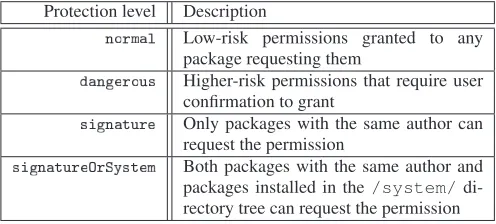
As mentioned earlier, Android defines a permission-based secu-rity model [4]. In this model, the principals that have these per-missions are apps, not users. Android retains the Linux concepts of user identifier and group identifier, but assigns these identifiers to in-stalled apps rather than users, as only one user is expected to use an Android device. There is a stock set of permissions defined by the Android framework, but developers are free to define additional per-missions as they see fit. Each permission has a protection level [3], which determines how “dangerous” the permission is and what other apps may request. Table 1 summarizes the defined protection lev-els in Android. Note that manufacturers and carriers often customize the Android system to add differentiating features to their products. In that context, thesignatureandsignatureOrSystem permission
protection levels are reserved to define capabilities that only vendor-written software should have access to. Permissions are checked ei-ther through annotating entry points defined in the manifest file or programmatically by the Android framework.
Pre−loaded Apps
Possible Path Identification Capability Leak Report Other System Images
Infeasible Path Pruning
Android Framework APIs
(e.g., framework.dex)
Figure 1: An Overview of Woodpecker
has taken place. In publish-subscribe fashion, Binder routes Intents through the system; during this routing process, it checks any permis-sion annotations, refusing to route Intents from unprivileged senders – or, in some cases, to unprivileged receivers. When an app is contacted via an Intent, one of the defined entry points gets an encapsulated ob-ject with information about the Intent content and its sender; it is the permission information carried by this object that can be checked by code running within the receiver.
3.
SYSTEM DESIGN
Our goal is to identifycapability leaks, i.e., situations where an app can gain access to a permission without actually requesting the permission (in its manifest file). Each such situation essentially leads to a violation from the permission-based security model in Android. Since there are some privileged permissions that may not be granted to a third-party user app, we in this work choose to focus on those per-missions used by the pre-loaded apps as a part of an Android phone firmware. For simplicity, the terms “permissions,” “capabilities,” as well as their representative APIs in the Android framework for per-mission checking are used interchangeably.
Figure 1 shows the high-level overview of our system. Based on the nature of two different kinds of capability leaks (i.e., either ex-plicit or imex-plicit), the system performs two complementary sets of analysis. Specifically, to expose explicit leaks of a capability, our system first locates those (pre-loaded) apps in the phone that have the capability. For each such app, our system further identifies whether a public interface is exposed that can be used to gain access to the capability. (The public interface is essentially the entry point defined in the app’s manifest file, i.e.,activity,service,receiver, andcontent provider.) In other words, starting from the public interface, there ex-ists an execution path that can reach some use of the capability. If the public interface is not guarded or the execution path does not have a sanity checking mechanism in place to prevent it from being invoked by another unrelated app, we consider the capability leaked. Our sys-tem then reports such leaks and further provides evidence that can be used to fashion input to exercise the leaked capability. This evidence includes the value of any variables needed to take the discovered path to the exposed capability, as well as the provenance of any arguments that are passed to it, which can be used to construct a concrete attack. On the other hand, implicit capability leaks arise from an optional attribute in the manifest file, i.e., “sharedUserId.” This attribute, if
set, causes multiple apps signed by the same developer certificate to share a user identifier. As permissions are granted to user identifiers, this causes all the apps sharing the same identifier to be granted the
unionof all the permissions requested by each app. To detect such leaks in an app that shares a user identifier, our system reports the exercise of an unrequested capability, which suspiciously has been requested by another app by the same author. We stress that an im-plicit leak requires a certain combination of apps to be installed: an app seeking to gain unauthorized capabilities can only do so if another app, with the same shared user identifier and signing key, is installed to grant the additional permission. In the context of the pre-loaded apps on the phone, we can identify whether such a colluding app ex-ists. However, due to the fact that we cannot rule out the possibility of a colluding app being installed at a later time, its mere absence does
not indicate such implicit leak is “safe” or may not occur later.
Assumptions In this work, we consider the scenario where a smartphone user will install an third-party app on the phone, and the author of the third-party app has necessary knowledge of the phone’s system image. Moreover, the app aims to maliciously perform some high-privilege activities (e.g., wiping out the user data on the phone or recording the user conversation), whose APIs are protected by per-mission checks. To do that, the attacker chooses to not request the required permissions to elude detection or these permissions cannot be granted to third-party apps. (Examples include those permissions defined assignatureorsignatureOrSystem– Section 2).
Meanwhile, we limit the scope of the attacker’s abilities by assum-ing that the underlyassum-ing Linux kernel and Binder IPC framework are trusted. Also, we assume that the signing keys to the system image are not available to the attacker. Given these constraints, a malicious app will not be able to directly access the high-privilege APIs. However, as many pre-loaded apps in the system image have the corresponding permissions, if the malicious app can cause one of these apps to in-voke the desired API on its behalf, it will have gained actual access to the capability it represents.
3.1
Explicit Capability Leak Detection
As discussed earlier, explicit leaks of a particular capability may occur in any app that has requested it in its manifest file. To de-tect these leaks, our system analyzes each such app in two steps. The first step, possible-path identification(Section 3.1.1), builds a control-flow graph to identify all the possible paths within the pro-gram from a well-defined entry point (in the manifest file) to some use of the capability. After identifying these possible paths, the sec-ond step,feasible path refinement(Section 3.1.2), employs field- and path-sensitive inter-procedural data flow analysis to determine which of these paths are feasible.
3.1.1
Possible Path Identification
Give an app under inspection, our system first extracts the Dalvik bytecode from the app, and then builds a control-flow graph (CFG) to locate all possible paths of execution. Though the CFG construction is a well-studied topic, there are several aspects that are unique in Android and unfortunately make the CFG construction complicated.
The first one comes from indirect control-flow transfer instructions in Dalvik. The Dalvik bytecode targets a hypothetical machine archi-tecture, which does not support most forms of indirect control-flow transfer. In fact, the only indirect transfers in Dalvik’s machine lan-guage are due to the Java equivalent of pointers: object references. However, object references are rather commonly passed as arguments within an app method, and due to inheritance it is often not possible to unambiguously determine what concrete class a reference represents. Further, as we are analyzing the bytecode, object references will nat-urally involve type resolution of related objects. In our current proto-type, we take a conservative approach. Specifically, when analyzing the Dalvik bytecode for an app, our system maintains a comprehen-sive class hierarchy. When an ambiguous reference is encountered, we consider all possible assignable classes. This is a straightforward approach, but one that will not introduce any false negatives.3
3
integrat-OS Scheduler Entry Point
Thread.start() Thread.run()
Dangerous Method
Figure 2: A discontinuity in the control flow introduced by the Android framework.
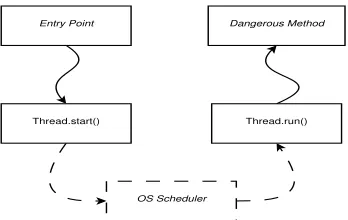
The second one arises from the event-driven nature in executing an Android-based app, which is also reflected in the app structure. In particular, due to the large number of callbacks used by the An-droid framework, app execution often passes through the framework to emerge elsewhere in the app. For a concrete example, consider thejava.lang.Threadclass. This class is used to implement native
threads, which Android uses in abundance to achieve better UI re-sponsiveness. A developer can simply extend this class, implement the run() method, and then call thestart() method to schedule
the thread. However, if we analyze only the code contained within the app, therun() method does not appear to be reachable (from
start()), despite the fact that after the start() method is called,
control flow goes through the Dalvik VM to the underlying thread scheduler and eventually to therun()method. In other words,
An-droid’s event-driven nature will unavoidably cause some discontinu-ity in the CFG construction if we only focus on analyzing the app code (Figure 2). Fortunately, beyond CFG construction, this interven-ing framework code is of no particular value to our analysis, and its behavior is well-defined in the Android framework APIs. Therefore, we leverage these well-defined semantics to link these two methods directly in the control flow graph, resolving the discontinuity in the process. We have applied this strategy to a number of other callbacks, such as those for AndroidMessagequeues, timers, and GPS position
updates. Some unrelated callbacks may also be safe to ignore. For example, our current prototype does not consider Android UI-related callbacks as they require the user’s intervention, which could expose and block the attack.
The third one is that an Android-based app does not necessarily have only one entry point. Instead, rather than a traditional “main method” of some kind, an Android app contains one or more compo-nents defined in its manifest file. Each component can potentially de-fine multiple entry points accessible through the Binder IPC mecha-nism. To take these factors into account, our prototype iterates through each entry point defined in the manifest file to build the CFG (by es-sentially treating it as a separate program). For each resulting CFG, we can then locate possible paths, each indicating the reachability from a known entry point to a point that exercises a specific permis-sion of interest.
3.1.2
Feasible Path Refinement
The previous step produces control-flow graphs which may repre-sent a tremendous number of potential paths. Among these possible paths, not all of them lead to a dangerous call that exercises the per-mission of interest, and of those that do, not all are feasible. There-fore, we employ inter-procedural data flow analysis to find paths that are both feasible and result in a dangerous call.
Specifically, we use symbolic path simulation, a path-sensitive data flow analysis technique. The underlying intuition behind this strategy is that a path of program execution can be modeled as a set of program
ing the latest developments in scalable, comprehensive points-to anal-ysis (Section 6).
Algorithm 1: Capability leak detection
Input: entry points, known method summaries
Output: a set of capability leaks
foreachentry point∈entry pointsdo
worklist=initial state: start of the entry point states=initial state
summaries=known method summaries
foreachstate∈worklistdo
removestatefromworklist
ifstate’s instruction is a method callthen ifa summary does not exist for the targetthen
summarize(target,summaries);
end end
worklist+ =δ(state)−states states+ =δ(state)
end
ifa dangerous-call state is flaggedthen
report the state as a capability leak
end end
states, each dependent on the last. In order for this set of states to be feasible, each program point (instruction) must follow from the pre-ceding ones. Similar to other data flow analysis techniques, symbolic path simulation implements an iterative algorithm that converges on a fix-point. At each program point, the set of input states are fed through a transfer function (representing the operation performed by that instruction) to produce a set of output states. However, before these output states are used as input states for that program point’s successors, we verify that their constraints are consistent. In this way, infeasible paths are not fed forward through the analysis.
Algorithm 1 summarizes our infeasible path reduction. In essence, it is a field- and path-sensitive symbolic simulation algorithm that considers multiple similar concrete paths through a program at once, while condensing methods into parameterized summaries relating their inputs to their outputs. Each state in the analysis encodes the value of data fields with constraints, allowing some similar states to be joined with one another. Particularly, the algorithm operates in the standard fashion for data flow analysis: a worklist is maintained of actively-considered states, and a transfer function (δ) is used to generate new
states from a given state. Only new states are added to the worklist, so eventually the algorithm converges on a solution that represents all the feasible states reachable from a given entry point.
Our algorithm has also been enhanced with several optimizations. For example, we accelerate the process by using method summaries to avoid recursively considering the same method-call chains multiple times. To save space,joining(rather than simply adding) new states to the worklist and visited-state list make the algorithm scale better both in terms of time and memory. Its actual implementation is cognizant of the value constraints placed on each memory item, and tries to merge very similar states where possible. As an example, if two states are joined that only differ by whether a boolean value is true or false, the resulting state will simply remove any constraint on the boolean value. In this way, fewer states need to be remembered, and fewer successors must be calculated using the transfer functionδ.
app. Due to the fact that the entry points in an app can be invoked in any sequence, we opt to take a conservative approach. Specifically, we do not attempt to model this initially-executed code, since any field initializations made in it could have been overridden by another exposed interface. As a result, our algorithm begins by assuming that a field might contain any assignable value. As that field is used along a path of execution, the list of possible values shrinks each time it is used in a way that renders some candidate values impossible.
When reducing infeasible paths, we also face the same type infer-ence problem experiinfer-enced in the first step. Fortunately, the set of inferences built up by symbolic path simulation naturally mitigates the path explosion caused by our first step. Specifically, object in-stances can be tracked during the path simulation, and some paths will become infeasible after the system first “guesses” at the object’s type somewhere along a path. In addition, certain Dalvik bytecode, especially type-carrying instructions, also help. For instance, the
hek-ast opcode establishes that its operand can be assigned to
the supplied type, or an exception is thrown.
In addition, the execution of the algorithm in our case also involves handling Android framework APIs or methods that do not belong to the app. Specifically, the app under inspection may invoke certain APIs that are exported by the Android framework. In our algorithm, the transfer function for a method invocation opcode is amethod sum-mary, which essentially phrases the method’s outputs in terms of its inputs. Without statically analyzing the code for an external method – and all of its dependencies – we cannot build such a summary. Yet analyzing the entire Android framework would easily lead to state explosion and place an enormous burden on our algorithm. To solve this dilemma, we again leverage the well-defined API semantics of the Android framework. Specifically, it contains a remarkably robust set of predefined libraries, which reduces the need for developers to pull in third-party libraries to support their code. By summarizing these built-in classes ahead of time, we can avoid paying the time, space, and complexity costs associated with doing so each time dur-ing application analysis. In our prototype, we found that this approach allows us to phrase some functions more succinctly than the algorithm would, as we can trim out unimportant details from the summaries.
During this infeasible path pruning step, we also need to account for explicit permission checks within the identified path. An app might allow any caller to invoke its entry points, yet deny unprivi-leged callers access to dangerous functionality by explicitly checking the caller’s credentials before any dangerous invocations. Such an ar-rangement would not constitute a capability leak, and so should not be reported. A naïve solution would be to mark any path encoun-tering an interesting permission check as infeasible. However, our approach does not know what kind of dangerous call lies at the end of the path beforehand. Allowing unrelated permission checks to mark whole paths as infeasible would therefore introduce false negatives. Instead, we model the permission system within our artificial method summaries. Explicit permission checks set a flag along their “true” branch; if that path of execution later encounters a corresponding dan-gerous call, it is not reported as a capability leak.
A side benefit of performing this kind of analysis is that it mod-els all data flow assignments, not just those relating to branch con-ditions. As a result, we can trace the provenance of any arguments to the dangerous method. With such information, we can character-ize the severity of the capability leak. A capability leak that directly passes through arguments from the external caller is obviously worse than one that only allows invocation with constant values, and this design can distinguish between the two. Given that path feasibility is undecidable, our design errs on the side of caution: it will not claim a feasible path is infeasible, but might claim the reverse is true. As a result, this argument information is valuable, as it can be used to generate a concrete test case that verifies the presence of the detected capability leak.
3.2
Implicit Capability Leak Detection
In explicit capability leak detection, we focus on those apps that request permissions of interest in their manifest file. If an app has asharedUserIdin its manifest but doesnotrequest a certain
(dan-gerous) permission, we also need to investigate the possibility of an implicit leak.
To detect implicit capability leaks, we employ much the same al-gorithm as for explicit leaks. However, some of the inputs to that algorithm must be changed to reflect a basic difference in focus: ex-plicit capability leak detection assumes the caller of an app’s exposed API is malicious, while implicit capability leak detection assumes the app itself might be malicious. Accordingly, instead of only starting from the well-defined entry points in the explicit leak detection, we also need to broaden our search to include the app’s initialization.
However, modelling the initialization process in an Android app is somewhat complicated. Specifically, there are two kinds of con-structors to handle:Instanceconstructors are explicitly invoked in the Dalvik bytecode (with thenew-instanebytecode operation);Class
constructors –statiinitialization blocks – are implicitly invoked
the first time a class is used. Accordingly, instance constructors are relatively straightforward to handle as they need to be explicitly in-voked. However, class constructors are more complicated. In partic-ular, a class constructor may be invoked in a number of scenarios: it is instantiated with thenewkeyword, astatimember of the class is
referenced, or one of its subclasses is likewise initialized. This means that this type of initialization can occur in a variety of orders. In our prototype, we treat all of the relevant instructions as branches, and take into account the class loading order to determine the path fea-sibility. Also, in our system, we consider a capability to have been implicitly leaked if there isanyway to exercise it, which is differ-ent from explicit capability leak detection. (This has implications in changing method summaries used for pruning infeasible paths – Sec-tion 3.1.2.)
Finally, once we have identified that an implicit capability leak ex-ists, we can perform an additional step to determine whether that leak may actually be exercised. In the context of a phone’s system image, we can determine the runtime permissions granted to each shared user identifier by crawling the manifest files of all the packages in the im-age. We union the permissions granted to each application with a given shared user identifier, which yields the set of permissions given to each of them. We report any implicitly leaked permissions con-tained within that set.
4.
IMPLEMENTATION
We have implemented a Woodpecker prototype that consists of a mixture of Java code, shell scripts and Python scripts. Specifi-cally, our static analysis code was developed from the open-source
baksmalidisassembler tool (1.2.6). As discussed in Section 3, our
static analysis approach is rather standard. In the following, we mainly focus on the peculiarities of the Android platform as well as the devi-ations they cause from standard practice.
4.1
Dalvik Bytecode & Manifest Extraction
To detect possible capability leaks in an Android phone, our system first leverages the Android Debug Bridge (adb) tool [2] to obtain
ac-cess the phone’s system image, mainly those files in the/system/app
and/system/frameworkdirectories. These directories contain all of
the pre-installed apps on the device, as well as any dependencies they need to run.
After obtaining the phone image, we then enumerate all pre-installed apps. For each app, our system decompresses the related Android package (apk) file to extract its manifest file (AndroidManifest.xml),
which is then paired with the app’s bytecode (eitherlasses.dexor
all the pre-installed apps and disassemble them to extract their byte-code for subsequent analysis. Based on the number of apps installed on the device as well as the complexity or functionality implemented in these apps, this process typically takes on the order of ten minutes per smartphone image.
Based on the extracted app manifest, we further comb through it for two things: requests for any permissions of interest and the op-tionalsharedUserIdattribute. Apps that are granted related
permis-sions are checked for explicit capability leaks, while those with the
sharedUserIdattribute set are checked for implicit capability leaks.
Naturally, we also compute the actual set of permissions granted to each pre-loaded app by combining all the permission requests made with the samesharedUserId.
4.2
Generic Control-Flow Graph Construction
Among all the pre-loaded apps on the phone device, we iterate through each app to detect possible capability leaks. As there are tens of dangerous permissions defined in the Android framework, instead of building a specific control-flow graph (CFG) for each permission, we choose to first build a generic CFG to assist our static analysis.
Specifically, we start from each entry point and build the CFG. The generic CFG will be the union of those CFGs from the defined en-try points. There is a subtlety between components defined in the manifest file and the actual entry points for CFG construction. In particular, some entry points are standard and can be readily deter-mined by the type of components contained within the app. There are in total four types, and each has a predefined interface to the rest of the system. For instance, any “receiver” defined in the man-ifest file must subclass android.ontent.BroadastReeiver. In
such cases, inspecting the class hierarchy allows to determine that the “onReeive(Context, Intent)” method is an entry point (as per
the specification).
Moreover, among these four types, three of them solely take data objects as inputs through their entry points, but services can be differ-ent. In particular, Android defines a CORBA-like binding language, the Android Interface Definition Language (AIDL), which allows ser-vices to expose arbitrary methods to other apps.aidlfiles are used at
compile-time to manufacture Binder stubs and skeletons that encap-sulate the necessary IPC functionality. At run-time, the component’s
onBind(Intent)method is called by the system, which returns an android.os.Binderobject. The methods contained within this
ob-ject are then exported to callers that have a compatible skeleton class. Since we only analyze the bytecode and do not have access to the originalaidlfiles used to define the interface, there is a need to
fur-ther parse and infer the internal structure of theBinderobject. Each
such object contains anonTransat()method that is passed a
par-cel of data that encodes which method to call. We can then treat this method as an entry point in order to build our CFG. However, once the graph has been built, it is more semantically accurate to treat the embedded method calls inonTransat()as entry points for the
pur-poses of our feasible path refinement stage.
From another perspective, Android-based apps essentially expose a set of callbacks to the system instead of a single “main method.” Our system leverages the knowledge of how these callbacks are de-fined in Android to identify them. In addition, the Android framework defines many other callbacks at run-time, which will similarly cause discontinuities in the CFG generation. One example is the previous
Thread.start()->run()scenario. In our prototype, instead of
stati-cally analyzing the entire Android framework, we opt to use knowl-edge of the framework’s semantics to connect the registration of a callback to the callback itself. To automate this process, we pro-vide a boilerplate file that represents knowledge about the framework. This file contains simplified definitions for any explicitly-modelled method in the framework, written in thedexformat; it is fed into our
system alongside the app’s code to facilitate CFG construction.
Permission Capability
ACCESS_COARSE_LOCATION Access coarse location (e.g., WiFi) ACCESS_FINE_LOCATION Access fine location (e.g., GPS)
CALL_PHONE Initiate a phone call (without popping up an UI for confirmation.)
CALL_PRIVILEGED Similar to CALL_PHONE, but can dial emer-gency phone numbers (e.g., 911)
CAMERA Access the camera device DELETE_PACKAGES Delete existing apps INSTALL_PACKAGES Install new apps
MASTER_CLEAR Remove user data with a factory reset READ_PHONE_STATE Read phone-identifying info. (e.g., IMEI)
REBOOT Reboot the device
RECORD_AUDIO Access microphones
SEND_SMS Send SMS messages
SHUTDOWN Power off the device
Table 2:13Representative Permissions (For brevity, we omit the
android.permission.prefix in each permission)
4.3
Capability Leak Detection
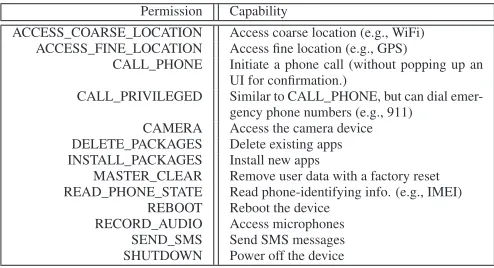
With the generic CFG and the set of entry points, we then aim to identify possible execution paths from one of the entry points to some use of an Android API that exercises a permission of interest. If the path is not protected by the appropriate permission checks and its en-try point is publicly accessible, an explicit capability leak is detected. Due to the large number of sensitive permissions defined in the An-droid framework, our study chooses thirteen representative permis-sions markeddangerous,signatureorsignatureOrSystem. These
permissions are summarized in Table 2 and were chosen based on their potential for abuse or damage.
For each chosen permission, our first step is to identify the list of related Android APIs that might exercise the permission. How-ever, such a list is not easy to come by. In fact, we found out that though Android’s permission-based security model might be com-prehensive enough in specifying the permissions required to access sensitive data or features, the available API documentation is incom-plete about which APIs a permission grants access to. Specifically, when dealing with various apps in the system image, we encountered numerous permissions not meant for general consumption – and that therefore do not even have formally specified APIs. One example is “android.permission.MASTER_CLEAR,” which allows an app to
per-form a factory reset of the smartphone. This permission is marked as
signatureOrSystem, so only apps included in the system image can
request it; it is intended to be implemented by the vendor and only used by the vendor, so none of the APIs listed in the API documenta-tion check this permission.
For each related permission and the associated Android APIs, our next step then reduces the generic CFG to a permission-specific CFG. Within the reduced CFG, we can then apply the Algorithm 1 to locate possible execution paths from an entry point to the associated An-droid APIs. For each identified path, we further look for the presence of certain permission checks. Our experience indicates that some per-mission checks are already defined in the manifest file (and thus au-tomatically enforced by the Android framework). However, many others will explicitly check their caller’s permissions. In our pro-totype, we resort to the Android Open Source Project (AOSP) to find explicit permission checks in the framework. There are also some cases that do not fall under the AOSP. For them we have to applybaksmalito representative phone images and then manually
examine each explicit permission check. Using the previous example of “android.permission.MASTER_CLEAR,” Android provides an
inter-face,android.os.IChekinServie, which declares themasterClear()
method. The Samsung Epic 4G’s factory reset implementation con-tains a class namedom.android.server.FallbakChekinServie.
This class implements this Android interface, whosemasterClear()
method explicitly checks the “android.permission.MASTER_CLEAR”
To facilitate our static analysis, our prototype also includes a fic-titiousdangerous class that has many static permission-associated
member fields. Each identified Android API call, if present in an execution path being analyzed, will update the member field related to the associated permission. As a result, we can detect dangerous calls by simply listing the related member fields in this class.
To model the impact a caller’s permissions have on whether a dan-gerous call can succeed, we use another fictitiouspermissionclass.
This class contains a number of member fields and an artificial method definition forContext.hekCallingPermission(). This method sets
these member fields dependent upon the permission it is called with. In other words, each member field flags whether a path of execution has checked a particular permission. During an explicit capability leak analysis run, we only consider a capability to have been leaked if a state exists that contains a dangerous-call field modification (in
dangerous) and does not have the corresponding permission-check
flag set (inpermission). Implicit capability leak analysis does not
need to be concerned about the value of the permission-check flags. Instead, it is sufficient to have a dangerous call field modification (in
dangerous).
5.
EVALUATION
In this section, we present the evaluation results of applying Wood-pecker to eight smartphones from four vendors, including several flagship phones billed as having significant additional bundled func-tionality on top of the standard Android platform. We first describe our methodology and tabulate our results in Section 5.1. In Sec-tion 5.2, we present three case studies: two explicit leaks and one implicit leak. Lastly, Section 5.3 consists of a performance measure-ment of our system, both in terms of the accuracy of its path-pruning algorithm and its speed.
5.1
Results Overview
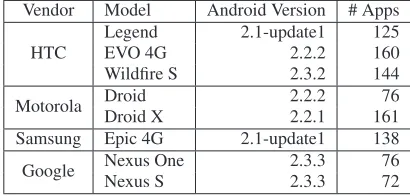
In order to assess capability leaks posed in the wild, we selected phones representing a variety of manufacturers and feature sets. Ta-ble 3 shows the phone images and their versions we analyzed using Woodpecker. These phones span most of the 2.x version space, and as shown by the app count for each phone image, some are considerably more complex than others.
Vendor Model Android Version # Apps
HTC
Legend 2.1-update1 125
EVO 4G 2.2.2 160
Wildfire S 2.3.2 144
Motorola DroidDroid X 2.2.22.2.1 16176
Samsung Epic 4G 2.1-update1 138
Google Nexus One 2.3.3 76
Nexus S 2.3.3 72
Table 3: Experimented Android-based Smartphones
Running Woodpecker on each phone image produces a set of re-ported capability leak paths. For each rere-ported path, we then man-ually verify the leak by tracing the path through the disassembled Dalvik bytecode. For explicit capability leaks whose paths seem plau-sible, we then craft a test application and run it on the actual device, where possible. The results are summarized in Table 4.
After identifying these capability leaks, we have taken considerable time in reporting them to corresponding vendors. As of this writing, Motorola and Google have confirmed all the reported vulnerabilities in the affected phones. HTC and Samsung have been really slow in responding to, if not ignoring, our reports/inquires. Though the uncovered capabilities leaks on the HTC and Samsung phones have not been confirmed from respective vendors, we have developed a test
app to exercise and confirm all the discovered (explicit) capability leaks on the affected phones.
We believe these results demonstrate that capability leaks consti-tute a tangible security weakness for many Android smartphones in the market today. Particularly, smartphones with more pre-loaded apps tend to be more likely in having explicit capability leaks. The reference implementations from Google (i.e., Nexus One and Nexus S) are rather clean and free from capability leaks except only one ex-plicit leak (marked as✓2in Table 4) by an appom.svox.pio. This
app defines a receiver, which can be tricked to remove another app,
om.svox.langpak.installerby any other third-party app.
4 Our
data also show that these capability leaks are not very evenly dis-tributed among smartphones – at least for the thirteen permissions we modelled. For example, those smartphones with system images (i.e., Motorola Droid) very close to the reference Android design (i.e., Google Nexus One and Nexus S) seem to be largely free of capability leaks, while some of the other flagship devices have several. De-spite this general trend, we caution against drawing any overly broad conclusions, as some devices (e.g., Motorola Droid X) with higher app counts nevertheless contained fewer capability leaks than sub-stantially simpler smartphones (e.g., HTC Legend).
5.2
Case Studies
To understand the nature of capability leaks and demonstrate the ef-fectiveness of our system, we examine three scenarios in depth. These scenarios were selected to illustrate some of the patterns we encoun-tered in practice, as well as how our system was able to handle them.
5.2.1
Explicit Capability Leaks Without Arguments
The simplest scenario, from Woodpecker’s perspective, involves an entry point calling a dangerous capability that is not influenced by any arguments. These capabilities tend to have simpler control flows, as there are no arguments to validate or parse. The Samsung Epic 4G’sMASTER_CLEARexplicit capability leak is of this type, as it
ends with the dangerous callChekinServie.masterClear(), which
functionally performs a factory reset.
To understand how Woodpecker detects this explicit ca-pability leak, we first explain the normal sequences when
the MASTER_CLEAR capability is invoked. Specifically, the
Samsung Epic 4G’s phone image has a pre-loaded app,
om.se.android.app.SeletiveReset, whose purpose is to
display a confirmation screen that asks the user whether to reset the phone. The normal chain of events has another system app broadcast the custom android.intent.ation.SELECTIVE_RESET
Intent, which theSeletiveResetReeiver class (defined in the
pre-loaded app) listens for. When this class receives such an intent, it opens the user interface screen (SeletiveResetApp) and waits
for the user to confirm their intentions. Once this is done, the
SeletiveResetServie is started, which eventually broadcasts
an intent android.intent.ation.SELECTIVE_RESET_DONE. The
originalSeletiveResetReeiverclass listens for thisIntentand
then callsChekinServie.masterClear().
Our system detects the last part of the above chain starting after the broadcasted intentandroid.intent.ation.SELECTIVE_RESET_DONE
is received in the same pre-loaded app. In particular, the intent arrives at one entry point defined in the app’s mani-fest file (i.e., the onReeive(Context, Intent) method within
SeletiveResetReeiver), which then executes a rather
straightfor-4This
om.svox.pio app implements a text-to-speech engine
that the accessibility APIs use to talk. However, it exports a public receiver interface, om.svox.pio.LangPakUninstaller
for android.speeh.tts.engine.TTS_DATA_INSTALLED intents. If
this intent is received, this app will blindly remove another app
om.svox.langpak.installer, which is hard-coded in the
HTC Motorola Samsung Google
Permission Legend EVO 4G Wildfire S Droid Droid X Epic 4G Nexus One Nexus S
E I E I E I E I E I E I E I E I
ACCESS_COARSE_LOCATION ✓ ✓ ✓ ✓ · ✓ · · ✓ · · · ·
ACCESS_FINE_LOCATION ✓ · ✓ · · ✓ · · ✓ · · · ·
CALL_PHONE · · · ✓ ✓ · · · ·
CALL_PRIVILEGED · · · ✓1 · · · ·
CAMERA ✓ · ✓ · ✓ · · · ·
DELETE_PACKAGES ✓2 · ✓2 · ✓2 · ✓2 · ✓2 · ✓2 · ✓2 · ✓2 ·
INSTALL_PACKAGES · · · ·
MASTER_CLEAR · · · ✓ · · · · ·
READ_PHONE_STATE · ✓ · ✓ · ✓ · · ✓ · · ✓ · · · ·
REBOOT · · ✓ · · · ·
RECORD_AUDIO ✓ · ✓ · ✓ · · · ·
SEND_SMS ✓ · ✓ · ✓ · · · ·
SHUTDOWN · · ✓ · · · ·
Total 6 2 8 2 4 4 1 0 4 0 3 2 1 0 1 0
Table 4: Capability Leak Results of Eight Android-based Smartphones (E: explicit leaks;I: implicit leaks)
wardIntent-handling code sequence:
1. Determines that the Intent it just received is a
android.intent.ation.SELECTIVE_RESET_DONEoperation;
2. Gets theChekinServiethat contains the master clear
func-tionality;
3. Checks whether it was retrieved successfully;
4. CallsChekinServie.masterClear()in a worker thread.
SinceChekinServie.masterClear()takes no arguments, no
addi-tional dataflow analysis needs be performed to characterize the capa-bility leak.
In our experiments, we found other capability leaks of the same na-ture, including theREBOOTandSHUTDOWNleaks on the HTC EVO 4G,
which involve a receiver listening for a new customIntentand then
immediately exercising the related functionalities. Also, on the same phone, we found a new vendor-defined capabilityFREEZEexposed by
a system app, which disables the phone’s touchscreen and buttons un-til the battery is removed. In those cases, there is literally no control flow involved, making these capability leaks trivial to exploit.
5.2.2
Explicit Capability Leaks With Arguments
Looking beyond simple imperative capability leaks, we consider more complicated cases that involve arguments-taking capabilities. For example, Android’s SMS API consists of three methods, each of which takes five or six arguments. The HTC phones have an explicit leak of this capability that entails significant preprocessing of these arguments, so we examine it next.
On these phones, the general om.android.mms messaging
app has been extended to include a non-standard service,
om.ht.messaging.servie.SmsSenderServie, which is used by
other vendor apps to simplify sending SMS messages. This service can be started with anIntentthat contains a number of additional
data key-value pairs, known asExtras. EachExtracontains some
data about the SMS to be sent, such as the message’s text, its call-back phone number, and the destination phone number etc.
The SmsSenderServie service processes these fields in its
onStart(Intent, int)entry point, ensuring that the mandatory
key-value pairs exist, including the message body and destination phone number. If they do, the Intent is bundled into a Message and
sent to theSmsSenderServie$ServieHandlerclass via the Android
message-handling interface. This interface is designed to allow differ-ent threads of execution to communicate using a queue ofMessages.
The typical paradigm uses a subclass ofandroid.os.Handlerto poll
for newMessageobjects, using ahandleMessage(Message)method.
Such android.os.Handler objects also expose methods to insert
Messages into their queue, such assendMessage(Message).
When building possible paths and pruning infeasible paths, our system will diligently resolve the super- and sub-class relation-ships that bracket the message-passing code. In this case, the initial SmsSenderServie$ServieHandler.sendMessage(Message)
call fully specifies the class that sendMessage(Message) will be
called upon, butSmsSenderServie$ServieHandlerdoes not
con-tain a definition for that method. Looking to its superclass,
android.os.Handler, Woodpecker finds an artificial method
def-inition of the appropriate signature. This definition in turn calls the android.os.Handler.handleMessage(Message) method,
which is extended by the SmsSenderServie$ServieHandler
class. In this case, our design has no difficulty resolv-ing these relationships, because the first call fully specifies the
SmsSenderServie$ServieHandlerclass. This type information is
then carried forward through the call chain as a constraint on the ar-guments to each call, as a class’ methods are associated with an object instantiating that class via an implicit argument (thethiskeyword).
Ultimately, the app execution flow will reach
SmsManager.sendMultipartTextMessage(), a method that
exer-cises the dangerous SEND_SMSpermission. The arguments by this
point have been transformed: the destination address remains the same, but the call-back number may not have been provided by the
Intent’s data, and the message body might have been chunked into
SMS-sized pieces if it is too long. When processing this execution path, Woodpecker reports this path as feasible and thus exposing the exercised permissionSEND_SMS. Since the exercised capability took a
number of arguments, our system also reports the provenance of each related argument to the Android API, which allows for straightfor-wardly linking the API arguments back to the originalIntentpassed
to the entry point at the very beginning. In other words, by simply including a premium number in the intent, the built-in app will start sending SMS messages to this premium number!
Our experience indicates most capability leaks we detected are of this form. For example, the explicit leak ofCALL_PHONE capability
in Samsung Epic 4G involves passing a component a “technical as-sistance” phone number, which it calls after considerable processing. Similarly, all the tested HTC phones export theRECORD_AUDIO
per-mission, which allows any untrusted app to specify which file to write recorded audio to without asking for theRECORD_AUDIOpermission.
5.2.3
Implicit Capability Leaks
Explicit leaks seriously undermine the permission-based security model of Android. Implicit leaks from another perspective misrepre-sent the capability requested by an app. In the following, we choose one representative implicit leak and explain in more detail.
Specifically, the HTC Wildfire S has a built-in MessageTab app,
capa-bility (marked as ✓1in Table 4) without declaring it in its
mani-fest. This MessageTab app is intended to manage the phone’s SMS messages, allowing the user to review sent messages and send new ones. For the sake of convenience, this app links messages sent to contacts with the appropriate contact information, allowing the user to dial contacts directly through a “contact details” screen. How-ever, this app does not declare the correct permissions to call phone numbers, as it only requests SMS-related permissions: neither the
CALL_PHONEnorCALL_PRIVILEGEDpermission occur in its manifest.
On the other hand, MessageTab does declare a sharedUserId
at-tribute: “android.uid.shared.” This user identifier is used by a
num-ber of core Android apps, includingom.android.htdialer– which
has both phone-dialing permissions.
When analyzing this app, Woodpecker reports an implicit leak in the om.android.MessageTab.ContatDetailMessageAtivity2
activity component. Specifically, this component has aonResume()
method – an entry point called when the activity is displayed on the screen. In this case, it is used to instruct on how to build a list of contacts to display on the screen, by calling
om.ht-.widget.HtListView.setOnCreateContextMenuListener() with
a callback object (ContatDetailMessageAtivity2$3). When
the user long-presses one of these contacts, that callback object’s
onCreateContextMenu() method is called. This method then calls ContatDetailMessageAtivity2.addCallAndContatMenuItems()
to make the contacts’ context menus. A call to a helper method,
android.mms.ui.MessageUtils.getMakeCallDiretlyIntent(),
builds the Intent to send to dial a contact. This
helper method builds the actual
android.intent.ation.-CALL_PRIVILEGED Intent, which will be broadcasted when
the user clicks on the contact. From the disassembled code,
the addCallAndContatMenuItems() method also registers an
ContatDetailMessageAtivity2$MsgListMenuClikListener
object as a callback for the click-able contact. This object’s
onMenuItemClik(MenuItem)method is then called, which takes the Intentassociated with the contact and calls om.android.internal-.telephonyITelephony.dialWithoutDelay(Intent)with it, which
immediately dials a phone number.
Note that this implicit capability leak traversed a number of call-backs that either require user intervention or are very visible to the user. These callbacks would normally not be considered useful for an explicit capability leak, which assumes a malicious caller. However, as implicit capability leaks assume that the app itself may be mali-cious, our algorithm simply reports them by not making such value judgments when considering possible execution paths.
5.3
Performance Measurement
Next, we evaluate the performance of our prototype, in terms of both the effectiveness of its path pruning algorithm and the amount of time it takes to process a smartphone’s system image.
To measure how well Woodpecker’s path pruning algorithm elim-inates infeasible paths, we consider its output from the experiments with a single permission,android.permission.SEND_SMS. In
partic-ular, we run only the possible-paths portion of the algorithm (i.e., with no pruning) and identify how many entry pointsmightcontain a path to a dangerous capability. Our results show that for each phone, Woodpecker will report more than8K possible paths. This surpris-ingly large number is due to the conservative approach we have taken in resolving an ambiguous reference to assignable classes. Fortu-nately, our re-run of the full system by pruning the infeasible paths immediately brings the number to the single digits. Specifically, our system only reports capability leaks in the HTC phones, especially 2, 3, 2 for the HTC Legend, EVO 4G, and Wildfire S respectively. Among the reported leaks, we then manually verify the correctness of the pruned paths. The results show they are all valid with no false positives. Note that the presence of one single path is sufficient to leak
Vendor Model Processing Time # Apps
HTC
Legend 3366.63s 125
EVO 4G 4175.03s 160
Wildfire S 3894.37s 144
Motorola Droid 2138.38s 76
Droid X 3311.94s 161
Samsung Epic 4G 3732.56s 138
Google Nexus OneNexus S 2059.47s1815.71s 7672
Table 5: Processing Time of Examined Smartphone Images
the related capability. We do not measure false negatives due to the lack of ground truth in the tested phone images. However, because of the conservative approach we have been taking in our prototype, we are confident in its low false negatives.
For the processing time, we measure them directly by running our system multiple times over the tested smartphone images. We analyze each image ten times on an AMD Athlon 64 X2 5200+ machine with 2GB of memory and a Hitachi HDP72502 7200 rpm hard drive. The mean of these results are summarized in Table 5. Each phone image took at most a little over an hour to process. We believe the average time (∼51.0minutes) per image to be reasonable given the offline
nature of our tool, which has not yet been optimized for speed.
6.
DISCUSSION
Our system has so far uncovered a number of serious capability leaks in current smartphones from leading manufacturers. Given this, it is important to examine possible root causes and explore future defenses.
First of all, capability leaks essentially reflect the classic confused deputy attack [20] where one app is tricked by another into improp-erly exercising its privileges. Though one may easily blame the man-ufacturers for developing and/or including these vulnerable apps on the phone firmware, there is no need to exaggerate their negligence. Specifically, the permission-based security model in Android is a ca-pability model that can be enhanced to mitigate these caca-pability leaks. One challenge however is to maintain the integrity of those capabili-ties when they are being shared or opened to other unrelated apps. In other words, either the capability-leaking app needs to ensure that it will not accidently expose its capability without checking the calling app’s permission or the underlying Android framework will diligently mediate app interactions so that the integrity will be maintained to not leak the capability. However, the interaction among apps are usually application-specific, and their semantic information could be hard for the Android framework to obtain.
Second, to avoid unsafely exposing capabilities, we can also de-velop a validator tool and release it together with the Android SDK. Note that such a validator tool needs to accommodate various ways on how the permission model is implemented in Android. Specif-ically, Android uses string identifiers to represent permissions, and permission information can be encoded in either the app’s manifest or code, which indicates that the permission model cannot be consid-ered type-safe. Accordingly, conventional Java source code analysis tools are not aware of the impact permissions have on program exe-cution. To the best of knowledge, we are not aware of any other tool that is designed to identify potential capability leaks within an app.
there is a lack of support in our current system when dealing with one advanced class of capability leaks:chained capability leaks. To illus-trate, consider three appsA,B, andC. AppChas aCALL_PHONE
capa-bility, which it safely exposes toBby defining a new permission, say
MY_CALL_PHONE. The new permission is acquired byB. For a chained
leak to occur,Bopens up the new permission unsafely toA. As a
re-sult, there is a call chainA->B->C, which could leak theCALL_PHONE
capability. Moreover, as the new permissionMY_CALL_PHONEcan be
arbitrary and specific to an particular app implementation, there is a need to explore innovative ways to extend our current prototype to accommodate such chained capability leaks.
Finally, our study only examines capability leaks among pre-loaded apps in the phone firmware. We also expect the leaks could occur among third-party user apps. Note that phone images are relatively homogeneous and static with usually a somewhat infrequent update schedule. Capability leaks, especially explicit ones, on phone images are of great interest to malicious third parties. Implicit leaks, on the other hand, appear to be relatively rare, which we assume are more software engineering defects than a real security threat. However, for third-party apps, implicit leaks could constitute collusion attacks that directly undermine the app market model. Specifically, app mar-kets do not report the actual permissionsgrantedto an app. Instead they report only the permissions an app requests or embodied in the manifest file. As a result, a cohort of seemingly innocuous apps could conspire together to perform malicious activities and the user may not be informed of the true scope of their permissions within the system. Meanwhile, we hypothesize that explicit leaks in user-installed apps may be less common and useful, as an app must have both a sizable installed base and unwittingly expose some interesting functionality in order for an attacker to derive much benefit from exploiting the leaked capabilities. In future work, we plan to apply Woodpecker to assess the threat posed by capability leaks in user apps.
7.
RELATED WORK
Smartphones have recently attracted considerable attention, espe-cially in the context of privacy. Accordingly, much work has been devoted to analyzing smartphone apps, either statically or dynami-cally. For example, TaintDroid [16] applies dynamic taint analysis to monitor information-stealing Android apps. Specifically, by ex-plicitly modeling the flow of sensitive information through Android, TaintDroid raises alerts when any private data is going to be trans-mitted from the device. A follow-up work [17] developed a Dalvik decompilerdedto statically uncover Java code from the Dalvik
byte-code in popular free Android apps. The uncovered Java byte-code is then fed into existing static analysis tools to understand or profile the app behavior. Woodpecker is different from these efforts with its unique focus on statically analyzing pre-loaded apps in smartphone firmware to uncover possible capability leaks.
From another perspective, researchers have also developed static analysis tools for privacy leaking detection. For example, PiOS [15] is a representative example, which constructs a control-flow graph for an iOS app and then looks for the presence of information-leaking execution through that graph. Specifically, PiOS tries to link sources of private information to network interfaces. In comparison, Wood-pecker was developed for the Android platform and thus needs to overcome platform-level peculiarities for the control-flow construc-tion and data flow analysis (Secconstruc-tion 3). Most importantly, Wood-pecker has a different goal in uncovering unsafe exposure of danger-ous capability uses, including both explicit and implicit ones. In the same vein, work by Chaudhuri et al. [11, 19] formalizes data flow on Android so that a data flow policy can be formally specified for an Android app, which can then be checked against the app code to ensure compliance. A SCanDroid system [19] has been accordingly developed to extract such specifications from the app’s manifests that accompany such applications, and check whether data flows through
the app are consistent with the specification. Note that SCanDroid requires accessing the app’s Java source code for the analysis, which is not available in our case for capability leak detection.
On the defensive side, TISSA [37] argues for a privacy mode in Android to tame information-stealing apps. Kirin [18] attempts to block the installation of apps that request certain combinations of per-missions with deleterious emergent effects. A development of that system, Saint [28], empowers the app developer to specify additional constraints on the assignment of permissions at install-time and their use at runtime. Apex [26] modifies the permission framework to al-low for selectively granting permissions and revoking permissions at runtime. MockDroid [9] allows privacy-sensitive calls to be rewritten to return “failure” results. In the .NET framework, Security by Con-tract [13] allows an application’s behavior to be constrained at run-time by a contract. Such contract-based systems might represent a de-fense against implicit capability leaks, though none of these share the same goal of exposing the capability leaks in smartphone firmware.
As discussed earlier, capability leaks essentially reflect the con-fused deputy attack [20]. Other researchers also warn of similar at-tacks in Android [14, 12, 27]. For example, Daviet al.[12] show a concrete confused deputy attack against the Android Scripting En-vironment. QUIRE [14] allows apps to reason about the call-chain and data provenance of requests, which could be potentially help-ful in mitigating this attack. Nils [27] manually analyzed the HTC Legend’s system image looking for possible permission abuses. In comparison to these efforts, our work develops a semi-automated system to systematically detect such capability leaks. In fact, only manual effort required by Woodpecker comes from verifying the de-tected leaks. Moreover, note that some Android malware such as Soundcomber [29] were developed by requesting certain Android per-missions. Our research shows that these requests could be poten-tially avoided as the permissions might have already been leaked (e.g.,
RECORD_AUDIO).
More generally, a number of systems that target desktop apps have been developed to detect system-wide information flow or confine untrusted app behavior. For example, TightLip [35] treats a target process as a black box. When the target process accesses sensitive data, TightLip instantiates a sandboxed copy, gives fuzzed data to the sandboxed copy and runs the copy in parallel with the target for output comparison and leak detection. Privacy Oracle [24] applies a differen-tial testing technique to detect the correlation or likely leaks between input perturbations and output perturbations of the application. Also, system-level approaches such as Asbestos [33], HiStar [36], Process Coloring [23], and PRECIP [34] instantiate information flow at the process level by labeling running processes and propagating those labels based on process behavior. While we expect some of these approaches will be applicable on resource-constrained mobile phone environments, they are more focused on detecting information leaks instead of capability leaks (and their applicability to the smartphone setting still remains to be demonstrated).