BURGER, WILLIAM. Exploring the Complex Computer-Mediated Communication Needs of Learners in a Multilingual, Multicultural Online Learning Environment. (Under the direction of Dr. Brad Mehlenbacher.)
The purpose of this study was to understand student perceptions of social presence that resulted from communicating and collaborating via different forms of Internet-based communication technologies in a diverse, multicultural, multilingual online learning environment. In that it describes how non-native English speaking students from different countries and cultures responded to the use of various asynchronous and synchronous computer-mediated communications technologies as they relate to developing a perceived sense of social presence, this study may assist educators and course designers as they consider how to implement an effective course design strategy toward meeting the complex needs of the multicultural online learning environment.
The questions guiding this research were (a) How do participants describe their perceived sense of presence while engaged with others in a multicultural online learning environment? (b) How do participants’ cultural histories influence their choice of
communication tools in the multicultural online learning environment? (c) What dynamics do participants encounter when communicating in the multicultural online learning
environment? (d) How do participants describe their reactions to using various CMC in the multicultural online learning environment?
by
William Peter Burger
A dissertation or thesis submitted to the Graduate Faculty of North Carolina State University
in partial fulfillment of the requirements for the degree of
Doctor of Education
Adult and Community College Education
Raleigh, North Carolina 2013
APPROVED BY:
_______________________________ ______________________________
Brad Mehlenbacher, Ph.D. Diane Chapman, Ed.D.
Committee Chair
________________________________ ________________________________
DEDICATION
There are many people I have met along life’s meandering path who have influenced roads chosen and actions taken. First and foremost, I must dedicate this dissertation to my wife and son, Nina and Trystan. You are my family and my life and I love you both dearly. Pursuing a doctorate requires sacrifice on all levels, and I thank you for enduring through this process with me and understanding why I had to pack up the laptop and leave the house way too many times in search of a quiet space.
BIOGRAPHY
William (Bill) Burger is a three-year veteran of the U.S. Army, 82nd Airborne Division, where he was a paratrooper-medic and decorated competitive marksman. After completing his tour in the military, he earned a B.A. in Photography, and then worked as owner-operator of an award-winning commercial advertising photography studio. Since that time, he has acquired a Master of Arts in Educational Media, Media Production (online) through Appalachian State University. Upon completing his M.A., Bill enrolled in North Carolina State University’s Adult and Community College Education, Training & Development Ed.D. program, with a concentration in Communication.
The desire to work in higher education has always been foremost in his mind. After twelve years of running his own photography business, he began his career in higher
education. Since that time, he has worked as Information Technology Specialist, Multimedia Specialist, Director of Distance Learning and Instructional Technologies, and as an
Instructional Designer. Bill’s areas of research include Cultural-Historical Activity Theory, effective online course design for non-native learners, adding ‘human-ness’ into the online learning environment, and addressing socio-cultural online learning needs via affordable Computer-Mediated Communication (CMC) technologies.
ACKNOWLEDGMENTS
I thank my friend and mentor of my M.A. program at Appalachian State, Dr. Roberto Muffoletto. Roberto introduced me to the fascinating worlds of distance/global education and CMC technologies. His approach to course design allowed me to experience first hand how multinational educators and students can effectively teach, learn, communicate and
collaborate while negotiating language differences, via affordable Internet-based technologies. These experiences provided the spark that ignited my professional and academic interests, and inspired me to pursue my doctorate.
I thank the staff and educators of the College of Education and the Department of Communication at North Carolina State University, for providing a superb learning experience. My doctoral education was of the highest quality.
During the pursuit of my doctorate, life has challenged me in so many ways. Certainly these have been the most demanding years of my life. I express my heart-felt thanks to Dr. Tim Hatcher for his words of motivation, and to my committee members for seeing this through with me, for believing in me, and for providing the down-the-stretch guidance that assisted me in completing this (amazing) achievement. So, my thanks to my advisor and committee chair, Dr. Brad Mehlenbacher, and committee members Dr. Diane Chapman, Dr. Kathy Lohr, and Dr. Steve Wiley.
TABLE OF CONTENTS
LIST OF FIGURES...ix
CHAPTER 1: INTRODUCTION...1
Research Questions...1
Context and Background ...2
Problem Statement...8
Purpose Statement ...12
Significance ...13
Limitations...14
The Researcher ...16
Assumptions ...17
Summary...18
CHAPTER 2: REVIEW OF THE LITERATURE...20
Introduction ...20
Theoretical Framework...22
Part 1: Intercultural Communication Theory...26
English as the Global Language...30
Complexities Derived of Non-Native Communication...32
Cultural Differences (We Are Misunderstood)...33
Part 2: Computer-Mediated Communication ...39
Introduction...39
Online Learning and Online Communication...40
Online Presence...41
Part 3: Adult Learning Theory...44
Learning is a Social Activity...45
Cultural Learning Styles...48
Part 4: Webcam-Mediated Communication ...50
Sense of Presence...50
Emotional Response to Webcams...55
Webcams and Second Language Dynamics...60
Webcams and Cultural Dynamics...63
Summary...65
CHAPTER 3: METHODOLOGY...71
Introduction ...71
Research Design ...72
Rationale For Qualitative Research...77
Rationale For Study Approach – Case Study ...79
Conceptual Framework...81
Preferred Means of Communication...81
Challenges to Online Communication...83
Study Setting, Context, Participants ...85
Data Collection Methods ...87
Data Analysis Methods...89
Organizing the Data...90
Data Immersion ...91
Categories and Themes...91
Data Coding...91
Written Report ...92
Ethical Issues ...92
Validation ...93
Summary...94
CHAPTER 4: FINDINGS...96
Finding 1: Achieving a Sense of Presence via CMC Technologies ...98
The Development of Community...104
The Development of Friends...108
The Conveyance of Emotion...113
Finding 2: How Cultures and Cultural Histories Influence One’s Preference of CMC Tools...116
Emergent Cultural Issues and Cultural Dynamics...117
Religion...119
Finding 3: The Challenges of Communicating in the Multicultural Online Learning Environment...121
Communicating With English as a Non-Native Language...122
Reliability of CMC Technologies...126
Technologies That Inhibit One’s Ability to Communicate...129
Finding 4: Participants Embrace the Use of Various CMC Technologies ...135
Comfort Experienced While Communicating With CMC Technologies...135
Environmental Affects on Desire or Ability to Participate Using CMC Technologies 139 Preferred CMC Technologies for Communicating in the Multicultural Online Learning Environment...141
Summary...144
CHAPTER 5: DISCUSSION...149
Achieving a Sense of Presence Through the Development of Friendships and Community ...149
Building a Global Community and World Peace via CMC...150
Building Communities of Practice via CMC...151
The Relationship Between Achieving a Sense of Belonging and Time Engaged With Others via CMC...152
Willingness of Others to Provide Assistance via CMC...154
The Ability of CMC to Evoke a Sense of Reality...157
How Individual Cultures and Cultural Histories May Have an Influence on Their Choice of Communication Tools ...158
Religious Influences...158
The Psychological, Religious, Linguistics, Temporal, Infrastructure, and Technological Dynamics of Communicating...159
Psychological Challenges...159
Religious Dynamics...161
Technical Limitations...162
Most Participants Embraced the Opportunity to Communicate With Various CMC Technologies...162
Participant Reactions to Effective Course Design Strategies...162
How CMC Supports the Development of Non-Native English Communication Skills...165
Participant Reactions to the Course Coming to a Close...165
Summary...167
CHAPTER 6: IMPLICATIONS, RECOMMENDATIONS, AND CONCLUSIONS..171
Overview ...171
Implications for Practice...172
Pre-Course Collection of Cultural Information...172
Pre-Course CMC Technology Training and Testing...173
CMC and Course Design...174
Staff-To-Learner and Peer-To-Peer Support Systems...175
Course Closure ...176
CHAT...176
Recommendations for Future Research...177
Utilizing CMC to Facilitate Effective Comprehension Between Second Language Speakers...177
Exploring the Potential Correlation That Exists Between Virtual Peer Support and Developing A Sense of Trust in the Online Learning Environment...178
Designing Thoughtful CMC Practices To Meet the Needs of Non-Western Religious Student Populations in the Online Learning Environment...179
Developing Communities of Practice via Facebook...179
Conclusions ...180
REFERENCES...186
LIST OF FIGURES
Figure 1: Theoretical foundation conceptual map...21
Figure 2: Vygotsky’s model of mediated action (Vygotsky, 1978) ...23
Figure 3: Tiered CMC technologies integration strategy (Burger, 2013) ...74
Chapter 1: Introduction
This study seeks to understand student perceptions of social presence that result from communicating and collaborating via different forms of computer-mediated communication technologies in a diverse, multicultural, multilingual online learning environment. This study provides insight pertinent to the fields of distance learning, communication,
linguistics, social presence, social learning, instructional systems design, computer-mediated communication, and multicultural studies. This qualitative, embedded, single-case study was theoretical anchored in Cultural-Historical Activity Theory (CHAT), and incorporated a purposeful maximum variation sampling strategy in its recruitment of 14 adult learner participants who were enrolled in a culturally diverse, online-delivered course hosted by a large university located in the Mid-Atlantic region of the United States.
Research Questions
The following research questions guided this study:
1. How do participants describe their perceived sense of presence while engaged with others in a multicultural online learning environment?
2. How do participants’ cultural histories influence their choice of communication tools in the multicultural online learning environment?
3. What dynamics do participants encounter when communicating in the multicultural online learning environment?
Context and Background
Advances in technology and increases in available bandwidth have provided the means for people to communicate synchronously with voice and video functionality (Day, Wood, Scutter, & Astachnowicz, 2003). Millions of communicants interact with others on a regular basis via computers over Internet-mediated technologies (Skype, 2011). However, synchronous Internet-based communication is not limited to using the personal computer platform. Mobile phones have evolved into handheld portable microcomputers dispersed throughout public places, being used to execute actions far more complex than to merely communicate via two-way voice technologies (de Souza E Silva, 2006). Many cell phones, including the Apple iPhone, allow people to communicate over mobile devices using synchronous audio and video technologies (Apple, 2011). Yamada & Akahori (2009) posit the capabilities of mobile technologies overcome limitations inherent in text-based
communication systems, allowing communicants to experience a perceived increase of being in the presence of others.
telephones, tablets, and Internet-mediated video communication applications such as Skype (Thorne & Payne, 2005).
A report published by Skype in 2011 states that in 2010, Skype was used by 124 million users per month. In the first six months of 2010, Skype users logged 95 billion minutes of voice and video communication time. Approximately 38 billion of those minutes (40%) incorporated the use of video communication. The rapid evolution and adoption of digital communication technologies allow citizens to engage in cross-border intercultural communication (Lee, 2009). Lee states, “it is becoming much more important for people to understand one another’s cultures, since culture plays an important role in shaping the identities, values, and beliefs of people around the world” (p. 1).
(Burbules & Torres, 2000). Some societies who do not have English as their native tongue have expressed concern that the influence of hegemonic powers is such that it places their non-English speaking people at a socio-economic disadvantage. There are additional concerns that English can have a dominating affect over their native language, having a distilling effect on their heritage and culture. So while technology has provided humans with the ability to communicate and share information at unprecedented levels, this capability ironically results in new complexities, which have the potential to produce unanticipated challenges that need to be addressed in order to deliver a quality and satisfying
teaching/learning experience.
Global business professionals frequently interact with coworkers and clients across national borders (St. Amant, 2002) and much of this communication takes place via the Internet. For instance, Skype is used by business people, academicians, students, and between friends and family (Skype, 2006). In their 3rd quarter report for 2006, sixteen percent of Skype user accounts were US-based while the remaining 84% were based ‘overseas.’ The demand for effective online-based transnational communication tools is evident and the demand extends into institutions of higher learning. Educause (2007) cites a large number of students and educators currently using Skype for scholarly communication and collaboration and estimates the total number of users at 250,000,000. By providing a means with which students can interact via computer technologies with transnational cultures, educators provide themselves and learners with a unique cross-cultural experience and valuable business communication skills.
from foreign countries. Approximately 56% of the ten largest US-based institutions of higher education have some form of collaborative degree program with international non-US-based institutions (Council of Graduate Schools, 2007).
It is important that these statistics be considered in the context of the times. When one hears the words ‘foreign students,’ thoughts may turn to images of students separated from their family and native culture, living on a campus in an environment completely new to them, experiencing differences in mores and cuisine, negotiating language differences, and being physically immersed in the local culture. However, students no longer must file for a visa and fly across spatial, political and temporal borders in pursuit of an international education. People who have access to current Internet-based technologies are provided opportunities to participate in extensive online learning, collaboration, and rich
communication events with people from all corners of the globe (St. Amant, 2002). The past decade has seen an incredible rise in the number of courses being offered via some form of distance learning (Sloan Consortium, 2012), and there is no sign of decline in the demand for courses to be delivered via distance learning delivery methods.
than 20 additional countries. Being a foreign student no longer equates to leaving the comfort of one’s home, abandoning one’s local support system, and moving away from one’s native culture. With a relatively inexpensive computer, fundamental PC skills, and a stable, broadband online connection, learners can gain access to online-based courses. This opens up a myriad of learning opportunities to learners from many corners of the world (Owen & Demb, 2004), provided the technology and infrastructure is available to them (Aderinoye, Siaciwena, & Wright, 2009).
The free-flowing nature of the Internet allows for the international transmission of data anywhere one can access a computer connected to the Internet. The Internet bypasses temporal and spatial boundaries providing people with the ability to connect, share, and learn from each other at an unprecedented scale. As McIsaac (2002) posits,
Distance education is taking advantage of these collaborative and connected learning spaces…Ideas and knowledge are shared in a global, connected learning
environment…Education, as never before, is crossing international boundaries and is offering us the opportunity to share our multiple cultural perspectives. (p. 18)
Problem Statement
Centuries of English imperialism and decades of US-based hegemonic influence (Kawai, 2007), have produced more non-native speakers of English than native English language speakers (Foley, 2007). The advent of technological advances in online communication in combination with advances in globalization has fueled the speed and expansion of promoting English as the global language (Kawai, 2007). While this may make teaching and learning more manageable for educators and students who are native to the English language, acceptance of English as the global language of education places many non-English speaking, English as a second language (ESL), and non-Westernized students and faculty at a participatory disadvantage. And language and cultural dynamics are not the only potential problems faced by ESL and non-Western students.
Ironically, while Internet-based technologies allow users to interact with more people than ever before, these same technologies impose a series of socio-psychological and communication challenges. In a 2005 survey of more than 2,200 educational institutions conducted by the Sloan Consortium (Allen & Seaman, 2006), while 72.6% of the
respondents agree that distance education reaches students who are not otherwise served by face-to-face brick-and-mortar programs, over 95% of the reporting Chief Academic Officers agreed that there are widespread challenges to student abilities of receiving an online
(Vygotsky, 1981, Laffey, Yu Lin, & Lin, 2006). Nicol, Minty, & Sinclair (2003) argue that effective communication via interaction and dialogue are essential elements to the success of productive learning in any learning environment. Moore (1993) advises us that when students feel isolated it can inhibit their ability to learn.
When courses delivered over the Internet are designed to facilitate communication between participants solely by text-based means (email, text-chat, Instant Messaging), the result is a learning environment void of auditory or visual symbols, signals, and information. Participants lose the ability to exchange the wide range of verbal and nonverbal
communication cues that are possible to transmit during face-to-face encounters (Doering & Poeschl, 2007).
During face-to-face exchanges, communicants see each others’ facial expressions, body language, and hand gestures. Participants can hear the tonal inflection in voices and feel the shake of a hand or receive a reassuring pat on the back. According to Munter (1993), 65 to 99 percent of all communication is conducted via non-verbal means. Anthropologist Birdwhistell (1970) places those numbers between 65 and 70 percent. However, currently much of the communication that takes place between people occurs via text-based means over mobile telephone and the Internet.
Siegel, & McGuire, 1984) suggests text-based computer-mediated communication lacks many essential verbal and nonverbal social cues and as a result, the communication experience is socially and emotionally impoverished (Doering & Poeschl, 2007). From an educational perspective, a lack of multi-sensory communication has the potential to
contribute to a decline in participant social satisfaction, negatively affect class retention, and impede the social learning process. When communicants from dissimilar countries and cultures are deprived of social cues while engaged in discourse, complications are likely to arise.
According to Whiteman (2002), “understanding relates to perceptions, attitudes, role expectations, relationship beliefs and patterns, self-concepts, conflict issues, communicative intentions, feelings, and immediate thoughts while observing and analyzing conversations” (p. 4). It is important to acknowledge the complexities that make up a quality conversation or exchange of knowledge between individuals, especially when the communication occurs online.
While the online delivery method provides for new and expanded learning
opportunities, the online learning environment is a digital one and as a result the classrooms are ‘virtual’ and commonly void of the elements that can fill the human senses. Face-to-face real-time contact is severed. This loss of face-to-face human contact inherent in the
traditional classroom setting is a recognized concern to educators, administrators,
desired by learners, it is also regarded by many educators as essential to the success of the learning experience. Thus the convenience and attractive aspects of online learning comes at a psychological price (Morgan, Morgan, & Hill, 2000). Online students may well lose the ability to see, hear, and touch one another.
Distance learning combines technology with pedagogy with the intent of providing a quality learning experience for learners. However, there are concerns for the ability of all participants to interact effectively (Stein, Wanstreet, Calvin, Overtoom, & Wheaton, 2005). By combining distance learning related technologies with sound pedagogical practices, educators can facilitate the development of an active distance learning community
(Romanoff, 2003). Learning communities can be instrumental in forming a sense of class unity and well being. Romanoff posits the lack of face-to-face interaction is not as critical as providing learning experiences that recognize individuals and the collective successes of its participants. It is therefore ironic that the same technologies that accommodate distance learning and have the potential to present spatial, cultural, and psychological challenges between educators and learners, are the technologies that have the capacity to minimize or improve these same social disparities. A potential barrier for some is the dominance of English as the globally accepted language of business and learning.
The following organizations have French and English as their official languages: NATO (NATO, n.d.), G8 summit communiqués (G8, 2003), the Olympics (International Olympic Committee, 2007), and the European Organization for Nuclear Research
as its sole official language. This has repercussions for governments, cultures, businesses, and academia. Non-English-speaking entities that wish to partner with the native-speaking West are forced to adapt, adopt, and comply or fall by the wayside.
The culmination of the above presents a predicament. If Western institutions continue to endorse the position that English is the global academic and business language, logically, these institutions should support non-native English speakers to enable and allow them to be valued and contributing members of these groups. In addition, if the US
educational system desires to attract people from other cultures to enroll in and enrich our educational institutions, then it is imperative these institutions provide the means possible with which to address potential linguistic and cultural imbalances of power by reaching out to accommodate their multicultural guests. If host institutions can build bridges that cross the sociological, psychological, linguistic, cultural, and technological challenges that exist between host and non-native participants, the results should prove beneficial to all
stakeholders. One such way of breaking through these challenges may be through the use of webcams in the multicultural online learning environment (Salam et al., 2013).
Purpose Statement
(including text-based means of communication, audio chat, and video chat), and social presence, culture, and linguistics in the multicultural online learning environment. Significance
The results of this case study indicate that multicultural, multilingual participants enrolled in an online course derived linguistic, cultural, and social benefits from the use of various CMC technologies in their social and educational communications. The results also indicate an individual’s cultural history and religion may influence or even limit the
Limitations
There were several limitations associated with this study. To address time and financial constraints, the study was limited in scope. The study was conducted with students enrolled in a ten-week, online delivered class hosted by a large Western-influenced
university located in the Mid-Atlantic region of the United States. The course default language was English and the course was designed around Western academic standards.
The success of this study was largely dependent on the level of cultural diversity of the participants. Logically, a more diverse pool of participants would provide greater insight and produce a richer data set than a more homogenous participant pool. Thus, every effort was made to locate a class delivered online that is historically comprised of a diverse, multi-cultural, multi-lingual pool of learners. The study population was successfully representative of four continents: South America, Africa, Asia, and Europe. The population did appear to be limited in its representation of world religions, and of the 14 participants, only one was male.
common may have influenced the ease with which they developed personal bonds, experienced building a sense of community and a community of practice.
Part of the course required students with webcams to communicate synchronously through the Internet via communication application ‘ooVoo.’ I personally funded the purchase and mailing of webcams and headsets to all student and educator participants. As such, monetary constraints were taken into consideration. I also recommended the use of ooVoo during the course to facilitate the ability to text-chat, conduct audio conferences, host multi-participant videoconferences, and exchange digital files. As the version of ooVoo used was free, advertisements were visible to the users.
The possibility of technological limitations must also be accounted for. Every effort was made to incorporate webcam technologies that make efficient use of bandwidth in order to avoid webcam-related technical complications. However, some students had restricted or interrupted access to the broadband connection speeds necessary to support an effective audio chat or video chat communication experience.
The study is also limited from a ‘technology in time’ perspective. Technology evolves continually and while the study used what can be considered ‘good’ quality
consumer-grade equipment by current technological time standards, by the time the study is published, improvements in audio chat or video chat technologies may have surpassed those used in the study.
raised and educated in the United States, and have been employed by Western-based
institutions of higher education. Further research will need to explore resulting data sets that are derived from studies from educational institutions based in non-Westernized cultures, and delivered by educators who are of a non-native-Western upbringing.
The Researcher
I am native to the United States and have extensive world-travel experience. As a student and education administrator, I have facilitated or participated in a variety of international educational partnerships. My immediate family has European roots. This provides a worldly experience-based lens through which I view matters relating to
In my professional capacity, I have had first hand successes with employing webcams as a tool in connecting teachers and learners as well as corporate staff personnel locally, nationally, and internationally. Not everyone is completely enamored with the use of webcam technology. I have had several students tell me they do not want to be ‘bothered’ learning how to use webcams as a means to supplement their interactivity and learning. A few co-workers have also told me that they prefer to remain visually anonymous in their virtual communications, and would rather communicate via audio-only or text-base methods of communication. Several others have mentioned experiencing difficulties associated with scheduling synchronous sessions across what can be extensive time zone differences.
I must acknowledge my great admiration for the field and delivery methods of distance learning. My Masters degree is in Educational Media, with a concentration in Distance Learning. The degree was an all-online program offered by Appalachian State University. As a distance learning and instructional systems design professional, I recognize and support the position that distance learning and the use of webcams in online
communication and collaboration is not ideally suited to or the preference of every learner, or in my opinion, every educator.
Assumptions
meaning through non-verbal means of communication, such as body language, tonal inflection, facial expression, or gesture. Second, intended meaning between people of differing languages and cultures can be easily misconstrued when the communication medium is limited to text-based means. Third, many distance learning classes are not designed to address the needs of presence, community, interactivity, cultural diversity, communication and understanding. Fourth, many learners are excited about the possibility of using new methods of Internet-based, webcam communications and look forward to engaging others in real-time with audio and visual communication technologies. Fifth, some students have no desire to learn new education-based, communication and collaboration tools, and have a preference to remain in audio video anonymity.
Summary
This chapter begins with the context and background that frames the study. This is followed by the study’s problem statement, statement of purpose, related research questions, significance of the study, the study overview and concludes with key terminology used in support of the study. In short, through hegemonic and other influences, English has become the global language of power and academia. Students foreign to the English language and Western culture, who are enrolled in Western-based online courses, are at a distinct disadvantage compared to those who are native to Western culture and native to speaking English. It is imperative that Western-based learning institutions provide the means necessary to accommodate foreign students as they negotiate any potential learning,
classes. By applying a perspective grounded in Cultural Historical Activity Theory (CHAT), this single-case study explains how students in a multicultural online learning environment perceive the role various CMC technologies play in negotiating potential social presence, culture, and language issues.
Chapter 2 will explore the literature that supports the areas of Intercultural
Chapter 2: Review Of Literature Introduction
The purpose of this study was to understand student perceptions of social presence that resulted from communicating and collaborating via different forms of Internet-based communication technologies in a diverse, multicultural, multilingual online learning environment. The research questions that guide this study are:
1. How do participants describe their perceived sense of presence while engaged with others in a multicultural online learning environment?
2. How do participants’ cultural histories influence their choice of communication tools in the multicultural online learning environment?
3. What challenges do participants encounter when communicating in the multicultural online learning environment?
4. How do participants describe their reactions to using various CMC in the multicultural online learning?
This qualitative, embedded, single-case study was conducted with the intent to explore the relationships that exist between the use of CMC technologies including webcams, and social presence, culture, and language in the multicultural online learning environment. To best comprehend and support related components of the study, a comprehensive literature review was conducted through all phases of the study.
understand the relationships that exist between technologies and their human consumers (Nardi, 1996). CHAT also has its foundations in social learning. In addition, CHAT requires the researcher to consider how culture and history play a role within intermingling
processes. As such, the theory seems particularly well suited to serve as the cornerstone of this study.
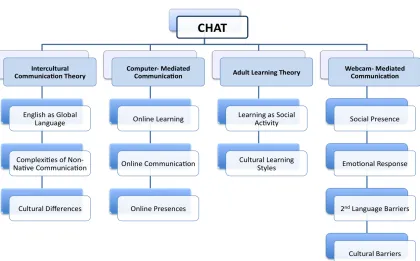
Figure 1: Theoretical foundation conceptual map
intercultural communication theory, computer-mediated communication, adult learning theory, and a relatively new concept that is highly relevant to this study that I am labeling ‘webcam-mediated communication.’ These interwoven theories and concepts served to provide the conceptual underpinning of the selected literature. Issues pertaining to
intercultural communication theory focus on: English as a global language; complexities of engaging others using a non-native language; and cultural differences that arise between diverse communicants. Issues pertaining to computer-mediated communication (CMC) focus on the following sub-components: CMC in online learning; CMC in online
communication; CMC in online presence. Issues pertaining to adult learning theory focus on: learning as a social activity; cultural learning styles. Issues pertaining to webcam-mediated communication focus on: how user communication experiences with webcams influence their perceived level of social presence; how webcams affect user emotional response; how webcams affect the dynamics that exist between communicants engaged in second language learning; how webcams affect the cultural dynamics that exist between online communicants.
Chapter 2 will begin with an overview of the theoretical framework followed by the conceptual framework for the literature review. The chapter will finish with a summary of the literature’s findings and a brief introduction to Chapter 3.
Theoretical Framework
Luria (Engeström, 2001). Activity theory takes the object-oriented, artifact-mediated collective activity system as its unit of analysis, thus bridging the gulf between the individual subject and the societal structure (Engeström, Meittinen, Punamäki-Gitai, & Punamäki, 1999).
Engeström (2001) posits any theory of learning must answer the following four questions: 1) who are the subjects of learning; 2) why do they learn; 3) what do they learn; 4) how do they learn? Cultural-Historical Activity Theory - or CHAT – provides a
systematic view of the development of the individual mind, the collective mind, the activity of the subject, and the evolving application of tools as they play a mediating role toward achieving an activity. CHAT has been proven useful for analyzing data recorded in actual classrooms as well as providing direction for change in troubled cultural environments (Roth & Lee, 2007).
Since its inception, CHAT has gone through three generational changes (Engeström, 2001). The principles of CHAT were initially developed by Russian Lev Vygotsky in the 1920s and 1930s and were eventually expanded upon by his colleague Alexei Leont’ev. Vygotsky’s interests were initially centered on the concept of mediation.
According to Vygotsky (1981), high-level human mental processes are mediated by historically and culturally constructed auxiliary means. These auxiliary means can be comprised of any of a number of indigenous cultural and symbolic artifacts, including language, numbers, and graphs. Vygotsky posits that a socially organized, goal-oriented practical activity designed to reflect on a learner’s progress toward achieving their goal, leads to consciousness for the learner. Emphasis needs to be placed on the social processes that enhance the ability for the individual to learn through collaboratively engaging in activities with others. Even though Vygotsky passed away prior to the birth of the personal computer, Lee (2009) writes Vygotsky’s position “illuminates the notion of multiple activity systems across time and space in the modern classroom with computers and
telecommunications” (p. 22).
activity is dependent on the final objective or goal. Researchers expert to the field of Socio-Cultural Theory have a slightly different view of activity (Lee, 2009).
According to Engestrom et al. (1999), Thorn (2005) and Wertsch (1995), activity can be defined as human action that is developed through culturally and historically constructed artifacts. The activity can then be applied as a unit of analysis, toward explaining learning and development (Lee, 2009).
Jonassen and Rohrer-Murphy (1999) declare that Activity Theory “is a powerful framework for the design and development of technology-based learning environments because its assumptions are consonant with the ideas of constructivism, situated learning, distributed cognition and everyday cognition” (p. 463). Greenhow and Belbas (2007) posit that since Activity Theory concentrates on the relationships of those immersed in a shared activity, this theory is well suited toward the study of intersubjective learning that occurs in the distance learning context.
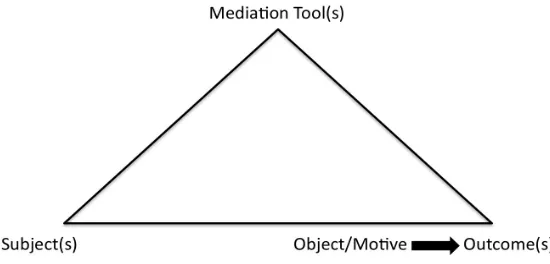
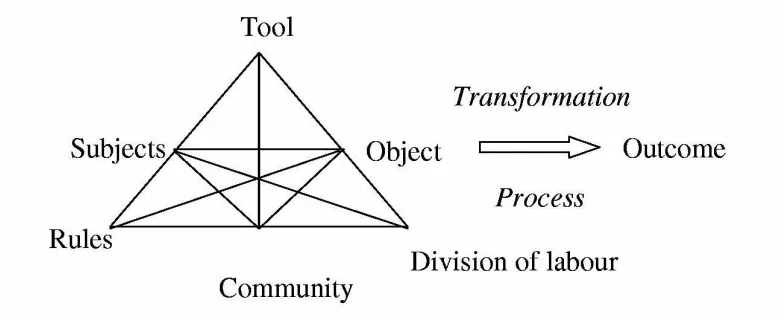
Engeström (1987) states, the Activity Theory framework are a reflection on how people interact with objects via mediating tools in order to effect outcomes. This occurs within a unique community comprised of its own set of rules and approaches to the distribution of labor. As Basharina (2007) writes, “When the students engaged with
computers in similar ways, and when their objects, rules/norms coincided, they formed one activity system” (p. 86).
Basharina (2007) declares, “Within an activity system, all elements constantly interact with one another and are virtually always in the process of working through changes. Changes in the design of a tool may influence a subject's orientation toward an object, which, in turn, may influence the cultural practices of the community” (p. 85).
Engestrom et al. (1999) believe deploying modern technology as a means for human activity to occur through social interaction can prove to be quite stimulating. “Learning through computers and telecommunications is one possible new direction to investigate human activity in order to promote the desired learning interaction” (Lee, 2009, p. 23). Part 1: Intercultural Communication Theory
Gunawardena and McIsaac (2003) write that language can be a barrier to learning amongst online learners, whether the learners are non-native to the language or native speaking. Language can become particularly troublesome when non-native online participants encounter communication containing the jargon, jokes, and culture-specific references that only online native speakers might understand (Mason & Gunawardena, 2001).
example can be found in the use of the cell phone (de Souza E Silva, 2006). de Souza E Silva declares cell phones can no longer be considered strictly as mobile telephones. Current-day mobile phones are portable microcomputers dynamically placed in public spaces. People of different cultures utilize them in different ways. Just how phones are used is dependent upon cultural and socioeconomic factors. For example, Asian and
Scandinavian communities use the voice communication functionality less than the other functions of the phone (Rheingold, 2002). The phone, then, has become a mediating tool, which is assigned site-specific social meaning (de Souza E Silva, 2006).
Internet communication tools are also impacted by local cultural influences (Thorne, 2003). Each culture perceives each tool to be a unique cultural artifact of its own making. In addition, since culture shapes identities, values, beliefs, communal “shared patterns of behavior, interaction, cognitive constructs, and effective understanding through
socialization, cultural fluency is essential for successful communication” (Lee, 2009, p. 2). Cultural influences, then, may impact the processes of communication, relationship
building, and language development (Thorne, 2003).
students feared they would convey misinformation, and in doing so, represent their school and nation in a negative light.
In addition to experiencing anxiety, the diversity of the student cultural pool resulted in several additional problems. Basharina (2007) writes, “Students whose tools, norms/rules and objects significantly mismatched oftentimes failed to form the shared community, experienced intercultural contradictions, and also remained outside the "third place," in the (zones) of their local contexts” (p.86). The study revealed three levels of contradictions: intracultural; inter-cultural; and technology-related. Intracultural represents contradictions that affected student assumptions and beliefs prior to engaging in class participation via telecollaborative technologies. Inter-cultural contradictions speak to contradictions that emerged once engaged with the diverse student pool of peers during telecollaborative activities. Technology-related contradictions refer to contradictions that were largely the product of the telecollaboration tools that were in use. “These contradictions were the result of having the same task–online telecollaboration–but engagement in different activities, characterized by differences in their objects/motives and mediating tools” (Basharina, 2007, p. 95).
Cultural differences can also be found between genders (Brunet & Schmidt, 2010). Research indicates each gender will choose how he/she communicates or expresses
him/herself based on the context of the situation and the presence or absence of social cues. The integration of videoconferencing technologies might serve as a way to offset a
videoconferencing systems across cultural borders, team members would be wise to factor in how various cultures would respond to applying videoconferencing as a way to meet the needs of these diverse virtual teams (Bekkering & Shim, 2006).
The use of CMC (computer-mediated communication) in the multi-cultural online learning environment has proven to be capable of yielding favorable results (Albuquerque & Velho, 2002; Jauregi & Ban-ados, 2008; Lee, 2009; Liaw, 2006). “The use of educational technologies and CMC as mediational artifacts can increase learners’ potentials. Thus, dynamic learning activity supported by technology has the potential to transform the learners’ social and cultural practice” (Lee, 2009, p. 40).
In a study conducted by Jauregi & Ban-ados (2008), online learners from the Netherlands and Chile constructed virtual bridges across cultural boundaries via CMC technologies and real-life exchanges, reaped the benefits that are available in authentic learning opportunities. Positive bonds were forged in a spirit of cooperation and enthusiasm. Participants shared knowledge and perspectives about their cultures, and pointed out
commonalities and differences. The Chilean students assisted the Dutch students in enhancing their Spanish as second language communication skills. The Dutch students provided two perspectives of Spanish to the Chilean’s: First, from a second-language learner perspective; Second, the Dutch offered their interpretation regarding the influence of
In another synchronous CMC-based online language learning course (Lee, 2009), learners were connected to people of varying cultures from across the world. The default language was English, and although the language was not native to many participants in the course, video chat technologies were utilized which enhanced the ability for participants to see non-verbal gestures used in communication. As a result, participants could understand one another and learners shared what difference gestures mean to different cultures. Bakić-Mirić (2007) states:
Communication between different cultures is a major topic for communication theorists. Culture and communication have evolved and become interdependent on one another. As long as people from different cultures have been encountering one another there has been intercultural communication. (p. 3)
Intercultural communication is “a symbolic, interpretive, transactional, contextual process” (Bakić-Mirić, 2007, p.3). Steeped in this level of complexity, people from different cultures may well create differing interpretations and expectations as to what actions should be taken in order to create more universal and comprehendible meaning.
English as the global language. The power distribution throughout today’s world has largely been shaped as the result of years of English imperialism and the hegemonic effects of US influence disseminated through political, economic, and cultural means
technologies in combination with advances in globalization have fueled the speed and expansion of promoting English as ‘the’ global language (Kawai, 2007). Those who are native to the English language are usually capable of expressing their intended meaning accurately. However, those who communicate with English as a second or third language – those on who English has become imposed - may inadvertently convey false meaning due to intercultural confusion or misinterpretation of the meaning they intend to convey. The educational implications are numerous.
Many international students seek educational opportunities in the United States and as such will need to have a good understanding of the English language. Ibrahim and Penfield (2005) found English as second language students (ESL) are confronted by language and cultural challenges not only while engaged in verbal discussions, but also in formal compositions. Often, ESL students are evaluated and held to the same standards as native English speakers (NES). While customized ESL classes have been developed, such customized classes may segregate and isolate ESL students from their native hosts. By designing a composition course to mix equal numbers of NES and ESL students, educators can still meet unique ESL student needs without isolating them. The end result promotes cultural understanding and facilitates interaction and cooperation amongst all students.
diversity of cultural backgrounds should be capitalized upon – students can use their cultural identities as a foundation for project fulfillment.
Complexities derived of native communication. The language barrier to non-native English speaking students is real and one that must be addressed. The ability for learners and educators to communicate and understand one another is logically essential (Stein, Wanstreet, Calvin, Overtoom, & Wheaton, 2005). The key to success in the distance learning environment is the quality of interaction that occurs between the teacher and the student (Wheeler, 2002).
Human communication is achieved by combining several sign systems simultaneously (Kreydlin, 2006), and each culture has its own collection of socially ‘acceptable’ and recognizable signs. “Cultural, individual and collective historical factors influence the ways students perceive Internet communication tools” (Thorne, 2003, p. 58.) As such, there is a need for individuals to acquire the knowledge that will allow them to recognize some of the diverse methods that other cultures use to effectively communicate. Only then can they hope to interact effectively with people of other cultures in face-to-face and international online forms of interaction.
comprised of peoples who speak–in many cases–more than one language and students and educators have historical roots with a number of differing cultures. Different cultures express themselves using a complex system of communication codes, symbols and cues (Kreydlin, 2006). If indeed 65 to 99 percent of all communication is conducted via nonverbal means (Munter, 1993; Birdwhistell, 1970), and if we accept the premise that in order to fully understand the verbal message we must have access to nonverbal cues (Streeck, 1993), a lack of access to auditory and visual cues may result in a trans-cultural participant wrongly interpreting the intended meaning being expressed by a person from a differing culture.
Cultural differences (we are misunderstood). In order to understand what it takes to successfully communicate and collaborate as a member of a multicultural community, it is helpful to discover how culture influences the system of cultural communication. As Gudykunst (1998) declares, “the greater our cultural and linguistic knowledge, and the more our beliefs overlap with those of the strangers of whom we communicate, the less the likelihood there will be misunderstandings” (p. 215).
terminate business relationships with Russian affiliates. It is their experience Russians like to “see” and get to know who they are dealing with.
Symbolic means of communication may differ wildly from culture to culture. According to Villareal (2007), in India, locals may get someone’s attention by “snapping” fingers at him or her. To the Indian who is accustomed to this act of his or her culture, snapping is a perfectly normal and effective behavior. However, a visiting businessperson from the United States may find being snapped at to be insulting, condescending or a display of impatience. Ultimately, the translation of the act is dependent upon the specific cultural lens that is being applied in the viewing. The individual interprets a gesture based upon a combination of his or her worldly knowledge, the culture from which the person were raised, and the way that individual experiences the world. A “snap” in and of itself has no meaning, but each unique individual will assign this act with a meaning based upon the symbolism the recipient attaches to the act, which is a direct result of one’s cultural heritage.
Symbolic means of communication extend into the virtual or synthetic realm as well (Wigham & Chanier, 2013). People engaged in virtual worlds such as Second Life assume a form of virtual being (avatar) through which they communicate with others. Avatars
communication means. Of course each instance of communication would need to be contextually considered when considering such generalizations.
In addition to culture having an influence on kinesic and proxemic practices, a peoples’ approach to time – or chronemics – can vary from culture to culture. According to Gurvich (1964), the concept of time in France “is not identical with time in Norway nor with time in Brazil” (p.14). The concept of time can be transferred to communication
considerations such as lapses of silence between communicants. Silence can mean different things to different people (Gudykunst, 1998), and Ting-Toomey (1999) reminds us, silence can also serve different needs depending upon the interlocutors and the context and
environment in which they are engaged. For example, Asian cultures such as those in Japan and China, embrace silence as a part of their communication culture. To the Westerner, silence may be met with feelings of uneasiness and impatience. For the Japanese, it may serve as a tool for communication control or as a method to facilitate ‘truth’ in conversation.
or not bothering others. Finns practice quietude. So in this case, the word ‘shy’ holds different meanings for various cultures.
People are different because individuals belong to different cultural groups and these cultural groups are brought up in different cultural environments (Wierzbicka, 1998).
Individuals think, feel, react and relate to different people in different ways. It is a logical extension that people of one culture may well express themselves differently than others do. How one elects to display emotion is a great part of who an individual is. Facial expressions are commonly incorporated in expressing emotion, such as the raising of an eyebrow to signal mistrust. And while the extension of the arm toward a guest while toasting may seem to some to be nothing more than a ritual part of drinking, to Russians, it is a part of the Russian culture that many Russians take seriously (Snavely, Miassoedov, & McNeilly, 1998). Other cultures pay particular interest to the use of haptics.
It is common practice for people of the United States to have a perceived sense of personal space – an imaginary spatial boundary - that surrounds their physical being. When someone not emotionally close to an individual crosses into that space, the action can be perceived as being rude (Hesar, Konca, & Zarfsaz, 2012). By comparison, people from Greek, Turkish, Arabic, and Israeli, cultures commonly express their feelings through haptics. “In those cultures, physical contact with people will signify friendship, intimacy, and trust” (p. 71).
learning is constructed in a linear fashion and accomplishments in rote memory and learning competitions are rewarded (Holmes, 2005). In a system founded on Confucianism, the student is the pupil and the teacher is the master, the master’s word is final and goes unchallenged. The Chinese learning system does not encourage communication, creativity or collaboration. Western learning institutions take a more dialogic approach where concepts are challenged and the students are encouraged to have an active voice in the teaching and learning process.
Chinese students placed in the Western learning environment are at a distinct disadvantage. Not only are they expected to read and write in a language that is not of their birth nation, they are expected to act and engage others in ways that are counter-intuitive to their core cultural programming. In Western classrooms, Chinese students are expected to challenge their peers and when necessary their educator. To do so is a direct affront to their culture and is viewed as an act of disrespect. The Chinese wish is to retain harmony and maintain an air of respect throughout the classroom and they will accomplish this goal by saving face and the face of others.
Native American learner does not know the answer to a complex question because he/she does not raise his/her arm may be affecting an unfair and inaccurate judgment on that individual (Pewewardy, 2008).
A study by Niehoff, Turnley, Yen, & Sheu (2001), finds there are significant differences between how Eastern and Western students perceive their individual identities. The United States tends to foster an individualistic culture where personal achievement and head-to-head competition is taught and reinforced from childhood. The Taiwanese foster a collectivistic culture where family and cooperation amongst people is stressed. As a result, Taiwanese students prefer to have more group assignments while their US counterparts prefer more in-class group activities. (Niehoff, Turnley, Yen, & Sheu, 2001).
While teaching via distance learning is fraught with its own variety of complexities and difficulties (Allen & Seaman, 2006), teaching and communicating via distance learning with a transnational and culturally diverse student base lends itself to an additional set of unique issues to contend with.
study suggests the practice of debating has been a part of Western culture since the rule of the ancient Greeks, which is bound to serve related interests of the Western learner. As previously noted, the Chinese and Taiwanese educational systems are influenced by Confucianism (Warden, Chen & Caskey, 2005), which emphasizes a master-student relationship. In Asian culture, it is commonly believed one must avoid any actions or comments that might lead to embarrassment or criticism. Students are taught to minimize their self-expression and practice saving face. This puts Asian students at a distinct disadvantage for arguing or supporting their opinion in an online discussion forum. These forms of cultural self-restraint could well lead to hesitation amongst the Asian students to post and discuss their opinions in an open discussion forum.
Part 2: Computer-Mediated Communication
Introduction. While it is widely recognized that there is great need to research Computer-Mediated Communication from a social psychological perspective (Gunawardena & McIsaac, 2003), the words Computer-Mediated Communication may be interpreted differently by different people. In defining Computer-Mediated Communication,
also state, “studies of CMC can view this process from a variety of interdisciplinary
theoretical perspectives by focusing on some combination of people, technology, processes, or effects” (p. 398). This perspective provides for flexibility in how one plans to approach researching CMC.
Online learning and online communication. Past history has shown that designers of online courses have neglected to provide opportunities for participant interaction and ultimately, the course design failed to facilitate collaborative learning (Gunawardena, 1999). However, a recent search on Google Scholar using the words online + learning +
communication and filtering the dates to run from January 2012 until March 2013, found about 91,700 results. Online course design that incorporates bi-directional participant communication is in direct support of Knowles’ principles of andragogy (Knowles, 1998). In particular, online learning should strive to acknowledge Knowles’ principle of using the adult learner’s experience as part of the learning situation.
Starke-Meyerring and Andrews (2006) recommend that educators structure courses delivered to multicultural audiences by accommodating the following objectives:
1. Facilitate discussions centered around topics communicated in globally distributed environments, the challenges found within, and develop communication expertise via experiential learning
2. Motivate students as soon as possible – provide a multimedia presentation or bring in a guest speaker to discuss the concept of virtual team work
3. Provide extended levels of student mentoring and support
4. As there are spatial and cultural challenges between educator and learners, insure clarity of meaning in all communications and when discussing, evaluating and revising writing assignments
5. Provide adequate time for students to work on class projects 6. Encourage intra-team collaboration and communication
7. Above all, collaborating with others across spatial and temporal borders should be enjoyable
The principal ideal remains that it is imperative that those who provide English-speaking, Western-based, intercultural online educational experiences to non-native English speakers, must design courses and provide any prudent technological solutions in a manner that bridges potential language and cultural challenges.
(Garrison & Arbaugh, 2007). While establishing social presence is an essential component of online learning (Stacey, 2002), establishing a sense of online social presence can prove challenging due to “the lack of verbal and non-verbal cues and the sensory perspectives and perceptions that exist in a close proximal setting” (Griffiths & Graham, 2009).
Research indicates many online learners experience a sense of isolation (Rovai & Downey, 2010; Rovai, 2001; Wheeler, 2002) and of being socially disconnected (Bibeau, 2001). Gunawardena and Zittle (1997) showed that “social presence is an important
predictor of learner satisfaction” (p. 373). Effective online course design provides an active-learning environment that facilitates active-learning as a social practice and engages learners in the learning process (Rovai & Downey, 2010). In a correlation design study conducted by Richardson and Swan (2003), online students who reported experiencing high levels of social presence reported high degrees of satisfaction with the instructor and a perceived sense of increased learning. Research findings of Garrison et al. take those student perceptions one step further, declaring that social presence has direct implications on academic performance (Garrison, Anderson, & Archer, 2010).
Lave and Wenger (1991) declare learning occurs outside formal educational
confines; it occurs through social activity. Learning is systematically interconnected with – amongst other things - the sharing of social and historical practices, and the sense of belonging to a community.
social context, online communication, and interactivity. There is a direct correlation
between an increase in the level of online interaction and a perceived increase in one’s level of social presence. According to Gunawardena and McIsaac (2003),
Social presence… is one factor that relates to the social dynamic of mediated communication, as well as to other factors such as interaction, motivation, group cohesion, social equality, and in general to the socio-emotional climate of a learning experience… Two-way video and audio systems that permit the transmission of facial expressions and gestures create social climates which are very different from the traditional classroom. (p. 383)
social presence in the online learning environment is an important component of the course design strategy as a way to provide for an effective and satisfying teaching and learning experience.
Part 3: Adult Learning Theory
While research has been conducted in instructional design components such as interactivity, collaboration, and sense of community, little specific research has been performed in examining their direct affects on adult learning (Ke, 2010). Prior to establishing associations between social presence and the adult learner, it is prudent to review some of the tenets of adult learning theory. In Adult Learning Theory, Knowles (Knowles, Holton, & Swanson, 1998) posits there are six assumptions that comprise the concept of andragogy which are as follows:
1. In maturity, the adult concept migrates from dependent personality toward self-direction
2. Adults need to understand why they need to learning something before they seek to learn it
3. An adult is a cornucopia of experience which serves as a resource in the quest for learning
5. Through maturation, time shifts the role of knowledge from that of future application to the need to ascertain knowledge to address an immediate life-centered need,
resulting in the adult being problem centered rather than subject centered in learning; 6. Adults are driven to learn by internal factors rather then external (Merriam &
Caffarella, 1999).
According to Cercone (2008), a high-quality adult online learning experience
consists of the following attributes: (1) opportunities for social interaction and collaboration amongst peers; (2) provide opportunities allowing new knowledge to be connected to participant’s past experiences; (3) participants perceive an ability to immediately apply the knowledge; (4) facilitate opportunities for self-reflection; and, (5) provide opportunities for self-regulated learning. In parallel with Cercone’s thinking are the thoughts of Majeski and Stover (2007) as pertains to the concepts behind deep learning. Deep learning occurs when highly collaborative learning experiences are combined with opportunities where
information and ideas can be synthesized, self-reflection can occur, and the knowledge attained is application-centered. This attainment of new knowledge is negotiated in a social learning environment.
Successful online social interaction instills a sense of belonging, provides the means from which participants establish trust between one another, and it allows for teamwork and collaboration to transpire. When one individual engages in discourse with another,
opportunities arise from which each may learn about the other. Indeed, through this increase in personal knowledge, each has a greater understanding of the other which facilitates the ability for participants to interact with each other more effectively (Whiteman, 2002). It is equally important to recognize that communication in the online learning environment is quite different from communication conducted in a traditional classroom setting.
Gunawardena (1999) posits achieving social satisfaction and collaboration in the traditional classroom environment requires a different approach to course design and delivery than teaching in an online virtual environment.
In a study comparing the use of the most popular means of communication devices used by college students, Flanagin (2005) observed the following:
(Face-to-face) communication was by far the most useful and most versatile channel for need satisfaction, suggesting that despite a growing number of increasingly complex and powerful media choices, nothing appears to compare to face-to-face communication in terms of satisfying individual’s communication, information and social needs…Landline phones were by far the least useful for need
satisfaction…though they did not differ significantly from email for social attention or for meeting new people. Email was also generally ranked low on needs
more than email for all needs satisfaction factors…IM is viewed as more effective than email for both utilitarian and social uses. (p. 182)
The online learning environment is a digital one and it can be relatively void of the elements that fill the human senses. Educators and students regard interaction between the learner and the instructor to be a highly valued component of the learning experience (Gunawardena, 1999). Thus, the benefits of online learning too often come at a psychological price (Morgan, Morgan, & Hill, 2000). Thompson and McRae (2001) declare:
The need to belong is a determinative factor in psychological, physical, social, and spiritual health. All individuals seem to share a common need to be connected with caring others, and common sense signals that individuals’ lives are better for being connected…This need to belong is a fundamental human motivation present in all cultures. (p. 40)
A lack of human-to-human interaction can potentially lead to students experiencing feelings of social disconnectedness, which may evolve into feelings of isolation (Bibeau, 2001). Physical separation tends to decrease the learner’s sense of community (Rovai, 2002). Rovai states:
making connections with other learners, to provide students with a larger base of academic support. (p. 7)
While studies agree that communication conducted via the Internet can be void of social context cues, it is the quality of the interaction that takes place and the sense of community that is developed amongst the participants that defines whether the communication is perceived as being interactive, interesting, and stimulating social medium (Whiteman, 2002).
Cultural learning styles. An individual equipped with a relatively inexpensive computer, fundamental PC skills and an online connection, can gain access to online-based courses. While this does not guarantee success in the potentially complex world of online learning, this kind of capability opens up a myriad of learning opportunities to learners from many corners of the world (Owen & Demb, 2004). However, every student’s needs and limitations must be understood and addressed by the educator in all aspects of a distance education program, from registration to assessment (Zheng & Smaldino, 2003). One such example can be found regarding a study conducted in Australia.
While participating in the program, Aboriginal ties to their culture remained strong and they placed immense value on family and local established community networks for support. RATEP utilized a variety of delivery and support methods including textbooks, workbooks, audio and video tapes, on-site tutors, teleconferencing, facsimile, email, and the Internet as ways to meet these students’ needs. The cornerstone of RATEP is custom
developed interactive multimedia software (IMM). The Indigenous students exuded a tendency to favor a hands-on, observation, practice, demonstration and immediate feedback process as a method of learning. Conducting lessons via the CD-based IMM was conducive to their preferred style of learning. Teleconferences were conducted weekly to accommodate the following: to inform; provide a means for students to lead classes; for problem solving purposes; to serve as a platform for a guest speaker; and as a means with which students could work on group activities. RATEP students and on-campus students participated in the teleconferencing sessions and many commented favorably on how the collaborative cross-culture environment provided a way for them to discuss cultural, theoretical, curriculum and pedagogical issues.