ABSTRACT
RENO, DEBORAH LYNN. Exploring The Process Of Civic Engagement: A Phenomenological Case Study. (Under the direction of Conrad Glass.)
Research expresses the need for society to develop ways that encourage civic responsibility. As the need to educate and encourage citizens to be more civic-minded
EXPLORING THE PROCESS OF CIVIC ENGAGEMENT: A PHENOMENOLOGICAL
CASE STUDY
by
Deborah Lynn Reno
A dissertation submitted to the Graduate Faculty of North Carolina State University
in partial fulfillment of the requirements for the Degree of
Doctor of Education
HIGHER EDUCATION ADMINISTRATION
DEDICATION
The culmination of my doctorate is dedicated to my parents, A. Dryden Reno and
Elizabeth W. Reno, and my Heavenly Father. I also dedicate this to my sister, Beth Forrest, my
brother, Bobby Reno, and life-long friend, Melissa Picudella. If it were not for their faithfulness
and example of “living a life worthy of the calling one receives,” (Ephesians 4:1, NIV) my journey
would not have led me to strive to achieve this educational experience.
First, to my Lord and Savior, who is Provider of All Things, giving wisdom and
understanding that guided the creation for the study’s conceptual framework. I dedicate the
findings and meaning this experience provided me and, hopefully, to a community of people. I
thank you for instilling within me a passion for helping people to develop themselves personally. I
also thank you for giving me a passion to help others recognize personal value within
conversation, realizing they can make a difference.
To my mother, whose example of commitment and faith to those around her impressed
upon me to assist those around me to feel valued and respected within the work I do and with
each person I meet. Thank you for your tremendous encouragement, endless support and
willingness to continually edit paper after paper through my educational career.
To my father, whose endless passion to learn and educate those around him, influenced
my thinking and reflecting on each step and phase of my doctorate. Being blessed with his dry
sense of humor brought me through times, which may have left one in despair if not taken lightly.
This is also his doctorate that he had always wanted to achieve.
You fought the good fight, you finished the race, you kept the faith.”
2 Timothy 4:7, NIV
BIOGRAPHY
Deborah Lynn Reno was born on January 8, 1972 in Waynesboro, Virginia. She is the
daughter of Dryden and Elizabeth Reno. The Reno family lived in Mechanicsville, Virginia
for 17 years. Since the death of her father, her mother has retired from teaching in
Englewood, Florida to teach missionary children in Guinea, West Africa.
Deborah L. Reno focuses on the quality of one’s life, as well as building community.
Her passion is to serve and create opportunities for individuals to develop greater skills to
lead more effectively within work environments and communities. She also seeks to create
greater awareness for how mutual partnerships between youth and adults enhance
opportunities for life-long learning.
In 1990, she enrolled at J. Sargeant Reynold’s Community College and transferred to
Longwood College in January 1992, where she received her Bachelor of Science in
Psychology in May 1994. In 1996, she received her Master’s degree from Syracuse
University in Counselor Education. While completing her doctorate, Deborah worked at
North Carolina State University with 4-H Youth Development Department coordinating the
state level of their National Campaign on the Conversation on Youth Development in the 21st
Century, as well as the National Initiative for Leadership and Institutional Effectiveness,
which provides climate surveying and strategic planning for community colleges and
universities across the nation.
Administratively, she has been employed with Longwood University, Virginia and
North Carolina School of the Arts, North Carolina, within the profession of Student Services.
She currently works at NC State University as the Coordinator for Educational Programs and
Training for the Shelton Leadership Initiative.
ACKNOWLEDGEMENTS
The pursuit of a graduate degree is a journey and process. Although the graduate
experience is ultimately the responsibility of one person, it is not achieved without the help of
others who have inspired, encouraged and supported the one experiencing the journey.
I would like to take this opportunity to humbly thank those who have contributed to
making the doctoral journey meaningful for me. As a journey is a process, so my remarks of
thanks will be to acknowledge those when they entered the path contributing to my journey.
To C.D. Merricks and Peggy Dodson, who encouraged me to pursue my doctorate
degree. I greatly appreciated their support as I traveled from North Carolina School of the Arts to
North Carolina State University weekly for class. The ease of knowing my supervisor, colleagues
and staff had everything under control allowed me the opportunity to focus on my studies, yet
complete administrative responsibilities I was expected to do. Many experiences I gained from
working at NCSA, I carried into the framework of this study.
To Dr. Mitzi Stumpf, one of my dearest friends is the first person who befriended me as I
began this journey. I am grateful for her friendship in many ways. Many times she would actively
listen and help me process through obstacles I was facing, whether it was writing a paper,
completing a project, or identifying the problem statement for my dissertation, which always
seemed to be a problem. We were a team through this journey but she led the way for me. If it
were not for Mitzi encouraging me to submit my resume to 4-H Youth Development, I would not
have completed my doctorate journey as I did.
To the department of 4-H Youth Development, the National Initiative for Leadership and
Institutional Development, and Office of Extension and Engagement, I am grateful for the
experiences gained during the last two years of my doctorate. I am indebted to you for believing in
me and supporting me as a colleague, as well as financially. To the Office of Extension and
Engagement, I am grateful for the trust you placed in me to enter into a community and engage
youth and adults in developing a Sustainable Community Plan.
To the Youth and Adults in Martin County who participated in the Youth Partnership
Project, I thank you for allowing me to be a part of engaging the community in developing a
Sustainable Community Plan and taking a risk not knowing how community members would
ultimately engage themselves in the process. I thank you for allowing me to engage yourselves in
identifying meaningful ways to enhance civic responsibility.
To Jennifer Brown, my friend and accountability partner, who assisted to keep my eyes
focused on things not of this world but of the Word. Her faithful encouragement in times of
distress kept me going during my research phase of the doctorate. Williamston High School’s
gathering would not have been as successful without her technological talents and assisting me that
day. Her self-less service to others is commendable.
Finally, to my Doctoral Committee, I am truly grateful to you for your willingness to serve
on my committee. To Dr. Conrad Glass, I am indebted to your commitment as my Chair and
making the journey one that was as pleasant as the graduate experience could be. To Dr. Thearon
McKinney, I thank you for the initial opportunity to engage in youth-adult partnerships that
helped me identify my true passion in life. To Dr. John Pettitt, I thank you for serving on my
committee and listening in moments of despair. To Dr. Colleen Weissner, I am grateful for your
encouragement and support throughout my qualitative research experiences. To all my committee
members, I can not extend to you enough, how meaningful it was to have all of you share in my
passion and make this journey one of hope and affirmation in what I hope to continue to pursue
in life.
TABLE OF CONTENTS
LIST OF FIGURES ...x
Chapter 1: Introduction Identifying the Problem ...1
Youth Adult Partnerships...2
Role of Education...3
Need for Project...5
Statement of Problem...6
Purpose of Study ...8
Significance of Study...8
Limitations of Study... 10
Glossary... 12
Chapter 2: Conceptual Framework Introduction ... 13
Concern for Civic Engagement... 14
Higher Education’s Role... 16
Youth-Adult Partnerships ... 19
Sociocultural Perspective ... 21
Integrating Learning Methods ... 25
Attributes within Groups... 30
Conceptual Framework... 36
Chapter 3: Process of Inquiry Introduction ... 40
Research Design ... 40
Case Study... 43
Community Background ... 44
Researcher’s Role... 44
Study Context... 46
Process of Youth Partnership Element ... 46
Preparatory Activities ... 46
Education Committee... 50
High School Sustainable Community Gatherings ... 50
Research Participants and Sampling Procedure ... 54
Data Collection Methods... 55
Data Analysis... 59
Ethics within Study ... 61
Methods for Confidentiality... 61
Chapter 4: Research Findings
Introduction ... 63
Researcher Reflection ... 64
Data Analysis... 65
Theme: It’s Been Like a Process ...65
Theme: If You Don’t Try, You’ll Never Know...70
Theme: For One, It Was a Small Group ...76
Theme: It’s What the Community Makes of It...84
Summary ... 95
Chapter 5: Insights, Discussions and Implications Introduction ... 97
Insights Gained from Questions... 98
Discussions and Implications... 110
Higher Education...112
Community Agencies...113
Further Research ... 114
Conclusions ... 114
Appendices... 118
Bibliography... 147
x
LIST OF FIGURES
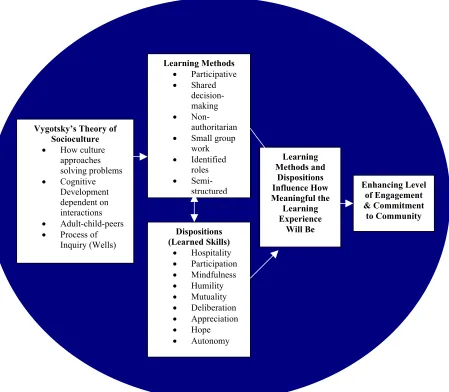
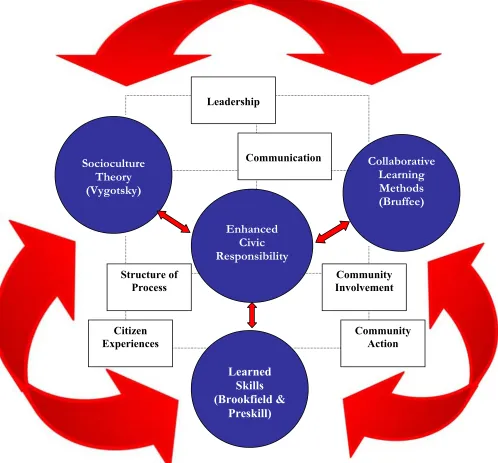
Figure. 1. Conceptual Framework page 39
Figure 2a. Reno’s Conceptual Framework for Enhanced page 116 Civic Engagement
C H A P T E R 1 : I N T R O D U C T I O N
“In a democratic community, the need for and the stress on democratic values, civic understanding and the readiness and willingness to participate in community decision-making should be a thread that runs through all our education.”
Chapman & Aspen, 1997, p. 170
Identifying The Problem
During the past three decades, civic well being of our nation has declined. Differing
agencies continue to address greater concern for youth civic disengagement (Fredericks, Kaplain,
& Zeisler, 2001; Delli Carpini, 2002; and Branson, 1999). In 1999, the “New Millennium Project”
reported by the National Association of Secretaries of State (NASS) found, in general, youth lack
knowledge, interest and trust concerning American politics and public life (Branson, 1999).
Disengagement occurs most often when those who are affected by decisions are not included in
decision-making and implementation processes (Fredericks, Kaplan & Zeisler, 2001). However,
adults are leading contenders in making decisions for resources and programs in communities,
which ultimately affect the youth adults serve.
Delli Carpini (2002) describes engaged citizens having “motivations, resources, [and
opportunities] to participate effectively in public life in a variety of ways” (p. 3). He suggests one’s
attitude, resources and behavior to influence the level of civic engagement. Delli Carpini suggests
when a person believes their participation is valued and contributing to the cause, the more civic
minded he or she will be. He proposes a person’s belief that he or she can make a difference in the
community means that he or she will feel more connected to the environment, which leads to
feeling valued more within the experience. Klindera, Menerweld and Norman (2001) propose
youth being viewed as equal partners in settings of decision-making provides adults an opportunity
to see youth as “thoughtful and contributing people” (p. 1). Therefore, having youth and adults
making decisions within the same setting may assist adults in developing new perspectives and
changing attitudes regarding youth’s ability to be contributing members in a community.
Youth-Adult Partnerships
The idea for youth-adult partnerships dates back to 1974 during the National
Commission on Resources for Youth. The Commission stated “there is mutuality in teaching
and learning and where each age group sees itself as a resource for the other and offers what it
uniquely can provide” (National Commission on Resources for Youth, 1974, p. 227). Camino
(2000a) argues for mutuality within teaching and learning, as well as the power provided to youth
in decision-making to define whether the youth-adult relationship will be one of partner or one
of authority. Camino’s research found adults experiencing greater difficulty than youth in
developing a mutual relationship across age groups. She proposes community action will more
likely be achieved when using cooperative methods within the decision-making process. She also
recommends youth and adults having equal opportunity to be heard and being flexible and open
to different perspectives within the decision-making process.
Collins and Branham (1999) suggest creating collaborative opportunities, inclusive of
youth and adults, as an essential avenue towards enhancing the youth civic engagement
movement. They suggest collaborative opportunities influence betterment of the entire
community. The “New Millennium Project” reported youth’s belief that utilizing a participatory
approach to teaching government courses encourages youth involvement in the community
(Branson, 1999). By participating in a communal process of decision-making, the sense of
ownership and empowerment through self-fulfillment increases because the outcomes are
understood (Kothari, 1996). Camino (2000b), and Hoover and Weisenbach (1999) concur that
youth need to be active members in the decision-making process. Developmentally, providing
youth opportunities to participate leads to fulfilling needs for belonging and independence
(Kothari, 1996), as well as stronger communication and leadership skills, improved competencies
and higher self-esteem (Kothari, 1996; Kirby & Coyle, 1997).
Role of Education
Since the founding of this nation, higher education institutions have been perceived as
resources to its surrounding communities (Urban & Wagoner, 2000; Boyte & Kari, 2000). As a
participant in creating a nation, Thomas Jefferson believed educational ideals needed to be
interconnected within political theory in order for change to occur. Education and politics were
one in the same (Urban & Wagoner, 2000; Jewett, 1997). Jefferson’s framework reflected the
Enlightenment period, which continues to assist in shaping America. Enlightenment implied
offering, “hope, welcomed change, and questioned entrenched authority” (Urban & Wagoner,
2000, p. 62). True believers of the Enlightenment rationalized no need to regulate human action
once the concept of natural order was understood by community as a whole (Urgan & Wagoner,
2000). Education was central to this rationalization. Educational institutions were viewed as the
resource, which housed these educational opportunities for its surrounding regions.
Pubic education continues to state its purpose today: to educate the student who lives
within the borders of the state (Colgan, 1994). Boyte and Kari (2000) and Colgan (1994) contend
higher education needs to revert back to Thomas Jefferson’s original ideal, which was to
promote public citizenry. The document, World Declaration of Higher Education for the Twenty-First
Century (1998), stressed the need for higher education institutions to become more aware of the importance of socio-cultural and economic development. The document emphasized
education’s responsibility to engage its citizens in democratic and accessible education to better
meet the needs of the community.
The Organization for Economic Co-Operation and Development (OECD) (1998)
contends that higher education institutions are receiving greater pressure from government to
contribute to regional development. Although most institutions’ mission statements promote
regional development, the challenge for institutions is to become more grounded in their
understanding of engagement in the development process. The UNESCO’s, Framework for
Priority Action for Change and Development of Higher Education (1998), states “government and policy makers should develop innovative schemes of collaboration between institutions of higher
education and different sectors of community to ensure that higher education and research
programmes effectively contribute to local, regional and national development” (p. 16). OECD
(1998) proposes higher education institutions need to shift from material to non-material assets
like knowledge, skills, and culture, and view regional citizens as important contributors to the
development of political and economic activities.
Thanki (1999) views higher education’s role within regional development as a valuable
asset because the university is a product of the region. Forrant, et. al. (2001) provide insight to how
the University of Massachusetts at Lowell has engaged in research around the role of the public
university and its responsibility as an active participant in the process of regional development. The
university has established interdisciplinary, cross-campus partnerships to collaboratively provide
resources to the community. Higher education institutions (HEI) that are able to expand their
knowledge on characteristics, which define the local region, will be able to identify ways to better
serve the stakeholders within its community. Stakeholders within HEI’s are those organizations
and people who have the potential to interact with institutions. Ultimately, higher education
institutions should view their role as being the “gateway” to the community (OECD, 1999).
Mawby (1998) stresses the point that higher education is in a state of crisis concerning a
positive public image. He iterates decision-makers have little confidence in higher education
institutions’ understanding of needs in community or how the institution should serve the
community to meet societal aspirations. Mawby argues that strengthening
collaborations with the youth and families is “credible response” to the crisis facing institutions
today. Providing youth a voice in community collaborations may assist to promote public citizenry,
particularly since they may soon enroll in these institutions. One community collaboration, which
institutions have begun to embrace, is the concept of sustainable community development
(Forrant, et. al., 2001; OECD, 1999). Higher education institutions seeing youth and families as
contributors, and providing opportunities to actively participate in community decisions, Mawby
(1998) argues, will be a contributing element towards building community support for higher
education.
Need for Project
Martin county in North Carolina has engaged the process of developing a Sustainable
Community Plan for its community. Sustainability is viewed as an on-going process, in which
citizens address current needs, while not limiting their ability to meet needs of future generations
within the community (Forrant, et. al., 2001). Developing a vision towards establishing a
sustainable community requires the local community to consider at least three factors: economic
development (Huckle & Sterling, 1996), environmental stewardship (Roseland, 1998), and quality
of life (Flint & Houser, 2001). The first two characteristics are straightforward factors and easier to
understand. However, quality of life involves consideration of many social aspects of the
community. It involves asking all community members, or stakeholders, to engage in making
long-term decisions about what he or she wants the community to look like in the future (Flint &
Houser, 2001). Youth, who are the leaders of tomorrow, are also valuable resources and emerging
leaders of today (Delli Carpini, 2002; Guajardo & Graber, 2002). This community believes it is
imperative to engage youth in assisting to identify needs within the community, as well as
envisioning what the leaders of today and tomorrow want their community to be in the future for
it to be sustainable.
Statement Of Problem
Current research shows that most youth are more likely to be disengaged than engaged in
civic issues (Galston, 2001; Hudson & Robinson & Robinson, 2001). Youth disengagement is
disconcerting because youth have played a vital part in civic life since WWII (Delli Carpini, 2002).
The continuance of democracy is dependent on American youth. How civically engaged youth are
today will determine how engaged they will be in the future (Delli Carpini, 2002). Research shows
that youth who are actively involved in community planning are more likely to be civic minded
(Fredericks, Kaplan, & Zeisler, 2001; Delli Carpini, 2000). Youth who are civically engaged are
more likely to have a positive relationship with the community; preserving the community as well
as enhancing the community (Camino, 2000a). Viewing youth as a central entity within the
creation of solutions can assist in bridging relations among youth, adults, and the community at
large. Fredericks, Kaplan, & Zeisler describe the concept of youth voice as involving the “inclusion
of young people as a meaningful part of the creation and implementation” of the solutions which
affect them (2001, p. 1). Although research has shown collaborative methods valuable in
enhancing the level of satisfaction and commitment towards achieving desired outcomes, emerging
research suggests a greater need to explore how collaborative methods and the interactions
between youth and adults influence civic mindedness (Kirby & Coyle, 2001; Zeldin, McDaniels,
Topitzes, & Lorens, 2001). Embracing a more collaborative approach in the decision-making
process assisted youth-adult relationships by fostering mutuality within the teaching, learning and
action of results (Zeldin, McDaniel, Topitzes, & Lorens, 2001).
Galston (2001) suggests one contributing factor for decline in civic engagement is lack of
civic knowledge. As concern for youth civic engagement increases, the need for educators and
practitioners to consider how youth-adult interactions influence the experience continue to grow
(Hughes & Curnan, 2000). In the field of education, research shows societal influences (Feldman,
2000), collaborative methods (Bruffee, 1999, Thompkins, 2001), and learned skills (Brookfield,
1999) as important variables to consider within the learning experience. However, little research
had been done to explore how these variables relate to one another within the process of
decision-making. Therefore, in order to better understand how youth-adult interactions can enhance the
level of civic engagement, further research needed to explore the relationship between how a
community approaches problem-solving and what learned skills used within the decision-making
process better assist in providing a more meaningful experience for those involved in the process.
This new knowledge will foster greater civic engagement among youth, more informed dialogue,
and more meaningful ways to engage all citizens in the decision-making process.
Purpose Of Study
The overall purpose of this phenomenological case study was to describe how
collaborative experiences influence civic engagement. The study addressed how a community
approaches problem-solving, and what learned skills used within the decision-making process,
better assist in providing a more meaningful experience for those involved in civic engagement
processes. The study also explored whether change in perception of the youth-adult interaction
influenced how meaningful the experience was for those involved; and if there was a change in
perception, if this contributed to a greater level of civic engagement and commitment from the
participants? To explore the phenomena, the study addressed the following two questions: (1)
How do youth and adults who are engaged in developing a sustainable development plan describe
their experience within the process of the project? and (2) What role does the implementation of a
collaborative method play in enhancing civic engagement involving both youth and adults, if any?
Significance Of Study
The founding ideals of Thomas Jefferson instilled in the American people, fostered a sense
of hope, faith and responsibility for fostering a democratic community. In a letter to James
Madison, Jefferson wrote, “The people are the only sure reliance for the preservation of our
liberty” (Pangle & Pangle, 1993, p. 74). Jefferson proposed education’s main purpose was to assist
citizens in managing concerns of community (Pangle & Pangle, 1993). Centuries later, education
continues to embrace Jefferson’s concept for engaging local citizens on how to best manage, or
sustain, their own communities as a central entity for sustainability (Forrant, et. Al., 2001). The
document, World Declaration on Higher Education for the twenty-first Century: Vision and Action (1998),
declared higher education’s core mission was “to educate, to train, to undertake research and to
provide services to the community [and] must be preserved, reinforced and expanded”
(http://www.unesco.org, retrieved on September 12, 2002). The document also declared higher
education’s need to better integrate with the whole educational system, specifically with secondary
education. Quality of services higher education needs to provide should be connected with the
solutions of problems within its communities (http://www.unesco.org, retrieved on September
12, 2002).
As research continues to explore education’s role in re-connecting with its regional
communities (Figueira-McDonough, 2001; Sherman & Torbert, 2000; Forrant, et. Al., 2001), it
also suggests youth voice is central to creating solutions for community development (Chibucos
&Lerner, 1999; Branson, 1999; UNESCO, 1998), as well as sustainability (Forrant, et. Al., 2001).
Although research has identified engaging citizens, both youth and adults, in community
decision-making, research in sustainability has not described what bearing the process plays when engaging
local citizens, specifically youth, or how the process may or may not lead to the participants having
a more meaningful experience within the process.
This study sought to explore how mutual relationship between community involvement
and educational involvements contribute to the framework for developing a sustainable plan. New
knowledge in this area will contribute to practitioners, educators, and businesses utilizing shared
knowledge and resources. This new knowledge will also assist citizens becoming more aware of
community affairs and how they can contribute to sustaining their future. The significance of the
current study also provides new knowledge on the integration of learning methods inside and
outside of the classrooms. The study sought to explore how youth and adult interaction
contributes to the cognitive development process. The study also sought to explore how learned
skills (or attributes) within the structure of small group learning methods contribute to the
meaningfulness of the experience. Although research has been done on youth-adult partnerships
(or learning experiences in decision-making) within youth organizations, this study was based
within the school setting, yet not associated specifically with classroom experiences. Educators
integrating community issues into class experiences may lead to youth who are more civic-minded.
The current study also expands on the knowledge National 4-H Council and other youth
organizations have contributed to the body of knowledge valuing youth-adult partnerships
enhancing the youth development movement.
Limitations of Study
There are several limitations within the current study. One contributing limitation was
each school’s flexibility to design the collaborative method implemented within the school, as
well as each school structuring the format of the gatherings differently. Some schools chose to
do the gatherings on multiple days and one chose to do the events in one day. And one school
chose to not have an opening session for their students and cancelled the large group session
due to academic priorities. This limited the ability to see a broad range of continuity from school
to school. Another limitation was how the elite participants were selected to participate in the
study. Most school officials selected the participants from their school. There was only one
young person who participated in the initial interview phase that was not originally selected by
the school principal. The two participants who self-selected not to complete the second
interview also brings a limitation to the study. It is a limitation because this school was not
represented in the final analysis describing the group experiences or if perspectives changed due
to experiences. Another limitation is that all nine elite participants did not participate in both
interviews, minimizing the validity of participant perspective through the experience.
Participants at one school were interviewed after the experiences but not before the
experiences. However, these participants were asked a majority of the questions, which guided
the initial interview during the second interview phase. Finally, my dual role as researcher and
professional, coordinating the project, may have contributed to study bias. However, several
strategies were implemented to minimize subjectivity: offering participants the opportunity to
review my findings to determine whether my findings were accurate; attempting to portray
discrepant information within my findings respective to differing participant perspectives;
identifying someone with whom I could debrief the process of the study to enhance the accuracy
of the context; and identifying someone to check the accuracy of my coding and presenting the
data ethically.
The next sections address the conceptual framework for the study as well as the
methodological approach used to explore the phenomena of engaging youth and adults in
developing a sustainable community plan for their community.
GLOSSARY
Collaboration. A mutually beneficial relationship between two or more parties who work toward common goals by sharing responsibility, authority, and accountability for achieving results…The purpose of collaboration is to create a shared vision and joint strategies to address concerns that go beyond the purpose of any particular party (Chrislip & Larson, 1994, p. 5).
Collaborative Learning Method. An activity to engage individuals, young people and adults in active exchanges of ideas within small group settings. Collaborative learning has been viewed as a part of a broader movement towards a “participatory democracy, shared decision-making, and non-authoritarian style of leadership and group life” (Bruffee, as cited in Trimbur, 1989, p. 605).
Community Development. Engaging all members in a project or process, both youth and adults, and inviting everyone to actively participate in the discussion, and appreciating what each person can possibly contribute to the conversation. Community development also means bringing people to the table not normally provided the opportunity to have a voice, especially the young people.
Discussion. An alternately serious and playful effort by a group of two or more to share views and engage in mutual and reciprocal critique (Brookfield, 1999, p. 6).
Sustainable Community Development. A continual course of action towards preserving a community by implementing approaches, which engage all constituents/stakeholders in future oriented decision-making around economic development, transportation systems, community design, and resource use within the local constituency. It involves “meeting the needs of the present without compromising the ability of future generations to meet their own needs” (Daniels, 2001, p. 1).
Visioning Process. Visioning involves “bringing together community members, environmental and social groups, and representatives from the private and public sector for a series of discussions about where a community should be headed” (Daniels, 2001, p. 11).
Youth. Individuals who are 12-19 years of age.
Youth Voice. “The inclusion of young people as a meaningful part of the creation and
implementation” of the solutions, which affect them (Fredericks, Kaplan & Zeisler, 2001, p. 1).
C H A P T E R 2 : C O N C E P T U A L F R A M E W O R K
“Youth voice is not about young people taking over. It is about young people and adults working together in partnerships based on mutual respect.”
Beilenson, 1993, p. 11
Introduction
The conceptual framework is viewed as the element within research, which provides
understanding and direction for underlying assumptions guiding a study (Babbie, 1998). The
conceptual framework should provide the reader an “[1] understanding and belief; [2] mak[e] sense
of things, and [3] hav[e] a coherent picture of [the holistic construct] being studied (Farmer &
Rojowski, 2001, p. 87). It is a process of theorizing frameworks of knowledge, which explain a
certain phenomena. Integrating different concepts and identifying areas lacking within research
assist to identify areas in need, for further exploration (Farmer & Rojowski, 2001). Vygotsky
(1986), Feldman (2000Meacham (2001), Bruffee (1999), and Thompkins (2001) have conducted
research pertaining to the relationship between the cognitive development process and
collaborative learning methods. Brookfield and Preskill (1999) have researched how learned skills
or attributes enhance the learning experience in the classroom. However, I believe societal
influences, implemented methods, and skills or attributes present within the learning experience
can also be applied within any context. For the purpose of this study, the context focuses on the
process of community decision-making. This chapter provides the reader a holistic perspective,
integrating theory and concepts that assist in describing the conceptual framework guiding the
current study.
Concern For Civic Engagement
Engaging youth as mutual partners in the structural framework for making decisions
concerning the community is an essential component towards enhancing the likelihood of youth
becoming more civic-minded. In, A Tribe A Part, Hersch (1998) advocates individuals should look
at adult culture first, to better understand the youth culture and adolescent needs. Hersch suggests
today’s youth spend more time alone than any other generation, which contributes to lacking a
sense of community. Understanding the essence of adolescence assists communities to begin to
understand benefits of involving both youth and adults in decision-making; and how mutual
involvement contributes to the development process. Hersch (1998) recollects from a
conversation with a youth, his perspective of adolescence. This young man described it as,
[A] journey, a search for self in every dimension of being. It is about dreams, fears, and hopes, as much as about hormones, SAT scores, and fashion. It is about endless possibilities as well as dead ends. It is searching, testing, and
experimentation. It is growth: it is undeniable that the young person at any one point in time will be different one year later – different physically, intellectually, emotionally, and experimentally.” (p. 17)
This epiphany from an adolescent perspective provides greater insight for how an adolescent is
processing this stage of his life and searching for self-identity. At the heart of adolescent years
youth are faced with the need to fit in with peers, and finding their own identity. However, youth
also desire to fit into the adult community; realizing they will soon be an adult.
These developmental years, when the adolescent is learning how to be him or herself,
filtering societal perspectives, and trying to make sense of his or her world, Brown (1996)
proposes that adult perspectives on youth culture are non-supportive for assisting youth through
this endeavor. Brown’s work is grounded in the adolescent role and norm transitions, taking a
developmental and contextual perspective (Brown, 1990). His research suggests adult attitudes
toward youth culture as a barrier. When asking adults to describe adolescents, 78 percent of the
categories were negative attributes. He also reported only 38 percent of adults believe today’s
young people are able to make America a better place to live in the future. Youth are also viewed
as poor decision-makers. The Innovation Center for Community and Youth Development
(2001) reported the findings of an ethnographic study involving 186 countries concluding that
young people in America are more excluded from community decision-making than in any other
country studied. Eliminating young people from decision-making processes minimizes
opportunity to overcome false stereotyping, skepticism or hard feelings. Elimination of youth
also minimizes the opportunity for youth to interact and learn from adults on how to be more
successful in decision-making skills and practices.
Chapman and Aspin (1997) propose involving schools in the communities as one way to
create social change. They suggest civic engagement will only be enhanced if civic education is
integrated into school curriculum. Chapman and Aspin believe people will more likely participate
in community decision-making when individuals are informed and educated on their rights and
responsibilities as citizens. Civic education involves,
• “educating young people in democratic understanding;
• promoting opportunities for parents and members of the community to participate in
school decision-making; [and]
• promoting involvement in community agencies in the life of the school” (p. 170).
Formal education (primary, secondary, and higher) has the ability to be viewed as a vital
connector and resource for its citizens and building community.
Galston (2001) proposes that recent research finds a correlation between “civic
information and civic attributes” (p. 2). He states that political knowledge of high school and
college graduates has declined over the past half century. He suggests two contributing factors to
this decline in political knowledge: (1) effectiveness of formal civic instruction decreases and (2)
weakness in outside processes. Galston proposes civic engagement of community members is
enhanced by how informed one is and by how one comes to understand the civic knowledge
provided. He contends greater civic knowledge increases consistency on community views and
assists individuals in becoming less skeptical of public affairs. Galston states, “Ignorance is the
father of fear, and knowledge is the mother of trust” (p. 3). Finally, Galston proposes civic
knowledge supports democratic values and, ultimately, assists individuals becoming more
participative in issues pertaining to community.
Niemi and Hepburn (1995) suggest civic instruction is vital during adolescence and early
adulthood because of psychological and social changes occurring within individuals. He also
stresses the importance of educators assessing civic instruction because those are the years during
which our community characteristically educates youth on citizen responsibility through course
work. His research suggests civic instruction integrated during adolescence and young adulthood
contributes to lifelong civic engagement.
Higher Educations Role
Chapman & Aspen (1997) state, “In a democratic community, the need for and the stress
on democratic values, civic understanding and the readiness and willingness to participate in
community decision-making should be a thread that runs through all our education” (p. 170). One
might suggest higher education’s role within regional development is a resource for educating
surrounding communities on the importance of being civically engaged in community. The
Organization for Economic Co-Operation and Development (OECD) (1998) contends higher
education institutions are receiving greater pressure from government to contribute to its regional
development. Although most institutions’ mission statements promote regional development, the
challenge for institutions is to become more grounded in their understanding of engagement in the
development process. The UNESCO’s, Framework for Priority Action for Change and
Development of Higher Education (1998), states “government and policy makers should develop
innovative schemes of collaboration between institutions of higher education and different sectors
of community to ensure that higher education and research programmes effectively contribute to
local, regional and national development” (p. 16). OECD (1998) proposes higher education
institutions need to shift from material to non-material assets like knowledge, skills, and culture,
and view regional citizens as important contributors to development of political and economic
activities.
Thanki (1999) views higher education’s role within regional development as a valuable
asset because the university is a product of the region. The University of Massachusetts at
Lowell has engaged in research around the role of the public university and its responsibility as
an active participant in the process of regional development (Forrant, 2001). The university has
established interdisciplinary, cross-campus partnerships to collaboratively provide resources to
the community. University of Massachusetts at Lowell’s sustainable community development
embraces this concept of community collaborations. Forrant suggests strategic planning is only
successful with regional development through reflection and continuous dialog with all members
involved in the process: students, staff, faculty, enterprises, administrators, and community
members. The current study focuses on the structure and processes involving youth in deciding
what are assets and non-assets in the community. Therefore, I will not elaborate on the concept
of sustainability, other than the importance of knowing fundamental elements of sustainability:
environment, education, community, economy, and amenities.
Daniels (2001) elaborates on how the institution can assist in community sustainability.
One element that contributes to sustainability is civic instruction and using service-learning within
instruction. Kaiser-Drobney (2001) states service-learning can lead to empowerment. She
developed a model for engaging secondary-aged students in this form of learning through, “The I
CARE Model”.
“I” stands for Identify, introducing the importance of individuals or groups to identify
assets and needs necessary to address within the community, as well as who is more appropriate
to address what has been identified. “C” stands for Collaborate. Collaboration involves identifying
ways to best partner with community members or organizations to tackle the identified
objective. “A”, or Act, represents need for authenticity within activity in order to meet
community needs and appropriate academic needs of students. “R” refers to importance of
Reflecting on experiences. What have people learned from participating in the process and what steps need to be taken next. Finally, “E” represents Encourage. It is important to acknowledge
work and contributions done by those involved in the process. Kaiser-Drobney also suggests
encouraging as addressing need for creating reports that summarize experiences; evaluate the experiences; refine goals and objectives for future experiences; as well as beginning the process
again for identifying areas of need and assets to better the community.
Although Kaiser-Drobney’s research addresses service-learning methods with youth that
are task-oriented in community settings, like food shelters, I suggest service-learning can also
occur within the context of the school setting Galston (2001) proposes the importance of
integrating civic knowledge in school curriculum, while Brown (2001) proposes that involving
youth in decision-making assists youth in becoming more civically engaged. Therefore,
integrating a collaborative decision-making method and service-learning method within the
school potentially enhances the civic engagement process.
Youth-Adult Partnerships
According to Collins and Branham (1999), creating collaborative opportunities, inclusive
of youth and adults, is an essential avenue towards enhancing youth civic engagement movements.
They suggest collaborative opportunities enhance quality of life within communities. The “New
Millennium Project” reported young people’s belief that utilizing a participatory approach to
teaching government courses encourages youth involvement in the community (Branson, 1999).
By participating in a communal process of decision-making, the sense of ownership and
empowerment through self-fulfillment increases because the outcomes are understood (Kothari,
1996).
Camino’s (2000b) research supports the need for youth to become active members in the
decision-making process. In order for social change to occur, Camino asserts the need to
demonstrate specific practices within the youth-adult partnership. Mutuality within teaching and
learning, as well as how empowered youth are within decision-making contributes to whether
the youth-adult relationship will be one of partner or one of authority (Camino, 2000a).
Camino’s research found adults have greater difficulty than youth in developing a mutual
relationship across generations. Camino proposes community action will more likely be achieved
when using cooperative methods within the decision-making process. She also recommends
equal opportunity for youth and adults having to be heard and being flexible and open to
different perspectives within the decision-making process. Communication and coaching were
additional elements described by Camino to contribute to the youth viewing their role as
important and meaningful to the partnership. The conceptual framework for this study
integrates the holistic concepts identified by Camino; however, the framework also suggests
collaborative methods benefit youth-adult partnerships.
Zeldin, et. al. (2001) found both youth and adults benefit greatly when mutually involved
in community decision-making. Although some adults had unconsciously stereotyped youth,
Zeldin described how perceptions of youth competence increased when both youth and adults
were making decisions within youth programming organizations. Adults described the youth as
competent and “crucial contributors” (p. 1) to the decision-making process. Zeldin also found
level of commitment and energy of adults enhanced because of the youth’s involvement in the
decision-making process. The adults also became more committed to the community. One adult
voiced, “Youth bring energy, fresh perspectives, knowledge of young people, and a sense of
community to decision-making processes” (p. 3).
While youth bring new perspective and energy, youth described adults as bringing
knowledge and experience to decision-making processes. Zeldin proposes mutuality among youth
and adults to create “synergy” (p. 4). If youth do not play a significant role within the structure of
the decision-making process, synergy will less likely occur within the experience. He suggests
attitudes are more likely to change when interactions are goal-oriented and have a clearly defined
purpose, occur over an extended amount of time, and outcomes are perceived as meaningful
(Innovation Center for Community and Youth Development and National 4-H Council, 2001).
Although this research supports the framework of the current study, the research is based on
youth involvement in organizations. The current study seeks to explore how this knowledge can be
implemented in the community, specifically within the school setting.
A Soc ocultural Perspective i
Understanding the elements within the adolescents’ cognitive development process will
contribute to educators and practitioners gaining greater insight for how group work activities
assist individuals in achieving higher levels of thought. This new knowledge will also provide
implications for educators on how group work contributes to cognitive development processes.
Finally, understanding how particular learning methods influence participant commitment within
experiences will also assist educators and practitioners in working within a small group experience.
Thompkins (2001) suggests an effective group involves all members in the group having an
opportunity to contribute to the formation of knowledge being developed. Vygotsky (1962, 1978)
and Piaget (1926) emphasized how social interaction contributed to cognitive development process
(referenced from Ben-Ari & Kedem-Friedrich, 2000). However, Vygotsky (1926/1997) proposed
the way in which cultures and societies approached problems influenced how an individual’s
cognitive development progressed through life. Vygotsky, unlike Piaget (1952), also viewed
cognitive development as dependent on interactions with others. He also believed children gained
greater understanding for how the world functioned through problem-solving exchanges with
adults and other peers (Feldman, 2000; Meacham, 2001). Vygotsky’s (1926/1978) sociocultural
theory assists in understanding factors that are meaningful to a given culture. What children learn
from their culture influences the type of skills he or she will develop (Feldman, 2000). Fernyhough
(1997) contends that in order for a child to fully develop his or her , thinking processes, beliefs,
and values, the creation of an adult-child partnership must be present.
Brookfield and Preskill (1999) elaborate on how Vygotsky’s theory extends throughout the
lifespan. Vygotsky’s research demonstrated an infant’s experience reaching for a spoon. They
proposed that the infant’s desire for relationship with the spoon and the spoon not responding, led
the infant to make several attempts to get the spoon to respond. Not until the mother responded
by pushing the spoon closer to the infant’s reach, did a relationship occur. However, the learning
experience occurred collaboratively with the mother and child, instead of with the spoon and child.
Vygotsky concluded that knowing is a process involving other people. Collaborative learning
occurred with the child comprehending that reaching for the spoon triggers a response from the
mother and the mother comprehending when the child is reaching for the spoon, she assists in the
learning by pushing the spoon closer to the infant.
As individuals develop, previous knowledge is stored and used in new knowledge
experiences (Brookfield and Preskill, 1999). They suggest experiences become more complex
through the lifelong learning process. A tool used to assist in solving problems is speech. Bruffee
contends Vygotsky’s theory suggests the most critical moment in intellectual development is when
speech and practical activity merge. Brookfield and Preskill state,
As a result of this engagement of speech in learning and thought, every function in our cultural development appears twice: first, on the social level, and later, on the individual level; first, between people…, and then inside. Instrumental speech therefore both helps us do everything we attempt to do and socializes everything we do. Conversation – direct, indirect, or internalized – makes even solitary tasks into collaborative ones. Once we begin to use speech instrumentally, we work together, whether we work together or apart. (p. 139).
“Dorm rapping,” during the college years, suggests the inseparability of knowledge,
discussion, emotional engagement, and social relationship to be inseparable. They propose the
process of working through problems continues to be collaborative, as in childhood. However, the
process is done internally instead of externally. As an adult, external problem-solving occurs when
stress arises or new knowledge formation occurs. The complexity of situations may differ from
infancy to adulthood, but the process for understanding the situation is the same. Vygotsky
(1926/1997) calls this the zone of proximal development.
A central entity to Vygosky’s theory is the state in which an individual enters the zone of
proximal development (ZPD). The zone of proximal development is the innermost part of
Vygosky’s theoretical construct (Doolittle, 1995). The potential for cognitive growth is contingent
on what he or she can accomplish alone (focusing on the lower end of cognitive growth) and what
he or she can achieve with assistance from a more knowledgeable person (focusing on the upper
end of cognitive growth). “What lies in the zone of proximal development at one stage is realized
and moves to the level of actual development at a second. In other words, what the child is able to
do in collaboration today he [or she] will be able to do independently tomorrow” (Vygosky, 1987,
p. 211).
Feldman (2000) describes Vygosky’s concept for this period of development as the level at
which a child’s cognitive abilities increase but will not fully be achieved without assistance from
someone who is more competent than he or she. Vygotsky suggests cognitive development will
only progress when there is new information presented by someone who is more skilled in the area
within the proximal development zone. This assistance is also referred to as scaffolding, which is
the support for learning and problem solving that encourages independence and growth.
Scaffolding assists children in contemplating and structuring a task in an appropriate manner. The
successful completion of a task allows the child to then model how to complete the task to
someone who is in the proximal development zone (Roggoff, 1995). Vygotsky (1986) suggests the
next step for the individual is for him or her to reach a “new level of consciousness” (p. 203). This
new knowledge is formed when the individual is able to comprehend multiple concepts and make
connections between them creating new knowledge (Meacham, 2001). Although critics suggest
Vygotsky’s precision for his conceptualization of cognitive growth is limited and lacking focus on
how specific information is processed and synthesized within the cognitive development
framework, his work has contributed significantly to understanding the importance of cultural,
societal and relationships in enhancing the cognitive development process (Feldman, 2000).
Thompkins (2001) contends the Vygoskian view suggests social interactions (direct or
indirect) as the intermediary avenue for knowledge construction utilizing different forms of
communication. Such forms consist of expressions, actions, and written and oral language. Lee
and Smajorinsky (2000) identify four principles that reflect Vygosky’s theory:
• learning to intercede initially on an interpsychological level cultivating personal
cultural pieces with those that others possess, which then transcends into an
intrapsychological level.
• learning intrapsychologically involves interactions with a more knowledgeable
person, also known as scaffolding.
• influencing individual cultural expectations and personal history based on concepts
of meaning, which is established through strategies the individual possesses.
• learning is a constant process and learning outcomes are based on prior knowledge,
makeup of the activity, structure of the learning setting, and quality of social
interaction among members in the group.
Learning takes place through the process of inquiry. The inquiry process involves a period
of time for an individual to question, explore and develop meaning with the information being
filtered and ultimately synthesized. There are two overlapping learning communities in the
classroom setting: (a) teacher and student and (b) professional team utilizing the classroom
experience as professional development (Lee & Smargorinsky, 2000). Therefore, integration of
teaching methods that includes group work, assists students in the learning process. Although the
current study’s focus centered around non-formal learning methods outside the classroom, I
suggest collaborative learning methods are beneficial in any context working towards solving
problems or engaging in conversation about issues that affect those involved in the process. Two
known teaching methods inclusive of group activities are cooperative and collaborative learning
methods, which will be discussed in depth in the next section of the chapter.
Integrating Learning Methods
One aspect of formal education is to provide individuals different avenues for achieving
higher levels of thinking or learning. Bruffee (1984) suggests learning opportunities are a process
by which one recognizes what is occurring around him or her and joins in on the conversation.
There are many different practices educators apply to assist students in achieving higher levels of
thought or progression through the cognitive development process. Practices are either formal
(traditional) or non-formal (non-traditional). Traditional practices tend to be directive, oriented on
lecture, and utilize minimal interaction between peers. Teachers’ questions do not demonstrate
higher cognitive level thinking because answers require factual information without any
opportunity to explain answers further (Adams & Krockover, 1999). Non-formal learning
practices incorporate small group exercises, which support opportunities for creative
problem-solving, conceptual learning, and oral language proficiency enhancement (Cohen, 1986).
Cooperative and collaborative learning are two theories that reflect Vygotsky’s philosophy of
cognitive development. Cooperative and collaborative learning theories focus the value of working
in small groups for the learning process (Feldman, 2000) and for creating independence that is
critical in sustainability.
Cooperative learning methods are designed more for practitioners working in primary
education. Two goals of cooperative learning are to create an environment where individuals work
respectfully together and strive to overcome cultural biases (Bruffee, 1995). Cooperative learning
focuses on designing activities for groups that involve tasks, problems, and projects (Hamm &
Adams, 1992). Being confronted with multiple interpretations of a particular situation enhances
the critical thinking process and assists to understand multiple perspectives (Bruner, 1996).
Supporters of cooperative learning suggest that problem solving in conjunction with others
encourages individuals to be more alert. When individuals are interacting and conversing with
others in a team assignment, all members become more involved in the learning process (Hamm
& Adams, 1992). Hamm and Adams (1992) suggest that engaging students in the learning process
will encourage individuals to make connections between new information and prior knowledge.
Practitioners of cooperative learning believe individuals gain greater understanding of the world
through interaction with others. Hamm and Adams also suggests creating a learning environment
that supports an individual informally struggling with ideas before shaping his or her thinking
framework to be critical in the developmental process.
Researchers (Nevin, Smith, & Udvari-Solner, 1999; West & Oldfather, 1996; Doolittle,
1995) portray cooperative learning experiences as instructional methods that are adaptable to many
grade levels and subject areas. The heterogeneous setting is structured to support peer interaction,
positive interdependence, and individual accountability, as well as interpersonal skill development.
Students view one another as resources. Students are also expected to meet group expectations.
Success is achieved through the success of all members in the group instead of success been
achieved individually. Adams and Hamm’s (1990) report research on cooperative learning to
enhance academic performance with low and high achievement students. These authors also
suggest individual initiative, self-esteem, and social relations are improved during a cooperative
learning method. The small group setting provides students an opportunity to ask questions and
challenge peer perspectives within a safe setting. When structuring learning activities in small
groups, Adams and Hamm recommend teachers to organize desks in a circle, provide expectations
for behavior, assign roles to each member (facilitator, checker, reader, recorder, and encourager),
and allow all students to be active participants in the evaluation process.
The goal of collaborative learning is to engage individuals in active exchanges of ideas
within small group settings. Collaborative learning has been viewed as a part of a broader
movement towards a “participatory democracy, shared decision-making, and non-authoritarian
styles of leadership and group life” (Bruffee, in Trimbur, 1989, p. 605). Proponents of this learning
method suggest this framework increases interest among group members. It also promotes critical
thinking on the topic (Gokhale, as cited in http://scholar.lib.vt.ejournals, May 1, 2002).
Collaborative learning is considered a process of negotiation and collective decision-making. The
opportunity for individuals to share and be engaged in the learning process, assists individuals in
taking ownership and becoming critical thinkers (Trimbur, 1989).
A collaborative community encourages a shared responsibility for learning and seeks to
promote continued conversation among individuals within the setting. Learning is achieved
through interactions with others. Collaborative experiences have been viewed as an indirect form
of teaching where problems are presented to the student to solve within a small group setting.
There are no assigned roles provided to members in the group, instead, roles emerge within the
group experience (West and Oldfather, 1996).
Bruffee (1999) extends the method of collaborative experiences provide an opportunity for
individuals to engage in conversation and reflective thought. Conversation is the most significant
context during collaborative experiences. Individual knowledge is established and preserved within
the community of knowledgeable peers. Normal discourse and dialog occurs by members in a
group during the process of collaborative experiences. During the phase of discourse, individuals
process fact with context, which assists individuals in achieving higher levels of thought. It is
important for individuals to challenge beliefs and collectively negotiate development of new
standards of thought. “Education is not a process of assimilating the truth but…a process of
learning to take a hand in what is going on by joining in the conversation of mankind” (p. 647).
Like cooperative learning (Hamm & Adams, 1992), collaborative learning methods have
been proven to enhance individual ability to retain information longer and achieve higher levels of
thought (Gokhale, as cited in http://scholar.lib.vt.ejournals, May 1, 2002). The small group format
assists members in understanding how power can be gained through collaborative conversations
with others (Trimbur, 1989). Vygotsky’s study (1926/1978) supports how collaborative situations
enhance an individual’s ability to perform at higher intellectual levels (Gokhale, in
http://scholar.lib.vt.ejournals, May 1, 2002).
Bruffee (1995/1999) suggests cooperative and collaborative learning are one in the same.
Although there may be some disagreement around terms and practices, the overall goals parallel
one another: learning is achieved at higher critical levels of thinking when working in small group
settings. Bruffee (1999) contends both practices support the idea that human relationships are
central to welfare and success. Cooperative and collaborative practices extend Dewey’s philosophy
viewing school as a social institution and experience as education. Social experience is viewed as
constructive conversation.
Understanding the differences in the two methods assists practitioners in defining what
practices are more appropriate for achieving a desired outcome. First, it is important to understand
that the learning theories were originally developed for two different age populations: cooperative
learning focuses on primary education and collaborative learning focuses on higher education.
However, both practices have been used in secondary education. Practitioners of cooperative
learning assign roles to group members, whereas collaborative practitioners have one person
identified the reporter for the group. In collaborative experiences, the reporter is assigned by
members within the group, and not by the practitioner. Cooperative instructors tend to intervene
and quiz members during the activity as well as assign grades to the group as a whole. However,
collaborative practitioners are not encouraged to evaluate the group process or interrupt the group
during the learning activity (Bruffee, 1995). In college settings, teachers tend to emphasize
self-governance as imperative to the collaborative experience. Level of accountability is not as strong in
collaborative experiences as it is in cooperative experiences, where structure within the group
setting is established and expected during the group activity (Bruffee, 1999).
Both cooperative and collaborative learning attempt to eliminate individual competition,
however, collaborative learning neither encourages nor exploits competition among different
groups. Collaborative learning methods also suggest dissent amongst individuals can be beneficial
to the learning process. Group members that question, rebel against the assignment or others in
the group, are viewed as powerful tools toward understanding and achieving a higher intellectual
level of thought. Collaborative learning contends that an answer presented today may not be the
same tomorrow (Bruffee, 1995). Although critics of collaborative learning believe this method of
learning stifles individual voice and creativity, developmentally both learning methods support
Vygotsky’s (1926/1978) desire to understand how cultural, societal and relations enhance cognitive
development process and engage students in a more meaningful learning experience (Feldman,
2000).
Although research suggests cooperative learning is a learning method beneficial for the
classroom settings, the current study proposed a less authoritative structure for learning as more
beneficial to the overall experience of those involved in decision-making processes. The current
study had co-facilitators (youth and adult) whose responsibilities were mutually shared. However,
the current study supports the need for roles identifying within small group settings (two
facilitators and a recorder). The current study also suggests providing guidelines for the
conversation process and making recommendations for how the structure of small groups to