Implicit Concept-based Image Indexing and Retrieval
for Visual Information Systems
Ibrahim Ahmed Aref Azzam
School of Computer and Mathematical Sciences Faculty of Health, Engineering and Science
Victoria University 2006
This thesis is presented in fulfillment of the requirements for the degree of
Abstract
This thesis focuses on Implicit Concept-based Image Indexing and Retrieval (ICIIR), and the development of a novel method for the indexing and retrieval of images.
Image indexing and retrieval using a concept-based approach involves extraction, modelling and indexing of image content information. Computer vision offers a variety of techniques for searching images in large collections. We propose a method, which involves the development of techniques to enable components of an image to be categorised on the basis of their relative importance within the image in combination with filtered representations. Our method concentrates on matching subparts of images, defined in a variety of ways, in order to find particular objects.
The storage of images involves an implicit, rather than an explicit, indexing scheme. Retrieval of images will then be achieved by application of an algorithm based on this categorisation, which will allow relevant images to be identified and retrieved accurately and efficiently.
We focus on Implicit Concept-based Image Indexing and Retrieval, using fuzzy expert systems, density measure, supporting factors, weights and other attributes of image components to identify and retrieve images.
Declaration
“I, Ibrahim Ahmed Aref Azzam, declare that the PhD thesis entitled Implicit Concept-Based Image Indexing and Retrieval for Visual Information Systems is no more than 100,000 words in length, exclusive of tables, figures, appendices, references and footnotes. This thesis contains no material that has been submitted previously, in whole or part, for the award of any other academic degree or diploma. Except where otherwise indicated, this thesis is my own work”.
Signature Date
A List of External Publications
[1] I. A. Azzam, C.H.C.Leung, J.F. Horwood, “Implicit Concept- based Image Indexing and Retrieval”, The 10th International Multimedia Modeling Conference MMM2004, Jan-2004, Brisbane, pp 354-359.
[2] I. A. Azzam, A. Charlapally, C.H.C.Leung, J.F. Horwood, “Content-based Image Indexing and Retrieval using XML Representation”, 2004 International Symposium on Intelligent Multimedia, Video & Speech Processing, October-2004, Hong Kong, pp 181-185.
[3] I. A. Azzam, C.H.C.Leung, J.F. Horwood, “A Fuzzy Expert System for Concept-based Image Indexing and Retrieval” , T h e 11th International Multimedia Modeling Conference MMM2005, Jan-2005, Melbourne, pp 452-457.
Acknowledgments
I am deeply indebted to my principal supervisor, Professor Clement Leung and my co-supervisor Dr. John Horwood, for their guidance, constant direction, and countless hours of time. I thank both of them for their patience and trust that allowed me perform at full potential. I also appreciate their encouragement and support through the difficult days. I have benefited immeasurably from their tutelage.
I greatly acknowledge Associate Professor Perter Cerone, Head of School of Computer Science and Mathematics and other staff of the School of Computer Science and Mathematics for being supportive and cooperative. I would like to thank my friend, Murad Karrar for his help and advice of technical discussions.
I deeply owe my appreciation to my wife, Laila Aziz Azzam, for her consistent support with trust and love in these years that I was able to do this research. I miss the moments that I could otherwise spend with my children, who understand their father’s reason for returning home late.
Last and not least, I praise GOD for leading me to pursue this dream, answering all my prayers, and fulfilling all my needs during this study.
Contents
Abstract ………..…….. ……. i
Declaration ……… ii
List of External Publications ………. iii
Acknowledgments ………. iv
Contents …………. v
List of Figures ……… xiv
List of Tables ……….xix
1. Introduction and Overview ……….……… 1
1.1 Objectives ………..……… 1
1.2 Thesis Aims ……….. 4
____________________________________________________________________
1.4 Summary of Significance ……….. 6
1.5 Thesis Organization ……… 7
2. Literature Review ………. 10
2.1 Introduction ………. 10
2.2 Methods of Modelling and Retrieving Images ……… 12
2.2.1 Concept-based Methods ………. 13
2.2.2 Content-based Methods ………. 16
2.3 Image Indexing and Retrieval ……… 17
2.3.1 Concept-based Image Indexing and Retrieval ………….. 22
2.3.2 Content-based Image Indexing and Retrieval ……… 30
2.3.3 Search efficiency ……… 31
2.3.4 Thesaurus ……… 32
2.3.5 Controlled and Uncontrolled Vocabulary ………...… 33
____________________________________________________________________
2.4 Problems of Existing Image Indexing and Retrieval Methods …… 41
2.4.1 Problems of Concept-based Methods ……….. 41
2.4.2 Problems of Content-based Methods ………..…… 43
2.4.3 Selection of Concept-based Method ……….… 46
2.5 Rule-Based Approach ……….. 48
2.5.1 Forward Chaining ……… 49
2.5.2 Backward Chaining ………. 51
2.6 Summary ………. 57
3. Image Organization ………. 60
3.1 Introduction ………. 60
3.2 Image Collection and Rules Construction ………. 63
3.2.1 Image Collection ……… 63
3.2.2 Rules Construction ……….. 65
3.3 Image Representation ……….. 73
____________________________________________________________________
3.4.1 Composite Relationship ………..… 80
3.4.2 Is-A Relationship ………..….. 81
3.4.3 Aggregation (Member-Of) Relationship ………..…… 81
3.5 Object Levels ………..…… 82
3.5.1 Low-Level Objects ………..…… 85
3.5.2 Mid-Level Objects ……….……. 86
3.5.3 High-Level Objects ……….…… 87
3.6 Building the Objects Levels ……… 88
3.6.1 Building Mid-Level Objects ……… 89
3.6.2 Building High-Level Objects ……….……. 90
3.7 Image Organization and Categorization ……….……. 93
3.8 Summary ……….……. 101
4. Measures of the Reliability of Objects ………. 103
4.1 Introduction ………..……… 103
4.2 Object’s Attributes ………... 105
4.3 The Measurements of Object’s Attributes ……… 108
____________________________________________________________________
4.3.2 Object’s Supporting Factor …..……… 115
4.3.3 Availability of Primitive Objects ………..…… 118
4.3.4 Object’s Values ………..….. 120
4.3.5 Object’s Rule Significant Factor ………. 124
4.3.6 Availability of Non-Primitive Objects ……….…….… 127
4.3.7 Object’s weight’s in Image ……….….… 129
4.3.8 Object’s Density ……….…….… 132
4.4 Summary ………. 140
5. Image Indexing Paradigm ……… 142
5.1 Introduction ………. 142
5.2 Image Indexing ……… 143
5.3 Database Structure ………..…… 145
5.4 Indexing Algorithm ………. 148
____________________________________________________________________
5.4.2 Data Extraction ……… 150
5.4.3 Objects Attributes’ Values Computation ………. 156
5.4.4 Data Storage and Indexing ……….…….. 161
5.5 Summary ……….. 163
6. Image Retrieval Paradigm ………..… 164
6.1 Introduction ………... 164
6.2 Image Retrieval ………... 165
6.3 Retrieval Algorithm ……… 170
6.3.1 User Interface ………. 171
6.3.2 Data Processing ……….. 172
6.3.3 Output (List of Images) ……….. 173
6.3.4 Feedback ………. 173
6.4 Image Retrieval Procedure /Methodologies ……… 174
____________________________________________________________________
6.4.2 Exact Image Search ………..…… 184
6.5 Summary ……….. 199
7. System Implementation ……… 201
7.1 Introduction ……… 201
7.2 Environment ………. 202
7.3 System Specifications ……….. 205
7.3.1 Hardware Specifications ……….. 205
7.3.2 Software Specifications ……… 205
7.4 System Architecture ………. 206
7.4.1 User Interface ……… 208
7.4.2 Transaction Manager ……… 208
7.4.3 Storage/Retrieval Manager ……….. 209
7.4.4 Query Manager ………. 209
____________________________________________________________________
7.4.6 Interpretation Manager ……… 210
7.5 System Pages ………... 211
7.6 ICIIR Evaluation and Search Criteria ……….. 212
7.6.1 System Scope ……….. 212
7.6.2 System Search Options ……… 213
7.6.3 System Performance ……… 213
7.6.4 System Presentation ……….… 213
7.6.5 System Support ……… 214
7.7 Summary ……….. 215
8. Experimental Results ………... 216
8.1 Introduction ………. 216
8.2 Experimental Results ……… 218
____________________________________________________________________
8.3 Interpretation of Experimental Results ……… 238
8.3.1 Joint Objects Search ……… 238
8.3.2 Separate Image Search ……… 239
8.3.3 Backward Image Search ………. 239
8.3.4 Performance of Implicitly Indexed Image Search ……….. 240
8.4 Precision and Recall ……… 241
8.5 Summary ………. 247
9. Conclusion ……… 249
9.1 Summary of Contributions ………..………… 249
9.2 Limitations ………..…… 255
9.3 Future Directions ………..….. 257
Bibliography ………. 258
List of Figures
2.1 Scope of MPEG-7 ……….……… 24
2.2 Playing Children Image ………...……….…… 27
2.3 Boxing Image ……….……….….. 28
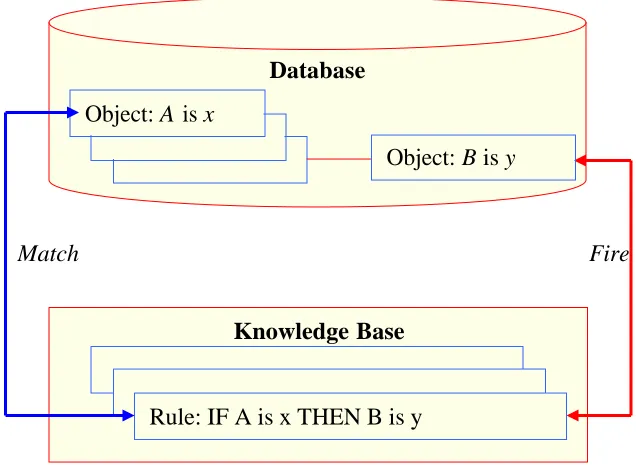
2.4 Inference Engine Match-Fire Cycles using a Match-Fire Procedure 48 2.5 Inference Chain ……….……… 49
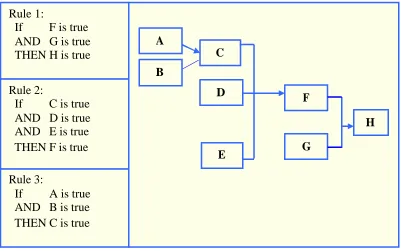
2.6 Forward “Rule 2.1” ……….……….. 50
2.7 Forward “Rule 2.2” ………...… 50
2.8 Forward “Rule 2.3” ……….……….. 51
2.9 Backward “Rule 2.4” ………...… 52
2.10 Backward “Rule 2.5” ……….………….….. 52
2.11 Backward “Rule 2.6” ………...……….… 53
2.12 Simple Decision Tree of Rule Generation …………...… 56
3.1 Index Expansions ……….……….… 74
3.2 Soccer Image ………..………..…. 76
3.3 Rule Hierarchy using Essential Objects of Soccer Category (A) .… 77 3.4 Rule Hierarchy using Essential Objects of Soccer Category (B) …. 77 3.5 Rule Hierarchy using Essential Objects of Soccer Category (C) ... 78
3.6 Rule Hierarchy using Essential Objects of Soccer Category (D) ... 78
______________________________________________________________________
3.7 Rule Hierarchy using all Objects within Soccer Image…………... 79
3.8 Composite Relationship ………...………... 80
3.9 Is-A Relationship ………...……. 81
3.10 Aggregation (Member-Of) Relationship ………. 81
3.11 Garden Image ………...………... 82
3.12 Steps of Constructing Three Levels of Objects …………..…….... 84
3.13 Three Levels of Objects ………...………... 84
3.14 Low- level Objects ………...………… 85
3.15 Essential Mid- level Objects ………...…………. 86
3.16 Essential and Non- Essential Mid- level Objects ………...………... 87
3.17 Wedding Image ………...……… 88
3.18 Building Mid-Level Object ………...……….. 89
3.19 Building High-Level Object ………..……….… 90
3.20 Building High- level Object using all Mid-Level Objects within Image ………...……… 91
3.21 All Levels of Objects Contained within Wedding Image ………... 92
3.22 Garden and Wedding Images ……….. 93
3.23 Image Falling in One Category “Garden” Category …………... 95
3.24 Image Falling in Two Categories (1/2 Garden) ………...…... 96
3.25 Image Falling in Two Categories (2/2 Wedding) …..………….… 96
3.26 Image Falling in Two Categories using All Objects within Image 97
_______________________________________________________________________
3.28 Image Falling in Three Categories (2/3 Wedding) ………... 99
3.29 Image Falling in Three Categories (3/3 Playground) ………... 100
3.30 Image Falling in Three Categories using All Objects within Image. 101
4.1 Objects’ Attributes ……….………...…… 105
4.2 Garden Image ……….……….……….. 108
4.3 Objects without Weights ……….………….………. 109
4.4 Weights of Low-Level Objects ……….…… 112
4.5 Weights of Mid-Level Objects ……….……….……… 114
4.6 Weights of All Objects within Image ……….……….. 114
4.7 Weights and Supporting Factors of Low- Level Objects………….... 116
4.8 Weights and Supporting Factors of Mid-Level Objects …………... 117
4.9 Weights and Supporting Factors of Low- level and Mid- Level Objects ……….………... 118
4.10 Weights in Image and Supporting Factors of All Levels of Objects within Image ……….………..….. 131
4.11 Different Levels of Densities ………..….. 134
4.12 Density Assignments ……….………... 135
4.13 Density Levels and Degree of Memberships ………..……. 138
5.1 Indexing Modules ………..…….………… 148
5.2 Objects of Type 1 and Type 2 ……….………...………. 151
5.3 Objects of Type 2 and Type 3 ………....………. 151
______________________________________________________________________
6.1 Thesaurus Cycle ……….………...…….. 169
6.2 Retrieval Modules ………...……… 171
6.3 Image Search Hierarchy ……….………...……….. 174
6.4 Objects in Categories ………...…... 178
6.5 Relevant and Retrieved Images ………...………... 178
6.6 (Relevant & Irrelevant) Retrieved and Not Retrieved Images……….……. 179
6.7 Joint Objects Search Query Design ………...…………. 180
6.8 Separate Objects Search Query Design ……….………..…... 183
6.9 Images Including One Specific Supporting Object ………..….…. 185
6.10 Images Including Two Specific Supporting Objects …………... 186
6.11 Images Including Three Specific Supporting Objects ………..….. 186
6.12 Images Excluding One Specific Supporting Object ………..….… 188
6.13 Images Excluding Two Specific Supporting Objects ………...….. 188
6.14 Images Excluding Three Specific Supporting Objects ………...… 189
6.15 Three Levels of Objects Weights within Images …………...……. 192
7.1 Processing of an Active Server Pages ……….……...……. 203
7.2 Overall Model of the System (System Architecture) ……….. 207
8.1 Joint Objects Search – Example 1A ……….………... 223
8.2 Separate Objects Search – Example 1A ……..…………..……... 225
_______________________________________________________________________
8.4 Separate Objects Search – Example 2A ……..………...…... 230
8.5 Joint Objects Search – Example 1B ……….………. 232
8.6 Separate Objects Search – Example 1B ……….…... 234
8.7 Joint Objects Search – Example 2B ………...…... 236
8.8 Separate Objects Search – Example 2B ……….…... 237
8.9 The Relation between the Precision and Recall ………..…….. 242
8.10 Retrieved and Relevant Images in the Database ………..……. 243
8.11 Relevant (Retrieved and Not Retrieved) and Retrieved Irrelevant Images ………..………. 244
8.12 Precision of Indexed and Non-Indexed Objects “Joint Objects Search” – Examples 1A & 1B ……….………...…….... 245
List of Tables
3.1 Image descriptions ……….………. 94
4.1 Garden Image Descriptions ………….………....…… 109
4.2 Linguistic Variables and their Ranges …….………... 133
4.3 Mathematical Equations ……….………….…… 141
5.1 Objects Levels and their Types ………….……….…………. 144
5.2 Objects in FACTS Table with Description ……….…… 145
5.3 Objects in FACTSDATA Table with Description ………….….… 146
5.4 Image Objects, their Types and Descriptions ……….…… 153
5.5 Primitive Objects of an Image ………...…… 154
5.6 Primitive Objects and the Created Mid-Level Object ……….….... 154
5.7 Primitive Objects, Mid-Level Objects and the Created High- Level Object ………...……..………. 155
5.8 Final List of Objects’ Data Extracting ………... 156
5.9 FACTS Table Contained Data …………...……….………… 162
5.10 FACTSDATA Table Contained Data ……….……… 162
6.1 Supporting Factors ……….…………. 167
6.2 Linguistic Variables Notations and Ranges ……….…... 168
6.3 Image Index May Contain “Flowers” Object …………...……….. 176
_______________________________________________________________________ 6.5 Probability of Selected Groups ……….… 191 6.6 Linguistic Variable: Object’s Availability ………..…….. 194 6.7 Linguistic Variable: Object’s Density ……….…………. 196 6.8 Probability of Selected Groups using One Supporting Object ……. 196 6.9 Probability of Selected Groups using Two Supporting Factors…... 197 6.10 Probability of selected groups using Three Supporting Factors ...… 198
7.1 Summary of the Evaluation Criteria ……….……… 214
8.1 Retrieved Images from Image Collection Using Different Objects .. 220 8.2 Retrieved Images from Image Collection Using Joint Objects
Search – Example 1A ……….………... 222 8.3 Retrieved Images from Image Collection Using Separate Objects
Search – Example 1A ………..……….. 225 8.4 Retrieved Images from Image Collection Using Backward Objects
Search ………..……….…. 226 8.5 Retrieved Images from Image Collection Using Different Number
of Objects – Example 2A ……….. 227 8.6 Retrieved Images from Image Collection Using Joint Objects
Search – Example 2A ………...……. 228 8.7 Retrieved Images from Image Collection Using Separate Objects
Search – Example 2A ………..….……. 229 8.8 Retrieved Images from Image Database Using Different Objects ... 231 8.9 Retrieved Images from Image Database Using Joint Objects Search
– Example 1B ………..……... 232 8.10 Retrieved Images from Image Database Using Separate Objects
______________________________________________________________________ 8.11 Retrieved Images from Image Database Using Different Number
of Objects – Example 2B ……….………... 234 8.12 Retrieved Images from Image Database Using Joint Objects
Search – Example 2B ……….……. 235 8.13 Retrieved Images from Image Database Using Separate Objects
Search - Example 2B ……….. 236 8.14 Relation between Precision and Recall …………...……….……... 241 8.15 Percentage of Retrieved Images using Different Number of
Non-Indexed Objects “Joint Objects Search” ” (Examples 1A & 1B) .. 245 8.16 Percentage of Retrieved Images Using Different Number of
1
Chapter 1
Introduction and Overview
1.1 Objectives
is to research existing methods of storing and retrieving images from a database, and to quantify the performance characteristics of the most effective existing methods, in order to provide a basis upon which to evaluate the performance of the algorithm developed in this thesis.
Due to the rapid increase in hardware and Internet capability, visual information, incorporating image storage and retrieval, has become a feasible source of information for many consumers. The technology for Visual Information Systems (VIS) is more urgently needed than ever before. What is needed are new computational methods to retrieve, index, compress and uncover pictorial information, new algorithms to allow access to very large databases of digital pictures and videos, as well as new systems with visual interfaces integrating the above components in new types of image databases. The construction of VIS represents a radical departure from building conventional information systems, and its architecture will incorporate fundamentally new capabilities for organising, processing, searching, querying and presenting information.
Many applications are empowered using visual representations of objects or situations, since both experts and naive users can obtain at first glance, more information than by reading textual descriptions.
Information in a visual form differs from traditional database information in many important ways. It requires more space for storage, is highly unstructured, and needs some kind of decoding process to determine its semantic content [SETH95], [LEUN92].
Management of visual information poses several challenges with respect to its storage and retrieval, its delivery and presentation, as well as its querying and searches. In order to satisfy the need of new requirements to retrieve images efficiently in large databases, many visual information retrieval systems have been developed, where the queries are based on both visual content and textual annotation in these systems.
In the past few years, the increase of picture data has encouraged research into the development of image retrieval systems. The limitation of the current image analysis techniques necessitates that most image retrieval systems use some form of text description provided by the users as the basis to index and retrieve images. These techniques are rather primitive at present and they need further development and refinement [HWAR00], [LIN99], [BARB95], [BARB94].
language, and content-based methods, which is pixel-based that allows user to post their query by an example or by image contents (colour, shape, texture, etc.). In this research, the focus will be on the concept-based method.
Current approaches are not as efficient as is desired for a technology that has become increasingly important in the processing of Visual Information System. For example, content-based methods have many disadvantages, which are explained with more detail later on in this thesis. These disadvantages include: images returned from query could be totally different from the target images, ambiguities with a multiple domain recall, and restricted access because these methods are not rich in image semantics. With concept-based methods, problems exist when extracting meaning from images in database applications. It is sometimes difficult to derive an image, which captures the meaning and context that the database user desires.
Hence, a more effective and more efficient algorithm to store images, which will be easy to retrieve, is urgently required.
1.2 Thesis Aims
The main aim of this thesis is to develop algorithms for the retrieval of image data from stored databases, using a methodology that incorporates implicit image indexing and retrieval.
enhancing the retrieval effectiveness and overcome many of the current problems involved with the retrieval of images in databases. In particular it aims to provide new mechanisms for building image data index, which will facilitate query processing and retrieval.
Since the search effectiveness in an image database is always a compromise between the indexing cost and semantic richness, a solution that provides a significant degree of semantic richness that simultaneously limits the indexing cost will be investigated.
We developed mathematical rules that can be used to define image structure by analysing image components and assigning weights, supporting factors, densities and other properties to the components based on their relative importance within the image. This is followed by the computing of the values for each image using the mathematical rules to be stored in the database, which can be used to efficiently retrieve the desired images.
An additional goal in this thesis is to provide a methodology that concentrates on matching subparts of images, defined in a variety of ways, in order to find particular objects. The approach used is to integrate our concept-based image indexing and retrieval method with the use of a fuzzy expert system. From the initial returned images, users can select images using partial or complete objects related to the images [TURK92].
enables us to qualify the imprecise data represented by subparts of an image. In this thesis fuzzy logic is used to compute object densities, which are used for indexing and retrieving the images [COX94].
1.3 Contribution to Knowledge
This thesis develops an innovative approach to the indexing and retrieval of image data. Current retrieval methods rely primarily on extensive and exhaustive descriptions of image data at the point of storage, which is labour intensive and considerably reduces the flexibility of retrieval. The proposed research makes use of semi-automatic indexing which significantly raise the efficiency of indexing while providing richer semantic to aid image retrieval.
This approach provides a new and innovative way to specify and view visual data across the whole spectrum of applications that involve processing of visual data.
1.4 Summary of Significance
image retrieval methodologies and also in terms of a more effective means of indexing image data consequent to the point of storage.
1.5 Thesis Organization
This thesis is organized as follows.
Chapter 2 , examines the methods and problems for modelling and retrieving images: the concept-based methods and the content-based methods. It also explains the reasons for selecting t h e concept-based method for our research together with retrieval engines and evaluation criteria.
Chapter 3, describes the image collections used in this research and rules construction. It shows that the image collection must represent a good selection of multi-object images and also be related to one another. Furthermore, it is shown how the rules used to determine the images categories are constructed. The image representation is described where the image index consists of many discrete object types (low- level objects, mid- level objects, high- level objects etc), which determines how different levels of objects were built. The object attributes and relationships between objects and its levels are explained as well.
demonstrates how the main step of density and fuzzy indexing and retrieving can be used for measuring and computing the object density, the steps used to determine the density levels and numerical ranges, the degree of membership of density components, construction of the fuzzy rules, and the encoding of these rules.
Chapter 5 discusses the process of implicit image indexing and its advantages. It shows various approaches for image indexing and retrieval system compared with our approach. Our method is based on the object that several atomic indices will be able to define intermediate indices, which in turn will be able to define higher indices and so on. The benefits of this method are also explained.
The data structures, creating the tables holding the data collected and computed from different level of objects within images are presented and the indexing algorithm are developed.
Chapter 6 provides a methodology that concentrates on matching images defined in different ways in order to find particular objects. This chapter also explains that a competent retrieval system should retrieve images that satisfy the user’s needs. Tables containing linguistic variables notion for objects’ attributes and their ranges using the fuzzy logic are constructed. The supporting objects and the advantage of using them when retrieving images are explained. The use of a thesaurus, controlled and uncontrolled vocabulary are explained in detail.
and relationship and the roles of all mangers contained in the system architecture are explained in detail. We explain our image retrieval engine and evaluation criteria.
Chapter 8, experiments to validate different aspects of our research a r e provided. Analysis of Concept-based Image Indexing and retrieval System is discussed with precision and recall being used for evaluating our search strategies.
10
Chapter 2
Literature Review
2.1 Introduction
unavailable in the past. VIS is now becoming increasingly feasible because of rapid advances in hardware and software technologies. The construction of VIS represents a radical departure from building conventional systems, and many novel, fundamental, and architectural issues will need to be addressed [LEUN99], [LEUN97a], [LEUN97b].
There is a popular maxim that “a picture is worth a thousand words”. Not surprisingly, the demand for digital photos on Web portals has continued to increase as the users are looking for better interfaces. As more digital multimedia archives are developed, they require specialized search engines that can index and search for these items. Since many image collections are indexed or annotated for data storage and retrievals, there is a great need for automated methods that could help users retrieve, browse, or structure image databases [ENSE95], [HOWA95].
The construction of VIS represents a different approach from building conventional information systems, and its architecture will integrate primarily new capabilities for organising, processing, searching, querying and presenting information.
2.2 Methods of Modelling and Retrieving Images
Many different methods and techniques have been proposed for modelling and retrieving images [SUTA99], [JORG98], [YANG97], [GUDI97], [SHAK96]. They largely fall into two categories, namely, concept-based methods and content-based methods, and the approach taken in this thesis is concept-based.
· Concept-based methods are mainly text-based approaches, which allow users to post their query by either simply using keywords or by using a form of natural language.
2.2.1 Concept-based Methods
The design and implementation of concept-based image retrieval systems is studied in [CHUA94]. Concept-based image retrieval includes the following, which are based on free-text description:
· The use of concept-based search engine, for the retrieval of concept and images.
· The use of relevance feedback to update the concept representations and image description.
A text-based query system, based on the Ternary Fact Model (TFM) database was proposed and developed in [SUTA99], [LEUN95], which makes use of visual entity-relationship index representations, rule-based conceptual hierarchy, and other features to support semi-automatic indexing. It also provides mechanisms to enhance query performance using a thesaurus system, relevance feedback mechanism, and user-tailored weighting components.
An image can be also retrieved using common names of entities that appear in it [SHAK96]. In many cases, a query is the formal expression method of label-based image retrieval request. An image is abstracted into a hierarchy of entity names and features, showing how relations are connected between entities visible in the image.
A fuzzy logic is a multi- valued logic that deals with degrees of membership and degrees of truth. It uses the continuum of logic value between zero and one. Classical binary logic can be considered as a special case of multi- valued fuzzy logic [COX94].
A fuzzy matching technique is used that compares semantic queries to image abstractions by assessing the similarity of context between the query and the candidate image. The objective of this matching technique is to distinguish between abstraction of different images that have the same labels but are different in context. From the initial returned images, users can select images using partial or complete objects related to the images [TURK92].
An Enigma information system is proposed to retrieve images on the basis of geometrical or iconical indexes consisting of an image indexing and retrieval component [GEVE92]. This image indexing consists of automatically generating semantic representation of an image.
supports composite modelling for entities, which consists of pictorial as well as alphanumeric attributes.
In [HWAR00], two ways of forming conceptual descriptions from images are proposed.
· Monitoring, just follow the flow of data from data images to interpretation, having little need for top- level control.
· Watching, this emphasizes the use of top-level control and actively selects evidence for task-based description of the dynamic scene.
A simple Picture Description Language (PDL) based on the entity-attribute-relationship (EAR) model is given in [LEUN92]. It furnishes degrees of standardisation that facilitates the indexing and storage of pictorial features in relational database.
2.2.2 Content-based Methods
The searches in image content use different low- level image features such as shape, colour, and texture. A content-based image retrieval system uses information from the content of images for retrieval and helps the user to retrieve database images relevant to the contents of a query image [SHAH04].
Images can be retrieved by an example image using edge or colour information; the system can also retrieve images using sketch [ABDE96].
In retrieval by an example image, for example, one image can be chosen from the database as query. A query can also be composed from images in the database using copy and paste. The system retrieves images with similar colour composition or similar edge information.
The clustering mechanism can categorise the images into different clusters based on their heterogeneous features (shape, colour, texture…etc). Database images are then classified based on their heterogenous feature. A database image is included into a feature sub-cluster only if the image contains all the features under the same cluster [SHEI98].
A colour-base image retrieval approach, by which a user can specify colour regions and their spatial information in a query picture, where the desired images that partially or exactly satisfy the user-specified query, can be retrieved. New regular-texture image retrieval approaches, where users can retrieve regular-texture image from a database, which are most similar to a sample query. In this approach, texture primitives and their displacement vectors are extracted from the query and each regular image in the database. This technique and these images that satisfy perceptual similarity to the users query can be retrieved from the database [LIN99].
2.3
Image Indexing and Retrieval
The number of digital images is rapidly increasing. Many years ago some researchers were estimating that as many as one million digital images were being produced every day [YONG99], [JAIN93]. Government agencies, educational institutions, museums, and the commercial sector are all creating image-bases. Images are being captured, converted and stored in digital format in diverse fields and disciplines such as medicine, geography, law-enforcement, art, space science, journalism, and mass communications.
opportunities for accessing and sharing digital images. However, the technologies for creating collections of digital images at present exceed our capabilities for effective and efficient retrieval of these images. End- user access is a topic of vital concern to all those involved in building image-bases.
The increasing availability of image and multimedia-oriented applications clearly impacts image/multimedia file and database systems. Image data are n o t well-defined keywords such as traditional text data used in searching and retrieving functions [CHAN01], [ORLA00], [SONG99], [KIM99], [ZIMB98]. Consequently, various indexing methodologies must be defined based on the characteristics of image data. Pictorial spatial database has been attracting growing interest; spatial relationships represent an important feature of objects in an image.
Some image collections are very large, like medicine (ultrasound, CAT scans), architecture (building plans), geography (aerial photos, maps), art (paintings, cartoons), business (trademarks), and history (photographs). Indexing collections of this size can be extremely time-consuming, and unlike text, images cannot be searched by keywords. Many automatic indexing systems have been developed, but what computers can currently extract from images are mostly low-level features like color, shape, and texture [RUI99].
particular user and the possible image descriptions can vary. Many studies are geared toward solving this problem and a few are even considered to be performance standards. The difficulty in designing powerful features is further aggravated if:
· Query images and images in the database can appear different due to non-essential environment changes, such as rigid motion, affined shape deformation, change in explanation and perspective.
· The objects in the database are similar in appearance, requiring highly selective description to tell them apart.
Many current systems for image indexing do not address the above two difficulties satisfactorily [GRAH99], [HAMP97], [PENT96], [FLIC95].
A variety of features have been used to index and retrieve images on contents, keywords, textual description or captions [SMEA96], [SETH95], [LEUN92].
Research on the information needs of users and on human perception of images may, in time, contribute the knowledge needed to produce the most precise and efficient retrieval systems possible. In the meantime, search engines contending with image collections have to make decisions about how best to provide access to them. Currently, there is no universal consensus in search engines.
approaches for access to visual information is among the most significant of technological, conceptual, and institutional challenges for information science community. From an institutional standpoint, libraries, archives, and museums have entered into digitization projects, varying in scope and scale, the results of which are beginning to challenge the manner in which information is described, stored, and delivered [LONG01], [LONG01a], [PAYN99]. The next section describes different methods of Image indexing and retrieval.
Image retrieval is one of the most exciting and fastest growing research areas in the field of visual information systems (VIS). Visual information, incorporating image retrieval, has become a preferred source of information for many consumers [AZZA04].
Research in image retrieval has, so far, been divided between two main categories; "concept-based" image retrieval, and "content-based" image retrieval. The former focuses on using words to retrieve images (e.g. title, subject heading, keyword, and caption), while the latter focuses on the visual features of the image (e.g. size, colours, textures, etc.) [SUTA99], [JORG98], [GUDI97], [YANG97], [SHAK96], [CHUA94].
Concept-based indexing uses controlled vocabulary or natural language to express what an image is or what it is about [ZHEN99], [MA98].
A method of evaluating image similarities, based on the modified "longest common subsequence" algorithm, is presented by many researches, but the proposed evaluation method cannot only separate out those images of which all icons and their spatial relationships are in full agreement with query images. The representation model and similarity evaluation also simplify the retrieval progress of linear transformations, including rotation and reflection, of images [SAME90], [CHAN87], [GUTT84].
The ability for users to express their search needs accurately and easily is crucial in any retrieval system. Image retrieval is no exception to this, though it is by no means obvious how this can be achieved in practice [RABB89].
of better methods for users to convey individual notions of image similarity [SANT97].
2.3.1 Concept-based Image Indexing and Retrieval
Indexing and abstracting are fundamental concepts in image retrieval, since they decide the effectiveness and efficiency of the retrieval process and results. In many scientific database applications, the information content of images is not explicit, and it is not easily suitable for direct indexing. In particular, the large scale image databases emerge as the most challenging problem in the field of scientific databases [OBEI01].
Concept-based is an improvement over keyword based indexing because it removes the ambiguities between keyword senses due to synonymy. Concept-based indexing is a primarily verbal and abstract identification of high- level concepts in an
image. This type of indexing requires the recognition of meaning and is primarily
performed by humans. Most production- level library systems rely on concept-based
indexing using keywords. Manual keyword indexing is, however, expensive and
introduces problems with consistency [RASM97].
Moving Picture Expert Group (MPEG)
The Moving Picture Expert Group (MPEG) is a working group that is in charge of the development of international standards for compression, decompression, processing, and coded representation of moving pictures, audio and the combination of both. MPEG files use less memory compared to other coding format for the same quality, which is advantageous [HWAR00].
MPEG-7 offers a comprehensive set of audiovisual Description Tools like the Description Definition Language (DDL), Description Schemes (DSs), and Descriptors (Ds), which form the basis for applications enabling the effective and efficient access to multimedia content. MPEG-7 consists of description schemes based on XML (Extensible Mark- up Language) as the language used for the purpose of Structured Annotations. MPEG-1, MPEG-2 and MPEG-4 make the content available while MPEG-7 helps in finding the content [FRAU01].
The MPEG-7 structured annotations provide a way to describe in XML the important concepts relating to an image in order to facilitate indexing, searching and filtering. The general requirement within MPEG-7 is that it should be based on XML syntax [MPEG02]. MPEG-7 Description Tools allows the creation of descriptions of content that may include:
· Low- level feature information of the content like colours, textures, sound timbres, melody description.
There are two ways of presenting the XML documents on the browser, the first is to display XML documents by transforming from XML format to HTML format; and the second when using a transformation language such as XSLT that is part of XSL [AZZA04a].
MPEG-7 description tools are used to extract the content feature and also for effective and efficient searching, filtering and browsing of the content according to the user needs as shown in Figure 2.1.
MPEG-7 description tools include the use of the Structured Annotations Description Schemas to define the nature of XML schemas and their component parts. The Structured Annotation is treated as a data type of XML. Structured Annotations gives the images textual description of events, people, animals, objects, places, actions, purposes, times, attributes, behaviour and relations among them. It provides a structured format that is simple but is also an expressive and powerful annotation tool. Syntactic relations such as subject, direct object, indirect object, and verb modifiers between actions and objects can be described. In addition the
Normative Part of MPEG-7 standard
Feature Extraction
Search Engine MPEG-7 Standard
Description
modifiers can be described for people, animals, objects, places, actions and times [AZZA04a]. XML schemas and their component parts are explained as follows.
Subjects
A subject is referred to as the textual description of the grammatical Subject of visual data, often representing living beings (people, animals), for example, “A
Koala sitting on the tree” and “the tree shedding its leaves”. <SUBJECT> koala </SUBJECT>
<SUBJECT> tree </SUBJECT>
Subjects can also have attributes like colour or size that can further describe the subject and can be specified by referencing the corresponding textual description of behaviour using the modifier attribute (grammatically speaking it is an adjective), for example, “The grey koala sitting on the tree” and “The tall tree shedding its leaves”
<SUBJECT modifier = grey> koala </SUBJECT> <SUBJECT modifier = tall > tree </SUBJECT>
Objects
An Object is referred to as the textual description of the grammatical object of visual data. The objects can be divided into direct objects and indirect objects, e.g.”
<OBJECT> cricket ball </OBJECT> (referring to direct object) <OBJECT> bat </OBJECT> (referring to indirect object)
Similar to subjects, objects also have attributes covering all aspects of modifiers, For example, “The batsman drives the white cricket ball with his bat”.
<OBJECT modifier = white> cricket ball </OBJECT>
Actions
Actions are referred to as the textual description of the grammatically occurring Action of the visual data corresponding to verbs, e.g. “The player lifting
the Australian open trophy, his national flags are waved by the crowd.”
<ACTION> lifting</ACTION> <ACTION> waved </ACTION>
Actions also have attributes, which can be specified by using the modifier attribute. Attributes of actions grammatically correspond to adverbs, e . g . “The player proudly lifting the Australian open trophy, his national flags are waved by the crowd.”
<ACTION modifier = proudly> lifting</ACTION>
Sub-elements
specifically the aspects corresponding to the Action. The Sub-elements can also have attributes, which can be specified by using the modifier attribute. Below is an example of the presentation for the data type as shown in Figure 2.2.
<TextAnnotation>
<FreeTextAnnotation xml:lang="en"> The children throwing the basketball. The children playing basketball </FreeTextAnnotation>
<StructuredAnnotation>
<Subject href=Image_location/img001.jpg">
<Name xml:lang="en">Children</Name> </Subject> <Object> <Name xml:lang="en">Basketball</Name> </Object>
<Action> <Name xml:lang="en">throwing</Name> </Action> <Action> <Name xml:lang="en">playing</Name> </Action>
</StructuredAnnotation> </TextAnnotation>
Here is another example shown in Figure 2.3 of the presentation for the data type containing multi-subjects and modifiers.
<TextAnnotation>
<FreeTextAnnotation xml:lang="en"> The boxer in the white jersey punches the boxer in black jersey. The referee and scorer are watching the game.
</FreeTextAnnotation> <StructuredAnnotation>
<Subject modifier=”white jersey” href=Image_location/img002.jpg"> <Name xml:lang="en">the boxer</Name> </Subject>
<Object modifier=”black jersey”>
<Name xml:lang=”en”>the boxer</Name> </Object>
<Action> <Name xml:lang="en">punches</Name> </Action> <Subject> <Name xml:lang=”en”> referee</Name> </Subject> <Subject> <Name xml:lang=”en”> scorer</Name> </Subject <Object > <Name xml:lang="en"> game</Name> </Object >
<Action> <Name xml:lang=”en”> watching </Name> </Action> </Structured Annotation>
</TextAnnotation>
Web Engines and Image Retrieval
Image search engines are based on existing search engine technology, but they use additional strategies to identify, categorize and rank images. A search engine's indexing of images is done automatically, rather than using human indexers, so it must find ways to predict the image's content. It might take into account its filename or any accompanying ‘ALT’ image tags (The ALT text provides alternative or substitute text, for use when the image is not being displayed). It might look for clues from the image's context, for example, the words or phrases that are close to the image, or the ‘META’ tags found at the top of the HTML coding. The characteristics of the Web site and its server will also often be taken into account [TASI03].
2.3.2 Content-based Image Indexing and Retrieval
In content-based methods, images can be retrieved according to their superficial visual appearance, not their semantic meaning. In content-based images concept, features are extracted from the images during population of the image database. The features extracted are based on low- level features like shape of objects in the image, image colour and image texture. These features are used to index the images. When making a search, the user enters a query into the system and features are extracted from the query image. The query image is compared with the database image by the image retrieval system on the basis of the closeness of the extracted features and the best matched images which are presented to the user. Since the images are rich in information, integrated approach incorporating a number of features are required [SAJJ97].
Visual properties of an image are extracted into victors according to some low-level features, such as colours, textures and objects shape [RUI96], [SMIT96], [ZHAN04]. In such a way, images are transformed into one or several points in a high dimensional feature space. Some similarity functions can then be defined to measure the distance between points, and the images whose points have the shortest distance are deemed the most similar to each others; colour is one of the most important features of an image [STRI95].
colour sets approach offers fast search because colour set feature vectors is binary, and shape representation can be classified as boundary-based and region-based representations. Boundary-based shape representation uses outer boundary of the shape, while region-based shape presentation uses the entire shape interior [FENG04].
2.3.3 Search efficiency
A significant limitation of current Concept-Based Image Retrieval (CBIR) technology is the problem of efficiently retrieving the set of stored images most similar to a given query. One of the many fundamental ways in which CBIR differs from text retrieval is that it is based on a fundamentally different model of data. Most text retrieval systems associate each document with a variable number of descriptors representing its content.
By contrast, the prime aim of CBIR systems is to sort the database in order of similarity to the query. Finding index structures which allow efficient searching of an image database is still an unsolved problem [FALO94]. None of the index structures proposed for text retrieval has proved applicable to the problem.
The most promising approach so far has been multidimensional indexing, using structures such as the R*-tree [DICK98], the TV-tree [LIN94] and the SS + -tree [KURN97]. A more recent approach, which seems to offer better prospects of success, is the use of similarity clustering of images, allowing hierarchical access for retrieval and providing a way of browsing the database as a bonus [JIN98], [VELL98].
2.3.4 Thesaurus
A Thesaurus is a list of synonyms a search engine can use to find matches for particular words if the words themselves don't appear in the databases.
In some search tools, the terms you choose to search on can lead you to other terms you may not have thought of. Different search tools have different ways of presenting this information, sometimes with suggested words you may choose amongst and sometimes automatically. The terms are based on the terms in the results of your search, not on some dictionary like thesaurus.
2.3.5 Controlled and Uncontrolled Vocabulary
When users’ perform Internet searches they tend to look for general topics. This is because they may be unsure of what they are looking for exactly, or may want to collect as much information about a topic as they can to familiarise themselves with it. Studies conducted on users have found that they tend to do searches for general topics and then use only one or two of the resources (Controlled and Uncontrolled Vocabulary) retrieved.
Controlled Vocabularies
closely as possible, and in a way that is as consistent as possible. Professional indexers add controlled vocabulary terms from a standard list to records as they are entered into the database, so that all the records on the same topic can be retrieved using the same search term. The controlled vocabulary terms are entered into a special field in each record. In library catalogues, controlled vocabulary terms are in the subject headings field. In other databases, they are often in fields labelled descriptors or subjects.
When you find a record that you like in a database you may look at its descriptor or subject field to find what controlled vocabulary terms were used to index that record. If any of the terms are appropriate to your topic, they can be used to expand your search. Another way to find controlled vocabulary terms is to search or browse the same standard list that professional indexers use. This list is called a thesaurus.
Uncontrolled Vocabularies
Experiments with document retrieval systems beginning in the early sixties have shown that uncontrolled vocabularies produce retrieval results that are comparable to those produced with controlled vocabularies [SPAR81], [SALT83].
A database thesaurus is similar to a language thesaurus; it lists synonyms and indicates relationships among terms. It has additional features that help with searching:
· It often includes definitions, or scope notes, for the chosen terms, explaining their meaning in the database.
· It also lists synonyms that are not used in the database and directs the user from those to the chosen terms.
· Under a chosen term, it lists other chosen terms that are more specific or more general.
· It may also list equally specific terms that are used for another facet of the chosen term.
Controlled Versus Uncontrolled Vocabularies
The main advantages of using a controlled vocabulary for searching are:
· Greater focus and level of relevancy
· Structure allows greater precision searches
· Lower recall
· Fewer missed citations because of terminology problems
· Not having to think of all the ways a topic maybe described
· Avoids problems with spelling variations
· Allows use of hierarchical searching (i.e. start broad and get narrower) The main disadvantages of using a controlled vocabulary for searching are:
· Some citations may be missed if an inappropriate controlled vocabulary term is chosen.
· New or unusual topics are not well represented.
· Very specific and well-defined topics are not well represented.
· The constantly evolving nature of human knowledge means controlled vocabularies have to be updated regularly.
· Users need to be made aware that a controlled vocabulary is available when performing a search and need to learn how to use it.
· Searches that use controlled vocabulary can search the subject or descriptor fields only.
The main advantages of using an uncontrolled vocabulary for searching are:
· Subject, title and abstract fields can be searched.
· Any term that is keyed in may be searched.
· Allows searches on novel topics for which there may be no controlled vocabulary available.
· Ability to perform very specific searches if the exact subject can be well-defined.
· Can often provide more results in a shorter time span, as there is no need to search through controlled vocabulary subject headings.
The main disadvantages of using an uncontrolled vocabulary for searching are:
· Low precision search.
· May retrieve many irrelevant items.
· No standard agreed terms for particular topics.
· Have to think of all the terms that could cover one topic, meaning that time must spent preparing the search strategy.
· In order to search successfully keywords , it should be used in conjunction with Boolean and proximity operators
2.3.6 Image Retrieval Engines and Evaluation
Criteria
In reviewing image search engines, it is helpful to use an evaluation criteria and a standard set of search terms. Although the exercise is still subjective, these will offer some basis for comparison. The evaluation criteria mainly depend on four points illustrated below; every point has its own requirement to satisfy the evaluation [TASI03]. The evaluation criteria, standard terms, and some of the major search engines offering image search options are shown later on in this section.
1. Scope
· Size and range: how big and comprehensive is the index? Is this clearly stated?
· Currency: how often is the index updated? Is this clearly stated?
2. Search Options
· Simple and advanced: are simple and advanced search options available?
· Sophistication: is it possible to conduct Boolean, phrase and wildcard or truncated searches?
· Filtering: can searches be limited before and after the search?
3. Performance
· Speed: the results quickly returned?
· Relevancy: how well do the results match the query?
· Quality: how good are the images supplied?
· Currency: are there any missing images or dead links?
· Duplication: is there any obvious duplication of images?
4. Presentation
· Thumbnails: are the results presented as thumbnails or just text links?
· File Information: do the results include any of the following useful information: file format, file size, image dimensions and colour information?
· Other Metadata: do the results include any of the following: caption, filename, alt tag, page title or other associated text?
· Copyright: is it clear who owns the copyright and how the images can be used? Is it possible to link to the original source of the image?
· Adverts: is the page cluttered with adverts? Are the results skewed in favour of commercial images?
Currently, the main English- language-based search engines offering image searches in the Web are AllTheWeb, AltaVista, Google and Lycos. Yahoo (strictly speaking a directory rather than a search engine) offers a picture search. HotBot, Web Search, and MSN Search do not offer true image search features; they simply enable users to limit their search results to 'only pages with images' [TASI03].
probably disappoint. The poor quality of their offerings is not surprising, since they reflect the randomness and unevenness of the Web. The frequent irrelevancy of their results is also understandable, since the automated engines are guessing at their images' visual subject content using indirect textual clues
Anything, then, that enables the user to have more control over their image searching is helpful. The ability to filter a search, to include and exclude items, is important in any searching, but particularly so when searching for images. An image search engine also needs to return a reasonable number of results, since in any given search a fair amount of the images found are likely to be irrelevant or of insufficient quality. Here is where the meta- image search engines tend to fail their users. They deny them sophisticated filtered searching and generally only bring back a handful of the results they find. Internet search engines can be useful in identifying the best image search engine for a particular task, but the final searching is better done directly, using the source search engines themselves. Google performed well in this review, but it is worth trying some of the others. As TASI's and our evaluation suggestions, they each have strengths and weaknesses.
are rare on the Web, and many image search engines do operate on commercial imperatives, even subtly skew their results towards commercial ends. The Web is a fast changing environment, so it is likely that some of the information in this review may become outdated in short time. The reader is well advised to check the sites themselves and to ask the kind of questions listed in the evaluation criteria, done in this chapter.
2.4 Problems of Existing
Image Indexing and
Retrieval Methods
There are many problems and disadvantage of existing image indexing and retrieval systems in both “concept-based” a n d “content-based” methods; we state some of these problems and disadvantages for each method.
2.4.1 Problems of Concept-based Methods
The image indexing and retrieval system still suffers from a number of limitations [LEUN92], some of which are:
· Organising the description of a picture’s subject matter in such a way that the picture can be most certainly and efficiently retrieved has to be considered carefully.
· It is tedious and time-consuming to associate keywords or text with each image.
· Some features are very difficult to describe with text, some special textures and complex shapes cannot be clearly represented.
· Text description is sometimes incomplete. It is possible that some image feature may not be mentioned in textual description.
· Text description is sometime subjective. Different indexer or even the same indexer may describe the same feature with different term or different feature with the same term [ROBE94].
A computational model for exploring the interaction of textual and photographic information in document understanding, where textual captions are used as collateral information in the interpretation of the corresponding photographs, is given in [SRIH93]. The final understanding of the image and caption reflects a consolidation of the information obtained from each of the two sources and thus can be used in intelligent information retrieval tasks. Problems often occur when performing a general-purpose search without adequate a priori knowledge.
annotate images with semantic concepts accurately and completely. The traditional approach is to manually annotate images, which is very tedious and time-consuming. Hence, it is desirable to automatically assign semantic concepts (Keywords) to images.
2.4.2 Problems of Content-based Methods
A typical content-based image retrieval system works basically on low- level visual features such as colour, texture, shape or regions. It is hard to link these low-level features to high- low-level concepts that correspond to objects and their semantics information within an image [CARS99], [SMIT96]. Content-base representation and retrieval provides only insufficient solutions to the problem of images retrieval [DENG04], [SMIT96a].
Naturally image search engines working on low- level features alone may sometime produce a great deal of nonsense results [SANT98]. Techniques such as spatial colour features, joint histograms, image classification and conceptual description have been proposed [HIRA00], [MUKE00], [CORR99], [PASS99], [HUAN98], [HUAN98a]. The difference in description and meaning between content-based representation and semantic description of images is still hard to overcome [SMEU00].
richness semantics [LIU05], [CHEN03], [MOJS01], [ZHOU00]. The success of content-based image retrieval is largely limited by the gap between low- level features and high- level semantics [QIN05].
The problem of content-based image searching has received considerable attention in the last few years. Thousands of images and multimedia are now available on the Internet, and many domain-specific applications require multimedia data searching. Sample domains include sports and entertainment, agriculture, e-commerce, weather prediction, medical imaging, and satellite imagery. Yet, in spite of the growing need for multimedia search capabilities, such technology is still largely unestablished as a mainstream field, nor is it widely used by search engines. Many of the major problems for this poor acceptance are inconsistent retrieval quality and poor usability. The content-based method suffers from a number of limitations [LEUN92], some of which are:
than QBE and Query-By-Image-Contents (QBIC) in this regard. Text-based queries are also very much faster than QBE and QBIC because text processing only takes a small fraction of time compared to image processing. Another advantage of text-based queries is the ease with which user could prepare the query, because it uses the same language as everyday human queries [SUTA99].
· One of the disadvantages of the content-based approach is that images returned from query could be totally different from the target images using shape concept [DICK98]. For example, users asking for images similar to ‘doors’ may receive images that semantically were not ‘doors’ at all.
· For the shape retrieval mechanism, many edge maps contain irrelevant edges, and the sketch comparison algorithm cannot calculate the similarity score very correctly.
· Multiple domain recall is another disadvantage of approaches, like QBIC using colour concept [BARB95], [FLIC95], [BARB94]. For example a query of 70% of blue colour and 30% of white colour may return an image of a white car parked behind a blue wall, and a white book on a blue table, and image of a beach with white sand, etc.
· In some methods like Two Dimension (2D) strings, which are used to express the image features and the query, the 2D strings cannot be generated automatically, because it is difficult to identify objects represented in the 2D strings without human intervention. Since objects are represented by points in 2D strings, some special relationship, such as DISJOINT, JOIN, CONTAIN, and BELONG between two objects, may not be determined correctly [TANG96].
· Another disadvantage of content-based methods is that they are not rich in image semantics; therefore it is difficult to use them to query high- level visual concepts.