Promoting E-Commerce in India:
Main Issues and Challenges
Sonnet Debbarma, Gypsy Nandi
Department of Computer Science & Engineering and IT, School of Technology, Assam Don Bosco University, Guwahati, Assam-781017, India
Abstract
-
E-commerce has immensely increased economicgrowth in domestic welfare and changes have arisen in the market scenario too. Internet represents a new environment for extensive growth of e-commerce, providing exchange of goods and services and also directing access of customer’s own personal accounts online. The trade negotiations on the fundamental key domestic policies, particularly in telecommunications, financial services, and distribution and delivery have significant important in economic growth. The varying characteristics of local environments, both infrastructural and socio-economic also play a significant role in the variation of the acceptance and growth of e-commerce in different regions of the world. The e-e-commerce technology and the usage of online shopping have increased domestic economics tremendously in India. This paper is an attempt to study and identify the factors influencing the growth of e-commerce and report the various issues faced in the e-commerce growth.
Keywords— E-commerce, online Shopping, Assocham, TRAI,
CAGR, Secure Sockets Layer (SSL), Platform for Privacy Preferences, Cyberspace.
I. INTRODUCTION
E-commerce is an outcome of Information and Communications Technology (ICT) revolution in economic fields or the most visible way of contribution of ICT to economic growth. ICT, as a tool of socio-economic development, is a significant issue for developing countries [3]. Governments have formulated ICT strategies and set significant objectives to ensure the effective deployment and use of ICTs for the benefit of the enterprises and the citizens in the developing countries. A common definition of e-commerce is to provide trade processes through data interchange, transaction of goods and services via computer networks such as the Internet [3].
E-commerce and online shopping in India is getting a noticeable growth as more usage of internet facilities, high educational standards, changing life style and economical growth of the country reasons in the demand of e-commerce techniques and tools. Versatile shopping experience and rapid development of transaction facilities is further boosting opportunities for the remaining market segments. The biggest advantage of e-commerce is the ability to provide secure shopping transactions via the internet and coupled with almost instant verification and validation of credit card transactions [2]. This significant impact has resulted in more numbers of customers to explode various fields of e-commerce for their benefits. There is also a significant national diversity in e-commerce adoption, particularly in downstream marketing, sales and
other customer-oriented activities. Increasing Internet penetration and availability of more payment options boosted the e-commerce industry [1]. One of the most important issues to be addressed in electronic commerce is the area of services.
The primary purpose of this study is to examine and uncover the impact of e-commerce and also identify the issues and areas important to the implementation of e-commerce that may help in enhancing the productivity in the economic growth of the country.
II. PROSPERITY OF E-COMMERCE IN INDIA
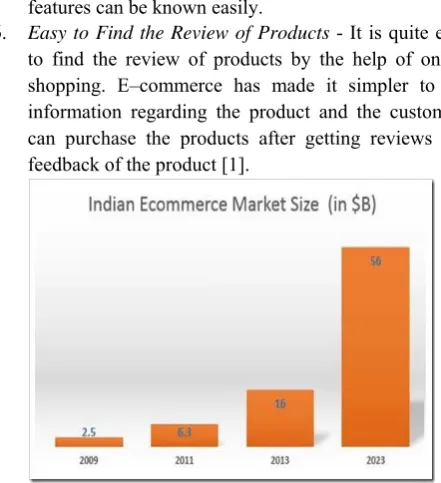
According to the survey by industry body Assocham (TheAssociated Chambers of Commerce and Industry of India), India's e-commerce market, which stood at $2.5 billion in 2009, reached $8.5 billion in 2012 and rose 88% to touch $16 billion in 2013[6]. The survey also estimated that the country's e-commerce market will soon reach $56 billion by 2023 with the rise of online retail.
Fig 1: Internet Population of India [8]
India is gradually becoming the country with highest number of internet literate population in the world and the internet penetration is largely driven by mobile phones, with some of the cheapest and most basic hand-sets currently offering access to the internet.
e-commerce websites among Indians have increased rapidly. Figure 1 below represents the year-wise internet users in India, growing at a CAGR (Compound Annual Growth Rate) of 20% [8]. As a result the numbers of internet users is expected to reach the figure of 700 million by 2019.
Fig 2: Frequency of Internet Usage in India [8] The key drivers in Indian e-commerce growth are:
1. Increased Usage of Internet - According to the Internet
and Mobile Association of India (IAMAI), the Internet user base in the country stood at 190 million at the end of June 2013. With more and more people accessing the web through mobile phones, the Internet user base in the country is projected to touch 243 million by June 2014, a year-on-year growth of 28 per cent. The growth of Internet users has also led to a substantial growth of other digital industries such as e-commerce and digital advertising [6].
2. Rising Educational Level in Computer - The
Government of India has put new horizontal efforts in the education of tools and techniques of computer studies. The students of urban areas, rural areas and business persons are attracted towards the advance computer technologies. The development of educational standards has enabled a great demand in the market.
3. Busy Lifestyle - The powerful influence of various
social media tools such as Pinterest or Facebook allows consumers to organize their favorite items and segment it into themed collections to share it with others. This fuels personal expression in shopping and makes others reflect on their purchase decision. 4. Rising middle class with disposable income - With the
rise of small and medium enterprises, foreign direct investment, and India’s own powerful multinational corporations creating millions of new jobs, a new generation of globally-minded Indian consumers has been created. With growing job opportunities the income sources have also increased. Because of high spending power, customers are willingly able to pay for the products online.
5. Awareness of Products - People are aware of the
availability of various products in the markets through the help of television, newspaper, website etc. Hence
the availability of a new product and its price and other features can be known easily.
6. Easy to Find the Review of Products - It is quite easy
to find the review of products by the help of online shopping. E–commerce has made it simpler to get information regarding the product and the customers can purchase the products after getting reviews and feedback of the product [1].
Fig 3: E-Commerce market growth in India [13] Let us now study the key market and technology trends in e-commerce which indirectly will lead to the increasing growth of e-commerce in India:
1. Online retailers would have to leverage technology to the fullest, and by developing strategies through analytics produced using big data will help in making customers feel special and increase brand loyalty. 2. Cash on Delivery (CoD) accounts for up to 60 per cent
of transactions, according to Internet and Mobile Association of India.
3. The increasing adoption and use of Smartphone’s enable businesses to collect large amount of data on consumers for utilization to do target-based marketing and advertising.
4. Product and service feedback via social media channels have an impressionable effect on the minds of the larger customer base.
5. It is necessary to create high quality and SEO-friendly ecommerce site for building long relationship with customers with exclusive content helps increase the profit volume ratio.
6. The service of providing 24 hours chat assistance to give instance response and guidance to customers has raised the quality of online shopping experience. 7. Mobile advertising route has the potential to increase
online shoppers as they are more comfortable with using mobile devices for browsing and shopping, they are now more open to getting messages from brands via their mobiles.
III.BASIC ISSUES IN E-COMMERCE
patterns of behaviour of corporations and government agencies, small business enterprises, and consumers. E-Commerce security also has some main issues such as interception of data, redirection of data, identification of parties, exploitable program errors, and being the weakest point in security [2].
The preceding sections have laid the foundation for a catalogue of issues impacting on participants in electronic commerce. Let us now study the main issues related to electronic commerce.
A. Issues in E-Commerce - Business-With-Business
There are some significant differences in the factors impeding adoption of electronic commerce by businesses and by consumers. The reasons for slow adoption in respect of commerce between business enterprises are
-1) Impediments to Business-With-Business
Organizational matters:
• organizational resistance to change of any kind;
• competing priorities for executive and management attention;
• communications difficulties among executives, managers and people with relevant technical expertise;
• nervousness about the collectability of debts, and the reliability of goods delivery and services performance;
Inter-organizational matters:
• resistance against multiple, incompatible requirements being imposed by major industry players in so-called 'hub-and-spoke' schemes, which inevitably involve some degree of duress on their generally smaller 'business partners', and frequently involve proprietary protocols, and impose costs on the smaller business which are specific to a particular partner, rather than shared across many partners;
• the challenges of achieving a 'critical mass' of electronically-capable business partners, such that duplication of channels and processes can be avoided, and real savings made;
Investment matters:
• long cycles for re-investment in organizational infrastructure;
• competing priorities for financial resources (including over-excitement about potential Y2K problems);
• limited apparent payback on the investment required;
• difficulties in establishing a compelling business case (e.g. the benefits from the investment would be likely to accrue to some party other than the investor);
Technological matters:
• inadequate infrastructure, technology or services;
• proprietary rather than open-standards-based infrastructure, technology or services, risking 'lock-in' to the initial providers because of excessively high switching costs to alternative providers in the future;
• poor fit between existing infrastructure, technology and services to the needs and practices of the particular organization and/or of the industry it operates in;
• Limited availability, unreliability and cost of technical skills.
B. Issues in E-Commerce- Business-With-Consumer
B2C involves a service or product exchange from a business to a consumer, whereby merchants sell products to consumers [9]. E-commerce also enables consumers and companies to gain access to worldwide markets and also to improve the level of customer service, speed the flow of goods and information, reduce transaction costs etc.
The developing countries face a number of challenges in utilizing the benefits in raising incomes and trade flows in the area of e-commerce [10]. A range of technical, legal and international governance considerations need to be addressed.
1) Payment Issues
Electronic commerce is presaged on the assumption that the participants will pay for what they buy. But there has been a marked reluctance among net-users to actually part with their money, particularly for digital goods and services. As a result, much of the current business on the Internet is funded using business models other than user-pays, primarily advertising and sponsorship.
2) Trust
Consumers are seriously concerned about a number of dimensions of trust. These concerns are discussed, and can be analyzed into the following categories:
Trust in thesecurity of value passed during electronic transactions with organizations. The forms of value that are involved include:
• money paid and received;
• goods and services offered and acquired; and
• assurances that refund is available for unsatisfactory goods and services;
Trust inthesecurity of personal data while it is in transit during electronic transactions;
Trust in theprivacy of personal data arising from electronic transactions. This involves a great deal more than the mere question of security of data storage, and is briefly addressed in the following sub-section; and
nature of any relationship that may arise from the transaction.
3) The Privacy of Personal Data
Many people are concerned about the trails that they leave behind them in cyberspace, and by the use of models of their behavior using the techniques of the digital persona, of data matching and of profiling. Every reputable online Web site offers information about how it processes your order. It is usually listed in the section entitled ―Privacy Policy [4]. Privacy in general is addressed, and Internet privacy is dealt with at considerable length in the following documents:
Internet Privacy: Cyberspace Invades Personal Space;
cookies;
spam; and
The W3C Platform for Privacy Preferences (P3P).
4) Identification Anonymity
The Internet has stimulated enthusiasm, and at times euphoria, for freedom in cyberspace, typified by John Perry Barlow's conception of it as the electronic frontier. One of the ways that has been suggested whereby trust can be engendered is through the use of digital signatures by each party to a transaction. Conventional digital signature technology involves compulsory and authenticated identification of the parties to an electronic transaction.
Anonymity has been the norm in many transactions in the past, and, even in the context of Internet, remains entirely feasible in many electronic transactions. Rather than converting hitherto anonymous transactions into identified ones, alternative approaches need to be applied, which are less threatening to consumers, in particular:
value authentication (which involves means of
ensuring that parties to a transaction have grounds for confidence in the security of value transferred);
attribute or eligibility authentication (which
provides means of testing whether a party has a particular characteristic relevant to participating in such a transaction, without recording the party's identity); and
pseudonymous transactions(where one party
remains anonymous to the other, means exists for the real identity to be discovered, but those means are subject to legal, organizational and technical protections).
5) Consumer Protections
Technology-based consumer transactions are, in many cases, not subject to the same kind of protections as are applicable to transactions using established points-of-sale, and door-to-door, mail and telephone telling. There are significant challenges confronting the establishment of an effective regulatory framework for Internet activities.
IV.CHALLENGES AND OPPORTUNITIES OF E-COMMERCE IN INDIA
The growth of ecommerce volumes in India is attracting the attention of players around the globe. India, the second most populous country in the world, is home to 1.2 billion people. India is a large and rapidly growing region with a rising middle class, accelerating internet access and a staggering penetration of mobile phones. India is becoming increasingly attractive to businesses, especially to e-commerce firms that thrive on global and scalable business models.
There are five key challenges that e-commerce firms are encountering in emerging Indian markets.
1. Indian customers return much of the merchandise they purchase online.
Ecommerce in India has many first time buyers. This means that they have not yet made up their mind about what to expect from ecommerce websites. As a result, buyers sometimes fall prey to hard sell. But by the time the product is delivered, they demonstrate remorse and return the goods. Though consumer remorse is a global problem, it is all the more prevalent in a country like India, where much of the growth comes from new buyers. Returns are expensive for ecommerce players, as reverse logistics presents unique challenges. This becomes all the more complex in cross-border ecommerce.
2. Cash on delivery is the preferred payment mode.
Low credit card penetration and low trust in online transactions has led to cash on delivery being the preferred payment option in India. Unlike electronic payments, manual cash collection is laborious, risky, and expensive [11].
3. Payment gateways have a high failure rate.
As if the preference for cash on delivery was not bad enough, Indian payment gateways have an unusually high failure rate by global standards. Ecommerce companies using Indian payment gateways are losing out on business, as several customers do not reattempt payment after a transaction fails.
4. Postal addresses are not standardized.
If you place an online order in India, you will quite likely get a call from the logistics company to ask you about your exact location. Clearly your address is not enough. This is because there is little standardization in the way postal addresses are written. Last mile issues add to ecommerce logistics problems.
5. Logistics is a problem in thousands of Indian towns.
logistics providers, private Indian companies, and the government-owned postal services are making a valiant effort to solve the logistics problem. If someone could convert the sheer size of the problem into an opportunity, we might soon hear of a great success story coming out of the Indian logistics industry.
V. KEY POINTS FOR EFFECTIVE ONLINE SHOPPING
1. It must be Secure – Every customer wishes for safe and
secure transactions during purchasing goods online. If the website is secure, customers will tend to purchase more from it. Secure Sockets Layer (SSL) is a standard security technology for establishing an encrypted link between the web server and a browser. E–commerce websites with the SSL certificate are able to prevent and protect the users’ information when customers access their websites [1].
2. There must be Easy and Understandable Content –
The website for online shopping should be in understandable language. The language should be kept simple while making the website, and if possible the translation of the content must be given on the website in simple languages.
3. Effectiveness and cost-efficiency should be of concern
– Internet marketing is one of the most effective and cost-efficient methods of advertisement. It is effective because it create a better chance to see the impact of internet marketing on your online business almost immediately. It is cost-efficient because the costs associated with starting a website, and then, using marketing articles or social media to establish an online presence is minimal when compared to the costs of traditional forms of advertising.
4. Choose a reliable hosting provider – Do analyze and
opt for the most reliable and cost effective choice of servers for your business. The most important things to measure while selecting are choosing a hosting provider that is tried and tested, guaranteed uptime, response times of the servers, security and the level of support and customer care provided.
5. Prompt Delivery and Quick Quality Services – The
processing of delivery and quick quality services of the product is an important feature to make the online shopping websites better than others. It must be quick in regards of home delivery services and payment etc. 6. Improve business credibility through online branding –
Internet marketing campaign will help your business increase product awareness and brand loyalty. Maintaining an online presence via internet marketing is a great way to keep up with the time and provide consumers with all of the opportunities they need 24 hours a day. As consumers browse the web, they may come across your business name or logo and become interested in what your business has to offer.
VI.CONCLUSIONS
Indian e-commerce and online shopping together plays a significant instrument in making comprehensive growth and will definitely witness greater changes in the coming years. It is contributing to the economy in a significant manner and has gained its popularity due to the fast development in the area of information technology. Owing to the increasing internet population, it has become easier and simpler in dealing with the competitive market for better deals on product. However, along with development and changes in e-commerce, there are also security and privacy concerns among the customers. Hence, researchers in this field will need to study more on the security and critical issues relate to e-commerce.
REFERENCES
[1] Dr. Anukrati Sharma, “A Study on E-Commerce and Online Shopping: Issues and Influences,” in International Journal of Computer Engineering and Technology, Volume 4, Issue 1, January- February 2013, pp. 364-376.
[2] Himani Grewal & Shivani, “ A Study of Ethical and Social Issues in E-Commerce,” in International Journal of Advanced Research in Computer Science and Software Engineering , Volume 2, Issue 7, July 2012, pp. 167-174.
[3] Lotfollah Forouzandeh Dehkordi , Ali Shahnazari, Ali Noroozi, “ A Study of the Factors that Influence the Acceptance of e-Commerce in Developing Countries: A Comparative Survey between Iran and United Arab Emirates,” in Interdisciplinary Journal of Research in Business, Vol. 1, Issue 6, June 2011,pp.44-49.
[4] Niranjanamurthy M, DR. Dharmendra Chahar,2013,, The study of E-Commerce Security Issues and Solutions “in International Journal of Advanced Research in Computer and Communication Engineering, Vol. 2, Issue 7, July 2013,pp. 2885- 2895.
[5] Tryambak Hiwarkar,2013,, E- Commerce impact on Indian Market: a Survey on social impact “in International Journal of Advanced Research in Computer Engineering & Technology (IJARCET), Volume 2, Issue 3, March 2013, pp. 870- 874.
[6] Indian e-commerce market up 88% in 2013,
http://timesofindia.indiatimes.com/tech/tech-news/Indian-e-commerce-market-up-88-in-2013 Survey/articleshow/28146273.cms
[7] India to have 243 million internet users by June 2014: IAMAI, http:// timesofindia.indiatimes.com/tech/tech-news/India-to- have-
243-million-internet-users-by-June-2014-IAMAI/articleshow/29563698.cms
[8] Growth of internet users in India and impact on country’s economy,http://www.dartconsulting.co.in/DARTBlogs/growth-of-internet-users-in-india-and-impact-on-countrys-economy/
[9] Business-to Consumer(B2C),
http://www.techopedia.com/definition/1424/business-to-consumer-b2c
[10] E-Commerce and Digital Divide: Impact on Consumers, http://www.iimahd.ernet.in/egov/documents/ecommerce-and-digital-divide.pdf
[11] 10 tips for running a successful online business, http://www.businesscomputingworld.co.uk/top-10-tips-for-running-a-successful-online-business
[12] The state of Indian Ecommerce trends and opportunities, http://www.indiaretailing.com/7/23/25/11445/The-state-of-Indian-Ecommerce--trends-and-opportunities
[13] Growth of Indian E-Commerce Market,
![Fig 1: Internet Population of India [8]](https://thumb-us.123doks.com/thumbv2/123dok_us/7845125.1300572/1.595.308.558.428.599/fig-internet-population-of-india.webp)