Johannes Mykkeltveit and Janusz Szmidt
Abstract. We explain the origins of Boolean feedback functions of nonlinear feedback shift registers (NLFSRs) of fixed orderngenerating de Bruijn binary
sequences. They all come into existence by cross joining operations starting from one maximum period feedback shift register, e.g., a linear one which always exists for any ordern.The result obtained yields some constructions
ofNLFSRsgenerating maximum period 2n
−1 binary sequences.
1. Introduction
The task of this note is to get insight into construction of Boolean feedback functions ofNLFSRs generating maximum period binary sequences. At the Inter-national Workshop on Coding and Cryptography 2013 in Bergen we discussed the problem whether it was true or not that an arbitrary de Bruijn sequence could be obtained by applying cross-join pair operations to a given one. It seems that this has been a several decades old unsolved problem. In this note we solve this prob-lem in the affirmative. In terms of Boolean feedback functions this result indicates which algebraic operations must be applied to get all feedback functions generating de Bruijn sequences starting from a given one. The same results are true when one deals with modified de Bruijn sequences of period 2n −1 and the corresponding
feedback functions.
Feedback shift registers (FSRs) are useful in generating periodic sequences, and that is the task for which they are mostly used in communication and cryptographic systems. Linear feedback shift registers (LFSRs) andNLFSRsare the main buiding blocks of many stream ciphers. The LFSRs are well-understood mathematically. The investigation ofNLFSRs started in the pioneering book of Golomb [9] and has continued for several decades. In cryptographic applications,NLFSRs generating modified de Bruijn sequences are important since in special cases the algebraic normal form (ANF) of the corresponding Boolean feedback functions is simpler than that of de Bruijn sequences (see, e.g., [16, 8]).
The operation of joining and disjoining cycles generated by nonsingularFSRs was discussed in Golomb’s book [9]. After that the notion of cross-join pairs was employed to construct new NLFSRs from given ones (see, e.g. [14, 7, 6, 17, 12, 20]). Helleseth and Kløve [11] proved an important result which gives the
1991Mathematics Subject Classification. Primary 94A55, 94C10; Secondary 06E30, 12Y05. Key words and phrases. De Bruijn sequences, cross-join pairs, nonlinear feedback shift registers, maximum period, quadraticm-sequences.
number of cross-join pairs for a binarym-sequence. In a recent paper of Dubrova [4] cross-join pairs were used to construct GaloisNLFSRs with maximum period.
Methods for findingNLFSRs with simple ANF of the feedback function were presented in [8, 2, 19, 3]. Gong and Mandal [15] following Mykkeltveitet al. [18] developed a recursive method for constructing maximum period NLFSRs. Chan, Games and Rushanan [2] conjectured existence of quadraticm-sequences for each ordern.In [3] we have verified this conjecture experimentally up to ordern= 29, finding simple quadratic NLFSRs by searching methods. In the present note we aim to relate the existence of NLFSRs generating quadratic m-sequences to the construction of cross joining. We give an example for order n = 7 and formu-late necessary conditions to be able to construct maximum periodNLFSRs whose feedback functions have some properties.
The paper is organized as follows. Section 2 recalls the known definitions and theorems about de Bruijn sequences and nonlinear feedback shift registers. Section 3 contains our main theorem together with its proof. Quadratic m-sequences and examples ofNLFSRsof order 4 and 7 generating modified de Bruijn sequences are presented in Section 4. In that section we relate the Chan, Games and Rushanan conjecture [2] to existence of a suitable collection of cross-join pairs for a given m-sequence.
2. Some definitions and known theorems
LetF2 ={0,1} denote the binary field and Fn2 the vector space of all binary
n-tuples. A binary feedback shift register (FSR) of ordernis a mapping
F:Fn2 −→F
n
2
of the form
(2.1) F: (x0, x1, . . . , xn−1)7−→(x1, x2, . . . , xn−1, f(x0, x1, . . . , xn−1)),
where the feedback function f is a Boolean function of n variables. The FSR is callednon-singular if the mappingFis one-to-one, i.e.,Fis a bijection ofFn
2. The
FSR is called linear (LFSR) if the feedback function f is linear, and nonlinear (NLFSR) if f is nonlinear, i.e., f has higher degree terms in its algebraic normal form (ANF).
Definition2.1. Ade Bruijn sequence of ordernis a sequence of length 2n of
elements ofF2 in which all differentn-tuples appear exactly once.
It was proved by Flye Sainte-Marie [5] in 1894 and independently by de Bruijn [1] in 1946 that the number of cyclically non-equivalent sequences satisfying Defi-nition 2.1 is equal to
(2.2) Bn= 22
n−1 −n.
Definition 2.2. A modified de Bruijn sequence of order n is a sequence of length 2n−1 obtained from a de Bruijn sequence of ordernby removing one zero
from the tuple ofnconsecutive zeros.
Let (st) = (s0, s1,· · ·, s2n−1) be a de Bruijn sequence. For the purpose of
this note we put Si = (si, si+1,· · ·, si+(n−2)), and write the de Bruijn sequence
0 ≤t ≤2n−1). In the latter representation each (n−1)-vector occurs exactly
twice.
Two elementsU, V ∈Fn−2 1 constitute across-join pair for the sequence (st) if
one can shift (St) cyclically so thatU, V occur in the orderU,· · ·, V,· · ·, U,· · ·, V.
It follows that for the pairs of states of a FSR generating the sequence (st):
α = (u, U), αb = (u, U) and β = (v, V), βb = (v, V), where u = u+ 1 is the negation of the bitu, they occur in the order α, β, α,b β.b
Theorem 2.3. Let (st)be a de Bruijn sequence of order n. Then there exists
a Boolean functionF(x1,· · · , xn−1)such that
(2.3) st+n=st+F(st+1,· · ·, st+n−1), t= 0,1· · ·,2n−n−1.
Proof. See [9] where a more general result is given.
This means that for the feedback function of (2.1) we have
(2.4) f(x0, x1,· · ·, xn−1) =x0+F(x1,· · ·, xn−1)
and de Bruijn sequences are generated by some non-singular FSRs. The problem mentioned in the Introduction can be formulated as follows: describe all feedback functions ofFSRs generating all de Bruijn sequences. As concerns applications in cryptography we are interested in modified de Bruijn sequences since some feedback functions ofNLFSRs generating these sequences have simpleANF.
Theorem2.4. Let(st)be a de Bruijn sequence satisfying (2.3). LetU, V be a
cross-join pair for(st)and letG(x1,· · ·, xn−1)be obtained fromF(x1,· · ·, xn−1)by
the negation of F(U)andF(V). ThenG(x1,· · · , xn−1)also generates a de Bruijn
sequence (ut), say. We say that (ut) is obtained from (st) by the cross-join pair
operation.
Proof. The negation of F(U) will split the de Bruijn sequence into two se-quences, and the negation ofF(V) will join these two sequences again (since U, V
is a cross-join pair).
3. The main theorem
Theorem 3.1. Let (ut),(vt)be two de Bruijn sequences of order n. Then(vt)
can be obtained from(ut)by repeated application of the cross-join pair operation.
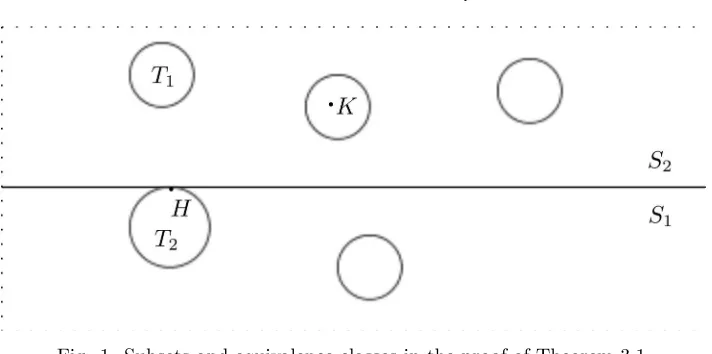
Proof. First, we observe that the cross-join pair operation leads to an equiva-lence relation in the set of all de Bruijn sequences. We order the truth tables of the functionsF in (2.4) lexicographically and denote this ordered set byS. We choose the ordering in such a way thatF(0,0,· · ·,0) is the most significant digit. Let T1
be the equivalence class containing the lexicographically largest de Bruijn sequence. Suppose that the theorem is false. Then there must exist a nonempty equivalence class T2 different from T1 and let H be the truth table for the lexicographically
largest de Bruijn sequence inT2. ThenH has the following two properties:
1. It is not the lexicographically largest de Bruijn sequence.
2. Any cross-join pair operation which can be applied to H will result in a truth table less thanH.
Define:
We are done if we can prove that H does not exist. Let K ∈ S2. Let
(z1,· · ·, zn−1) be the smallest (n−1)-vector such that H(z1,· · · , zn−1) is
dif-ferent from K(z1,· · ·, zn−1). Since H < K we have H(z1,· · · , zn−1) = 0 and
K(z1,· · ·, zn−1) = 1 and the choice of (z1,· · ·, zn−1) implies that if
(u1,· · ·, un−1)<(z1,· · ·, zn−1)
then
H(u1,· · ·, un−1) =K(u1,· · · , un−1).
LetH1 be obtained fromH by putting H1(z1,· · · , zn−1) = 1 and keeping H1 =
H for all other function arguments. Clearly this change will split the de Bruijn sequence so thatH1 generates two sequences C1 andC2, say.
We have
(3.1) H1(z1,· · · , zn−1) =K(z1,· · · , zn−1),
which implies that (z0, z1,· · ·, zn−1) and (z1,· · · , zn−1, z0+K(z1,· · ·, zn−1))
ei-ther both belong to C1 or both belong to C2. It is no restriction to assume that
they both belong toC1.
SinceK generates a de Bruijn sequence there exists an n-tuple (v0,· · · , vn−1)
such that
(v0, v1,· · ·, vn−1)∈C1
and
(v1,· · · , vn−1, v0+K(v1,· · ·, vn−1)∈C2,
and sinceH1 generatesC1 we have
(v1,· · ·, vn−1, v0+H1(v1,· · ·, vn−1))∈C1.
Since we have (3.1) andH1(v1,· · ·, vn−1)6=K(v1,· · · , vn−1) this implies that
(z1,· · · , zn−1)6= (v1,· · ·, vn−1),
and since (z1,· · · , zn−1) is the smallest (n−1)-tuple (x1,· · ·, xn−1) such that
H1(x1,· · ·, xn−1)6=K(x1,· · · , xn−1) we must have
(3.2) (z1,· · · , zn−1)<(v1,· · ·, vn−1).
LetH2 be obtained fromH1 by puttingH2(v1,· · · , vn−1) =K(v1,· · · , vn−1)
and keeping H2 =H1 for all other function arguments. ThenH2 will generate a de Bruijn sequence since the latter operation (changingH1 to H2) corresponds to joining C1 andC2. H < H2 as a consequence of (3.2), i.e. the de Bruijn sequence
generated by H2 is obtained from the one generated by H by the cross-join pair operation. This means thatH does not exist, since by definition it is impossible to obtain a de Bruijn sequence greater than the one generated byH by the cross-join
Fig. 1. Subsets and equivalence classes in the proof of Theorem 3.1. K, H, H1 and H2 are functions mapping Fn−2 1 to F2; T1, T2 are equivalence
classes of such functions. All functions in S1 are lexicographically smaller than
those in S2. We have K ∈ S2, but it is irrelevant for the proof whether K ∈ T1
or not. We have K /∈ T2 sinceS1∩S2 = Ø. Moreover S1∪S2 = S, the set of
all functions generating de Bruijn sequences of ordern.A prori there can be many equivalence classes of de Bruijn sequences, but we prove that there is only one.
Since there is a one-to-one correspondence between de Bruijn sequences of order n, which have length 2n or period 2n when considered as periodic sequences, and
modified de Bruijn sequences of length (period) 2n−1, Theorem 3.1 is literally true
for modified de Bruijn sequences. As an immediate consequence of Theorem 3.1 we also have the following:
Lemma3.2. For every de Bruijn sequence (modified de Bruijn sequence) there exist cross-join pairs.
According to Helleseth and Kløve [11] the number of different cross-join pairs for an m-sequence of order n (modified de Bruijn sequence of maximum period 2n−1 generated by the feedback function ofLFSR) is equal to
(3.3) (2n−1−1)(2n−1−2)/6.
For modified de Bruijn sequences of order n generated by feedback functions of NLFSRs we do not have explicit formulae for the number of cross-join pairs, but our experiments show that for small ordersn= 4,5,6 these numbers change with NLFSRs of given order and are around the value (3.3). ANF of the feedback function of a given de Bruijn sequence of order n is different from that of the corresponding modified de Bruijn sequence of the same order (obtained by removing one zero from the tuple ofnconsecutive zeros). Iff(x0, x1,· · · , xn−1) is a Boolean
feedback function which generates a modified de Bruijn sequence of ordern, then the Boolean feedback function of the corresponding de Bruijn sequence is equal to (3.4) f(x0, x1,· · · , xn−1) +x1x2· · ·xn−1.
According to (3.4) a Boolean feedback function which generates a de Bruijn se-quence contains the termx1· · ·xn−1; it has algebraic degreen−1. Boolean
a small number of terms in theirANF.In [8] Gammel et al. have foundNLFSRs up to order of n = 33, algebraic degree up to 5 and containing up to around 30 terms in theirANF.According to Theorem 3.1 we know that such simple feedback functions of maximum periodNLFSRs can be obtained by repeated application of the cross-join operation to a feedback function ofLFSR generating anm-sequence. The problem is to find an effective algorithm to realize this task. The next section presents our efforts in this direction.
4. Applications
In this section we will consider modified de Bruijn sequences and feedback func-tions ofNLFSRs generating these sequences. We use the cross-join pair operation to construct newNLFSRs from a given one. Letf(x0, x1,· · ·, xn−1) be a feedback
function generating a modified de Bruijn sequence. Let
α= (a0, a1,· · · , an−1), αb= (a0, a1,· · · , an−1),
β = (b0, b1,· · ·, bn−1), βb= (b0, b1,· · ·, bn−1)
be a cross-join pair for the sequence generated by the functionf(x0, x1,· · · , xn−1).
Then the function
f(x0, x1,· · ·, xn−1) + (x1+a1)· · ·(xn−1+an−1) + (x1+b1)· · ·(xn−1+bn−1)
is a feedback of a new modified de Bruijn sequence. When we apply the cross-join operation several times to a maximum periodLFSRit can happen that the resulting higher degree terms cancel and we obtain a feedback function with a simpleANF. In fact, we do not have strict control on the process of algebraic cancellation of terms resulting from cross-join pairs, and findingNLFSRs with a simpleANF is a random process.
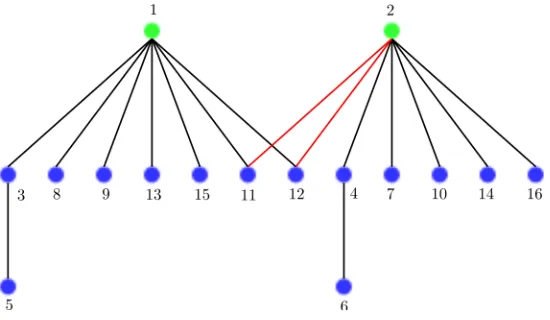
4.1. NLFSRs of order 4. This example was a starting point for our investi-gations. We give here a list of feedback functions generating all modified de Bruijn sequences of ordern= 4. Functions 1 and 2 represent primitiveLFSRs of order 4. Each of the sequences generated by them has seven cross-join pairs. Applying The-orem 2.4 we get in total twelve new nonlinear feedback functions, since two of them appear twice (the red lines in Figure 2). But these are not all existing nonlinear feedback functions generating modified de Bruijn sequences. An application of two additional cross-join operations gives two missing nonlinear feedback functions (the edges (3,5) and (4,6) of the graph). One can see that any two vertices of the graph can be connected by a path which results as an application of several cross-join operations.
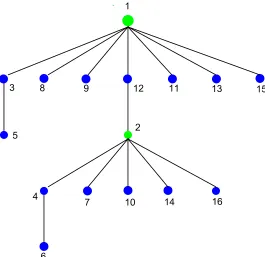
Now the problem arises whether one can implement an algorithm which takes as input a feedback function of a primitive LFSR and constructs by repeated ap-plication of the cross-join operation all feedback functions (linear and nonlinear) of modified de Bruijn sequences. We have implemented such an algorithm. It works forn= 4 (see Figure 3) andn= 5 giving all corresponding feedback functions. For n= 5 we have 2048 feedback functions altogether, see (2.2). The algorithm works for greater ordersntoo. Forn= 6 we have 226maximum periodNLFSRs.
Here is a list of all feedback functions (linear and nonlinear) generating 16 modified de Bruijn sequences of order 4. TheNLFSRs are obtained by using the cross-join operation.
(1) x0+x1
(2) x0+x3
(3) x0+x1+x1x2x3+x1x2x3=x0+x1+x2+x1x2
(4) x0+x3+x1x2x3+x1x2x3=x0+x2+x3+x1x2
(5) x0+x1+ (x1x2x3+x1x2x3) + (x1x2x3+x1x2x3)
=x0+x1+x2+x1x3
(6) x0+x3+ (x1x2x3+x1x2x3) + (x1x2x3+x1x2x3)
=x0+x2+x3+x1x3
(7) x0+x3+x1x2x3+x1x2x3=x0+x2+x1x2+x1x3
(8) x0+x1+x1x2x3+x1x2x3=x0+x1+x2+x3+x1x2+x1x3
(9) x0+x1+x1x2x3+x1x2x3=x0+x1+x2+x2x3
(10) x0+x3+x1x2x3+x1x2x3=x0+x2+x3+x2x3
(11) x0+x1+x1x2x3+x1x2x2=x0+x1+x1x2+x2x3
(12) x0+x1+x1x2x3+x1x2x3=x0+x3+x1x2+x2x3
(13) x0+x1+x1x2x3+x1x2x3=x0+x2+x1x3+x2x3
(14) x0+x3+x1x2x3+x1x2x3=x0+x1+x2+x3+x1x3+x2x3
(15) x0+x1+x1x2x3+x1x2x3=x0+x1+x2+x1x2+x1x3+x2x3
(16) x0+x3+x1x2x3+x1x2x3=x0+x2+x3+x1x2+x1x3+x2x3
We illustrate below the process of constructing NLFSRs of order 4 starting from twoLFSRs(Fig. 2) and starting from oneLFSR (Fig. 3).
Fig. 3. The second graph of cross joining forNLFSRs of order 4.
4.2. Quadratic m-sequences. Chen, Games and Rushanan [2] have inves-tigated the case when the feedback function (2.4) is a quadratic Boolean function ofnvariables; i.e., has the following algebraic normal form:
(4.1) f(x0, x1,· · ·, xn−1) =
X
0≤i≤j≤n−1
aijxixj.
Let us note that x2
i =xi for alli≥0, hence the coefficientsaii correspond to the
linear terms of the functionf. The recurrence (2.3) corresponding to the quadratic function (4.1) has the form
(4.2) sn+k =
X
0≤i≤j≤n−1
aijsi+ksj+k
for allk≥0.The authors of [2] have introduced a notion of quadraticm-sequences by analogy to the linear ones.
Definition 4.1. A binary sequence s is called a quadratic m-sequence of ordern(spann) if it satisfies the quadratic recurrence (4.2) and has period 2n−1.
The authors of [2] have studied algorithmic generation of some quadratic m-sequences and listed them up to ordern= 12. Namely, they considered quadratic Boolean functions of the form
(4.3) f(x0, x1,· · ·, xn−1) =g(x0, x1,· · ·, xn−1) +xi+xixj,
wherei6=j, 1≤i, j ≤n−1 and
is a linear function which generates anm-sequence, i.e., the corresponding polyno-mial in the ringF2[x]
p(x) =xn+c
n−1xn−1+· · ·+c1x+ 1
is primitive. Primitive polynomials of degreenhave their roots in the finite Galois field F2n; these roots are primitive elements (generators) of the multiplicative
groupF∗2n. It is known that there is a one-to-one correspondence between linear
m-sequences of period 2n−1 and primitive polynomials of degreen.The number of
primitive polynomials of degreenis equal to ϕ(2n−1)/n, where ϕ(.) is the Euler
function. The proofs of all these facts can be found in the books [9, 10, 13]. The quadratic recurrences corresponding to Boolean functions (4.3) are modi-fications of the linear one. The termxi+xixj introduces a nonlinearperturbation
to the givenm-sequence. The states of theLFSR for which the functionxi+xixj
equals 1 break or join the corresponding cycles of theLFSR. The case when after running over all states of theFSRwe get only one cycle is the sought-forNLFSR. In fact, this is a random phenomenon. The relevant discussion has been presented in [2]. In practice, not all primitive polynomials and terms xi +xixj lead to a
suitable coincidence giving a quadraticm-sequence.
In [3] we continued the search for those NLFSRs generating quadratic m-sequences up to ordern= 29 and found the feedback Boolean function
f(x0,· · ·, x28) =x0+x3+x5+x6+x11+x12+x16+x19+x22+x23+x27+x20x28
which generates a modified de Bruijn sequence of period 229−1.Here the termx 20
coming from a primitive polynomial of degree 29 cancels with such a term in the expressionx20+x20x28.
4.3. A NLFSR of order 7. We take the primitive polynomialp(x) =x7+
x+ 1. The feedback function of the corresponding LFSR is x0 +x6. We start
from the initial state s0 = (x0, x1, . . . , x6) = (1,0, . . . ,0) and generate all nonzero
states s1, . . . , s126 of the LFSR. Let us consider the states for which x2 = 1 and
x4= 0; there are altogether 32 of them. We can find eight cross-join pairs having
no common states, which all cover the states with (x2, x4) = (1,0).Here is a list of
those cross-join pairs (α,α;b β,β) :b
(10,29; 17,101), (20,58; 21,91), (25,47; 32,62), (37,118; 113,125),
(38,107; 71,119), (42,55; 50,94), (59,82; 81,90), (65,97; 70,106). We now apply the cross-join operation to each cross-join pair to obtain
f =x0+x6+x1x2x3x4x5x6+x1x2x3x4x5x6+x1x2x3x4x5x6+x1x2x3x4x5x6
+x1x2x3x4x5x6+x1x2x3x4x5x6+x1x2x3x4x5x6+x1x2x3x4x5x6
+x1x2x3x4x5x6+x1x2x3x4x5x6+x1x2x3x4x5x6+x1x2x3x4x5x6
+x1x2x3x4x5x6+x1x2x3x4x5x6+x1x2x3x4x5x6+x1x2x3x4x5x6
=x0+x6+x2+x2x4.
4.4. Necessary conditions. Let us consider a candidate for a feedback func-tion ofNLFSRof maximum period 2n−1 which has the form
(4.4) f(x0, x1,· · · , xn−1) =g(x0, x1,· · · , xn−1) +h(x1,· · ·, xn−1),
wheregis a function as in (4.3) andhis a Boolean function of low algebraic degree (say up to 5) and with the number of terms from 10 to 20. The number of all terms inf must be even. In our construction we need to know the setS of states (x0, x1,· · ·, xn−1) for which
h(x1,· · ·, xn−1) = 1,
and the number of states in S must be a multiple of 4. Now we find a set C of cross-join pairs for the m-sequence generated by the feedback functiong, but only those whose states belong toS.Suppose the collectionCof cross-join pairs has the following properties:
(1) All cross-join pairs inC are disjoint; they do not contain common states fromS.
(2) All states in cross-join pairs ofC exactly cover the setS.
Then conditions 1 and 2 are necessary for the function (4.4) to generate a sequence of maximum period 2n−1.An example of such a family of cross-join pairs is given
above in Section 4.3. We have verified experimentally this construction of maximum periodNLFSRswith feedback functions of the form (4.3) for orders up to n= 17. Conditions 1 and 2 are not sufficient to guarantee the maximum period. When they are satisfied one must check the period of the sequence generated by the feedback function f.
References
[1] N. G. de Bruijn.A combinatorial problem.Indag. Math., 8(1946), pp. 461-467.
[2] A. H. Chan, R. A. Games, J. J. Rushanan. On the quadratic m-sequences.Proceedings of Fast Software Encryption. LNCS vol. 809, pp. 166-173. Springer-Verlag, 1994.
[3] P. Dabrowski, G. Labuzek, T. Rachwalik, J. Szmidt.Searching for nonlinear feedback shift registers with parallel computing.IACR Cryptology ePrint Archive 2013/542. 2013 Military Communications and Information Systems Conference. MCC 2013, Malto, France.
[4] E. Dubrova. A scalable method for constructing Galois NLFSRs with period 2n
−1 using
cross-join pairs.IEEE Trans. on Inform. Theory, 59(1), 2013, pp. 703-709.
[5] C. Flye Sainte-Marie. Solution to question nr. 48. L’Interm´ediaire des Math´ematiciens, 1(1894). pp. 107-110.
[6] H. Fredricksen. A class of nonlinear de Bruijn cycles. J. of Combinatorial Theory (A), 19(1975), pp. 192-199.
[7] H. Fredricksen.A survey of full length nonlinear shift register cycle algorithms.SIAM Review, 24(2), 1982, pp. 195-221.
[8] B. M. Gammel, R. Goetffert, O. Kniffler. Achterbahn 128/80. The eSTREAM project, www.ecrypt.eu.org/stream/, www.matpack.de/achterbahn/
[9] S. W. Golomb. Shift register sequences. San Francisco, Holden-Day, 1967, revised edition, Laguna Hills, CA, Aegean Park Press, 1982.
[10] S. W. Golomb, G. Gong.Signal Design for Good Correlation. For Wireless Communication, Cryptography, and Radar.Cambridge University Press, 2005.
[11] T. Helleseth, T. Kløve.The number of cross-join pairs in maximum length linear sequences. IEEE Trans. on Inform. Theory, 31(1991), pp. 1731-1733.
[12] C. J. A. Jansen.Investigations on nonlinear streamcipher systems: Construction and evalu-ation methods.Ph.D. Thesis, Technical University of Delft, 1989.
[14] K. B. Magleby. The synthesis of nonlinear feedback shift registers. Technical Report no. 6207-1. Stanford Electronics Laboratories, 1963.
[15] K. Mandal, G. Gong. Cryptographically strong de Bruijn sequences with large periods. Se-lected Areas in Cryptography. L. R. Knudsen, K. Wu (Eds.). LNCS, vol. 7707, pp. 104-118. Springer-Verlag, 2012.
[16] G. L. Mayhew, S. W. Golomb.Linear spans of modified de Bruijn sequences.IEEE Trans. Inform. Theory, 36(5), 1990, pp. 1166-1167.
[17] J. Mykkeltveit.Generating and counting the double adjacencies in a pure cycing shift register. Trans. on Computers, C-24, 1975, pp. 299-304.
[18] J. Mykkeltveit, M-K. Siu, P. Tong.On the cyclic structure of some nonlinear shift register sequences.Inform. and Control, 43(1979), pp. 202-215.
[19] T. Rachwalik, J. Szmidt, R. Wicik, J. Zabocki.Generation of nonlinear feedback shift regis-ters with special purpose hardware.2012 Military Communications and Information Systems Conference. MCC 2012, pp. 151-154. IEEE Xplore Digital Library. IACR Cryptology ePrint Archive 2012/314.
[20] M. S. Turan. On the nonlinearity of maximum-length NFSR feedbacks.Cryptography and Communications, 4(3-4), 2012, pp. 233-243.
[21] Python Programming Language.http://www.python.org
[22] SAGE Mathematical Software.Version 5.8. http://www.sagemath.org
International Research Institute of Stavanger (IRIS), Bergen, Norway Miltary Communication Institute, ul. Warszawska 22A, 05-130 Zegrze, Poland