R E S E A R C H
Open Access
A new RREQ message forwarding technique
based on Bayesian probability theory
Venetis Kanakaris
*, David L Ndzi, Kyriakos Ovaliadis and Yanyan Yang
Abstract
The flooding method, which is used by many mobile ad-hoc routing protocols, is a process in which a route request packet (RREQ) is broadcasted from a source node to other nodes in the network. This often results in unnecessary re-transmissions, causing packet collisions and congestion in the network, a phenomenon called broadcast storm. This article presents firstly the impact of a different message forwarding probability on the RREQ and secondly a RREQ message forwarding scheme which is implemented on Ad-hoc On-Demand Distance Vector Routing (AODV) routing protocol, a Bayesian probability based the AODV extended version based on a modified version of Bayesian probability (AODV_EXT_BP) that reduces routing overheads, by calculating the probability with respect to the neighbour density as well as the posterior probability. The performance of the AODV_EXT_BP is compared to that of extended version of AODV (AODV_EXT), AODV, Destination Sequenced Distance Vector, dynamic source routing and Optimized Link State Routing protocols and the simulation results show that the AODV_EXT_BP protocol achieves better results in all sectors.
Keywords:Mobile ad-hoc network, Routing message overhead, Route discovery, Broadcast, Bayesian probability, Flooding, Power-aware routing, Routing protocols, AODV, AODV_EXT, AODV_EXT_BP, DSDV, DSR, OLSR
Introduction
An ad-hoc network is a promising technology which can be applied in an extensive number of areas ranging from environmental monitoring to disaster management. Fur-thermore, ad-hoc networks can be implemented in appli-cation of sensors for process automation in a diversity of industrial applications. Events such as earthquakes can often serve to illustrate the weakness of centrally managed networks and the importance of research and development in ad-hoc networks such as mobile ad-hoc networks (MANETs), where a centralized connectivity is not needed. MANET is a wireless network which consists of mobile nodes with no pre-determined infrastructure. One of the major restrictions of ad-hoc network systems is the energy availability and continuous reduction in the size of devices which means that power reduction cannot simply be improved with big battery systems [1]. Apart from the op-eration of onboard electronics, power consumption de-pends on numerous processes and overheads required to maintain connectivity.
There are numerous recommended solutions to deal with connectivity problems and power limitation in ad-hoc networks. Such techniques comprise development of hardware, routing algorithms, protocols and battery tech-nology or power management systems [2,3]. There are re-searchers that have suggested the development of an optimized hardware which can be used in applications based on data rates [4]. There is a proposal in [5,6] to adapt energy control to applications where the voltage, and therefore processing speed and power, can be reduced for non-time sensitive applications. Other methods that have been proposed in [7] are aimed at avoiding network partitioning by controlling power consumptions of critical link nodes. Recently, many probabilistic approaches have been proposed in [8-11] with the aim to alleviate the flood-ing phenomenon and solve the broadcast storm problem. The authors have already proposed a probability-based algorithm in [12] which is an improved version of Ad-hoc On-Demand Distance Vector Routing (AODV), the AODV_EXT, which reduces energy consumption by 3%. In this article, we propose a modification of AODV, the AODV_EXT_BP, protocol which improves the energy and data transmission * Correspondence:[email protected]
School of Engineering, University of Portsmouth, Anglesea Road, Portsmouth PO1 3DJ, UK
efficiency of the network by using the Bayesian probability theory and give better results compared to AODV_EXT.
In general, ad-hoc wireless networks broadcast packets to the whole network as a means of transmitting infor-mation from one node to the other in the network [13]. Broadcasting in MANETs is not only an essential action for unicast routing protocols in mobile scenarios, but also a unique process of a number of multicast routing proto-cols. A variety of unicast, multicast, and geocast protocols uses the broadcasting method in order to provide the im-portant control and route establishing functionality. Broad-casting a packet to the whole network has a wide range of applications in MANETs. Consequently, improving the process of broadcasting will result in savings in several ad-hoc applications.
Flooding is the simplest technique used by source nodes to broadcast packets to the adjacent nodes [14]. Each neighbour node receiving the packet for the first time rebroadcasts it ensuring forward propagation from the source node until every node in the network has received and transmitted the broadcast packet exactly once.
The broadcasting protocols can be classified into two main categories, namely deterministic and probabilistic. The probabilistic approach usually offers a simple solution in which every node that receives a broadcast packet has a predefined probability of forwarding the message [15]. But this approach does not ensure full network coverage. On the other hand, the deterministic approach can provide full coverage and can be further categorized into two catego-ries, namely location information and neighbour set based. In MANETs, the routing task is delivered through net-work nodes which act as both routers and end points in the network. In order for a route to a specific destination node to be discovered, existing on-demand routing proto-cols use a simple flooding mechanism whereby a route request packet (RREQ) originating from a source node is broadcasted without exception to all nodes in the network [16]. This can result to considerable redundant retrans-missions, causing congestion and packet collisions in the network.
The implication of broadcast routing messages on net-work performance is presented in this article. The follo-wing protocols have been studied and their performances in simulated networks are analysed: dynamic source rout-ing (DSR), AODV, Destination Sequenced Distance Vector (DSDV) routing and Optimized Link State Routing (OLSR). These protocols have widely been used and cited in literature [17].
This article is organized as follows: “Routing protocols” section describes the protocols that will be evaluated in this article. The routing procedure of AODV is also described. “The modification of AODV using different RREQ mech-anism message forwarding probability scheme”and “Simu-lation and metrics of a different message forwarding
probability scheme on the RREQ mechanism of AODV protocol”sections present the modification and the results of the AODV behaviour when using different message for-warding probability implemented on the RREQ mecha-nism, respectively. “The modification of AODV RREQ mechanism using Bayesian probability approach” section presents a description of the proposed modification to AODV as well as the Bayesian probability theory. In “Simu-lation and metrics of AODV RREQ mechanism using the Bayesian approach” section, the simulated scenario is described together with the settings, network configura-tions and the parameters that have been used in order to evaluate the performance of the protocols. The results of the simulation and discussions are provided in“Results and discussions”section which is followed by the conclusions.
Routing protocols
In DSDV [18] protocol, there is an exchange of messages between mobile nodes within range. Routing updates may
Table 1 Definition of the different message forwarding probability
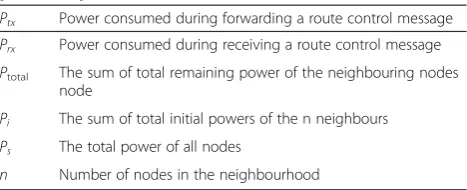
Ptx Power consumed during forwarding a route control message
Prx Power consumed during receiving a route control message
Ptotal The sum of total remaining power of the neighbouring nodes node
Pi The sum of total initial powers of the n neighbours
Ps The total power of all nodes
n Number of nodes in the neighbourhood
Table 2 Simulation Parameters of AODV to evaluate different RREQ message forwarding probabilities
The protocol Probabilistic RREQ message forwarding protocol
Topographical area 800 × 800 m2
Number of nodes 10, 20, 30, 40, 50, 60, 70, 80, 90, 100
Mobility 1–30 m/s
Probability 0.10–1.0 (step 0.1)
Radio-propagation model TwoRayGround
Network interface type WirelessPhy
MAC type 802_11
Interface queue type DropTail/PriQueue
Antenna model OmniAntenna
Total simulation time 100 s
Transport/traffic type CBR over UDP
Tx power of the nodes 0.1819 W
Rx power of the nodes 0.0501 W
Idle power of the nodes 0.0350 W
Initial energy of the nodes 1000.0 J
be enabled or routine. The update process starts when routing information from one of the adjacent nodes forces a change in the routing table. If there is a packet which the route to its destination is unknown, it is cached whilst routing queries are sent out. The packets are cached until route-replies are received from the destination node. The buffer has a specific size and time limitation for caching packets beyond which packets are dropped. When the route to the destination is known the packets are routed directly. In a case that the destination node is not found,
the packets are forwarded to the default target node which is the routing agent.
In DSR protocol, the routing agent controls every data packet for source-route information [19]. The packets are then forwarded according to the routing information. In case, it cannot find any routing information in the packet, it offers the source route if route is known. When the des-tination is not known it caches the packet and broadcasts route queries. The routing query is initially sent to all the adjacent nodes and it is always enabled by a data packet Figure 1The average consumed power.
which has no route information about its destination. Route-replies are sent back if the information regarding the route to the destination is needed.
The OLSR [20] is a routing protocol in which the nodes are aware of all the valid routes. The OLSR protocol uses the flooding method in order to inform all active nodes in the network when there is a topology change. The OLSR reduces the possible overhead in the network by using the multi-point relays (MPR). The main concept of MPR [21] is to reduce the number of duplicate retransmissions when a broadcast packet is forwarded. By this method, the number of retransmissions is confined to a small group of nearby nodes, instead of using all the neighbours. This group of nodes is kept as small as possible by selecting the nodes which cover (in terms of one-hop radio range) the same network region as the complete set of nearby nodes. The OLSR routing protocol has two types of control
messages, namely Topology Control (TC) and Hello. TC messages are used for sending information regarding the adjacent nodes which contains the MPR selector list, instead of Hello messages which are used in order to dis-cover information about the link status and the host’s neighbours. The OLSR protocol has a drawback due to the fact that every host periodically transmits the up-dated topology information to the whole network thus Figure 3MAC Load against the number of nodes.
Table 3 Definition of AODV_EXT_BP parameters
n The total nodes in the network
Fi Any nodeFi,i= 1,2,. . .,nthat receives the RREQ message
Pi Packet forwarding probability derived from neighbour node count
d Minimum node density or minimum expected neighbours—if the node density at a forwarding nodeFiis less than this, then that node will forward the RREQ message to avoid the probability of path failure at that location. This means that the nodes will forward the packet without any further condition checking. In this studydis set to 5
r Random number (between 0 and 1). This is used to generate varying conditions in the network. By this variable we are trying to avoid flooding in the RREQ mechanism as it compares each time toPiwhich must be smaller than 1 (100%)
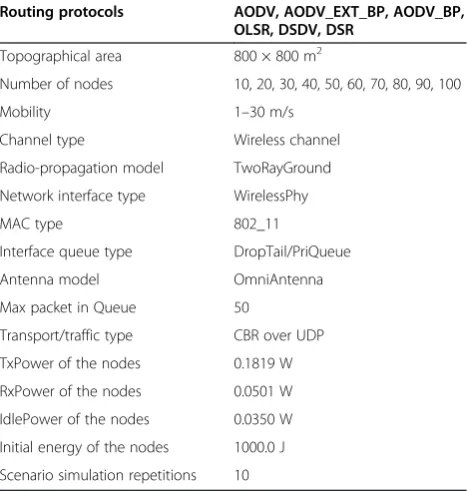
Table 4 Simulation parameters and configuration of AODV, AODV_EXT, AODV_EXT_BP, OLSR, DSDV, DSR
Routing protocols AODV, AODV_EXT_BP, AODV_BP, OLSR, DSDV, DSR
Topographical area 800 × 800 m2
Number of nodes 10, 20, 30, 40, 50, 60, 70, 80, 90, 100
Mobility 1–30 m/s
Channel type Wireless channel
Radio-propagation model TwoRayGround
Network interface type WirelessPhy
MAC type 802_11
Interface queue type DropTail/PriQueue
Antenna model OmniAntenna
Max packet in Queue 50
Transport/traffic type CBR over UDP
TxPower of the nodes 0.1819 W
RxPower of the nodes 0.0501 W
IdlePower of the nodes 0.0350 W
Initial energy of the nodes 1000.0 J
increasing bandwidth usage. But this problem is solved by using the MPR, which forwards only the messages regard-ing the topology of the network.
The AODV protocol is a mix of DSDV and DSR pro-tocols [22]. It uses the hop-by-hop routing sequence numbers and beacons of DSDV and keeps the basic route-discovery and route-maintenance mechanism of DSR. When a node needs to know a route to a specific destin-ation, it generates an RREQ. The RREQ packet is for-warded by intermediate nodes which also create a reverse route from the destination. When the request reaches a node with a route to the destination node it also creates a Route Reply (RREP) which contains the number of hops that are required to reach the destination. The interme-diate nodes that take part in forwarding, reply to the source node and create a forward route to destination. This route created from each node from source to destin-ation is a hop-by-hop state and not the entire route as in source routing.
The modification of AODV using different RREQ mechanism message forwarding probability scheme
In this article, we propose a modification to AODV proto-col to use a probability-based message forwarding scheme in the RREQ mechanism. In the original AODV protocol, in the RREQ mechanism, 100% (probability of 1.0) all intermediate nodes are involved in forwarding the message in order to find a route to a destination. In our proposed modification, we can have the same outcome by using only a percentage of the number of the intermediate nodes. By using a lower probability than 1.0, we use only a selected number of nodes to forward the messages thus reducing energy consumption and the number of retransmissions.
The following lines describe the proposed modification to the RREQ mechanism:
Assume that there areNnodes in the network and
nis the number of nodes in the neighbourhood of a transmitting node;
In normal AODV route message forwarding, if a node is forwarding a packet then all thenneighbours will try to forward the message again. IfPrxis the power consumed by a node when receiving a route control message and
Ptxis the power consumed when a node forwards a route control message, then all n nodes will spend
Ps¼ðPrxþPtxÞ n ð1Þ
IfPiis the sum of total initial power of then neighbouring nodes, then the total remaining power of the neighbouring node remaining is
Ptotal¼ðPiPsÞ ð2Þ
If probabilistic route message forwarding scheme is used, for example, assume that only 50% of the nodes are allowed to forward the message at any instance based on probability of 0.5, this means that onlyn2nodes will receive and forward the message. This means that the network residual power will be
Ptotal¼ Pi
Ps
2
ð3Þ
If we compare Equations (2) and (3), the latter will preserve battery power and double the lifetime of the network whilst reducing the number of retransmissions.
Simulation and metrics of a different message forwarding probability scheme on the RREQ mechanism of AODV protocol
Network Simulator 2 (NS2) has been used to evaluate the modified AODV routing protocol using the probability-based message forwarding scheme (Table 1). The simula-tions were carried out to assess the performance of the routing protocols with network sizes of 10, 20, 30, 40, 50, 60, 70, 90 and 100 nodes with mobile node speeds between 1 and 30 m/s. The mobility mode that has been used in all simulation was the random way point. In this model, nodes in a specific area choose some destination, and move there at a random speed uniformly chosen from (0,Vmax), where
Vmaxis the maximum speed of the simulation. The average
speed is expected as the simulation evolves, and simulation results are in the form of an average over a period of time [23]. The simulation scenario has been repeated ten times and hence the results are the average of the ten times simulation scenarios. In all cases, the nodes send Constant Bit-rate (CBR) over user datagram protocol (UDP). The metrics that have been used to evaluate the performance of the network and protocols are the following [24]:
Consumed power: the average consumed battery power.
Number of packets dropped:this is the number of data packets that are not successfully sent to its destination.
MAC Load:this is the ratio of the number of MAC layer messages propagated by every node in the network to the number of data packets successfully delivered to all destination nodes. In other words, the MAC Load is the average number of MAC
messages generated for each data packet successfully delivered to the destination.
The simulation configuration and specification are specified in Table 2.
Figure 1 shows that 0.3 (30% of the intermediate nodes) and 0.4 (40% of the intermediate nodes) forward probabil-ity in terms of power consumption present very good results in every network size instead of using probability 1.0 which is the original probability that the AODV proto-col uses. Moreover, good results are achieved by 0.2 prob-ability (20% of the intermediate nodes) but not in every network size. As we can see from the graph (Figure 1) in large-scale networks (more than 70 nodes), the use of 0.2 forward probability consumes more power than the 1.0 forward probability, meaning that needs more retransmis-sions in order to a valid route to the destination node to be found. By using less probability than 1.0 (100%) we use only a selected number of nodes to forward the messages avoiding with this way the consumption of more energy.
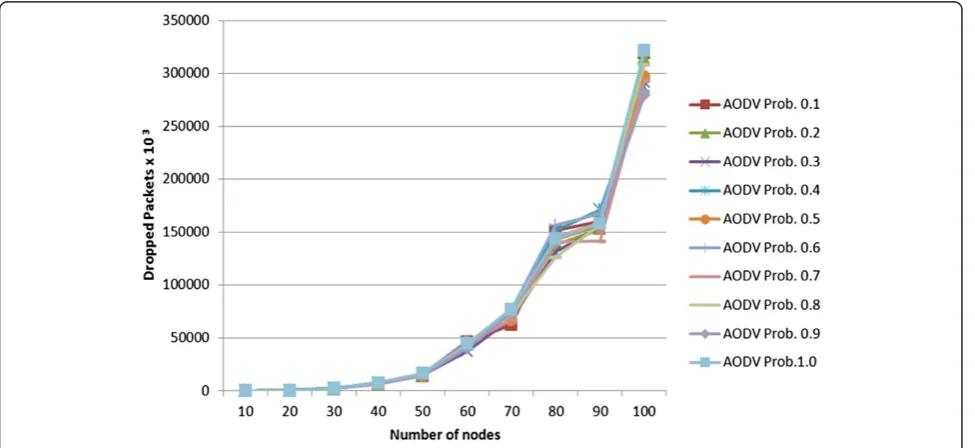
Figure 2 shows that in small network sizes, smaller than 30 nodes, the forward probability-based scheme presents almost identical results, whilst in larger net-work sizes (bigger than 30 nodes) the use of 0.3 or 0.8 forwarding probability shows lower dropped packets than using probability 0.1, 0.7 and 1.0. This shows that when using of the following forwarding probabilities, 0.3 and 0.8, the number of retransmissions is lower as the number of data packets that are successfully sent to their destinations are higher. Good results are also achieved with 0.5 forwarding probability but only for network sizes with the number of nodes between 70 and 100.
Figure 3 shows that the MAC Load increases rapidly when the probability is 0.1, 0.7 and 1.0 while on probabil-ity 0.3, 0.4 and 0.8 the MAC Load is very low. The MAC Load explains how successfully the number of data pack-ets is delivered to the destination node. The forwarding probabilities 0.3, 0.4 and 0.8 provide very low MAC Load meaning high success on data packet delivery while all the other forwarding probability values give very high MAC Load which lead to redundant retransmissions and deple-tion of battery power of the intermediate nodes.
All the above results have been used by the authors to develop a technique to change dynamically the forwarding probability according to the network density. In the fol-lowing section, a heuristic approach using the Bayesian theory is presented.
The modification of AODV RREQ mechanism using Bayesian probability approach
Below are the steps that are followed during the RREQ and RREP processing mechanism of AODV:
➢When a source node,S, tries to send a packet to destinationD.
➢IfSdoes not know the next hop forD, then it broadcasts a route request message.
➢The RREQ message propagates in all directions to reach the destinationD.
➢All the intermediate nodes that receive the RREQ message forward the packet to all its one hop neighbours.
➢ If the destination,D, receives an RREQ message through a nodeM, then it sends an RREP toSby forwarding it toMsinceMmay contain at least one routing table entry forS.
➢On receiving the RREQ message through different nodes, the destinationDwill send the RREP message through different nodes and they may reach the source node through different possible paths.
➢At the end, the source nodeSwill have different possible resolved paths to select from based on defined criteria.
In this RREQ mechanism, we intervene and use a ver-sion of the modified Bayesian probability theory in order to improve the function of the RREQ. In this section, the Bayesian probability theory and similar research that have been conducted by other researchers, together with a detailed explanation of our proposed algorithm, will be presented.
Bayesian probability theory
The Bayesian probability theory [25] manipulates condi-tional probabilities. The joint probability of two events,A andB, can be expressed as
Pð Þ ¼AB P Að =BÞ P Bð ÞorP Bð =AÞ P Að Þ ð4Þ
In Bayesian probability theory, one of these events is called hypothesis and denoted with H and the other is called data and denoted withD. The Bayesian probability theory assesses the probability of the observed data D resulting from hypothesisH.
P Hð =DÞ ¼P Dð =HP Dð ÞÞ P Hð Þ ð5Þ
The term P(H) is called the prior because it reflects prior knowledge before the data are considered. The term P(D) is the result of the sum of P(D|H)P(H) over allH. Finally, the termP(H|D) is known as the posterior and reflects the probability of the hypothesis after con-sideration of the data.
There have been many efforts to us Bayesian probability in order to alleviate the flooding phenomenon. Jain et al. [26] proposed a heuristic algorithm with a route establish-ment technique using Bayesian approach. This algorithm improves the performance of route discovery by amelio-rating the cost of route establishment using a history-based Bayesian method together with the relative region informa-tion of the destinainforma-tion node. The drawback of this effort is that it process and compares many information from each node (region, distance, status, destination node id and source node id) and which makes the algorithm complex, energy inefficient and time consuming in order to find the best route. Moreover, the simulations that have been con-ducted by other researchers were limited both in network size (number of nodes) and speed of the nodes. In large networks (bigger than 30 nodes), the behaviour of the net-work is different and there is bigger traffic congestion which causes unnecessary collision and packet overhead.
de Leoni et al. [27] have used the Bayesian probability theory in order to predict the disconnections that may oc-curred in MANETs. This research assumes that the nodes that are equipped with GPS receiver/transmitter and uses Bayesian filter to predict possible disconnections and con-trol adjacent nodes to move to a location that that will provide continuous coverage. The disadvantage of the proposed algorithm is that it assumes that all nodes are equipped with GPS.
In our approach, we are using the Bayesian probability the-ory which is modified according to two major assumptions:
1. The posterior probabilityPiis the forward probability of five nodes which is 1 (100%). In this case, when we have only five nodes or less the forward probability is 100%.
Using this approach the RREQ mechanism was modi-fied to broadcast only to a percentage of nodes for discov-ery the route. An example of how the Bayesian technique is implemented and how it affects the AODV protocol is described in details.
Assume that a nodeDsends (forward) messages to ano-desDithen using the probability forwarding schemePiis
P Dð =D1Þ ¼
PðD=D1Þ∗Pð Þi
D1=D
ð Þ∗Pð ÞD1 þPðD2=DÞP∗Pð Þ þD2 ⋯þPðDn=DÞ
∗PðDnÞ
ð6Þ
If it is assumed that there are nine nodes, in this case Pi is the posterior probability which is the forwarding
probability of five nodes which is 1 [when we have only five nodes or less the forward probability is 1 (100%)]. The forward probability is calculating from the above equation:
PðD=DiÞ¼
1
21
1
212þ1212þ1212þ1212þ1212þ1212þ1221þ1212þ1212
¼121 9 4
¼ 4 18¼0:22
ð7Þ
This is the probability that if we forward the message with probability of 100% using the above approach 22% of the nodes will receive the message. This is for when P Dð 1=DÞ ¼P Dð Þ ¼1 1
2which is an independent probability that explains that the probability of the node receiving the message is 50% probability.
Table 3 presents the variables that have been used in the proposed algorithm.
If the RREQ is received from an intermediate node then there will be at least one possible route which includes that node in its route list. Therefore, if only selected nodes are allowed to forward the RREQ packet, then only these nodes will be included in the path list. In this proposed scheme, the neighbourhood density of an intermediate node is considered as a criterion in RREQ forwarding de-cision at intermediate node. It denotes that if the number of nodes in the neighbourhood is high, then the Bayesian probability of any node transmitting will decrease and therefore reduces the transmission overhead. Random se-lection of nodes from the neighbourhood set increases the chances of full network coverage. Greater savings could be achieved by using a range-dependent technique to select nodes for transmission but this can only be achieved at the cost of greater complexity.
Proposed AODV_EXT_BP algorithm
➢ Any nodeFii= 1,2,. . .nreceiving the RREQ
message will process the packet as follows:
➢ If the RREQ message originated from the nodeSior
received at destination nodeDijust process it in the
normal way. IfFiis not theSiorDithen it will be an
intermediate node:
➢The nodeFiwill resolve the neighbourhood density DiThe Bayesian ProbabilityPiis:
Pi¼ PðD Dj Þ i P ið Þ
P Dð 1j Þ D P Dð Þ þ1 P Dð 2j Þ D P Dð Þ þ2 . . .þP Dð nj Þ D P Dð Þn
* ½ðn=dÞ
➢IfPi<rthen
Forward the RREQ message Else
Ignore and drop the RREQ message End
(Hereris a random number between 0 and 1)
The proposed algorithm is based on the Bayesian probability theory and disseminates the RREQ packet not at the whole network of nodes but only at those nodes that the algorithm chooses which is lesser than the complete network. In that case, the major differences are the following:
a. One of the main advantages of the proposed algorithm is that reduces the number of
re-broadcasts without significantly compromising on its reachability, while the traditional probability scheme that the AODV uses, produces more re-broadcasts. b. The Bayesian probability scheme forwards the RREQ
packet into lessen nodes than the traditional probability scheme.
c. By using the Bayesian probability scheme the power consumption is less by 3.3% than the traditional probability scheme.
Simulation and metrics of AODV RREQ mechanism using the Bayesian approach
The NS2 has been used to evaluate the protocols [28-31]. The simulations were carried out to assess the perform-ance of the routing protocols with network sizes of 10, 20, 30, 40, 50, 60, 70, 90 and 100 nodes with mobile node speeds between 1 and 30 m/s. The simulation scenario
has been repeated ten times in order the procedure and the results to be reliable so all the values on each graph are the average of the ten times simulation scenarios. For simplicity, in all cases the nodes send CBR over UDP. The metrics that have been used to evaluate the performance of the network and protocols are the following [24]:
Number of packets dropped: This is the number of data packets that are not successfully sent to its destination.
Consumed power:The average consumed battery power.
Throughput:This measures how well the network can constantly provide data to the sink. Throughput is the number of packet arriving at the sink per millisecond.
MAC Load:This is the ratio of the number of MAC layer messages propagated by every node in the network to the number of data packets successfully delivered to all destination nodes. In other words, the MAC Load is the average number of MAC messages generated for each data packet successfully delivered to the destination.
Control message overhead:This control message overhead is the total routing control messages transmitted and received in the network.
The simulation configuration and specification used are specified in Table 4.
Results and discussions
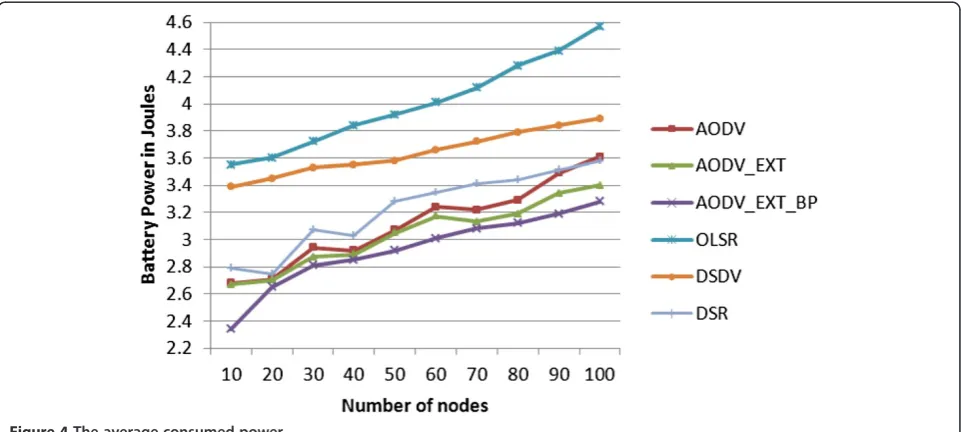
Figure 4 shows that AODV_EXT_BP consumes less power than the other five protocols. Most importantly, the power
consumption of AODV_EXT_BP-based network improves in comparison to that of already improved version of AODV the AODV_EXT and the standard AODV. The AODV_EXT_BP performances best in all the range of network densities. DSR protocol-based networks con-sumes more energy compared to AODV_EXT and AOD-V_EXT_BP but shows better performance in comparison to AODV when the number of nodes in the network is close to 100 nodes. On the contrary, the power consump-tion in networks using DSDV and OLSR rises steadily starting from fairly high levels. With increasing number of nodes, the energy depletion of OLSR-based networks increases faster than those for the other protocols. OLSR protocol uses a mechanism that constantly updates infor-mation about nodes in the neighbourhood and therefore consumes more energy. As the number of nodes in the network increases, more updates are required and hence proactive protocols perform poorly, especially when the network is subject to changes, e.g. in mobile environment.
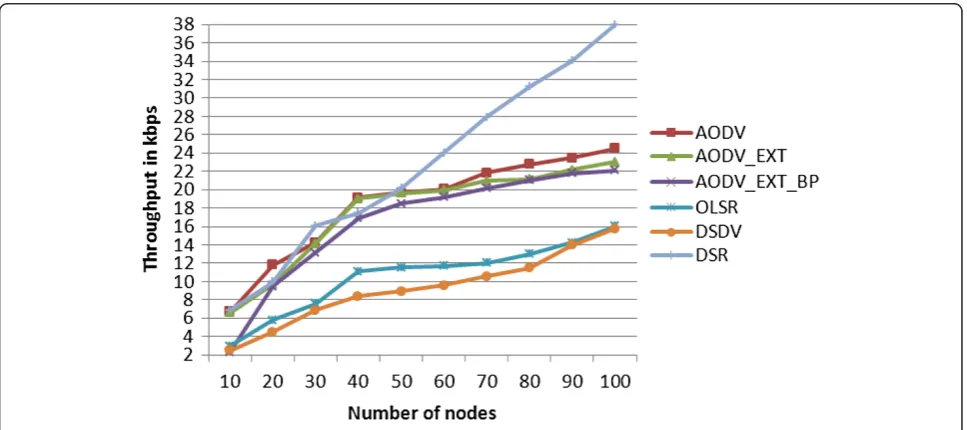
Figure 5 shows the performance of the protocols based on data throughput. It shows that the traditional DSR achieves the best performance. However, AODV_EXT_BP shows very good performance in average density networks (until 50 nodes). With AODV_EXT_BP, AODV_EXT and AODV protocols, every node does not need to keep infor-mation regarding the route between two nodes. This reduces the amount of signalling required for route dis-covery and maintenance. OLSR and DSDV both show poor performances compared to the four protocols. This is because both are proactive protocols and require table updates and generate relatively high messaging overhead that can cause congestion in large networks, especially in mobile networks, and reduces data rate performance of the network. However, these protocols are better suited to low data rate transmission because their self-updating
scheme ensures connectivity rather than the availability of bandwidth for application data. But in our simulation results the AODV_EXT_BP performs, also, as well as the other two routing protocols (OLSR, DSDV).
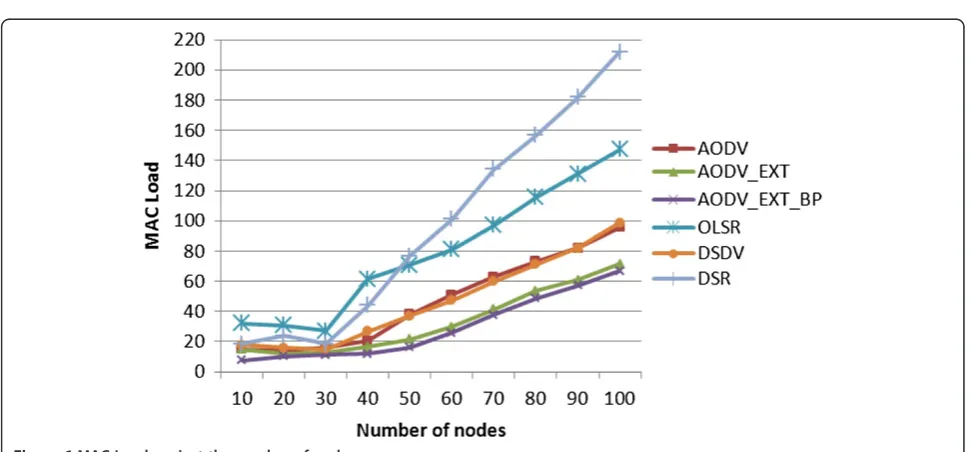
Figure 6 shows MAC loading of the protocols. It shows that for large networks, a relatively high number of mes-sages are generated by OLSR and DSR-based networks. This explains why the number of successfully delivered data packets is very low and therefore increases re-trans-missions. DSDV and AODV exhibit only moderate in-creases. The figure shows that the use of density-based scheme as applied in AODV_EXT_BP significantly reduces the number of routing messages in the network. The proposed scheme reduces the amount of messages retrans-mitted in every range of the network density; the improve-ment is 50% better than the standard AODV and by 3% over the AODV_EXT.
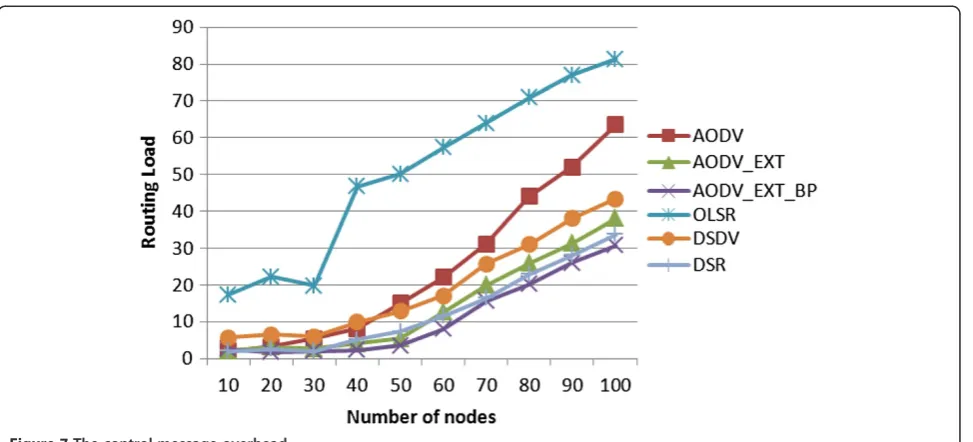
Figure 7 shows the routing control message overheads (routing load). In the case of AODV_EXT_BP, it is lower than that of the improved version of standard AODV, the AODV_EXT, and the original AODV protocol. DSR and DSDV show better performances due to the fact that they transmit and receive the least number of control mes-sages. On the other hand, OLSR protocol has the worst performance of all the protocols and this degrades signifi-cantly as the number of nodes is between 30 and 40.
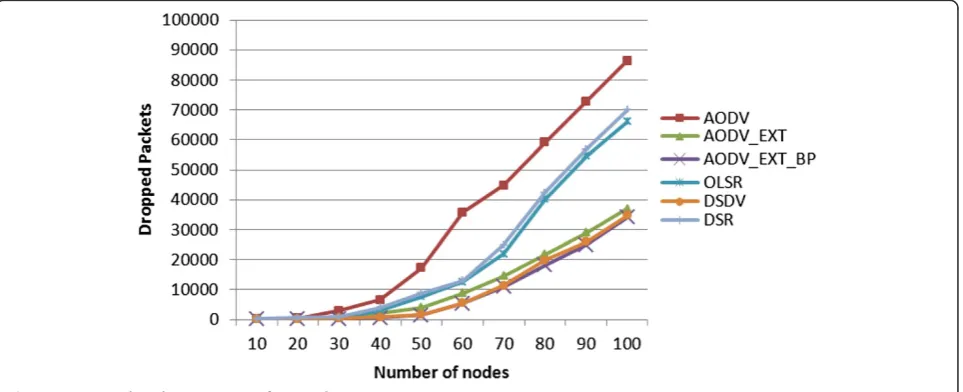
Figure 8 shows the dropped packets in terms of network size. In case of AODV_EXT_BP, it is lower than that of the AODV_EXT and the original AODV protocol. DSDV presents almost the same results as AODV_EXT_BP be-cause the mechanism that uses only adjacent nodes to send/receive packets has better performance in every scale of the network. OLSR and DSR show better performance in small-scale networks (until 30 nodes) after which both of them present low performances. The original AODV
protocol shows very poor performance of all the protocols when the number of nodes exceeds 20.
Conclusions
The evaluation of six widely used protocols (AOD-V_EXT, AODV_EXT_BP, AODV, DSDV, DSR and OLSR) has been presented in this article. Their perfor-mances in different size networks and in mobile scenar-ios have been studied using simulations developed in NS2. AODV has been modified to use a modified Bayesian probabilistic approach for transmitting RREQ. The modified version has been named AODV_EXT_BP. Un-like in some probability-based approaches, where every node is assigned a fixed probability that does not ensure full network coverage, the technique proposed in this article combines concepts from maximum range node selection with node pruning to reduce redundant re-transmissions in route request but offer connectivity and better network coverage guarantees inherent in deter-ministic techniques.
The reduction in route request transmissions in a network using AODV_EXT_BP has resulted in 3.3% which is 0.3% better energy efficiency savings compared to AODV_EXT [12], more than 70% reduction in the number of dropped packets because of reduced packet collision and increased data throughput. The results from this simulation can be compared with those in the research conducted by Khelifa and Maaza [32] proposed the Energy Reversed Ad-Hoc On-Demand Distance Vector (ER-AODV) routing protocol and consumes up to 2.0% more power than AODV_EXT_BP. Moreover, AODV_EXT_BP improves the data throughput by more than 20% compared to the standard AODV and 12% more than ER-AODV. The results also show that proactive protocols, whilst they are more reliable in terms of connecti-vity, exhibit poor performance in large networks. Reactive protocols, on the other hand, are more suited to large net-works. Both classes of protocols perform poorly in large mo-bile networks due to large overheads associated with routing as the nodes move. A hybrid protocol such as AODV offers a compromise and the technique proposed in this article to re-duce redundant re-transmissions based on transmitting node neighbourhood density has produced very promising results when compared to standard protocols. This research has showed that fine tuning of protocols to suit specific applica-tions or traffic scenarios to achieve optimum performance in ad-hoc networks is essential.
In the future, a different probability approach such as a Monte Carlo algorithm implementation at the route request discovery mechanism, it could be challenging research, investigates whether it alleviates the storm phenomenon or not.
Competing interests
The authors declare that they have no competing interests.
Received: 17 February 2012 Accepted: 12 September 2012 Published: 23 October 2012
References
1. R Min, A Chandrakasan, Top five myths about the energy consumption of wireless communication. Mob. Comput. Commun. Rev.7(1), 65–67 (2003) 2. V Kanakaris, D Ndzi, D Azzi, Ad-hoc networks energy consumption: a review
of the ad-hoc routing protocols. J. Eng. Sci. Technol. Rev.
3(1), 162–167 (2010)
3. R Ramdhany, P Grace, G Coulson, D Hutchison, Dynamic deployment and reconfiguration of ad-hoc routing protocols. J. Internet Services Appl.
1(2), 135–152 (2010)
4. Y Xu, J Heidemann, D Estrin, Geography-informed energy conservation for ad hoc routing, inProceedings of the Seventh Annual ACM/IEEE International Conference on Mobile Computing and Networking, July 16–21((Rome) Italy, 2001), pp. 70–84
5. J Rabaey, J Ammer, JL da Silva Jr., D Patel, PicoRadio: ad-hoc wireless networking of ubiquitous low-energy sensor/monitor nodes, inProceedings of the IEEE Computer Society Annual Workshop on VLSI (WVLSI'00), April
(Orlando, FL. USA, 2000), pp. 9–12
6. V Raghunathan, CL Pereira, MB Srivastava, RK Gupta, Energy aware wireless systems with adaptive power-fidelity tradeoffs. IEEE Trans. Very Large Scale Integr. (VLSI) Syst13(2), 211–225 (2005)
7. CC Shen, C Srisathapornphat, R Liu, Z Huang, C Jaikaeo, E Lloyd, CLTC: a cluster-based topology control framework for ad hoc networks. IEEE Trans. Mob. Comput.3(1), 18–32 (2004)
8. M Bani Yassein, M Bani Khalaf, A Al-Dubai, A new probabilistic broadcasting scheme for mobile ad hoc on-demand distance vector (AODV) routed networks. J. Supercomput53(1), 196–211 (2010)
9. M Bani Yassein, M Ould-Khaoua, LM Mackenzei, S Papanastasiou, Performance analysis of adjusted probabilistic broadcasting in mobile ad hoc networks. Int. J. Wirel. Inf. Netw13(2), 127–140 (2006)
10. Y Sasson, D Cavin, A Schiper, Probabilistic broadcast for flooding in wireless mobile ad hoc networks, inProceedings of IEEE wireless communication and networking conference (WCNC 2003), (2),March( New Orleans, LA, USA, 2003), pp. 1124–1130
11. Q Zhang, DP Agrawal, Dynamic probabilistic broadcasting in MANETs. J. Parallel Distrib. Comput.65(2), 220–233 (2005)
12. V Kanakaris, DL Ndzi, K Ovaliadis, Improving AODV performance using dynamic density driven route request forwarding. Int. J. Wirel. Mob. Netw. (IJWMN)3(3), 16–27 (2011)
13. Survey: broadcasting in wireless sensor network, ad-hoc network and delay-tolerant network. (2011). http://www.cs.tamu.edu/academics/tr/2011-9-2 14. N Karthikeyan, V Palanisamy, K Duraiswamy, Optimum density based model
for probabilistic flooding protocol in mobile ad-hoc network. Eur. J. Sci. Res.
39(4), 577–588 (2010)
15. J Wu, F Dai, Efficient broadcasting with guaranteed coverage in mobile ad-hoc networks. IEEE Trans. Mob. Comput.4(3), 259–270 (2005) 16. A Jamal,Probabilistic route discovery for wireless mobile ad-hoc networks
(MANETs), PhD thesis(University of Glasgow, 2009)
17. JC Requena, T Vadar, R Kantola, N Beijar,AODV-OLSR scalable ad hoc routing proposal, in Symposium on Wireless Pervasive Computing( Espoo, Finland, 2006), pp. 1–5. Jan
18. AH Abd Rahman, ZA Zukarnain, Performance comparison of AODV, DSDV and I-DSDV routing protocols in mobile ad-hoc networks. Eur. J. Sci. Res
31(4), 556–576 (2009)
19. The dynamic source routing protocol for mobile ad-hoc networks. http:// tools.ietf.org/html/draft-ietf-manet-dsr-10, Accessed 2 April 2008 20. F De Rango, M Fotino, S Marano, EE-OLSR: energy efficient OLSR routing
protocol for mobile ad-hoc networks, inIEEE Military Communications Conference( 2008), pp. 1–7
21. A Qayyum, L Viennot, A Laouiti,Multipoint relaying for flooding broadcast messages in mobile wireless networks(35th Annual Hawaii International Conference on System Sciences (HICSS'02), Hawai, 2002),
pp. 3866–3875. (9),Jan
22. Ad-hoc on-demand distance vector (AODV) routing. (2000). http://tools.ietf. org/html/draft-ietf-manet-aodv-08
24. A Rahman, S Islam, A Talevski,Performance measurement of various routing protocol in ad-Hoc network, Proceedings of the International MultiConference of Engineers and Computer Scientists 2009 (IMECS), (1)( Hong-Kong, 2009), pp. 321–323
25. Bayesian probability. (2010). http://people.cs.kuleuven.be/~danny. deschreye/urks-slides2007-1x3.pdf, Accessed 5 Jan
26. R Jain, M Parameswaran, C Hota, An efficient on-demand routing protocol for MANETs using Bayesian approach, inThird International Conference on Communication Systems and Networks (COMSNETS), Jan( Bangalore, India, 2011), pp. 1–4
27. M de Leoni, S Humayoun, M Mecella, R Russo, A Bayesian approach for disconnection management in mobile ad hoc networks, in16th IEEE International Workshops on Enabling Technologies: Infrastructure for Collaborative Enterprises (WETICE 2007), June(Paris France, 2007) 28. Ns-2 network simulator. http://www.isi.edu/nsnam/ns/, Accessed 2 May
2008
29. CMU Monarch BPensions to NS-2. http://www.monarch.cs.cmu.edu/cmu-ns. html, Accessed 2 May 2008
30. Marc Greis’Tutorial for the UCB/LBNL/VINT Network Simulator“ns”. http://web. uct.ac.za/depts/commnetwork/tutorial_ns_full.pdf, Accessed 2 May 2008 31. Installing OLSR on NS-2. http://masimum.inf.um.es/um-olsr/html, Accessed
20 May 2008
32. S Khelifa, M Maaza, An energy multi-path AODV routing protocol in ad hoc mobile networks, in5th International Symposium on I/V Communications and Mobile Network (ISVC), Oct( Oran Algeria, 2010), pp. 1–4
doi:10.1186/1687-1499-2012-318
Cite this article as:Kanakariset al.:A new RREQ message forwarding technique based on Bayesian probability theory.EURASIP Journal on Wireless Communications and Networking20122012:318.
Submit your manuscript to a
journal and benefi t from:
7Convenient online submission
7Rigorous peer review
7Immediate publication on acceptance
7Open access: articles freely available online
7High visibility within the fi eld
7Retaining the copyright to your article