Volume 2010, Article ID 239370,10pages doi:10.1155/2010/239370
Research Article
A Simulation Study: The Impact of Random and Realistic
Mobility Models on the Performance of Bypass-AODV in
Ad Hoc Wireless Networks
Ahed Alshanyour
1and Uthman Baroudi
21Electrical and Computer Engineering Department, Concordia University, Montreal, QC, Canada H3G 1MB
2Computer Engineering Department, King Fahd University of Petroleum and Minerals, Dhahran 31261, Saudi Arabia
Correspondence should be addressed to Uthman Baroudi,[email protected]
Received 13 October 2009; Revised 2 April 2010; Accepted 6 August 2010 Academic Editor: Kameswara Rao Namuduri
Copyright © 2010 A. Alshanyour and U. Baroudi. This is an open access article distributed under the Creative Commons Attribution License, which permits unrestricted use, distribution, and reproduction in any medium, provided the original work is properly cited.
To bring VANET into reality, it is crucial to devise routing protocols that can exploit the inherited characteristics of VANET environment to enhance the performance of the running applications. Previous studies have shown that a certain routing protocol behaves differently under different presumed mobility patterns. Bypass-AODV is a new optimization of the AODV routing protocol for mobile ad-hoc networks. It is proposed as a local recovery mechanism to enhance the performance of the AODV routing protocol. It shows outstanding performance under the Random Waypoint mobility model compared with AODV. However, Random Waypoint is a simple model that may be applicable to some scenarios but it is not sufficient to capture some important mobility characteristics of scenarios where VANETs are deployed. In this paper, we will investigate the performance of Bypass-AODV under a wide range of mobility models including other random mobility models, group mobility models, and vehicular mobility models. Simulation results show an interesting feature that is the insensitivity of Bypass-AODV to the selected random mobility model, and it has a clear performance improvement compared to AODV. For group mobility model, both protocols show a comparable performance, but for vehicular mobility models, Bypass-AODV suffers from performance degradation in high-speed conditions.
1. Introduction
Research has gained a significant advance in the develop-ment of routing protocols for wireless ad hoc networks [1, 2]. The movement pattern of mobile nodes plays an important role in the performance analysis of mobile and wireless networks. Additionally, mobility has a major effect on the route stability and availability. For example, to maintain communication, signaling traffic is needed for route construction and subsequent route maintenance. The extra signaling traffic over the air interface consumes radio resources, and it increases the interferences that affect the performance of other mobile nodes. Therefore, movement modeling is an essential building block in analytical and simulation-based studies of such systems. Moreover, some researchers [3, 4] have observed that the performance of
The Ad hoc On-demand Distance Vector (AODV) [1] is a distributed reactive routing protocol. It reacts relatively fast to the topological changes, and it saves storage space as well as energy. AODV performs better than other reactive protocols [8] in more stressful situations, such as a large number of nodes and highly mobile environments, but it suffers from high routing overhead compared to the Dynamic Source Routing (DSR) protocol. Bypass-AODV [9] is one of the recently developed routing protocols. It is an optimization of the AODV for mobile ad hoc networks, which uses a specific strategy, cross-layer MAC-notification, to identify mobility-related packet loss, and then it sets up a bypass between the node at which the route failure occurred and its old successor via an alternative node. By restricting the bypass to a very small topological radius, route adaptations occur only locally and communication costs are small. This approach has two main properties: simplicity and very promising performance compared to other existing approaches.
The Random Waypoint (RWP) [3] mobility model was used to evaluate the performance of Bypass-AODV, which has shown a clear performance gain over the conventional AODV [9], but RWP does not reflect the mobile nodes’ movement patterns in real-life applications. Therefore, to analyze the performance of any new routing protocol thoroughly and systemically, there is a need to use mobility models that emulate the real-life applications. Otherwise, the observations made and the conclusions drawn from the simulation studies may be misleading. This study has the following two main objectives.
(1) To study the impact of other well-known random mobility models, Random Walk (RW) [5] and Random Direction Mobility (RDM) [3], on the performance of the Bypass-AODV routing protocol. In these two models, users move individually in random directions with random velocities.
(2) To evaluate the performance of the proposed pro-tocol with real-life applications by using one of the group mobility models, Reference Point Group Mobility (RPGM) [10], and two vehicular mobility models: Freeway (FRW) and Manhattan (MAN) [5]. For RPGM, users move in groups toward certain attraction points, while for FRW and MAN they move like groups in certain directions with controlled velocities.
To evaluate mobility impacts, we opt to simulation method-ology for the following reasons. First, carrying out real experimental verification on the same scale as we carried out our simulation in is very difficult. Second, the theoretical analysis is not tractable for these networks with such complex mobility settings. The simulation results show that the Bypass-AODV routing protocol is insensitive to the random mobility pattern used in simulation. Under group mobility models, Bypass-AODV and AODV have similar performance. Although Bypass-AODV is a suitable choice for VANET applications at low to moderate speeds, it
shows performance degradation at high speeds due to the unnecessary increase in the route length.
Our findings in this paper shall help the research community in understanding better the behavior of the studied protocols and their implications on new applications such as VANET networks. Moreover, this paper provides future directions for new studies in this interesting area.
The remainder of this paper is organized as follows. In Section 2, we briefly present the AODV routing protocol, and then we present our enhanced local recovery routing scheme, Bypass-AODV, and we outline its advantages. Section 3 describes commonly used mobility models and their appli-cations.Section 4presents the network simulator (nss’) [11] simulation environment used to evaluate the performance of routing protocols under the selected mobility models. Section 5 discusses the performance of Bypass-AODV and original AODV. Finally,Section 6summarizes the paper and suggests future research directions.
2. AODV and Bypass-AODV
In this section, we shall summarize the basics of AODV and Bypass-AODV routing protocols.
2.1. AODV Routing Protocol. AODV is a reactive routing
protocol used for dynamic wireless networks where nodes might enter and leave the network frequently. It is an on-demand routing algorithm that builds routes when desired by source nodes. When a source node desires a route to a destination for which it does not already have a route, it broadcasts a route request message (RREQ) to its immediate neighbors. If any of its neighbors has a valid route to the destination, it replies with a route reply message (RREP). Otherwise, nodes, neighbors rebroadcast the RREQ. This process of broadcasting continues until the RREQ reaches the requested destination or reaches a node with a fresh enough route to that destination. As a result, several RREPs may be sent back to the source node, which in turn chooses the suitable route. To ensure loop-free and route-freshness properties, a combination of sequence numbers and hop counts is associated with the RREQ. Sequence numbers and hop counts are used by intermediate nodes to decide either to rebroadcast the RREQ or to discard it.
AODV has a local maintenance scheme to maintain the routes as long as they are active. When a link break in an active route occurs, the node upstream of that break tries to repair the route if it is closer to the destination than the source node. To repair the link break, the node broadcasts an RREQ for that destination. Otherwise, the node makes a list of unreachable destinations consisting of the unreachable neighbor and any additional destinations in its local routing table that use the unreachable neighbor as the next hop. Then, the node broadcasts a route error message (RERR) to notify its neighbors to invalidate the routes using the broken link.
2.2. Bypass-AODV Routing Protocol. Bypass-AODV uses
Original route Connectivity S
I J
K
M L D
Figure1: Route maintenance using Bypass-AODV.
packet loss, and then it triggers the routing layer to start a local repair process. It allows the upstream node of the bro-ken link to set up a bypass to connect with the downstream node via an alternative node. The MAC-notification message is used to distinguish between mobility-related packet loss and other source-related packet losses (signal interference, packet error rate, fading environment, and packet collision). Unlike AODV, the bypassing mechanism minimizes routing overheads by limiting the area of route bypass search based on spatial locality where a node cannot move too far too soon. Thus, with high probability, the new distance between the broken links end nodes will not exceed 2 hops. Moreover, bypass-AODV minimizes packet losses because it has the ability to repair the broken link regardless of its location.
However, packet losses occur when route bypassing does not work, specifically when the distance between broken links end nodes is >2 hops. In such a case, Bypass-AODV follows AODV link invalidation scheme. Several bypasses for the same route may lead to an unnecessary increase in the route hop count. To handle this issue, the bypassed-route is a temporary route that lasts for a period long enough to transmit packets that left the source node.
Figure 1 gives a brief illustration of route bypassing. Initially, the flow from sourceSto destinationDgoes through nodesI,J,K,andL. The nodeK will detect a break in the link that connects it withL. As a consequence,Kwill initiate a limited route discovery cycle to search for a bypass toL. Neighbors ofKwill receive the RREQ and rebroadcast it to their neighbors. Assuming the new distance betweenKand Lis 2 hops;Lwill receive the RREQ and then unicasts an RREP toK.Figure 1shows a situation where the RREQ is unicasted toKvia nodeM. Our simulation results show that, in most cases, no need to bypass the broken link because the detected route failure is a factious one that results from network congestion.
3. Mobility Models
Mobility models can be categorized into two categories: entity and group mobility models. The entity mobility models represent the behavior of an individual node or group of nodes independently from other nodes. On the other hand, the group mobility models take into account the interaction among individual mobile nodes. Group mobility
P1 P6
P3
P2
P5
P4
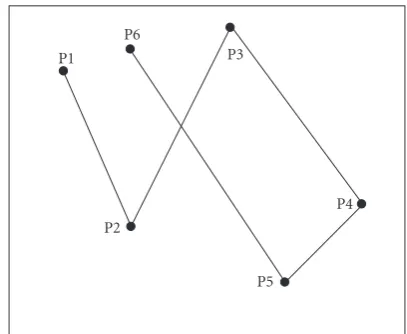
Figure2: Example of node movement in the Random Waypoint Model.
models are more suitable for some ad hoc network scenarios such as groups of soldiers in military actions or a group of fire fighters in action. In this section, in addition to RWP model, we will discuss two other random mobility models: RW and RDM. Next, we discuss the RPGM, FRW and MAN mobility models.
3.1. Random Walk Mobility Model (RW). This model was
originally proposed to emulate the unpredictable movement of particles in physics. In this model, a node moves from its current position to a new position by selecting a random direction and a random speed. The node randomly and uni-formly selects its new directionθ(t) from (0, 2π] and speed
v(t) from (0,Vmax]. During the time interval t, the node moves with the velocity vector (v(t) cosθ(t),v(t) sinθ(t)). As the node reaches the boundary of the simulation region, it bounces back to the simulation region with an angle of
θ(t) orπ−θ(t). The Random Walk model is memoryless it generates an unrealistic movement pattern, and hence it does not match real-life applications.
3.2. Random Waypoint Mobility Model (RWP). In RWP, each
node randomly selects a new target location and then moves to that location with a constant speed chosen uniformly and randomly from (0,Vmax], where Vmax represents the maximum allowable speed for the mobile node. Once the mobile node reaches that location, it becomes stationary for a predefined pause time,Tpause. After that it selects another random location within the simulation region and moves into it. The whole process is continuously repeated until the end of the simulation time.Figure 2shows an example for the movement trace of a node. Two key parameters,Vmax andTpause, define the mobility behavior of the mobile nodes. IfVmax is small andTpauseis large, the network topology is expected to be stable. On the other hand, large Vmax and smallTpausewill produce a highly dynamic network topology [12].
capture the characteristics of temporal dependency (i.e., the velocities at two different time slots are dependent) spatial dependency (i.e., the movement pattern of mobile nodes may be influenced by and correlated with nodes in its neighborhood), and geographic constraints (nodes’ movements are restricted by obstacle, along streets and freeways) [5].
3.3. Random Direction Mobility Model (RDM). The spatial
node distribution of RWP is transformed from uniform node distribution to nonuniform distribution as the simulation time elapses and finally it reaches a steady state. In steady state, the mobile nodes are concentrated at the central region and are almost zero around the boundaries [12,13]. The RDM model [14] was proposed to overcome such phenomenon. In RDM, the node randomly and uniformly chooses a direction and moves along that direction until it reaches a boundary. After reaching the boundary and stopping for someTpause, it randomly and uniformly chooses another direction to travel. Therefore, the resultant node distribution from this model is more stable than that of RWP.
3.4. Reference Point Group Mobility Model (RPGM). The
RPGM model emulates group movement patterns. In RPGM, mobile nodes inside the simulated region form cer-tain groups. Each group has a group leader that determines the group members’ motion behavior. It acts as a reference point for that group. Group members’ mobile nodes ran-domly move about their own predefined reference points with a speed vectorVmember(t) and direction vectorθmember(t) that is derived by randomly deviating from that of the group leader’s velocity and direction, (Vleader(t),θleader(t)), respectively. A Speed Deviation Ratio (SDR) and an Angle Deviation Ration (ADR) are used to control the deviation of the velocity vector of group members from that of the leader.
−→Vmember=V→−leader+ rand(·)∗SDR∗maxs,
−→Θmember=Θ→−leader+ rand(·)∗ADR∗maxa, (1)
where 0≤SDR, ADR≥1. maxsand maxaare used to limit the maximum speed and the maximum angle the group member can take, respectively. Since the movements of the group’s members are controlled by the group leader’s movement, this mobility model is expected to have high spatial dependency for small values of SDR and ADR. As shown in Figure 3, at time t, the mobile nodes deviate from their estimated reference points,RP(t), (the five black dots). At timet+ 1, five new reference points are estimated,
RP(t + 1). Also, mobile nodes deviated from their new estimated reference points.
−→Vi(t+ 1)=−→Vi(t)+ rand(·)∗−→ai(t) ∀i,j,t, Di,j(t)≤SD=⇒−→Vi(t)≤−→Vj(t),
(2)
3.5. Freeway Mobility Model (FRW). The FRW is proposed to
emulate the motion behavior of mobile nodes on a freeway
RP(t) MN1
MN2
MN3 MN4
Leader RP(t+ 1)
MN1 MN2
MN4 MN3
Leader
Figure3: Example: a group of five mobile nodes movements using the RPGM model.
Figure4: Example of node movement in the Freeway Model.
(exchange the traffic status or track a vehicle on a freeway). In this model, each freeway has several lanes in both directions. Thus, the mobile node movement is restricted to its lane on the freeway (a strict geographic restriction on the node movement) and its velocity at different instants of time is temporally dependent. Moreover, mobile nodes’ movement in the same lane is spatially dependent (the vehicle’s speed is constrained by the speed of vehicles ahead of it. The vehicle adjusts its speed and position to keep a Safe Distance (SD) from the one ahead of it).Figure 4illustrates the maps used for simulating the FRW mobility model.
3.6. Manhattan Mobility Model (MAN). MAN is proposed
Figure5: Example of node movement in the Manhattan model.
A mobile node can probabilistically move straight, turn right, or turn left at the intersections with probabilities of 0.5,
0.25, or 0.25, respectively. In this model, the mobile node
movement has the same restrictions as in FRW, and the same velocity equations are applicable. MAN is expected to have spatial dependency, strong temporal dependency, and strict geographic restrictions on the node movements. Figure 5 illustrates the maps used for simulating the MAN mobility model.
4. Simulation Environment
We implement a simulation model using thensto evaluate the performance of Bypass-AODV. Free Space propagation model is used to predict the signal power strength at the receiver side. The signal strength is used to determine if the frame is received successfully.nsmainly uses three thresholds to determine whether a frame is received correctly by the receiver. If the signal strength of the frame is less than the carrier sensing threshold (CSThresh), the frame is discarded in the PHY module and will not be visible to the MAC layer. If the signal strength of the received frame is stronger than the reception threshold (RxThresh), the frame is received correctly. Otherwise, the frame is tagged as corrupted and the MAC layer will discard it. When multiframes are received simultaneously by one mobile node, it calculates the ratio of the strongest frame’s signal strength to the sum of other frames’ signal strengths. If it is larger than the capturing threshold (CPThresh), the frame will be received correctly and other frames are ignored. Otherwise, all frames are collided and discarded. In our simulation, we choose TCP instead of UDP to evaluate the performance of our proposed protocol against large data packets and excessive overhead. The IEEE 802.11 MAC standard [15] and the TCP New-Reno are used at the MAC and TCP layers, respectively. The transmission rate is assumed to be constant at 1 Mbps.
In each simulation-iteration, we generate a scenario with a source-destination pair that is randomly and uniformly
Table1: Evaluation parameters.
Parameter Value
Transmission range (Rx) 180 m
Interference range 400 m Transmission bit rate 1 Mbps
CPThresh 10.0 dB
CSThresh −72 dBm
RXThresh −65 dBm
Transmission power 20 dBm Simulation region 1000 m×1000 m Number of nodes 60 Number of TCP
connections 1
Session interval 150 sec Simulation time 160 sec Maximum speed (Vmax) 1, 5, 10, 20, 30,and 40 m/sec
Packet size 1060 byte Pause time (Tpause) 0 sec
SDR and ADR 0.1
chosen. The simulation results reported in the next section represent the average results over6000 different scenarios. Each reading is averaged over 30 independent runs. The velocity for each node is selected randomly and uniformly from (0,Vmax].Table 1 shows the values of all parameters used in the simulation. The following metrics are computed to evaluate the impact of each mobility model on the performance of the Bypass-AODV as well as the original AODV.
(1) The routing overhead ratio is the ratio of the amount in bytes of control packets transmitted to the amount in bytes of data packets received. This measure is important to estimate the cost of introducing the new protocol.
(2) The goodput of the TCP is the number of sequenced bits that a TCP receiver receives per unit of time. This measure will show the effectiveness of the routing protocol from the application perspective.
(3) The “goodput improvement ratio” is the TCP good-put observed with a Bypass-AODV strategy as com-pared to the standard AODV routing strategy.
5. Simulation Results and Discussion
In this section, we examine the impact of different random mobility models as well as group and vehicular mobility models on the performance of Bypass-AODV and AODV routing protocols.
5.1. Impact of Node Speeds on TCP Connection Length. Let
1 5 10 15 20 25 30 35 40
Figure 6: The percent of received TCP packets with short hop counts (hop count≤3).
speeds on the connection hop counts for RPGM, FRW, and MAN mobility models. These findings are important for understanding the behavior of routing protocols and their effect on TCP performance.
Figures6and7show the percentage of short and medium routes at different speeds. For the considered environment, it is rare to find a connection of length more than 6 hops. Moreover, node speeds have a minimal effect on the length of the TCP connection in terms of number of hops for RPGM because of the strict movements of nodes. On the other hand, for FRW and MAN, the higher the node speed, the higher the tendency for short connection (≤3). This behavior is natural because as nodes move in opposite and perpendicular directions, the TCP connections will suffer frequent breakage especially the long ones. This phenomenon has a direct effect on TCP performance, as will be discussed in the next sections.
5.2. Impact of Random Mobility Models on Bypass-AODV. The RWP, RW, and RDM models are used to evaluate the performance of Bypass-AODV and AODV. Our objective is to study the performance of Bypass-AODV on both long and short TCP connections (in terms of hop counts) To achieve this objective, we make the TCP connection’s end nodes static, while other nodes are allowed to move in accordance with the assumed mobility model with a maximum speed of 20 m/s. Hence, the physical distance (the physical distance between the source and the destination of a TCP connection remains relatively unchanged during a simulation run. It is worth to note that the minimum distance between TCP connection end nodes in terms of the number of hops, assuming nodes use their maximum transmission range (180 m)) between the connection’s end nodes remains relatively unchanged during a simulation run.
1 5 10 15 20 25 30 35 40
Figure7: The percent of received TCP packets with medium hop counts (4≤hop count≤6).
Actually, all the nodes in the ad hoc network share the same transmission medium. If a node is transmitting, other nodes within a certain range of the transmitting node cannot transmit. Two ranges are defined by the IEEE 802.11 MAC and are used in our simulation: the transmission range and the sensing range. The transmission range is the maximum distance between two nodes, such that a signal transmitted by one node can be received by the other node and can be decoded correctly. The sensing range is defined as the maximum distance between two nodes, such that a signal transmitted by one node can be received by the other node, but cannot be decoded correctly. The sensing range is much larger than the transmission range. In our simulation setting, the transmission range is 180 m while the sensing range is 400 m. The IEEE 802.11 MAC protocol ensures that while a node is transmitting, other nodes within its sensing range cannot transmit.
1 2 3 4 5 6 100
101
102
103
The physical distance between the connection end nodes (hops)
Goodput
(kbps)
RWP RW RDM
Figure8: TCP goodput for Bypass-AODV routing protocol.
uniformly distributed over the simulation area. However, the average route lifetime is small compared to RWP, due to the continuous node mobility which leads again to frequent link breakage.
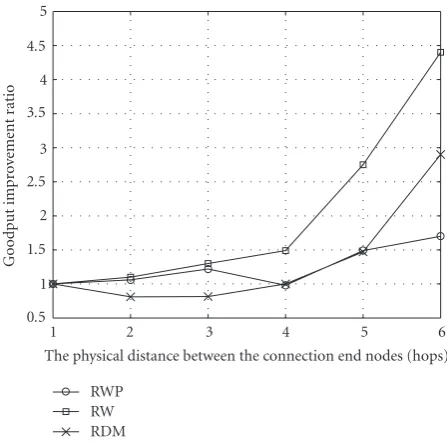
For a number of hops ≥4, the connection end nodes start to reside at boundaries, and therefore Bypass-AODV shows clear enhancement in performance with RW and RDM models due to the uniform distribution of nodes that creates homogeneous and highly connected networks. However, the nonuniform distribution of mobile nodes may partition the network frequently as in RWP. Finally, these findings confirm previous results in the literature, namely, a routing protocol may behave differently under different mobility models especially for long connections [16].
Figure 9 compares the performance of Bypass-AODV and AODV. It shows a clear improvement in the TCP goodput ratio, especially for long TCP connections. When the physical distance is ≥4 hops, there is a possibility of simultaneous contention on the transmission medium (collision). Collision causes unsuccessful packet transmis-sion. The IEEE 802.11 MAC translates unsuccessful packet transmission into link failure. Therefore, there is a need for an efficient MAC mechanism that distinguishes mobility-related failures from other source-mobility-related failures such as contention. The existence of such mechanism will reduce the frequency of route mechanism invocation, and it will minimize the routing overheads and packet drops. This justifies why the Bypass-AODV outperforms the AODV especially for uniformly distributed nodes and long TCP connections.
5.3. Impact of Group Mobility Models on Bypass-AODV. we
explore the dependency of routing protocols performance on the movement pattern used in the simulated environment. For the RPGM model, we use four groups of 15 nodes,
1 2 3 4 5 6
The physical distance between the connection end nodes (hops)
Goodput
Figure9: Goodput improvement ratio (Bypass-AODV/AODV).
each one is moving independently of the others and in an overlapping fashion.
Figure 11shows that the Bypass-AODV routing protocol has a slight enhancement in goodput at high speeds and similar performance at low speeds. Figure 12 shows the goodput improvement ratio. The similarity in performance can be attributed to the fact that both routing protocols have short connection most of the time.Table 2shows that about 98% of the received TCP packets have a short hop count (≤3) under RPGM mobility model. Figure 10 from a previous work [9] shows that Bypass-AODV and AODV have similar performance for short-distance TCP connections. Bypass-AODV effectively minimizes packet drops by buffering the data packets for subsequent transmission after doing the route bypassing. However, a bypassed route is temporary and it lasts for a period of time, that is, long enough to forward the buffered packets, and then a new route discovery mechanism will start. Nevertheless, the routing overhead in Bypass-AODV experiences little increase relative to AODV, as shown in Figure 13. On the other hand, increasing the speed will increase the possibility of overlapping between groups, and it will shorten the physical distance between the connection end nodes if they exist at different groups.
Furthermore,Figure 11illustrates that the RPGM move-ment pattern doubles the goodput of both routing protocols relative to RWP. This considerable enhancement in goodput is due to the spatial dependency nature of the RPGM model, which increases the lifetime of the routes.
1 2 3 4 5 6
Physical distance between the connection end nodes (hops)
Goodput
Figure 10: Goodput improvement ratio (Bypass-AODV/AODV) for different number of simultaneous TCP connections.
1 5 10 15 20 25 30 35 40
Figure11: Goodput (Bypass-AODV and AODV).
Table2: The connection hop count distribution (hc); node’s speed is 20 m/sec.
Mobility model Shorthc≤3 Medium
4≤hc≤6 Longhc >6
RPGM 98% 2% 0%
FRW 84% 10% 6%
MAN 72% 22% 6%
the models. In each experiment setting, the direction of movement of the communicating end nodes forms two groups of scenarios. The first group has scenarios with the same direction, but the second group has scenarios with an opposite or perpendicular direction. In FRW, the first
1 5 10 15 20 25 30 35 40
Figure12: Goodput improvement ratio (Bypass-AODV/AODV).
1 5 10 15 20 25 30 35 40
Figure13: Routing overhead ratio.
1 5 10 15 20 25 30 35 40
Figure14: Goodput, Bypass-AODV, and AODV routing protocols.
received packets with short hop count is found to be 84% under FRW model, while only 72% under MAN model. These percentages clarify why Bypass-AODV shows better performance under FRW than MAN.Figure 14shows that, as the node’s speed increases, the TCP goodput performance degrades. This result is expected due to the nodes’ high speeds, which increases the number of link failures and their corresponding constructed bypasses. Furthermore, AODV and Bypass-AODV show lower TCP goodput for MAN environment compared with FRW. Finally, Bypass-AODV is behaving reasonably as AODV under FRW nobility model except at very high speed (144 km/h). However, for MAN-similar environment, Bypass-AODV shows a quick degradation as node’s speed exceeds 36 km/h.
6. Conclusions and Future Work
Accurate evaluation of mobility impact on the routing proto-cols requires the testing of different mobility patterns. Other-wise, the observations made and the conclusions drawn from the simulation studies may be misleading. In this paper, we investigated the behavior of an optimized Bypass-AODV for a wide range of mobility models including VANET models. Simulation results show that Bypass-AODV is insensitive to random mobility models and has a clear performance improvement compared to AODV. Moreover, Bypass-AODV always outperforms AODV when nodes are uniformly distributed for the long TCP connections. In addition, Bypass-AODV has a comparable performance under group mobility model compared to AODV. Currently, Bypass-AODV is not suitable for handling VANET applications at very high speeds. As a future work, Bypass-AODV needs more improvement in order to handle VANET applications. We believe that several parameters, such as vehicle speed and direction, are necessary for appropriate route selection in VANET applications. The route selection process should be
responsive and intelligent to avoid unnecessary long paths and at the same time to make use of neighboring nodes to receive the requested service. In fact, several studies have shown that proactive routing protocols are unreliable for VANET applications [17,18].
Acknowledgment
This paper is supported by King Fahd University of Pet-roleum and Minerals, Dhahran, Saudi Arabia under Fast Track project FT 2005-16.
References
[1] C. E. Perkins and E. M. Royer, “The ad hoc on-demand distance vector protocol,” inAd Hoc Networking, pp. 173–219, Addison-Wesley, Reading, Mass, USA, 2001.
[2] D. B. Johnson, D. A. Maltz, and J. Broch, “DSR: the dynamic source routing protocol for multi-hop wireless ad hoc networks,” inAd Hoc Networking, pp. 139–172, Addison-Wesley, Reading, Mass, USA, 2001.
[3] T. Camp, J. Boleng, and V. Davies, “A survey of mobility mod-els for ad hoc network research,”Wireless Communications and
Mobile Computing, vol. 2, no. 5, pp. 483–502, 2002.
[4] T. K. Madsen, F. H. P. Fitzek, and R. Prasad, “Impact of different mobility models on connectivity probability of a wireless ad hoc network,” inProceedings of the International
Workshop on Wireless Ad-Hoc Networks, pp. 120–124, June
2004.
[5] F. Bai, N. Sadagopan, and A. Helmy, “Important: a frame-work to systematically analyze the impact of mobility on performance of routing protocols for adhoc networks,” in
Proceedings of the 22nd Annual Joint Conference on the IEEE
Computer and Communications Societies (INFOCOM ’03), pp.
825–835, April 2003.
[6] D. R. Choffnes and F. E. Bustamante, “An integrated mobility and traffic model for vehicular wireless networks,” in Proceed-ings of the 2nd ACM International Workshop on Vehicular Ad
Hoc Networks (VANET ’05), pp. 69–78, September 2005.
[7] R. Baumann, S. Heimlicher, and M. May, “Towards realistic mobility models for vehicular ad-hoc networks,” in Proceed-ings of the Mobile Networking for Vehicular Environments
(MOVE ’07), pp. 73–78, May 2007.
[8] V. D. Park and M. S. Corson, “A highly adaptive distributed routing algorithm for mobile wireless networks,” in Pro-ceedings of the 16th IEEE Annual Conference on Computer
Communications (INFOCOM ’97), pp. 1405–1413, April 1997.
[9] A. Alshanyour and U. Baroudi, “Bypass-AODV: improving performance of ad hoc on-demand distance vector (AODV) routing protocol in wireless ad hoc networks,” inProceedings of the International Conference on Ambient Media and Systems
(Ambi-sys 2’08), 2008.
[10] X. Hong, M. Gerla, G. Pei, and C.-C. Chiang, “A group mobility model for ad hoc wireless networks,” inProceedings of the 2nd ACM International Workshop on Modeling, Analysis
and Simulation of Wireless and Mobile Systems (MSWiM ’99),
1999.
[11] K. Fall and K. Varadham, http://www.isi.edu/nsnam/ns/ns-documentation.html.
[12] C. Bettstetter and C. Wagner, “The spatial node distribution of the random waypoint mobility model,” inProceedings of the 1st
German Workshop on Mobile Ad Hoc Networks (WMAN ’02),
[13] D. M. Blough, G. Resta, and P. Santi, “A statistical analysis of the long-run node spatial distribution in mobile ad hoc networks,” inProceedings of the ACM International Workshop on Modeling, Analysis and Simulation of Wireless and Mobile
Systems (MSWiM ’02), pp. 30–37, September 2002.
[14] E. M. Royer, P. M. Melliar-Smith, and L. E. Moser, “An analysis of the optimum node density for ad hoc mobile networks,” in
Proceedings of the International Conference on Communications
(ICC ’01), pp. 857–861, June 2000.
[15] Wireless LAN Medium Access Control (MAC) and Physical Layer (PHY) Specifications, IEEE standard 802.11, 1997. [16] G. Jayakumar and G. Ganapathi, “Reference point group
mobility and random way-point models in performance evaluation of MANET routing protocols,”Journal of Computer
Systems, Networks, and Communications, vol. 2008, Article ID
860364, 10 pages, 2008.
[17] J. Nzouonta, N. Rajgure, G. Wang, and C. Borcea, “VANET routing on city roads using real-time vehicular traffic infor-mation,”IEEE Transactions on Vehicular Technology, vol. 58, no. 7, pp. 3609–3626, 2009.