R E S E A R C H
Open Access
Fractional order polytopic systems: robust
stability and stabilisation
Christophe Farges, Jocelyn Sabatier
*and Mathieu Moze
* Correspondence: Jocelyn. [email protected] University of Bordeaux, IMS Laboratory (CRONE Team), CNRS UMR 5218, 351 Cours de la Libération, 33405 Talence, France
Abstract
This article addresses the problem of robust pseudo state feedback stabilisation of commensurate fractional order polytopic systems (FOS). In the proposed approach, Linear Matrix Inequalities (LMI) formalism is used to check if the pseudo-state matrix eigenvalues belong to the FOS stability domain whatever the value of the uncertain parameters. The article focuses particularly on the case of a fractional orderνsuch that 0 <ν< 1, as the stability region is non-convex and associated LMI condition is not as straightforward to obtain as in the case 1 <ν< 2. In relation to the quadratic stabilisation problem previously addressed by the authors and that involves a single matrix to prove stability of the closed loop system, additional variables are then introduced to decouple system matrices in the closed loop system stability
condition. This decoupling allows using parameter-dependent stability matrices and leads to less conservative results as attested by a numerical example.
Keywords:Fractional order systems, inear Matrix Inequalities, Robust control, State feedback, Polytopic systems
Introduction
As for linear time invariant integer order systems, it is now well known that stability of a linear fractional order system depends on the location of the system poles in the complex plane. However, pole location analysis remains a difficult task in the general case. For commensurate fractional order systems, powerful criteria have been pro-posed. The most well known is Matignon’s stability theorem [1]. It permits to check the system stability through the location in the complex plane of the dynamic matrix eigenvalues of the system pseudo-state space representation. Matignon’s theorem is in fact the starting point of several results in the field [2,3]. This is the case of the Linear Matrix Inequalities (LMI) stability conditions recently proposed by the authors [4]. These conditions are used to synthesise a stabilising pseudo-state feedback whatever the system fractional orderν in the set ]0,2[.
Although much progress has been made in the field of fractional system stability, lin-ear time invariant fractional systems robust stability remains an open problem. Among the existing results and only for interval fractional systems, the stability issue was dis-cussed in [5-7]. As commented in [5,8], the result is rather conservative. To reduce the conservatism, in [8], a new robust stability checking method was proposed for interval uncertain systems, where Lyapunov inequality is used for finding the maximum
eigenvalue of a Hermitian matrix. However, the results presented in [8] only provide sufficient conditions. Note also that these results are dedicated to SISO systems.
In this article, the robust stability and stabilisation problems of linear time invariant fractional order linear systems with convex polytopic uncertainties are studied. The article particularly focuses on the case of a fractional order νsuch that 0 <ν < 1, as the stability region is non convex and associated LMI stability condition is not as straight-forward to obtain as in the case 1 <ν < 2. A quadratic stability analysis condition that involves a single matrix variable is proposed in [4]. This condition is used to derive a quadratic pseudo-state feedback synthesis method [4]. In this article, additional vari-ables are introduced to decouple system matrices from the ones proving system stabi-lity. This decoupling allows using parameter-dependant stability matrices and lead to less conservative results for both analysis and synthesis purposes as attested by a numerical example.
Notations: The transpose of a matrix Ais denotedA’, its conjugate A¯ and its conju-gate transpose A*. For Hermitian matrices, > (≥) denotes the Löwner partial order, i.e.
A>BiffA-Bis (semi) positive definite.
Preliminaries and problem statement
In this article are considered Linear Time Invariant (LTI) commensurate FOS. In this section, preliminary results are stated in the certain case for an LTI FOS admitting a pseudo-state space representation of the form
Dνx(t)
y(t)
=
A B C D
x(t) u(t)
(1)
wherex(t)ÎRnis the pseudo-state vector,u(t)Î Rmis the input vector,y(t)Î Rpis the output vector, νis the fractional order of the system and A,B, CandDare con-stant matrices.Dνis the fractional differentiation operator of orderν(presented results are valid whatever definition is used: Riemann-Liouville [9,10] or others [11]). Transfer matrix is H(s) =C(sνI-A)-1B+Dand impulse response matrix ish(t) =L-1{H(s)}.
Definition 1 [1] A linear fractional order system defined by its impulse time responseh is bounded-input bounded-output (BIBO) stable iff∀uÎ L∞(R+, Rm),y =
h*uÎ L∞(R+,Rp).
LTI integer order systems stability can be checked via the location of the eigenvalues of the pseudo-state matrix Ain the complex plane. This result was extended to LTI commensurate fractional order systems of order 0 <ν < 1 by Matignon.
Theorem 1 [1] System (1), with minimal triplet (A, B, C) and 0 <ν < 1, is BIBO stable if and only if
|Argeig(A)|> νπ
2. (2)
This result remains valid when 1 <ν< 2 as proved in [12]. Stability domain is thus defined as follows:
Ds=z∈C:|Arg(z)|> νπ
2 . (3)
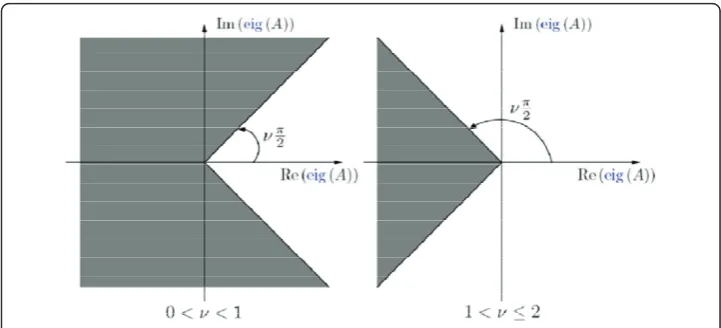
Remark 1Throughout the article, triplet (A,B,C) is always supposed to be minimal. Testing if the eigenvalues of matrix A belong to a region of the left half plane defined by (3) with 1 <ν < 2 is a well-known problem in LMI control theory because it corresponds to a performance requirement on the damping ratio of the system. A solu-tion of this problem is provided by the LMI region framework [13]. Extending this LMI condition to the case 0 <ν < 1 is far from trivial because the location of eigenva-lues in this region corresponds to unstable integer order systems. Moreover, region of the complex plane defined by (3) is not convex as shown in Figure 1. However, this problem has been solved in [4] in which the following result was proposed.
Theorem 2 Fractional system (1) of order 0 < ν < 1 is BIBO stable iff ∃X = X*Î
Cnxn
>0s.t.
rX+¯rX¯A+ArX+¯rX¯<0 (4)
where
r=ej(1−ν) π 2.
Using this result, the pseudo-state feedback stabilisation problem has been solved in [4]. Theorem 3 [4] Fractional system (1) of order 0 <ν < 1 is BIBO stabilisable by pseudo-state feedback control law u = Kx + yr iff∃X = X*ÎCnxn >0 and YÎRmxn>0
s.t.
rX+¯rX¯A+ArX+¯rX¯+YB+BY <0 (5)
where
r=ej(1−ν) π
2.A stabilising controller gain is then:
K =YrX+r¯X¯−1. (6)
Feedback stabilisation of polytopic fractional order systems Problem statement
Let the polytopic fractional order system described by:
Dνx(t)
y(t)
=
A(λ) B(λ) C(λ)D(λ)
x(t) u(t)
=M(λ)
x(t) u(t)
(7)
where lis a vector of parametric uncertainties. The parameter-dependent system matrixM(l) belongs to the convex polytope M with Nvertices defined by
M =co{M1,· · ·,MN}=
This article is devoted to giving constructive conditions for pseudo-state feedback control laws of the form u=Kx + yr, whereKis a constant matrix gain andyris the reference signal, robustly stabilising the closed loop system:
The closed loop system matrices Mcl(l) belong to the polytope Mcldefined by:
Mcl=coMcl1,. . .MclN (10)
The next sections present two results on robust control of MIMO fractional order systems. The first one is a straightforward extension of Theorem 3 to handle uncertain polytopic fractional systems (7). In the second one, elimination lemma is used to derive a less conservative condition.
Polytopic stabilisation
Using a single matrix X to attest stability for the whole set of uncertainty is known to be overly conservative. However, the coupling between stability matrixX and dynamic matrix A(l) prevents from directly using a parameter-dependent stability matrixXcl (l). The following result allows us to overcome this problem.
Theorem 4 Fractional polytopic system (7) of order 0 <ν< 1 is robustly BIBO stable if there exist N matrices Xi= Xi*ÎCn×n, Xi> 0 and a matrix GÎ C2n × ns.t.∀iÎ{1.N}:
Proof Suppose a solution (Xi, G) to (11). Computation of convex combination over the Nvertices allows to write for all uncertainties:
Applying elimination lemma [14] to the last inequality leads to:
which is exactly (4) with parameter-dependant matrices and thus, according to Theorem 2, proves the robust stability of the system.
Theorem 4 provides a sufficient condition for stability but decoupling between stabi-lity matrix and dynamic matrix in (12) allows to use the parameter-dependant stabistabi-lity matrixX(l) defined by (13). As proved in [15,16], stability condition of Theorem 4 is always less conservative than the one of theorem 18 in [4] based on the use of quadra-tic stability condition.
Based on Theorem 4, the following result allows to design a pseudo state feedback control law while stability of the closed loop system is attested by a parameter-depen-dant stability matrix.
Theorem 5Fractional polytopic system (7) of order 0 <ν< 1 is robustly BIBO stabili-sable by pseudo-state feedback control law u = Kx + yr if there exist N matrices Xi =
Xi*Î Cn×n , Xi> 0, FÎRn×nand KtÎRm×ns.t. ∀iÎ {1.N}:
A stabilising controller gain is then:
K=KtF−1. (16)
Proof Suppose a solution (Xi, F, Kt) to (15). Then the controller definition implies thatKt=KF, which allows to write:
According to Theorem 4, this last inequality proves that the closed loop system is robustly stable.
In order to maintain convexity, matrix A0 appearing in Theorem 5 cannot be a vari-able but must be chosen a priori such that it is stvari-able. Indeed, elimination lemma shows that existence of matrices Xi=Xi* > 0, FandA0 verifying (15) is equivalent to existence of matricesXi=Xi* > 0 andA0verifying the following two inequalities:
Remark Contrary to the analysis case, synthesis result of Theorem 5 cannot be proved to be always less conservative than the one of Theorem 18 in [4] based on the use of quadratic stability condition. However, improvement can be significant on some given examples, as shown in next section.
Numerical example
The proposed numerical application is a fractional version of an example proposed in [17]. Studied system is described by representation (7) where:
A=
−3 +α 2
−3 1.5 +γ
B=
1 β
(21)
with
|α|≤αmax |β|≤0.5 |γ |≤1.5 (22)
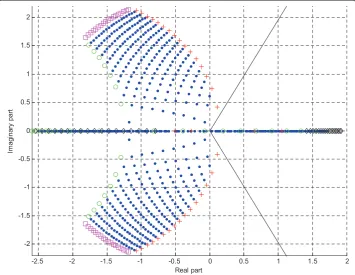
Fractional order νis chosen equal to 0.7. As parameters a,band gvary in the inter-vals defined by relation (22), eigenvalues of matrixAare represented Figure 2 foramax = 0.7. That figure demonstrates that the system can be stable or unstable depending on the valuesa,band guncertain parameters values.
The goal is now to compute a pseudo-state feedback control law of the formu=Kx + yrthat robustly stabilises the system.
For comparison purpose, quadratic stabilisation theorem proposed in [4] and theo-rem proposed in section“Feedback stabilisation of polytopic fractional order systems” are applied to compute a stabilising pseudo-state feedback for model (21-22).
-2.5 -2 -1.5 -1 -0.5 0 0.5 1 1.5 2
-2 -1.5 -1 -0.5 0 0.5 1 1.5 2
Real part
Im
ag
inar
y par
t
First, Theorem 18 in [4] is used to compute a stabilising controller of gainK. Parser Yalmip [18] and LMI solver SDPT3 are used to get matricesX andYsolutions of the semi-definite problem associated with LMI condition
rX+r¯X¯Ai+Ai
rX+¯rX¯+YBi+BiY <0 (23)
where
r=ej(1−ν) π
2,×=X*Î C
n×n
,X > 0 andYÎRm×ns.t.∀iÎ {1.N}. A stabilising
controller gain is then:
K =YrX+r¯X¯−1. (24)
For such a problem, a solution exists for values of amaxup to αquadmax = 0.57.
Then, this solver has been used to get matrices Xi, i Î {1.N}, Fand Ktassociated with LMI condition (15) of Theorem 5 with the matrixA0chosen equal to:
A0=
−2 0 0 −2
. (25)
A solution exists for values of amaxup to αAmax0 = 0.74 and corresponding gain Kis obtained using Equation 14:
K=−15.56 33.29. (26)
This represents an improvement of about 30%.
Eigenvalues of matrix A+BK(closed loop state matrix) as parameters a,b andg vary in the intervals defined by relation (24) withamax= 0.74 are represented Figure 3. This figure confirms that the closed loop system is robustly BIBO stable.
The degrees of freedom offered by matrixA0 are now used to find a controllerKfor higher values of parameter amax. Matrix A0 is first chosen equal to:
A10=
λr−λi λi λr
. (27)
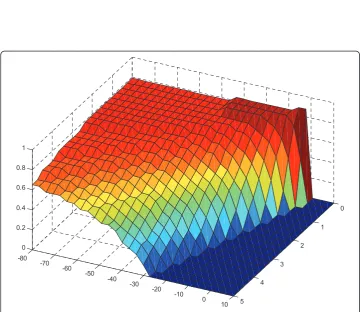
Figure 4 represents the amaxvalues obtained with -50≤lr ≤0 and 0≤li ≤2. This figure highlights the existence of an infinity of matrices A0 that permit to obtain a
solution and provides a value ofamaxequal to αA 1 0
max= 0.86 forlr= -15.86 andli= 0. Matrix A0 is now chosen equal to:
A20=
λr1 0
0 λr2
. (28)
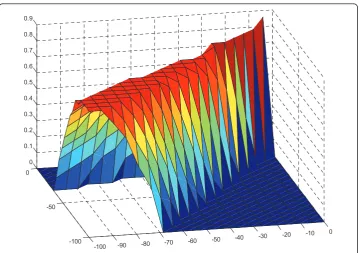
Figure 5 represents the amax values obtained with −50≤λr1 ≤0 and 0≤λr2 ≤2.
As previously, this figure shows that the maximal value of αmax(αA2 0
max= 0.88) is
obtained forA0 eigenvalues λr1 =−19.31 and λr2 =−19.31.
-20 -15 -10 -5 0 5 -10
-8 -6 -4 -2 0 2 4 6 8
Real part
Im
ag
inar
y par
t
Figure 3MatrixA+BKeigenvalues locus (·) with∣a∣≤0.7,∣g∣≤1.5,∣b∣≤0.5, stability domain limits (–) (+a= -0.7,○a= 0.7,◇g= -1.5,□g= 1.5,∇b= -0.5,Δb= 0.5).
0
1
2
3
4
5 -80
-70 -60
-50 -40
-30 -20
-10 0
10 0
0.2 0.4 0.6 0.8 1
Conclusion
In this article, a solution is proposed for the robust stability and stabilisation problems of fractional order linear systems subjected to convex polytopic uncertainties. Pre-sented results are derived from the LMI stability analysis and synthesis conditions recently proposed by the authors for the certain case [4].
In relation to the analysis result proposed in [4] that involves a single matrix in order to prove stability of the system, additional variables are then introduced to decouple system matrices from the ones proving stability of the closed loop system. This decou-pling allows using parameter-dependant stability matrices and obtained LMI stability analysis condition is always less conservative than the one involving a single stability matrix.
The method is extended to handle the state feedback synthesis problem. Although, synthesis result based on the use of parameter-dependant matrices cannot be proved to be always less conservative than the quadratic one, significant improvement is obtained on a numerical example.
As shown in the numerical example, this last condition offers some degree of free-dom. Some parameters have to be set a priori and this choice has an influence on the quality of the obtained result. Authors are currently working on a systematic method to choose those parameters.
-100 -90 -80 -70 -60 -50
-40 -30 -20 -10 0
-100 -50 0
0 0.1 0.2 0.3 0.4 0.5 0.6 0.7 0.8 0.9
Figure 5Research ofamaxfor various values ofλr1andλr2.
Table 1 Values ofamaxobtained
αquad
max αmaxA0 αA
1 0
max αA
2 0
max
Abbreviations
BIBO: bounded-input bounded-output; FOS: fractional order polytopic systems; LMI: Linear Matrix Inequalities; LTI: Linear Time Invariant.
Authors’contributions
All the authors have contributed in all the paper part.
Competing interests
The authors declare that they have no competing interests.
Received: 11 December 2010 Accepted: 22 September 2011 Published: 22 September 2011
References
1. Matignon, D: Stability results on fractional differential equations with applications to control processing. pp. 963–968. Computational Engineering in Systems Applications, Lille, France2, (1996)
2. Moze, M, Sabatier, J, Oustaloup, A: LMI tools for stability analysis of fractional systems. 20th ASME International Design Engineering Technical Conferences & Computers and Information in Engineering Technical Conference (ASME IDETC/ CIE’05), Long Beach, California, USA (2005)
3. Sabatier, J, Farges, C: On stability of fractional order systems. International Journal of Bifurcation and Chaos. (2011, in press)
4. Farges, C, Moze, M, Sabatier, J: Pseudo state feedback stabilization of commensurate fractional order systems. Automatica.46(10), 1730–1734 (2010). doi:10.1016/j.automatica.2010.06.038
5. Chen, YQ, Ahn, HS, Podlubny, I: Robust stability check of fractional order linear time invariant systems with interval uncertainties. Signal Process.86, 2611–2618 (2006). doi:10.1016/j.sigpro.2006.02.011
6. Petras, I, Chen, Y, Vinagre, BM, Podlubny, I: Stability of linear time invariant systems with interval fractional orders and interval coefficients. pp. 1–4. Proceedings of the International Conference on Computation Cybernetics (ICCC04), Vienna, Austria (2004)
7. Tan, N, Ozguven, OF, Ozyetkin, MM: Robust stability analysis of fractional order interval polynomials. ISA Trans.48(2), 166–172 (2009). doi:10.1016/j.isatra.2009.01.002
8. Ahn, HS, Chen, YQ, Podlubny, I: Robust stability test of a class of linear time-invariant interval fractional-order system using Lyapunov inequality. Appl Math Comput.187(1), 27–34 (2007). doi:10.1016/j.amc.2006.08.099
9. Caputo, M: Linear models of dissipation whose q is almost frequency independent–II. Geophys. J Int.13(5), 529–539 (1967)
10. Miller, KS, Ross, B: An Introduction to the Fractional Calculus and Fractional Differential Equations. Wiley, New York (1993)
11. Samko, SG, Kilbas, AA, Marichev, OI: Fractional Integrals and Derivatives: Theory and Applications. Gordon and Breach Science Publishers, Amsterdam (1993)
12. Sabatier, J, Moze, M, Farges, C: LMI Stability conditions for fractional order systems. Comput Math Appl.9, 1594–1609 (2010)
13. Boyd, S, El Ghaoui, L, Feron, E, Balakrishnan, V: Linear Matrix Inequalities in System and Control Theory. SIAM Studies in Applied Mathematics, Philadelphia. (1994)
14. Skelton, RE, Iwazaki, T, Grigoriadis, K: A Unified Approach to Linear Control Design. Taylor and Francis, London (1998) 15. Paucelle, D: Formulation générique de problèmes en analyse et commande robuste par les fonctions de Lyapunov
dépendant des paramètres. PhD thesis dissertation, Toulouse III University (2000)
16. Peaucelle, D, Arzelier, D: New LMI-based conditions for robust H2 performance analysis. Proceedings of the American Control Conference, Chicago Illinois. 317–321 (2000)
17. De Souza, CE, Trofino, A: An LMI approach to stabilization of linear discrete-time periodic systems. Int J Control.73, 696–709 (2000). doi:10.1080/002071700403466
18. Lofberg, J: A toolbox for modeling and optimization in MATLAB. Proceedings of the CACSD Conference, Taipei, Taiwan (2004)
doi:10.1186/1687-1847-2011-35
Cite this article as:Fargeset al.:Fractional order polytopic systems: robust stability and stabilisation.Advances in Difference Equations20112011:35.
Submit your manuscript to a
journal and benefi t from:
7Convenient online submission 7 Rigorous peer review
7Immediate publication on acceptance 7 Open access: articles freely available online 7High visibility within the fi eld
7 Retaining the copyright to your article