Volume 2010, Article ID 415438,11pages doi:10.1155/2010/415438
Research Article
A Novel Quantize-and-Forward Cooperative System:
Channel Estimation and M-PSK Detection Performance
Iancu Avram, Nico Aerts, Dieter Duyck, and Marc Moeneclaey
Department of Telecommunications and Information Processing, Faculty of Engineering, Ghent University, 9000 Gent, Belgium
Correspondence should be addressed to Iancu Avram,[email protected]
Received 26 January 2010; Revised 16 May 2010; Accepted 4 July 2010
Academic Editor: Carles Anton-Haro
Copyright © 2010 Iancu Avram et al. This is an open access article distributed under the Creative Commons Attribution License, which permits unrestricted use, distribution, and reproduction in any medium, provided the original work is properly cited.
A method to improve the reliability of data transmission between two terminals without using multiple antennas is cooperative communication, where spatial diversity is introduced by the presence of a relay terminal. The Quantize and Forward (QF) protocol is suitable to implement in resource constraint relays, because of its low complexity. In prior studies of the QF protocol, all channel parameters are assumed to be perfectly known at the destination, while in reality these need to be estimated. This paper proposes a novel quantization scheme, in which the relay compensates for the rotation caused by the source-relay channel, before quantizing the phase of the received M-PSK data symbols. In doing so, channel estimation at the destination is greatly simplified, without significantly increasing the complexity of the relay terminals. Further, the destination applies the expectation maximization (EM) algorithm to improve the estimates of the source-destination and relay-destination channels. The resulting performance is shown to be close to that of a system with known channel parameters.
1. Introduction
As wireless communication networks become more wide-spread, new methods are being developed to increase the reliability of information transfer. In a multipath propaga-tion environment, the reflected signals can combine both constructively or destructively at the receiving antenna, giving rise to Rayleigh fading. This imposes an upper bound on the reliability of a point-to-point communication system. One way to overcome this problem is by the use of multi-element sending or receiving antennas [1]. However, due to size constraints of mobile terminals, this technique cannot always be applied.
In a cooperative communication system, this problem is overcome by exploiting the broadcast nature of wireless communication. Information broadcast by the source is also received by terminals other than the destination. These terminals relay to the destination the information sent by the source, creating additional independent channels between source and destination. This technique is analyzed from an information theoretic point of view in [2], where upper and lower bounds are obtained for the capacity of the relay
channel. In [3], it is shown that in a fading environment, the spatial diversity introduced by the relay terminals improves the reliability of a communication system, which is now determined by the probability that all channels are simultaneously in fading. By increasing the reliability of the communication system, higher data rates can be achieved without increasing the transmitter power. Alternatively, one can keep the data rate constant and lower the transmission energy, extending the battery life of portable devices.
Source
Relay
Destination
First timeslot Second timeslot
h1
h0
h2
Figure1: A relay channel consisting of half-duplex devices.
Wyner-Ziv coding scheme. Other quantization methods have been analyzed in [6,7]. The QF protocol described in [6] is attractive for the use in wireless sensor networks, because the complexity of the individual relay terminals is kept low. This is done by moving the more computational intensive tasks to the destination, where typically there is more processing power available.
While cooperative communication has been well inves-tigated from an information theoretic point of view, other aspects also need to be studied in the development of a practical implementation. The issue of channel coding is addressed in [8], where low density parity check (LDPC) codes are designed for the Decode and Forward (DF) proto-col. Channel parameter estimation is discussed in [9] for the AF protocol, where pilot-based estimates are calculated for the different channel coefficients involved. Because only the received pilot symbols are used in [9], the obtained estimates could be further refined by also using the information about the channels that is embedded in the received data symbols. This is technique is applied for the DF protocol in [10], where a code-aided estimation method is used to obtain very accurate channel estimates. The DF protocol however requires the relay to partially decode the received symbols, significantly increasing the computational complexity and making the system less suitable for sensor networks.
This contribution addresses the issue of channel param-eter estimation in QF, keeping in mind the resource con-straints at the relay. Because of its low complexity relaying strategy, the QF protocol described in [6] is used as a starting point. In [6], the relay quantizes the phase of the received M-PSK modulated signal without knowing the state of the source-relay channel. The destination is assumed to know all the channel coefficients when decoding the received symbols. It is shown that uniform quantization of the phase with log2M+ 1 bits is sufficient to closely approach the performance of a pure AF system. When the channel parameters are considered to be unknown, they need to be estimated at the destination, before the received symbols can be decoded. However, because the destination is not connected to the source-relay channel, obtaining an accurate estimate of this channel is very difficult. This problem is solved by introducing a novel quantization scheme, which greatly facilitates channel parameter estimation, without
introducing a significant increase in computational complex-ity at the relay.
In the proposed quantization scheme, the relay first makes a coarse estimate of the source-relay channel based on pilot symbols received from the source. This estimate is used to compensate for the channel rotation of this channel, before quantizing the received signal. As will be shown, the proposed protocol requires only log2M bits for the quantization of each symbol to achieve a performance similar to that of a pure AF system. The issue of channel parameter estimation for the proposed QF protocol has been touched in [11], where estimates are obtained for the source-destination and relay-source-destination channel coefficients. All noise variances are assumed to be known to the destination. This contribution, besides providing additional results and insights, also deals with the estimation of the different noise variances.
At the destination, initial estimates of the source-destination and relay-source-destination channel coefficients and noise variances are obtained from the received pilot symbols. These initial estimates are then refined using the expectation maximization (EM) algorithm [12], which is an iterative algorithm that also uses the information embedded in the received data symbols when calculating a new estimate of the channel parameters involved. It is shown that using the proposed algorithms, the performance of the system with estimated channel parameters can be made to be very close to that of a system with known parameters. In an attempt to reduce the computational complexity of the EM algorithm, an approximation is discussed that yields only a minor loss in error performance.
2. System Model
At the source, blocks of K information bits are encoded into blocks ofN coded bits which are then mapped onKd M-PSK symbols. In a first timeslot, the source transmits
Kp pilot symbols along with the Kd coded data symbols, which are received by both the relay and the destination. In a second timeslot, the relay sends to the destination Kp pilot symbols followed by a quantized version of the noisy
Kd coded symbols received from the source. The relay also sends to the destination an estimate of the instantaneous signal-to-noise ratio (SNR) on the source-relay channel, usingKγM-PSK coded symbols. The destination combines the signals received during both timeslots in order to detect the information bits sent by the source. The pilot symbols are used for estimating the source-destination and relay-destination channels (at the relay-destination). The instantaneous SNR on the source-relay channel is needed at the destination for properly combining the signals received from the relay and from the source.
Considering the channel model, the output of the different channels can be written as (all vectors are denoted as row vectors.)
r0=h0cs+n0,
r1=h1cs+n1,
r2=h2cr+n2,
(1)
withcsthe symbols sent by the source, andcr the symbols sent by the relay. The channel coefficients hi are constant during a timeslot. All channel coefficients have a zero mean circular symmetric complex gaussian (ZMCSCG) distribution with varianceNhi =1/din, withdithe distance between the two terminals involved (i = 1, 2, 3) andn the path loss exponent. The elements of the vectorni are also ZMCSCG distributed with varianceNi(i=1, 2, 3).
Both source and relay use the same amount of energy for the transmission of a frame consisting ofKinformation bits. This energy equals KEb, with Eb the energy needed to transmit one information bit. The latter is proportional to the energy of the symbols sent by the source and relay, denoted Es and Er, respectively. Taking into account the transmission of pilot symbols and the instantaneous SNR on the source-relay channel,EsandErcan be expressed in terms ofEb
Es= Kd
Kd+Kp
Klog2M
N Eb,
Er= Kd
Kd+Kp+Kγ
Klog2M
N Eb.
(2)
2.2. Structure of the Relay Terminal. We propose a relay that compensates for the channel rotation caused by the source-relay channelh1, before quantizing the received signal. This compensation makes use of an estimateh1 of this channel, based on pilot symbols transmitted by the source. The ith symbolcr,iis a quantized version of theith elementr1,iofr1
cr,i=ejqi, (3)
whereqiis defined by the relationship
qi= 2πki
2Q , (4)
if
π
2Q(2ki−1)<arg
r1,ih∗1
< π
2Q(2ki+ 1), (5)
withk∈ {0, 1,. . ., 2Q−1}andQthe number of quantization bits. When using this quantization scheme, the destination will only be required to know the instantaneous SNR on the source-relay channel, given by γ = |h1|2/N1, and not the exact value ofh1, as will be proven in the next subsection. This instantaneous SNR is estimated by the relay, quantized,
Calculate and encodeγ
cγ
cr
Quantization
h1
N1 Estimation
r1p
r1
Figure2: Schematic representation of the relay terminal.
encoded, mapped to M-PSK symbols, and forwarded to the destination. The resulting structure of the relay terminal is represented schematically inFigure 2.
Instead of compensating for the channel rotation caused by the source-relay channel, an estimate of this rotation could also be sent to the destination, along with the estimate of the SNR on the source-relay channel. However, the quantization of the channel rotation is more complex than the quantization of the SNR on the source-relay channel. While a coarse quantization is sufficient for the SNR, a much more refined quantization is required for the channel rotation, especially when the phase of h1 is near the edge of a quantization interval. While this could be achieved by quantizing the channel rotation using a large number of bits or by using a logarithmic quantization scheme, it would significantly increase the complexity of the relay terminal. Therefore, it is beneficial to compensate for the channel rotation caused by the source-relay channel at the relay, instead of forwarding an estimate of this rotation to the destination. Furthermore, when compensating for the source-relay channel rotation at the relay, the received information can be quantized with one bit less as opposed to when no compensation is used. This further lowers the complexity of the relay terminal.
2.3. Signal Combining at the Destination. For decoding purposes, the likelihoods of the received symbols must be determined by the destination. Because the source-destination and relay-source-destination channels are orthogonal, the likelihood of theith received source symbolcs,iequals
prd,i|cs,i,h,N
=pr0,i|cs,i,h0,N0
pr2,i|cs,i,h1,h2,N1,N2
, (6)
withrd,i=(r0,i,r2,i),h=(h0,h1,h2) andN=(N0,N1,N2). The first factor from (6) can be written as
pr0,i|cs,i,h0,N0
= 1
πN0e
(−|r0,i−h0cs,i|2
The second factor from (6) can be expressed as the marginal (8) can be calculated using the phase density function [6]
fΘθ,γ=21π e−γ+πγcos(θ)e−γsin 2(θ)
erfc−γcos(θ).
(10)
This function describes the distribution of the received phase when a symbol with amplitude 1 and phase 0 is sent over an AWGN channel. The variable γ is the SNR ratio at the receiving terminal (the relay in this case). Using this function, one obtains
where the integration in (11) is over the quantization interval (5) forki=k.
The second factor in the integrand from (8) depends on the optimization criteria used for calculating the estimate of
h1. InSection 3.1, the maximum likelihood (ML) estimate of
h1based onKppilot symbols is shown to be equal to
withcspthe pilot symbols sent by the source andr1pthe part ofr1corresponding with the received pilot symbols. By using (1), this can be written as
By taking into account the ZMCSCG noise distribution, one obtains the following expression for the distribution of h1 conditioned onh1andN1:
The resulting likelihood (6) ofcs,i contains the channel parametersh0,h1,h2,N0,N1, andN2. As these parameters at not known at the destination, the likelihood (6) will be computed at the destination with the true channel parameters replaced by estimates. The channel gainsh0and
h2 and noise variances N0 and N2 are estimated at the destination, while estimates of h1 and N1, computed by the relay, could be sent from the relay to the destination. However, in order to avoid the numerical integration in (8), the destination will use the simplifying assumption that the relay makes a perfect estimate ofh1, so that
ph1|h1,N1
As a result, as far as the source-relay channel is concerned, only the valueγnow needs to be known by the destination; an estimate ofγis sent from the relay to the destination.
Although the approximation (16) does not hold for small values ofh1, it does not significantly affect the error performance. As the value of h1 (and γ) approaches zero,
of the source-relay channel. This results in a very robust system: with decreasing values ofh1(andγ), the error caused by assuming the relay makes a perfect channel estimate increases, but the impact this assumption has on the error performance decreases.
Finally, the impact approximation (16) has on the error performance will also depend on the state of the source-destination channel. When the source-source-destination channel is in fading (smallh0), the calculation of the symbol likelihoods (6) will be more affected by (false) approximations con-cerning the relay channel, as the direct path cannot provide information on the symbols sent.
3. Estimation
When the channel parameters are unknown at the receiver, they need to be estimated. The first step in the estimation process is the calculation of an initial estimate of the different channel coefficients and noise variances, using known pilot symbols sent by the source and the relay. Thereafter, the estimates of the source-destination and relay-destination channel coefficients will be refined using the EM algorithm at the destination. The estimate of the source-relay channel coefficient is not refined using the EM algorithm at the relay, as the increase in complexity would be unacceptable.
3.1. Pilot-Based Estimation. Both the relay and the destina-tion must calculate a first estimate of the channel coefficient and the noise variance associated with the channel(s) they are connected to. This is done using pilot symbols sent by the source and the relay. Here we concentrate on the estimation ofh0andN0at the destination. The ML estimatesh0andN0 resulting from the pilot symbols are obtained by solving the following maximization problem
h0,N0
=arg max h0,N0p
r0p|h0,N0
, (20)
wherer0pis the part ofr0corresponding to the received pilot symbols. As shown inAppendix A, the values ofh0 andN0 that maximize (20) are equal to
h0=
r0pcHsp
KpEs
, (21)
N0=
r0p−h0csp 2
Kp
, (22)
wherecsp denotes the pilot symbols sent by the source and
Kpis the number of pilot symbols sent by both source and relay. Similar equations are obtained for the estimation ofh1 andN1at the relay (based on theKppilot symbols sent by the source) andh2andN2at the destination (based onKppilot symbols sent by the relay).
When using an estimate ofh0instead of the actual value in (22), the estimate of the noise variance is biased by a factor (Kp−1)/Kp, as shown inAppendix B. Especially when using a small number of pilot symbols, it is important to compensate for this bias by multiplying (22) withKp/(Kp−1). Further,
it can be advantageous to average out the noise variance between consecutive frames, because this variance tends to fluctuate much slower than the channel coefficients. This can be accomplished by using a noise varianceN0(k)equal to
N0(k)=αN0(k−1)+ (1−α)N0, (23)
when evaluating the symbol likelihoods (6) in the kth received frame. The notation N0(k−1) is employed for the variance used in the previous frame andN0, given by (22), is an estimate of the noise variance based on the pilot symbols received in the current frame. The weighting factor α lies between 0 and 1 and depends on the expected speed of fluctuation of the noise variance.
The relay uses the estimates h1 andN1 to compute an estimate γ = |h1|
2
/N1 of the instantaneous SNR on the source-relay channel, to be forwarded to the destination. The estimates of h0 and h2 will be further refined at the destination by means of the EM algorithm. As shown in
Section 4.2.1, there is little to gain in refining the pilot based estimates ofN0andN2. Therefore, only the estimates ofh0 andh2will be updated using the EM algorithm.
Because the mean-square error (MSE) of (21) satisfies
Eh0−h0
2
= N0
KpEs =
Kp+Kd
Kp 1
K N0
Eb, (24)
transmitting a fixed number of K information bits and keeping the ratioKd/Kpconstant will make the MSE related to the channel coefficient estimation essentially independent of the constellation sizeM.
3.2. EM Algorithm. The channel coefficient estimates dis-cussed in the previous section are solely based on the pilot symbols which represent only a small part of the received signal energy. In order to improve these estimates, the EM algorithm can be used. The EM algorithm is an iterative algorithm that alternates between an estimation step and a maximization step. It allows calculating a ML estimate of a set of parameters from an observation that is also influenced by other unknown variables, named nuisance parameters. In this specific case, the source-destination channel coefficient (h0) and the relay-destination channel coefficient (h2) are the parameters that need to be estimated, while the symbols sent by the source and relay, denotedcsandcr, respectively, are considered nuisance parameters.
Introducingrd=(r0,r2),cd =(cs,cr), andhd =(h0,h2), the estimation step during iterationkinvolves calculating the function
Qhd,h(dk−1)
=Ecd lnp(rd|cd,hd)|rd,h
(k−1)
d
. (25)
In order not to overload the notation, the dependency of the distributions on the noise variance is not noted explicitly. The maximization step involves determining a value forh0 andh2that maximizes theQfunction from (25), so the new estimates calculated at iterationkare equal to
h(dk)=arg max hd
Qhd,h(dk−1)
whereh(0)d contains the estimate of (h0,h2) obtained from the pilot symbols only. As shown inAppendix C, the values ofh0 andh2that maximize (26) are equal to
with us and ur denoting the a posteriori expectations (conditioned onrd andh(dk−1)) of the symbol vectorscsand
cr, respectively.
The components ofusandurthat correspond to the pilot symbols are equal to these pilot symbols. The computation of the components ofusandurthat correspond to the data symbols is outlined below. Theith elements of the vectorsus andurare equal to and/orcr,ican adopt. Further development of the conditional distribution ofcr,iin (29) yields (18), the destination makes use of the estimateγ, forwarded by the relay. The marginal a posteriori probabilities of the data symbols cs,i can be calculated by the decoder at the destination [13]; therefore, this EM approach is referred to as code-aided.
A simple lower bound on the MSE related to the EM estimation of the channel coefficients is obtained by assuming that the data symbols transmitted by the source and the relay are known to the destination (i.e., us = cs,
ur =cr). A same reasoning as for the pilot-based estimation yields
3.2.1. EM with Iterative Decoders. The EM algorithm is used to iteratively refine the channel parameter estimates. For each EM iteration k, expressions (28) and (29) are evaluated in order to obtain the a posteriori symbol expectationsusand
ur. The latter are used in (27) to obtain a new estimate of the channel coefficientsh0andh2, respectively.
Bothusandurdepend on the a posteriori symbol proba-bilities p(cs,i | rd,h(dk−1)). These probabilities are calculated by the channel decoder, in which the symbol likelihoods (6) are evaluated using a previous estimate h(dk−1) of the channel coefficientsh0andh2. As a result, each EM iteration
k, the channel code needs to be fully decoded in order to obtain the a posteriori symbol probabilities, conditioned on the channel coefficient estimates from the previous iteration. When using an iteratively decoded channel code, multiple decoding iterations are needed within each EM iteration, which can be a very intensive computational task.
When decoding is iterative, the computational com-plexity can greatly be reduced by executing only one decoder iteration for each EM iteration, without resetting the decoder. The a posteriori symbol probabilities obtained this way will only be an approximation of the true a posteriori symbol probabilities. However, with successive EM-code iterations, the channel decoder converges, and the approximated symbol probabilities will approach the real a posteriori probabilities. As shown in [14], this approach does not have a considerable effect on error performance, while it significantly decreases computational complexity.
3.2.2. Assumption of Uncoded Transmission. To lower the computational complexity, the calculation of the marginal a posteriori symbol expectations (28) and (29) can be carried out under the (false) assumption that the M-PSK symbols transmitted by the source are uncoded: the symbols contained incsare considered statistically independent and uniformly distributed over the M-PSK constellation. This approximation involves the following substitution in (28), (29):
Table1: Type of data sent during each timeslot.
First timeslot Second timeslot
Noncooperative i1,p1 p2
Cooperative i1,p1 i1,p1
4. Simulations
We consider a source that encodes frames of 1024 informa-tion bits by means of a (1, 13/15)8 RSCC turbo code [15] and maps the encoded bits to M-PSK symbols. The relay is located halfway between source and destination. The path loss exponent equals 4, and the distance between source and destination is considered unity. By means of computer simulations, the Frame Error Rate (FER) performance of the proposed system with the different estimation strategies is determined as function of the Eb/N0 ratio. Using (2), the energy of the symbols sent by the source and the relay is determined for a given value of Eb. All noise variances are assumed equal (N0=N1=N2), but are estimated separately. Unless stated otherwise, the relay uses log2M bits for the quantization of the received symbols.
4.1. Known Channel Parameters. First the FER performance of the novel QF protocol, the pure Amplify and Forward (AF), and a noncooperative system are compared, assuming the relay and the destination are known to all relevant channel parameters. In order to achieve a fair comparison between noncooperative communication and a cooperative system, the turbo code is punctured from rate 1/3 to rate 2/3 when using cooperative communication; this way, the destination receives 1024 information bits and 2048 redundant bits in both scenarios. This is illustrated in
Table 1.
When using noncooperative communication, the source uses the first timeslot to send to the destination 1024 information bits, denoted byi1, and 512 parity bits, denoted by p1. In the second timeslot, the source sends to the destination another 1536 parity bits, denoted by p2. At the end of the second timeslot, the destination received 1024 information bits (i1) and 2048 redundant bits (p1,p2). When using cooperative communication, 1536 parity bits
p2 are removed by puncturing the output of the channel encoder. In the first timeslot, the source again broadcasts 1024 information bits i1 and 512 parity bits p1. In the second timeslot, the relay forwards to the destination the information it received in the first timeslot. The forwarded information bits and parity bits are denoted by i1 and
p1, respectively. At the end of the second timeslot, the destination again received 1024 information bits (i1) and 2048 redundant bits (p1,i1,p1).
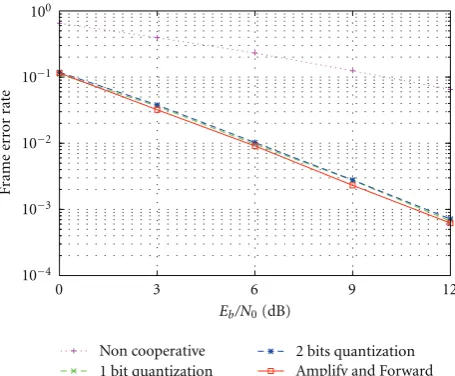
The FER curve for BPSK mapping is shown inFigure 3. Note that the proposed QF protocol closely approaches the performance of AF when quantizing only with log2M(=1) bits. Quantizing with more than log2Mbits only marginally improves the error performance. When using QPSK and 8-PSK mapping, we have verified (results not displayed) that quantization with 2 and 3 bits, respectively, is again sufficient
10−4 10−3 10−2 10−1 100
0 3 6 9 12
F
rame
er
ro
r
rat
e
Eb/N0(dB) Non cooperative
1 bit quantization
2 bits quantization Amplify and Forward
Figure3: Frame Error Rate of a turbo-coded Quantize and Forward system with known channel parameters using BPSK mapping and 12 decoder iterations.
to closely approach the FER performance of a pure AF system using the same constellation. While achieving a similar FER performance, the proposed QF protocol can be used with half-duplex relay terminals, whereas the relay terminals in an AF system need to be able to transmit and receive data at the same time. This makes the QF protocol more suitable for the use in resource-constrained networks. Because of their higher spatial diversity, the cooperative systems considerably outperform the noncooperative system.
4.2. Estimated Channel Parameters. We determine the effect of the different estimation methods, discussed inSection 3, on the FER of the proposed QF system. To be able to calculate an initial estimate for the channel coefficients and noise variances,Kppilot symbols are sent by both source and relay. To maintain a nearly fixed (Kd+Kp)/Kdratio in (2), 9, 5, and 3 pilot symbols are sent when using BPSK, QPSK, and 8PSK mapping, respectively.
The relay converts the estimated valueγof the instanta-neous SNR to dB and uniformly quantizes it betweenγmin,db
and γmax,db using 5 bits. Using computer simulations, we
have selected the values ofγmin,dbandγmax,dbsuch that they minimize, atEb/N0=6 dB, the FER of the system with known channel parameters as described inSection 4.1, but with the value ofγunknown to the destination. For all values ofEb/N0 in (0 dB, 12 dB), we used the γmin,db and γmax,db that are optimum atEb/N0 =6 dB. The quantized bits are encoded with a simple (1, 3)8convolutional code, mapped on M-PSK symbols and sent to the destination.
A factor α, equal to 0.95 which is used in (23) for averaging out the noise variances. The EM iterations and turbo decoding iterations are carried out as explained in
10−4 10−3 10−2 10−1 100
0 3 6 9 12
F
rame
er
ro
r
rat
e
Eb/N0(dB)
EM code-aided EM lower bound Reference system
EM uncoded approximation Pilot-based symbol
Figure4: Frame Error Rate of the different proposed estimation techniques using 8-PSK mapping.
iterations, after which the turbo code is decoded using 12 iterations.
The FER performance resulting from the considered estimation technique is compared to an EM lower bound. This EM lower bound on the FER corresponds to the best performance the EM algorithm can achieve and is calculated by assuming that the data symbols sent by the source and relay are known at the destination when calculating the estimates of h0 and h2. As compared to the reference system with known channel parameters and no pilot symbols transmitted, this EM lower bound has the worse FER performance due to channel estimation errors (especially the estimation of the source-relay channel coefficient, where only pilot symbols are used) and the smallerEsandErfrom (2), because of the pilot symbols (assuming a constant total transmit energy per frame).
Three different estimation methods are being considered: pilot based only, code-aided EM, and uncoded EM. The pilot-based approach uses only the received pilot symbols for calculating an estimate of the different channel parameters, without running the EM algorithm. In the code-aided EM method, the a posteriori symbol probabilities needed to calculate (28) and (29) are provided by the channel decoder, while in the uncoded EM approach, these probabilities are approximated as explained inSection 3.2.2.
The effect of the different estimation methods on the error performance for BPSK, QPSK, and 8-PSK mapping is summarized in Table 2 for FER = 0.01 while Figure 4
shows the FER versus Eb/N0 in the case of 8-PSK. The results indicate that the effect of channel estimation errors on the FER becomes more severe as the number of bits per symbol increases (and the minimum distance between 2 constellation points decreases). The simulation results also show that the assumption of uncoded symbols works
Table2:Eb/N0ratio needed to achieve an FER of 0.01.
BPSK Eb/N0(dB) Difference (dB)
Reference system 5.94 0
EM lower bound 6.04 +0.10
EM code-aided 6.04 +0.10
EM uncoded approx. 6.05 +0.11
Pilot based only 6.52 +0.58
QPSK Eb/N0(dB) Difference (dB)
Reference system 6.06 0
EM lower bound 6.29 +0.23
EM code-aided 6.32 +0.26
EM uncoded approx. 6.42 +0.36
Pilot based only 6.91 +0.85
8-PSK Eb/N0(dB) Difference (dB)
Reference system 8.10 0
EM lower bound 8.52 +0.42
EM code-aided 8.67 +0.57
EM uncoded approx. 9.18 +1.08
Pilot based only 9.78 +1.68
10−4 10−3 10−2 10−1
10−5
0 3 6 9 12
M
ean
squar
e
er
ror
Eb/N0(dB)
EM lower bound
EM uncoded approximation; 8-PSK EM code-aided; 8-PSK
EM uncoded approximation; BPSK EM code-aided; BPSK
Pilot-based estimation
Figure5: Mean Square Error values for the estimate ofh0.
very well for BPSK, but the performance deteriorates as the number of bits per symbol increases.
10−4 10−3 10−2 10−1
10−5
0 3 6 9 12
M
ean
squar
e
er
ror
Eb/N0(dB)
EM lower bound
EM uncoded approximation; 8-PSK EM code-aided; 8-PSK
EM uncoded approximation; BPSK EM code-aided; BPSK
Pilot-based estimation
Figure6: Mean Square Error values for the estimate ofh2.
estimates ofh0andh2. The difference between the likelihoods of the different symbols in (32) will become less pronounced when there are more constellation points, making it harder to determine which symbol has been sent, and thus making an accurate estimation difficult. The MSE of the code-aided approach is closer to the EM lower bound compared to the uncoded approximation for the same constellation, but also rises with the increasing number of bits per symbol due to the higher symbol error rate (QPSK) and more decoding errors (8-PSK) than in the case of BPSK. From (28) and (29), one notices that the a posteriori expectation of the symbol vectors sent by both source and relay is conditioned on the observation of both communication channels (direct link and relay path). This cooperative nature accounts for the very accurate estimate of the source-destination and relay-destination channel.
4.2.1. Noise Estimation Performance. In this section, the per-formance loss resulting from the noise variance estimation is analyzed. This is done by comparing a system with estimated noise variances to a system where the noise variances are assumed to be known to the destination. The noise variance estimates are computed as described in Section 3.1 while the other channel parameters are estimated using a code-aided EM approach. The FER performance of both systems is displayed in Figure 7 in the case of BPSK and 8-PSK mapping. As shown in the aforementioned figure, the FER performance of the system with estimated noise variances is very close to that of the system in which the noise variances are assumed to be known. This shows that there is little to be gained in refining the noise variance estimates, as the potential improvement in FER performance is very small.
Estimated noise variances; 8-PSK Known noise variances; 8-PSK Estimated noise variances; BPSK Known noise variances; BPSK 10−4
10−3 10−2 10−1 100
0 3 6 9 12
F
rame
er
ro
r
rat
e
Eb/N0(dB)
Figure 7: Frame Error Rate of a system with estimated noise variances, compared to a system with known noise variances, for both BPSK and 8-PSK mapping.
5. Conclusions
In this paper, a novel Quantize and Forward protocol has been introduced, which involves the relay making a coarse estimate of the source-relay channel, using only the received pilot symbols. Doing so, it is shown that quantization with only log2M bits is sufficient to approach the performance of an AF system, while respecting the half-duplex constraint at the relay terminals. Furthermore, one aspect of the relay terminal becomes less complicated, in comparison to [6], because no overhead is needed in order to allow the destination to make an estimate of the source-relay channel. This makes the proposed QF protocol suitable for the use in sensor networks where a low complexity at the relay terminals is mandatory.
Appendices
A. Pilot-Based ML Estimation
By definition, the ML estimates of a channel coefficienthand noise varianceN, given the channel observationr, are equal to
In a Rayleigh fading environment, the probability distribu-tion ofris given by
withcspbeing a vector consisting ofKp-known pilot symbols with a symbol energy that is equal toEs. By substituting (A.2) in (A.1), the latter can be written as
Maximizing (A.3) with respect tohyields
searching the root of the derivative with respect to N of (A.3), yielding the following equation:
0= −Kp
Solving this equation yields
B. Noise Variance Estimation Bias
The ML estimate of the noise variance of a direct Rayleigh fading channel is given by (22). When the channel coefficient
his not known, an estimatehcan be used instead, yielding
When using an ML channel coefficient estimate (21), and taking into account the channel model defined by (1), (B.1) can be written as
Calculating the expected value of (B.2) yields
E N= 1
The statistical independence of the noise samples can be expressed as
Taking (B.4) into consideration, (B.2) can be rewritten as
The expression above shows that when an ML estimate of
his used in (22), the estimate of the noise variance is biased by a factor that is equal to (Kp−1)/Kp. This estimate can be made true by multiplying it withKp/(Kp−1).
C. Maximization of
Q
(
h
d,
h
(dk−1))
For each EM iteration k, new estimates of the channel coefficientsh0andh2are calculated by selecting the value of those parameters that maximizes the functionQ(hd,h(dk−1)). Using factorization (6), this function can be written as
Qhd,h(dk−1)
The new estimate of h0 should maximize the first term in (C.1) while the new estimates of h2 should maximize the second term in(C.1)
Taking into consideration the Rayleigh fading channel model defined inSection 2.1, the first line of (C.2) can be written as
By introducing the notationusfor
cdcsp(cd | rd,h(k−1)), (C.3) can be written as
h(0k)=arg min h0
h0h∗0
Kp+Kd
Es−r0h∗0uHs −h0usrH0
.
(C.4)
This minimization problem is very similar to (A.4), yielding the following solution forh(0k):
h(0k)=
r0uHs
Kp+Kd
Es
. (C.5)
A similar method can be used in the second line of (C.2), in order to obtain an estimateh(2k) of the relay-destination channel coefficient, yielding
h(2k)=
r2uHr
Kp+Kd
Er
, (C.6)
with
ur=
cd
crp
cd|rd,h(k−1)
. (C.7)
Acknowledgment
The authors wish to acknowledge the activity of the Network of Excellence in Wireless COMmunications NEWCOM++ of the European Commission (Contract no. 216715) that motivated this work.
References
[1] G. J. Foschini, “Layered space-time architecture for wireless communication in a fading environment when using multi-element antennas,”Bell Labs Technical Journal, vol. 1, no. 2, pp. 41–59, 1996.
[2] T. M. Cover and A. A. EL. Gamal, “Capacity theorems for the relay channel,”IEEE Transactions on Information Theory, vol. IT-25, no. 5, pp. 572–584, 1979.
[3] A. Sendonaris, E. Erkip, and B. Aazhang, “User cooperation diversity—part I: system description,”IEEE Transactions on Communications, vol. 51, no. 11, pp. 1927–1938, 2003. [4] J. N. Laneman, Cooperative Diversity in Wireless Networks:
Algorithms and Architectures, Massachusetts Institute of Tech-nology, Cambridge, Mass, USA, 2002.
[5] A. El Gamal, M. Mohseni, and S. Zahedi, “Bounds on capacity and minimum energy-per-bit for AWGN relay channels,”IEEE Transactions on Information Theory, vol. 52, no. 4, pp. 1545– 1561, 2006.
[6] M. Souryal and H. You, “Quantize-and-forward relaying with M-ary phase shift keying,” inProceedings of the IEEE Wireless Communications and Networking Conference (WCNC ’08), p. 6, Las Vegas, Nev, USA, March 2008.
[7] B. Djeumou, S. Lasaulce, and A. G. Klein, “Practical quantize-and-forward schemes for the frequency division relay chan-nel,” Eurasip Journal on Wireless Communications and Net-working, vol. 2007, Article ID 20258, 11 pages, 2007.
[8] A. Chakrabarti, A. de Baynast, A. Sabharwal, and B. Aazhang, “LDPC codedesign for the relay channel,” IEEE Journal on Selected Areas in Communications, vol. 25, no. 2, pp. 280–291, 2007.
[9] B. Gedik and M. Uysal, “Impact of imperfect channel esti-mation on the performance of amplify-and-forward relaying,”
IEEE Transactions on Wireless Communications, vol. 8, no. 3, Article ID 4801499, pp. 1468–1479, 2009.
[10] Y. Gong, Z. Ding, T. Ratnarajah, and C. F. N. Cowan, “Turbo channel estimation and equalization for a superposition-based cooperative system,”IEE Proceedings Communications, vol. 3, no. 11, pp. 1790–1799, 2010.
[11] I. Avram, N. Aerts, and M. Moeneclaey, “A novel quantize-and-forward cooperative system: channel parameter estima-tion techniques,” in Proceedings of the Future Network and Mobile Summit, Florence, Italy, June 2010.
[12] A. Dempster, N. Laird, and D. B. Rubin, “Maximum likelihood from incomplete data via the EM algorithm,”Journal of the Royal Statistical Society, vol. 39, no. 1, pp. 1–38, 1977. [13] H. Wymeersch,Iterative Receiver Design, Cambridge
Univer-sity Press, London, UK, 2007.
[14] N. Noels, C. Herzet, A. Dejonghe, et al., “Turbo-synchronization: an EM algorithm approach,” inProceedings of the IEEE International Conference on Communications (ICC ’03), Anchorage, Alaska, May 2003.