R E S E A R C H
Open Access
Parameter identification based on lag
synchronization via hybrid feedback
control in uncertain drive-response
dynamical networks
Hongming Liu
1, Weigang Sun
1*and Ghada Al-mahbashi
2*Correspondence:
[email protected] 1Department of Mathematics,
School of Science, Hangzhou Dianzi University, Hangzhou, 310018, China
Full list of author information is available at the end of the article
Abstract
In this paper, we use a hybrid feedback control method to study lag synchronization in uncertain drive-response dynamical networks with a feature that the unknown system parameter exists in the node dynamics. We then design two hybrid feedback control methods to achieve the lag synchronization including the linear and adaptive feedback control. With the designed controllers and update laws for the system parameter in the node dynamics, we obtain two theorems on the lag synchronization based on the LaSalle invariance principle. When the lag synchronization is achieved, we identify the unknown system parameter. Finally, we provide two numerical examples to verify the efficiency of the proposed control schemes.
Keywords: lag synchronization; uncertain network; parameter identification
1 Introduction
Complex networks [, ] have attracted considerable attention as a fundamental tool in understanding the dynamical behaviors of real systems, such as internet, World Wide Web, food webs, electrical power grids, metabolic networks, scientific citation web and fractal networks []. The dynamics of complex networks has been an interesting issue with focus on the interplay between the local node dynamics and the overall topological structures. As a typical collective behavior, synchronization of complex networks has been widely investigated because of many applications in engineering []. Among many types of synchronization of complex networks, inner synchronization inside a network and outer synchronization between two coupled networks are striking. Generally the method of syn-chronization is to transform the networked systems into some low dimensional systems and obtain the criteria of synchronization by the master stability function or linear ma-trix inequality [, ]. When the inner synchronization may not happen inside a network with unappropriate topological connections and node dynamics, some controlling (e.g., the adaptive, feedback, pinning and impulsive control) methods are employed for realiz-ing the synchronization (see [–] and many references cited therein).
To study the outer synchronization between two coupled networks, Li et al. applied the open-plus-closed-loop control to achieve outer synchronization []. This original work
theoretically and numerically demonstrated the feasibility of this type of synchronization. In reality, when the trains arrive at the platform in subway systems, the inner and outer doors simultaneously open or close, showing that both inner synchronization and outer synchronization happen. Afterwards, the expanded works on the outer synchronization, such as introducing the adaptive control, effect of noise and fractional-order node dynam-ics, can be found in the literature [–].
It should be noted that all of the above-mentioned works on the synchronization fo-cus on the known node dynamics and topological connections. This assumption cannot be used in many real networks with evolving or adaptive couplings, e.g., flocks of robots []. Recently the synchronization of dynamical networks with unknown information has received increasing attention. Zheng used the impulsive control to study the synchro-nization of uncertain complex-variable chaotic delayed systems []. Wu and Lu studied the outer synchronization and parameter identification between two networks with time-varying connections by designing the adaptive controllers []. By designing the nonlin-ear controllers, we achieved the generalized outer synchronization between two uncertain networks where the couplings of each network are unknown nonlinear functions [].
During the studies on the synchronization of complex networks, most of the existing works studied the complete synchronization. Apart from this type of synchronization, lag synchronization is an interesting phenomenon, which is referred to as the coincidence of the states between two coupled systems, where one system is delayed by a finite time. Presently lag synchronization has been observed in lasers, neural models and electronic circuits [] and applied in secure communication []. Recently the lag synchronization of coupled networks has become a new issue in the research of complex networks. Li et al. studied the successive lag synchronization on nonlinear dynamical networks by the linear feedback control []. Zhao et al. considered the lag synchronization between two different networks based on the state observer and designed the corresponding adaptive controllers []. Projective lag synchronization in drive-response dynamical networks was studied by proposing a hybrid feedback control method [, ]; however they did not consider the parameter identification. To reduce the number of control nodes, the lag synchronization by pinning control was studied in [, ].
Inspired by the above discussions, we study lag synchronization in drive-response dy-namical networks by the method proposed in [, ] and identify the unknown parame-ter in the node dynamics. By designing the hybrid feedback controllers, we achieve the lag synchronization. With the proposed controllers and update laws for the system parame-ter, we obtain two theorems on the lag synchronization and identify the unknown system parameter when the lag synchronization happens. In addition, this control method is ef-fective for the drive system with and without mismatched terms. Our findings may help a deeper understanding of the consensus or agreement of the connected agents.
The rest of this paper is organized as follows. In Sections and , preliminaries and network models are given. Section studies the lag synchronization by linear and adaptive feedback control. Numerical examples are shown to verify the efficiency of the proposed adaptive schemes in Section . Finally, conclusions are drawn in Section .
Notations: Throughout this paper, some necessary notations are first introduced. The norm of a vectorxisx=√xTx. The norm of a matrixAisA=λ
max(ATA), where
λmax(ATA) denotes the maximal eigenvalue of matrixATA.⊗is the Kronecker product.
2 Preliminaries
Consider the following uncertain dynamical system:
˙
x(t) =fx(t),θf
x(t)+f
x(t)θ, () wherex∈Rnis the state vector,θ∈Rmis an unknown system parameter vector.f
:Rn→
Rnis a continuous vector function andf
:Rn→Rn×mis a continuous matrix function. Assumption There exists a positive constantLsatisfying
(y–x)Tf(y,θ) –f(x,θ)≤L(y–x)T(y–x), wherex,y∈Rnare time-varying vectors.
Lemma ((LaSalle invariance principle) []) Let⊂D be a compact set that is positively invariant with respect tox˙=f(x).Let V:D→R be a continuously differentiable function such thatV˙(x)≤in.Let E be the set of all points inwhereV˙(x) = .Let M be the largest invariant set in E.Then every solution starting inapproaches M as t→ ∞. 3 Model presentation
The uncertain drive-response coupled networks with the designed controllers is given by
˙
xd(t) =f
xd(t)+f
xd(t)θ+(t), () ˙
yri(t) =f
yri(t)+f
yri(t)θ˜(t) + N
j=
aijyrj(t) +ui(t), i= , , . . . ,N, ()
wherexd= (xd
,xd, . . . ,xdn)T∈Rnis the state vector of the drive system.f,fhave the same meanings in Eq. (). (t) is the nonlinear mismatched term.yr
i = (yri,yri, . . . ,yrin)T∈Rn denotes the state vector of theith node.θ= (θ(),θ(), . . . ,θ(m))T∈Rmis the unknown pa-rameter vector.θ˜(t) = (θ˜()(t),θ˜()(t), . . . ,θ˜(m)(t))T∈Rm is the estimation of the unknown parameter θ.∈Rn×n is an inner coupling matrix measuring the interactions of vari-ables.A= (aij)N×N is the coupling configuration matrix denoting the topological struc-tures of networks. The entriesaijare defined as follows:aij> if there is a link between nodeiand nodej(i=j); otherwiseaij= (i=j), and the diagonal entriesaii= –
N j=,j=iaij,
i= , , . . . ,N.ui(t) (i= , , . . . ,N) are the controllers to be designed. The lag synchronization error is defined asei(t) =yr
i(t) –xd(t–τ),i= , , . . . ,N, where τ > is a constant denoting time delay or lag. Then the lag synchronization between the reference node () and the dynamical networks () is achieved if
lim
t→∞y r
i(t) –xd(t–τ)= , i= , , . . . ,N. 4 Lag synchronization analysis
4.1 Linear feedback control
Theorem Suppose that Assumptionholds.If the controllers are designed as follows:
works()and()is achieved and the unknown parameterθcan be identified.
Proof From networks () and (), we obtain the following error dynamical system:
˙
Consider the following Lyapunov function:
V(t) =
The time derivative ofV(t) along the trajectories of error system () gives
˙ invariance principle, the orbits converge asymptotically to the setE, which means that the lag synchronization is achieved. It also gives that the system parameter vectorθ can be identified by the updating laws () when the lag synchronization is achieved.
Remark For this linear feedback control, the expected feedback gainsdineed satisfy
di≥L+λmax((P+PT)/) + . As many studies on the linear feedback control show [,
], the theoretical values ofdi are much bigger than those needed in practice. To deal with the shortcoming of linear feedback control, we will use the adaptive technique to achieve the lag synchronization.
4.2 Adaptive feedback control
In this subsection, we apply the adaptive controllers to achieve the lag synchronization and identify the unknown parameter in the node dynamics. The corresponding adaptive controllers and update laws are then designed.
Theorem Suppose that Assumptionholds.The lag synchronization in drive-response networks()and()is achieved and the unknown parameterθ is also identified with the following adaptive controllers and the corresponding updating laws:
⎧
where hiare arbitrary positive constants.
Proof Choose the Lyapunov function candidate as follows:
is the largest invariant set of the setE={ ˙V(t) = }. According to the LaSalle invariance
principle of differential equation, the orbits asymptotically converge to the setE. It shows that the system parameter vectorθcan be identified by the updating laws () when the lag synchronization is achieved.
Remark It is noted that the mismatched term(t) has no effect on the derivative of Lyapunov functionV(t), which shows that this method is robust for some control systems with parameters perturbation and noise disturbance.
5 Numerical analysis
In this section, we will provide numerical examples to show the effectiveness of the pro-posed control schemes obtained in the previous sections, which includes the linear and adaptive feedback controls. In the numerical simulations, the node dynamical equations are taken as the Lorenz chaotic system [], which is given by
⎧
Then the system can be rewritten in the following form: ⎛ chronization process and take the inner coupling matrix=I.
5.1 Lag synchronization by linear feedback control
In this subsection, we use the linear feedback control schemes () in Theorem to realize the lag synchronization and to identify the unknown parameter in the node dynamics. We choose an undirected coupling network, and the coupling matrix is
According to Theorem , the estimation of the unknown parameterθ˜(t) reads as ⎛
⎜ ⎜ ⎝ ˙˜ θ()(t)
˙˜ θ()(t)
˙˜ θ()(t)
⎞ ⎟ ⎟ ⎠=
⎛ ⎜ ⎝
–Ni=(yr
i(t) –yri(t))ei(t) –Ni=yr
i(t)ei(t) N
i=yri(t)ei(t) ⎞ ⎟ ⎠.
Based on the results obtained in [] on the Lorenz system, one can choose a positive constantL= such that Assumption holds. According to Theorem , the feedback gains
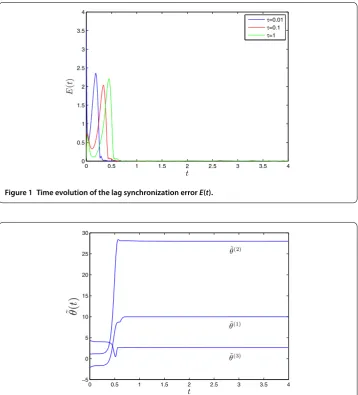
di≥L+λmax((P+PT)/) + . We then takedi= ,i= , , . . . , , for numerical simulations and employ the mismatched terms as(t) = (sin(t), , .cos(t))T. The real values for the system parameterθare set asθ()= ,θ()= ,θ()= /. The initial values are randomly chosen in (–, ). The numerical results are presented in Figures and . Figure displays the time evolution of the lag synchronization errorE(t) with a delayτ= ., indicating that the lag synchronization between the drive and response networks is achieved.
Fig-Figure 1 Time evolution of the lag synchronization errorE(t).
Figure 2 The estimated unknown parameterθ˜= (θ˜(1),θ˜(2),θ˜(3))Tby linear feedback control with
ure shows the identification of the uncertain system parameterθ, which means that the unknown parameter is successfully estimated. In addition, we increase the network size
N≤ and the lag <τ ≤ and see that these two quantities have a little effect on the lag synchronization.
5.2 Lag synchronization by adaptive feedback control
In this subsection, we apply the adaptive technique to control the lag synchronization by using the controllers and corresponding laws () in Theorem . In this numerical example, we take a directed network as follows:
A= ⎡ ⎢ ⎢ ⎢ ⎢ ⎢ ⎢ ⎢ ⎢ ⎢ ⎢ ⎢ ⎢ ⎢ ⎢ ⎢ ⎢ ⎢ ⎢ ⎣
– – – – – – – – – –
⎤ ⎥ ⎥ ⎥ ⎥ ⎥ ⎥ ⎥ ⎥ ⎥ ⎥ ⎥ ⎥ ⎥ ⎥ ⎥ ⎥ ⎥ ⎥ ⎦ .
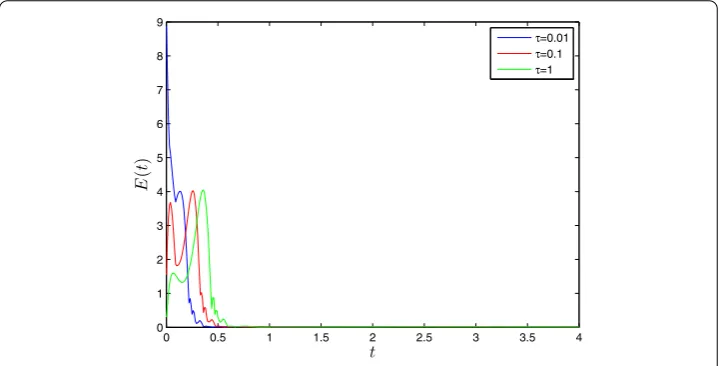
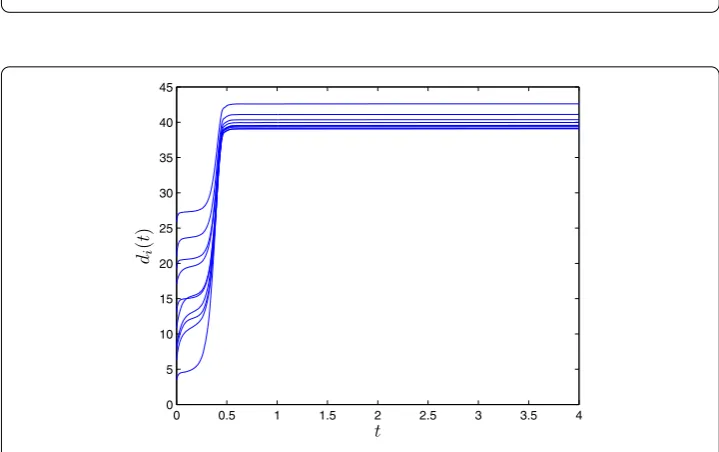
The mismatched terms are chosen as (t) = (sin(t),cos(t), )T, and the initial values are chosen randomly in (–, ). The corresponding numerical results are shown in Fig-ures , , . The time evolution of lag synchronization errorE(t) is depicted in Figure . From Figure , the proposed adaptive controllers and update laws can identify the un-known system parameter. Figure shows the curves of the adaptive feedback gainsdifor
i= , , . . . , , which converge to some constants when the lag synchronization is achieved. These results show that the required lag synchronization has been realized with our de-signed control laws (). Compared to the linear feedback control, the adaptive control method is better for realizing the lag synchronization and identifying the unknown pa-rameter.
Figure 4 The estimated unknown parameterθ˜= (θ˜(1),θ˜(2),θ˜(3))Tby adaptive feedback control with
τ= 0.05.
Figure 5 Time evolution of feedback gainsdi(t) withhi= 10,i= 1, 2, . . . , 10.
6 Conclusions
Competing interests
The authors declare that they have no competing interests.
Authors’ contributions
All the authors contributed equally to this work. All authors read and approved the final manuscript.
Author details
1Department of Mathematics, School of Science, Hangzhou Dianzi University, Hangzhou, 310018, China.2School of
Mathematical Sciences, Faculty of Science and Technology, Universiti Kebangsaan Malaysia UKM, Bangi, Selangor Darul Ehsan 43600, Malaysia.
Acknowledgements
This work was supported by the Zhejiang Provincial Natural Science Foundation of China (No. LY16A010014) and the National Natural Science Foundation of China (No. 61673144).
Publisher’s Note
Springer Nature remains neutral with regard to jurisdictional claims in published maps and institutional affiliations.
Received: 5 December 2016 Accepted: 12 April 2017
References
1. Boccaletti, S, Latora, V, Moreno, Y, Chavez, M, Hwang, D: Complex networks: structure and dynamics. Phys. Rep.424, 175-308 (2006)
2. Albert, R, Barabási, AL: Statistical mechanics of complex networks. Rev. Mod. Phys.74, 47-97 (2002)
3. Sun, W, Wang, S, Zhang, J: Counting spanning trees in prism and anti-prism graphs. J. Appl. Anal. Comput.6, 65-75 (2016)
4. Arenas, A, Díaz-Guilera, A, Kurths, J, Moreno, Y, Zhou, C: Synchronization in complex networks. Phys. Rep.469, 93-153 (2008)
5. Pecora, L, Carroll, T: Master stability functions for synchronized coupled systems. Phys. Rev. Lett.80, 2109-2112 (1998) 6. Wang, X, Chen, G: Complex networks: topology, dynamics and synchronization. Int. J. Bifurc. Chaos12, 885-916 (2002) 7. Yu, W, Chen, G, Lü, J: On pinning synchronization of complex dynamical networks. Automatica45, 429-435 (2009) 8. Zheng, S: Synchronization analysis of complex-variable chaotic systems with discontinuous unidirectional coupling.
Complexity21, 343-355 (2016)
9. Wu, Z, Leng, H: Impulsive synchronization of drive-response chaotic delayed neural networks. Adv. Differ. Equ.2016, 206 (2016)
10. Feng, J, Sun, S, Xu, C, Zhao, Y, Wang, J: The synchronization of general complex dynamical network via pinning control. Nonlinear Dyn.67, 1623-1633 (2002)
11. Zheng, S: Impulsive complex projective synchronization in drive-response complex coupled dynamical networks. Nonlinear Dyn.79, 147-161 (2015)
12. Li, C, Sun, W, Kurths, J: Synchronization between two coupled complex networks. Phys. Rev. E76, 046204 (2007) 13. Wu, X, Zheng, W, Zhou, J: Generalized outer synchronization between complex dynamical networks. Chaos19,
013109 (2009)
14. Wang, G, Cao, J, Lu, J: Outer synchronization between two nonidentical networks with circumstance noise. Physica A
389, 1480-1488 (2010)
15. Sun, Y, Zhao, D: Effects of noise on the outer synchronization of two unidirectionally coupled complex dynamical networks. Chaos22, 023131 (2012)
16. Asheghan, M, Míguez, J, Hamidi-Beheshti, M, Tavazoei, M: Robust outer synchronization between two complex networks with fractional order dynamics. Chaos21, 033121 (2011)
17. Sun, W, Wu, Y, Zhang, J, Qin, S: Inner and outer synchronization between two coupled networks with interactions. J. Franklin Inst.352, 3166-3177 (2015)
18. Stanley, K, Bryant, B, Mikkulainen, R: Evolving adaptive neural networks with and without adaptive synapses. In: The 2003 Congress on Evolutionary Computation, CEC ’03, vol. 4, pp. 2557-2564 (2003)
19. Zheng, S: Further results on the impulsive synchronization of uncertain complex-variable chaotic delayed systems. Complexity21, 131-142 (2016)
20. Wu, X, Lu, H: Outer synchronization of uncertain general complex delayed networks with adaptive coupling. Neurocomputing82, 157-166 (2012)
21. Sun, W, Li, S: Generalized outer synchronization between two uncertain dynamical networks. Nonlinear Dyn.77, 481-489 (2014)
22. Fischer, I, Vicente, R, Buldú, J, Peil, M, Mirasso, C, Torrent, M, García-Ojalvo, J: Zero-lag long-range synchronization via dynamical relaying. Phys. Rev. Lett.97, 123902 (2006)
23. Li, C, Liao, X, Wong, K: Chaotic lag synchronization of coupled time-delayed systems and its applications in secure communication. Physica D194, 187-202 (2004)
24. Li, K, Yu, W, Ding, Y: Successive lag synchronization on nonlinear dynamical networks via linear feedback control. Nonlinear Dyn.80, 421-430 (2015)
25. Zhao, M, Zhang, H, Wang, Z, Liang, H: Observer-based lag synchronization between two different complex networks. Commun. Nonlinear Sci. Numer. Simul.19, 2048-2059 (2014)
26. Al-mahbashi, G, Noorani, M, Bakar, S: Projective lag synchronization in drive-response dynamical networks with delay coupling via hybrid feedback control. Nonlinear Dyn.82, 1569-1579 (2015)
28. Sun, W, Wang, S, Wang, G, Wu, Y: Lag synchronization via pinning control between two coupled networks. Nonlinear Dyn.79, 2659-2666 (2015)
29. Guo, W: Lag synchronization of complex networks via pinning control. Nonlinear Anal., Real World Appl.12, 2579-2585 (2011)
30. LaSalle, J: The extent of asymptotic stability. Proc. Natl. Acad. Sci.46, 363-365 (1960)
31. Sparrow, C: The Lorenz Equations: Bifurcation, Chaos and Strange Attractor. Springer, New York (1982)