R E S E A R C H
Open Access
On certain hypergeometric identities
deducible by using the beta integral method
Adel K Ibrahim
1,3, Medhat A Rakha
2,3*and Arjun K Rathie
4*Correspondence:
2Department of Mathematics and
Statistics - College of Science, Sultan Qaboos University, Alkhoud, P.O. Box 36, Muscat, 123, Oman
3Permanent address: Department of
Mathematics, Faculty of Science, Suez Canal University, Ismailia, Egypt
Full list of author information is available at the end of the article
Abstract
The aim of this research paper is to demonstrate how one can obtain eleven new and interesting hypergeometric identities (in the form of a single result) from the old ones by mainly applying the well-known beta integral method which was used
successfully and systematically by Krattenthaler and Rao in their well known, very interesting research papers. The results are derived with the help of generalization of a quadratic transformation formula due to Kummer very recently obtained by Kimet al.Several identities, including one obtained earlier by Krattenthaler and Rao, follow special cases of our main findings. The results established in this paper are simple, interesting, easily established and may be potentially useful.
MSC: Primary 33C05; 33C20; secondary 33C70
Keywords: hypergeometric series; Kummer summation theorem; beta integral
1 Introduction and preliminaries
The generalized hypergeometric seriespFqis defined by [, ]
pFq
⎡ ⎢ ⎣
α, . . . , αp;
z
β, . . . , βq;
⎤ ⎥ ⎦=
∞
n=
(α)n· · ·(αp)n
(β)n· · ·(βq)n
zn
n!, ()
where (a)nis the Pochhammer symbol (or the shifted or raised factorial, since ()n=n!)
defined (fora∈C) by
(a)n=
⎧ ⎨ ⎩
, n= ,
a(a+ )· · ·(a+n– ), n∈N={, , . . .}
=(a+n)
(a) , a∈C\Z
–
()
andZ–denotes the set of non-positive integers,Cthe set of complex numbers, and(a) is the familiar gamma function. Here,pandqare positive integers or zero (interpreting an empty product as unity), and we assume for simplicity that the variablez, the numerator parametersα, . . . ,αpand the denominator parametersβ, . . . ,βqtake on complex values,
provided that no zeros appear in the denominator of (), that is,
βj∈C\Z–; j= , . . . ,q. ()
For the detailed conditions of the convergence of series (), we refer to []. It is not out of place to mention here that if one of the numerator parameters, sayaj, is a negative integer,
then series () reduces to a polynomial inzof degree –aj.
It is interesting to mention here that whenever a generalized hypergeometric function reduces to a gamma function, the results are very important from the application point of view. Thus the classical summation theorems such as those of Gauss, Gauss second, Kum-mer and Bailey for the seriesF, Watson, Dixon, Whipple and Saalschütz for the series
F and others play an important role in the theory of hypergeometric and generalized
hypergeometric series.
In a very interesting, popular and useful research paper, Bailey [], by employing the above mentioned classical summation theorems, obtained a large number of results in-volving products of generalized hypergeometric series as well as quadratic and cubic transformations. Several other results were also given by Gauss and Kummer.
Evidently, if the product of two generalized hypergeometric series can be expressed as another generalized hypergeometric series with argumentx, the coefficients ofxnin the
product must be expressible in terms of gamma functions.
In our present investigation, we are interested in the following quadratic transformation due to Kummer []:
( –x)–aF ⎡ ⎢ ⎣
a, b; –x
–x
b;
⎤ ⎥ ⎦=F
⎡ ⎢ ⎣
a, a+; x
b+;
⎤ ⎥
⎦. ()
This result was independently rediscovered by Ramanujan [, Entry , p.].
Using () and employing the so-called beta integral method, recently Krattenthaler and Rao [, Eq. (.), p.] obtained the following interesting identity:
F ⎡ ⎢ ⎣
a, a+, d, d+; b+
, e,
e+
;
⎤ ⎥ ⎦
=(e)(e– a–d)
(e– a)(e–d)F
⎡ ⎢ ⎣
a, b, d;
b, + a+d–e;
⎤ ⎥
⎦ ()
provided aordis a nonpositive integer.
Very recently, Kimet al.[] have obtained a generalization of Kummer’s quadratic trans-formation formula () in the form
( –x)–a
F ⎡ ⎢ ⎣
a, b; ––xx b+j;
⎤ ⎥ ⎦
= (b)( –b)
(b+ j+
|j|)( –b– [
j+ ])
· ∞
n=
Aj(n)
xn
n!
(a)n(a+)n(b+ [j+ ])n
(b+ j)n(b+
j+
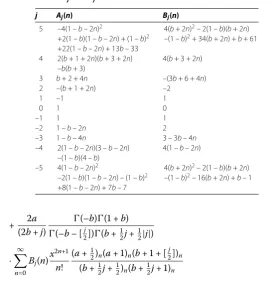
Table 1 The coefficientsAjandBj
j Aj(n) Bj(n)
5 –4(1 –b– 2n)2
+2(1 –b)(1 –b– 2n) + (1 –b)2 +22(1 –b– 2n) + 13b– 33
4(b+ 2n)2– 2(1 –b)(b+ 2n) –(1 –b)2+ 34(b+ 2n) +b+ 61
4 2(b+ 1 + 2n)(b+ 3 + 2n) –b(b+ 3)
4(b+ 3 + 2n)
3 b+ 2 + 4n –(3b+ 6 + 4n)
2 –(b+ 1 + 2n) –2
1 –1 1
0 1 0
–1 1 1
–2 1 –b– 2n 2
–3 1 –b– 4n 3 – 3b– 4n
–4 2(1 –b– 2n)(3 –b– 2n) –(1 –b)(4 –b)
4(1 –b– 2n)
–5 4(1 –b– 2n)2
–2(1 –b)(1 –b– 2n) – (1 –b)2 +8(1 –b– 2n) + 7b– 7
4(b+ 2n)2– 2(1 –b)(b+ 2n) –(1 –b)2– 16(b+ 2n) +b– 1
+ a
(b+j)
(–b)( +b)
(–b– [j])(b+j+|j|) ·
∞
n=
Bj(n)
xn+
n!
(a+)n(a+ )n(b+ + [j])n
(b+j+)n(b+j+ )n
()
forj= ,±,±,±,±,±.
Here, as usual, [x] denotes the greatest integer less than or equal toxand its modulus is denoted by|x|. The coefficientsAjandBjare given in Table .
Here, in this paper, we show how one can easily obtain eleven interesting hypergeomet-ric identities including the Krattenthaler-Rao result () in the form of a single unified re-sult by employing the beta integral method developed by Krattenthaler and Rao []. The results are derived with the help of generalization () of Kummer’s formula (). Several interesting special cases of our main result including () are also explicitly demonstrated. The results presented in this paper are simple, interesting, easily established and (po-tentially) useful.
2 Main result
Our eleven main identities are given here in the form of a single unified result asserted in the following theorem.
Theorem For a or d to be a non-positive integer, the following generalization of Krattenthaler-Rao formula()holds true:
(e)(e– a–d)
(e– a)(e–d)F
⎡ ⎢ ⎣
a, b, d;
b+j, + a+d–e;
⎤ ⎥ ⎦
= (b)( –b)
(b+ j+
|j|)( –b– [
j+ ])
· ∞
n=
Aj
n!
(a)n(a+)n(b+ [j+ ])n
(b+ j)n(b+
j+
)n
(d)n(d+)n
( e)n(
e+
+ a (b+j)
d e
(–b)( +b)
(b+j+|j|)(–b– [j]) ·
∞
n=
Bj
n! (a+
)n(a+ )n(b+ + [
j
])n
(b+j+)n(b+j+ )n
( d+
)n(
d+ )n
(e+)n(e+ )n
()
for j= ,±,±,±,±,±.The coefficients Ajand Bjare the same as given in Table.
Proof Let us assume that ais a non-positive integer, say a= –m, wheremis a positive integer. Now, multiplying the left-hand side of () byxd–( –x)e–d–, where we suppose
temporarily thatRe(e) >Re(d) > , and integrating the resulting equation with respect to xfrom to , expressing the involvedFas a series and change the order of integration
and summation, which is easily seen to be justified due to the uniform convergence of the involved series, and denoting it byS, we have
S=
∞
n=
(a)n(b)n(–)n
(b+j)nn!
xd+n–( –x)e–d–a–n–dx.
Evaluating the beta-integral and using the identity
(α–n) = (–)
n(α)
( –α)n
,
we have, after some algebra,
S=
(d)(e–d– a)
(e– a) ∞
n=
(a)n(b)n(d)n
(b+j)n( + a+d–e)n
n
n!.
Summing up the series, we have
S=
(d)(e–d– a)
(e– a) F
⎡ ⎢ ⎣
a, b, d;
b+j, + a+d–e;
⎤ ⎥
⎦. ()
Also, multiplying the right-hand side of () byxd–( –x)e–d–, and proceeding similarly
as above and denoting it byS, we get after some simplification
S=
(b)( –b)
(b+j+|j|)( –b– [j+ ]) ·
∞
n=
Aj
n!
(a)n(a+)n(b+ [j+ ])n
(b+ j)n(b+
j+
)n
xd+n–( –x)e–d–dx
+ a
(b+j)
(–b)( +b)
(b+j+|j|)(–b– [j]) ·
∞
n=
Bj
n! (a+
)n(a+ )n(b+ + [
j
])n
(b+j+)n(b+j+ )n
Evaluating the beta integrals and using Legendre’s duplication formula
we have, after some simplification,
S=
Finally, equating () and (), we get the desired result (). This completes the proof of (). The above restriction on the parametersdandemay now be removed by appeal to analytic
continuation.
3 Special cases
Here we shall consider some of the very interesting special cases of our main result (). Each of the following formulas holds true provided aordmust be a non-positive integer.
Corollary
Proof Settingj= in () and simplifying the resulting identity, we are led to formula
+ ad
Proof Settingj= in () and simplifying the resulting identity, we are led to formula ().
Proof Settingj= – in () and simplifying the resulting identity, we are led to formula
().
Proof Setting j= in () and simplifying the resulting identity, we are led to formula
– ad
Proof Settingj= – in () and simplifying the resulting identity, we are led to formula
().
Proof Setting j= in () and simplifying the resulting identity, we are led to formula
().
Proof Settingj= – in () and simplifying the resulting identity, we are led to formula
().
Result () is the well-known result of Krattenthaler and Rao [] and results () to () are closely related to it.
Remark We conclude this section by mentioning that the seriesFappearing on the
right-hand side of results () to () can also be written as a sum of twoF, and then we
Competing interests
The authors declare that they have no competing interests.
Authors’ contributions
All authors contributed equally in this paper. They read and approved the final manuscript.
Author details
1Department of Mathematics, Faculty of Science, Jazan University, Jazan, Saudi Arabia.2Department of Mathematics and
Statistics - College of Science, Sultan Qaboos University, Alkhoud, P.O. Box 36, Muscat, 123, Oman.3Permanent address: Department of Mathematics, Faculty of Science, Suez Canal University, Ismailia, Egypt.4Department of Mathematics, School of Mathematical and Physical Sciences, Central University of Kerala, Riverside Transit Campus, Padennakkad P.O. Nileshwar, Kasaragod, Kerala 671 328, India.
Acknowledgements
The authors are thankful to the referee for making certain very useful suggestions. The work of this research paper was supported by the research grant (05/4/33) funded by Jazan University - Jazan, Saudi Arabia.
Received: 12 August 2013 Accepted: 29 October 2013 Published:25 Nov 2013
References
1. Bailey, WN: Generalized Hypergeometric Series. Cambridge University Press, Cambridge (1964) 2. Rainville, ED: Special Functions. Chelsea Publishing, New York (1971)
3. Bailey, WN: Products of generalized hypergeometric series. Proc. Lond. Math. Soc.28, 242-254 (1928)
4. Kummer, EE: Uber die hypergeometrische reihe 1 +α1··γβx+α(1α·2+1)·γ·(βγ(+1)β+1)x2+· · ·. J. Reine Angew. Math.15, 39-83 (1836) 5. Berndt, BC: Ramanujan’s Notebooks, Part II. Springer, Berlin (1989)
6. Krattenthaler, C, Rao, KS: Automatic generation of hypergeometric identities by the beta integral method. J. Comput. Appl. Math.160, 159-173 (2003)
7. Kim, YS, Rakha, MA, Rathie, AK: Generalizations of Kummer’s second theorem with applications. Comput. Math. Math. Phys.50, 387-402 (2010)
10.1186/1687-1847-2013-341
Cite this article as:Ibrahim et al.:On certain hypergeometric identities deducible by using the beta integral method.