SYNTHESIS, CHARACTERIZATION, AND ANTHELMINTIC ACTIVITY OF NOVEL
BENZOTHIAZOLE DERIVATIVES CONTAINING INDOLE MOIETIES
ALETI RAJAREDDY
1*, SRINIVAS MURTHY M
21Department of Pharmaceutical Chemistry, Mall Reddy Pharmacy College, Secunderabad, Telangana, India, 2Department of
Pharmaceutical Chemistry, Vignan Institute of Pharmaceutical Sciences, Deshmukhi, Telangana, India. Email: [email protected]
Received: 31 October 2018, Revised and Accepted: 06 January 2019 ABSTRACT
Objective: The objective of this study was to synthesize and evaluate the anthelmintic activity (AA) of novel benzothiazole derivatives containing indole moieties (BDIM).
Methods: The present works which involve the substituted isatin Schiff bases undergo acetylating and reacting with 2-aminobenzothiazole to give novel BDIM.
Results: All the newly synthesized molecules (5a-5o) were characterized by Fourier-transform infrared spectroscopy, H_nuclear magnetic resonance,
and mass spectral analysis along with physical data. The biological potentials of the newly synthesized compounds are evaluated for their AA using an Indian earthworm (Pheretima posthuma), and albendazole was used as standard drug.
Conclusion: The synthesized compound 5f, 5n,and5o showed good AA, whereas others exhibited significant activities.
Keywords: Substituted benzaldehyde, Isatin, p-Toluidine, 2-aminobenzothiazole, Anthelmintic activity.
INTRODUCTION
Heterocyclic compounds are those which have a cyclic structure with two, or more, different kinds of atom in the ring. This two kinds of atoms are like carbon and the other elements (heteroatoms), most often N, O and S. Although the parent compound, benzothiazole is not widely used, many of its derivatives are found in commercial products or in nature[1-3 ]. Benzothiazole ring found to be possessing pharmacological activities such as antitumor, antitubercular, antimalarial, anticonvulsant, anthelmintic, analgesic, anti inflammatory and antifungal. Isatin or 1H-indole-2, 3-dione is an indole derivative. Indole derivatives have acquired conspicuous significance due to their wide spectrum of biological activities.
In view of the high degree of bioactivity shown by the benzothiazole derivatives mentioned above facts, we aimed to construct a system combining both these vital moieties such as benzothiazole and indole in a single molecular framework, together with an exploration of the additive effects of their biological activities. Hence, we describe here in the synthesis, characterization, and anthelmintic activity (AA) of novel benzothiazole derivatives containing indole moieties (BDIM).
METHODS
The synthesized compounds were screened for anthelmintic activities [4-7]. The IR spectra were recorded on a Shimadzu 8700 spectrometer using the ATR technique (Attenuated Total Reflectance) in the range of 400–4000 cm-1. and values are reported in cm-1 and
the spectra were interpreted.1H-nuclear magnetic resonance (NMR)
spectra were recorded on DPX-200 MHz NMR spectrometer using dimethyl sulfoxide (DMSO)-d6 and chemical shifts (δ) are reported in
parts per million downfield from internal reference tetramethylsilane ,and the spectra were interpreted. Mass spectra were recorded on mass spectrophotometer (model Shimadzu) by Liquid chromatography–mass spectrometry (LC-MS) and the spectra were interpreted. Precoated
Silica gel G plates were used to monitor the progress of reaction as well as to check the purity of the compounds: n-Hexane:ethyl acetate (8:2).
General procedures for the preparation of 2-aminobenzothiazole (2-ABT)
Aniline (4.6 g, 0.05 mol) and potassium thiocyanate (3.8 g, 0.05 mol) were dissolved in absolute ethanol containing 4 ml of concentrated hydrochloric acid (HCl). To this mixture, bromine in glacial acetic acid (6.75 ml, 0.125 mol) was added and the reaction mixture was refluxed for 1 h. Then, it was cooled in ice bath. The precipitate obtained was filtered, washed with cold water, and dried. The crude product was recrystallized from ethanol [8].
Synthesis of substituted isatin from aniline
In a round-bottomed flask are placed 9gm of chloral hydrate and 120ml of water. To this solution are then added, in order: 13gm of crystallized sodium sulphate, a solution of 4.5 gm of aniline in 30ml of water to which 5.12 gm of concentrated hydrochloric acid has been added to dissolve the amine and finally, a solution of 11gm of 5 hydrochlorid in 50ml of water. Flask was then heated vigorously until the reaction was completed. After it, the solution containing beaker was cooled in running water followed by the filtration of reminder crystallized product with suction pump and air dried. 18.4 g of concentrated sulfuric acid (10.0 ml) was warmed to 50°C and 2.5 g of dry isonitrosoacetanilide was added in such a rate so as to keep the temperature between 60°C and 70°C but not higher. External cooling was applied at this stage so that the reaction could be carried out more rapidly after the addition of isonitroso compound was finished. The solution was heated to 80°C and kept at this temperature for about 10 min to complete the reaction. Then, the reaction mixture was cooled to room temperature and poured it into 10 times its volume of cracked ice. After standing for 90 min, the final product was filtered with suction pump followed by washing with cold water to remove sulfuric acid and dried in air.
© 2019 The Authors. Published by Innovare Academic Sciences Pvt Ltd. This is an open access article under the CC BY license (http://creativecommons. org/licenses/by/4. 0/) DOI: http://dx.doi.org/10.22159/ajpcr.2019.v12i3.30530
Synthesis of isatin schiff bases (ISB) (3a-3i)
A mixture of equimolar quantity of substituted aromatic aniline (0.01 mol) and compound 2a-2d was dissolved in 20 ml of ethanol and refluxed for 2–3h in the presence of few drops of 2 ml glacial acetic acid. The progress of the reaction was monitored by thin-layer chromatography (TLC) (n-Hexane:EtoAc 7:3). The reaction mixture was cooled to room temperature and kept in the refrigerator for overnight to get precipitate. A solid was obtained, which was filtered off and recrystallized from methanol or ethanol to give crystalline solid.[9]
Synthesis of 1-acetyl-3-(phenylimino) indolin-2-one derivatives
A mixture of equimolar (0.01) quantity of compound (3a-3i, ISB) and 5.1 ml of acetic anhydride was taken in to 250ml round bottom flask. Then, whole of the content was of refluxed for about 4 h, and then, the solution was poured into beaker containing crushed ice followed by the filtration and drying of the product.
General procedure for the synthesis of novel 1-((E)-1-(benzo[d] thiazol-2-yl) imino) ethyl)-3-(phenylimino) indolin-2-one (5a-5o)
A mixture of equimolar quantity of substituted N-acetyl isatin derivatives (0.01 mol) and compound 1a-1b was dissolved in 20 ml of ethanol and refluxed for 2–3h in the presence of few drops of 2 ml glacial acetic acid. The progress of the reaction was monitored by TLC (n-Hexane:EtoAc 8:2). The reaction mixture was cooled to room temperature and kept in
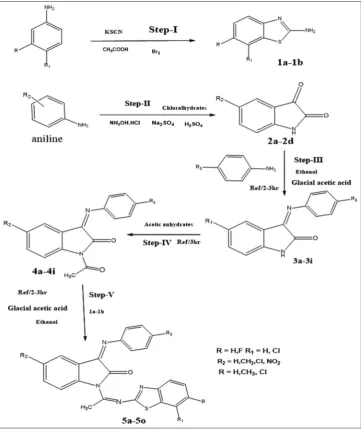
the refrigerator for overnight to get precipitate. A solid was obtained, which was filtered off and recrystallized from methanol or ethanol to give crystalline solid (Fig. 1)
5a: (E)-1-((E)-1-(benzo[d]thiazol-2-yl) imino) ethyl)-3-(phenylimino) indolin-2-one
M.P. 219–221°C; Mol. formula: C23H16N4OS, yield 78%, IR (𝜈 cm−1):
3143, 3054 (C-H Str, Ar), 2930, 2891, 2793 (C–H Str, Aliphatic), 2311 (C-S-C Str), 1684 (C=O Str, Indole), 1588 (C=N Str), 1515 (C=CH Str), 1431 (C=C Str, Ar). 1H-NMR (DMSO) 𝛿𝛿 ppm: 8.38–8.27 (d, 2H, Ar-H),
8.11–7.88 (d, 2H, Ar-H), 7.84–7.77(t, 3H, Ar-H), 7.69–7.67 (d, 2H, Ar-H), 7.55–7.54 (d, 2H, Ar-H), 7.51–7.41 (t, 3H, Ar-H). 3.33 (S, 3H, -CH3); Mass
(ESI-MS): m/z 396 (M), 397 (M+1, 100%).
5b: (E)-5-chloro-1-((E)-1-(benzo[d]thiazol-2-yl) imino) ethyl)-3-(phenylimino) indolin-2-on
M.P. 213-215°C;Mol. formula: C23H15N4OSCl, yield 82%,IR (𝜈 cm−1):
3037, 2932 (C-H Str, Ar), 2872 (C–H Str, Aliphatic), 2346 (C-S-C Str), 1721 (C=O Str, Indole), 1555 (C=N Str), 1520 (C=CH Str), 1432 (C=C Str, Ar), 771 (C-Cl Str, Ar).1H-NMR (DMSO) 𝛿𝛿 ppm: 8.37–8.28 (t, 3H,
Ar-H), 7.88–7.84 (t, 3H, Ar-Ar-H), 8.10 (s, 1H, Ar-Ar-H), 7.83–7.68 (d, 4H, Ar-Ar-H), 7.58–7.57 (d, 2H, Ar-H), 7.55–7.51 (d, 2H, Ar-H), 3.39 (s, 3H, -CH3); Mass
(ESI-MS): m/z 430 (M), 431 (M+1, 100%),432 (M+2, 30%).
5c: (E)-1-((E)-1-(benzo[d]thiazol-2-yl) imino)
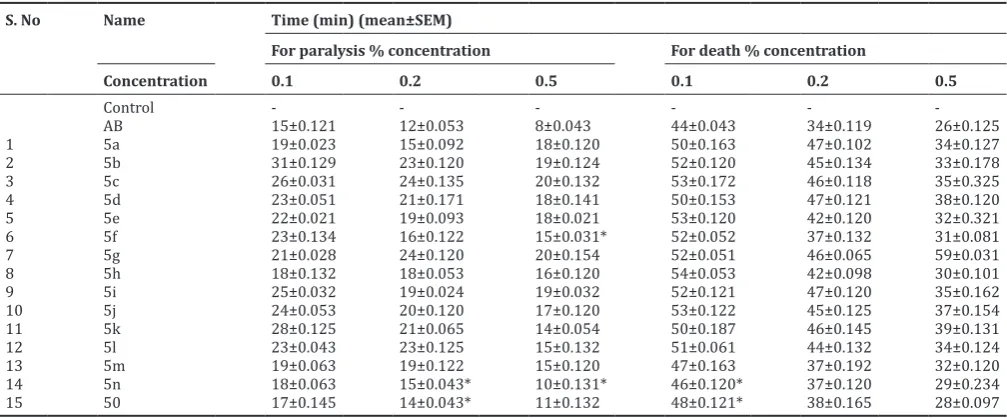
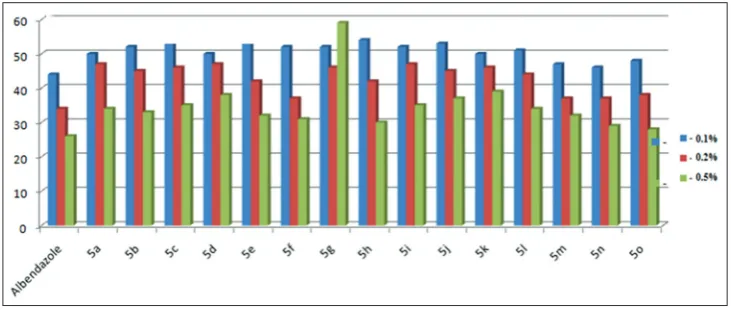
ethyl)-3-(p-The synthesized compounds are screened for anthelminthic activity using earthworms. Six earthworms of nearly equal size were placed in standard drug solution and test compound’s solutions at room temperature. Normal saline was used as a control. The standard drug and test compounds were dissolved in minimum quantity of DMSO and adjusted the volume up to 10 ml with normal saline solution to get the concentration of 0.1% w/v, 0.2 % w/v, and 0.5% w/v. Albendazole was used as a standard drug. The compounds were evaluated by the time taken for complete paralysis and death of earthworms (Figs. 2 and 3). The mean lethal time for each test compound was recorded and compared with standard drug. The time taken by worms to become motionless was noted as paralysis time. The death time of worm was recorded after ascertaining that worms neither moved when shaken nor when given external stimuli. The mean lethal time and paralysis time of the earthworms for different test compounds and standard drug are tabulated in Table 1.
RESULTS AND DISCUSSION
The synthetic routes are outlined in Schemes 1. In the first case, aniline was heated with ammonium thiocyanate, to obtain 2-amnino
Table 1: Antihelmintic activity of BDIM
S. No Name Time (min) (mean±SEM)
For paralysis % concentration For death % concentration
Concentration 0.1 0.2 0.5 0.1 0.2 0.5
Control - - -
-AB 15±0.121 12±0.053 8±0.043 44±0.043 34±0.119 26±0.125 1 5a 19±0.023 15±0.092 18±0.120 50±0.163 47±0.102 34±0.127 2 5b 31±0.129 23±0.120 19±0.124 52±0.120 45±0.134 33±0.178 3 5c 26±0.031 24±0.135 20±0.132 53±0.172 46±0.118 35±0.325 4 5d 23±0.051 21±0.171 18±0.141 50±0.153 47±0.121 38±0.120 5 5e 22±0.021 19±0.093 18±0.021 53±0.120 42±0.120 32±0.321 6 5f 23±0.134 16±0.122 15±0.031* 52±0.052 37±0.132 31±0.081 7 5g 21±0.028 24±0.120 20±0.154 52±0.051 46±0.065 59±0.031 8 5h 18±0.132 18±0.053 16±0.120 54±0.053 42±0.098 30±0.101 9 5i 25±0.032 19±0.024 19±0.032 52±0.121 47±0.120 35±0.162 10 5j 24±0.053 20±0.120 17±0.120 53±0.122 45±0.125 37±0.154 11 5k 28±0.125 21±0.065 14±0.054 50±0.187 46±0.145 39±0.131 12 5l 23±0.043 23±0.125 15±0.132 51±0.061 44±0.132 34±0.124 13 5m 19±0.063 19±0.122 15±0.120 47±0.163 37±0.192 32±0.120 14 5n 18±0.063 15±0.043* 10±0.131* 46±0.120* 37±0.120 29±0.234 15 50 17±0.145 14±0.043* 11±0.132 48±0.121* 38±0.165 28±0.097
All the results were shown in table and expressed as a mean±SEM of six worms in each group, BDIM: Benzothiazole derivatives containing indole moieties, SEM: Standard error of mean, AB: Albendazole
Table 2: Physical data of compounds 4a-4i
S. Code M. for. R R1 M. Wt. M.P(°C) % Yield Rf value
Fig. 2: Graphical representation of anthelmintic activity of compounds (5a-50) - Paralysis time (min)
Fig. 3: Graphical representation of anthelmintic activity of compounds (5a-5o) - Death time (min) Table 3: Physical data of compounds 5a-5o
S. Code M. for. R R1 R2 R3 M. Wt. M. P % Yield RfV
5a C23H16N4OS H H H H 396 219–221 78 0.63
5b C23H15N4OSCl H H Cl H 430 213–215 82 0.76
5c C24H18N4OS H H H CH3 410 203–205 77 0.57
5d C24H17N4OSCl H H Cl CH3 444 231–233 66 0.61
5e C24H18N4OS H H CH3 H 410 191–193 67 0.53
5f C25H20N4OS H H CH3 CH3 424 217–219 74 0.81
5g C23H15N5O3S, H H H NO2 441 251–253 76 0.67
5h C24H17N5O3S, H H NO2 CH3 455 231–233 81 0.51
5i C23H15N4OSCl H H H Cl 430 187–189 78 0.83
5j C23H14N4OSClF Cl F H H 448 231–233 80 0.59
5k C24H16N4OSClF Cl F CH3 H 462 193–195 78 0.75
5l C25H18N4OS Cl F CH3 CH3 476 215–217 78 0.84
5m C23H13N4OSFCl2 Cl F H Cl 482 263–265 81 0.66
5n C23H13N5SClF Cl F NO2 H 493 243–245 68 0.71
5o C23H13N4OSCl2F Cl F Cl H 482 225–227 76 0.77
S. Code: Sample code,M. for.: Molecular formula, M. wt.: Molecular weight, M. P: Melting point, RfV: Rfvalue
benzothiazole (2-ABT). The substituted ISBs undergo acetylation and react with 2-ABT to give novel BDIM. The physical data results are shown in Tables 2 and 3. The synthesized compounds were screened for AA. The structures of all the newly synthesized compounds were characterized as5a-5o on the basis of satisfactory analytical and spectral data including IR, LC-Mass, and1H NMR data.
AA
The synthesized compounds (5a-5o) were evaluated for AA on Indian earthworms (Pheretima posthuma). All compounds showed that
AA is shown in Table 1. A closer inspiration of data from this table indicated that the synthesized compounds 5f, 5n, and 5o showed good AA, whereas others showed significant activities. After all, the synthesized compounds in overall estimation confirm the better activity against P. posthuma. The results are shown in Figs. 2 and 3.
CONCLUSION
The present study highlights the importance of benzothiazole derivatives having various heterocyclic moiety features responsible for the AA and may serve as a lead molecule for further modification to obtain clinically useful novel entities. The AA of all the synthesized compounds showed moderate activity.
AUTHORS’ CONTRIBUTIONS
The corresponding author has done all the work, interpreted the data, and written the manuscript.
CONFLICTS OF INTEREST
The authors declare that they have no conflicts of interest. The authors alone are responsible for the content and writing of the paper.
REFERENCES
1. Catalano A, Desaphy JF, Lentini G, Carocci A, Di Mola A,
Bruno C, et al. Synthesis and toxicopharmacological evaluation of
m-hydroxymexiletine, the first metabolite of mexiletine more potent than the parent compound on voltage-gated sodium channels. J Med Chem 2012;55:1418-22.
2. Carocci A, Catalano A, Lovece A, Lentini G, Duranti A, Lucini V, et al.
Design, synthesis, and pharmacological effects of structurally simple ligands for MT1 and MT2 melatonin receptors. Bioorg Med Chem 2010;18:6496-511.
3. Baell JB, Duggan PJ, Forsyth SA, Lewis RJ, Lok YP, Schroeder CI,
et al. Synthesis and biological evaluation of nonpeptide mimetics of
omega-conotoxin GVIA. Bioorg Med Chem 2004;12:4025-37. 4. Gaware VM, Dhamak KB, Kotade KB. Synthesis and evalution of
benzothiazole derivatives for anthelmintic activity. Eur J Pharm Med
Res 2016;3:454-9.
5. Cavalluzzi MM, Bruno C, Lentini G, Lovece A, Catalano A, Carocci A,
et al. One-step synthesis of homochiral O-aryl and O-heteroaryl
mandelic acids and their use as efficient 1H NMR chiral solvating
agents. Tetrahedron Asymmetry 2009;20;1984-91.
6. Siddiqui N, Rana A, Khan SA, Bhat MA, Haque SE. Synthesis of benzothiazole semicarbazones as novel anticonvulsants the role of hydrophobic domain. Bioorg Med Chem Lett 2007;17:4178-82. 7. Kaur H, Kumar S, Singh I, Saxena KK, Kumar A. Synthesis,
characterization and biological activity of various substituted benzothiazole derivatives. Dig J Nanomater Biostruct 2010;5:67-76.
8. Leena KP, Subin MZ, Deepthy CH. In silico design, synthesis and
characterization of some novel benzothiazole derivatives as anticancer agents. Asian J Pharm Clin Res 2017;10:50-15.
9. Mohammed JM. Synthesis, characterization and preliminary antimicrobial evaluation of new Schiff bases of ampicillin and amoxicillin derived
from isatin derivatives. Int J Pharm Pharm Sci 2016;8:113-6.
10. Ajaiyeoba EO, Onocha PA, Olarenwaju OT. In vitro anthelmintic
properties of Buchholzia coriaceae and Gynandropsis gynandra
extract. Pharm Biol 2001;39:217-20.
11. Maneshwar T, Krishna M, Vijetha N. Synthesis, characterization and biological evaluation of novel benzimidazole derivatives. J Pharm Res 2015;4:188-92.
12. Himaja M, Sirisha B, Moonjit D, Munirasekhar D. Synthesis and anthelmintic activity studies of 1-substituted benzimidazole derivatives. J Indian Chem Soc 2015;92:908-10.