Volume 2009, Article ID 208524,8pages doi:10.1155/2009/208524
Research Article
A Cross-Layer Routing Design for Multi-Interface
Wireless Mesh Networks
Tzu-Chieh Tsai and Sung-Ta Tsai
Department of Computer Science, National Chengchi University, Taipei, Taiwan
Correspondence should be addressed to Tzu-Chieh Tsai,[email protected]
Received 15 April 2009; Accepted 7 August 2009
Recommended by Naveen Chilamkurti
In recent years, Wireless Mesh Networks (WMNs) technologies have received significant attentions. WMNs not only accede to the advantages of ad hoc networks but also provide hierarchical multi-interface architecture. Transmission power control and routing path selections are critical issues in the past researches of multihop networks. Variable transmission power levels lead to different network connectivity and interference. Further, routing path selections among different radio interfaces will also produce different intra-/interflow interference. These features tightly affect the network performance. Most of the related works on the routing protocol design do not consider transmission power control and multi-interface environment simultaneously. In this paper, we proposed a cross-layer routing protocol called M2iRi2which coordinates transmission power control and
intra-/interflow interference considerations as routing metrics. Each radio interface calculates the potential tolerable-added transmission interference in the physical layer. When the route discovery starts, the M2iRi2will adopt the appropriate power level to evaluate
each interface quality along paths. The simulation results demonstrate that our design can enhance both network throughput and end-to-end delay.
Copyright © 2009 T.-C. Tsai and S.-T. Tsai. This is an open access article distributed under the Creative Commons Attribution License, which permits unrestricted use, distribution, and reproduction in any medium, provided the original work is properly cited.
1. Introduction
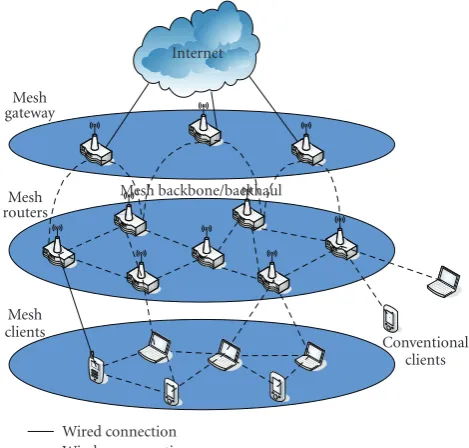
Wireless Mesh Networks (WMNs) have the characterisitcs of low deployment cost, easy maintenance, and reliable service coverage technologies to form robustness networks. The task group “s” (TGs) of IEEE 802.11 develops a flexible and extensible standard for wireless mesh networks based on the original IEEE 802.11. However, IEEE 802.11 TGs adopts two main proposals—SEE-Mesh (Intel) and Wi-Mesh (Nortel) intending to specify a framework for WLAN Mesh networking [1]. In WMNs, nodes are comprised of mesh routers and mesh clients [2]. Mesh routers form a wireless backbone of WMNs, which provide multi-hop connectivities between mesh clients and mesh gateways that have wired connectivity with Internet (Figure 1).
WMNs are dynamically self-organized and
self-configured, with the nodes in the network automatically establishing and maintaining mesh connectivity among themselves and compatible with conventional Wi-Fi clients. Multi-interface WMNs provide multiple radio interfaces of
appropriate transmission power level selection can improve network performance [6–8]. Traditional transmission power control problems in wireless ad hoc networks mainly focus on reducing energy consumption. Some researches address power selection problems but still use minimum hop-count as the routing metric. Power control indeed impacts multiple network protocol layers. Transmission power control tightly affects network performance [9]. The theoretical studies [10] have demonstrated that transmission power control can improve wireless network capacity. The result in [11] presents that the need to design future protocols is based on variable-range power control, not on common-range transmission power control. The higher transmission power increases network connectivity and gives lower end-to-end delay in the low traffic load with slight interference. However, the higher transmission power will create high interference when concurrent transmissions in the vicinity are increased. This will decrease the spatial reusability. In this high loading case, using lower transmission power will result in lower interference, and thus increase the throughput. The motivation of our cross-layer routing protocol development is inspired from the above features we observed.
We previously proposed the MiRii (Multi-Interface Rout-ing with Intra/Inter-flow Interference) [5] routing protocol that measures intra-/interflow interference and applies to routing path selection in the network layer. The multi-interface feature is utilized by considering the channel diversity of the routing path. By contrast with AODV [12], ETX [13], and WCETT [4] (will be introduced later in
Section 2.2), the simulation results demonstrate that our MiRii routing protocol can improve packet delivery ratio and decrease end-to-end delay. To further improve the performance, the routing protocol has to work together with the physical layer. In this paper, we propose our cross-layer routing protocol, namely, M2iRi2(Multi-power, Multi-interface Routing with Intra/Inter-flow Interference), that incorporates MiRii routing protocol with perflow transmission power control. M2iRi2routing protocol jointly coordinates the transmission power at each traffic flow and route selection among multi-interface nodes. The protocol interplays between the network and the physical layers. It aims to select appropriate transmission power to reduce the noise interference more efficiently when the traffic loading in the network is increased.
The rest of the paper is organized as follows.Section 2
reviews the past work related to link quality routing, load-balancing routing, and the transmission power control on the physical layer.Section 3describes our cross-layer routing protocol in detail. Section 4presents the simulation result and analysis. Finally,Section 5 concludes the paper with a summary and proposes the future work.
2. Related Work
We first introduce some related work to our cross-layer routing protocol M2iRi2, namely the transmission power control and routing metrics in WMNs, including our previous MiRii routing protocol.
Internet Mesh
gateway
Mesh routers
Mesh clients
Mesh backbone/backhaul
Conventional clients
Wired connection Wireless connection
Figure1: Wireless Mesh Networks.
2.1. Transmission Power Control. Previous transmission power control schemes for ad hoc networks have focused on throughput improvement or power consumption. We do not consider the power consumption in our work becasue WMN backbone does not have power consumption issues. In [10], the author shows that reducing the transmission power can increase the carrying capacity of the network. The work in [11] concludes that variable-range transmission power can improve the overall network performance. Some researches address the power-controlled problem on the network layer [6, 7]. The COMPOW protocol [6] relies on the DSDV routing protocol to discover the smallest common power level at which the entire network is still connected. However, it suffers when some nodes can only use high power to be connected. In [7], the proposed CLUSTERPOW protocol performs the routing protocol several times with different power levels at each run and independently builds a routing table at each power level. A node consults the routing table with the lowest power to forward packets to the next hop. This consumes too much network resource.
acceptable-power-to-send (APTS) back to the sender. In other words, the protocol design is based on CSMA/CA and modifies the RTS/CTS to RPTS/APTS (Request-Power-To-Send/Acceptable-Power-To-Send) to support potential interfering transmissions to transmit concurrently rather than to silence it. However, PCMA uses the additional separate control channel to send the busy tone pulses. PCDC (Power Controlled Dual Channel) [14] also uses dual channels for data and control packets. A single channel solution for transmission power control (POWMAC) is used in [15]. In POWMAC, the interference tolerance is inserted into the CTS packet and an additional control packet DTS (Decide-To-Send) is used by transmitter to confirm the transmission. Furthermore, the DTS is utilized to inform the neighbors of transmitter about the power level that the transmitter will use for its data transmission. The neighbors of the transmitter can determine whether or not they can receive the data packets form other nodes simultaneously through DTS.
From the comparisons of [8,14, 15], we finally adopt the interference tolerance concept to be integrated into our cross-layer routing protocol design. We will facilitate concurrent interference-tolerable transmissions in the same vicinity of the receiver to enhance the WMN backbone capacity. Furthermore, we piggyback the interference toler-ance information in probe packets which are integrated in the network layer routing protocol. It is not using a separate control channel to alert the neighboring nodes.
2.2. Routing Metrics in WMNs. Most of the routing protocols use “hop count” as the routing metric. The minimum hop-count routing is not suitable for wireless networks because of dynamic wireless link quality characteristics. The work in [4,13] proposes new routing metrics considering the link quality dynamics. MiRii proposed in [5] further considers the intra-/interflow interferences in multi-interface routing path selections.
The work in [13] proposed the concept of the expected transmission count (ETX) as the routing metric. ETX is calculated by measuring the delivery ratios for probe packets in bidirectional transmissions of each link. It predicts the number of data transmissions required to send a packet and get a successful acknowledgment. Therefore, the ETX accounts for interference among the successive links of a path. Although ETX does well in single-radio wireless ad hoc network, it does not perform well in multiradio and multichannel wireless mesh networks. Reference [4] presents a new routing metric for multiradio, multihop wireless mesh networks, called WCETT (Weighted Cumulative Expected Transmission Time). WCETT assigns weights to individual links based on the Expected Transmission Time (ETT) of a packet over the link. As a result, the WCETT of a route withnhops can be the sum of the ETTs of all hops along the path. Further, WCETT assumes that the network has a total of k channels in an n-hop path. However, Xj is the sum of transmission time of hops that uses channel jalong the path. The total path throughput will be dominated by the bottleneck channel, which has the highestXj. WCETT
takes both link quality (ETT) and channel diversity (Xj) into considerations. Thus, WCETT combines these two features by taking their weighted average as follows:
WCETT=1−β∗n
i=1
ETTi+β∗max
1≤j≤kXj. (1)
In fact, the WCETT metric takes “intraflow” (means the same flow, but between different hops) interference into consideration, but does not capture “interflow” (means between different neighboring flows) interference. In our previous work [5], we propose a new routing metric, MiRii, that considers both intraflow and interflow interference in the multi-interface WMNs. In order to capture the interflow interference, we calculate the nodal activity and intertraffic flow interference. We introduce Little’s Result into the routing metric design that makes the interflow interference unit cost compatible with WCETT. To this end, we assume node k and node k’s neighboring nodes as a closed system and the Activity Time (AT) of nodekis shown in (2). Also, Nk and λk are the average queue length and average packet receiving rate of node k, respectively. The sum of average queue length of k’s neighboring nodes is the second parameter of numerator, and the sum of average packet receiving rate ofk’s neighboring nodes is the second parameter of denominator in (2). The Activity Time (ATk) regarding to kis the total average queue length divided by total average packet receiving rate of the system:
ATk=Nk+
m
nb=1Nnbk
λk+mnb=1λknb. (2) Therefore, by combining both intraflow and interflow inter-ferences, the MiRii routing cost is defined as (3)
MiRii=α siderations and end-to-end delay over ann-hops path. The
chanETTiis the sum of transmission times of hops using channelj, and represents the channel-diversity in multiradio WMNs. Finally, ATk is the interflow interference, and represents the load-balanced routing cost.
3. Cross-Layer Routing Protocol Design
Network layer Link quality measurement
iTolerance info exchange
MiRii routing protocol
TxPower level selection
iTolerance calculation Physical layer
Figure2: The cross-layer routing protocol architecture.
propagation, handling, and queuing delays. When the traffic loading is low, the queuing day may be insignificant. It is better to use high transmission power to reduce hop count and also reduce the handling delay. However, under high traffic loading, the low transmission power reduces the queuing delay because the queue length will grow due to more neighbors’ interference or collisions. Therefore, it is a good policy that we should adapt the appropriate transmission power level according to the surrounding interference constraints. This is one of the basic motivations of our work.
3.1. Overview of Protocol. The scheme of the proposed M2iRi2 cross-layer routing protocol is shown in Figure 2. The routing protocol is based on AODV [12]. We modify it to support MiRii routing metric and transmission power level selection on a perflow basis. The network layer coor-dinates with the physical layer to choose the appropriate transmission power level and to find a routing path with better link quality. The proposed M2iRi2routing protocol is operated among mesh routers. The mesh clients can access the network by directly connecting to mesh routers. The protocol does not consider dynamic channel assignment for simplicity at this point. In the physical layer of the model, there are several discrete transmission power levels for each NIC (network interface card). The function of “iTolerance Calculation” calculates the interference tolerance of each ongoing receiving NIC at the node. The “Link Quality Measurement” function measures the ETT and AT that are used in the MiRii routing protocol. All the measurement and information exchanges are through probe packets that are broadcasted proactively by each NIC.
3.2. iTolerance Calculation. Suppose that a packet transmis-sion from nodei to node j is a successful reception if the received SINR (Signal-to-Interference Noise Ratio) is above a certain threshold:
SINRi= PiGij
l /=iPlGl j+Nj ≥SINR Threshold, (4)
Pi means the transmit power for node i and PiGij is the
received power at nodej, whereGijis the propagation gain for the direct transmission from node i to j. Also, Nj is the thermal noise at node j, andl /=iPlGl j is the sum of interferences that transmit concurrently with nodei.
However, iTolerance is defined as the interference toler-ance that a receiver node can tolerate a new joining neigh-boring interference without destroying its existing ongoing receptions. So, the radio interface at nodej, regarding to the flow from nodei, can allow its iTolerance as follows:
iTolerancej= PiGij
SINR Threshold−
⎛ ⎝
l /=i
PlGl j+Nj
⎞ ⎠. (5)
In the protocol design, we measure the actual propagation gain based on the received power of the probe packet at the receiver side. Nodes can locally measure their interference tolerance according to the sum of the strengths of all the interfering signals. Each radio interface on the node will advertise its interference tolerance to its one hop neighbors.
In the network layer, each node updates its neighbors’ iTolerance through the probe packet. When the route discovery starts, the node looks up its neighbors’ iTolerance and chooses the appropriate TxPower (transmission power) level to send RREQ or forward RREQ messages. From the (6), the routing protocol will select the highest TxPower when the iTolerance constraints can be satisfied:
max
TxPower level|TxPower level
≤minneighborl
iTolerancel
Gil
.
(6)
We also apply for the MiRii routing metric which is referred in (3) in our M2iRi2. Hence, each traffic flow select the appropriate transmission power to send its route request messages and use the MiRii routing metric to choose a routing path that has the smallest MiRii cost. In M2iRi2, we use the probe packet to measure the link quality and piggyback the iTolerance information with the neighbors.
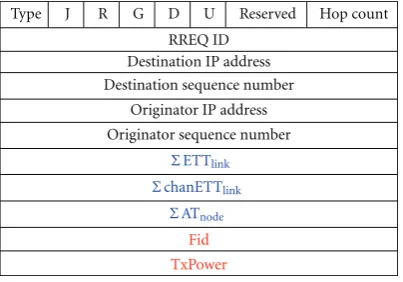
Type J R G D U Reserved Hopcount
RREQ ID Destination IP address Destination sequence number
OriginatorIP address
Originatorsequence number
ΣETTlink
ΣchanETTlink
ΣATnode
Fid
TxPower
Figure3: The format of RREQ packet.
adjusts the transmission power level for this traffic flow to forward to the next hop.
The data transmission is based on CSMA/CA and the iTolerance value at the radio interface changes dynamically. So, we still transmit the data packet by using the lowest transmission power level even if there is no power level satisfied the iTolerance constraints. Notice that here, for simplicity and fair performance comparisons later, we do not apply call admission control to reject any new flows. The Route Request (RREQ) packet format is illustrated in
Figure 3. The fields of (ETTlink,
chanETTlink,
ATnode)
are used to calculate the MiRii value. The fields of (Fid, TxPower) are utilized to achieve the per-flow transmission power control.
In reality, the channel fading and interference change dynamically. It is difficult to calculate exact tolerable power level or link quality. There are some papers [16, 17] that proposed different approaches to deal with these. However, in concern with complexity of the algortihm, we are not dealing with the fading channel problem here. Instead, in our design, we use the “moving average” estimation to find the path in the sense of “statistically approximation”. Thus, it may combat the slow fading but not fast fading channels. Our proposed M2iRi2 can find the path with considering both existing and tolerable adding intereference. In this way, the throughput is increased with reducing the failed transmissions due to suffering too much intereference. Therefore, energy consumption from the system view is reduced, and efficiency is increased.
4. Simulation Results and Analysis
In this section, we evaluate the throughput and delay for M2iRi2 using NS-2 and contrast it with the flow-based MiRii and AODV routing protocol. The radio propagation model adopts Two-Ray Ground model in NS-2. Each node is equipped with two NICs. The off-the-shelf Cisco Aironet 350 series client adapters or access points allow different transmit power setting for one of 1, 5, 20, 30, 50, and 100 mW. We adopt the 30 mW and 100 mW in our NS-2 simulation. The SINR threshold is setting to 6.02 dB and the noise floor at each node is −120 dBm. The traffic flow type is CBR
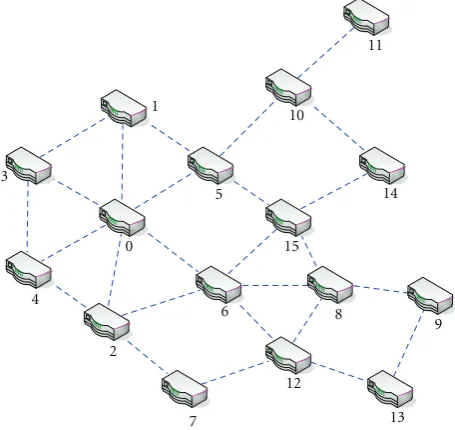
0 1 2 3 4
5 6 7 8 9
Flow1 Flow2
Flow3 Flow4
Figure4: A simple network topology.
Table1: Delay-Throughput with different power levels.
Number of flows 1 2 3 4
MiRii-30 mW delay (ms) 14.0 37.9 102.3 157.7 MiRii-30 mW throughput (Kbps) 511.1 884.7 1119 1284 MiRii-100 mW delay (ms) 11.8 16.8 141.5 210.6 MiRii-100 mW throughput (Kbps) 510.2 1004 1057 931
(Constant Bit Rate) during the ON period of an equally ON-OFF model and the packet sizes are 1000 Bytes.
We first look at a simple topology (see Figure 4) which clearly demonstrates the benefits of using the appropriate transmission power level at different interference environ-ments. The flow-based MiRii routing protocol is introduced to evaluate these two cases of power levels. The dash line in 4 denotes the connectivity using 30 mW power, while the communication range is double farther if using 100 mW power.Table 1 shows the throughput and end-to-end delay with different traffic flow numbers. Each traffic flow transmits with data rate 512 KBits/s. “MiRii-30 mW” indicates that we fix transmission power at 30 mW in the entire network. The average end-to-end delay is defined as the time of packet from leaving the source to successful receiving at the destination. It includes the buffering time before the routing path discovery, the queuing time, the delay of retransmission at MAC layer, and propagation delay. When the number of traffic flow is one, the traffic loading is low and interference is slight. We can utilize high transmission power level (100 mW) to reduce end-to-end delay since it can travel through small hop counts. When the numbers of flows are increased, the interference among radio interfaces is increased. MiRii-30 mW can perform well since radio interfaces with lower transmission power level reduce the interference generating to its neighbors. The MiRii-30 mW has lower end-to-end delay and higher throughput than MiRii-100 mW.
Now we consider a 4×4 uniform topology in a
500 m×500 m region. Each node locates 80 meters apart. In Figure 5, the light color (red) bars represent the high traffic loading with data rate 1 Mbits/s and the dark color (blue) bars represent the low traffic loading with data rate 512 Kbits/s. We consider the traffic flows in the WMNs randomly start and terminate. We let the CBR traffic flow randomly on/off but keep the number of active flows in the network to be five in average. The numbers of traffic flows and traffic pattern are the same in both cases.Figure 5
0
Traffic type: CBR, average flow number:5 flows
Figure5: Throughput of different traffic load in a uniform network topology.
Traffic type: CBR,average flow number: 5 flows
Figure 6: Average end-to-end delay of different traffic load in a uniform network topology.
on/off and choose the source-destination pair randomly. The destination-based routing protocol also increases RREQ broadcast times and increases the packets waiting in the buffer before the routing path establishment. The flow-based routing protocol has the delay better than destination-based routing protocol. Even if the flow-based routing protocol needs to broadcast RREQ packets for each flow, it can discover better routing path than destination-based routing protocol. When the data rate increases to 1 Mbits/s, the transmission power fixed at 30 mW has throughput better than 100 mW, and the end-to-end delay has the same result. In this case, M2iRi2 have the throughput similar to MiRii-30 mW, and improve the throughput 13% contrasting with MiRii-100 mW. InFigure 6, the results of average end-to-end delay of M2iRi2 are decreased by 30% and 48% contrasting with MiRii-30 mW and MiRii-100 mW, respectively.
We next simulate our protocol on a topology that nodes are randomly placed in a 500 m×500 m area (Figure 7). The simulation parameters are the same as the uniform topology. The throughputs are almost similar in these routing pro-tocols at low traffic loading as we observe in the uniform topology case. However, from Figure 8, the throughput of M2iRi2 is better than MiRii-30 mW and MiRii-100 mW
1
Figure7: A random network topology.
0
Traffic type: CBR, average flow number: 5 flows
Figure8: Throughput of different traffic load in a random network topology.
about 7% and 14% at high data rate. Figure 9 shows the average end-to-end delay in the high and low data rate. The delay of M2iRi2 is further lower than MiRii-100 mW and is better than MiRii-30 mW about 28% at high traffic data rate. The simulation results indicate that our proposed cross-layer routing protocol utilizes the advantages of different power levels in different network environments and performs well by controlling the transmit power efficiently for perflow per hop transmission.
0
Traffic type: CBR, average flow number: 5 flows
Figure 9: Average end-to-end delay of different traffic load in a random network topology.
Traffic type: CBR, average flow number: 5 flows
Figure 10: Throughput of different traffic load in a random network topology with gateway.
0
Traffic type: CBR, average flow number: 5 flows
Figure11: Average end-to-end delay of different tra0-40pt
also operate well when the flow data rate is 512 Kbits/s. The destination-based AODV routing protocol might have the lower end-to-end delay depending on whether the traffic flows have the same destination (gateway) or not, which will reduce the route discovery time. The results also indicate that our M2iRi2 routing protocol operates well when the traffic are all going towards gateways in the WMN.
5. Conclusion and Future Work
In the paper, we proposed M2iRi2 routing protocol for multi-interface WMNs. The main purpose is to coordinate the physical layer and the network layer for a cross-layer routing protocol development. Previous researches show that variable transmit power level control can improve network performance but they still use minimum hop counts as the routing metric. We introduce the iTolerance to constrain the transmit power level and incorporate it to the route discovery. The MiRii routing metric is utilized to evaluate the routing path with consideration of both intraflow and interflow interferences. Furthermore, the power control is designed on perflow, perhop basis. We thoroughly observe the performance of M2iRi2 at different traffic loadings. When the traffic loading is high, the newly traffic flow chooses the appropriate transmission power level along less interference path to transmit the data packets in order not to create intolerable interference to the existing transmissions. Through the simulation results, we have demonstrated that our M2iRi2 routing protocol can enhance both network throughput and end-to-end delay.
In the current version of M2iRi2 routing protocol, the traffic flow selects the lowest power level even if it would violate the interference tolerance constraint. In the future, we may incorporate M2iRi2 with the traffic flow admission control and extends the M2iRi2 to more stability and even better performance.
Acknowledgment
This work is granted by NSC-97-2221-E-004-004-MY2.
References
[1] H. Aoki, N. Chari, L. Chu, et al., “802.11 TGs simple efficient extensible mesh (SEE-Mesh) proposal,” IEEE802.11 document 05/0562r0, 2005.
[2] I. F. Akyildiz and X. Wang, “A survey on wireless mesh networks,”IEEE Communications Magazine, vol. 43, no. 9, pp. 22–30, 2005.
[3] A. Adya, P. Bahl, J. Padhye, A. Wolman, and L. Zhou, “A multi-radio unification protocol for IEEE 802.11 wireless networks,” in Proceedings of the 1st IEEE International Conference on Broadband Networks (BroadNets ’04), pp. 344–354, October 2004.
[5] T.-C. Tsai and T.-F. Liu, “Multi-interface routing with intra/inter-flow interference (MiRii) considerations in wire-less mesh networks,” in Proceedings of the 3rd Asia-Pacific Symposium on Queueing Theory and Network Applications, 2008.
[6] S. Narayanaswamy, V. Kawadia, R. S. Sreenivas, and P. R. Kumar, “Power control in ad-hoc networks: theory, archi-tecture, algorithm and implementation of the COMPOW protocol,” inProceedings of the European Wireless Conference (EW ’02), 2002.
[7] V. Kawadia and P. R. Kumar, “Principles and protocols for power control in wireless ad hoc networks,”IEEE Journal on Selected Areas in Communications, vol. 23, no. 1, pp. 76–88, 2005.
[8] J. P. Monks, V. Bharghavan, and W. W. Hwu, “A power con-trolled multiple access protocol for wireless packet networks,” inProceedings of the 20th Annual Joint Conference on the IEEE Computer and Communications Societies (INFOCOM ’01), vol. 1, pp. 219–228, 2001.
[9] M. Krunz, A. Muqattash, and S.-J. Lee, “Transmission power control in wireless ad hoc networks: challenges, solutions, and open issues,”IEEE Network, vol. 18, no. 5, pp. 8–14, 2004. [10] P. Gupta and P. R. Kumar, “The capacity of wireless networks,”
IEEE Transactions on Information Theory, vol. 46, no. 2, pp. 388–404, 2000.
[11] J. Gomex and A. T. Campbell, “Variable-range transmission power control in wireless ad hoc networks,”IEEE Transactions on Mobile Computing, vol. 6, no. 1, pp. 87–99, 2007.
[12] C. Perkins, E. Belding-Royer, and S. Das, “Ad hoc on-demand distance vector (AODV) routing,” IETF RFC 3561, 2003. [13] D. S. J. de Couto, D. Aguayo, J. Bicket, and R. Morris, “A
high-throughput path metric for multi-hop wireless routing,” in
Proceedings of the Annual International Conference on Mobile Computing and Networking (MOBICOM ’03), pp. 134–146, San Diego, Calif, USA, 2003.
[14] A. Muqattash and M. Krunz, “Power controlled dual chan-nel (PCDC) medium access protocol for wireless ad hoc networks,” in Proceedings of the Annual Joint Conference on the IEEE Computer and Communications Societies (INFO-COM ’03), pp. 470–480, 2003.
[15] A. Muqattash and M. Krunz, “POWMAC: a single-channel power-control protocol for throughput enhancement in wire-less ad hoc networks,” IEEE Journal on Selected Areas in Communications, vol. 23, no. 5, pp. 1067–1084, 2005. [16] L. Xiao, M. Johansson, and S. P. Boyd, “Simultaneous
routing and resurce allocation via dual decomposition,”IEEE Transactions on Communications, vol. 52, no. 7, pp. 1136– 1144, 2004.