MP-01.01
The use of active surveillance in men diagnosed with Gleason 6 prostate cancer in a Canadian health region
Cristea, Octav M.1; Stokl, Andrew3; Montroy, Joshua3; Cnossen, Sonya2;
Mallick, Ranjeeta2; Cagiannos, Ilias1,2,3; Morash, Christopher1,2,3; Breau,
Rodney H.1,2,3
1Division of Urology, Department of Surgery, The Ottawa Hospital, Ottawa,
ON, Canada; 2Ottawa Hospital Research Institute, Ottawa, ON, Canada; 3Department of Surgery, University of Ottawa, Ottawa, ON, Canada
Introduction and Objectives: Recent guidelines have recommended against
prostate cancer screening, citing the risks of over-treating clinically indolent disease. We sought to determine the proportion of patients with Gleason 6 cancer managed with active surveillance in a Canadian health region.
Methods: We reviewed all patients referred for prostate cancer assessment
at the Ottawa Region Cancer Assessment Clinic between April 1, 2008 and January 31, 2013. All patients with biopsy proven Gleason 6 cancer were included. Active surveillance was defined as monitoring with the option to treat if the patient developed evidence of progression. Relative risk (RR) >1.0 signified a higher risk of immediate treatment.
Results: Of 1481 patients diagnosed with prostate cancer, 486 (33%) had
Gleason 6 cancer based on biopsies performed at our centre. Active surveil-lance was chosen by 215 patients (44%), while 244 (50%) chose imme-diate treatment via surgery (n=176; 36%), radiotherapy (n=66; 14%), or HIFU (n=2; <1%). Twenty-seven (6%) were undecided, lost to follow-up, or opted for palliative watchful waiting. Factors associated with immediate treatment were palpable tumours (RR 1.3; P<0.01), PSA density >0.2 (RR 1.4; P=0.012), >2 positive biopsy cores (RR 1.6-2.2; P<0.001) and at least 1 biopsy core with >50% cancer (RR 1.5; P<0.0001). Factors associated with surveillance were age >70 (RR 0.5; P<0.0001) or higher Charleston Co-morbidity Index score (RR 0.8 per point; P<0.0001). Family history and baseline PSA were not associated with management choice. Of 176 men who chose immediate surgical treatment, 100 (57%) were found to have Gleason 7 or higher grade cancer on final pathology.
Conclusions: Active surveillance is a common management strategy for
men with Gleason 6 cancer. Factors associated with immediate treatment are consistent with factors associated with more advanced cancer. These practice patterns indicate the uncoupling of diagnosis and treatment, which should be considered when assessing the merits of prostate cancer screening.
MP-01.02
MRI-guided transurethral ultrasound ablation in patients with localized prostate cancer: 12-month outcomes of a prospective multi-national phase I clinical trial
Billia, Michele1; Pahernik, Sascha 2; Relle, James3; Burtnyk, Mathieu4; Röthke,
Matthias 2; Hafron, Jason3; Schlemmer, Heinz-Peter2; Chin, L.K. Joseph1 1Department of Urology and Department of Radiology, London Health
Sciences Centre, University of Western Ontario, London, ON, Canada;
2Department of Radiology and Department of Urology, German Cancer
Research Center DKFZ, Heidelberg, Germany; 3Department of Urology,
Beaumont Health System, Royal Oak, MI, United States; 4Profound Medical
Inc., Toronto, ON, Canada
Introduction and Objectives: MRI-guided transurethral ultrasound
abla-tion (TULSA) is a novel minimally-invasive technology aiming to provide local control of prostate cancer (PCa) with low morbidity. The objective of this prospective Phase I study is to determine safety and feasibility of MRI-guided TULSA.
Material and Methods: Thirty low-intermediate risk PCa patients were
enrolled: T1c-T2a; PSA≤10ng/ml; GS 3+3 (3+4 in Canada only). Under general anesthesia, the ultrasound device (TULSA-PRO, Profound Medical) is positioned in the prostatic urethra with MRI guidance. Treatment planning is performed under MRI visualization with therapeutic intent of conservative whole-gland ablation, including 3mm safety margins at the prostate capsule. Treatment is delivered precisely using real-time MRI thermometry feedback control. Patients recover as outpatient, with a suprapubic catheter left in for 2 weeks. Primary endpoints are safety and feasibility, with follow-up to 12 months (mo). Exploratory endpoints are at 5 years, including PSA, biopsies, IPSS and IIEF.
Results: Median (5%–95%) treatment time was 36 (24–54) mins and median
prostate volume was 44 (30–89) cc. Median spatial control of thermal ablation was ±1.3mm and CE-MRI confirmed the conformal non-perfused volume in all cases. Complications (CTCAEv4) included hematuria (14pts Grade1; 2pts G2), UTI (10pts G2), retention (3pts G1; 5pts G2), and epididy-mitis (1pt G3). There were no rectal injuries or intraoperative complications. PSA decreased from 5.8 (2.8–8.9) ng/ml to 0.8 (0.1–3.2) at 1mo (n=30), stable to 0.8 (0.1–2.2) at 12mo (n=21). MRI and biopsy at 12mo show diminutive prostate volumes, with average 47% fibrosis (n=20). Biopsies are positive in 12 of 20 patients, though with 62% reduction in total biopsy core cancer length.
Conclusions: MRI-guided TULSA provides accurate planning, real-time
dosimetry and precise control of prostate ablation, with a well-tolerated side-effect profile. Phase I data are sufficiently compelling to study the TULSA-PRO in a larger trial, with reduced safety margins.
MP-01.03
Real time MR imaging-guided in-bore focal laser ablation for low-to-intermediate risk prostate cancer: Results of combined Phase I/II study
Ghai, Sangeet2; Finelli, Antonio1; McCluskey, Stuart3; Hlasny, Eugen2; Corr,
Kateri1; Nesbitt, Michael1; Van der Kwast, Theodorus4; Kucharczyk, Walter2;
Zlotta, Alexandre1; Trachtenberg, John1
1Division of Urology, Department of Surgical Oncology, University Health
Network, University of Toronto, Toronto, ON, Canada; 2Joint Department
of Medical Imaging, University Health Network, Toronto, ON, Canada;
3Department of Anesthesia & Pain Management Toronto General Hospital,
University Health Network, Toronto, ON, Canada; 4Department of
Pathology, University Health Network, Toronto, ON, Canada
Introduction and Objectives: Men with low-intermediate risk prostate
can-cer (PCa) are usually offered either active treatment (surgery or irradiation) with almost certain impairment in quality of life (sexual, genitourinary, or bowel dysfunction), or active surveillance, with risk of disease progression and very long periods of careful observation leading to significant burden to the patient and health care systems.
Although prostate cancer is often multifocal, the volume of the index tumor is the likely source of local and distant spread of the tumor. The index lesion is usually demonstrated on multi-parametric MRI and creates a treatment target. Thus focal ablation of the index cancer could provide the best bal-ance between oncologic control and maintenbal-ance of quality of life. The goal of our study was to assess the safety and feasibility of focal laser ablation therapy in PCa under MR guidance.
Materials and Methods: Patients with biopsy-proven low or intermediate
risk PCa were prospectively enrolled. Treatment was performed as an out-patient in the MR suite under deep sedation. A MR-compatible transperineal
Poster Session 1: Prostate (I)
template was used for initial treatments. The final 15 treatments were performed with a trajectory alignment device (robot).
Upon confirming optimal catheter placement, 980 nm water cooled laser fiber was placed and the ablation monitored in real-time by MRI thermography. Contrast enhanced imaging confirmed post-procedure coagulation. Follow-up biopsy was performed 4-6 months post ablation in 47/50 patients. All patients filled out IPSS and IIEF-5 questionnaires at baseline, 1 month and 4 months after treatment.
Results: No significant change in the median IPSS and IIEF-5 scores were
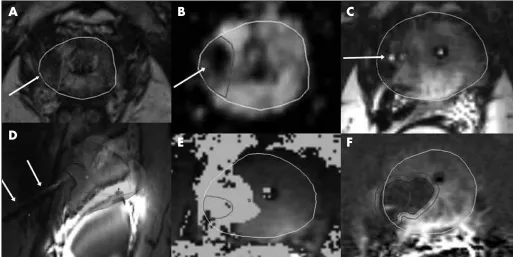
noted at conclusion of follow up. At 4 -6 month biopsy, 32/47 patients (68.1%) were treated successfully, while 15 had evidence of residual can-cer in the treated region. Of these 15 patients, 6 reduced in risk category to very low. Presence of a definite lesion on diagnostic MRI and complete lesion coverage by thermal ablation zone were significantly associated with no residual disease (P<0.05). Reasons for residual tumor likely include registration error, MR unrecognized sparse tumor at periphery of target, and deformation of the prostate at the 4 month biopsy (Fig. 1).
Conclusions: Focal laser ablation is a feasible, safe, and possible effective
therapy for low-to-intermediate risk PCa. Enhanced definition of tumor margins and the ability to accurately biopsy the treated area post therapy, will further enhance the science of in-bore focal treatment of PCa.
MP-01.04
MRI-guided cognitive targeted biopsy of the prostate: Do we really hit the target?
Cerantola, Yannick1,4; Haberer, Eleonore1; Torres, Jose2; Alameldin, Mona2;
Aronson, Samuel1; Levental, Mark3; Bladou, Franck1; Anidjar, Maurice1 1Urology, Jewish General Hospital, Montreal, QC, Canada; 2Pathology,
Jewish General Hospital, Montreal, QC, Canada; 3Radiology, Jewish
General Hospital, Montreal, QC, Canada; 4Urology, Centre hospitalier
universitaire vaudois, Lausanne, Switzerland
Introduction and Objectives: Cancer of the prostate (PCa) is one of the
most common solid neoplasms in Western countries. Its diagnosis relies on digital rectal examination (DRE) and elevated prostate specific antigen (PSA) levels leading to systematic transrectal ultrasound-guided prostate biopsy. Multiparametric magnetic resonance imaging (mpMRI) allows for targeted biopsy of suspicious areas of the prostate instead of random 12-cores biopsy. This method has been shown to be more accurate in detecting significant prostate cancer. However the precise spatial accuracy of cognitive targeting is unknown. The present study aimed to evaluate the accuracy of cognitive targeted biopsy.
Methods: From November 2012 to September 2014, all patients
undergo-ing MRI-guided cognitive targeted biopsy of the prostate and consecutive robot-assisted radical prostatectomy (RARP) were included in the present analysis. The 27 regions of interest (ROIs) described by Dickinson et al. were used as spatial reference. The index lesion reported on MRI was subsequently targeted using the cognitive approach. PCa mapping on radical prostatectomy specimen was used as reference to determine true positive MRI findings. Correlation analysis was performed for each target.
Results: Within the study period, 40 patients underwent preoperative
MRI, cognitive targeted biopsy and subsequently RARP. Overall, 137 ROIs were involved by suspicious index lesions on MRI. After correlating these findings with final pathology, 117 ROIs were considered as true positive lesions. A total of 102 cores directed towards such true positive ROIs were available for final analysis. Cognitive targeted biopsy hit the target in 82% of the cases (84/102). The only identified risk factor for missing the target was anterior situated areas (p=0.01).
Conclusions: In experienced hands, cognitive MRGTB allows for an
accu-racy of 82% in hitting the correct target, given it is a true positive lesion. MRI-ultrasound fusion software might allow for a more precise targeting, especially for anterior situated lesions.
Fig. 1. MP-01.03. Focal laser ablation therapy of a Gleason 7 tumor in the right apex peripheral zone. Diagnostic imaging with axial T2-WI (A) and ADC maps (B) confirms the lesion (arrows). C) Axial images shows final intra-operative position of cannula (arrow) prior to laser ablation. D) Laser catheter (arrows) is localized to the target (red). E) MR thermography: orange pixels show the area of thermal ablation, red color outlines target. F) Immediate post treatment images with contrast, derived from overlaying pre-treatment planning images, shows complete tumor coverage.
A
B
C
MP-01.05
Cost-effectiveness of multiparametric MRI and targeted biopsy in diagnosing prostate cancer
Dragomir, Alice1; Cerantola, Yannick 1; Tanguay, Simon1; Bladou, Franck1;
Aprikian, Armen1; Kassouf, Wassim1
1Urology, McGill University, Montreal, QC, Canada
Introduction and Objectives: Transrectal US-guided biopsy (TRUSGB)
is the recommended approach to diagnose prostate cancer (PCa). Overdiagnosis and sampling errors represent major limitations. Multiparametric MRI accurately identifies PCa lesions within the prostate. Targeted biopsy (MRGTB) detects significant PCa in a higher proportion of men and reduces the diagnosis of insignificant PCa. Costs and technical limitations still prevent MRGTB from becoming the new standard in PCa diagnosis. The goal of the present study was to assess whether the added costs of MRI outweigh the benefits of MRGTB in a cost-utility model.
Methods: A Markov model was developed to estimate the incremental
cost-effectiveness ratio (ICER) over 10-, 15- and 20 years. The model takes into account probability of men harboring PCa, diagnostic accuracy of both procedures and probability of being assigned to the various treat-ment options was created. Direct medical costs were included. ICER below $50,000/quality adjusted life year gained (QALY) was considered as cost-effective.
Results: Following standard TRUSGB pathway, calculated cumulative
effects at 5-, 10-, 15- and 20-years were 4.25, 7.17, 9.03 and 10.09 QALY, respectively. Cumulative effects in the MRGTB pathway were 4.29, 7.26, 9.17 and 10.26 QALY, respectively. Costs related to the TRUSGB strategy were $8,027, $11,406, $14,883 and $17,587 at 5, 10, 15 and 20 years, respectively, as compared to $7,231, $10,450, $13,267 and $15,400 for the MRGTB strategy. At 5-, 10-, 15- and 20 years, the MRGTB was established dominant strategy.
Conclusions: The incorporation of MRI and MRGTB in PCa diagnosis and
management represents a cost-effective measure at 5-, 10-, 15- and 20 years after initial diagnosis.
MP-01.06
Factors predicting prolonged operative time for individual sur-gical steps of Robot-Assisted Radical Prostatectomy (RARP): A single surgeon’s experience
Alenizi, Abdullah M.2; Valdivieso, Roger2; Rajih, Emad 1; Meskawi, Malek2;
Taorta, Cristian 2; Bienz, Marc2; Hueber, Pierre-alain2; Lavigueur-Blouin,
Hugo2; Trudeau, Vincent2; El-Hakim, Assaad1; Zorn, Kevin C.2
1Division of Robotic Urology, Department of Surgery, Hôpital du
Sacré-Cœur de Montréal, Montreal, QC, Canada; 2Section of Urology,
Department of Surgery, Centre hospitalier de l’Université de Montréal, Montreal, QC, Canada
Introduction and Objectives: Acquiring robotic skills is not a simple task
for residents and fellows as it is demonstrated by the lengthy learning curve. Despite the use of simulation, a standardized robotic prostatec-tomy curriculum has yet to be established. In order to demonstrate a benchmark to aim for during apprenticeship we describe the time required to complete each step of our surgical technique. We also sought to evalu-ate preoperative risk factors that would predict a prolonged surgical step.
Methods: We retrospectively identified patients who underwent RARP,
performed by an experienced robotic surgeon at a single institution (CHUM). Duration of steps and baseline characteristics were recorded. A multivariable logistic regression model was performed to predict factors of prolonged individual steps.
Results: In multivariable analysis, obesity was a significant predictor of
prolonged operative time (OT) in: docking (Odds Ratio [OR]: 1.96), ure-thral division (OR: 3.13) and vesico-ureure-thral anastomosis (VUA) (OR: 2.63). Prostate volume was also a significant predictor of longer OT in: dorsal vein complex ligation (OR: 1.02), bladder neck division (OR: 1.03), pedicle control (OR: 1.04), urethral division (OR: 1.02) and VUA (OR: 1.03). Finally, the presence of a median lobe was a predictor of a pro-longed bladder neck division (OR: 5.03). Only obesity (OR: 2.56) and prostate volume (OR: 1.04) were predictors of a longer overall OR time.
Conclusions: Obesity and prostate volume were powerful predictors of
longer OT time. The presence of a median lobe was a strong predictor of
a longer time of bladder neck division. Obesity was a predictor of longer OT of three different steps and prostate volume at TRUS was a predictor in five surgical steps. These results should be taken into consideration when acquiring robotic surgical skills and also should be considered when constructing a learning curriculum.
MP-01.07
Omega-3 fatty acid-enriched diet favors a reduction of murine TRAMP-C2 prostate tumor growth compared to Omega-6 fatty acid-enriched diet
Gevariya, Nikunj R.1,2; Bergeron, Alain1,2; Besançon, Marjorie1,2; Picard,
Valerie1,2; Leger, Caroline1,2; Fradet, Yves1,2; Al Esawi, Anwar1,2; Fradet,
Vincent1,2
1Cancer Research Centre, Laval University, Québec, QC, Canada; 2Laboratoire d’Uro-Oncologie Expérimentale, Centre hospitalier de
l’Uni-versité de Québec Research Centre, Québec, QC, Canada
Introduction and Objectives: Inflammation is one of the contributing
factors to prostate cancer (PCa). The potential anti-inflammatory effects of omega (χ) 3 fatty acids (FAs) on PCa microenvironment still remain to be explored. The goal of our study was to compare the effects of dietary χ3 vs. χ6 FAs on the growth of tumors and on the intratumoral immune response in a murine PCa model.
Methods: Groups of 10 C57BL/6 mice were fed with χ3 or χ6-enriched
diets. After 4 weeks of diet, 2x10⁶ TRAMP-C2 cells were injected
sub-cutaneously at two sites in all mice. Tumor growth was measured every other day. Mice were sacrificed when the tumor volume reached 2 cm3.
Plasma, red blood cells (RBC), and tumors were collected from each mouse at sacrifice. The FA profiles of RBCs and tumors were determined by capillary gas-liquid chromatography. Cytokine profiles of plasma and tumor lysates were determined using Luminex assays. Tumors were dis-sociated and analyzed for immune cell infiltration by multicolor flow cytometry.
Results: Tumors of mice of the χ6 group were found to grow faster than
those of the χ3 group (Log rank p=0.0003). FA profile analyses showed substantial incorporation of χ3-FAs in the tumors of χ3 vs. χ6 mice (100-fold). A hemopoietic growth factor, GM-CSF was detected in the tumors of half of the χ3 mice but of none of the χ6 mice. Eosinophil recruiting cytokine (Eotaxin) was observed in the tumors of most of the χ3 mice but in only one of the χ6 mice. IL-1b, IL-13, and, MIP-1b were expressed at significantly higher levels in the χ3 group (fold change: 1.5, 1.4, and 1.6 & p=0.004, 0.046 and, 0.022 respectively). Tumor infiltrating lymphocytes were significantly more abundant in the tumors of the χ6 mice compared to those of the χ3 mice.
Conclusions: Our results show that dietary χ3 FAs help to reduce the
growth of prostate tumors. This could be achieved by favoring a more effective immune response.
MP-01.08
Potential for failure of focal prostate hemi-ablation strategies O’Malley, Padraic G.1; Al Hussein Al Awamlh, Bashir1; Sarkisian,
Alexander M.1; Jin, Shiyi1; Nguyen, Daniel P.1; Lee, Richard1; Scherr,
Douglas S.1; Barbieri, Christopher E.1; Herman, Michael1
1Urology, Weill Cornell Medical College, New York, NY, United States
Introduction and Objective: Multiple strategies exist for focal therapy
for prostate cancer (PCa). PCa however is a multifocal disease and our detection methods, i.e. biopsy and MRI are limited. There is a potential for under treatment of significant disease with focal therapy. We sought to evaluate what the potential risk is by evaluating putative failure rates.
Methods: A prospectively collected database of men who underwent
We assessed the rate of non-organ confined disease (non-OCD), the rate of clinically significant bilateral disease, and the overall putative rate of failure (defined as Gleason 8 or higher, advanced disease (T3), or contra-lateral Gleason 7 disease) before and after utilization of MRI. Rates were compared using Fisher’s exact test.
Results: Of 200 men with both detailed prostatectomy and biopsy
infor-mation, after applying focal therapy exclusion criteria we identified 61 men eligible for hemi-ablative focal therapy. 39 (63.9%) of men had left sided disease, 28 (45.9%) had Gleason 7 disease, and 22 (36.1%) cases were multifocal. Amongst the RP MRI- cohort, the rate of non-OCD was 19.7%, 43 (70.5%) men had Gleason 7 (p=0.006), and 23 (37.7%) men had bilateral significant disease (i.e. Gleason 7 or higher bilaterally). In the RP MRI+ cohort the rate of non-OCD was reduced to 13.1%, 25 (78.1%) Gleason 7, and 15 (24.6%) of men with bilateral significant disease. The putative failure rate without MRI was 29 (47.5%) amongst the RP MRI- group but was reduced to 21 (34.4%) after MRI assessment (p=0.04).
Conclusions: The multifocal nature of PCa leads to a significant risk of
failure after focal therapy. MRI imaging significantly lowers this failure rate. However, the rate of failure, was still high at 34.4%. This highlights the need for better risk assessment of men prior to focal therapy.
MP-01.09
Impact of obesity on surgical, functional and oncological out-comes of robot-assisted radical prostatectomy: A Canadian per-spective
Toarta, Cristian2; Bienz, Marc2; Trudeau, Vincent1,2; Alesawi, Anwar1;
Valdivieso, Roger1,2; Hueber, Pierre-alain1,2; Alenizi, Abdullah M.1; Trinh,
Quoc-Dien3; El-Hakim, Assaad1; Zorn, Kevin C.1
1Urology, Centre hospitalier de l’Université de Montréal, Montreal, QC,
Canada; 2Medicine, University of Montreal, Montreal, QC, Canada; 3Surgery, Harvard University, Boston, MA, United States
Introduction and Objectives: Obesity is a worldwide epidemic and its
prevalence is increasing at an alarming pace. Our goal was to determine if the body mass index (BMI) of patients undergoing robot-assisted radi-cal prostatectomies (RARP) has an impact on surgiradi-cal, functional and oncological outcomes.
Methods: A retrospective analysis of surgical, functional and oncological
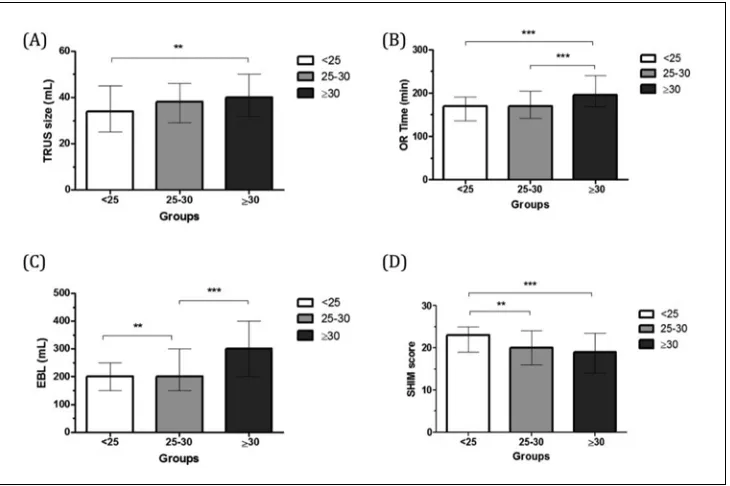
outcomes stratified according to BMI (<25, 25- 30, >30) was performed on a cohort of 541 patients who underwent RARP and were followed post-operatively for 2 years. Data was prospectively collected and included oncological parameters, continence and sexual function variables and post-operative complications.
Results: When compared to overweight (BMI 25-30) or obese patients
(BMI 30-35), patients with BMIs <25 had lower estimated blood losses (p<0.001) and shorter OR times (p<0.001). No statistically significant differences were noted with regard to operative and post-operative com-plications within the first month of follow-up, oncopathologic outcomes and biochemical recurrence (Fig. 1).
Conclusions: Overall, our results show that optimal body weight is
associ-ated with improved operative parameters and recovery of urinary conti-nence. Conversely, body weight did not influence oncological parameters. Therefore, RARP should not be contraindicated for overweight or obese patients that are otherwise appropriate surgical candidates.
MP-01.10
The incidence of treatment-related complications with contem-porary treatment for clinically-localized prostate cancer Wallis, Christopher J.1; Mahar, Alyson1; Cheung, Patrick2; Herschorn,
Sender1; Klotz, Laurence1; Al-Matar, Ashraf1; Kulkarni, Girish S.3; Lee,
Yuna4; Kodama, Ronald T.1; Narod, Steven A.5; Nam, Robert K.1 1Division of Urology, Sunnybrook Health Sciences Centre, University of
Toronto, Toronto, ON, Canada; 2Radiation Oncology, Sunnybrook Health
Sciences Centre, University of Toronto, Toronto, ON, Canada; 3Division
of Urology, University Health Network, University of Toronto, Toronto, ON, Canada; 4Medicine, St. Michael’s Hospital, University of Toronto,
Toronto, ON, Canada; 5Public Health Sciences, University of Toronto,
Toronto, ON, Canada
Introduction and Objective: Complications from the treatment of prostate
cancer are common and may have a significant impact over the course of a patient’s life. We sought to estimate the incidence of complications other than erectile dysfunction or urinary incontinence for patients treated for clinically localized prostate cancer.
Methods: Using the SEER-Medicare registry, we conducted a
population-based, retrospective cohort study of patients aged 65 to 79 years who underwent radical prostatectomy (open or minimally-invasive) or radio-therapy (brachyradio-therapy, or external beam) between January 1, 2001 and December 31, 2008. We assessed complications in four categories: 1) minimally invasive urologic procedures; 2) rectal-anal procedures; 3) hospital admissions; and 4) major surgical procedures.
Results: Among 60,476 men, 14,492 underwent primary surgery (with
or without post-operative radiation) and 45,984 underwent primary radiotherapy (with or without salvage surgery). After adjustment for age, comorbidity, rural residence, ethnicity, and marital status, patients who had radiation experienced a higher incidence of urologic procedures (rela-tive rate (RR)=1.25, 95% CI: 1.2-1.3, p<0.0001), of rectal-anal procedures (RR=1.4, 95% CI: 1.4-1.5, p<0.0001) and of hospital admissions (RR=1.8, 95% CI: 1.8-1.9, p<0.0001), compared to patients who had surgery, but irradiated patients experienced a lower rate of major surgical procedures (RR=0.9, 95% CI: 0.8-0.9, p<0.0001). For both treatment groups, the rate of complications peaked within two years of treatment, but continued at a steady rate for the next 10 years.
Conclusions: Complications are common following prostate cancer
ment and occur many years after treatment. The type of primary treat-ment (radiotherapy versus prostatectomy) is an important predictor of complication rates for all categories.
MP-01.11
Transurethral (TURP) biopsy of suspected anterior prostate can-cers identified by MRI: Pilot study of a novel technique Dason, Shawn R.1; Allard, Christopher B.1; Shayegan, Bobby1 1Division of Urology, McMaster University, Hamilton, ON, Canada
Introduction and Objectives: Anterior prostate tumors are difficult to
diagnose with standard transrectal ultrasound (TRUS) biopsy. Magnetic resonance imaging (MRI) has shown some promise in identifying anterior tumors. Biopsy of MRI identified lesions is still necessary prior to treat-ment. In this prospective study we describe a novel technique of cogni-tively directed transurethral resection of the prostate (TURP) to sample suspicious anterior lesions identified on MRI.
Methods: Patients were prospectively included in this study from October
2012 to December 2014 if they had an abnormality identified by MRI as suspicious for an anterior prostate cancer and underwent TURP for biopsy of the MRI-identified lesion. All patients had initially undergone MRI for persistent clinical suspicion that they had prostate cancer despite 1 or more prior negative biopsies. Preoperatively, MRI images were reviewed and the orientation of the suspicious lesion relative to the urethra was noted in 3-dimensions. TURP biopsy followed our institutional TURP clinical pathway. The primary outcome of this study was the detection rate of clinically significant prostate cancer (Gleason 4 in biopsy specimen). Secondary outcomes included biopsy complications, including 30-day readmissions, emergency room visits, transfusions, or positive bacterial culture results. Details regarding subsequent treatment were also recorded including final pathologic stage for those having radical prostatectomy as well as whether there was any additional difficulty perceived to be related to the TURP biopsy.
Results: A total of 15 consecutive patients were enrolled in this study.
Patients had a median PSA of 12 ng/mL and a median of 2 prior nega-tive TRUS biopsies. Mean specimen weight was 2 grams. Twelve (12/15, 80%) patients had clinically significant prostate cancer. One patient was readmitted for self-limiting hematuria. Five patients ultimately underwent robotically-assisted laparoscopic radical prostatectomy which was not felt to be more difficult and confirmed clinically significant disease.
Conclusions: This pilot study demonstrates that cognitively directed TURP
biopsy for MRI-identified anterior prostate lesions is feasible and has an excellent pickup rate for clinically significant cancer.
MP-01.12
The role of prostate cancer antigen 3 test and multi-parametric prostatic magnetic resonance imaging for diagnosis of prostate cancer in patient with multiple prior negative biopsies Alkasab, Thamir1; Hamilton, Robert J.1; Kulkarni, Girish S.1; Finelli,
Antonio1; Zlotta, Alexandre1; Jewett, Michael1; Fleshner, Neil1
1Uro-oncology, Princess Margaret Cancer Research Centre, Toronto, ON,
Canada
Introduction: Clinicians continue to be perplexed in how to best manage
patients with multiple negative biopsies and worrisome PSA parameters. The Prostate cancer antigen 3 (PCA3) gene test as well as multi-parametric prostatic MRI have been considered as promising adjunctive tests in this clinical scenario. We aimed to evaluate the role of multi-parametric pros-tatic MRI and PCA3 test as additional diagnostic tools for improving the accuracy of the prostate biopsies patients with increased PSA levels and more than two previous negative biopsies.
Methods: Eighty patients with at least 2 prior negative biopsies and
wor-risome PSA changes were evaluated with urinary PCA3, multi-parametric prostate MRI, and a repeat biopsy in order to rule out missed cancer. Overall cancer detection and test performance was evaluated.
Results: Among this cohort, average patients age was 63 years, mean PSA
was 7.3 ng/nm (0.9 – 60), and greater than 3 biopsies was performed in 55%. PCA-3 testing was abnormal in 45% and suspicious MRI was noted in 51% (Pirads 3-5). A histological diagnosis of prostate cancer of subsequent biopsy was found in 33 patients of 80 cases (41.7%). Gleason score distribution was 69%, 23%, and 7% for Gleason 6, 7, and 8 respec-tively. While no prostate cancer was found in 47 patients (58.3%). The sensitivity and specificity of MRI were 69.8% and 56.1% respectively (positive predictive value of 65.1%, negative predictive value of 35.7%). For PCA3, the sensitivity and specificity were 61% and 71%, respec-tively (positive predictive value of 58.5%, negative predictive value of 63%). When comparing both test together, (20/33) 40% had both PCA3 and MRI positive. MRI alone missed 55% and PCA-3 alone missed only 26%. In group of 47 patient in which prostate cancer was not detected by subsequent biopsy, both tests were falsely positive in (8/47)17% and MRI alone was positive in (10/47) 21.3% while PCA3 alone was positive in (18/47) 38.2%.
Conclusions: In patients with more than two previous negative biopsy
and persistently elevated PSA levels, our results highlight the limitation of these novel diagnostic aids among this challenging group of patients and clinicians should be aware that neither PCA-3 test or multi-parametric prostate MRI are considered a good sensitive diagnostic tools to better detect hidden prostate cancer in this challenging group of patients.
UP-01.01
Utility of preoperative magnetic resonance imaging in the pre-diction of prostate adenocarcinoma disease burden: An initial single-centre experience
Bjazevic, Jennifer1; Kaler, Kamaljot1; Rittberg, Rebekah1; Saranchuk, Jeffery
W.1; Drachenberg, Darrel E.1
1Section of Urology, University of Manitoba, Winnipeg, MB, Canada
Introduction and Objectives: Magnetic resonance imaging (MRI) of
the prostate is increasingly utilized prior to radical prostatectomy (RP). However, the predictive ability of MRI to detect disease burden varies significantly in the literature. Following its introduction at a single institu-tion, we evaluated the capability of MRI to determine extent of disease.
Methods: Twenty-three initial, consecutive patients who underwent
multi-parametric MRI imaging prior to RP were retrospectively reviewed. All MRIs were reviewed and correlated with pathologic specimens. The sen-sitivity and specificity of MRI in predicting tumor location, extracapsular extension (ECE), seminal vesicle invasion (SVI), and lymphadenopathy was determined.
Results: Twenty-three patients with a median age, PSA, and Gleason score
with no evidence of lymphadenopathy on imaging had pathologically positive pelvic lymph nodes. MRI predicted four (16.7%) patients had SVI, and two (50%) of these patients had positive SVI on pathology. Comparatively, seven (29.2%) patients with no evidence of SVI on MRI had positive seminal vesicles on final pathological analysis. For SVI, MRI had a sensitivity and specificity of 22.2% and 86.7% respectively. Six (25.0%) patients had ECE present on MRI and five (83.3%) of these patients were subsequently confirmed to have ECE on pathology. In comparison, ten (41.7%) patients with no evidence of ECE on MRI had pathologically positive ECE. MRI imaging has a sensitivity of 33.3% and a specificity of 88.9% for predicting ECE.
Conclusions: Prostate MRI can provide valuable information for
treat-ment decisions and operative planning. However, the ability of MRI to accurately predict ECE, SVI, and lymphadenopathy remains limited in our cohort.
UP-01.02
Genitourinary infections and prostate cancer: Results from a North-American case-control study PROtEuS (Prostate Cancer and Environment Study)
Boehm, Katharina2; Meskawi, Malek1; Valdivieso, Roger1; Larcher,
Alessandro3; Sun, Maxine1; Graefen, Markus2; Saad, Fred1; Parent,
Marie-Élise4; Karakiewicz, Pierre I.1
1Cancer Prognostics and Health Outcomes Unit, Centre hospitalier de
l’Université de Montréal, Montreal, QC, Canada; 2Urology, Martini-Klinik
am Universitätsklinikum Hamburg-Eppendorf, Hamburg, Germany;
3Urology, IRCCS Ospedale San Raffaele, Milan, Italy; 4Epidemiology,
INRS-Institut Armand-Frappier, Laval, QC, Canada
Objectives: To examine the potential association between presence of
history of genitourinary infection and prostate cancer (PCa) at needle biopsy we relied on a population-based case-control study (PROtEuS).
Methods: We used categorical analyses and multivariable logistic
regres-sion to test associations.
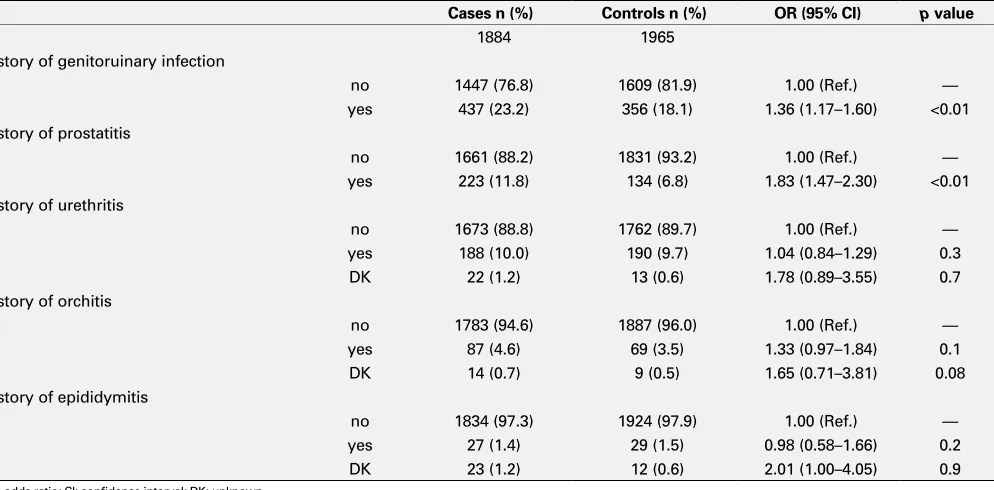
Results: After multivariable adjustment, prostatitis increased the risk of
PCa at biopsy (OR 1.8; 95% CI 1.4-2.3; p<0.001), but not urethritis (OR
1.1; 95% CI 0.8-1.3; p=0.7), orchitis (OR 1.3; 95% CI 0.9-1.8; p=0.1) or epididymitis (OR 1.0; 95% CI 0.6-1.7; p=0.9) (Table 1). In PSA and DRE-testing exposed individuals, history of prostatitis was also associated with PCa at biopsy (OR 1.5; 95% CI 1.2-1.9; p=0.002). An increased risk (OR 2.9; 95% CI 1.9-4.4; p<0.001) was recorded in patients without BPH-history vs. a protective effect (OR 0.7; 95% CI 0.5-0.9; p=0.04) was recorded in those with BPH-history.
Conclusions: In summary, we demonstrated an elevated risk of PCa in
patients with history of prostatitis but not urethritis, orchitis or epididymi-tis. BPH-history distinguished between even more elevated risk of PCa in presence of prostatitis, when BPH-history is absent vs. protective effect, when such history is confirmed. These considerations should be used in clinical risk stratification of individuals in whom the risk of PCa is pertinent.
UP-01.03
Severe urinary adverse events after high vs. low dose rate pros-tate brachytherapy: A population-based analysis
Liberman, Daniel2; Jarosek, Stephanie L.2; Virnig, Beth A.1; Elliott, Sean P.2 1Department of Urology, University of Minnesota Medical School,
Minneapolis, MN, United States; 2Division of Health Policy and
Management, School of Public Health, University of Minnesota, Minneapolis, MN, United States
Introduction and Objectives: We have shown that at 10 years
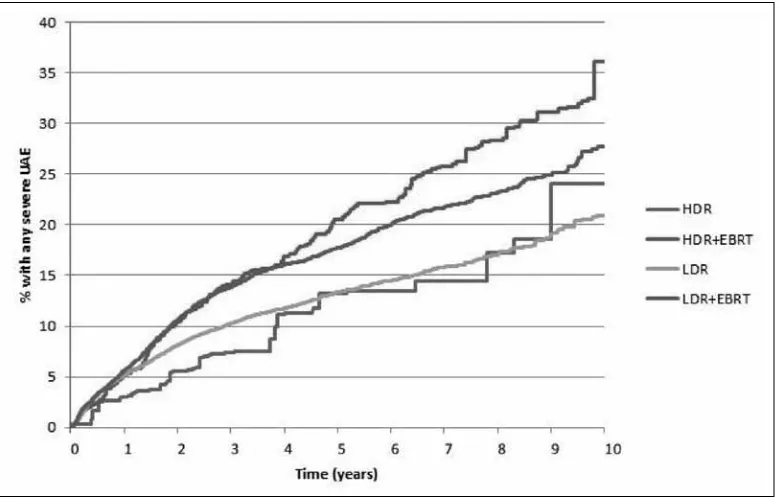
post-prostate cancer treatment, severe urinary adverse events (UAEs) occur in 20% after brachytherapy (BT) and 28% after BT plus external beam radiotherapy (BT+EBRT). Severe UAEs include surgical treatment of ure-thral stricture, urinary incontinence and radiation cystitis. Our objective is to compare the incidence of UAEs after low dose rate BT (LDR) and high dose rate BT (HDR) as well as LDR+EBRT and HDR+EBRT.
Methods: From a SEER-Medicare cohort of men aged ≥66 years diag-nosed with non-metastatic prostate cancer (1998- 2007) we identified men treated with LDR (n=12801), HDR (n=685), LDR+EBRT (8518) and HDR+EBRT (n=2392). The populations were balanced by propensity weighting and the Kaplan-Meier incidence of severe UAEs was
com-Table 1. UP-01.02. Association between history of any genitourinary infection, prostatitis, urethritis, orchitis, epididymitis and prostate cancer at needle biopsy, results of PROtEuS 2005–2009
Cases n (%) Controls n (%) OR (95% CI) p value
1884 1965
History of genitoruinary infection
no 1447 (76.8) 1609 (81.9) 1.00 (Ref.) —
yes 437 (23.2) 356 (18.1) 1.36 (1.17–1.60) <0.01 History of prostatitis
no 1661 (88.2) 1831 (93.2) 1.00 (Ref.) —
yes 223 (11.8) 134 (6.8) 1.83 (1.47–2.30) <0.01 History of urethritis
no 1673 (88.8) 1762 (89.7) 1.00 (Ref.) —
yes 188 (10.0) 190 (9.7) 1.04 (0.84–1.29) 0.3
DK 22 (1.2) 13 (0.6) 1.78 (0.89–3.55) 0.7
History of orchitis
no 1783 (94.6) 1887 (96.0) 1.00 (Ref.) —
yes 87 (4.6) 69 (3.5) 1.33 (0.97–1.84) 0.1
DK 14 (0.7) 9 (0.5) 1.65 (0.71–3.81) 0.08
History of epididymitis
no 1834 (97.3) 1924 (97.9) 1.00 (Ref.) —
yes 27 (1.4) 29 (1.5) 0.98 (0.58–1.66) 0.2
DK 23 (1.2) 12 (0.6) 2.01 (1.00–4.05) 0.9
pared. Propensity-weighted Cox proportional hazards models were used to compare the adjusted hazard of UAEs.
Results: Median follow-up was 4.3 years. At 8 years, the propensity
weighted cumulative UAE incidence was highest after HDR+EBRT (28%) and lowest after LDR (17%; see Fig. 1). Compared to LDR as the reference, the adjusted hazard of severe UAEs was not elevated with HDR (HR 0.9; CI 0.6-1.4). HDR+EBRT (HR 1.6; CI 1.4-1.8) and LDR+EBRT (HR 1.4, CI 1.3-1.5) were associated with a statistically significant increased risk of severe UAEs compared to LDR demonstrated that when compared to LDR; but HDR+EBRT and LDR+EBRT were not different from each other.
Conclusions: There is no difference in severe UAE risk between HDR
vs. LDR or between HDR+EBRT vs. LDR+EBRT. However, combination radiotherapy (either HDR+EBRT or LDR+EBRT) increases the risk of severe UAEs compared to HDR alone or LDR alone, and whereas only 40% of all LDR is delivered as LDR+EBRT, 78% of all HDR is delivered as HDR+EBRT. This tendency to add EBRT to HDR increases the risk of severe UAEs.
UP-01.04
Skeletal-related events impact significantly the health-related quality of life of chemo-naive men with metastatic castration-resistant prostate cancer
Saad, Fred1; Ivanescu, Cristina2; Phung, De3; Loriot, Yohann4; Mansbach,
Hank5; Beer, Tomasz M.6; Tombal, Bertrand7; Holmstrom, Stefan3 1Urology, University of Montreal, Montreal, QC, Canada; 2Consulting,
Quintiles, Hoofddorp, Netherlands; 3Astellas Pharma Europe, Leiden,
Netherlands; 4Institut Gustave Roussy, Villejuif, France; 5Medivation Inc.,
San Francisco, CA, United States; 6Oregon Health & Science University,
Portland, OR, United States; 7Cliniques Universitaires Saint-Luc, Brussels,
Belgium
Introduction and Objectives: Metastatic castration-resistant prostate
can-cer (mCRPC) patients (pts) are at risk of skeletal-related events (SREs), defined as pathologic bone fracture (fracture), spinal cord compression (compression), and need for radiotherapy or surgery to bone (radiotherapy/ surgery). We examined clinical relevance of SREs on health-related quality of life (HRQoL) mCRPC pts.
Methods: We analysed data from pts experiencing SREs (n=587;
irrespec-tive of treatment) in PREVAIL, a phase 3 trial of enzalutamide in 1717 asymptomatic/mildly symptomatic chemotherapy-naive mCRPC pts. For pts with multiple SREs, only the first event was included. HRQoL was assessed using the FACT-P and EQ-5D. Impact of first SRE on HRQoL was evaluated as follows: (1) estimate each pt’s longitudinal HRQoL trajectory before first SRE using repeated measures analysis; (2) calculate how SREs affect HRQoL changes.
Results: We found statistically significant declines in utility scores after all
3 types of SREs, with an adjusted mean change of -0.06 (95% confidence interval [CI] -0.10, -0.02) for radiotherapy/surgery (n=107), -0.20 (95% CI -0.36, -0.04) for fractures (n=31) and -0.24 (95% CI -0.39, -0.08) for compression (n=23). Fractures and compression affected a number of FACT-P domains and total score to a clinically meaningful and statisti-cally significant extent. Compression had the broadest negative impact, affecting 7 of 9 FACT-P domains and inducing a mean decrease in FACT-P total score of -16.96 (95% CI -26.47, -7.44). Radiotherapy/surgery was associated with a statistically significant decline in physical (-1.28; 95% CI -2.06, -0.50) and functional well-being scores (-1.51; 95% CI -2.37, -0.64), and improvement in social well-being score (1.26; 95% CI 0.60, 1.91).
Conclusions: SREs were significantly associated with poorer HRQoL in
this pt population. Therapy reducing or delaying occurrence of SREs may slow HRQoL decline in mCRPC pts.
UP-01.05
Snapshot of active surveillance trends for prostate cancer: A cross-sectional study results by province in Canada
Timilshina, Narhari3; Alibhai, Shabbir3; Ouellet, Veronique1; Delvoye,
Nathalie1; Drachenberg, Darrel E.2; Finelli, Antonio3; Jammal,
Marie-Paule6; Lapointe, Helene7; Li, Kathy3; Lynch, Kenny4; Mes-Masson,
Anne-Marie1; Paradis, Jean Benoit7; Sitarik, Paula2; So, Alan4; Sutcliffe, Simon5;
Saad, Fred1
1Centre de recherche du Centre hospitalier de l’Université de Montréal,
Montreal, QC, Canada; 2Manitoba Prostate Center, Winnipeg, MB,
Canada; 3University Health Network, Toronto, ON, Canada; 4Vancouver
Prostate Centre, Vancouver, BC, Canada; 5British Columbia Cancer
Agency, Vancouver, BC, Canada; 6Centre de Santé et des Services Sociaux
de Laval, Laval, QC, Canada; 7Centre de Santé et des Services Sociaux
de Chicoutimi, Chicoutimi, QC, Canada
Introduction and Objectives: In active surveillance (AS), practitioners
delay curative treatment in low risk patients until there is evidence of dis-ease progression, at which time active treatment is initiated.Although AS appears to be increasing, the uptake in Canada remains largely unknown. The Canadian Prostate Cancer Biomarker Network (CPCBN) is focused on the identification of markers that predict risk of progression in order to inform clinical management decisions, and in particular, AS.In addi-tion, the CPCBN is interested in gathering Canadian statistics regarding the use of AS in low risk prostate cancer.
Methods: We used the database interrogation approach in four different
provinces (BC, QC, MB and ON) to evaluate the use of AS in men who underwent a biopsy in 2010.Clinical and pathological information was collected for a period of 12 months following the last biopsy in 2010. Cases with missing Gleason grade and stage were excluded.Eligibility for AS and immediate treatment trends by region were compared using a chi-square test.
Results: Of 941 patients, 239 (25.4%) were prevalent and 702 (74.6%)
were incident cases while 90 (57 incident and 33 prevalent) were excluded due to missing data. In our study, 645 patients were eligible for AS with a median Charlson score of 0, of whom over two-thirds (439, 68.1%) chose AS at diagnosis.Patients undergoing AS varied in mean age by region from 61.8 to 65.4 years (p=0.007).There were statistically significant differences in the use of AS by region (63.1% in BC, 100% in MB, 72.9% in MontrealQC, 43.3% in ChicoutimiQC, 57.5% in LavalQC, p=0.001). 105 (16.3%) were re-biopsied within one year and rate was higher in LavalQC (29.8%) compared to other regions (24.4% in MB, 20% in BC, 11.6% in MontrealQC, and 5% in ChicoutimiQC).Overall 26.4% of patients displayed progression on second biopsy (19.1% grade and 20.9% volume).Overall progression by region varied from 0 to 44.4%. Similarly, progression of grade ranged from 0 to 50.0% and volume from 0 to 33.3% by region.
Conclusions: These results suggest AS is commonly practiced across
Canada, although there are significant differences in practice patterns between and within provinces.More in-depth analyses will be required to understand the root causes of these differences, and also to determine whether AS uptake is changing over time.
UP-01.06
Capturing men’s perspectives about active surveillance or describing perspectives of prostate cancer patients about active surveillance
Fitch, Margaret2; Pang, Kittie 2; Ouellet, Veronique1; Mes-Masson,
Anne-Marie1; Chevalier, Simone 3; Drachenberg, Darrel E.4; Finelli, Antonio5;
Hamel, Lucie3; Li, Kathy5; Palmer, Maureen6; Sitarik, Paula4; Sutcliffe,
Simon7; So, Alan6; Tanguay, Simon3; Saad, Fred1
1Centre de recherche du centre hospitalier de l’Université de Montréal,
Montreal, QC, Canada; 2Sunnybrook Health Sciences Centre, Toronto,
ON, Canada; 3McGill University Health Centre, Montreal, QC, Canada; 4Manitoba Prostate Centre, Winnipeg, MB, Canada; 5University Health
Network, Toronto, ON, Canada; 6Vancouver Prostate Centre, Vancouver,
BC, Canada; 7British Columbia Cancer Agency, Vancouver, BC, Canada
Introduction and Objectives: With the specification of biomarkers that
will reliably identify low risk for progression in prostate cancer, men face a decision about being monitored through an active surveillance (AS) approach rather than undergoing surgical or radiation treatment at a point in time. This approach runs contrary to the traditional message of undergoing treatment as soon as possible following a cancer diagnosis. A deeper understanding of men’s perspectives about AS will help to identify factors that influence their decision about undergoing AS and assist health professionals in having conversations about this option for follow-up care.
Methods: Focus group interviews (n=7) were held in several Canadian cities
with men (N=56) who had been diagnosed with prostate cancer and had been eligible for AS. The men’s viewpoints were captured regarding their understanding of AS, the factors that influenced their decision to engage in
AS, and their experience with the approach. A content and theme analysis was performed on the verbatim transcripts from the sessions.
Results: The majority of the participants were on AS at the time of the
session. In those choosing AS, many had difficulty describing the differ-ence between AS and watchful waiting. However, all described the notion that their disease was not “large enough” to require treatment. They could wait for the disease to progress before they would need surgery or radia-tion or other treatment. By waiting, they could avoid the side effects of the treatments and continue with their current quality of life. They felt comfortable about postponing treatment until it was really necessary because of the close monitoring they were undergoing and the idea that they could easily receive treatment if needed. The conversation with the doctor, and how AS was explained, was a key influence for the men in their decision. Other important factors in choosing or not AS included lack of information about treatment options, low confidence in the health system, personality, experiences of others with prostate cancer, personal perspectives on quality of life, and attitudes expressed by others.
Conclusions: AS is a relatively new approach for the care of men with
low risk prostate cancer. However, men need to have clear explanations to make informed decisions about engaging in this approach.
UP-01.07
MIM Symphony software registration can improve the diagnostic accuracy of MRI-targeted transperineal prostate biopsies Akhter, Waseem1; Khan, Mohammad Jamal M. J.1; Moghul, Masood1;
Karim, Omer O.1; Laniado, Marc M.1
1Urology, Wexham Park Hospital, Slough, United Kingdom
Introduction: The MIM Symphony software registration system offers an
alternative technique among other MRI/TRUS fusion systems to achieve high diagnostic yield. It has novel features that increase the accuracy of MRI-targeted transperineal biopsies compared to standard visual or soft-ware-registration fusion systems. These features include (1) a virtual rectal probe that corrects for the rotation of the prostate when hips are flexed at the time of biopsy compared to the supine position used for multiparam-eteric MRI (mpMRI) (2) a soft water-filled balloon to cover the transrectal probe that maintains the prostate shape unchanged for transperineal biop-sies compared to the deformation that occurs when a transrectal probe is used to press against the prostate on transrectal MRI/USS fusion biopsies.
Aim: To determine the utility of MRI targeted biopsies using the MIMS
software registration system.
Methods: This prospective study included 26 patients presenting to a
single consultant urologist. mpMRI scans performed on all patients prior to prostate biopsy procedure on a 3Tesla MR Siemens MRI scanner. MRI lesions were graded using a Likert scale based on the Pi-RADS system by specialist uro-radiologists. The combination of Gleason score 6 & maxi-mum cancer core length of 3 mm was considered insignificant cancer; significant cancer was defined as primary Gleason pattern 4 or maximum cancer core length >/= 6 mm.
Results: There were 26 patients with characteristics (mean) age 62 years,
mean/ median PSA 6.8/6.5 ug/L, mean/median prostate volume 46/40 ml,mean/median PSA density 0.17/0.16 ng/ml/cm3, 17% free PSA normal:abnormal feel (69%:31%), Caucasian 92%: 1 Asian, 1 African patient, 15% family history of prostate cancer. The results are shown in the table by PIRAD score. Seven patients underwent radical prostatectomy. Rather than upgrading, there was downgrading of 3 of the 7 men from higher to lower Gleason scores (4+3 to 3+4).
Conclusion: The MIM Symphony software system has soft water filled
UP-01.08
A prospective cohort of patients on active surveillance for low-risk prostate cancer in a community setting
Ray, A. Andrew1; Foell, Kirsten A.1; Hartsburg, Cory J.1; Zadra, Joseph1;
Iocca, Angelo J.1
1Division of Urology, Royal Victoria Regional Health Centre, Barrie, ON,
Canada
Introduction and Objectives: Prostate cancer (CaP) is common, affecting
1 in 7 men in their lifetime. However, overdiagnosis and overtreatment have plagued treatment. Current data show that 91% of new cases of CaP are clinically localized and 5-yr survival approaches 100%. With growing evidence that patients with low risk CaP do not require treat-ment, active surveillance (AS) has now risen to fill the treatment gap. In fact, AS has become the preferred treatment option for men with low-risk CaP. Our purpose was to examine the clinical data for all patients on AS in Barrie, ON.
Methods: A prospective database has existed for all patients in Barrie, ON
undergoing transrectal ultrasound (TRUS) guided prostate biopsies since July 1, 2010. We reviewed data from all biopsies conducted between July 1, 2010 and August 1, 2013. Analysis was limited to patients with histologically proven CaP with a minimum of one additional follow-up TRUS-guided prostate biopsy after 1-year. Rates of disease progression and treatment recommendations were tabulated. Progression was defined as an increase in either Gleason Score or burden of CaP present. Curative treatment was offered to all patients who progressed.
Results: One-year follow-up was available for 119 patients with CaP in
our AS program. The mean age of patients on AS was 66.0 years and the mean PSA at diagnosis was 6.40 ng/mL. Repeat prostate biopsy at 1-year failed to demonstrate CaP in 33 cases (27.7%). The rate of disease progres-sion at 1 year of follow-up was 29.4% (35/119). Of those patients who experienced disease progression, 25 (71.4%) chose treatment with cura-tive intent (either radical prostatectomy or radiation), while 10 (28.6%) chose not to pursue any treatment. Two additional patients chose to have treatment rather that continue on AS. Factors that were found to be predic-tive of progression on AS were older age at diagnosis (p=0.04), smaller prostate size (p=0.03), presence of ASAP (p=0.04) and ≥2 cores involved at baseline biopsy (p=0.02).
Conclusions: Our results are similar to those reported by the largest cancer
centres. Furthermore, we report definite risk factors for disease progression on repeat prostate biopsy. This data will help to improve risk-stratification of patients on AS in the future.
UP-01.09
PSA screening and prediction of high grade prostate cancer in a cohort of New Brunswick patients
Marzouk, Karim1; Whelan, Thomas F.2; Hasan, Tariqul 3; McBriarty,
Heather2
1Urology, Dalhousie University, Halifax, NS, Canada; 2Urology, Dalhousie
University, Saint John, NB, Canada; 3Mathematics and Statistics, University
of New Brunswick, Fredericton, NB, Canada
Background: Prostate cancer screening is a controversial and widely
debated topic. Practice patterns vary among primary care physicians, with no overall consensus. Recently the Canadian Task Force on Preventative Health (CTFPHC) has published guidelines recommending against regular
prostate cancer screening. The Urological community in Canada believes that abandoning screening will lead to an increase in the number of undetected clinically significant prostate cancers, and ultimately prostate cancer related deaths. It is our belief that PSA can be used as a screening tool to aid in detection of high-grade prostate cancer (HGPca).
Methods: This study evaluated men referred to a single tertiary care center
in Saint John, NB for consideration of prostate biopsies. Using a prospec-tively gathered database, we identified all males between the ages of 55-70 who were assessed between 2005-2010. The primary outcome was the detection of high grade prostate cancer (Gleason ≥ 8). Collected data included age, PSA values, DRE findings, TRUS visible lesion and family history. All patients reported to be taking 5ARI’s (Finasteride & Dutasteride) were excluded from analysis. Using logistic regression analysis we identi-fied the significance of these variables in their ability to predict HGPca.
Results: 1356 patients were identified in the appropriate age range, of
which 482 (35%) were diagnosed with any grade prostate cancer. 38 (2.8%) were found to have HGPca. The median age of diagnosis of HGPca was 68, with a median PSA of 8.80 ng/ml. Logistic regression analy-sis revealed that PSA was a significant predictor of high grade disease. Levels ≥ 20 ng/ml predicted HGPca with an Odds Ratio of 10.3, (3.02, 35.84; 95%CI). Chi-Square analysis revealed that any PSA > 4.0 was also significantly associated with HGPca (p=0.002). Abnormal DRE was also significantly associated with HGPca at the 90% CI level, OR=2.02 (1.04, 3.92, 90%CI). Age, family history, TRUS visible lesions were not significantly associated with HGPca.
Conclusions: In our cohort of patients from New Brunswick, PSA >20ng/
ml was associated with the highest odds of predicting HGPca. Both abnor-mal PSA (>4.0 ng/ml) and abnorabnor-mal DRE were significantly associated with HGPca. Thus, despite recent CTFPHC recommendations, PSA screen-ing and DRE exams can still be used to aid in detection of clinically relevant HGPca.
UP-01.10
Implications of recent prostate cancer guidelines and initiatives on clinical practise at a regional community hospital
Webster, Todd M.2; Newell, Ken1
1Pathology, Grey Bruce Health Services, Owen Sound, ON, Canada; 2Surgery, Grey Bruce Health Services, Owen Sound, ON, Canada
Introduction: Recently the Canadian task for on Preventative Health Care
(CTFPHC) produced a guideline on PSA screening consistent with the 2012 USPSTF. Their recommendation is not to screen men of any age for prostate cancer despite some evidence that screening may improve mortality. Ironically, just prior to these guidelines being released we had completed work to establish a rapid access clinic or prostate cancer diagnostic assessment pathway (DAP). Also, there has been an increased tendency to manage men with low grade prostate cancer with active surveillance (AS).
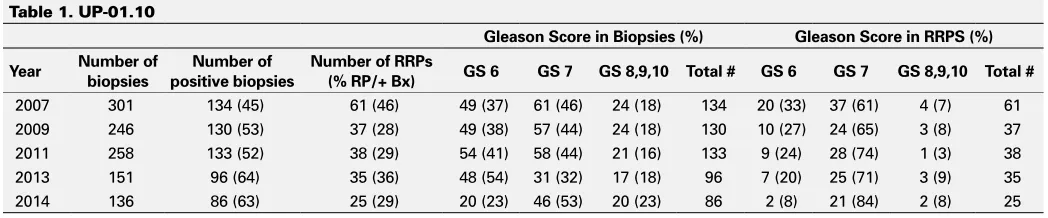
Methods: We reviewed our database to determine the number of biopsies
and prostatectomies performed at our institution in 2007,2009,2011,2013, and 2014 (Table 1). We analysed the data to determine total number of biopsies performed, positive biopsy rate, and total number of prostatec-tomies performed. The results were categorized by grade. We reviewed the literature to compare our results to published values and reflected on recent guidelines to assess implications for future community practice.
Table 1. UP-01.10
Gleason Score in Biopsies (%) Gleason Score in RRPS (%) Year Number of biopsies positive biopsiesNumber of Number of RRPs (% RP/+ Bx) GS 6 GS 7 GS 8,9,10 Total # GS 6 GS 7 GS 8,9,10 Total #
Results: Refer to Table 1.
Conclusions: The number of men undergoing TRUS biopsy is decreasing
while the positive detection rate is rising. This may be due to decreased screening and referral or increased selectivity of the Urology group. The number of prostatectomies performed at our institution is also decreas-ing with very few patients undergodecreas-ing surgery for low grade disease, possibly due to the increased role of active surveillance. Our prostate cancer DAP can play an active role in prospectively monitoring referral volumes, indication and number of biopsies performed, positive detection rate and treatment plan.
UP-01.11
Impact of posterior vesicourethral reconstruction on return to urinary continence following robot-assisted radical prostatec-tomy: A randomized controlled trial
Wang, Yuding1; Hoogenes, Jen1; Wu, Christopher H.1; Shayegan, Bobby1 1Department of Surgery, Division of Urology, McMaster University,
Hamilton, ON, Canada
Introduction and Objectives: Urinary incontinence is a known
complica-tion following radical prostatectomy, and often has a negative impact on patient quality of life. While 12-month continence rates are reportedly between 84 – 97%, few patients are continent in the early post-operative period. Few reports have suggested some improvement in early return to continence using the posterior reconstruction of the musculofascial plate (Rocco stitch), over conventional anastomosis. To date, no randomized trial has compared these approaches. Therefore, we are conducting a single-blind randomized controlled trial to compare these techniques during robot-assisted radical prostatectomy (RARP), with time to return to continence as the primary outcome measure. We hypothesize that the Rocco stitch will be superior in improving early return to continence.
Methods: Patients with clinically localized prostate cancer scheduled
for RARP are consecutively recruited in clinic and randomly allocated to either the Rocco stitch or conventional anastomosis group. Patients are blinded to allocation status, and the surgeon is notified immediately before the case. Participants complete the validated EPIC-26 Short Form at baseline and at 2, 3, 4, 6, 8, and 12 months post-operatively. The trial is powered to detect a significant improvement in continence of 40-75% at 3 months with an χ level of 0.05 at 80% power with 65 patients per group. We will recruit 150 patients to account for attrition.
Results: We have enrolled 103 patients to date, with some data currently
available up to the 8-month follow-up. At months 2, 3, and 4, use of pads for the control group and intervention group at 0-1 per day was 24% and 39%, 42% and 64%, and 64% and 90%, respectively, indicating a trend toward early total urinary control in the Rocco stich group.
Conclusions: Interim analysis supports the positive impact of the Rocco
stitch technique compared to conventional urethrovesical anastomosis in early return to continence following RARP.
UP-01.12
Fate of prostate cancer antigen 3 (PCA3) levels more than 100: Does inflammation play a role?
Alkasab, Thamir1; Hamilton, Robert J.1; Kulkarni, Girish S.1; Finelli,
Antonio1; Zlotta, Alexandre1; Jewett, Michael1; Fleshner, Neil1
1Uro-oncology, Princess Margaret Cancer Research Centre, Toronto, ON,
Canada
Introduction: Increased PCA3 corresponds to an increased probability
of a positive biopsy and has diagnostic value in men with a previous negative biopsy and an elevated PSA level. In the setting of high level PCA3 (>100), cancer specificity of the urinary PCA3 test is purported to be maintained in the face of prostatitis. We aimed to analyze the impact of PCA3 ratio >100 in post-prostatic massage urine in the clinical management of patients with abnormal PSA and in those with already known disease (active surveillance), re-evaluating its diagnostic ability and predictive value of tumor aggressiveness.
Methods: We analyzed the fate of thirty nine patients with PCA3 ratio >
100 and corresponding biopsy in an observational, prospective, single center study of patients with suspected prostate cancer diagnosis who are candidates for biopsy and in patients on active surveillance. Thirty of these patients had a subsequent prostate biopsy within 1 year of the PCA3 results and 9 of them were already on AS. Multi-parametric prostatic magnetic resonance imaging of the prostate to rule out “missed” cancers at biopsy was performed in 92 % of these patients.
Results: Of the thirty nine patients, 63% had prostate cancer of which
45% were high grade. Among patients without cancer at biopsy, 75% had demonstrated acute inflammation at biopsy. The sensitivity and specificity of high PCA3 in our cohort is 62% and 39 % respectively. The mean age, PSA and PCA3 ratio in our cohort were 66, 7.6, and 118 respectively. From the 9 patients on AS, 22% showed either upgrade or upstage on subsequent prostate biopsy while 45% of them showed acute inflamma-tion in the subsequent biopsy without any upgrading or upstaging. The positive predicting value for PCA3 > 100 was only 62%.
Conclusions: Despite prior evidence suggesting that inflammation does