R E S E A R C H
Open Access
Context-aware radio resource management
below 6 GHz for enabling dynamic channel
assignment in the 5G era
Ioannis-Prodromos Belikaidis
1*, Stavroula Vassaki
1, Andreas Georgakopoulos
1, Aristotelis Margaris
1,
Federico Miatton
2, Uwe Herzog
3, Kostas Tsagkaris
1and Panagiotis Demestichas
4Abstract
Heterogeneous networks constitute a promising solution to the emerging challenges of 5G networks. According to the specific network architecture, a macro-cell base station (MBS) shares the same spectral resources with a number of small cell base stations (SBSs), resulting in increased co-channel interference (CCI). The efficient management of CCI has been studied extensively in the literature and various dynamic channel assignment (DCA) schemes have been proposed. However, the majority of these schemes consider a uniform approach for the users without taking into account the different quality requirements of each application. In this work, we propose an algorithm for enabling dynamic channel assignment in the 5G era that receives information about the interference and QoS levels and dynamically assigns the best channel. This algorithm is compared to state-of-the-art channel assignment algorithm. Results show an increase of performance, e.g., in terms of throughput and air interface latency. Finally, potential challenges and way forward are also discussed.
Keywords:Dynamic channel assignment, Channel segregation, Quality of service, Heterogeneous networks, 5G
1 Introduction
5G is characterized by the challenges of rapid growth in mobile connections and traffic volume [1, 2]. To address these challenges, the European project SPEED-5G (standing for quality of service provision and capacity expansion through extended-DSA for 5G) focuses on the efficient exploitation of wireless technologies so as to provide higher capacity along with the ultra-densification of cellular technology [3]. Under the frame-work of SPEED-5G, novel techniques for optimizing spectrum utilization will be developed, following three main dimensions: (i) ultra-densification through small cells, (ii) load balancing across available spectrum, and (iii) exploitation of resources across different technolo-gies. Considering the specific three-dimensional model, which is referred to as extended-dynamic spectrum allo-cation (eDSA), different spectrum bands and technolo-gies can be jointly managed so as to improve the users’ quality of experience (QoE). Hence, the ultimate goal of
SPEED-5G boils down to the development of a dynamic radio resource management framework, including mech-anisms for interference control, coexistence of heteroge-neous networks, management of spectral resources in lightly licensed bands, and other smart resource alloca-tion schemes. It is worth menalloca-tioning that this work is an extended version of the work published by the authors in [4, 5].
One of the main scenarios addressed in SPEED-5G is the case of heterogeneous networks where a massive de-ployment of small cells is put into place to deliver a uni-form broadband experience to the users, considering applications with different QoS requirements, such as high resolution multimedia streaming, gaming, video calling, and cloud services. A significant challenge in these networks is the efficient management of co-channel interference (CCI) that occurs due to proximity among the SBSs. Hence, given that the same channels are reused among SBSs due to the scarce spectral re-sources, CCI constitutes an important restrictive factor for the network performance.
* Correspondence:[email protected]
1WINGS ICT Solutions, Athens, Greece
Full list of author information is available at the end of the article
To confront this challenge, dynamic channel assign-ment (DCA) techniques have been proposed in the lit-erature, either considering a centralized approach [6] or a distributed one [7]. In particular, in [6], a centralized DCA technique considering a heterogeneous network that consists of small cells and macro cells is investi-gated based on the graph approach. It should be noted that the centralized approaches have several advantages in terms of performance. Nevertheless, the high com-putational complexity renders them inappropriate for the case of a heterogeneous network with a massive number of small cells. Therefore, distributed DCA techniques have gained the interest of many researchers as a solution that can be applied in future wireless net-works. An interesting approach of a distributed adap-tive channel allocation scheme known as channel segregation has been proposed in [8], to improve the spectrum efficiency in cellular networks. According to this approach, each cell creates a priority table with the available channels and tries to use the channels with the highest priority. Using this technique, an efficient stable channel re-use pattern is formed and the system performance is ameliorated. Due to the inherent advan-tages of this method, various DCA mechanisms based on channel segregation have been proposed by the re-search community [9–12]. However, the majority of the DCA schemes in the literature consider that the SBSs do not differentiate between traffic requests from user equipment (UE) applications, even if the applications do not have the same priority from the user point of view. Considering that in 5G networks, the traffic will range from high data rates to machine type traffic, cov-ering a variety of different applications, there is an emerging need for DCA schemes that provide differen-tiated QoS to each user, coping with the changing net-work conditions and the time-varying CCI. Based on this remark and the work presented in [9], we study a modified distributed channel segregation mechanism that takes into account the CCI and the QoS character-istics of the users. The proposed interference and QoS aware channel segregation-based DCA (IQ-CS-DCA) can be employed in order to use the spectral resources efficiently and at the same time prioritize the users with delay-constrained applications (such as video streaming).
The rest of the paper is organized as follows: In Sec-tion 2, a brief descripSec-tion of the scenarios considered in SPEED-5G is given, focusing on the scenario of interest. Section 3 summarizes the previous work in this research area, and Section 4 presents an algorithmic description of the proposed IQ-CS-DCA mechanism. Finally, Section 6 discusses the challenges that should be addressed in the mechanism and some future work whereas Section 7 concludes the paper.
2 Scenarios in SPEED-5G
SPEED-5G will mainly investigate indoor and indoor/ outdoor scenarios (around buildings) where capacity de-mands are the highest and where eDSA will exploit effi-ciently the co-existence of different technologies. More specifically, the selected scenarios are the following:
Massive IoT (Internet of Things): This scenario refers to the“low-end IoT”and covers devices with sporadic and delay-tolerant traffic, mainly composed of short packets. Among others, this category typic-ally includes wearable devices, smart meters, home automation devices, healthcare, non-critical smart cities sensors, and wireless sensor networks for en-vironmental monitoring.
Ultra-reliable communications: This scenario refers to a network that supports services with extreme requirements on availability and reliability.
Particularly, it is envisioned to have new applications based on M2M (machine-to-machine) and IoT communication with real-time constraints, enabling new functionalities for traffic safety, traffic efficiency, or mission-critical control for industrial and military applications.
High-speed mobility: This use case considers high-mobility environments (e.g., high-speed trains and cars on highways) where broadband communica-tions need to be achieved.
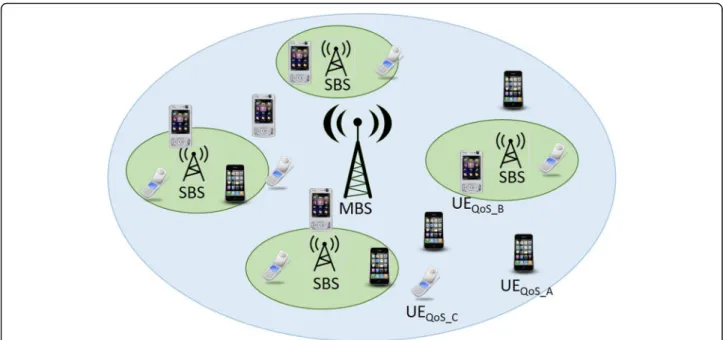
Broadband wireless: This use case constitutes the scenario of interest, and it focuses on a mixture of domestic, enterprise and public access outdoor and indoor environments located in a densely populated urban area (see Fig.1). In this case, a large number of small cells co-exist within a macro-cell offering an improved communication experience to the users.
In order to meet the 5G requirements, which characterize the specific use case, we propose a DCA mechanism for the efficient usage of the available spectrum, driven by the coordination of the CCI and the users’QoS requirements.
3 Related work
One of the first approaches of channel segregation ap-pears in [8]. In this work, each BS acquires its favorite channel independently, through learning from statistical data. As a result, the process of channel re-use is self-organized, leading to an amelioration of spectrum effi-ciency. In the simulation results, the proposed mechan-ism is compared with a system without segregation and the performance improvement in terms of blocking probability and channel utilization is demonstrated.
In [9], the authors modify the previous CS-DCA mechanism for application to Distributed Antenna Net-works (DANs). According to the modified scheme, known as interference-aware CS-DCA (IACS-DCA), the average CCI is computed for the available channels and a CCI table attached to each antenna is created with the first channel to have the lowest CCI value. Hence, before a transmission attempt, the user selects the closest dis-tributed antenna and the first channel of the corre-sponding table is assigned to him. In the simulation analysis, the performance improvement due to the exist-ence of DAN is confirmed. Furthermore, the superiority of the proposed algorithm compared to a fixed channel allocation (FCA) mechanism is proven. Based on this mechanism, the authors in [11] examine several metrics such as the autocorrelation function, the fairness index of channel reuse pattern and the minimum co-channel distance among the BSs. From their analysis, it can be seen that the proposed scheme forms a CCI minimized channel reuse pattern that ameliorates the signal-to-interference ratio (SIR) compared to other channel as-signments schemes.
Taking into account the increasing number of wireless terminals, the authors in [12] propose a modification of the IACS-DCA, named as ‘multi-group IACS-DCA.’ According to this mechanism, the available channels are divided into multiple groups and the initial IACS-DCA
is applied to each channel group. As they highlight in their simulation analysis, the specific mechanism results not only in a more stable reuse pattern in case of mul-tiple users but also in amelioration of the SIR compared to the single-group IACS-DCA scheme.
An energy-efficient approach of the IACS-DCA scheme is presented in [13]. In this work, the use of a transmission power control scheme in combination with IACS-DCA is studied and the stability of the channel re-use patter is verified. From the simulations analysis, some indicative positive results for the transmission power reduction are presented. A similar energy-efficient approach is also proposed by the authors in [14]. In their work, they propose a modified approach of IACS–DCA mechanism in combination with a learning game-theoretic algorithm for the BS sleep process. The performance of the proposed mechanism is investigated through simulation and its superiority in terms of energy and spectral efficiency is proven.
4 Algorithmic approach for RRM/MAC
In this section, we describe the proposed IQ-CS-DCA mechanism that is based on the IACS–DCA mechanism presented in [9]. At first, we present an abstract formu-lation of the considered optimization problem whereas in the second subsection a more algorithmic approach of the proposed mechanism is given.
4.1 Abstract form of the optimization problem
4.1.1 Given:
The large number of SBSs
The diverse QoS requirements of the UEs
The time-varying network conditions (due to various traffic characteristics, changing propagation environ-ment, power control, etc.)
The limited number of spectrum channels
4.1.2 Find:
An efficient association of UEs to SBSs An efficient channel assignment to UEs
4.1.3 So as:
To maximize the spectral-efficiency (via an adequate re-use channel pattern)
To satisfy the communication quality of the UEs
4.2 High level description of IQ-CS-DCA mechanism
The proposed mechanism can be divided in five main steps. The following flowchart in Fig. 3 summarizes the
IQ-CS-DCA mechanism, and each phase is briefly
described.
Initialization phase: During this phase, each SBS chooses randomly a channel from the pool of available channels and broadcasts a beacon signal on this channel. Measurement phase: Each SBS measures periodically
the instantaneous beacon signal power on each of the available channels for a specific time duration. The
received power can be computed considering both path loss and fading phenomena for a more complete analysis of the radio propagation environment. Creation of channel priority table: Each SBS
creates the channel priority table based on average CCI power levels. In this step, the average CCI power can be computed either by using the first-ordering filtering similar to [9] or by using other learning/average mechanisms that use past CCI measurements and result in a stable assignment. The channel with the lowest CCI ap-pears first in the priority table and the other channels with descending order of CCI follow. UEs-SBS association: During this phase, each UE
associates with a SBS depending on various metrics (e.g., the highest receive signal strength indicator (RSSI) and the load due to other UEs associated with this SBS).
Collection of requests: Each SBS collects the channel requests from the UEs.
Creation of user QoS requirement priority tables: UEs are prioritized depending on their application priority, and the SBSs divide its priority table into multiple tables (depending on the number of UEs/applications). The first channel of each table is assigned to each UE depending on its
application priority and the channel quality given by the CCI power level (better channels are given to UEs with stricter QoS requirements).
Channel assignment: Each SBS assigns the channels to the users as follows based on the QoS priority tables.
4.3 Implementation approach of the proposed algorithm
To evaluate our proposed solution, we have imple-mented two algorithms as a first stage. In order to pro-vide results as a“proof of concept,”we have introduce a state-of-the-art algorithm and our proposed algorithm which uses the interference levels acquired from the net-work as well as the QoS requirements from each UE.
The different QoS requirements are related to the 5G scenarios as explained at the SPEED-5G project. For ex-ample IoT users will have low priority in our algorithm. Ultra reliable communications will be at highest priority, meaning that they will be assigned to channels with bet-ter SINR value. Finally, the broadband communications where the users will either have a medium priority with respect to the quality of the channel assigned to or even a high priority given that could belong to a category of users that need to have low latencies and high throughputs.
In advance, those two solutions are compared with an algorithm from the presented state-of-the-art. The algo-rithm that was developed is the dynamic channel assign-ment scheme for distributed antenna networks found at [9] that our solution was based on. Figure 4 illustrates the procedure of the algorithm on the assignment of the channels for the multitude of the antennas as presented into the article.
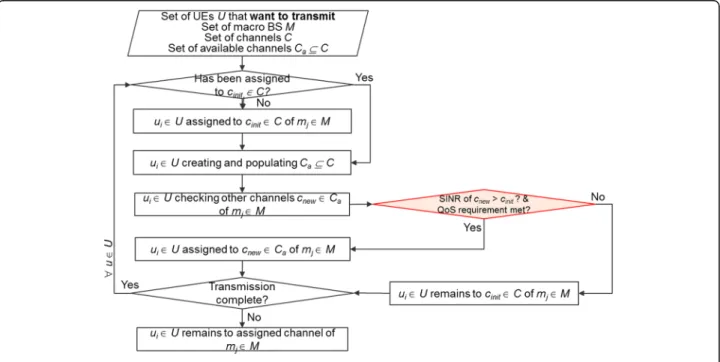
Specifically, the first algorithm that has been investi-gated is called “random-based channel assignment (CA) algorithm”(Fig. 5). This solution does not have a certain logic for the assignment of channels that is why it is called ‘random,’ it arbitrarily allocates users to different channels without any knowledge of the channels current status or the whole system. As input, we have a set of UEs U that want to transmit, a set of macro BS M, a set of channels C, a set of available channels Ca⊆C. Then a certain procedure is followed in order to allocate certain channels to UEs as the flowchart illustrates.
The random-based channel assignment algorithm is used as a baseline in order to compare, evaluate, and
Fig. 3Flowchart of IQ-CS-DCA mechanism
optimize the effectiveness of the next algorithm that we propose (Fig. 6). As input, we have again a set of UEs U that want to transmit, a set of macro BS M, a set of channels C, a set of available channels Ca⊆C. The selection procedure differs from the random channel assignment
algorithm since here we introduce a control point for check-ing the best available channels in order to select these (if available). The best channel is identified according to the SINR and if the SINR of a new channel is better than the currently utilized one, then the UE will switch to the better channel. This algorithm enables context-aware RRM as each base station can collect the interference levels for each user that is connected to a specific channel in order to deduce the radio environment status and exploit it appropriately. In general, it is expected that through this algorithm, it will be possible to achieve better quality (e.g., higher throughput and less latency).
In order to calculate the SINR levels, every SBS at every cycle, creates the average interference that it calculates from the input of the UEs in the area for each other SBS. Instead of recalculating the signal strength at the location of the SBS, we are using the feedback from the SBS’ served UE devices, to make the measurements more realistic and efficient. The UE devices store the signal strength per SBS in their physical layer variables. Therefore, we are averaging out this signal strength to calculate the average per rat interference. After this calculation, we then turn to the history of our RRM model transmission. Since it is not possible to know beforehand what collisions will occur on an air frame, we are using the previous transmission (history) to calculate these collisions and assume that statistically the impact will be the same. We create the resource utilization mask for each SBS, based on the RBs utilization data that were stored in the history variable.
Fig. 5Flowchart of the random-based CA algorithm
5 Evaluation aspects of the proposed algorithms
5.1 Simulation tool
For the evaluation of such concepts, extensive system level simulations are conducted. The implementation of our suggested solution was performed under a proprietary system-level simulation tool which is fully developed in Java with various capabilities and has been calibrated ac-cording to the 3GPP specifications. The simulator takes into account various parameters such as traffic level, avail-able infrastructure elements, availavail-able channels and evalu-ates the various test cases. The calibration state of the proprietary simulator has been checked against the refer-ence results of the 3GPP LTE calibration campaign [36.814] [15]. As a result, the cumulative distribution function (CDF) of coupling loss and downlink SINR have been checked in order to calibrate the tool with leading operators and vendors such as Nokia, Ericsson, Docomo, Huawei, and Telecom Italia.
The configuration is fully customizable so as to in-clude various types of cells (i.e., macro and small cells).-Specifically, it is possible to customize the following: the size of playground; the area type (e.g., dense urban); the number and position of macro base stations and their inter-site distances (ISDs); the number and position of small cells per macro base station; the number and pos-ition of end-user devices in the playground; the number of available channels. In addition, the pathloss models
for macrocells at 2 GHz band is set to
L= 128.1 + 37.6log10(R), R in km, and for small cells is set toL= 140.7 + 36.7log10(R), R in km.
5.2 Simulation parameters
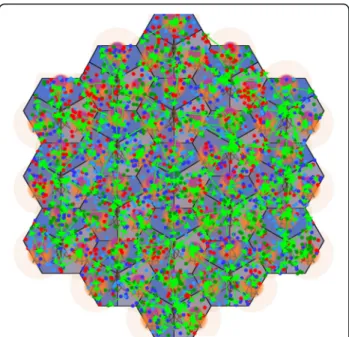
The parameters imported to the simulator are, 19 macro base stations (BS) each with three cells and also 9 small-cells per (BS) giving us a total of 228 cells (in which 171 are small cells uniformly distributed in the simulation playground) throughout the network. In addition, we have utilized 4 channels at 20 MHz band-width for every cell. The topology of the network cre-ated by the simulation tool is illustrcre-ated at (Fig. 7), and the differing shapes and symbols can be interpreted as the UEs and the wireless communication links. Specif-ically users are shown as small circles with four differ-ent colors (red, green, blue, and light blue) that represent the four channels that have been utilized for our scenarios. Furthermore, the green arrows illustrate the transmission process and the connection topology between UEs and BSs of each user to a specific cell of our network. The small cells are located close to the center of the macro cells and are working at the 3.5 Ghz band in contrary to the macro cells that are working on 2 Ghz, giving us a heterogeneous environ-ment for our scenarios.
In addition, Table 1 presents the configuration of the base stations used in each case and their values that have been introduced to our simulator for the develop-ment and evaluation of our solution.
5.3 Experimentation scenarios and test cases
In order to analyze these two algorithms with the use of the simulation tool we had to introduce different scenar-ios and test cases that are summarized in our experi-ments Table 2. We have experimented with five values of sessions that every user requests per day ranging from 2880 up to 14,400 sessions. The file size requested from each user is 2 Mb, which means that a user can request from 4 up to 20 Mb/min. Those values could provide us with a broader knowledge of the algorithm capabilities for the specific network topology implemented to the simulator.
For each of the cases, three algorithms have been eval-uated. Algorithm (A) is our proposed algorithm which builds on state-of-the-art and adds the notion of QoS prioritization. Algorithm (B) is a state-of-the-art algo-rithm which sorts available channels based on SINR values, and Algorithm (C) uses a random allocation of channels (not necessarily the best one).
Moreover, high, medium, and low priority services are considered where our proposed algorithm tries to
Fig. 7Network topology created by the simulation tool
Table 1Configuration of BSs
BS MIMO mode Bandwidth
Macro 2 × 2 20 Mhz
allocate the best possible channels firstly to the high priority services, then to the medium and finally to the low priority services.
5.4 Evaluation results
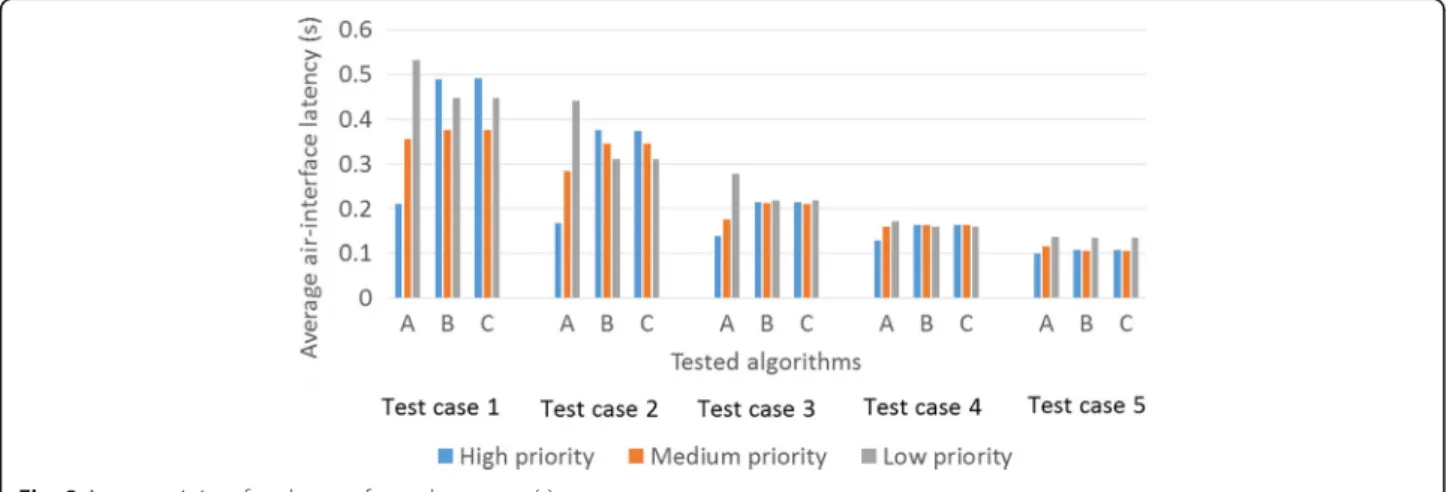
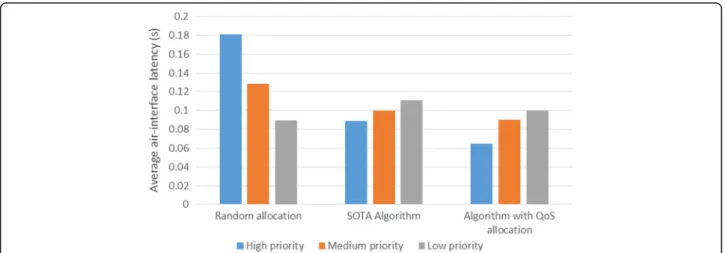
Figure 8 indicates the results from our experimentation. The barchart illustrates the cases of Table 1 and specific-ally the average air interface latency. On average, it is shown that our proposed algorithm outperforms the other two algorithms (up to 50%) especially in high and medium priority services by giving them a performance boost. On the contrary, low priority services seem that they do not benefit as much as the other two.
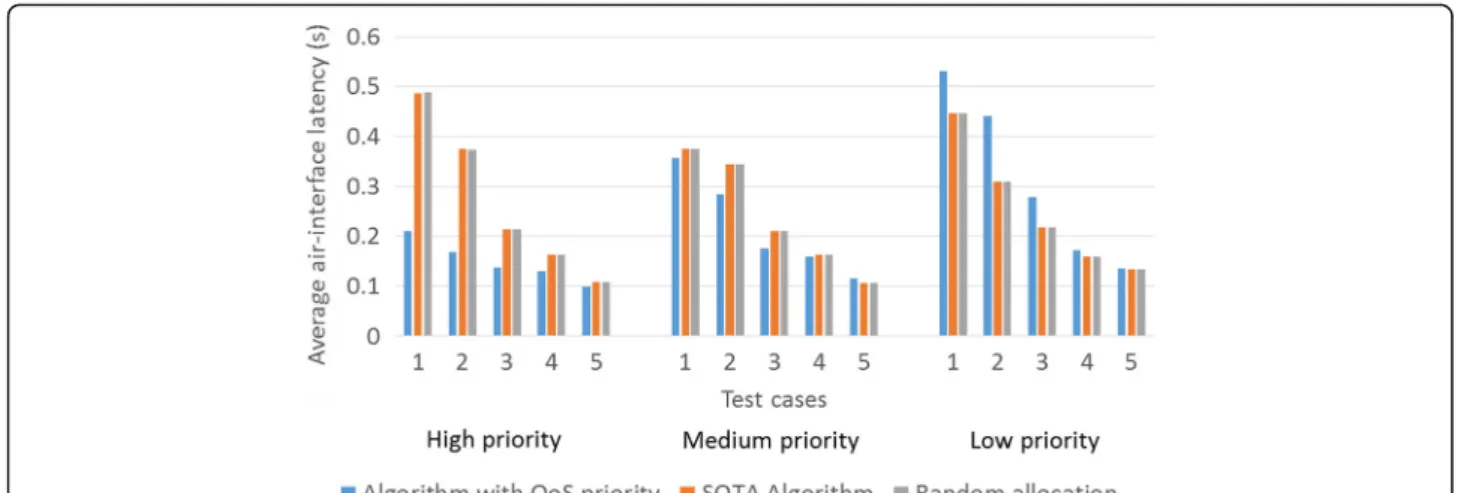
In Fig. 9, the results are sorted by priority levels, and we see in a clearer way the large benefit of our algorithm for high priority which is not the case for low priority services.
Furthermore, Fig. 10 illustrates the normalized throughput for each of the test cases and compared among each algorithm. It is evident that our algorithm performs better in almost every test case and especially in cases with higher loads (compared to less-loaded simulations).
Similarly, Fig. 11 illustrates the normalized throughput as of service priority levels and also here (as shown in la-tency charts), our solution seems to perform better espe-cially in higher and medium priority services compared to low priority services. In this article, we investigated how a radio resource management algorithm utilizing
contextual information acquired from the network and taking into account QoS requirement can cope on some specific scenarios. The test cases introduced here where designed in order to investigate the performance differ-ence between the state-of-the-art and our proposed so-lution for an environment of almost one user per square meter at the case of 5000 users and files for 2 Mb size and variable number of requests per minute per user (ranging from 2 to 10). Our proposed solution was able to dynamically choose the best channel based on inter-ference of the current position and thus allow each user to connect with higher speed and receive the file faster with less air interface latency.
On the contrary, the algorithms that used for compari-son on average were making the less optimal selection of the channels (without giving priority based on QoS re-quirements), hence the users were not able to download at full speed and with higher loss packet ration, creating a continuously loop of poor selection of channels with-out being able to overcome this situation.
Furthermore, there are some differences between ran-dom allocation of channels and state-of-the-art algo-rithm when increased load is provided in the system. Specifically, Fig. 12 illustrates the differences between the algorithms for various priorities when 2× more ses-sions/day/user are tested in the system compared to test case 1. The random allocation has worst performance in high and medium priority services. The state-of-the-art algorithm performs better and our proposed algorithm has the best performance especially in high and medium priority services (which is the main aim of our study).
6 Challenges and future work
In the following, we discuss some challenges that we would like to address in the development of IQ-CS-DCA as well as some of the possible improvements left for future work.
Table 2Tested scenario cases
Test cases Users Sessions/day/user Packet size
1 5000 14400 2MB
2 5000 11520 2MB
3 5000 8640 2MB
4 5000 5670 2MB
5 5000 2280 2MB
The ultra-densification of networks that is currently envisioned for 5G will bring new challenges to the radio access, especially related to interference management. In fact, ultra-dense networks are characterized by interfer-ence patterns that change quickly in time and that strongly depend on the realistic network deployment [16]. Therefore, interference mitigation techniques must be sufficiently dynamic and operate on a sufficiently small time-scale to ensure that the fluctuations in the interference are captured. Clearly, the same challenges also apply to other mechanisms that take into account interference measurements to operate, as in the case of the proposed IQ-CS-DCA.
Additionally, the aggregation of multiple radio access technologies (RATs), possibly operating on very diverse frequency bands with different characteristics, brings new challenges related to efficient ways to ensure the provision of the end-to-end QoS, as some RATs may not supply an explicit way to perform QoS management. This is currently a very active area of research in both academia and industry [17]. Examples of current
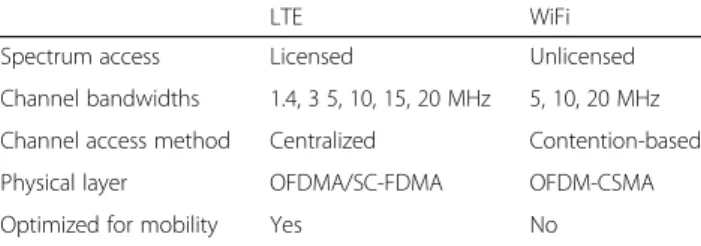
technologies that will still play an important role in the decades to come are the Long Term Evolution (LTE) and the IEEE 802.11 (WiFi) family of standards. Table 3 gathers some of the key differences between the two, ex-emplifying the challenge due to the differences in the physical layer and the radio channel access.
As it has been referred in the Introduction section, a purely centralized approach to DCA might not be feas-ible in practice due to the large amount of feedback that must be exchanged between the BSs and the strict delay requirements that must be met by the network infra-structure. On the other hand, purely decentralized
tech-niques might not be able to address all the
aforementioned challenges. As a future work, we would like to investigate hybrid or semi-decentralized ap-proaches, for instance cluster-based algorithms that take decisions with a minimum amount of feedback to be ex-changed between the SBSs. Clearly, investigations should be performed to analyze the tradeoff between the com-plexity introduced due to the feedback channel required by these techniques versus the achieved benefits.
Fig. 9Average air-interface latency for each service priority level
Hybrid approaches to DCA can also bring benefits against the bursts of interference that can occur in het-erogeneous networks, since they may avoid the strong interference factor generated by closely located BSs, dur-ing the initial measurement phase of the IQ-CS-DCA al-gorithm. It is worth saying that the assumption of a clustered architecture of SBSs is a viable hypothesis, since other functional entities of the network may already require this structure (e.g., to perform inter-cell interference coordination or soft handovers between SBSs). These approaches could leverage the X2 interface currently defined in LTE-Advanced, as well as the Xw interface newly introduced in LTE Release 13 between a 3GPP BS and a WiFi access point [18].
The approach presented in this paper is directly ap-plicable to the case of heterogeneous RATs. Compared to an algorithm that deals with the underlying available channels agnostically, improvements are expected by providing additional information related to the different available technologies in the channel assignment step. As an example, a fast moving UE might better be
assigned to a licensed band using LTE, rather than scheduled to an unlicensed band operating on WiFi. In other cases, though, it may be beneficial to off-load broadband static users to unlicensed WiFi in order to re-duce the CCI generated in the licensed band. Additional information is needed by such evolved mechanisms, in-cluding the UE’s capabilities (i.e., the supported bands and technologies), as well as a characterization of the user’s mobility pattern, among others.
Finally, the growing importance of techniques for dy-namic spectrum access in next-generation wireless sys-tems should also be taken into consideration in the design of efficient DCA algorithms, together with the di-verse characteristics of the underlying frequency bands. For instance, TV White Spaces (TVWS) are highly loca-tion dependent. TVWS frequencies might be available in a particular geographical area while being completely oc-cupied at another location. Therefore, a centralized geo-location database might be necessary to implement a coexisting LTE-TVWS system. In such system, the infor-mation provided by the geolocation database is semi-Fig. 11Normalized throughput for each service priority level
static and does not change often in time. However, the in-herent unpredictability of these frequencies might make them ideal only to best-effort applications with no QoS re-quirements, further highlighting the importance of intelli-gent RAT-aware algorithms, as pointed out in [17].
7 Conclusions
In this paper, we consider the case of a heterogeneous net-work scenario with macro-cell and small cells. Due to the inherent network architecture, one major challenge is the efficient management of CCI. In our work, numerous interference aware DCA mechanisms are discussed and the channel segregation approach is presented. A high level modified interference aware DCA mechanism that takes into account the differentiated QoS requirements of the users is proposed. Furthermore, the algorithmic ap-proach of the mechanism is presented through some flow charts and two algorithmic approaches for the evaluation and the proof of concept are examined. The algorithm with the interference aware capability that uses the SINR measurements acquired from the network is able to pro-vide better results. The advantage of our algorithm intro-duced here can further explored with the utilization of the small-cell at the macro cell edge in order to attract prob-lematic traffic due to the great CCI presented in those areas. Finally, possible challenges and points for future work are recognized in order to have a more complete analysis of the resource allocation problem.
Acknowledgements
This work has been performed in the framework of the Horizon 2020 project SPEED-5G (ICT-671705) receiving funds from the European Union.
Funding
This work has received funding from European Commission, Horizon 2020, SPEED-5G project as mentioned also in the Acknowledgment section.
Authors’contributions
IPB contributed to the problem statement, algorithm implementation, simulation execution, and results. SV contributed to the problem formulation and related work search. AG contributed to the problem formulation, scenario definition, simulation execution, and result analysis. AM contributed to the implementation of state-of-the-art algorithm and simulation execution. FM contributed to the state-of-the-art with emphasis on the heterogeneous network scenario and relation to our proposed work. UH contributed to the definition of technical use cases and simulation scenarios in order to emphasize the benefits/advancements of our work with respect to the state-of-the-art. KT contributed to the algorithm implementation and simulation execution. PD contributed to the problem statement, formulation, and algorithm specification. All authors read and approved the final manuscript.
Competing interests
No competing interests are foreseen for this publication.
Publisher’s Note
Springer Nature remains neutral with regard to jurisdictional claims in published maps and institutional affiliations.
Author details
1WINGS ICT Solutions, Athens, Greece.2Sistelbanda, Valencia, Spain. 3EURESCOM, Heidelberg, Germany.4University of Piraeus, Piraeus, Greece.
Received: 6 October 2016 Accepted: 19 September 2017
References
1. J.G. Andrews et al.,“What will 5G be?”Selected areas in communications. IEEE Journal on32(6), 1065–1082 (2014)
2. P. Demestichas et al., 5G on the horizon: key challenges for the radio-access network. Vehicular Techn. Magazine, IEEE8(3), 47–53 (2013)
3. SPEED-5G EU project site: https://speed-5g.eu/. Accessed Sept 2017. 4. S. Vassaki, A. Georgakopoulos, F. Miatton, K. Tsagkaris, P. Demestichas,
Interference and QoS aware channel segregation for heterogeneous networks: a preliminary study(2016 European Conference on Networks and Communications (EuCNC), Athens, 2016), pp. 195–199
5. A. Georgakopoulos, A. Margaris, K. Tsagkaris, P. Demestichas, Resource sharing in 5G contexts: achieving sustainability with energy and resource efficiency. IEEE Veh. Technol. Mag.11(1), 40–49 (2016)
6. S.-J. Kim, I. Cho, Y.-K. Kim, C.-H. Cho, A two-stage dynamic channel assignment scheme with graph approach for dense femtocell networks. IEICE Trans. Commun.E97-B(10), 2222–2229 (2014)
7. D. Goodman, S.A. Grandhi, and R. Vijayan, Distributed dynamic channel assignment schemes, Proc. IEEE 43rd Vehicular Technology Conference (VTC1993-Spring), 1993
8. Y. Furuya, Y. Akaiwa, Channel segregation, a distributed adaptive channel allocation scheme for mobile communication systems. IEICE Trans. Commun.74(6), 1531–1537 (1991)
9. R. Matsukawa, T. Obara, and F. Adachi. A dynamic channel assignment scheme for distributed antenna networks. Vehicular Technology Conference (VTC Spring), 75th. IEEE, 2012
10. S. Glisic, and B. Lorenzo. Advanced wireless networks: cognitive, cooperative & opportunistic 4G technology. London: Wiley ;2009.
11. Y. Matsumura et al., Interference-aware channel segregation based dynamic channel assignment for wireless networks. IEICE Trans. Commun.98(5), 854–860 (2015)
12. T. Katsuhiro, and F. Adachi. Multi-group interference-aware channel segregation based dynamic channel assignment. Network Infrastructure and Digital Content (IC-NIDC), 2014 4th IEEE International Conference on. IEEE, 2014 13. Y.Matsumura, et al. Interference-aware channel segregation based dynamic
channel assignment using SNR-based transmit power control. Intelligent Signal Processing and Communications Systems (ISPACS), 2013 International Symposium on. IEEE, 2013
14. A. Mehbodniya, et al. Energy-efficient dynamic spectrum access in wireless heterogeneous networks. Communication Workshop (ICCW), 2015 IEEE International Conference on. IEEE, 2015
15. 3 GPP TR 36.814, Further advancements for E-UTRA physical layer aspects, March 2010.
16. B. Soret et al., Interference coordination for dense wireless networks. IEEE Commun. Mag.53(1), 102–109 (2015)
17. U. Herzog et al., Quality of service provision and capacity expansion through extended-DSA for 5G, European Conference on Networks and Communications (EuCNC 2016), 2016, in press
18. 3 GPP TR 37.870 V13.0.0, Study on multiple radio access technology (Multi-RAT) joint coordination, June 2015.
Table 3Comparison between LTE and WiFi
LTE WiFi
Spectrum access Licensed Unlicensed
Channel bandwidths 1.4, 3 5, 10, 15, 20 MHz 5, 10, 20 MHz
Channel access method Centralized Contention-based
Physical layer OFDMA/SC-FDMA OFDM-CSMA

![Fig. 4 Flowchart of channel assignment at the n-th antenna [9]](https://thumb-us.123doks.com/thumbv2/123dok_us/928606.1112712/5.892.459.806.731.1066/fig-flowchart-channel-assignment-n-th-antenna.webp)