R E S E A R C H
Open Access
Low-complexity
a posteriori
probability
approximation in EM-based channel
estimation for trellis-coded systems
Nico Aerts
*, Iancu Avram and Marc Moeneclaey
Abstract
When estimating channel parameters in linearly modulated communication systems, the iterative
expectation-maximization (EM) algorithm can be used to exploit the signal energy associated with the unknown data symbols. It turns out that the channel estimation requires at each EM iteration thea posterioriprobabilities (APPs) of these data symbols, resulting in a high computational complexity when channel coding is present. In this paper, we present a new approximation of the APPs of trellis-coded symbols, which is less complex and requires less memory than alternatives from literature. By means of computer simulations, we show that the Viterbi decoder that uses the EM channel estimate resulting from this APP approximation experiences a negligible degradation in frame error rate (FER) performance, as compared to using the exact APPs in the channel estimation process.
Keywords: A posteriorisymbol probability; ML estimation; EM algorithm; Trellis-coded modulation; Viterbi decoder
1 Introduction
When the channel between a source and destination node is not known, it is primordial for the destination to esti-mate this channel in order to decode the transmitted information. Typically, the source assists the destination with this task by transmitting known pilot symbols along with the unknown data symbols. Making use of only these pilot symbols, the destination is able to estimate the chan-nel. The drawback of this pilot-aided method is that the channel information contained in the data part of the sig-nal is not harvested during the estimation. Hence, in order to obtain an accurate channel estimate, a large number of pilot symbols should be present, yielding a substantial reduction of both power and bandwidth efficiency.
To accommodate these problems, the iterative expec-tation-maximization (EM) algorithm [1,2] can be used to also exploit the signal energy associated with the unknown data symbols during the channel estimation; this way, much less pilot symbols are needed to achieve a given estimation accuracy. Application of the EM algorithm requires that at each iteration thea posteriori probabil-ities (APPs) of these data symbols be calculated. When
*Correspondence: [email protected]
TELIN, UGent, Sint-Pietersnieuwstraat 42, Gent 9000, Belgium
using a trellis code to map the information bits on the data symbols, the Viterbi algorithm [3] minimizes the frame error rate (FER) by performing maximum likeli-hood (ML) sequence detection. The exact APPs of the trellis-coded data symbols are obtained by means of the Bahl-Cocke-Jelinek-Raviv (BCJR) algorithm [4], which however is roughly three times as complex as the Viterbi algorithm [5].
Several low-complexity approximations of the BCJR algorithm have been proposed in the literature, mainly in the context of iterative soft decoding of concatenated codes, referred to as turbo decoding. Among them are the max-log maximum a posterioriprobability (MAP) algo-rithm [5] and the soft-output Viterbi algoalgo-rithm (SOVA) [6], which are roughly twice as complex as the Viterbi algo-rithm [7], and the soft-output M-algoalgo-rithm (SOMA) [8], which reduces complexity by considering only the M most likely states at each trellis section. Some improvements of the SOVA algorithm in the context of turbo decoding have been presented in [9-13]. Whereas these referenced papers make use of the approximate APPs inside the iter-ative decoder, we focus on using the approximate APPs only in the iterative estimation algorithm and use the standard Viterbi algorithm (which does not need symbol APPs) for decoding. Because an accurate approximation
of the true APPs is less critical for the proper operation of the EM algorithm, we propose a simpler approximation of the APP computation with roughly half the complex-ity of max-log MAP and with substantially less memory requirements. We compare the resulting EM algorithm in terms of estimation accuracy and FER of the Viterbi decoder, with the cases where the EM estimator uses either the true APPs, or the APPs resulting from SOMA, or the APPs that are computed under the simplifying assumption of uncoded transmission.
1.1 Notations
All vectors are row vectors and in boldface. The Hermi-tian transpose, statistical expectation, the mth element, the firstmelements, and estimate of the row vectorxare denoted byxH,E[x],xm,x1:m, andx, respectively.ˆ 2 System description
A source transmits to the destination a frame consisting of a sequence ofKppilot symbolscpand a sequence ofK
data symbolsc; the latter is obtained by applyingKb
infor-mation bitsbto a trellis encoder [5]. We assume that the pilot symbols have a constant magnitude√Esand that the
data symbols satisfyE|cm|2=Es, withEsdenoting the
average symbol energy at the transmitter. Considering a channel that is characterized by a channel gainhthat is constant over the frame and a noise contribution n, the signal received by the destinationrt=rp,r
is defined by
rp=hcp+np, (1)
r=hc+n. (2)
The elements ofnpandn are independent zero mean
circular symmetric complex Gaussian random variables with variance N0. The destination produces a
chan-nel gain estimate hˆ and uses a Viterbi decoder to obtain the ML information bit sequence decision bˆ = arg maxb˜p
r|b= ˜b,h= ˆhwithb˜belonging to the set of all 2Kbinformation bit sequences of lengthK
b. If the
esti-matehˆwere equal to the actual channel gainh, the Viterbi decoder would minimize the FER given by Prbˆ=b .
As the operation of the Viterbi decoder is well docu-mented in the literature [3], we only briefly recall its main features. The decoder makes use of the fact that the trel-lis encoder can be described as a finite-state machine. At the start of themth symbol interval, the encoder accepts a vector um ofNb information bits (the information bit
sequencebis partitioned asb = (u1,· · ·,uK)) and
out-puts a coded data symbolcmwhich is given by the output equationcm = g(Sm,um); hereSm denotes the encoder state at the start of themth symbol interval. At the end of themth symbol interval, the encoder has reached the stateSm+1given by the state equationSm+1=f(Sm,um).
For anym,Sm belongs to the set = {σ1,· · ·,σL}, with
L denoting the number of encoder states. The resulting trellis code has a rate of Nb information bits per coded
symbol. The Viterbi algorithm recursively computes the sequencescˆ1:m(σl)and their log-likelihood for allσl∈, and m = 1,· · ·,K; here,cˆ1:m(σl) is the ML sequence consisting ofmdata symbols that yieldsSm+1 = σl. The
log-likelihood ofˆc1:m(σl)is given by−m(σl) /N0, where
the path metricm(σl)satisfies the following recursion:
m(σl)=min the encoder operation (i.e., a bit vectoru, satisfying both˜
˜
is determined by the a priori distribution of the initial stateS0. The ML data sequence decision is given bycˆ =
decisionbˆis the information bit sequence consistent with
ˆ
c,SˆK+1, and the encoder operation. The Viterbi decoder
operation requires the storage ofLdata symbol sequences of lengthK. The above is straightforwardly extended to (i) multidimensional trellis coding, where a transition from stateSmto stateSm+1gives rise to multiple data symbols,
and (ii) the presence of termination bits at the encoder input to impose a known final stateSK+1.
3 Estimation strategy
As mentioned before, the source transmits pilot symbols cp to assist the destination with the channel estimation
process. The ML pilot-based estimate ofhthat uses only rpis given by [14]
The estimate (5) gives rise to a mean-squared estimation error (MSE) that is equal to
E|ˆh−h|2 = N0 KpEs
. (6)
Hence, for givenEs, the estimation accuracy is improved
When exploiting also the data part of the received signal,
Because of the summation over all possible 2Kb data sequences, obtaining from (8) the ML estimate for large
Kbis computationally complex. Fortunately, the EM algo-rithm [1] allows to compute the ML estimate iteratively. For the problem at hand, the EM channel estimate hˆ(i) during theith iteration is obtained as
ˆ When the data symbols have a constant magnitude, the numerator of (9) reduces to(Kp+K)Es. The iterations are
initialized with the pilot-based estimate from (5), which we denote ashˆ(0).
The APP Prcm=α|r,hˆ (for notational convenience, we drop the iteration index) ofcmcan be expressed as
Pr
where∝means equal within a normalization factor, and the summation is over all valid codewords withcm equal to α. Making use of the finite-state description of the encoder, the APPs (12) can be computed efficiently for
m=1,· · ·,Kby means of the BCJR algorithm [4]. How-ever, its complexity is still about three times that of the Viterbi algorithm [5]. Hence, assuming that the EM algo-rithm converges after I iterations, the BCJR algorithm must be applied I times, after which, the Viterbi algo-rithm (withhˆ = ˆh(I)) is used to detect the information bit sequence. The resulting complexity is 3I+1 times that of a single use of the Viterbi decoder.
The MSE resulting from (8) cannot be obtained in closed form. Therefore, we resort to the modified Cramer-Rao bound (MCRB) [15], which is a fundamental lower bound on the MSE performance of any unbiased estimate. For the observation model (1)-(2), the MCRB reduces to
E|ˆh−h|2 ≥ N0 K+Kp
Es
(13)
Comparison of (6) with (13) indicates the possibility of substantially reducing the MSE when also including the data portionr of the observation in the estimation process, especially whenKKp.
4 Complexity reduction
In order to avoid the computational complexity asso-ciated with the BCJR algorithm (or the max-log MAP or SOMA approximations), we consider two reduced-complexity approximations for computing the APPs. In the first algorithm (A1), we do not exploit the code prop-erties and compute the APPs as if the transmission was uncoded. The second algorithm (A2), which exploits the path metrics from the Viterbi decoder to approximate the APPs, represents our main contribution.
4.1 AlgorithmA1
A trivial low-complexity approximation is obtained by simply ignoring the code constraint during the EM itera-tions. More specifically, it is assumed that the data sym-bols are statistically independent, which implies that the received samplesrk withk =1,. . .,Kandk=mdo not
contain any information about cm. In (12), we can thus replacerbyrm. This yields
Here, we present a new low-complexity approximation to the APP computation, that makes use only of the Viterbi decoder metrics{m(σl)}of the surviving paths. The APP
approximation makes use of the following simplifications:
(i) We ignore future observations. More specifically, we approximate the APPPr
cm=α|r,hˆ of a symbol
cmby conditioning on only the past and present observationsr1:m. This APP is obtained by simply
other, non-surviving, paths is assumed to be zero. This yields the approximation
Prcm=α|r,hˆ ∝ σl∈
ˆ
cm(σl)=α
pr1:m|ˆc1:m(σl),hˆ
Pr [c]
(18)
(iii) We replace in (18) the summation over the valid symbol sequences by a maximization and finally obtain the approximation
Prcm=α|r,hˆ ∝ max
σl∈
ˆ
cm(σl)=α
pr1:m|cˆ1:m(σl),hˆ
(19)
Hence, from all surviving sequencescˆ1:m(σl)with ˆ
cm(σl)=α, only the sequence with the highest likelihood contributes to the APP approximation (19). Taking into account the relation between the Viterbi decoder path metricm(σl)from (3) and the likelihood ofˆc1:m(σl), we obtain from (19) the approximation
Pr
cm=α|r,hˆ ∝exp−m,min(σl)/N0
, (20)
with
m,min(σl)= min
σl∈
ˆ
cm(σl)=α
m(σl) (21)
Hence, when the surviving path with the largest likelihood at the end of themth trellis section has
cm=α, our APP approximation for the symbolcmis largest forcm=α. Approximating the APPs
Pr
cm=α|r,hˆ form=1,· · ·,Kusing (21) yields a complexity similar to that of the Viterbi algorithm. Hence, assuming that the EM algorithm converges
afterI iterations, the complexity as compared to a single use of the Viterbi decoder isI+1times for algorithmA2, whereas it is3I+1times when the APP computation is according to the BCJR
algorithm. Note that unlike the Viterbi algorithm, the computation of the APP (21) ofcmdoes not require to store the data symbol decisionsˆcn(σl)forn<m,
so that algorithmA2uses considerably less memory than the Viterbi algorithm does.
Whereas simplifications similar to (ii) and (iii) have also been applied to APP algorithms from literature (e.g., max-log MAP), this is not the case for simplification (i). As the APP algorithms from the literature also make use of future observations, the APP ofcmrequires updating each time future observationsrm+1,rm+2,. . .become available,
yielding a higher computational complexity and more memory requirements. Hence, approximation (i) is crucial for obtaining a very simple APP computation.
5 Numerical results
We consider a trellis encoder consisting of an eight-state rate 1/2 (15,17)8convolutional encoder with known initial
and final states, followed by Gray mapping of the convolu-tional encoder output bits to 4-QAM symbols. Each frame containsKp=5 pilot symbols andK =200 data symbols
(including four termination symbols). We consider both an Additive white Gaussian noise (AWGN) channel with
h = 1 and a Rayleigh fading channel withE|h|2 = 1. We investigate the performance of the estimator and the Viterbi decoder by means of Monte-Carlo simulations, in terms of MSE and FER, respectively. The EM algorithm has essentially converged after only one iteration, i.e.,
I = 1; for I = 1, the complexity reduction obtained by computing the APPs using the new algorithmA2 instead of the BCJR algorithm is about a factor of 2. In the fol-lowing, we consider the APP computation according to
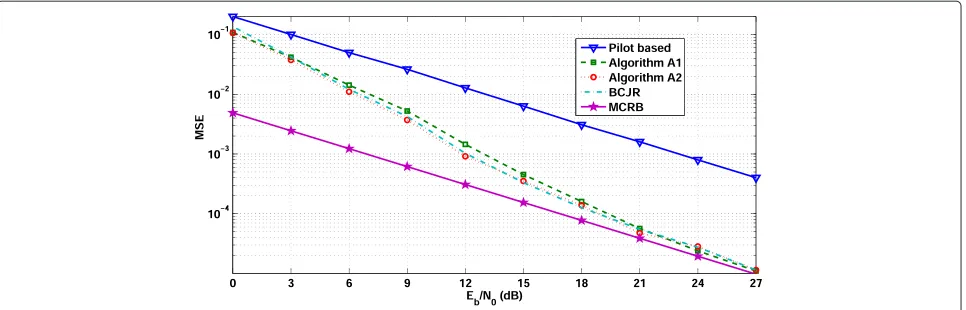
Figure 2MSE for a (15,17)8convolutional code: Rayleigh channel.
the BCJR algorithm, the SOMA(M = 4)version of the exact APP algorithm from [16] and the above A1 and A2 algorithms.
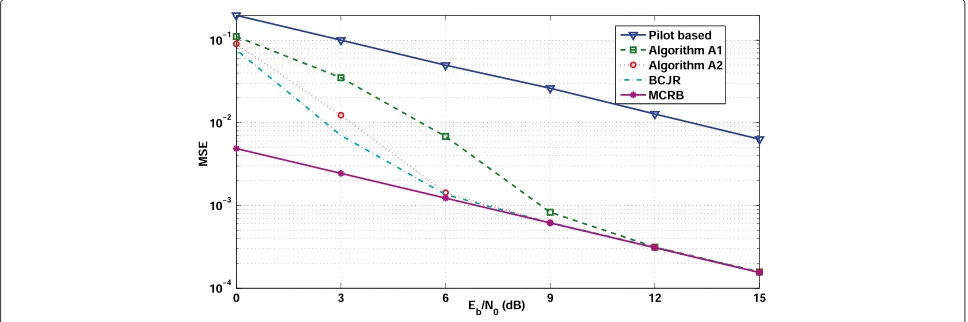
The MSE performance for the AWGN channel and the Rayleigh fading channel is depicted in Figures 1 and 2, where the MCRB (13) is used as benchmark. The MSE performance of the EM-based channel estimators (a) converges to the MCRB with increasing signal-to-noise ratio (SNR) and (b) outperforms the system where only pilot symbols are used to estimate h. Ranking the APP algorithms according to the resulting MSE, we see that BCJR (which computes exact APPs) performs best, SOMA (which takes past, present, and future observations into account) is a very close second, and A2 (which ignores future observations) is only slightly worse than BCJR and SOMA; A1 (which uses only the present observation) is considerably worse than BCJR, SOMA, and A2 for low and medium SNRs.
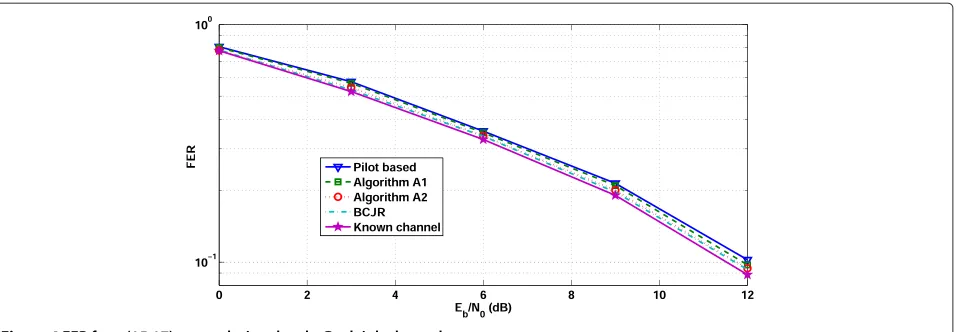
Figures 3 and 4 show the FER of the Viterbi decoder for the AWGN channel and the Rayleigh fading channel
as a function ofEb/N0, withEbdenoting the energy per
information bit. Hence,
Es Eb =
Nb·K−Kter K+Kp
, (22)
where Kter is the number of termination symbols. As
benchmark, we use the FER of a reference system with
K,Kp
= (200, 0) where the channel coefficient h is known to the receiver. Hence, as compared to this refer-ence system, the system withK,Kp
= (200, 5)suffers from an irreducible power efficiency loss of 10 log10205200= 0.11 dB because of the presence of pilot symbols; the actual degradation will exceed 0.11 dB because of chan-nel estimation errors. We observe that (a) the A2, SOMA, and BCJR algorithms yield essentially the same FER per-formance and require, for given FER, about 0.11 dB more
Eb/N0 than the reference system: for these algorithms,
the channel estimation is sufficiently accurate so that the degradation is mainly determined by the power efficiency
Figure 4FER for a (15,17)8convolutional code: Rayleigh channel.
loss caused by the pilot symbol insertion. (b) The A1 algo-rithm performs worse than the A2, SOMA, and BCJR algorithms because ignoring the code constraints when computing the APPs yields less accurate channel esti-mates. (c) The FER performance is worst when only pilot symbols are used to estimateh. Hence, from a computa-tional complexity and memory requirement point of view, it is advantageous to compute the trellis-coded symbol APPs in the EM algorithm by means of the new algorithm A2 (that ignores future observations) rather than the con-sidered APP algorithms from the literature (that take also future observations into account).
6 Conclusions
EM-based channel estimation in the presence of trellis-coded modulation requires the use of the BCJR algorithm to efficiently compute the exact symbol APPs. As the computational complexity of the BCJR algorithm is about three times that of the Viterbi algorithm which we use for decoding, we have proposed a new approximation to the APP computation that beats the main APP algorithms from the literature in terms of computational complexity and memory requirements. By means of computer sim-ulations, we have pointed out that when using the new APP computation instead of the exact APPs from the BCJR algorithm, the resulting Viterbi decoder FER perfor-mances are essentially the same. Hence, this motivates the use of the new APP approximation in the context of EM channel estimation for trellis-coded modulation.
So far, we have limited our attention to a time-invariant channel, i.e., the channel gain takes a constant valueh dur-ing a frame. For time-varydur-ing channels, a similar approx-imation of the symbol APPs can be derived. Denoting by
hmthe channel gain associated with the data symbolcm, the branch metric corresponding tocm= ˜cbecomes
λm(c˜)= |rm− ˆhm˜c|2, (23)
Note that (23) is obtained by replacing in (4)hˆ byhˆm, which denotes the estimate ofhm. Collecting the channel gain estimates at the data symbol positions into the vector
ˆ
h, the likelihoodpr|c,hˆcan be decomposed as
pr|c,hˆ
=
K
m=1
prm|cm,hˆm
, (24)
where p
rm|cm,hˆm
∝ exp(−λm(cm)/N0), withλm(˜c)
given by (23). Hence, the symbol APP approximations for time-varying channels are simply obtained by replacing in the APP approximationsA1andA2for time-invariant
channels the quantityλm(c˜)by the right-hand side of (23) instead of (4). The resulting approximated symbol APPs can be used in, for instance, a MAP EM channel estima-tion algorithm that exploits the correlaestima-tion between the time-varying channel gains [17].
Competing interests
The authors declare that they have no competing interests.
Acknowledgements
This research has been funded by the Interuniversity Attraction Poles Programme initiated by the Belgian Science Policy Office and is also supported by the FWO project G.0022.11 ‘Advanced multi-antenna systems, multi-band propagation models and MIMO/cooperative receiver algorithms for high data rate V2X communications’.
Received: 21 May 2014 Accepted: 2 September 2014 Published: 17 September 2014
References
1. A Dempster, N Laird, DB Rubin, Maximum likelihood from incomplete data via the EM algorithm. J. Roy. Stat. Soc.39(1), 1–38 (1977) 2. J Choi,Adaptive and Iterative Signal Processing in Communications.
(Cambridge University Press, New York, 2006)
3. AJ Viterbi, Error bounds for convolutional codes and an asymptotically optimum decoding algorithm. IEEE Trans. Inform. Theor.13, 260–269 (1967)
5. S Lin, D Costello,Error Control Coding, 2nd edn. (Pearson Education Inc., Upper Saddle River, 2004)
6. J Hagenauer, A Viterbi algorithm with soft-decision output and its applications. GLOBECOM.3, 1680–1686 (1989)
7. M Mansour, A Bahai, Complexity based design for iterative joint equalization and decoding. Proc. IEEE VTC.4, 1699–1704 (2002) 8. R Mehlan, H Meyr, Soft output M-algorithm equalizer and trellis-coded
modulation for mobile radio communication. Proc. IEEE VTC.2, 586–591 (1992)
9. S Papaharalabos, P Sweeney, BG Evans, PT Mathiopoulos, Improved performance SOVA turbo decoder. IEE Proc. Commun.153(5), 586–590 (2006)
10. AA Hamad, Performance enhancement of SOVA based decoder in SCCC and PCCC schemes. SciRes. Wireless Engineering and Technology. 4, 40–45 (2013)
11. R Motwani, T Souvignier, Reduced-complexity soft-output Viterbi algorithm for channels characterized by dominant error events, inIEEE Global Telecommunications Conference(Miami, FL, USA, 6–10 Dec 2010), pp. 1–5
12. DW Yue, HH Nguyen, Unified scaling factor approach for turbo decoding algorithms. IET Commun.4(8), 905–914 (2010)
13. CX Huang, A Ghrayeb, A simple remedy for the exaggerated extrinsic information produced by SOVA algorithm. IEEE Trans. Wireless Commun. 5(5), 996–1002 (2006)
14. JG Proakis,Digital Communications, (McGraw-Hill, New York, 1995) 15. AD Andrea, U Mengali, R Reggiannini, The modified Cramer-Rao bound
and its applications to synchronization problems. IEEE Trans. Commun. 42(234), 1391–1399 (1994)
16. L Lee, Real-time minimum-bit-error probability decoding of convolutional codes. IEEE Trans. Commun.COM-22, 146–151 (1974) 17. N Aerts, M Moeneclaey, SAGE-based estimation algorithms for
time-varying channels in amplify-and-forward cooperative networks, in International Symposium on Information Theory and its Applications (ISITA) (Honolulu, HI, USA, 28–31 Oct 2012), pp. 672–676
doi:10.1186/1687-1499-2014-153
Cite this article as:Aertset al.:Low-complexitya posterioriprobability approximation in EM-based channel estimation for trellis-coded systems. EURASIP Journal on Wireless Communications and Networking20142014:153.
Submit your manuscript to a
journal and benefi t from:
7 Convenient online submission 7 Rigorous peer review
7 Immediate publication on acceptance 7 Open access: articles freely available online 7 High visibility within the fi eld
7 Retaining the copyright to your article