R E S E A R C H
Open Access
Wavelets optimization method
for evaluation of fractional partial
differential equations: an application
to financial modelling
Asmat Ara
1, Najeeb Alam Khan
2*, Oyoon Abdul Razzaq
3, Tooba Hameed
2and
Muhammad Asif Zahoor Raja
4*Correspondence:
[email protected] 2Department of Mathematics,
University of Karachi, Karachi, 75270, Pakistan
Full list of author information is available at the end of the article
Abstract
In the present paper, we employ a wavelets optimization method is employed for the elucidations of fractional partial differential equations of pricing European option accompanied by a Lévy model. We apply the Legendre wavelets optimization method (LWOM) to optimize the governing problem. The novelty of the proposed method is the inclusion of differential evolution algorithm (DE) in the Legendre wavelets method for the optimized approximations of the unknown terms of the Legendre wavelets. Sequentially, the functions and components of the pricing models are discretized by utilizing the operational matrix of fractional integration of Legendre wavelets. Illustratively, the implementation of the LWOM is exemplified on a pricing European option Lévy model and successfully depicted the stock paths. Moreover, comparison analysis of the Black-Scholes model with a class of Lévy model and LWOM with q-homotopy analysis transform method (q-HATM) is also deliberated out. Accordingly, the technique is found to be appropriate for financial models that can be expressed as partial differential equations of integer and fractional orders, subjected to initial or boundary conditions.
Keywords: pricing models; Lévy processes; wavelets approximation; optimization
1 Introduction
The study of financial theory is a versatile field that connects the assumptions of finance and techniques of mathematics. With the expeditious expansion of financial derivatives like options and futures, it has incited the attention of researchers particularly toward the area of pricing models. In 1973, Black, Scholes, and Merton made an innovative assump-tion that the stock price and other observable quantities that depend on the volatility of the option price are explicitly related to hedging approaches. The considerable inspira-tion of the Black-Scholes-Merton (BS) model defines that by keeping a certain quantity of stock the risk-free rate of the option price, known as delta, is a dynamically hedged option situation. On this key innovation, Scholes and Merton were awarded the Nobel prize in 1997. After the development of the BS model, many endeavors have been organized to sort out the rigorous notions of pricing models. Merton [1] proposed a Merton jump diffusion
model (MJD) by considering a symmetricα-stable Lévy process in place of an exponential Brownian motion. Many advancements have been contrived on the MJD model by consid-ering the Lévy models with jumps. Bates [2] discovered that the stochastic volatility and elucidated the ‘volatility smile.’ Under the systematic jumps and volatility risk, the Hes-ton model [3] merged a stochastic volatility and a jump-diffusion process (SVJD). Some stochastic models with infinite activity pure jump processes, such as FMLS (finite mo-ment log stable), CGMY (Carr-Madan-Geman-Yor) and KoBol (Koponen-Boyarchenko-Levendorskii) can be found in [4–12]. The characteristics of these price models are more flexible and present realistic descriptions of the price process at various time scales.
Fractional derivatives offer a more delicate mechanism for many fields, in comparison with the integer-order derivatives, to confine the characteristics of processes, materials,
etc. This special branch has analyzed various problems of different aspects by many re-searchers and scientists. Numerous papers have been published in this regard to explore and enhance the definitions and properties in order to overcome the inadequacies of pre-vious definitions of fractional calculus, such as conformable derivatives [13], fractional derivatives with smooth [14], nonlocal and nonsingular kernel [15],etc. [16, 17]. Many re-searchers have proposed different techniques to solve fractional partial differential equa-tions numerically and analytically. A general finite difference scheme is applied on three FPDEs under some infinite activity Lévy models (FMLS, KoBol, and CGMY) using the Grunwald-Letnikov definition [18]. The approach in [19] is based on a combination of the Laplace transformation and homotopy methods for the approximate analytical solution of FPDEs in the Liouville-Caputo and Caputo-Fabrizio sense. In [20] a new Adomian decom-position method based on conformable derivatives is utilized to solve FPDEs. The local fractional derivative with homotopy perturbation Sumudu transform technique is studied to solve FDEs in [21]. Hence, by means of different theories of fractional derivatives, the behaviors of many FPDEs have been studied, and various techniques have been developed [22, 23].
Motivated by the worth-mentioning research works found in the literature, in this en-deavor, exploring the applications of FPDEs in financial mathematics, we consider the BS model and a class of Lévy models (FMLS), which is used to model stock price [5, 18]. The proposed method, the Legendre wavelets optimization method (LWOM), is success-fully implemented on BS and FMLS. The technique is an amalgamation of the Legen-dre wavelets approximation and differential evolution algorithm. The LegenLegen-dre wavelets method has been extensively used to approximate the unknown functions of integer- and fractionorder differential equations [24, 25]. Besides, the differential evolution (DE) al-gorithm, the famous meta-heuristic scheme, has nowadays gained popularity for its global optimization attribute [26, 27]. Here, after discretizing the functions using the Legendre wavelets, the equations are optimized using the DE scheme to find the unknown parame-ters. The transparent numerical comparison of the BS and FMLS models with q-homotopy analysis transform method (q-HATM) [18] also expounded.
2 Fractional prerequisites
In this section, we give a few basic results and definitions from fractional calculus, which are helpful for the advance evolution.
Definition 2.1 Letν> 0,m=ν, andφ(z,τ)∈Cm( ×
+). Then the Caputo fractional derivative ofφ(z,τ) with respect toτ is defined asDν
τφ(z,τ) = Imτ–ν ∂m
∂τmφ(z,τ), where Imτ–ν is the Riemann–Liouville fractional integral given as
Imτ–νφ(z,τ) =
Some essential properties of fractional differential and integral operators are are the fol-lowing:
For more details, see [28].
Lemma 2.2 Let m– 1 <ν ≤m and φ(·,τ)∈Cm([0,T]). Then Iν
Definition 2.3 The two-parameter Mittag-Leffler functionEν,μ(τ) is defined as
Eν,μ(τ) =
Definition 2.4 The left-handed and the right-handed Riemann-Liouville fractional derivatives [28] of orderνare defined as
integer derivatives ifν=m, that is,
3 Background of option pricing model
The mathematical and financial background of pricing options is described here in order to identify the problem. The Brownian motion is a famous stochastic process and is a part of the Black-Scholes model. It is profoundly recognized as a Wiener process, named after Norbert Wiener, who was the first to explain the process mathematically [29].
The model proposed by Black and Scholes is an approximation of the underlying asset as a geometric Brownian motion (GBM) [6]. In a market, the BS model has two different assets, a risk-free assetBand a risky assetS, mathematically defined by
dBt=rBtdt, (6)
dSt=rStdt+σStdWt, (7)
whereris the interest rate,σis the volatility, and W is the Wiener process. The BS PDE for a European option can be modeled as [18]
∂v(S,t)
The more standard type of stochastic process is a Lévy process in which the Brownian motion is an example. It consists of three terms, drift, diffusion, and a jump, which play a crucial role in constructing different market models.
In financial mathematics, pricing derivatives are studied by means of FPDEs. Here, we investigate the following Lévy model in the form of fractional diffusion equations, named as finite moment log stable model (FMLS)
∂v(x,t) tional derivative, defined in Eq. (2), is used to approximate the spatialγth-order fractional derivative.
The structure of FMLS model under the European call option is given by Eq. (9) with
A=
4 Features of Legendre wavelets optimization method
4.1 The Legendre wavelets approximation
On continuous variation of dilation parameterαand translation parameterβ, the family of continuous wavelets is retrieved, that is,
ηα,β(ξ) =|α|–kη
ξ–β
α , α,β∈R,α= 0. (12)
If parametersαandβare restricted toα= 2–k andβ=nˆ2–k, wherenˆ= 2n– 1, withn= 1, 2, . . . , 2k–1andkis any positive integer, then the following family of orthogonal Legendre wavelets is attained:
ηnm(ξ) =
m+122k2Lm(2kξ–nˆ) fornˆ–1
2k ≤ξ≤nˆ2+1k ,
0 otherwise. (13)
Form= 0, 1, . . . ,M– 1, whereMis a positive integer,ηnm(ξ) forms a basis of L2([0, 1)), and the coefficient√m+ 1/2 is for orthonormality. Here,Lm(2kξ–nˆ) are the shifted Legendre polynomials of orderm, which are attained by dilating and translating the well-known Legendre polynomials. These polynomials are constructed with the following recurrence formulae [24, 25]:
Lm(τ) = m
k=0
(–1)m+k (m+k)!
(m–k)!(k!)2τ. (14)
A functionv(τ)∈L2([0, 1)) can be expanded by infinite series of Legendre wavelets as
v(τ) = +∞
n=1 +∞
m=0
enmηnm(τ), (15)
whereenm=v(τ),ηnm(τ), and·,·denotes the inner product. If Eq. (15) is truncated, then it can be written as
v(τ) = 2k–1
n=1 M–1
m=0
vnmηnm(τ) =VT(τ), (16)
whereVTand(τ) are 2k–1M×1 matrices defined as
V= [v10,v11, . . . ,v1M–1,v20, . . . ,v2M–1, . . . ,v2k–10, . . . ,v2k–1M–1]T (17)
and
(τ) =η10(τ),η11(τ), . . . ,η1M–1(τ),
η20(τ), . . . ,η2M–1(τ), . . . ,η2k–10(τ), . . . ,η2k–1M–1(τ)
T
Analogously, any arbitrary two-dimensional functionv(x,t) on [0, 1)×[0, 1) may be ex-panded by the truncated series of Legendre wavelets as
v(x,t) = tion of Legendre wavelets is defined as
Pν∼ series of Legendre wavelets,that is,
v(x,t) =
5 Implementation of LWOM
In this section, we implement the LWOM on the FPDE stated in Eq. (9). Using all the expansions as defined in Section 4, the components of Eq. (9) are discretized as
∂γ++1v(x,t) ∂t∂+xγ
=T(x)V(t), (22)
where V and(·) are defined in Eqs. (17) and (18), respectively. Integrating Eq. (22) with respect tot, we get
Now, by fractional integration of orderγ of Eq. (23) with respect toxfromLtoxwe get
v(x,t) =Pγx(x)TVP1t(t) +I+γs(x)– (x–L)s(L) + (x–L) ∂
Substituting Eq. (25) into Eq. (24) and Eq. (24) into Eq. (23), we get the approximation for
v(x,t):
Differentiating Eq. (26) with respect tot, we get
∂v(x,t)
(a)K= 0.3
(b)K= 70
Figure 1 Price values of underlying asset.
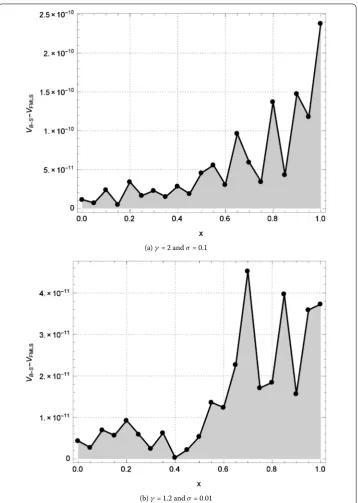
(a)γ= 2 andσ= 0.1
(b)γ= 1.2 andσ= 0.01
Figure 2 Comparison of BS versus FMLS solutions att= 1.
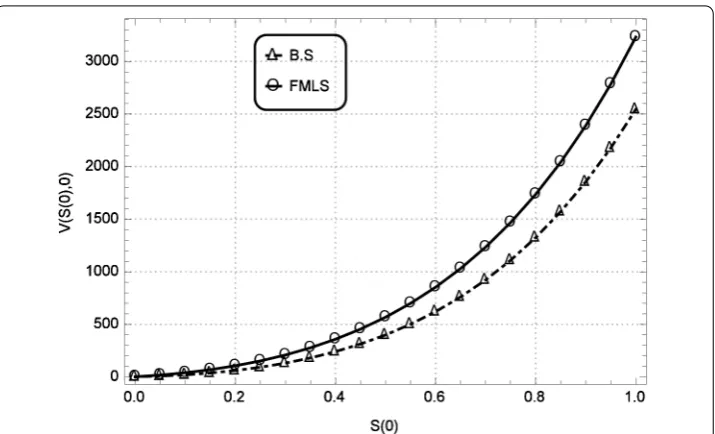
Figure 3 Simulated stock paths of BS and FMLS models atγ= 2,t= 0.
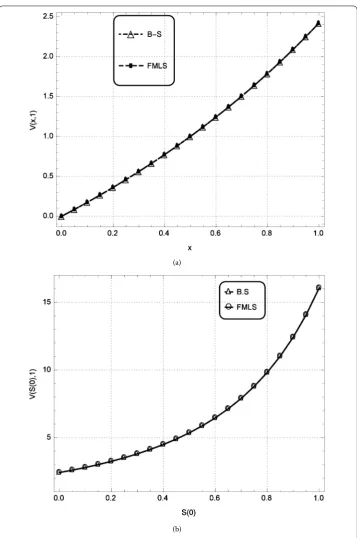
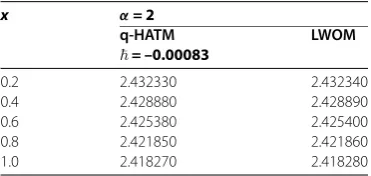
exhibited in Figures 4(a)-(b). The minimum values of the residual functionR(vij)≤10–kfor positive integersk= 1, 2, . . . , 15 can be seen in Table 1. The comparison between LWOM and q-HATM [22] is presented in Tables 2 and 3. Generally, LWOM solutions match with the q-HATM up to two to three decimal places.
6 Conclusions
This paper embodied the exploration of some applications of fractional partial differential equations in financial mathematics. Since the solutions of financial models are advanta-geous to illustrate multiple behaviors of the stock market prices, we undertook some well-known financial models, namely, the Black-Scholes (BS) model and a class of Lévy models, finite moment log stable model (FMLS). A new amalgamation of two eminent techniques, Legendre wavelets and differential evolution, was introduced for numerical demonstra-tion of stock market parameters of these models. Thus, from the facts and figures it is possible to conclude that:
• The Legendre wavelets optimization method is successfully implemented in the fractional partial differential models that occur in financial modeling.
• Legendre wavelets produce a good approximation of arbitrary functions. • LWOM enables to interpret the effects of the parameters smoothly.
• The numerical solutions of the model enable us to locate the pricing variations and the parameters affecting the stock market.
• From the simulated stock paths of the BS and FMLS models it can be easily depicted that the European call options of both the models converge asγ →2.
• Since Lévy models consider the jumps of the market, FMLS being a class of Lévy models shows an incremental path of the stock prices att= 0, which differs from the path of the BS model.
(a)
(b)
Figure 4 European call options of BS and FMLS models atγ= 2,t= 1.
Table 1 Global optimum residual errorsR(vij) forNP= 20
γ BS FMLS
σ= 0.01 σ= 0.1 σ= 0.01 σ= 0.1
2.0 9.4463×10⁻⁸ 7.3315×10⁻¹⁵ 2.0887×10⁻¹⁵ 7.3314×10⁻¹⁵
1.2 8.7099×10⁻¹⁵ 7.3312×10⁻¹⁵ 6.9499×10⁻¹⁵ 4.2934×10⁻¹⁵
Table 2 Comparison of LWOM with q-HATM [22] atσ= 0.1,x= 1, andn= 3
t α= 2
q-HATM = 0.00085
LWOM
0.2 0.383141 0.361403
0.4 0.759879 0.771825
0.6 1.223750 1.242120
0.8 1.796510 1.785540
1.0 2.475530 2.418280
Table 3 Comparison of LWOM with q-HATM [22] atσ= 0.1,t= 1, andn= 3
x α= 2
q-HATM = –0.00083
LWOM
0.2 2.432330 2.432340
0.4 2.428880 2.428890
0.6 2.425380 2.425400
0.8 2.421850 2.421860
1.0 2.418270 2.418280
• The proposed technique is appropriate for different financial models that can be expressed as partial or ordinary differential equations of integer and fractional orders, subjected to initial/boundary conditions.
Thus, this paper contributes a new method of finding solutions of FPDEs and presents wide applications of FPDEs in management sciences.
Acknowledgements
Author Najeeb Alam Khan would like to thank the Dean faculty of science of the University of Karachi for supporting this research.
Competing interests
The authors declare that they have no competing interests.
Authors’ contributions
All authors contributed equally to this work. All authors read and approved the final manuscript.
Author details
1Department of Computer Science, Muhammad Ali Jinnah University, Karachi, 75400, Pakistan.2Department of
Mathematics, University of Karachi, Karachi, 75270, Pakistan.3Department of Humanities & Natural Sciences, Bahria University, Karachi, 75260, Pakistan.4Department of Electrical Engineering, COMSATS Institute of Information Technology, Attock, Pakistan.
Publisher’s Note
Springer Nature remains neutral with regard to jurisdictional claims in published maps and institutional affiliations.
Received: 14 September 2017 Accepted: 28 December 2017 References
1. Merton, RC: Option pricing when underlying stock returns are discontinuous. J. Financ. Econ.3, 125-144 (1976) 2. Bates, D: Jump and stochastic volatility: exchange rate processes implicit in Deutsche mark in options. Rev. Financ.
3. Heston, SL: A closed-form solution for options with stochastic volatility with applications to bond and currency options. Rev. Financ. Stud.6(2), 327-343 (1993)
4. Singh, VK: Pricing competitiveness of jump-diffusion option pricing models: evidence from recent financial upheavals. Stud. Econ. Finance32(3), 357-378 (2015)
5. Cartea, A, del-Castillo-Negrete, D: Fractional diffusion models of option prices in markets with jumps. Physica A374, 749-763 (2007)
6. Company, R, Jódar, L, Pintos, JR: A numerical method for European option pricing with transaction costs nonlinear equation. Math. Comput. Model.50, 910-920 (2009)
7. Robinson, GK: Practical computing for finite moment log-stable distributions to model financial risk. Stat. Comput.
25(6), 1233-1246 (2015)
8. Carr, P, Wu, L: The finite moment log stable process and option pricing. J. Finance58(2), 753-777 (2003) 9. Carr, P, Geman, H, Madan, D, Yor, M: The fine structure of asset returns: an empirical investigation. J. Bus.75(2),
305-332 (2002)
10. Cartea, A, del Castillo-Negrete, D: Fractional diffusion models of option prices in markets with jumps. Physica A374, 749-763 (2007)
11. Koponen, I: Analytic approach to the problem of convergence of truncated Levy flights towards the Gaussian stochastic process. Phys. Rev. E52(1), 1197-1199 (1995)
12. Boyarchenko, SI, Levendorskii, SZ: Non-Gaussian Merton-Black-Scholes Theory. World Scientific, Singapore (2002) 13. Khan, NA, Razzaq, OA, Ayaz, M: Some properties and applications of conformable fractional Laplace transform (CFLT).
J. Fract. Calc. Appl.9(1), 72-81 (2018)
14. Caputo, M, Fabrizio, M: A new definition of fractional derivative without singular kernel. Prog. Fract. Differ. Appl.1(2), 73-85 (2015)
15. Atangana, A, Baleanu, D: New fractional derivatives with non-local and non-singular kernel theory and application to heat transfer model. Therm. Sci.20(2), 763-769 (2016)
16. Singh, J, Kumar, D, Qurashi, MA, Baleanu, D: A new fractional model for giving up smoking dynamics. Adv. Differ. Equ.
2017, Article ID 88 (2017)
17. Singh, J, Kumar, D, Baleanu, D: On the analysis of chemical kinetics system pertaining to a fractional derivative with Mittag-Leffler type kernel. Chaos27, 103-113 (2017)
18. Marom, O, Momoniat, E: A comparison of numerical solutions of fractional diffusion models in finance. Nonlinear Anal., Real World Appl.10, 3435-3442 (2009)
19. Delgado, VFM, Aguilar, JFG, Martinez, YH, Baleanu, D, Jimenez, RFE, Peregrino, VHO: Laplace homotopy analysis method for solving linear partial differential equations using a fractional derivative with and without kernel singular. Adv. Differ. Equ.2016, Article ID 164 (2016)
20. Acan, O, Baleanu, D: A new numerical technique for solving fractional partial differential equations (2017). arXiv:1704.02575
21. Ziane, D, Baleanu, D, Belghaba, K, Cheirf, MH: Local fractional Sumudu decomposition method for linear partial differential equations with local fractional derivative. J. King Saud Univ., Sci. (2017).
https://doi.org/10.1016/j.jksus.2017.05.002
22. Srivastava, HM, Kumar, D, Singh, J: An efficient analytical technique for fractional model of vibration equation. Appl. Math. Model.45, 192-204 (2017)
23. Singh, J, Kumar, D, Nieto, JJ: A reliable algorithm for local fractional Tricomi equation arising in fractal transonic flow. Entropy18, Article ID 206 (2016)
24. Heydari, MH, Hooshmandasl, MR, Mohammadi, F: Legendre wavelets method for solving fractional partial differential equations with Dirichlet boundary conditions. Appl. Math. Comput.234, 267-276 (2014)
25. Khan, NA, Razzaq, OA: An efficient computer based wavelets approximation method to solve fuzzy boundary value differential equations. Nonlinear Eng.5(1), 1-6 (2016)
26. Storn, R, Price, K, Lampinen, JA: Differential Evolution: A Practical Approach to Global Optimization. Springer, Berlin (2005)
27. Saruhan, H: Differential evolution and simulated annealing algorithms for mechanical systems design. Int. J. Eng. Sci. Technol.17, 131-136 (2014)
28. Meerschaert, MM, Tadjeran, C: Finite difference approximations for two-sided space-fractional partial differential equations. Appl. Numer. Math.56(1), 80-90 (2006)