R E S E A R C H
Open Access
Two-way relaying using constant envelope
modulation and phase-superposition-phase-forward
Huai Tan and Paul Ho
*Abstract
In this article, we propose the idea of phase-superposition-phase-forward (PSPF) relaying for 2-way 3-phase cooperative network involving constant envelope modulation with discriminator detection in a time-selective Rayleigh fading environment. A semi-analytical expression for the bit-error-rate (BER) of this system is derived and the results are verified by simulation. It was found that, compared to one-way relaying, 2-way relaying with PSPF suffers only a moderate loss in energy efficiency (of 1.5 dB). On the other hand, PSPF improves the transmission efficiency by 33%. Furthermore, we believe that the loss in transmission efficiency can be reduced if power is allocated to the different nodes in this cooperative network in an‘optimal’fashion. To further put the performance of the proposed PSPF scheme into perspective, we compare it against a phase-combining phase-forward
technique that is based on decode-and-forward (DF) and multi-level CPFSK re-modulation at the relay. It was found that DF has a higher BER than PSPF and requires additional processing at the relay. It can thus be
concluded that the proposed PSPF technique is indeed the preferred way to maintain constant envelope signaling throughout the signaling chain in a 2-way 3 phase relaying system.
Keywords:2-way relaying, phase-only-forward, decode-and-forward, cooperative communications, constant envelope modulation, continuous phase modulation, CPFSK, discriminator detection
1. Introduction
Cooperative transmission is a cost effective way to combat fading because it creates a virtual multiple-input-multiple-output (MIMO) communication channel without resort-ing to mountresort-ing antenna arrays at individual nodes [1,2]. Earlier researches on cooperative transmission focus on one-way relaying with amplify-and-forward (AF) and decode-and-forward (DF) protocols [3-5]. Orthogonal time-slots are employed by the source and the relay to allow the destination node to obtain independent faded copies of the same message for combining purpose [3,4]. The creation of these orthogonal time slots reduces the throughput of the system [6]. For example, the so-called Protocol II in [7] has a throughput of 1/Nmessage/slot, whereNis the number of relays in the system.
To improve the transmission efficiency of cooperative communication, two-way relaying is proposed [8-12]. For example in [12], a two-way relay network where two users exchange information with the assistance of an
intermediate relay node was considered. Specifically, the authors consider the so-called decode-superposition-for-ward (DSF) and decode-XOR-fordecode-superposition-for-ward (DXF) protocols for 2-way 3-phase relaying. These protocols can support bi-lateral transmission over three orthogonal time slots, leading to an improved throughput of 2/3 message/slot, i.e., a 33% improvement over 1-way relaying with a single relay.
The signals transmitted by all three nodes in the system in [12] are QAM-type linear modulations. While linear modulation has many desirable features, it imposes a relatively stringent requirement on amplifier linearity. This is especially true in the case of DSF, where the transmitted signal constellation at the relay is essentially the superposition of two constituent QAM constellations. In contrast, constant envelope modulation enables the use of inexpensive nonlinear (Class C) power amplifiers. These modulations are widely used in public safety (police, ambulance) and private mobile communication systems (taxi, dispatch, courier fleets), even though they are, in general, not as bandwidth efficient as QAM mod-ulations. The use of constant envelope modulations in
* Correspondence: [email protected]
School of Engineering Science, Simon Fraser University, Burnaby, British Columbia V5A 1S6, Canada
cooperative communications had been considered in [13-15]. Specifically, in [15], continuous-phase frequency-shift-keying (CPFSK) and phase-forward was proposed for 2-node MRC-type cooperative communication system with time-selective Rayleigh fading and discriminator detection. The authors reported that PF has a lower BEP than decode-and-forward. It also delivers the same per-formance as amplify-and-forward when dual-antenna selection is available at the relay. They concluded that PF is a cost-effective alternative to AF and DF, since it does not need signal regeneration at the relay nor does it need expensive linear amplifiers.
In this article, we consider the application of CPFSK and phase-forward in a 2-way 3-phase cooperative com-munication system with time-selective Rayleigh fading. A major contribution is in the development of a phase-superposition phase-forward (PSPF) strategy that main-tains the constant envelope property at the relay without resorting to any intermediate decoding. The usefulness of the proposed PSPF scheme is confirmed via a semi-analy-tical bit-error-rate (BER) analysis, as well as comparing it against one-way relaying and against a 2-way 3-phase strategy based on decode-and-forward and multi-level CPFSK re-modulation at the relay.
The article is organized as follows. We first describe in Section 2, the signal and system model for the proposed PSPF relaying scheme and competing Decode and For-ward (DF) schemes based on multilevel CPFSK re-modu-lation at the relay. The detection and combining strategies are presented in Section 3, followed by a discussion of implementation issues in Section 4. The BER of the pro-posed scheme is analyzed in Section 5, and the companion numerical results provided in Section 6. Finally, conclu-sions of this investigation are given in Section 7.
We adopt the following notations/definitions through-out the article:j2= -1; (·)* and |·| denote, respectively, the conjugate and magnitude of a complex number; (·)Tand (·)†represent, respectively, the regular and Hermitian transposes of a matrix;E[·] is the expectation operator;
1 2E
|x|2 the variance of a zero-mean complex random variablexwith independent and identically distributed (i.i.d.) real and imaginary components;CN(μ,s2) refers to a complex Gaussian random variable with meanμand variances2; sinc(x) = sin(πx)/(πx); and x˙ the derivative of x.
2. 3-phase 2-way cooperative communication system model
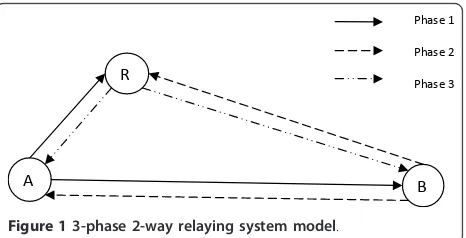
We consider a 3-phase 2-way relay cooperative commu-nication system consisting of three nodes: userAand its bilateral partner userB, as well as a relayR. All nodes operate in half duplex mode. The system diagram is shown in Figure 1. During the first phase,A transmits
its data toB, while BandRlisten. The received signals atRandBare
yR,1(t) =gAR(t)xA(t) +nR,1(t) (1) and
yB,1(t) =gAB(t)xA(t) +nB,1(t), (2) where xA(t) is the signal transmitted by A,nR,1(t) and nB, 1(t) the zero-mean complex additive white Gaussian noise (AWGN) terms atRandBin the first phase, and gAR(t) andgAB(t) the zero-mean complex Gaussian pro-cesses that represent Rayleigh fading in the A-Rand A-Blinks.
In the second phase, it isB’s turn to transmit its data toA. This time, bothAandRare in the listening mode. The received signals atRand Aare
yR,2(t) =gBR(t)xB(t) +nR,2(t) (3) and
yA,2(t) =gBA(t)xB(t) +nA,2(t), (4) wherexB(t) is the signal transmitted byB,nR, 2(t) and nA,2(t) the AWGNs atRandAin the second phase, and gBR(t) andgBA(t) the zero-mean complex Gaussian pro-cesses that represent Rayleigh fading in theB-RandB-A links.
Finally in the last phase, onlyRtransmits, bothAand Blisten. The received signals atAandBare
yA,3(t) =gRA(t)xR(t) +nA,3(t) (5) and
yB,3(t) =gRB(t)xR(t) +nB,3(t), (6) where xR(t) is the signal transmitted byR,nA,3(t) and nB,3(t) the complex AWGNs atA and B in the third phase, and gRA(t) and gRB(t) the zero-mean complex Gaussian processes that represent Rayleigh fading in the R-AandR-B links. In this investigation, we assume the six fading processes in (1) to (6) are statistically
R
A B
Phase1
Phase2
Phase3
independent. In addition, all the six noise terms in (1) to (6) are i.i.d.
In this article, all the transmitted signals xA(t),xB(t), andxR(t) are constant envelope signals.
Specifically, the former two are CPFSK signals of the form
xi(t) =ejθi(t); i∈ {A, B}, (7) where
θi(t) =πh
k−1
n=0
di,n
+πhdi,k·(t−kT)/T, kT<t≤(k+ 1)T, (8)
is the information carrying phase, with di, k Î {±1} being the data bit in thek-th symbol interval for Useri, iÎ {A,B},hbeing the modulation index, andT the bit-duration. Note that the derivative of the information carrying phase is
˙
θi(t) =πhdi,k/T, kT<t≤(k+ 1)T, (9) which is proportional to the data bitdi, k. This property is crucial in understanding the decision rule made by the discriminator detector presented in the next section. Another property of CPFSK that is important to the understanding of the results is the bandwidth of the sig-nal. It is well known [16] that CPFSK signals, are in gen-eral, not band-limited. As such, a common practice is to adopt the frequency range that contains 99% of the total signal power as the bandwidth of the signal. This is referred to as the 99% bandwidth [16]. As an example, consider the so-called minimum shift keying (MSK) scheme, i.e., CPFSK withh= 1/2. Using the results from [17], the 99% bandwidth of MSK is found to be 1.1818/T.
2.1 Phase superposition phase forward
The signal transmitted by the relay, xR(t), assumes the following form
xR(t) = exp
jarg[yR,1(t)] + arg[yR,2(t)] , (10) where arg[yR,1(t)] and arg[yR,2(t)] are the phases of the signalsyR,1(t) andyR,2(t), respectively. Note thatxR(t) is both constant envelope and continuous-phase, just like the data signalsxA(t) andxB(t). We thus call the forward-ing strategy in (10) a phase superposition-phase-forward (PSPF) scheme. Since this phase superposition is equiva-lent to a multiplication of (the hard-limited versions of) the signalsyR,1(t) andyR,2(t) in the time domain, the cor-responding frequency domain convolution will lead to a spectrum expansion if the relay is destined to transmit without any bandwidth limitation.
One nice feature of the proposed PSPF technique is that constant envelope signaling is maintained at the relay without requiring it to perform any demodulation and
re-modulation. A natural question to ask is, how does PSPF compare to decode-and-forward strategies that employ constant envelope signaling at the relay? To be able to answer this question, we introduce next the 3-level decode-and phase-forward (3-DPF) scheme and the alter-nate 4-level decode-and-phase-forward (A4-DPF) scheme as possible alternatives to PSPF. For both schemes, the relay first make decisions on UserA’s and UserB’s data based on the its received signalsyR,1(t) andyR,2(t). It then applies the decisions, dˆA,n and dˆB,n, to (7) and (8) to re-generate User A’s and User B’s signals according to
ˆ
xA(t) = exp
jθˆA(t)
andxˆB(t) = exp
jθˆB(t)
.
2.2 3-level decode and phase forward (3-DPF)
With this decode and forward strategy, the relay adds the decoded phases in xˆA(t) and xˆB(t) synchronously to form the relay signal
xR(t) = exp
j
ˆ
θA(t) +θˆB(t)
=xˆA(t)xˆB(t). (11)
This signal is both constant envelope and continuous-phase, just like the data signalsxA(t) and xB(t). Further-more, because of synchronous mixing, we can viewxR(t) as a 3-level CPFSK signal with modulation indexhand symbol values +2, 0, -2 that occur with priori probabil-ities 14,12,14. The three signal levels and the correspond-ing priori probabilities are due to the fact that the decoded bits dˆA,n and dˆB,n at the relay are {± 1} binary random variables. Another consequence of synchronous phase mixing is that the bandwidth ofxR(t) is less than the sum bandwidth of xˆA(t) and xˆB(t), even though
xR(t) =ˆxA(t)xˆB(t). Using MSK as example again, the sum bandwidth is two times 1.1818/Tor 2.3636/T. The 99% bandwidth of the correspondingxR(t), on the other hand, is only 1.832/T.
2.3 Alternate 4-level decode and phase forward (A4-DPF) In general, we can construct a constant-envelope relay signal based on the superposition of the decoded phases as follows
xR(t) = exp
jwAθˆA(t) +wBθˆB(t)
(12)
the unequal weightings on the two decoded phases will translate into an asymmetric error performance at A and B. This problem can be alleviated by alternating the weighting rules between even and odd time slots as follows:
wA= 2,wB= 1; even time slot,
wA= 1,wB= 2; odd time slot.
(13)
We call this strategy alternate 4-level decode and phase forward or A4-DPF.
3. Discriminator detection of the relay signals As shown in (1) to (6), the transmitted signals atA,B, and R, will in general, experience time-selective fading. This makes the implementation of coherent detection rather complicated. As such we consider the much simpler dis-criminator detector. This non-coherent detector does not need channel state information when making data deci-sions and it thus spares the receiver from performing com-plicated channel tracking and sequence detection tasks. Without loss of generality, we demonstrate in the follow-ing sections how UserAdetects the data intended for it from UserB, i.e., thedB, k’s, using a discriminator detector. The detection of UserA’s data at NodeBfollows exactly the same procedure. It is further assumed that ideal low-pass filters (LPF) are used to limit the amount of noise admitted into the detector, with the bandwidth of each receive LPF set to the 99% bandwidth of its incoming signal. As such, the noise processes in (1) to (6) are all band-limited white Gaussian noises.
3.1 Detection of PSPF signals
To see how discriminator detector works in the proposed PSPF system, we first rewrite the two received signals at the relay as
yR,1(t) =gAR(t)ejθA(t)+nR,1(t) =aR,1(t)ejψR,1(t) (14) and
yR,2(t) =gBR(t)ejθB(t)+nR,2(t) =aR,2(t)ejψR,2(t), (15) whereaR,1(t), aR,2(t),ψR,1(t), andψR,2(t) are the ampli-tudes and phases of the two signals. As stated in (10), the relay broadcasts
xR(t) = exp
jθR(t)
,
θR(t) =ψR,1(t) +ψR,2(t),
(16)
toAandBin the last phase. Substituting (16) into (5), the received signal at Aduring the third phase can now be written as
yA,3(t) =gRA(t)ejθR(t)+nA,3(t) =aA,3(t)ejψA,3(t), (17)
whereaA,3(t) andψA,3(t) are, respectively, the ampli-tude and phase.
In order to detect the signal from B, User A first removes its own phase θA(t) fromψA,3(t). The resultant complex signal is
YA,3(t) =aA,3(t)ejA,3(t),
A,3(t) =ψA,3(t)−θA(t).
(18)
It then combines YA,3(t), non-coherently, with the signal
yA,2(t) =gBA(t)ejθB(t)+nA,2(t) =aA,2(t)ejψA,2(t) (19) from (4), whereaA,2(t) andψA,2(t) are, respectively, the received signal amplitude and phase.
Specifically at the decision making instant, which is taken to be the mid-symbol position in each bit interval, the non-coherent detector adds the phase derivatives
˙
ψA,2 and ˙A,3 according to the maximal ratio combin-ing principle [15]
D=D2+D3, (20)
Where
D2= 2a2A,2ψ˙A,2= (y∗A,2y˙∗A,2)
0−j j 0
yA,2 ˙
yA,2
,
D3= 2a2A,3˙A,3= (YA∗,3Y˙A∗,3)
0−j j 0
YA,3 ˙
YA,3
,
(21)
and then makes a decision on the data bit in question, dB, according to
ˆ
dB,k= sgn(D). (22)
An intuitive understanding of the above decision rule can be gained by considering the ideal situation where there are no fading and noise in all the links. In this case, the received phase derivatives at the relay and at nodeAduring the first and second phases of transmis-sion are ψ˙R,1(t) =πhdA,k/T and ψ˙A,2(t) =πhdB,k/T; see (9). Furthermore, the received phase derivative at node
A during the third phase is simply
˙
ψA,3(t) =πh(dA,k+dB,k)/T. As a result, ˙
3.2. Detection of the 3-DPF and A4-DPF signals
From the discussion in Sections 2.1 and 2.3, we can see that 3-DPF is a specific case of A4-DPF. For both schemes, the relay broadcasts a signal of the form xR(t) = exp
jθR(t)
in the final phase of cooperation,
where θR(t) =
wAθˆA(t) +wBθˆB(t)
is the phase of the
relayed signal,θˆA(t)andθˆB(t) are the decoded phases at the relay, (wA,wB) = (1,1) for 3-DPF, and (wA,wB) alter-nates between (3,1) and (1,3) for A4-DPF. Using (17) as the definition of the received signal at A during the third phase, we first remove A’s own phase from ψA,3(t)
and then combine the derivative ofΨA,3(t) non coher-ently with ψ˙A,2, the received phase derivative at A in Phase 2, according to (20) and (21). As in the case of PSPF, the decision rule is given by (22).
One nice feature about DF-based strategies is that the modulation index used at the relay,hR, needs not to be identical toh, the modulation index used by A and B. This flexibility is especially important if we want to impose stringent bandwidth requirement on the signal transmitted by the relay. If the relay does use a different modulation index, the effective form of the forwarded
phase is θR(t) =ρ
wAθˆA(t) +wBθˆB(t)
, wherer =hR/h is the ratio of modulation indices. In this case, (23) should be modified to
before combining with ψ˙A,2 according to (20) and (21).
4. Implementation issues
We provide in this section some implementation guide-lines for the proposed PSPF strategy. Comparison with the considered decode-and-forward schemes, in terms of implementation complexity, will also be made.
According to (10), a PSPF relay needs to first convert the signalsyR,1(t) andyR,2(t) in (1) and (3) into the con-relaying. Given that the relay is half-duplex and cannot transmit and receive at the same time, it must first detect and store (the sufficient statistics of) the data packets it receives from A and B in their entireties
before generating and forwarding the product constant envelope signal in the final phase. The procedure requires frame synchronization at the relay to ensure proper time-alignment of ˆyR,1(t) and yˆR,2(t). This can be done by inserting a special sync pattern into each data packet and correlating the received signals with this pattern at the relay. As for storage of the entire frames of yˆR,1(t) and yˆR,2(t), this will be done in the digital domain via sampling and quantization. The mini-mum sampling frequency will be twice the bandwidth of xR(t), rather than twice the bandwidth of individual
ˆ
yR,1(t) and ˆyR,2(t). This stems from the fact that signal mixing (multiplication) is a bandwidth-expanding pro-cess. We found that when the two source signals in (1) and (3) (namelyxA(t) and xB(t)) are MSK, then the pro-duct signalxR(t) has a bandwidth of 1.832/T, where 1/T is the bit rate. Therefore, in this case, a sampling fre-quency of 4/Twould be sufficient to create signal sam-ples that capture all the information about the product signal. As for quantization, it is relatively straight for-ward because, unlike the original received signalsyR,1(t) and yR,2(t), the real and imaginary components of
ˆ
yR,1(t) and ˆyR,2(t) all have finite dynamic range. Speci-fically, the values of these components are confined to the interval [-1, +1]. Given the limited dynamic range, we can use a simpleb + 1 bits uniform quantizer, where b is chosen such that the signal-to-quantization noise ratio (SQNR) is much higher than the channel signal-to-noise ratio seen at the destination receiver. Since the SQNR of a uniform quantizer (assuming that the real and imaginary components of yˆR,1(t) and yˆR,2(t) are uniformly distributed in [-1, +1]) varies according to 22 (B + 1)
[18], an 8-bit (b= 7) quantizer can already yield a SQNR of 48 dB, which is much higher than the antici-pated channel Signal-to-Noise-Ratio (SNR).
From the above discussion, it becomes clear that the proposed PSPF scheme requires a total of
NPSPF = 4·(b+ 1)·K·N (25) bits to store the signals yˆR,1(t) and yˆR,2(t) at the relay, where fs = K/T is the sampling frequency,b + 1is the number of bits used in quantization,Nis the num-ber of bits in each data packet, and the factor of 4 is the total number of real and imaginary components in
ˆ
yR,1(t) and yˆR,2(t). In contrast, the 3-DPF and A4-DPF schemes described in Sections 2.2 and 2.3 require only
NDPF = 2N (26)
requirement comes at the expense of additional compu-tations required for demodulation and re-modulation at the relay. According to (21), the discriminator detec-tor used for demodulation needs to compute the phase derivatives in the original received signalyR,1(t) and yR,2 (t) at the decision making instants. These derivatives can be expressed in terms of the constant envelope signals yˆR,1(t) and ˆyR,2(t) as −j· ˆy∗R,1(t)y˙ˆR,1(t) and −j· ˆy∗R,2(t)˙ˆyR,2(t), where yˆ∗ and ˙ˆyrepresent respectively signal conjugation and derivative. Let us assume the two signal derivativesy˙ˆR,1(t)andy˙ˆR,2(t)are computed in the digital domain with yˆR,1(t) and yˆR,2(t) represented by samples spacedT/K seconds apart, whereKis an inte-ger that is large enough to ensure that the sampling fre-quencyfs =K/Tis higher than twice the bandwidth of the product signal xR(t) =yˆR,1(t)yˆR,2(t). Then the corre-sponding discrete-time differentiator is simply a K-tap digital finite impulse response filtera with a computa-tional complexity of K complex multiply-and-add (CMAD) for each decoded bit dˆA,n or dˆB,n. As a result, the total demodulation complexity is
CDEMOD= 2KN(CMAD) (27)
As for the re-modulation complexity in DPF, if we assume a table look-up based modulator, then the basic operations are waveform fetching and concatenation. These operations can be assumed insignificant when compared to the multiply-and-add operations men-tioned above. Although a table-look-up re-modulator requires storage of all possible modulation waveforms, this should not be counted towards the storage require-ment of the two DPF schemes, since the modulator is always required to transmit a node’s own data, irrespec-tive of whether it uses PSPF or DPF while in the relay mode. Another implementation structure that is com-mon to PSPF and DPF is the analog-to-digital converter front end.
In summary, from the computational complexity point of view, PSPF is simpler because it avoids the CMAD operations required for demodulation at the relay. Although it requires substantially more storage, the tra-deoff still favors PSPF because memory is inexpensive while additional computational load can, in general, lead to quicker battery drain and even the need of a more powerful processor. We note further that the complexity of PSPF can be further reduced if we adopt direct band-pass processing. This is achieved by first band-passing ˜yR,1(t) and y˜R,2(t), the bandpass versions of yR,1(t) andyR,2(t), through a bandpass filter, followed by bandpass limiting [19], then bandpass sampling [20] and quantization. As shown in [20], the sampling frequency of the bandpass
signals is roughly the same as that of their complex baseband versions. Therefore, no high-speed analog to digital converter (ADC) is required. By direct bandpass processing, we can bypass up and down conversions in PSPF altogether, which in turn reduces the number of multiplication and addition required to perform these steps in a digital modulator/demodulator. It should be emphasized that with decode-and-phase-forward, down and up conversion are unavoidable.
5. Performance analysis 5.1. The BER of PSPF
The BER performance of the proposed PSPF scheme with discriminator detection is evaluated using the characteristic function (CF) approach; see [15]. In the analysis, the var-iances of the fading processesgAR(t),gBR(t),gAB(t),gBA(t),
gRB, respectively, with
σ2
nB,3, respectively, with
σ2
whereN0is the noise power spectral density (PSD),B12the bandwidth of the receive LPFs in Phases I and II, andB3 the bandwidth of the receive LPF in Phase III. In this inves-tigation,B12is always set to the 99% bandwidth ofxA(t) and xB(t), whileB3is either the same asB12, or set to the 99% bandwidth of the relay signalxR(t). Given the nature of the symbol-by-symbol detectors described in the previous sec-tion, we take the liberty to drop the symbol index k indA, k anddB, kin the performance analysis.
First, it is observed that the terms D2 in (21) is a quadratic forms of complex Gaussian variables (yA,2,y˙A,2) when conditioned on θ˙B; refer to the Appen-dix for the statistical relationships between different parameters in the general channel model
y(t) =g(t)ejθ(t)+n(t) =a(t)ejψ(t),
whereg(t) andn(t) are, respectively, CN
0,σg2
and
CN0,σn2 ,θ(t) is the signal phase, and a(t) and ψ(t) are respectively the amplitude and phase ofy(t). With-out loss of generality, we assume dB, k= +1 and hence
˙
can find the two poles of the CF ofD2 as following:
whereaA,2,bA,2,rA,2are determined from (A10) under the conditions θ˙=πh/T, σ2
g =σg2BA, and σ
2
n =N0B12;B12 the bandwidth of the receive filter in Phases I and II.
How about the term D3 in (21)? This term can be
which is once again a quadratic form of complex Gaussian variables. This quadratic form, however, depends on a number of parameters. First is the data phase derivation θ˙A. Second, it depends on the for-warded phase derivative θ˙R=ψ˙R,1+ψ˙R,2, which in turns
determine from (A10) the poles of the CF ofD3as
Q1= decision when D< 0. Since the characteristic function ofDis φD(s) = (p1p2)(Q1Q2)
{(s−p1)(s−p2)(s−Q1)(s−Q2)},
the probability that D< 0 is the sum of residues of -jD(s)/sat the right plane polesp2andQ2, yielding given θ˙A and θ˙B, respectively, the unconditional error probability can be expressed in semi-analytical form as
Pb=1
where the marginal probability density functions (PDF) p(ψ˙R,1| ˙θA=πhdA/T) and p(ψ˙R,2| ˙θB=πh/T) can be determined from (A5) to (A6) in the Appendix.
5.2. BER of 3-DPF and A4-DPF Signals
The two multi-level DPF signals broadcasted by the relay in (11) and (12) are constructed from decisions made by the relay about UsersAand B’s data. Although different from (10), the exact BER analysis of these sig-nals can still be determined via the characteristic func-tion approach. This stems from the fact that the decision variable D of these DPF schemes are again quadratic forms of complex Gaussian variables when conditioned on the data phase derivatives θ˙A and θ˙B, as well as their decoded versions θ˙ˆAandθ˙ˆBat the relay. Specifically, the poles of the CF of D2 are identical to those in the PSPF case, and can be found in (28). As for the poles of the CF ofD3, we should first replace the term θ˙ in the Appendix byθ˙R=wAθ˙ˆA+wBθ˙ˆBand then modify theFmatrix in (A10) to
F=
The resultant poles are found to be
Z1= Phase III. As in the case of PSPF, the conditional BER is expressed in the form
wAandwBin (13). It should be pointed out the error prob-abilitiesPe, AandPe, B can be determined by integrating the marginal pdf in (A6) from -∞to 0 when the data bit is a + 1, or from 0 to +∞when the data bit is a -1. The end result is of the form [15,21]
Pe,i= 1
2(1− |ρi|); i=A,B, (37)
where |rA| and |rB| are |r| in (A5) obtained under the conditions σg2=σg2AR, σ
2
n =N0B12 and
σ2
g =σg2BR,σ
2
n =N0B12, respectively. 6. Results
We present next some numerical results for the pro-posed 2-way 3-phase PSPF and DPF relaying schemes. For simplicity, we only consider the case of minimum shift keying (MSK), i.e.,h= 1/2, and plot the BER of the resultant cooperative communication system as a func-tion of the SNR in the direct link between AandB. In general, the SNR of a link is defined as the fading var-iance σg2 to noise variance σn2 ratio in that link. Since the energy per transmitted bit is Eb=σg2ABT and the
noise variance is σn2=N0B12=N0×1.1818/T in the direct link, whereN0is the noise power spectral density and 1.1818/Tis the 99% bandwidth of MSK, the SNR is equivalent to 0.85Eb/N0. Unless otherwise stated, all the links are assumed to have the same SNR and the same fade ratefd.
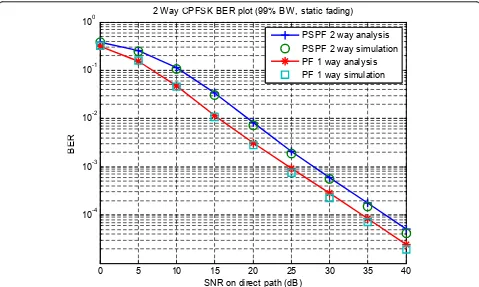
Figure 2 considers the case of static fading. Figure 3 considers the case of time-selective fading with a nor-malized Doppler frequency offdT= 0.03 in all the links. To put the 2-way relaying results into perspective, we compare them against the 1-way relaying results from [15] for MSK source signal and phase-forward relay sig-nal. The BER curves shown in these figures were obtained from the semi-analytical expression in (22) and as well as from simulation. The two sets of results are in good agreement.
In the static fading case, it is observed from Figure 2 that 2-way relaying is consistently 3 dB less power effi-cient than 1-way relaying over a wide range of BER. In the‘fast’fading case, 2-way relaying has an irreducible error floor around 10-3while that of 1-way relaying sits at 6 × 10⁻⁴. Above the irreducible error floors and at a BER of 10-2, the difference between 1 and 2-way relay-ing is about 5 dB.
One source for the degraded performance stated above is simply energy normalization. In both figures, we assume all the nodes transmit with a bit-energy of Eb. This means 1-way relaying needs a total of 4Ebto transmit two bits while 2-way relaying needs only 3Ebto transmit the same amount of information. Therefore, if
we normalize the energy, the difference between the two schemes in the static fading case actually reduces to only 1.5 dB. We regard this loss as acceptable, given that 2-way relaying improves the transmission efficiency by 33%.
The results obtained above were based on using a receive low pass filter (LPF) in the R-A path whose bandwidth, B3, equals the 99% bandwidth of the relay signal. As mentioned earlier, because of the spectral convolution effect, the bandwidth of the relay signal is larger than that of the original MSK signal and is found to be 1.832/T. A natural question is, how would PSPF perform if the signal in theR-Apath is band-limited to that of the MSK signal? Specifically, what is the tradeoff between a reduced noise figure, but an increased signal distortion because of tighter filtering?
Figure 4 shows the effect of using the same LPF in the relay path and the direct path, i.e., B3=B12= 1.1818/T. The simulation results show that with a narrower filter in the relay path, the proposed PSPF scheme actually achieves a better performance. We attribute this to the fact that non-coherent detection is not match filtering, and the reduction in noise level through tighter filtering more than compensates for the self interference that it generates.
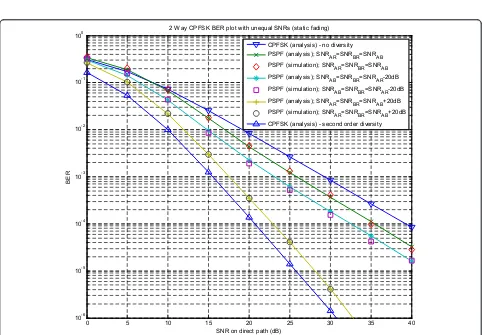
In a 3-phase 2-way system, the SNRs of different links are not necessarily equal. For instance, if the relay is much closer to one ofAand B, then we expect the SNR in theAR or BRlink to be higher than that in the AB link. We next show in Figures 5 and 6 BER results for different asymmetric channel conditions, for both static fading and time-selective fading with a normalized fade rate of 0.03. As in Figure 4, the bandwidth of the LPF filter in theR-A path is set to that of MSK. Three differ-ent scenarios are considered–(1) all the links have the same SNR, (2) the two source-relay paths have higher SNRs, and (3) only one of the source-relay paths is stronger. Also included in Figures 5 and 6 are the BERs of MSK without diversity and with dual-receive diver-sity. From the figures, we can see that when the SNR in both the A-RandB-Rlinks is 20 dB stronger than that in theA-Blink, the BER curve exhibits a very prominent second order diversity effect. In contrast, when all the three links are equally strong, the diversity effect disap-pears (the case when only the ARlink has a higher SNR than theA-Blink falls in between these two cases).
0 5 10 15 20 25 30 35 40 10-4
10-3 10-2 10-1 100
SNR on direct path (dB)
BER
2 Way CPFSK BER plot (99% BW, static fading)
PSPF 2 way analysis PSPF 2 way simulation PF 1 way analysis PF 1 way simulation
Figure 2BER of PSPF 2-way 3-phase cooperative transmission in a static Rayleigh fading channel;B12= 1.1818/TandB3= 1.832/T.
0 5 10 15 20 25 30 35 40 10-4
10-3 10-2 10-1 100
SNR on direct path (dB)
BER
2 Way CPFSK BER plot (99% BW, fdT=0.03)
PSPF 2 way analysis PSPF 2 way simulation PF 1 way analysis PF 1 way simulation
0 5 10 15 20 25 30 35 40 10-3
10-2 10-1 100
SNR on direct path (dB)
BER
2 Way CPFSK BER plot with different Rx LPF
PSPF analysis; LPF BW=1.832/T PSPF simulation; LPF BW=1.832/T PSPF analysis; LPF BW=1.1818/T PSPF simulation; LPF BW=1.1818/T
Figure 4Effect of using the different LPF bandwidth,B3, in Phase 3 of PSPF 2-way 3-phase cooperative transmission;fdT= 0.03.
0 5 10 15 20 25 30 35 40
10-6 10-5 10-4 10-3 10-2 10-1 100
SNR on direct path (dB)
BE
R
2 Way CPFSK BER plot with unequal SNRs (static fading)
CPFSK (analysis) - no diversity PSPF (analysis); SNRAR=SNRBR=SNRAB
PSPF (simulation); SNRAR=SNRBR=SNRAB
PSPF (analysis); SNRAB=SNRBR=SNRAR-20dB
PSPF (simulation); SNRAB=SNRBR=SNRAR-20dB
PSPF (analysis); SNRAR=SNRBR=SNRAB+20dB
PSPF (simulation); SNRAR=SNRBR=SNRAB+20dB
CPFSK (analysis) - second order diversity
0 5 10 15 20 25 30 35 40
10-3
10-2
10-1
100
SNR on direct path (dB)
BE
R
2 Way CPFSK BER plot with unequal SNRs (fdT=0.03)
CPFSK (analysis) - no diversity
PSPF (analysis); SNRAR=SNRBR=SNRAB
PSPF (simulation); SNRAR=SNRBR=SNRAB
PSPF (analysis); SNRAB=SNRBR=SNRAR-20dB
PSPF (simulation); SNRAB=SNRBR=SNRAR-20dB
PSPF (analysis); SNRAR=SNRBR=SNRAB+20dB
PSPF (simulation); SNRAR=SNRBR=SNRAB+20dB
CPFSK (analysis) - second order diversity
Figure 6BER atBfor unequal SNR and a fade rate offdT= 0.03; SNRAR, SNRBR, and SNRABare the SNR’s in theA-R, B-R, andA-Blinks.
0 5 10 15 20 25 30 35 40
10-4
10-3
10-2
10-1
100
SNR on direct path (dB)
BE
R
Multi-Level DFP and PSPF (equal links, static fading)
3-DPF analysis 3-DPF simulation A4-DPF analysis A4-DPF simulation PSPF analysis PSPF simulation
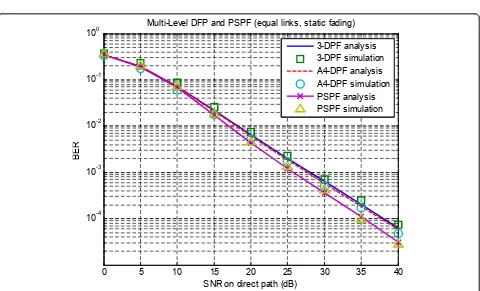
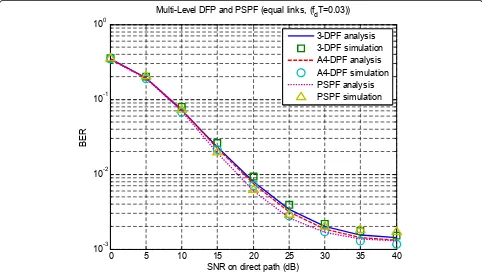
fading, the simulation results indicate PSPF and A4-DPF have somewhat similar performance and both are more power efficient than 3-DPF. Hence, it can be concluded that the proposed PSPF scheme not only offers a com-plexity advantage over multi-level DPF, it also provides a BER advantage.
7. Conclusions
We consider in this article the use of constant envelope modulation in 2-way 3-phase cooperative transmission. Specifically, a technique referred to as PSPF is proposed and its BER performance compared to 1-way relaying and to 2-way relaying based on decode-and-forward and multi-level re-modulation. As demonstrated in the paper, the proposed technique allows us to maintain constant envelope signaling throughout the signaling chain and does not require complicated signal proces-sing at the relay like its decode-and-forward counter-parts. Through analytical and simulation studies, we found that the BER of PSPF with discriminator detec-tion in Rayleigh fading suffers only a moderate loss in energy efficiency (of 1.5 dB after energy normalization) when compared to its 1-way relaying counterpart. We consider this loss as acceptable, considering that PSPF improves the transmission efficiency by 33% and it offers a way to avoid expensive linear power amplifiers and complicated signal processing at the relay. We also found that, in comparison with its decoded and forward
counterparts, the proposed PSPF scheme offers a lower BER, while at the same time relieves the relay from per-forming unnecessary demodulation and re-modulation tasks.
Appendix
We discuss in this Appendix the statistical properties of the faded signal
y(t) =g(t)ejθ(t)+n(t) =a(t)ejψ(t), (A1) whereg(t)and n(t)are zero-mean complex Gaussian processes with variances (per dimension) of σg2 and σn2, respectively,θ(t)the transmitted signal phase, which is treated as a‘deterministic’parameter, anda(t)andΨ(t), respectively, the amplitude and phase of y(t). Further-more, the autocorrelation functions of g(t) follows a Jakes spectrum, that is
Rg(τ) = 12E
g∗(t)g(t+τ)=σg2J0(2πfdτ) (A2) wherefdis the bandwidth (Doppler frequency) ofg(t). The noise term, n(t), on the other hand, is band-limited white noise with an autocorrelation function of
Rn(τ) = 12E
n∗(t)n(t+τ)=σn2sinc(Bτ); (A3) where σ2
n =N0B,N0 being the power spectral density ofn(t), andBthe bandwidth of ejθ(t).
0 5 10 15 20 25 30 35 40
10-3
10-2
10-1
100
SNR on direct path (dB)
BE
R
Multi-Level DFP and PSPF (equal links, (fdT=0.03))
3-DPF analysis 3-DPF simulation A4-DPF analysis A4-DPF simulation PSPF analysis PSPF simulation
At any time instant, the joint pdf of a, its derivative
˙
a, ψ its derivative ψ˙, given the data phase derivative
˙ y(t), respectively. A useful marginal pdf of (A4) is the pdf of ψ˙ given θ˙, which is found to be
Another useful property is that the random vector
r=
is zero mean complex Gaussian with a covariance matrix of
Consequently, the CF of the quadratic form
D=r†Fr (A9)
is
φ(s) =I+ 2sF−1= p1p2 (s−p1)(s−p2)
, (A10)
where ||•|| denotes the determinant of a matrix,sthe transform domain parameter, and p1 < 0 andp2 > 0, respectively, the left and right plane poles of the CF.
Endnotes a
Note that in theory, we can use a higher (>K) order dif-ferentiator to improve the accuracy of the derivative estimate. However, it is unclear if this is actually benefi-cial in practice, given that such a differentiator inevitably involves using samples that span multiple bits and the bit transitions may actually degrade the accuracy of the derivative estimate at the decision making instants.
List of abbreviations
AF: amplify-and-forward; ADC: analog to digital converter; A4-DPF: alternate 4-level decode-and-phase-forward; AWGN: additive white Gaussian noise; BER: bit-error-rate; CF: characteristic function; CPFSK: continuous-phase frequency-shift-keying; DF: decode-and-forward; DSF: decode-superposition-forward; 3-DPF: 3-level decode-and phase-decode-superposition-forward; DXF: decode-XOR-forward; LPF: low-pass filters; MIMO: multiple-input-multiple-output; MSK: minimum shift keying; PSD: power spectral density; PDF: probability density function; PSPF: phase-superposition-phase-forward; SQNR: signal-to-quantization noise ratio.
Acknowledgements
This work was supported by the Natural Sciences and Engineering Research Council (NSERC) of Canada. It was presented in parts at VTC 2010F in Ottawa, Canada, Sept 2010.
Competing interests
The authors declare that they have no competing interests.
Received: 14 December 2010 Accepted: 6 October 2011 Published: 6 October 2011
References
1. A Nosratinia, TE Hunter, A Hedayat, Cooperative communication in wireless network. IEEE Commun Mag.42(10), 74–80 (2004). doi:10.1109/
MCOM.2004.1341264
2. A Sendonaris, E Erkip, B Aazhang, User cooperative diversity–part I: system description. IEEE Trans Commun.51(11), 1927–1938 (2003). doi:10.1109/ TCOMM.2003.818096
3. JN Laneman, DNC Tse, GW Wornell, Cooperative diversity in wireless networks: efficient protocols and outage behavior. IEEE Trans Inf Theory 50(12), 3062–3080 (2004). doi:10.1109/TIT.2004.838089
4. A Ribeiro, XD Cai, GB Giannakis, Symbol error probabilities for general cooperative links. IEEE Trans Wireless Commun.4(3), 1264–1273 (2005) 5. YD Jing, H Jafarkhani, Single and multiple relay selection schemes and their
achievable diversity orders. IEEE Trans Wireless Commun.8(3), 1414–1423 (2009)
6. Y Zhao, R Adve, TJ Lim, Improving amplify-and-forward relay networks: optimal power allocation versus selection. IEEE Trans Wireless Commun. 6(8), 3114–3123 (2007)
7. RU Nabar, H Bolcskei, FW Kneubuhler, Fading relay channels: performance limits and space-time signal design. IEEE J Select Areas Commun.22(6), 1099–1109 (2004). doi:10.1109/JSAC.2004.830922
8. SJ Kim, P Mitran, V Tarokh, Performance bounds for bidirectional coded cooperation protocols. IEEE Trans Inf Theory54(11), 5235–5241 (2008) 9. XJ Zhang, Y Gong, Adaptive power allocation in two-way
amplify-and-forward relay networks, inIEEE ICC’09(August 2009)
10. ZH Yi, IM Kim, Optimum beamforming in the broadcasting phase of bidirectional cooperative communication with multiple decode-and-forward relays. IEEE Trans Wireless Commun.8(12), 5806–5812 (2009)
11. QF Zhou, YH Li, FCM Lau, B Vucetic, Decode-and-forward two-way relaying with network coding and opportunistic relay selection. IEEE Trans Commun. 58(11), 3070–3076 (2010)
12. M Chen, A Yener, Power allocation for multiple access two-way relaying, in
Proceedings of IEEE ICC’09, Dresden, Germany, (June 2009) 13. RL Maw, PA Martin, DP Taylor, Cooperative relaying with CPFSK and
distributed space-time trellis codes. IEEE Commun Lett.12(5), 356–358 (2008)
14. MC Valenti, D Torrieri, T Ferrett, Noncoherent physical-layer network coding using binary CPFSK modulation, inMillcom 2009(October 2009) 15. Q Yang, P Ho, Cooperative transmssion with continuous phase frequency
shift keying and phase-only forward relays, inProceedings of IEEE Globecom’09Hawaii, USA, (December 2009)
16. JB Anderson, T Aulin, C-EW Sundberg,Digital Phase Modulation(Plenum, New York, 1986)
17. JG Proakis,Digital Communications, 4th edn. (McGraw Hill, New York, 2000) 18. AV Oppenheim, RW Schafer,Discrete-Time Signal Processing, 2nd edn.
19. J Max,Envelope Fluctuation in the Output of a Bandpass Limiter. IEEE Trans Commun Technol.COM-18(5), 597–605 (1970)
20. RG Vaughan, NL Scott, DR White,The Theory of Bandpass Sampling. IEEE Trans Signal Process.39(9), 1973–1984 (1991). doi:10.1109/78.134430 21. P Ho, JH Kim, Pilot symbol-assisted detection of CPM schemes operating in
fast fading channels. IEEE Trans Commun.44(3), 337–347 (1996). doi:10.1109/26.486328
22. SM Elnoubi, Analysis of GMSK with discriminator detection in mobile radio channel. IEEE Trans Veh Technol.VT-35(2), 71–76 (1986)
doi:10.1186/1687-1499-2011-120
Cite this article as:Tan and Ho:Two-way relaying using constant envelope modulation and phase-superposition-phase-forward.EURASIP Journal on Wireless Communications and Networking20112011:120.
Submit your manuscript to a
journal and benefi t from:
7Convenient online submission 7Rigorous peer review
7Immediate publication on acceptance 7Open access: articles freely available online 7High visibility within the fi eld
7Retaining the copyright to your article