Volume 2010, Article ID 102460,13pages doi:10.1155/2010/102460
Research Article
Random Field Estimation with Delay-Constrained and
Delay-Tolerant Wireless Sensor Networks
Javier Matamoros and Carles Ant ´on-Haro
Centre Tecnol`ogic de Telecomunicacions de Catalunya (CTTC), Parc Mediterrani de la Tecnologia, Av. Carl Friedrich Gauss 7, 08860-Castelldefels, Barcelona, Spain
Correspondence should be addressed to Javier Matamoros,[email protected]
Received 23 February 2010; Accepted 3 May 2010 Academic Editor: Davide Dardari
Copyright © 2010 J. Matamoros and C. Ant ´on-Haro. This is an open access article distributed under the Creative Commons Attribution License, which permits unrestricted use, distribution, and reproduction in any medium, provided the original work is properly cited.
In this paper, we study the problem of random field estimation with wireless sensor networks. We consider two encoding strategies, namely, Compress-and-Estimate (C&E) and Quantize-and-Estimate (Q&E), which operate with and without side information at the decoder, respectively. We focus our attention on two scenarios of interest:delay-constrainednetworks, in which the observations collected in a particular timeslot must be immediately encoded and conveyed to the Fusion Center (FC);delay-tolerant(DT) networks, where the time horizon is enlarged to a number of consecutive timeslots. For both scenarios and encoding strategies, we extensively analyze the distortion in the reconstructed random field. In DT scenarios, we find closed-form expressions of the optimal number of samples to be encoded in each timeslot (Q&E and C&E cases). Besides, we identify buffer stability conditions and a number of interesting distortion versus buffer occupancy tradeoffs. Latency issues in the reconstruction of the random field are addressed, as well. Computer simulation and numerical results are given in terms of distortion versus number of sensor nodes or SNR, latency versus network size, or buffer occupancy.
1. Introduction
In recent years, research Wireless Sensor Networks (WSNs) has attracted considerable attention. This is in part motivated by the large number of applications in which WSNs are called to play a pivotal role, such as parameter estimation (i.e., moisture, temperature), event detection (leakage of pollutants, earthquakes, fires), or localization and tracking (e.g., border control, inventory tracking), to name a few [1]. Typically, a WSN consists of one Fusion Center (FC) and a potentially large number of sensor nodes capable of collecting and transmitting data to the FC over wireless links. In many cases, the underlying phenomenon being monitored can be modeled as a spatial random field. In these circumstances, the set of sensor observations are correlated, with such correlation being typically a function of their spatial locations (see, e.g., [2]). By effectively handling correlation in the data encoding process, substantial energy savings can be achieved.
In a source coding context, the work in [3] constitutes a generalization to sensor trees of Wyner-Ziv’s pioneering studies [4]. The authors propose two coding strategies, namely Quantize-and-Estimate (Q&E) and Compress-and-Estimate (C&E), and analyze their performance for vari-ous networks topologies. The Q&E encoding scheme is a particularization of Wyner-Ziv’s to scenarios with no side information at the decoder. Consequently, each sensor obser-vation is encoded (and decoded)independently. Conversely, C&E turns out to be a successive Wyner-Ziv-based coding scheme and, for this reason, it is capable of exploiting spatial correlation.
In a context of random field estimation with WSNs, the pioneering work of [5] introduced the so-called “bit-conservation principle”. The authors prove that, for spatially
error. In [6] and, again, for bandlimited processes with
arbitrary statistical distributions, the authors propose a mathematical framework to study the impact of the random sampling effect (arising from the adoption of contention-based multiple-access schemes) on the resulting estimation accuracy. ForGaussianobservations, [7] presents a feedback-assisted Bayesian framework for adaptive quantization at the sensor nodes.
From a different perspective but still in a context of random field estimation, [2] proposes a novel MAC protocol which minimizes the attempts to transmit correlated data. By doing so, not only energy but also bandwidth is preserved. Besides, in [8], the authors investigate the impact ofrandom
sampling, as opposed to deterministic sampling (i.e., equally-spaced sensors) which is difficult to achieve in practice, in the reconstruction of the field. The main conclusion is that, whereas deterministic sampling pays off in the high-SNR regime, both schemes exhibit comparable performances in the low-SNR regime.
Contribution. In this paper, we address the problem of (nonnecessarily bandlimited) random field estimation with wireless sensor networks. To that aim, we adopt the Q&E and C&E encoding schemes of [3] and analyze their performance in two scenarios of interest: delay-constrained (DC) and
delay-tolerant (DT) sensor networks. In DC scenarios, the observations collected in a particular timeslot must be immediately encoded and conveyed to the FC. In DT networks, on the contrary, the time horizon is enlarged to
Lconsecutive timeslots. Clearly, this entails the use of local buffers but, in exchange, the distortion in the reconstructed random field is lower. To capitalize on this, we derive closed-form expressions of the distortion attainable in DT scenarios (unlike in [2,6,8], we explicitly take into account quantization effects). From this, we determine the optimal number of samples to be encoded in each of theLtimeslots as a function of the channel conditions of that particular timeslot. This constitutes the first original contribution of the paper. Along with that, we identify under which circumstances buffers are stable (i.e., buffer occupancy does not grow without bound) and, besides, we study a number of distortion versus buffer occupancy tradeoffs. To the best of our knowledge, such analysis has not been conducted before in a context of random field estimation. Comple-mentarily, we analyze the latency in the reconstruction ofn
consecutive realizations (i.e., those collected in one timeslot) of the random field, this being an original contribution, as well.
The paper is organized as follows. First, inSection 2, we present the signal and communication models, and provide a general framework for distortion analysis. Next, inSection 3, we focus on delay-constrained scenarios and particularize the aforementioned distortion analysis. In Sections4and5
instead, we address delay-tolerant scenarios and analyze the behavior of the Q&E and C&E encoding schemes, respec-tively. Next, Section 6 investigates latency issues associated with DT networks. InSection 7, we present some computer simulations and numerical results and, finally, we close the paper by summarizing the main findings inSection 8.
y1 y2
u1
u1 u2 uN
u2
γ1 γ2 γN
uN
yN
Wireless transmissions Random field
Fusion center Observations Sensors
Y(s)
d
N−1
Y(s)
Figure1: System model.
Sensing
Time slot
Sensing
TX TX TX
Sensing
Figure2: Sensing and transmission phases.
2. Signal Model
LetY(s) be a one-dimensional random field defined in the range s ∈ [0,d], with s denoting the spatial variable. As in [2,8,9], we adopt a stationary homogeneous Gaussian Markov Ornstein-Uhlenbeck (GMOU) model [10] to char-acterize the dynamics and spatial correlation ofY(s). GMOU random fields obey the following linear stochastic differential equation
dY(s)=θY(s)ds+σW(s), (1) where, by definition,Y(s)∼N(0,σ2
y) withσ2y=σ/2θ,W(s)
denotes Brownian Motion with unit variance parameter, and θ, σ are constants reflecting the (spatial) variability of the field and itsnoisybehaviour, respectively. According to this model, the autocorrelation function is given by
RY(s1,s2) = σy2e−θ|s2−s1| and, hence, the process is not
(spatially) bandlimited.
The random field is uniformly sampled by N sensor nodes, with intersensor distance given by d/(N − 1) d/N (see Figure 1). The spatial samples can thus be readily expressed as follows [11]:
yk=Y
kd
N
=e−θ(d/2N)y
k−1+nk, k=1,. . .,N, (2)
wherenk∼N(0,σ2y(1−e−θ(d/N))).
{y(i)
k } n
i=1 = {yk(1),. . .,y
(n)
k }. Next, in the transmission
phase,{y(i)
k }ni=1 is block-encoded into a length-ncodeword {u(i)
k (vk)}ni=1 in codebookCat a rate ofRkbits per sample.
The encoding (quantization) process is modeled through the auxiliary random variableuk =yk+zkwithzkstanding for
memoryless Gaussian noise with varianceσ2
zkand statistically
independent of yk(for the ease of notation, we drop the
sample index.) . The corresponding codeword indexvk ∈
{1,. . ., 2nRk};k = 1. . . N is then conveyed to the FC, in
a total of m/N channel uses, over one of the Northogonal
channels (for other encoding schemes, such as Compress-and-Estimate inSection 3.2,vkdenotes the index of thebinto
which the codeword belongs to. For further details, see [3]). The codeword can only be reliably decoded at the FC if the encoding rateRksatisfies
nRk≤m
where SNR stands for the average signal-to-noise ratio experienced in the sensor-to-FC channels, and γ1,. . .,γN
denote the corresponding channel squared gains. In the sequel, such gains will be modeled as independent and exponentially-distributed unit-mean random variables (i.e., Rayleigh-fading channels) and independent over time slots (block fading assumption).
From thesetof decoded codewords, the FC reconstructs the random fieldY(s) foralls∈[0,d]. As a result of the spa-tial sampling process and the channel bandwidth constraint, the reconstructed field Y(s) is subject to some distortion which, throughout this paper, will be characterized by the following metric
D(s)=EY(s)−Y(s)2 ; ∀s∈[0,d]. (4)
2.2. Distortion Analysis: A General Framework. For the distortion metric given by (4), the optimal estimator turns out to be the posterior mean given all the codewordsu =
[u1,. . .,uN]T; that is, the MMSE estimator [12, Chapter 10]
Y(s)=E[Y(s)|u]; ∀s∈[0,d]. (5)
For mathematical tractability, however, only the two closest
decoded codewords, namely uk−1 and uk, will be used to
reconstruct Y(s) for all the corresponding intermediate spatial points (in noiseless scenarios, that is, σ2
zk = 0 for
all k, this approach turns out to be optimal due to the Markovian property of GMOU processes. For the general case, yet suboptimal, it capitalizes on the codewords which retain more information on the random field at the spatial points) (seeFigure 1), that is
For the ease of notation and without loss of generality, in the sequel, we assume k = 1 and, hence, the interval between
observations readss∈[0,d/N]. From [12, Chapter 10], the distortion associated to the estimator (6) is given by
Dk(s)=σY2(s)|uk−1,uk=σ For our signal model and after some algebra, the various terms in the expression above can be computed as
σY2(s)|uk−1= It is worth noting that the variance of the quantization noise
σ2
zk−1andσ
2
zkare determined by the encoding strategy in use
at the sensor nodes.
3. Delay-Constrained WSNs
In delay-constrained (DC) networks, thensamples collected in the sensing phase of a given timeslot must be necessarily encoded and transmitted to the FC in the corresponding transmission phase. Bearing this in mind, we particular-ize the analysis of Section 2.2 and compute the average distortion for the cases of Delay-Constrained Quantize-and-Estimate (QEDC) and Compress-Quantize-and-Estimate (CEDC) encoding strategies.
3.1. Quantize-and-Estimate: Average Distortion. Here, each sensor encodes its observation regardless of any side infor-mation that could be made available to the FC. From [13], the following inequality holds for the rate at the output of thekth encoder (quantizer)
Rk≥I
yk;uk b/sample
, (9)
with I(·;·) standing for the mutual information. As dis-cussed before, the encoding (quantization) process is mod-eled through the auxiliary variableuk = yk+zk withzk ∼
N(0,σ2
zk) and statistically independent ofyk(see, e.g., [3,14]
By taking equality in (11), the variance of thequantization
with W = m/n standing for the sample-to-channel uses ratio. By replacing (12) into (7), the distortion in an arbitrary spatial pointsin thekth segment reads
DQEDCk (s)
The average distortion (over the spatial variables) in thekth network segment can be computed as
DQEDCk =
and, from this, the average distortion (over channel realiza-tions) follows:
3.2. Compress-and-Estimate: Average Distortion. In Com-press-and-Estimate encoding, the FC incorporates some side information into the decoding process. This extent can be exploited by the sensors in order to encode their observations more efficiently. For simplicity, we assume that only the codeword sent by the adjacent sensor, uk−1 will be used
as side information for decoding codeworduk(alternatively,
we could use all the sensor observations but due to the spatial Markov property of the random field model, this is not expected to substantially decrease the encoding rate). Accordingly, the minimum rate per sample can be expressed as follows:
where the second equality is due to the fact that, again,uk↔
yk ↔uk−1form a Markov chain. Clearly, the codeword can
be reliably transmitted if and only if
m
By taking equality in (18), the minimum variance of the
quantizationnoiseσ2
zkfollows:
From (7), the distortion at an arbitrary spatial pointsreads:
DCEDCk (s)=
The average distortion for each network segment can be computed as follows:
and, finally, the average distortion (over the channel realiza-tions and network segments) yields:
DCEDC=Eγ1,...,γN
4. Delay-Tolerant WSNs with
Quantize-and-Estimate Encoding
Letnk(i) = αk(i)nbe the number of samples encoded
in m/N channel uses by sensor k in time-slot i. As in the previous section, we have that
m
By replacingσ2
zk from (25) into (7), the distortion per In order to minimize the average distortion over the L
timeslots at an arbitrary spatial points, we need to solve the following optimization problem, implicitly, we are assuming that sensor (k−1)th encodes at a constant rate over timeslots. This extent will be verified later on in this section:
min
where the constraint in (27) is introduced to ensure the stability of the system. Unfortunately, a closed-form solution for αk(1),. . .,αk(L) cannot be obtained for this problem.
Instead, we attempt to solve an approximate problem in which we assume that only codeword uk will be used
by the FC to reconstruct the random field Y(s) in s ∈
[(k−1)(d/N),k(d/N)]. Yet, suboptimal (the FC will actually use both codewords, namely uk and uk−1), this solution
outperforms those obtained in delay-constrained scenarios (see computer simulations section). Bearing all this in mind, the new cost function which follows from (26) can be readily expressed as Clearly, only the second term in the summation of the cost function ˇDkQEDT,αk(i)(s) is relevant to the optimization problem,
which can be rewritten as
min
It is straightforward to show that this problem is convex. Hence, one can construct the lagrangian as follows:
L(λ,αk(1),. . .,αk(L))= where λ is the Lagrange multiplier. By setting the first derivative of (30) w.r.t.αk(i) to zero we obtain
withω−1(·) denoting the negative real branch of the Lambert
function [15]. As for the computation of λ∗, the future channel gains (γk(i + 1),. . .,γk(L)) would be needed, in
principle. However, asL → ∞this noncasuality requirement vanishes: by the law of large numbers, we have that
lim
and, hence,λ∗can be readily obtained by replacing this last expression into the constraint of (29), namely
λ∗= −σ2
where we have defined
REγ
log21 +SNRγ. (34) Finally, replacingλ∗into (31) yields
α∗k(i)=
kth sensor node reads:
σ2 which evidences that the encoding rate is constant over timeslots (as initially assumed) and over sensors too.
4.1. Average Distortion in the Reconstructed Random Field. By inserting α∗k(i) into the original cost function of (26), the
Interestingly, distortion is not a function of the channel gain experienced by the kth sensor in timeslot i (i.e., distortion does not depend onα∗k(i)). As a result and unlike
in QEDC encoding, the distortion experienced in every timeslot i = 1,. . .,L is identical. This can be useful in applications where a constant distortion level is needed.
After some tedious manipulations, the average distortion in theentirereconstructed random field can be expressed as
DQEDT= 1
4.2. Buffer Stability Considerations. In order to derive a closed-form solution of the optimal number of samples to be encoded in each time slot (α∗k(i)), in (32) we let the number
of timeslotsLgrow to infinity. Clearly, this might lead to a situation were buffer occupancy grows without bound, that is, to buffer unstability. To avoid that, we will encode and transmit a (slightly) higher number of samples per timeslot, namely appendix) that buffers are stable. Unsurprisingly, this come at the expense of an increased distortion in the estimates (see computer simulation results inSection 7).
5. Delay-Tolerant WSNs with
Compress-and-Estimate Encoding
As in previous section, we letnk(i)=αk(i)nbe the number
of samples encoded inm/Nchannel uses (i.e., one timeslot). Again, the rate at the output of the C&E encoder must satisfy
m C&E encoder assumes that the FC will useuk−1todecodeuk
and, hence,σ2
ykhas been replaced byσ
2
yk|uk−1. Therefore, from
(7) and the definition ofσy2k|uk−1in (20), we have that for the
current block ofαk(i)nsamples the distortion reads
DkCEDT,αk(i)(s)=
By averaging over L timeslots, the following optimization problem results:
Solving this problem leads to a closed-form solution that is identical to that of the QEDT case, namely,
α∗k(i)=log2
that is, the encoding rate in CEDT networks is constant over sensors and timeslots, as implicitly assumed in the score function (43). To remark, the stability analysis ofSection 4.2
also applies here.
5.1. Average Distortion in the Reconstructed Random Field. By inserting α∗k(i) into the original cost function of (43), the
distortion for an arbitrary point in thekth segment reads
DCEDTk,αk(i)(s)= σ
As in the QEDT case, distortion is not a function of the channel gain experienced by the kth sensor in timeslot i. Hence, the distortion experienced in every timeslot i =
each network segment can be computed in a closed form as
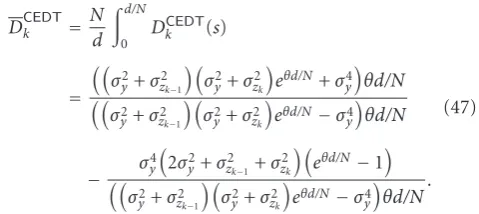
Finally, the average distortion in the whole reconstructed random field yields
In delay-tolerant networks, each sensor encodes and trans-mits a variable number of samples per timeslot. As a result, the time elapsed until the FC receives the first n samples fromalltheNsensors in the network (which allows for the reconstruction of the firstnrealizations of the random field) is unavoidably larger than in delay-constrained networks. In this section, we attempt to characterize such latency. To that aim, we start by analyzing the time needed foronesensor to transmit nconsecutive samples of the random field. Next, we derive the latency of the QEDT and CEDT encoding strategies, respectively.
6.1. Latency Analysis for a Single Sensor Node. Letn∗k(i) =
α∗
k(i)nbe the number of samples encoded inm/Nchannel
uses in timesloti. The probability thatl=0,. . .,n−1 samples are encoded in arbitrary timeslotican be expressed as
pl=Pr
On that basis, we model our system as an absorbing Markov chain [16, Chapter 8] withntransient states (S1,. . .,Sn−1)
and one absorbing state (Sn) defined as follows (see,
Figure 3):
lsamples have been transmitted in previous timeslots,
l=0,. . .,n−1,
nor more samples have been transmitted in previous timeslots,
l=n.
(53)
The transition matrixPof an absorbing Markov chain has the following canonical form:
P=
is a (n+ 1)×1 nonzero vector (otherwise the absorbing state could never be reached from the transient states). The entries of the matrixQcan be computed as follows:
ql,j= probability of absorbtion from each transient states, are given by
rl=1− n−1
j=0
ql,j; l=0,. . .,n−1. (56)
Our goal is to characterize the time elapsed until the absorbing state is reached or, in other words, the time needed to transmitnconsecutive samples of the local observation of the random field at sensor k (i.e., sensor latency). For an absorbing Markov chain, the time to absorbtion,τ, is a random variable which obeys the so-called Discrete Phase-type (DPH) distribution. From [17], the probability mass and cumulative distribution functions can be expressed as:
fτ(t)=Pr(τ =t)=πTQt−1r; t=1,. . .,∞ (57)
Fτ(t)=Pr(τ≤t)=1−πTQt1; t=1,. . .,∞ (58)
where the (n+ 1)×1 vectorπ is used to define the initial conditions. Since we assume that initally no samples have been transmitted, this yields
πT=[1, 0,. . ., 0]T. (59)
From all the above, theaveragetime to absorbtion reads:
E[τ]=
∞
t=1
t fτ(t). (60)
Alternatively, from [16, Chapter 8], one can compute
q1,2=p1
q0,1=p1
S0 S1 Sn−1 Sn
1
qn−1,n−1=p0
q1,1=p0
q0,0=p0
rn−1
r0
Transient states Absorbing state
· · ·
. . . .
. . .
. .
. . .
Figure3: An absorbing Markov chain.
the elements of which account the average time to absorbtion from stateS0. . .Sn. Consequently, the average sensor latency
is given by its first element, namely,E[τ]=u(1).
Finally, we need to derive a closed-form expression for the set of probabilities {p0,p1,. . .,pn}defined in (50) and
(52). From (35), we have that
α∗k(i)=
log21 +SNRγk(i)
R . (62)
withR=Eγ[log2(1 +γSNR)] and, hence,
pl=Pr
l n ≤α
∗ k(i)<
l+ 1
n
=Pr
l
nR≤log2
1 +SNRγk(i)
<l+ 1
n R
=Fγ
2((l+1)/n)R−1
SNR
−Fγ
2(l/n)R−1
SNR
(63)
forl = 0,. . .,n−1 and pn = 1−Fγ((2R−1)/SNR). For
Rayleigh-fading channels, the CDF of the channel gain is given byFγ(x)=1−e−x.
6.2. Latency Analysis for QEDT Encoding. At this point, the interest lies in characterizing the time elapsed until theN
sensors in the network encode and transmit their first n
samples of the random field. Let Ψ be a random variable which accounts for QEDT latency, namely
Ψ= max
k=1,...,Nτk, (64)
whereτk stands for the latency associated to the individual
sensor k as defined in the previous section. Since, on the one hand, sensors experience i.i.d fading channels and, on the other, codewords from different sensors are decoded independently, then τ1,. . .,τN turn out to be i.i.d. DPH
random variables with marginal pmf ’s and CDFs given by
(57) and (58), respectively. From all the above, the CDF of the latency associated to QEDT encoding reads
FΨ(t)=Pr(Ψ≤t)=Pr
max
k τk≤t
=Pr(τ1≤t,τ2≤t,. . .,τN≤t)
=FN τ(t)=
1−πTQt1N, t=1,. . .,∞.
(65)
The probability mass function can be computed as
fΨ(t)=Pr(Ψ=t) =FΨ(t)−FΨ(t−1)
=1−πTQt1N−1−πTQt−11N, t=1,. . .,∞. (66) and, from this last expression, the average latency yields
E[Ψ]=
∞
t=1
t fΨ(t). (67)
Intuitively, latency is a monotonically increasing function in the number of sensors (the more sensors, the larger the time needed to collect all samples). This extent will be verified in
Section 7(Simulation and numerical results).
6.3. Latency Analysis for CEDT Encoding. The latency anal-ysis for CEDT strategies if far more involved due to the successive encoding of data that C&E schemes entail. In general, this does not allow for the derivation of closed-form expressions and, thus, we will resort to an approximate (yet accurate) model.
(N−1)c0n
u1
1
Ti
m
e
N−2 N−1 N
Sensors
Decoded samples
n
2c0n
c0n
uN−2 uN−1 uN
Figure4: Approximate CEDT decoding for latency analysis.
sensors are not time-aligned), when the firstnsamples sent by sensorN are ready to be decoded, a total of n+con >
n samples from sensor N −1 have already been decoded on average. Accordingly, a total ofn+ (N−1)consamples
from sensor #1 have already been decoded too (seeFigure 4). Hence, the firstnrealizations of theentirerandom field can be reconstructed if, equivalently,n+ (N−1)consamples sent
by the first sensor have already been decoded by the FC. The encoding/decoding process for the first sensor is identical in C&E and Q&E schemes and, hence, in order to compute the latency for the reconstruction of therandom field, it suffices to compute the time to absorbtion for anindividualsensor (sensor #1) as we did inSection 6.1. The only change with respect to the model given in (54) is that the Markov chain has now a total ofn+ (N−1)constates (instead ofn) and,
hence, the size and elements of matrixQand vectorsπandr
in (57) and (58) must be adjusted accordingly.
As for parameterco, which exclusively depends on the pdf
of the sensor-to-FC channel gains, it can only be determined empirically (see next section).
7. Simulations and Numerical Results
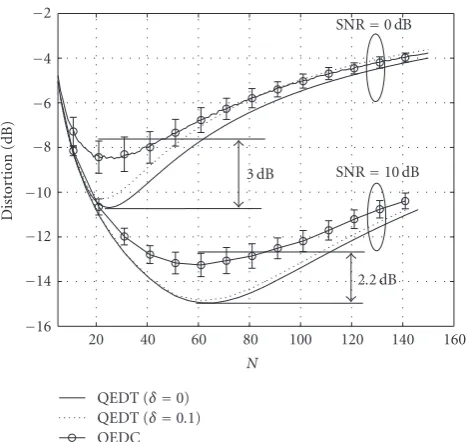
Figure 5 depicts the (pertimeslot) distortion in the recon-structed random field for both the QEDC and QEDT encoding strategies and different SNR values. For the QEDC strategy, we show the average value along with the ±σ
confidence interval (to recall that, unlike in the QEDT case, the distortion in QEDC encoding varies from timeslot to timeslot). Several conclusions can be drawn. First, for each curve there exists an optimal operating point; that is, a network size for which distortion can be minimized. The intuition behind this fact is that, despite that spatial variations of the random field are better captured by a denser grid of sensors, for a total bandwidth constraint the available rate per sensor progressively diminishes, this resulting into a more rough quantization of the observations. Thus, the optimal trade-off between these two effects needs to be identified. Second, the distortion associated to delay-tolerant strategies is, as expected, lower than for delay-constrained ones. Moreover, the lower the average SNR in the sensor-to-FC channels (namely, sensors with lower transmit power),
2.2 dB SNR=10 dB 3 dB
SNR=0 dB
−16
−14
−12
−10
−8
−6
−4
−2
D
ist
or
ti
on
(dB)
20 40 60 80 100 120 140 160
N
QEDT (δ=0) QEDT (δ=0.1) QEDC
Figure5: Average distortion versus network sizeN(W=150,θd= 10).
δ=0.1
δ=0.05
δ=0
0 2 4 6 8 10 12 14 16 18
Av
er
ag
e
b
u
ff
er
co
nt
ent
in
b
lo
cks
o
f
n
samples
0 100 200 300 400 500 600 700 800 Time slot
QEDT
Figure6: Average buffer occupancy versus time (SNR=0 dB).
the higher the gain (up to 3 dB for SNR = 0 dB). Third, guaranteing buffer stability in the QEDT scheme only results into a marginal penalty in distortion, as shown in the curves labeled with δ = 0 and δ = 0.1. Complementarily, in
Figure 6, we depict buffer occupancy for several values of
δ. Forδ = 0, the system is clearly unstable. Conversely, by letting δ take positive values, for example, for δ = 0.1 as inFigure 5, the average buffer occupancy can be kept under control (with a relatively small average buffer occupancy of 3n samples, in this case). Clearly, increasing δ has a two-fold effect: the average buffer occupancy diminishes but, simultaneously, the resulting distortion increases.
ΔSNR=4 dB
−18
−17
−16
−15
−14
−13
−12
−11
−10
−9
−8
D
ist
or
ti
on
(dB)
0 5 10 15 20
SNR (dB) QEDC
QEDT (δ=0.1) QEDT (δ=0)
Figure7: Average distortion versusSNR(W=150,θd=10).
2 dB
SNR=10 dB 3 dB
SNR=0 dB
−18
−16
−14
−12
−10
−8
−6
−4
−2
D
ist
or
ti
on
(dB)
0 50 100 150 200 250
N
CEDC CEDT (δ=0.1) CEDT (δ=0)
Figure8: QEDT encoding: average distortion versus network size (W=150,θd=10).
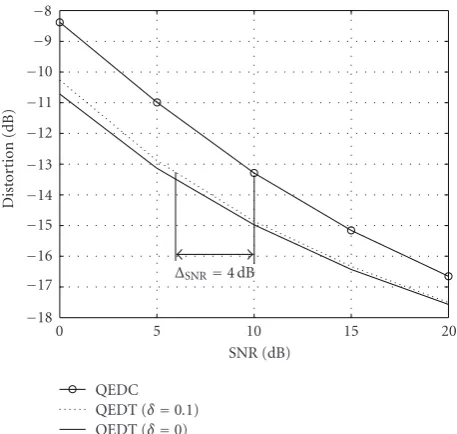
operating points) for an increasing SNR is shown inFigure 7. For intermediate distortion values, the gap is approximately 4 dB. That is, for a prescribed distortion level, the energy consumption in delay-constrained networks is 2.5 times higher.
Figure 8illustrates the average distortion in the recon-structed random field for the CEDC and CEDT encod-ing strategies. As in quantize-and-estimate encodencod-ing, there exists an optimal number of sensors nodes. Finding such
N∗ reveals particularly useful for random fields with low
SNR per sensor, since the curve is sharper in this case. The gap between the minimum distortion attainable by the CEDC and CEDT schemes (which results from an
−35
−30
−25
−20
−15
−10
D
ist
or
ti
on
(dB)
0 5 10 15 20
SNR (dB) QEDT (θd=10)
CEDT (θd=10)
QEDT (θd=1)
CEDT (θd=1)
Figure9: Distortion versusSNR(W=150).
1 1.5 2 2.5 3 3.5 4 4.5
Lat
ency
0 20 40 60 80 100
N
SNR=0 dB
SNR=10 dB
SNR=20 dB
Theoretical Simulations
Figure10: CEDT encoding: average latency versus network size.
adequate exploitation of channel fluctuation in the delay-tolerant approach) is approximately 2-3 dB. Concerning buffer occupancy-distortion tradeoffs, the same comments as in the quantize-and-estimate case apply.
Next, in Figure 9, we compare the distortion attained by QEDT/CEDT encoding strategies for random fields with low and high spatial variabilities (θd =1,θd =10, resp.). Due to the fact that CEDT is capable of exploiting spatial correlation, it always outperforms QEDT. Moreover, the higher the spatial correlation (θd = 1), the larger the gap between the curves.
0 5 10 15 20 25 30 35
Lat
ency
5 10 15 20 25 30
N
c0=1
c0=0.6
c0=0.3
Approximated theoretical model Simulated
Figure11: Average latency versus network size.
Interestingly, there exists a trade-offin terms of attainable distortion versus latency. Whereas in CEDT encoding latency exhibits alinearincrease in the number of sensors, in QEDT encoding latency grows logarithmically (i.e., more slowly). However, CEDT schemes attain a lower distortion than QEDT ones. Besides, in Figure 10 it is also worth noting the perfect match between simulations and numerical results and, unsurprisingly, that the higher the average SNR, the lower the latency. Also, Figure 11 reveals that by using an appropriate value ofco(i.e.,co=0.6), the latency associated
to the approximate model described inSection 6.3matches the actual one.
8. Conclusions
In this paper, we have extensively analyzed the problem of random field estimation with wireless sensor networks. In order to characterize the dynamics and spatial correlation of the random field, we have adopted a stationary homo-geneous Gaussian Markov Ornstein-Uhlenbeck model. We have considered two scenarios of interest: delay-constrained (DC) and delay-tolerant (DT) networks. For each scenario, we have analyzed two encoding schemes, namely, quantize-and-estimate (QE) and compress-quantize-and-estimate (CE). In all cases (QEDC, QEDT, CEDC and CEDT), we have carried out an extensive analysis of the average distortion experienced in the reconstructed random field. Moreover, for the QEDT and CEDT strategies we have derived closed-form expressions of (i) the average distortion in the estimates, and (ii) the optimal number of samples of the random field to be encoded in each timeslot (under some simplifying assump-tions). Interestingly, the resulting pertimeslot distortion in DT scenarios is deterministic and constant whereas, in DC scenarios, it ultimately depends on the fading conditions experienced in each timeslot. Next, we have focused on the latency associated to the QEDT and CEDT strategies. We
have modeled our system as an absorbing Markov chain and, on that basis, we have fully characterized the pdf, CDF, and the average latency for the QEDT case. For CEDT encoding, we have identified an approximate system model suitable for the computation of the average latency. Simulation results reveal that, under a total bandwidth constraint, there exists an optimal number of sensors for which the distortion in the reconstructed random field can be minimized (QEDC, QEDT, CEDC and CEDT cases). This constitutes the best trade-off in terms of, on the one hand, the ability to capture the spatial variations of the random field and, on the other, the persensor channel bandwidth available to encode observations. Besides, the distortion associated to tolerant strategies is, as expected, lower than for delay-constrained ones: some 2-3 dB for both the QE and CE encoding schemes. Moreover, buffer occupancy can be kept at very moderate levels (3 timeslots) with a marginal penalty in terms of distortion (less than 0.3 dB). We also observe that CE schemes effectively exploit the spatial correlation and, by doing so, attain a lower distortion than their QE counterparts (DC and DT scenarios). As far as latency is concerned, we have empirically shown that CEDT exhibits alinearincrease in the number of sensors whereas in QEDT encoding latency grows logarithmically (i.e., more slowly). However, CEDT schemes attain a lower distortion than QEDT ones. Besides, for the QEDT case, there is a perfect match between simu-lations and the theoretical model and, for the CEDT case, latency can be accurately represented by adequately parame-terizing the aforementioned approximate system model.
Appendix
Buffer Stability Analysis
We want to prove that buffers are stable (i.e., their occupancy is bounded) for large L. Let bk(i) denote the number of
samples in the buffer of thekth sensor in time slot i, with initial conditions given bybk(0)=L0n. AfterLtimeslots, the
increase in the number of samples stored in the buffer can be expressed as
bk(L)−bk(0)=Ln− L
i=1
αk(i)n, (A.1)
whereLnaccounts for the number of samples generated in thoseLtimeslots, and#Li=1αk(i)nwith
αk(i)=log2
1 +SNRγk(i)
R−δ > α
∗
k(i), (A.2)
stands for the actual number of samples encoded and transmitted by the kth sensor node. The probability of experiencing an increase greater thannin the number of samples stored reads
Pr(bk(L)−bk(0)≥n)=Pr
⎛ ⎝Ln−L
i=1
αk(i)n≥n
⎞ ⎠
=Pr
⎛ ⎝L
i=1
αk(i)≤L−
⎞ ⎠.
for any>0. Replacing (A.2) into this last expression yields: where we have defined
Var(R)Eγ
log21 +SNRγ(i)−R2 . (A.5) For large L, we can resort to the central limit theorem by which Hence, as long asδtakes strictly positive values (δ >0), we have that
This result states that, as long as we encode a slightly higher number of samples per timeslot (which depends on parameter δ) the probability that the increase in buffer occupancy exceedsnsamples (for afinitevalue of) can be made arbitrary small for largeL. That is, buffers are stable. Conversely,δ=0 yields
lim
L→ ∞Pr(bk(L)−bk(0)≥n) δ=0
= 1
2, (A.8) this meaning that, even for arbitrarily large values of, the probability that buffer occupancy increases beyond n is unavoidably 1/2 (i.e., unstable buffers).
In addition to this main result, the probability for buffers to drain afterLtimeslots can be expressed as
pdrain=Pr(bk(L)=0)
By resorting again to the central limit theorem, we have that for any positive value ofδ
lim
and, thus, buffers will drain with probability one after a sufficiently large number of timeslots.
Acknowledgment
This work is partly supported by the Catalan Government (2009 SGR 1046), the EC-funded project NEWCOM++ (216715), and the Spanish Ministry of Science and Innova-tion (FPU grant AP2007-01654).
References
[1] I. F. Akyildiz, W. Su, Y. Sankarasubramaniam, and E. Cayirci, “Wireless sensor networks: a survey,”Computer Networks, vol. 38, no. 4, pp. 393–422, 2002.
[2] M. C. Vuran and I. F. Akyildiz, “Spatial correlation-based col-laborative medium access control in wireless sensor networks,”
IEEE/ACM Transactions on Networking, vol. 14, no. 2, pp. 316– 329, 2006.
[3] S. C. Draper and G. W. Wornell, “Side information aware coding strategies for sensor networks,” IEEE Journal on Selected Areas in Communications, vol. 22, no. 6, pp. 966–976, 2004.
[4] A. D. Wyner and J. Ziv, “The rate-distortion function for source coding with side information at the decoder,” IEEE Transactions on Information Theory, vol. 22, no. 1, pp. 1–10, 1976.
[5] P. Ishwar, A. Kumar, and K. Ramchandran, “Distributed sampling for dense sensor networks: a bit-conservation prin-ciple,” inProceedings of the 2nd International Workshop on Information Processing in Sensor Networks, vol. 2634 ofLecture Notes in Computer Science, pp. 17–31, April 2003.
[6] D. Dardari, A. Conti, C. Buratti, and R. Verdone, “Mathe-matical evaluation of environmental monitoring estimation error through energy-efficient wireless sensor networks,”IEEE Transactions on Mobile Computing, vol. 6, no. 7, pp. 790–802, 2007.
[7] A. Dogandˇzi´c and K. Qiu, “Decentralized random-field estimation for sensor networks using quantized spatially correlateddata and fusion-center feedback,”IEEE Transactions on Signal Processing, vol. 56, no. 12, pp. 6069–6085, 2008. [8] M. Dong, L. Tong, and B. M. Sadler, “Impact of data retrieval
pattern on homogeneous signal field reconstruction in dense sensor networks,”IEEE Transactions on Signal Processing, vol. 54, no. 11, pp. 4352–4364, 2006.
[9] D. Marco and D. L. Neuhoff, “Reliability vs. efficiency in distributed source coding for field-gathering sensor net-works,” inProceedings of the 3rd International Symposium on Information Processing in Sensor Networks (IPSN ’04), pp. 161– 168, Berkeley, Calif, USA, April 2004.
[10] I. Karatzas and S. E. Shreve,Brownian Motion and Stochastic Calculus, Springer, 1988.
[11] S. Finch, “Ornstein-uhlenbeck process,” May 2004, http://algo.inria.fr/csolve/ou.pdf.
[12] S. M. Kay,Fundamentals of Statistical Signal Processing: Estima-tion Theory, Hall Signal Processing Series, Prentice-Hall, Englewood Cliffs, NJ, USA, 1993.
[13] T. M. Cover and J. A. Thomas,Elements of Information Theory, Wiley Series in Telecommunications, Wiley, New York, NY, USA, 1993.
[15] R. M. Corless, G. H. Gonnet, D. E. G. Hare, D. J. Jeffrey, and D. E. Knuth, “On the LambertWfunction,”Advances in Computational Mathematics, vol. 5, no. 4, pp. 329–359, 1996. [16] C. D. Mayer, Matrix Analysis and Applied Linear Algebra,
SIAM, 2001.